Thursday, May 22, 2025


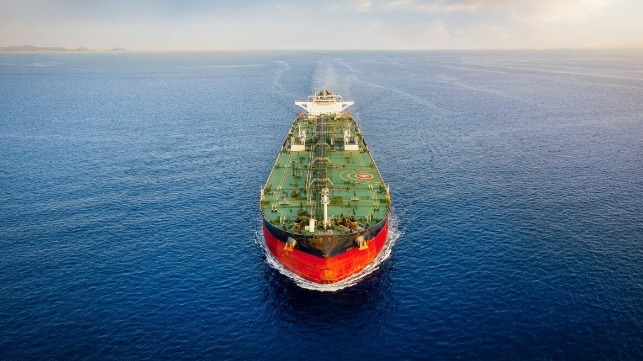
Report: Hanwha Ocean Plans Large-Scale Expansion of Philly Shipyard
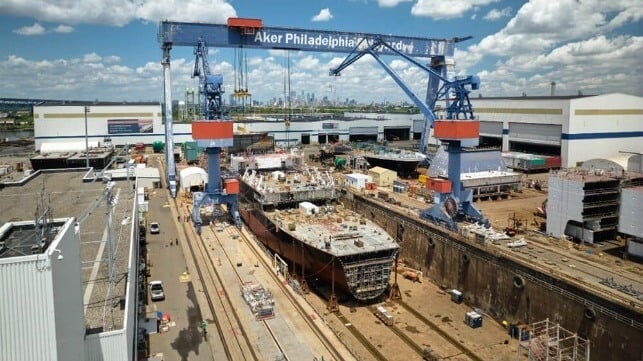
Philly Shipyard
Hanwha Ocean is developing plans to expand and modernize the operation at Philly Shipyard (Hanwha Ocean Philly Shipyard)

Published May 20, 2025 7:46 PM by The Maritime Executive


Months after having completed the acquisition of the Philly Shipyard, South Korea’s Hanwha Ocean is planning to invest more than $70 million to modernize and expand the shipbuilder’s operations to realize the opportunities as the U.S. looks to revitalize its navy and merchant marine. According to reports in the Korean media, the company detailed the plans to expand production at the Philadelphia yard during a tour with Korean stock analysts.

The Korean Economic Daily reports the company told analysts that it will increase the production capacity at the yard, which currently delivers about one ship a year, to a capability to build eight to ten ships per year. 

A team of 50 specialists is on site at the yard from Korea working with the newly installed management to assess current conditions at the yard and develop the plans for productivity improvements and modernizing the facilities. They are planning a technology transfer from the company’s Geoje Shipyard in South Korea and the implementation of new technologies such as welding robots.

Hanwha purchased the shipyard for $100 million, closing the acquisition in December 2024. Even before the deal was completed, it highlighted the opportunities to expand into additional government work, possibly as a components supplier building sections of ships with other yards for the navy or auxiliary fleet. With the SHIPS Act in Congress and the Trump White House calling for rapid growth of the U.S. fleet, the yard sees strong potential, including leveraging its expertise in LNG carriers to build the first U.S.-flagged vessels. The proposal from the U.S. Trade Representative includes a requirement for a portion of U.S. LNG exports to be conducted with U.S.-built and flagged ships. 

Philly Shipyard was started in 1997 as a government partnership with Norway’s Kvaerner Shipbuilding division at a portion of the former Philly Naval Shipyard. In the early 2000s, production began, and the yard built product tankers and containerships. It reports that it has built half of the current Jones Act vessels in the U.S. since 2000. When Hanwha Ocean acquired it, the order book consisted of the five MARAD training ships, a rock installation vessel for Great Lakes Dredge & Dock Company, and three containerships for Matson.

Hanwha Ocean reportedly told the analysts that the site had lacked investment for many years. The yard is currently only operating the Number 4 dry dock for assembly and the Number 5 dry dock as an outfitting berth. Plans call for modernizing the Number 4 dry dock and rehabilitating the Number 5 dry dock to be fully functional for additional assembly space.

The Philadelphia Inquirer newspaper reported in April that a Congressional delegation visited the shipyard. The newspaper writes that management discussed the need for additional space. Senator Chris Coons of Delaware suggested that he would explore moving the stored vessels by the U.S. Navy adjacent to the yard to provide additional space for Hanwha Ocean. The company also said it was exploring industrial space across the Delaware River in New Jersey for the possible expansion of its operations. 

Hanwha Ocean told the analysts during the tour that the goal is to increase revenues from the yard from the current level of $368 million per year to $4 billion per year by 2035. It will also look to more than double the current workforce to 3,000 employees over the next decade.

 

Final Construction Permits Issued for First Gulf Coast LNG Bunker Port

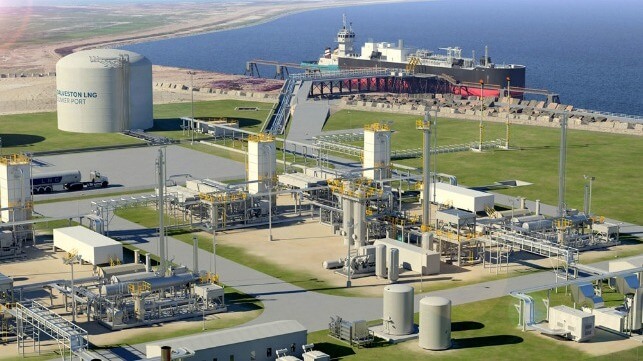
Galveston LNG
LNG terminal is expected to be operational in 2027 (Galveston LNG)

Published May 19, 2025 8:27 PM by The Maritime Executive


The Galveston LNG Bunker Port is now fully permitted for construction to start after receiving authorization from the U.S. Army Corps of Engineers and a recommendation from the U.S. Coast Guard. The project, which is being developed as the first LNG bunker port on the Gulf Coast, is advancing to a financial investment decision from partners Pilot LNG and Seapath Group, a Libra Group subsidiary.

To be located on the Texas City Ship Channel in the Texas City industrial area, and will supply LNG by fuel barge to the rapidly expanding fleet of LNG-fueled vessels in the greater Houston-Galveston region. According to the partners, the bunker hub will be optimally located to serve major ports, including Port Houston, the Port of Galveston, and the Port of Texas City. 

The plan calls for the terminal to be developed in two phases. The first would involve a 140-acre site and will target an initial capacity of 360,000 gallons per day. The companies are targeting the second half of 2027 for the initial product deliveries. A second phase would require an additional eight to 12 months and provide a total capacity of 720,000 gallons per day. It will be supported by two 3-million-gallon storage tanks.

“After several years of challenging and complex work bringing together the engineering, permitting, and third party supplies for gas and power to the project, we are now comfortably ahead in the marketplace to be the first dedicated LNG marine fuels supplier in the U.S. Gulf,” said Josh Lubarsky, President of Seapath Group. “We have made a significant financial commitment to this project and, over the course of the last several years, have positioned GLBP to be the foremost clean fuel supply hub in the Galveston Bay/Gulf region.”

The project, which is expected to cost more than $300 million, had received the necessary authorization from Texas earlier this year. Currently, LNG is being supplied by JAX LNG located in Jacksonville, Florida. It has a capacity of 360,000 gallons per day and is supplying LNG to the ports in South Florida as well.


Video: World’s Largest Cruise Ship, Star of the Seas, Starts Sea Trials

Star of the Seas cruise ship
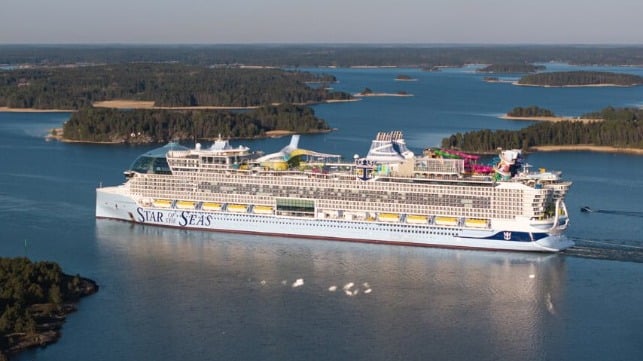
At 250,800 gross tons, Star of the Seas will become the world's largest cruise ship (RCI)

Published May 20, 2025 4:57 PM by The Maritime Executive


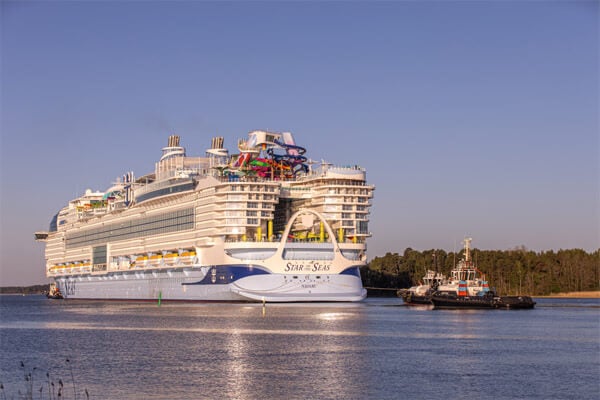
The second vessel of Royal Caribbean International’s Icon class, Star of the Seas, has begun its first sea trials, going to sea for the first time on Sunday, May 18. Due to enter commercial service in August, the ship will be slightly larger than her sister Icon of the Seas, and at an expected 250,800 gross tons, she becomes the largest cruise ship in the world.

Royal Caribbean highlights that the sea trials mark a key milestone in the construction of the ship and come less than 100 days ahead of her debut in her homeport of Port Canaveral, Florida. Over a total of 11 days, more than 2,000 experts from the naval architecture, engineering, navigation, and design spaces are testing the ship across a wide range of areas, mostly focusing on technical operations. 

The ship, based on its AIS signal, is currently in the Baltic undertaking its tests. The line reports this includes how the ship moves through the open water as well as testing engine performance. They are saying the new ship, which is 1,196 feet (364 meters) in length and has 20 decks, reached a speed of 25 knots while they were pushing its engine performance to the limits. The Star of the Seas will cover hundreds of miles during these tests.

It is the next critical step for the ship which was floated from the assembly dock in September 2024 and started its engines for the first time in February. She was fueled with LNG for the first time in April. After the sea trials, the ship will return for the final phase of construction and outfitting at the Meyer Turku shipyard in Turku, Finland. Another acceptance trial is anticipated closer to delivery and her August 2025 debut.


She follows Icon of the Seas, which is 248,663 gross tons. Introduced in January 2024, she became the largest cruise ship in the world. Each of the ships has a double occupancy of approximately 5,600 passengers (total occupancy of approximately 7,600 passengers using all berths) and a crew of 2,350. Royal Caribbean typically makes small changes to each ship in a class, with the later vessels becoming slightly larger in size, as is the case with Star of the Seas.

They highlight that the design features eight “neighborhoods” that are destinations in themselves, designed for families, children, suite passengers, entertainment, and other experiences. The ship will feature 26 dining locations and 18 bars and lounges. They are boasting of the fastest and tallest waterslides and seven pools, among the amusements aboard.

Star of the Seas is the third of the line’s LNG-fueled cruise ships, and she will be offering 7-day cruises to the Eastern and Western Caribbean from the central Florida homeport. She joins Utopia of the Seas (236,473 gross tons), which was introduced last summer and also sails from Port Canaveral.


Star of the Seas went to sea for the first time on May 18 (RCI)


Royal Caribbean was the first to surpass the 200,000 gross ton threshold in 2009 with the Oasis of the Seas (226,838 gross tons) and continues to expand in this ultra-large ship category. The company has built six ships in the Oasis class with a seventh on order at Chantiers de l’Atlantique. A third Icon class ship, named Legend of the Seas, is being assembled in the building dock in Finland and will enter service next year. A fourth Icon class ship is on order for delivery in 2027, and the line has options for two more ships of the class.

The success of the ultra large ships has spurred MSC Cruises to introduce its World class (217,000 gross tons) with two ships in service and now four more on order. Disney Cruise Line will also introduce a 208,000 gross ton cruise ship in December 2025. Both Carnival Cruise Line and Norwegian Cruise Line have ordered ultra-large cruise ships to be built by Fincantieri.


Princess Cruise Ship Captain Dies Suddenly After Medical Emergency

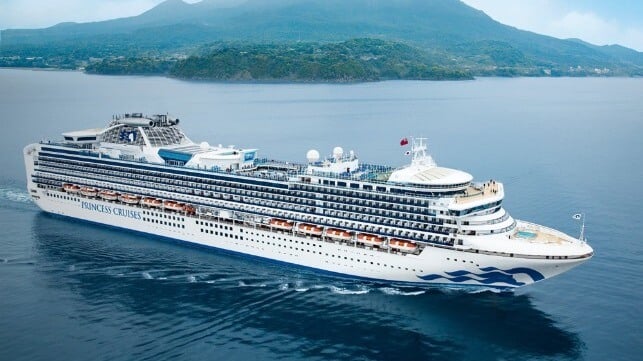
Diamond Princess
File image courtesy Princess Cruises

Published May 20, 2025 5:11 PM by The Maritime Executive


The master of a Princess Cruises passed away from a sudden medical issue while under way on a weeks-long cruise, the cruise line has confirmed. 

Capt. Michele Bartolomei, a Princess veteran with nearly 30 years at the company, was in command of the 2,700-passenger Diamond Princess on a voyage in East Asia. Overnight May 18-19, while the vessel was in Taiwan, Capt. Bartolomei died unexpectedly on board.

 Passengers learned of the incident in an early-morning PA call that summoned medical personnel, and the details were confirmed when crewmembers delivered a letter to their cabins. The notice informed them that Capt. Salvatore Macera was taking over command for the rest of the voyage. 

“It is with profound sadness that we share the news of the passing of Captain Michele Bartolomei, who had a sudden medical emergency and died onboard Diamond Princess,” Princess Cruises told media in a statement. “Captain Bartolomei was a respected leader, whose decades of service at sea exemplified professionalism, dedication, and care for both guests and crew. Our hearts are with Captain Bartolomei’s family during this incredibly difficult time, and we extend our deepest condolences to them."

Diamond Princess is due to continue her voyage as planned, and will finish her itinerary in Japan on May 25. 

Global Shipping Industry in Mid-Cycle Transition

Veson Nautical

Published May 21, 2025 1:30 PM by The Maritime Executive


[By: Veson Nautical]

The current market conditions in the global shipping industry resemble the mid-cycle transition seen in previous shipping cycles - a phase where the market appears stable on the surface, but underlying pressures are quietly building. That’s the central message of a new white paper from Veson Nautical, a global leader in maritime data and freight management solutions.

Titled ‘The Anatomy of Shipping Cycles: What History Can Tell Us About Tomorrow’s Market’, the white paper argues that as fleet deliveries increase, global trade slows, and regulatory constraints tighten, the risk of tipping into overcapacity is mounting.

“Looking back at the history of previous shipping cycles, we’re likely in the mid-phase of the transition from the high point to the low,” says Matt Freeman, white paper co-author and VP of Valuation & Analytics at Veson Nautical. “To navigate this fragile equilibrium successfully will require not only operational discipline, but a deep understanding of the structural patterns that have shaped previous cycles.”

What past shipping cycles reveal
The paper explores how cyclical patterns have repeated across decades of maritime history, shaped by different macroeconomic forces, yet following a familiar arc: overconfidence, overcapacity, and correction.

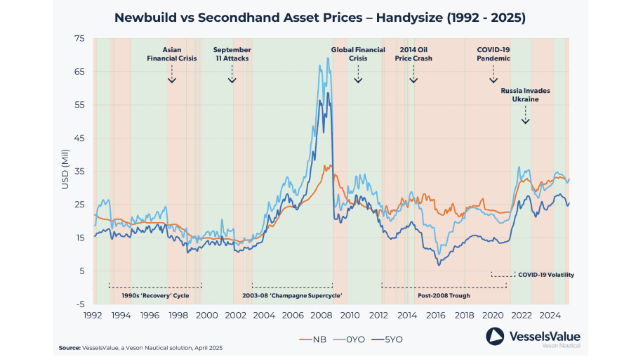
It cites the 2003–2008 “Champagne Supercycle,” driven by China’s industrial boom. At its peak, Capesize rates surged from $20,000 to nearly $200,000 per day in just five years. This spike triggered a global ordering frenzy, with the orderbook swelling to 60% of the active fleet.

“When the world was engulfed by the 2008 financial crisis, earnings collapsed almost overnight, but deliveries continued for years, compounding the downturn,” says Freeman. “If you look at examples like this, you start to see patterns that can help companies prepare for when the market inevitably turns.”

The paper also examines the COVID-19 disruption in 2020, noting that although freight rates soared, most vessel owners resisted over-ordering. The result was temporary volatility - not a full structural cycle - thanks to a more measured, disciplined response.

Reading the current signals
While no two cycles unfold in exactly the same way, the paper identifies a set of recurring markers that often precede inflection points. One of the clearest is newbuild parity - a condition where five-year-old or zero-year-old vessels begin trading at or above the cost of newbuilds. This signal, which reflects urgency outweighing asset fundamentals, has historically appeared at market peaks, including before the 2008 crash, the 2014 oil price collapse, and the post-COVID container rate spike.

“Today, the return of newbuild parity in several market segments is a warning sign,” says Felix Tordoff, co-author and Junior Valuation Analyst at Veson. “It suggests a market where urgency is outweighing discipline, and an environment where short-term opportunity may cloud long-term judgment.”

The white paper notes that scheduled fleet deliveries are rising, particularly in the bulker segment, peaking in 2027–2028. At the same time, global trade growth is slowing, with the WTO revising its 2025 forecast down to 2.2%, well below the post-2010 average.

While new environmental regulations such as EEXI and CII may reduce effective fleet capacity, the authors argue this will not be enough to counterbalance incoming tonnage.

“Taken together, these signals suggest the industry is at an inflection point, where the next shift could come without warning,” Tordoff says. “As in previous cycles, the balance may hold for a time before tipping suddenly.” 

Cycles can’t be avoided, but they can be navigated
The white paper concludes that shipping cycles are not anomalies to be feared, but recurring patterns that can be understood and strategically managed. While predicting their exact timing remains elusive, recognizing their structure and signals offers operators a powerful decision advantage.

“In today’s complex environment where sentiment is rising, supply is building, and demand is softening, you need to be able to read the signals,” Freeman concludes. “The ability to step back, assess the full cycle, and make informed decisions isn’t just smart. It’s essential.”

The products and services herein described in this press release are not endorsed by The Maritime Executive.


Port Everglades Inks 10-Year Agreement with Everglades Company Terminal

Port Everglades

Published May 21, 2025 1:33 PM by The Maritime Executive


[By: Port Everglades]

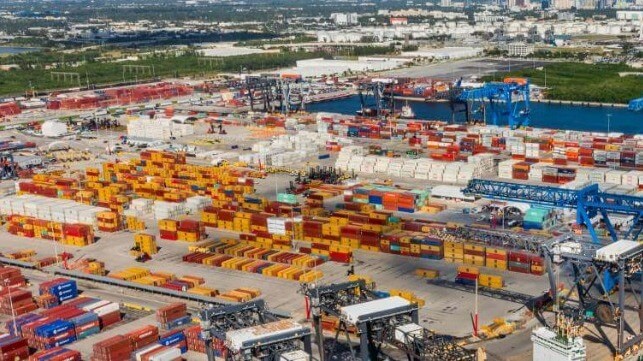
Everglades Company Terminal, Inc., (ECT) has signed a new 10-year Marine Terminal Lease and Operating Agreement with Broward County, underscoring the Port Everglades' position as South Florida's port of choice and a leading driver of economic growth in Broward County and the state.

The Broward County Board of County Commissioners recently approved the long-term agreement granting Everglades Terminal Company, a subsidiary of Mediterranean Shipping Company (MSC), a new lease on a 39.18-acre terminal in the port's Southport cargo area that is operated by Port Everglades Terminal, LLC. The agreement runs through December 31, 2034, with two optional five-year extensions.

This agreement replaces a previous lease held since 2004 by MSC.

"This agreement with ECT and the continuity provided by its terminal operator Port Everglades Terminal, LLC, further strengthens our position as a vital global gateway for trade," said Joseph Morris, CEO and Port Director of Port Everglades.

According to economic analysts at Martin Associates, ECT's operations under the new lease are expected to generate more than $161 million in business service revenue each year within the region, continue to support 425 direct jobs and contribute approximately $10.5 million in state and local taxes in its first year, based on 85,000 container moves. These numbers are expected to grow substantially over the life of the agreement.

"As a stevedoring and terminal services company, we are committed to providing the superior services for our shipping customers and the local community that relies on the goods that move through our terminal," said Rick Blackmore, CEO of Port Everglades Terminal, LLC.

The new agreement also transfers permanent leasehold improvements made by Port Everglades Terminal to Port Everglades, including an office building, Rubber-Tired Gantry pads, refrigerated racks for 450 stacked reefers, and an inspection dock that has shore power infrastructure for 116 refrigerated shipping containers.

The products and services herein described in this press release are not endorsed by The Maritime Executive.


Crew Rescued Near Singapore After Fishing Vessel Collides with Tanker

rescued crew transferring from bulker
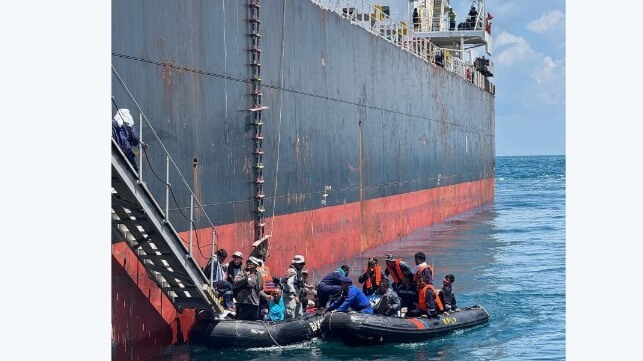
Survivors were transferred from the bulker that picked them up to Indonesia rescue boats (Bernama - Batam Pro)

Published May 20, 2025 2:02 PM by The Maritime Executive


The maritime authorities in Singapore and Indonesia coordinated the rescue of the crew from a capsized fishing vessel near the eastern terminus of the Singapore Strait. The fishing vessel is reporting it was in a collision in an area that has been historically disputed between Singapore and its neighbors, but today is monitored by Singapore.

Indonesian media is reporting that the fishing vessel Pacific Memory II had been operating between Sumatra, Batam, and finally in the waters near the Riau Islands in Indonesia. Reports, however, placed the vessel near the border with Singapore and Pedra Branca, a rocky outcrop near the eastern end of the Singapore Strait best known for Horsburgh Lighthouse.

Batam Pos is quoting the survivors as saying their vessel collided with a tanker and began to sway violently. Crewmembers who were asleep reportedly panicked as the boat began to tilt and sink with several people ending up in the water. Other reports said the boat tilted and came back up, but one survivor is reporting that he was in the water for four hours, clinging to a lifejacket. It appears the crew was able to transmit a distress call.

The Hong Kong-registered containership Cosco Development (140,600 dwt) first reported the incident to the Maritime Rescue Coordination Center in Singapore at 0720 on Tuesday, May 20. The Maritime and Port Authority of Singapore reports it alerted the services in Indonesia and Malaysia, as well as requesting assistance from vessels in the area. They reported that the fishing vessel capsized about 17 miles from Pedra Branca.

The Greek-owned bulker Andros Spirit (82,740 dwt), registered in Liberia, was directed to the scene. It rescued the 30 crewmembers from the fishing vessel.

Indonesian authorities were working to receive the survivors, but reported that the Andros Spirit was already underway. They arranged for the vessel to transport the survivors to Batam, where they met with the vessel and transferred the survivors to the Indonesian rescue boat. 


Fire on Oil Platform off Angola Injures 17 People

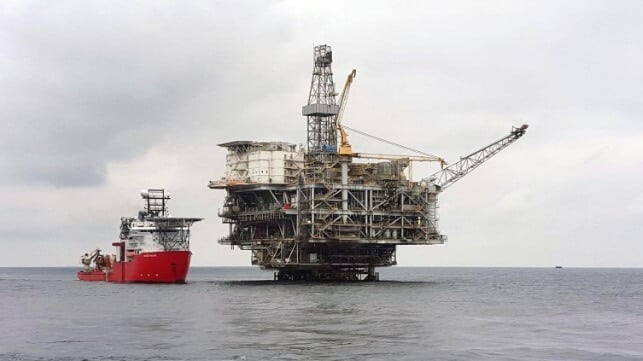
Chevron's BBLT platform (file image courtesy Chevron)

Published May 20, 2025 4:05 PM by The Maritime Executive


A fire on Chevron's deepwater Benguela-Belize-Lobito-Tomboco (BBLT) platform off Angola has injured 17 people, including four who are in serious condition, the oil major confirmed Tuesday. 

The BBLT platform was in the middle of a scheduled annual maintenance cycle, Chevron said, and it had been shut in since May 1 for repairs. At about 0310 hours on Tuesday morning, a fire broke out on the BBLT platform's cellar deck. The fire was brought under control by company employees who responded "immediately," Chevron said. 17 people were injured in the accident. 

Chevron's local subsidiary, Cabgoc, is focused on the safety of all other personnel and on getting to the root causes of the casualty. An investigation is under way, supported by Angolan regulator ANPG. 

BBLT is a bottom-fixed compliant tower platform located about 50 nautical miles off the Cabinda coast of Angola. The platform's rare design relies on a 1,200-foot flexible platform jacket, which is partially supported by its own buoyancy. The jacket can sway horizontally, giving it better resistance to wave action. Examples include Chevron's Petronius platform, Exxon's Lena, and BBLT. 

The platform's maximum production capacity is 220,000 barrels per day. The effect of the fire on the timeline for resuming operations is not immediately known. 


Salvors Raise First Component of Lost Superyacht Bayesian

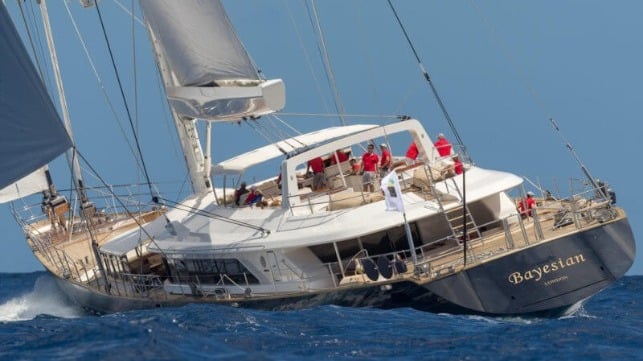
Bayesian in her prime (file image courtesy Perini Navi)

Published May 20, 2025 5:43 PM by The Maritime Executive


Salvors have raised the first major component of the lost superyacht Bayesian, which sank in a severe storm off the coast of Sicily last August. Seven people died in the tragedy, including the owner.

The boom is just one piece of a much larger salvage project. The team plans to recover the rest of the vessel's rigging, then parbuckle the wreck and raise it out of the water. The objective is to uncover new evidence to support two parallel investigations into the cause of the sinking. Raising the yacht will also address the risk of pollution from remaining fuel in its tanks. 

A salvage project of this size and complexity is not without risks. On May 9, Dutch commercial diver Rob Huijben was killed while attempting to remove Bayesian's boom with a cutting torch. The cause of the fatality is under investigation. 

Bayesian (ex name Salute) was a 180-foot aluminum-hulled sailing yacht built in 2008. Her sinking made headlines around the world, both for the unusual nature of the casualty and the high profile of the owner, British tech tycoon Mike Lynch. The ultra-modern megayacht departed Italy on August 14, 2024 with a prominent guest list, including Lynch. The vessel went down five days later in a sudden squall while anchored off Sicily, killing Lynch, his teenage daughter, the chairman of Morgan Stanley International, Lynch’s defense lawyer, and three others. Huijben's death earlier this month brings the total fatality count to eight. 

A criminal investigation focused on the actions of the crew is currently under way, led by local Italian prosecutors. A separate technical inquiry by the UK Marine Accident Investigation Branch - representing Bayesian's flag state - recently released its initial report. Based on Bayesian's design and her configuration at the time of the casualty, MAIB concluded that the vessel would have been vulnerable to capsizing when exposed to wind gusts of as little as 63 knots on the beam. On the night of the accident, the vessel's mast was bare, its retractable keel was raised, and it had just 10 percent stores on board - a combination not covered by in the vessel's stability book. 


Polish Military Responds to Shadow Fleet Tanker Acting Suspiciously

tanker at sea
A sanctioned tanker was ibserved performing suspicious maneuversi n the Baltic (iStock)

Published May 21, 2025 1:39 PM by The Maritime Executive


Tensions remain high in the Baltic with the latest incident involving a shadow fleet tanker transpiring late on Tuesday, May 20. Poland’s Prime Minister Donald Tusk and other government officials reported that the Polish military had been used as a deterrent after a shadow fleet tanker was observed “performing suspicious maneuvers.”

“After the effective intervention of our military, the ship sailed,” Poland’s Prime Minister wrote on social media. He said the vessel was a tanker in the Russian shadow fleet covered by the sanctions.

Poland’s Ministry of National Defense provided additional details, saying that the tanker had been tracked with reconnaissance and that they had observed a tanker in international waters in the Baltic performing suspicious maneuvers. The tanker was in the vicinity of an undersea power cable connecting Poland and Sweden.

A Polish aircraft was dispatched to the area. The patrol plane appeared to scare away the tanker. 

Poland’s state electricity transmission system, PSE, later reported that a cable was functioning normally. The Prime Minister, however, said the ORP Heweliusz, a survey ship operated by the Polish Navy, was sailing to the scene. The Ministry of Defense confirmed that the vessel would carry out a survey of the sea floor in the area. In the past, other nations had been able to find trails left by anchors dragged on the sea floor that were used to damage undersea infrastructure.

An official speaking to Reuters later identified the suspect tanker as the Sun sailing under the flag of Antigua. The Equasis database lists the vessel as a 159,000 dwt crude oil tanker owned by Turkish interests. Its AIS signal shows it was traveling from India and reporting a destination of Tallinn, Estonia.

Polish officials said they would be conducting a meeting on Thursday at the country’s Maritime Operations Center in Gdynia to review maritime security. The Prime Minister is expected to attend. 

The Chief of the General Staff of the Polish Armed Forces, Wies?aw Kuku?a, noted that NATO had already agreed to deploy additional naval assets in the Baltic after last week’s incident. Estonia tried to stop a shadow fleet tanker for an inspection, and the vessel refused to change course. At the same time, a Russian fighter jet briefly traveled into Estonian airspace in what is believed to be a defense of the tanker. NATO planes were also overhead observing while Estonia decided to escort the vessel from its waters.

Baltic and Scandinavian nations increased their patrols of the region earlier this year after the incident in which Finnish undersea assets were damaged. There were several other incidents, all linked to shadow fleet tankers, which also resulted in NATO deploying additional resources to the region.

In the past week, both the European Union and the UK dramatically increased the number of sanctioned tankers in the Russian oil trade. Political leaders said the goal is to further restrict the Russian oil trade, while Russian officials have vowed to defend the tanker fleet.