It’s possible that I shall make an ass of myself. But in that case one can always get out of it with a little dialectic. I have, of course, so worded my proposition as to be right either way (K.Marx, Letter to F.Engels on the Indian Mutiny)
Thursday, May 22, 2025
TotalEnergies Launches Largest Solar Project in Europe Near Seville
TotalEnergies (EPA:TTE) has inaugurated its largest solar power installation in Europe, a 263-megawatt (MW) solar cluster located near Seville, Spain. The project, comprising five solar fields, will generate 515 gigawatt-hours (GWh) of electricity annually—enough to power more than 150,000 Spanish households. The project is a key step in Spain’s push toward 80% renewables by 2030.
Strategic Context and Regional Impact
The solar complex, which includes 400,000 bifacial panels equipped with sun-tracking systems, has been declared a project of “strategic interest” by the regional government of Andalucía. Its construction injected a significant economic boost into the local economy by involving 14 Spanish firms—over half of them Sevillian—and creating 800 direct and indirect jobs.
Electricity from the facility will be primarily sold through long-term power purchase agreements (PPAs), with the remaining supply traded on the wholesale market. This aligns with Spain’s broader energy policy goals, which prioritize both decarbonization and energy security.
Company Strategy and Future Outlook
Olivier Jouny, Senior Vice President for Renewables at TotalEnergies, emphasized the company's commitment to delivering “clean firm power” by integrating renewables with flexible gas-fired generation. TotalEnergies currently ranks as Spain’s fourth-largest provider of electricity, gas, and related services, serving over two million customers across residential and professional sectors.
This new project supports the company’s broader ambition to reach 35 GW of gross installed renewable capacity by the end of 2025 and more than 100 TWh of net electricity production by 2030. As of March 2025, TotalEnergies had already achieved 28 GW in installed renewable capacity globally.
Broader Implications
The Seville project underscores TotalEnergies’ pivot toward a more diversified and sustainable energy portfolio. By combining solar, wind, and flexible generation assets like CCGTs and storage, the company is executing a differentiated Integrated Power strategy designed to deliver reliable, low-carbon electricity across its global markets.
Spain, with its abundant solar resources and aggressive renewables targets, remains a key battleground for European energy giants competing to dominate the green transition. TotalEnergies’ investment not only strengthens its market position but also illustrates how strategic public-private partnerships can accelerate regional decarbonization.
TotalEnergies Launches Major Solar Project in Spain
France’s supermajor TotalEnergies is launching its biggest solar project cluster in Europe—five solar projects with a total installed capacity of 263 MW near Seville, Spain.
The solar field will produce 515 GWh per year of renewable electricity, equivalent to the consumption of over 150,000 Spanish households, and will avoid 245,000 tons of CO2 emissions per year, TotalEnergies said on Thursday.
Most of the electricity produced will be sold through long-term power purchase agreements (PPAs) and the rest will be sold on the wholesale market, said the French supermajor, which hasn’t scaled down its ambitions in renewable energy generation despite a general drive among Europe’s Big Oil firms to reduce investments in green energy solutions.
As of the end of March 2025, TotalEnergies had 28 gigawatts (GW) of installed gross renewable electricity generation capacity and aims to reach 35 GW by the end of 2025. The company also targets more than 100 TWh of net electricity production by 2030.
Apart from oil and gas production and trading, TotalEnergies is building an Integrated Power portfolio that combines renewables and flexible gas-fired power plants to deliver clean firm power to customers.
TotalEnergies is currently the 4th largest provider of electricity, gas, and related services in Spain, where it has more than 2 million residential and professional customers.
The Seville solar project contributes to Spain’s ambition of 80% of renewables in its mix by 2030, said Olivier Jouny, Senior Vice President Renewables at TotalEnergies.
While the majors aren’t abandoning all the renewable projects they embarked on in 2020 and 2021, they have started to scale back investments and are streamlining these on developments and energy solutions that they see as profitable.
France’s TotalEnergies is the outlier in the group, as it has continued to focus on growing renewable energy capacity and power generation through acquisitions and joint ventures globally.
By Tsvetana Paraskova for Oilprice.com
New York Wind Project Revived With Natgas Quid Pro Quo
A wind project in New York mothballed by the Trump administration is getting a new lease on life through a compromise.
On his first day in office, Trump issued an executive order pausing new leasing and permitting of wind projects.
The compromise includes the revival of an abandoned natural gas pipeline from Pennsylvania to New York.
A wind project in New York mothballed by the Trump administration is getting a new lease on life through a compromise that would also see an abandoned natural gas pipeline from Pennsylvania to New York revived.
Norway’s Equinor was three months into Empire Wind, a $5 billion offshore wind farm, when Trump came to power and set about dismantling the Biden administration’s wind power program.
On his first day in office, the second-term president issued an executive order pausing new leasing and permitting of wind projects, which he said are ugly, expensive and harmful to wildlife.
But Equinor, which recently shifted its focus to oil and gas from renewables, told Reuters that construction can resume on Empire Wind, which is expected to bring power to half a million homes after 2027, following the lifting of a one-month stop-work order.
The move comes amid industry challenges.
“The offshore wind industry is challenged in the short term with headwinds relating to supply chain, regulatory, and macroeconomic developments,” Orsted, the world’s biggest offshore wind project developer, said in its first-quarter press release on May 7.
Due to higher costs and interest rates, the Danish company announced it had decided to discontinue the development of the Hornsea 4 offshore wind project in the UK, ahead of the planned final investment decision (FID) later this year.
Earlier this month, Equinor said it is considering its legal options after the Trump administration ordered its Empire offshore wind project off New York halted. That of course will no longer be necessary.
Equinor is Norway’s largest oil and gas company, outputting about 70 percent of its total production, or 2 million barrels of oil equivalent per day. In February Equinor said it is reducing its renewable energy targets for 2030, citing challenges in the renewable energy sector.
Instead, the company is increasing its focus on oil and gas production, aiming to grow output by 10 percent from 2024 to 2027.
Norway’s energy market is experiencing turmoil due to increased energy exports to Germany and related political instability.
It appears Equinor’s Empire Wind project was only allowed to continue in exchange for the reinstatement of a stalled natural gas pipeline called Constitution. The Pennsylvania to New York line was canceled in 2020 after years of regulatory and legal battles over the environment, for one.
“Americans who live in New York and New England would see significant economic benefits and lower utility costs from increased access to reliable, affordable, clean American natural gas,” US Interior Secretary Doug Burgum wrote in a post on X on Monday.
Department officials reportedly said the former Biden administration had rushed the project's approval without sufficient environmental analysis.
Norwegian Finance Minister Jens Stoltenberg said the reversal was good news for investors in the U.S. as the stop-work order threatened to create uncertainty after permits had been granted by U.S. authorities.
Equinor had warned it stood to lose billions of dollars due to the order which sent shockwaves through the offshore wind industry, raising concerns that fully permitted developments representing billions in investment are not safe.
In May, 17 states and Washington D.C. filed a lawsuit against the Trump administration over the halting of permits for wind-energy projects. The lawsuit said that the government’s decision presents a threat to the burgeoning industry. “This administration is devastating one of our nation’s fastest-growing sources of clean, reliable and affordable energy,” said Attorney General Letitia James of New York, which is one of the plaintiffs. James said the move threatened “the loss of thousands of good-paying jobs and billions in investments” and was “delaying our transition away from the fossil fuels that harm our health and our planet.”
The United States currently has four operating offshore wind farms and four under construction, including Empire Wind.
By Andrew Topf for Oilprice.com
Lighting up a Unique Wind Farm Converter Platform in the North Sea
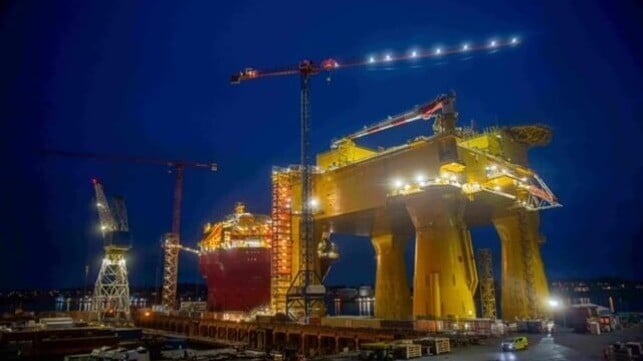
European grid operator TenneT is in the process of installing an offshore grid connection system in the North Sea, which will deliver electricity from three wind farms some 100 km off the German coast. The innovative DolWin 5 project eliminates the need for a wind farm substation, as the electricity generated will be transmitted directly as three-phase AC current to the giant DolWin epsilon converter platform.
A consortium consisting of Seatrium and Aibel is building and preparing DolWin epsilon, a High Voltage Direct Current (HVDC) offshore platform. Once operational, it will convert approximately 900 megawatts (MW) of green electricity from the wind farms, enough to power more than one million households.
Glamox has delivered lighting to the offshore converter platform DolWin epsilon. In total, it provided 2,084 marine-grade luminaires and the systems to remotely monitor and test emergency lighting via the platform’s SCADA system.
“Most of the time, this gigantic platform will be unoccupied, but the lighting is needed for remote inspection and for visiting crews and maintenance teams. It’s extremely costly to repair or swap out lighting when it’s offshore. Therefore, our certified marine luminaires must be long-lasting and able to cope with the harshest conditions of the North Sea. We know lives depend on it,” says Eirik Hagem, Head of Business Development for Glamox’s Offshore Wind business.
The product delivery includes a complete light package for the platform’s living quarters and the topside substation. Glamox products include MAX ex zone 1 (explosion-proof) linear luminaires and tough MIR linear luminaires. The installation also includes FL60 and FL70 marine floodlights, lighting for interior areas, E85-S escape route and anti-panic lights, and E20 exit/escapeway lighting.
The offshore converter platform DolWin epsilon is currently docked at Aibel’s yard in Haugesund, and later this year the company will commission, transport and install the complete converter platform offshore.
Powering more than one million households The Dolwin epsilon offshore converter platform is unmanned, but provides accommodation for 50 people, a helipad, a crane and a lifeboat. The three-phase alternating current generated by the wind farms at sea is converted into direct current on the platform, before it is transported south to Hamswehrum near the river Ems in East Frisia via a 100-kilometre-long submarine cable. Next, a 30-kilometre-long land cable leads to the land converter station in Emden. The current is then converted back into three-phase alternating current and fed into the extra-high voltage grid on land.
“DolWin5 is the first offshore grid connection system in which TenneT connects the wind turbines directly via 66-kilovolt (kV) three-phase electric power cables to the offshore platform. From a macroeconomic perspective, this leads to enormous cost savings,” Tennet writes in its description of the project.
The products and services herein described in this press release are not endorsed by The Maritime Executive.
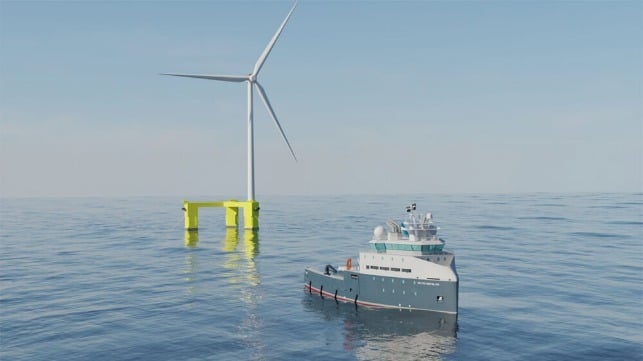
Vessel Concept Meets Challenges of Floating Wind Turbine Installation
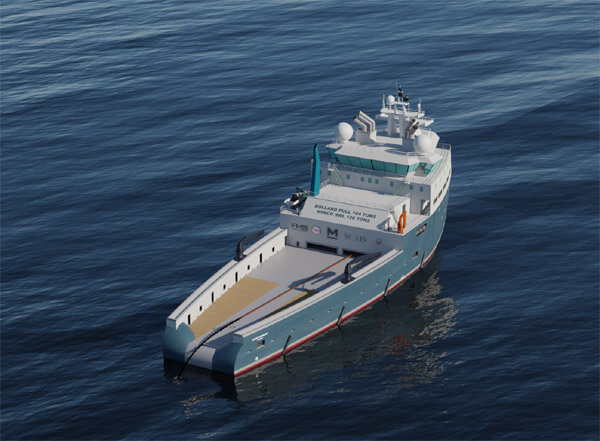
New vessel design specifically for installation of floating offshore wind turbines (Morek Engineering)
A consortium based in the UK is working on the designs for a new segment of the shipping industry specifically designed to support floating offshore wind installations. As the offshore wind energy industry moves toward its next phase, which will require floating turbines, it will also need a new type of vessel better suited to the challenges of positioning and anchoring turbines.
“At present, the global fleet falls far short of what is required for serialized installation of floating turbines and their infrastructure,” explains Ian Godfrey of Tope Ocean, an engineering firm involved in the project.
The vessel concept focuses on a section of the floating wind installation process that is yet to be optimized. According to the project partners, the vessel will work with any of the three main anchor types for floating wind turbines being considered by the industry. Drag embedment anchors, they highlight will require installation by high bollard pull anchor handling vessels, while suction piles and driven piles, which require large subsea cranes to install them into the seabed.
The first feasibility stage has been completed for the Future FLOW Installation Vessel. It will meet the requirements of the next phase by installing the mooring lines onto the installed anchors, enabling quick connection to floating foundations towed to the offshore site. The design also incorporates low-carbon fuels, providing fuel efficiency advantages, a hydrodynamically optimized hull, and expanded mooring capacity.
“We’ve reimagined the mooring installation process, designing a vessel focused on these new requirements,” says Simon Hindley of Solis Marine Engineering. “By combining an energy-efficient hull form with a low-emission powertrain, we can tackle high-duty construction tasks without relying on traditional, fossil fuel-powered vessels, improving the overall efficiency of the offshore construction activities.”
The vessel has been designed to maximize mooring line capacity while minimizing running costs. The selection of azimuth thrusters and reduced resistance to station-keeping and dynamic positioning efficiency is partnered with the alternative fuel choice of methanol. To maximize mooring line capacity, the vessel also has a large below-deck cable tank for synthetic mooring ropes as well as large chain lockers to hold the kilometers of chain expected for the floating wind industry.
The project is part of the Clean Maritime Demonstration Competition Round 4 (CMDC4), funded by the UK Department for Transport and delivered by Innovate UK. Consortium partners include naval architects Solis Marine Engineering, innovation specialists Tope Ocean, marine operations specialists First Marine Solutions, and Celtic Sea Power.
The consortium reports it is now advancing toward the next design stage, which will focus on the equipment for handling large quantities of synthetic ropes, weather-limit analyses, and regulatory and design challenges faced by methanol propulsion systems. The target is to secure an Approval in Principle from a major ship classification society by December 2025.
Uzbekistan Leads Central Asia in Electric Vehicle Adoption
Uzbekistan has experienced a rapid increase in electric vehicle sales, becoming the leading adopter of EVs in Central Asia.
Government incentives in Uzbekistan, such as exemptions from duties and taxes, have significantly boosted electric vehicle sales and imports.
China dominates the global electric vehicle market, accounting for a large portion of sales in Uzbekistan and other emerging markets.
The International Energy Agency is spotlighting Uzbekistan for the country’s rapid embrace of electric vehicles.
An IEA report, titled Global EV Outlook 2025, notes that electric vehicle sales have skyrocketed in Uzbekistan, making the country the leading adopter in Central Asia. The report adds that the cost of imported electric vehicles has fallen “almost threefold” in recent years.
The Uzbek State Customs Committee reported earlier this year the number of imported electric and hybrid vehicles in 2024 exceeded that of gasoline-powered passenger cars. Figures published by the committee showed an overall total of 74,525 passenger cars were imported last year, with EVs accounting for 24,095 and hybrids an additional 17,480, a roughly 55 percent combined share.
The Uzbek government offers a variety of incentives to promote electric vehicle sales. Most imports, for example, are exempt from excise duties, customs fees and vehicle taxes. The government has also launched initiatives to boost domestic manufacturing capacity and expand the number of charging stations.
More broadly, the IEA report shows that China is tightening its grip on the global EV market. More than 17 million electric cars were sold worldwide in 2024, a roughly 25 percent increase over the previous year’s sales total. China’s domestic market alone accounted for 11 million vehicles sold, almost two-thirds of the 2024 global sales total.
In Uzbekistan, roughly 85 percent of EVs purchased in 2024 were Chinese models. Chinese-made EVs also enjoy large market shares in other Asian and Latin American markets. In Brazil, the largest auto market in South America, year-on-year EV sales doubled in 2024, reaching 125,000.
“Policy support and relatively affordable electric car imports from China played a central role in increasing sales in some emerging electric vehicle (EV) markets,” the report states.
Freight transport could become the highest emitting sector by 2050 without significant decarbonisation, especially as demand triples in developing regions.
While electric and hydrogen trucks show promise, 97% of heavy-duty vehicles in the EU still run on diesel, and most decarbonisation technologies remain far from mass deployment.
Major efforts in the U.S., India, and EU point to growing momentum, but transforming freight requires international coordination, infrastructure investment, and policy reform.
One of the most difficult sectors to decarbonise is freight, and yet it’s one of the industries we most rely on in the modern world. While several countries are making leaps and bounds in terms of renewable energy production, little progress has been seen in decarbonising hard-to-abate sectors, despite the introduction of several national policies and international targets. So, just how hard will it be to decarbonise freight in the coming decades as many countries strive to achieve net-zero carbon emissions?
Freight transportation contributes around 8 percent of global greenhouse gas emissions, and as much as 11 percent if warehouses and ports are included. Asia, Africa, and Latin America are expected to triple the global demand for freight by the mid-century, which could double the sector’s greenhouse gas emissions. While other sectors strive to reduce fossil fuel use, freight is expected to continue to rely heavily on oil and gas, which could make it the highest emitting sector by 2050 if no action is taken to decarbonise the industry.
In 2018, the OECD’s International Transport Forum (IRF) published a report entitled Decarbonising Maritime Transport - Pathways to zero-carbon shipping by 2035. The report examined what was required to decarbonise international shipping by 2035. It found that “Maximum deployment of currently known technologies [at the time] could make it possible to reach almost complete decarbonisation of maritime shipping by 2035. The four potential decarbonisation pathways for shipping identified in this report would result in a CO2 emission reduction between 82 percent and 95 percent of the currently projected 2035 level.”
The ITF suggested that alternative fuels, such as advanced biofuels and renewable energy, could deliver much of the required reductions. Modern engines and more efficient practices, such as using vehicle space more efficiently or reducing freight demand, could also contribute to an emissions reduction.
However, to achieve the desired outcome, the ITF recommended setting a clear, ambitious emissions-reduction target to drive the decarbonisation of maritime transport, supporting the realisation of emissions-reduction targets with a comprehensive set of policy measures and providing smart financial incentives to advance the decarbonisation of maritime shipping.
Since 2018, several countries have begun to invest heavily in the rollout of higher levels of renewable energy capacity, the production of advanced biofuels, and the development of alternative fuels such as green hydrogen. However, the current global capacity of these energies and fuels remains far too little to have a meaningful impact on the freight industry.
The high emissions from the freight sector largely come from road transport, particularly in Europe. According to Eurostat, in 2022, road freight accounted for 77.8 percent of total freight traffic in the EU. Road freight, especially heavy-duty vehicles (HDVs), contributes heavily to transport emissions due to its ongoing reliance on fossil fuels. Several European countries have worked to promote the shift from road to rail freight, however, the high costs involved with this shift have deterred several countries from making the jump.
One of the most attractive decarbonisation methods is switching the power source of road freight. Companies have explored the use of battery-electric and hydrogen-powered trucks, as well as alternative fuels, but little progress has been seen in rolling out these technologies on a large scale, with 97% of heavy goods vehicles registered in the EU in 2023 still running on diesel. As of a 2025 analysis, electrification appears the most viable option for reducing carbon emissions from road freight, largely thanks to the falling cost of batteries and the rollout of high-power recharging infrastructures. In addition, recent innovation in battery-electric trucks (BET) is showing great promise.
It is not only in Europe where electrified road freight is taking off. In India, NITI Aayog launched the Electric Freight Accelerator for Sustainable Transport, a platform aimed at enhancing collaboration between the government and private sector for large-scale freight electrification. The initiative has led to 16 major manufacturing and logistics companies collectively signalling demand for 7,750 electric freight vehicles by 2030. Meeting this demand will require the development of new national policies and regulations, infrastructure development, and blended financing platforms to attract private investments.
Meanwhile, in the U.S., the Department of Energy (DoE) announced a $68 million investment to design, develop, and demonstrate innovative electric vehicle (EV) charging sites near key ports, distribution hubs, and major corridors in January. The programme falls under the DoE’s SuperTruck Charge initiative, which launched in 2009 and aims to provide large-scale public EV charging infrastructure for medium- and heavy-duty EVs.
Governments and logistics companies worldwide are increasingly seeing the need for a low-carbon freight network. However, while significant funding has been contributed to research and development, establishing these networks is highly complex and requires international cooperation, as well as high levels of financing for innovative low-carbon solutions. Further, the focus on developing the renewable energy capacity required for domestic power alone has detracted from a focus on decarbonising hard-to-abate industries, such as freight.
By Felicity Bradstock for Oilprice.com
Diplomacy Fails To Yield Breakthrough In Russia-Ukraine War
Recent high-level talks between Russia and Ukraine, with involvement from the US, concluded without achieving a breakthrough, particularly failing to establish a 30-day cease-fire.
Key disagreements, such as Russia's demand for Ukraine to withdraw troops from certain regions and recognize them as Russian territory, continue to obstruct progress toward a peaceful resolution.
The United States' role in brokering peace is uncertain, with potential shifts in involvement and ongoing debates about sanctions on Russia and military aid to Ukraine.
A flurry of intense diplomacy over Russia’s war against Ukraine, centered around the first direct peace talks between Kyiv and Moscow in three years and a long phone call between US President Donald Trump and his Russian counterpart Vladimir Putin, ended earlier this week without a breakthrough.
The main objective set out by Ukraine and the West, a 30-day cease-fire, was not achieved.
Russian attacks continued during and after the talks, and Ukraine launched drone strikes on defense industry targets in Russia in the wake of the negotiations.
In a social media post after his two-hour-plus conversation with Putin, Trump suggested that the United States might be stepping back from efforts to broker a peace deal, four months after he entered office following a campaign in which he had said he could end the war in a day or two.
Now what?
With Russia’ full-scale invasion of Ukraine well into its fourth year, RFE/RL examines what to watch and where things may be headed. More Talks? A Memorandum?
In his post on Truth Social after the phone call with Putin on May 19, Trump said negotiations between Russia and Ukraine “toward a cease-fire and more importantly, an end to the war” would start “immediately.” He mentioned the Vatican as a possible venue and concluded, “Let the process begin!”
There was no word from Kyiv or Moscow on a new meeting, but Finnish President Alexander Stubb said on May 21 that he sides were likely to hold “technical-level talks" next week, possibly at the Vatican.
Ukrainian President Volodymyr Zelenskyy, who also spoke to Trump on May 19, said the next day that “Ukraine is ready for any negotiation format that delivers results,” but that “if Russia continues to put forward unrealistic conditions and undermine progress, there must be tough consequences.”
So far, Russia has given no sign that it is prepared to make any substantial compromise. It has often signaled the opposite, repeating long-stated positions that Ukraine has called unacceptable.
In his own statement after the call with Trump, Putin repeated his mantra about the need to eliminate the “root causes” of the war -- blame for which, despite the fact that Russia launched the invasion unprovoked, he has continued to lay entirely at the feet of Kyiv and the West.
While Trump spoke of immediate negotiations, Putin focused on something Trump did not mention and was couched in the kind of ifs, ands, and buts that analysts say Putin has used to slow any move toward a truce. In the meanwhile, Moscow seeks to recruit more soldiers, build more weapons, and improve its position on the battlefield.
Russia, he said, is “ready to work with the Ukrainian side on a memorandum regarding a possible future peace treaty with the definition of a number of positions, such as, for example, the principles of settlement, the timing of a possible peace agreement, and so on.”
Continuing to reject an immediate truce, he said steps toward a solution could include “a possible cease-fire for a certain period of time if appropriate agreements are reached.”
Zelenskyy suggested that a bilateral memorandum could be a possibility, but that Ukraine would have to see what Russia is proposing before making any decisions.
‘The Crux’
Whatever the status of the negotiations process, there are several big barriers to progress. Territory is one of them.
Analysts often say that grabbing land is not Russia’s main goal -- that what Putin really wants is the subjugation of Ukraine, and that aside from Crimea and perhaps part of the Donbas, he would be satisfied with any amount of land as long as the country and its government are Russia-friendly and firmly in Moscow’s grip.
Part of the litany of complaints Putin has used to justify the full-scale invasion is that the West has turned Ukraine into the ‘anti-Russia’ -- though many say that Putin has done that himself, first by seizing Crimea in 2014 and fomenting war in the Donbas in 2014, and then by launching the full-scale invasion in 2022.
For now, though, territory is perhaps the most concrete sticking point between Kyiv and Moscow.
In September 2022, Putin baselessly claimed that four Ukrainian regions -- Donetsk, Luhansk, Zaporizhzhya, and Kherson -- belong to Russia. Russian forces held only parts of those regions at the time, and that’s still the case.
But according to Ukrainian officials who spoke to multiple media outlets on condition of anonymity, the Russian delegation in Istanbul said there could be no cease-fire until Ukraine withdraws its troops from those regions -- and demanded international recognition that they belong to Russia.
Ukraine has called those demands unacceptable, and Zelenskyy repeated this week that Kyiv will not withdraw troops from its own territory.
Russia’s progress toward taking the parts of those regions it does not hold has been slow and extremely costly. The capitals of Kherson and Zaporizhzhya remain in Kyiv’s hands.
“[The] Russian army will not be able to take control of the remaining parts of the four regions it has already occupied. First of all, this is a very large area, and even at last year’s pace, the Russian army would not be able to fully capture even one region -- such as Donetsk,” said Yan Matveyev, a Russian military analyst who lives outside the country.
The prospect of Russia seizing the city of Kherson, which lies across the Dnieper River from the current positions of its forces, “seems absolutely fantastical and impossible,” Matveyev told Current Time on May 21.
At the same time, after a major counteroffensive fizzled in 2023, the chances of Ukraine regaining a substantial amount of land anytime soon are seen as very slim.
“Russia wants what they do not currently have and are not entitled to, and Ukraine wants what they cannot regain militarily,” US Secretary of State Marco Rubio said at a Senate Foreign Relations Committee hearing on May 20. “And that’s been the crux of the challenge.”
Stepping Away?
Faced with the yawning gap between the Russian and Ukrainian positions, is the United States stepping away from the push for peace?
In his Truth Social post on May 19, Trump suggested that Ukraine and Russia might be left to their own devices, saying that the conditions for a cease-fire and an end to the war “will be negotiated between the two parties, as it can only be, because they know details of a negotiation that nobody else would be aware of.”
In comments to reporters in the Oval Office later the same day, though, Trump repeated the warning that Washington could step aside but indicated that it had not quite reached that point yet, and said that he still believes progress is possible.
“In my head I definitely have a red line” on when to stop pushing the sides to reach agreement, he said, “but I don't want to say what it is because it makes negotiations so much more difficult.”
“It's a European situation, it should be this way, but the previous administration got us involved. I feel something may happen,” Trump said. “If not, we'll walk away and leave it to them.”
Sanctions And Support
At the same time, Trump also cited the chance for progress as a reason to avoid slapping additional sanctions on Russia for now, even as the European Union imposed its 17th package of sanctions on Moscow since its full-scale invasion of Ukraine and, along with Britain, considers what European leaders say would be “massive” new punitive measures.
Hitting Russia with new sanctions could “make the whole thing very much worse and now I still have a sense [that] things still can be done,” Trump said.
Asked whether the United States would continue to send Ukraine weapons in the future, Trump also indicated that would depend on what happens with the push for peace.
“We'll have to see. I believe Putin still wants to do this,” he said, meaning end the war. “I think Putin has had enough.”
Many observers disagree, arguing that Putin is unlikely to make concessions in the absence of major setbacks on the battlefield or upheaval in Russia, neither of which is expected any time soon.
As it stands, a substantial test of Russia’s intentions -- and of the West’s resolve -- may come when and if Moscow lays out its position on the path to peace, or its conditions for a cease-fire, as part of the memorandum that Putin has proposed.
It’s unclear when that might happen.
“There are no deadlines [for that process] and there cannot be any,” Kremlin spokesman Dmitry Peskov said on May 20. “It is clear that everyone wants to do this as quickly as possible, but, of course, the devil is in the details."
A senior adviser to Zelenskyy, Mykhaylo Podolyak, predicted Russia’s demands won’t change.
"They will sign a memorandum that is exactly what one could most reasonably expect, he told RBC-Ukraine on May 21. “This includes removing the so-called 'sources of war' -- which, in their view, means that Ukraine must cease to exist.”
By RFE/RL
Indonesian coal shipments to China slide amid new benchmark push
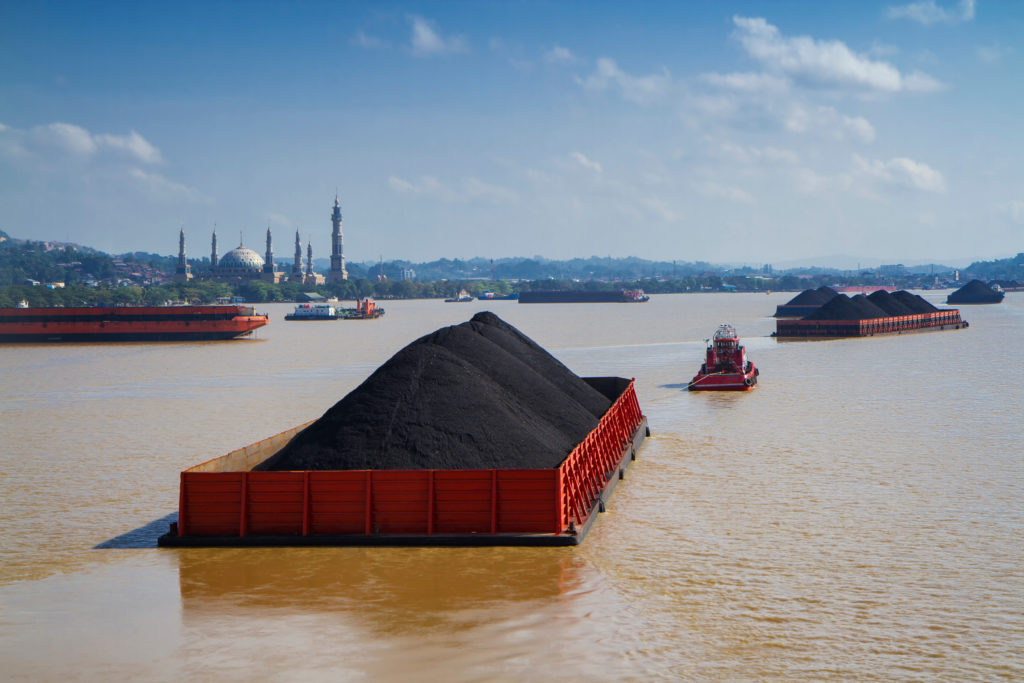
Coal imports from China’s largest supplier Indonesia tumbled 20% to 14.286 million tons in April, customs data showed on Tuesday, as Chinese buyers rejected a push by Jakarta to use its government-set benchmark in international sales, in a bid to increase royalties.
Indonesia began using the new government-set price, known as HBA and previously used only to calculate royalties, on March 1 to exert more national control over the value of both domestic and export transactions for the fuel commodity, but traders complain the index is opaque and more expensive.
Also weighing on Indonesian imports were lower prices for domestic coal in China, which dragged down overall coal imports by 16% year-on-year in April.
Domestic prices are at four-year lows, cutting into profit for imported coal.
China’s coal imports from other top suppliers also fell last month. Russian shipments fell 13% in April from the same month last year to 7.397 million metric tons, the data showed.
Moscow is planning to support its coal industry, hit by Western sanctions, with discounts on rail transportation rates and guaranteed exports, according to a letter seen by Reuters and reports from coal-producing regions, which could support shipments to neighbouring China going forward.
Imports from Mongolia, mostly of coking coal, dipped 3% to 7.014 million tons last month. Imports from Australia also declined 3% in the month to 6.97 million tons.
(By Colleen Howe and Michele Pek; Editing by Edwina Gibbs and David Evans)
Alberta Energy Regulator approves Gina Rinehart-backed Grassy Mountain coal project
Despite intense pushback, Alberta's energy regulator has approved a controversial coal exploration project at Grassy Mountain, near Crowsnest Pass.
Alberta’s energy regulator has approved a polarizing coal exploration project in the eastern slopes of the Rocky Mountains, with a few conditions.
In the decision announced Thursday, an Alberta Energy Regulator (AER) panel ruled on three applications from Northback that will allow exploratory drilling at Grassy Mountain in the Crowsnest Pass.
“We are satisfied that throughout the proceeding and in our decision, we have considered the purposes and factors identified in the relevant enactments, and we find that the applications meet all the regulatory requirements,” the decision reads.
The proposed project has been met with protest from residents in the area, with many raising concerns about its potential effects on the environment.
Grassy Mountain, peak to left, and the Grassy Mountain Coal Project are seen north of Blairmore, Alta., Thursday, June 6, 2024.
(Jeff McIntosh/The Canadian Press)
The project’s approval is contingent upon Northback meeting several conditions, which include:
Managing drilling waste, including drill fluids and cuttings, and their subsequent disposal to the satisfaction of the AER;
Sharing a project-specific erosion and sediment control plan with the AER before exploration operations begin;
Making the program consistent with Northback’s integrated weed management plan; Environmental mitigation measures being consistent with the recommendations in the company’s pre-disturbance site assessment; and
Meeting the conditions required by Alberta Forestry and Parks for Crown land reservations in the area.
“An applicant must comply with conditions or it is in breach of its approval and subject to enforcement action by the AER. Enforcement of an approval includes enforcement of the conditions attached to that licence,” the decision notes.
Northback also made several commitments to the Piikani Nation, including:Making data collected by Northback as part of the exploration program available to the nation for their review and analysis;
Regaining Piikani members as “cultural and environmental monitors” for the duration of the program; and
Providing to the nation, upon their request, the information obtained from Northback’s trail cameras located in the area near the project sites.
In a brief statement Thursday, Northback thanked the AER for its decision.
“With this outcome, Northback continues our commitment to bring benefits to Albertans while adhering to the highest environmental standards,” the company said.
Gina Rinehart's Australian company says it is creating plans for a future commercial mining operation – one that would also need AER approval.
The controversial mining project proposal was revived after it was rejected in 2021 over environmental concerns.
Despite strong opposition from area producers and residents, Northback will be permitted to divert water to the mine site that it says is not directly connected to other waterways. “This is a diversionary tactic by Northback to move forward with a drilling application rather than the whole mine. The AER is clear that the application is related to the drilling application and two other applications, not to the whole mining project itself,” Chris Spearman, a spokesperson for Water for Life and a Pincher Creek resident, told CTV News.
The AER held a public oral hearing in Pincher Creek, Alta., about the issue in December 2024. The hearing continued in Calgary in January, with closing arguments provided on March 4.
About 150 protesters took to the steps of the AER’s Calgary office on the final day, voicing concerns around the three proposals.
The full decision can be found on the AER’s website.
With files from CTV News Calgary’s Camilla Di Giuseppe and Tyson Fedor
Canada’s Mineral Exports Hit Record High, Gold Becomes Second-Largest Export
A recent new report by the Mining Association of Canada (MAC) reveals that Canada’s mining sector contributed C$117 billion, accounting for 4% to the country’s GDP in 2023. Meanwhile, driven by rising commodity prices, gold production surged, surpassing passenger vehicles to become Canada’s second-largest export. Canada produces over 60 minerals and metals through mining activities. In 2023, the total value of mineral production reached C$71.9 billion, up significantly from C$58.6 billion in 2021. This growth was primarily fueled by increased production values for non-metallic minerals and coal. Since 2000, the total value of Canada’s mineral and metal production has quadrupled. As a global leader in mineral production, Canada is the world’s top producer of potash, the second-largest producer of niobium and uranium, and the third-largest producer of gem-quality diamonds (by value) and palladium (by metal content).
Pierre Gratton, CEO of MAC, stated: “Despite economic headwinds, mining remains a pillar of stable growth for Canada’s economy. As Canada and its allies work to secure critical minerals for economic, security, and climate goals, fully developing our mineral potential could unlock tremendous wealth opportunities.”
The report highlights that the mining sector directly employs 430,000 workers in high-quality jobs and supports an additional 281,000 indirect jobs—meaning 1 in every 28 Canadian workers is linked to the industry. Mining is also a key employer for Indigenous communities, providing jobs for over 12,000 Indigenous individuals in 2023.
Looking ahead, the industry will need more than 100,000 new workers over the next decade. While progress has been made in Indigenous recruitment, MAC emphasizes the need to attract more women, young workers, and minorities to reflect Canada’s workforce diversity. Additionally, increasing the number of university and college graduates in mining-related fields is crucial to building a strong talent pipeline.
Gratton cautioned that Canada cannot take its mining strength for granted. “Geopolitical challenges, national security concerns, the transition to a low-carbon economy, and the need to build a resilient economy amid trade barriers will drive mineral demand far beyond current production levels,” he said. “Canada’s mining sector is better positioned than most to withstand economic shocks from tariffs—now is the time to double down on investment and strengthen this vital industry.”
With record-breaking mineral exports and growing global demand, Canada’s mining sector is poised to play a pivotal role in the economy of the future.