[Editor’s note: Socialist Party of Malaysia activists Amanda Shweeta Louis and Gandipan Natha Gopalan will be speaking at Ecosocialism 2025, September 5-7, Naarm/Melbourne, Australia. For more information on the conference visit ecosocialism.org.au.]
Republished from ThinkLeft. Original translation by Wendy Lim and introduction by Mark Johnson for Europe Solidaire Sans Frontières.
In an era when socialist politics faces marginalisation globally, the story of the Parti Sosialis Malaysia (Socialist Party of Malaysia, PSM) offers vital lessons. Born from grassroots organising amongst plantation workers, urban settlers, and marginalised communities, PSM demonstrates how authentic socialist politics can emerge from the most exploited sectors of society. Their quarter-century struggle against neoliberal capitalism, from opposing free trade agreements to fighting privatisation of public services, mirrors battles being waged across the Global South.
For feminist and internationalist readers, PSM’s trajectory reveals how class-based organising intersects with anti-imperialist resistance and community self-defence. Their experience navigating state repression whilst building popular power from below provides crucial insights for movements confronting authoritarian drift worldwide. As ecosocialist politics gains urgency, PSM’s integration of environmental justice with workers’ rights offers a model for holistic praxis in the 21st century.
25 years of PSM: A brief history
This article is published to commemorate the 25th anniversary of the founding of the Socialist Party of Malaysia (PSM), which fell on 30 April 2023. This article only provides a brief overview of part of PSM’s journey from before its founding until the second decade of the 21st century, and indeed cannot encompass all events involving PSM throughout this period.
Prologue: The era at the threshold of PSM’s founding
The Socialist Party of Malaysia (PSM) is a left-wing political party in Malaysia that emerged from the struggle movement of the Marhaen [marginalised and oppressed] people. Left-wing politics means politics that fight for equality and fairness in the distribution of society’s wealth as well as the liberation of the people from all forms of oppression and exploitation, in contrast to right-wing politics which supports the hierarchical structure of capitalist society that prioritises the profits of the capitalist ruling elite by exploiting the lower classes.
PSM was founded in the post-Cold War era of the 20th century. Our world was shackled by the Cold War for more than four decades after the end of World War II, where the confrontation between two major power blocs – the Western Bloc led by the United States (US) and the Eastern Bloc led by the Soviet Union – pushed the world’s people into various geopolitical conflicts, proxy wars and iron-fisted governments that restricted the democratic space of the people. The imperialist power of the US in the Western Bloc used various dirty and despicable tactics to destroy progressive movements fighting for social justice and true liberation; whilst the Stalinist bureaucratic government in the Eastern Bloc used extreme violence to crush all efforts at more democratic and liberating socialist reform.
The fall of the Berlin Wall in 1989 and the dissolution of the Soviet Union in 1991 marked the bankruptcy of Stalinist bureaucratic rule, but at the same time also had a tremendous impact on left-wing movements around the world. “Socialism”, a term that had inspired people worldwide to rise against the exploitative capitalist socio-economic system and fight for a more just society, became less attractive in the eyes of the general public at the end of the 20th century. The experiment in the form of “state socialism” in the Eastern Bloc, which was full of tragic history and ultimately failed, had damaged the credibility of socialism and became a historical burden for socialist movements everywhere, even though they were not necessarily aligned with the political stance of Eastern Bloc governments. The People’s Republic of China also opened its doors to global capitalism beginning in the late 1970s. Many left-wing parties not only changed their names but also altered their direction and political programmes with a more moderate appearance, supposedly in line with the circumstances of the time. In Malaysia, the Malaysian People’s Socialist Party (PSRM) dropped “Socialist” (S) from its name and party constitution in 1989.
Meanwhile, those who supported the capitalist system became increasingly arrogant and rampant in implementing neoliberal economic policies that liberalised international trade, privatised the public sector to profit-motivated corporations and deregulated markets to facilitate corporate profit-making activities, thereby further widening the gap between rich and poor worldwide, whilst worsening the environmental crisis. In Malaysia, the government under Mahathir Mohamad’s leadership at the time also embraced free market economic policies mixed with cronyism, nepotism and patronage politics since the 1980s, whilst restricting democratic space by using oppressive acts such as the Internal Security Act (ISA) [allowing detention without trial], the Universities and University Colleges Act (AUKU), the Sedition Act and the Printing Presses and Publications Act. The mass arrests under the ISA during Operation Lalang [a major crackdown on dissidents] in 1987 to eliminate opposition voices was one of the repressive black spots in the history of Mahathir’s administration.
Origins of PSM: The struggle of the Marhaen people for human rights and dignified living
Malaysia’s economy experienced rapid growth in the 1990s, but it was based on great sacrifices and severe exploitation of the Marhaen people, including plantation workers, factory workers, urban settlers, Orang Asli/Asal [Indigenous] communities, youth, small traders and others. For example, in the plantation sector, although plantation workers had toiled for several generations to generate profits for large plantation companies, they were still not paid monthly wages in the early 1990s. Even worse, when large plantations shifted from rubber to oil palm cultivation, many workers were dismissed and evicted from their housing within plantation areas without alternative accommodation. This oppression of plantation workers gave birth to the plantation workers’ movement led by the Plantation Community Support Committee (JSML), where community groups united under JSML became an important component in establishing PSM.
JSML played an important role in mobilising various plantation community campaigns, such as demanding monthly wages for plantation workers and others. JSML launched a national campaign in 1992 demanding the inclusion of plantation communities in rural development plans. There were also many struggles in plantation community areas against forced evictions in the 1990s and early 2000s, such as those that occurred at Ladang Stratshila, Ladang Klebang, Ladang Sungai Rasah and others. The activists and plantation workers involved in these struggles later became part of the backbone of PSM’s organisation.
One other component of the Marhaen community movement that led to PSM’s birth was the struggle of urban settlers. Urban settlers are those who migrated from rural to urban areas during the process of industrial economic development and urbanisation in our country but were forced to build houses on government land or privately owned land due to the absence of comprehensive public housing policies. When major cities were further developed, these urban settlers were exposed to the threat of forced eviction. Moreover, the “Zero Squatter” policy practised by the government also victimised urban settlers. There were many urban settler community struggles against forced eviction and demanding housing rights around the 1990s, such as Kampung Bukit Sungai Putih, Kampung Udara and Kampung Sungai Nipah.
The struggles carried out by Marhaen communities in plantations and urban settler communities were struggles to uphold human rights and defend dignified living for the lower classes. These struggles became the catalyst and pioneer for efforts to form a new left-wing political party to champion the fate of the Marhaen people in our country.
PSM’s founders
On 1 May 1994, Dataran Merdeka [Independence Square] in Malaysia’s capital was shocked and shaken by a mass gathering attended by approximately 3,000 Marhaen people to celebrate International Workers’ Day. This mass action was the largest Workers’ Day gathering in 20 years at the time. Several years before that, civil society in Malaysia was still shrouded in a gloomy atmosphere following Operation Lalang 1987, with no large-scale protest actions since then.
The International Workers’ Day celebration in Kuala Lumpur in 1994 was organised by the 1 May Committee formed from a network of community groups organising plantation communities and urban settlers. Three main groups involved in this community network were Suara Warga Pertiwi (SWP) [Voice of the Citizens], Alaigal [Waves] and the Community Development Centre (CDC). In the book “Why 10 years to register PSM?” (2020), its author S. Arutchelvan, one of PSM’s founders, described the 1994 Workers’ Day gathering as “a crossroads” where these three points met. These three community groups that met during the 1994 Workers’ Day celebration became the foundation and core of PSM’s subsequent establishment.
Suara Warga Pertiwi (SWP) was a community group established by Dr. Mohd Nasir Hashim and V. Selvam. Dr. Nasir and Selvam’s involvement in activism can be traced back to their participation in the Labour Bureau of the Institute for Social Analysis (INSAN) in the 1980s. They were involved in many grassroots community struggles at the time. Dr. Nasir was detained for 15 months under the ISA in 1987 during Operation Lalang. Dr. Nasir was also one of the founders of Suara Rakyat Malaysia (SUARAM) [Voice of the Malaysian People], a human rights organisation established by former ISA detainees and their families originally to fight for the abolition of the ISA. Selvam was involved in the Wilson Parking workers’ struggle in Kuala Lumpur and Petaling Jaya around the 1980s.
Dr. Nasir and Selvam had joined the Malaysian People’s Socialist Party (PSRM) and were active in organising Marhaen people’s struggles through the PSRM Brickfields Branch. However, PSRM’s central leadership decided to drop “Socialist” from the party’s name and constitution in 1989. This decision by PSRM’s leadership was strongly opposed by Dr. Nasir and Selvam, so they were forced to leave the party. Nevertheless, Dr. Nasir and Selvam continued to be active in organising Marhaen people’s struggles. They established SWP with the main objective of fighting to defend the rights of the oppressed and discriminated lower classes in our country. SWP aspired to create a vehicle for socialist struggle. Dr. Nasir and Selvam were also involved in establishing the Urban Settlers Support Committee (JSPB) in 1993, which at its organisational peak coordinated struggle efforts in more than 30 urban settler villages around the Klang Valley [Greater Kuala Lumpur metropolitan area].
The Alaigal group can trace its origins as early as 1977 when a group of students from the University of Malaya undertook a community project in plantation areas in Sungai Siput [a town in Perak state]. Among the two students who played important leadership roles at that time were Jeyakumar Devaraj and Rani Rasiah. They later established an informal group to mobilise grassroots community organising work. Besides Jeyakumar and Rani, also mobilising the group were M. Sarasvathy and Nehru. Sarasvathy had extensive experience from her involvement with the Young Christian Workers (YCW) group. They initially established an education group that focused on work with plantation communities, then transformed into Alaigal which actively organised grassroots community groups. Alaigal means “waves” in Tamil.
Another group was the Community Development Centre (CDC) founded by students from the National University of Malaysia (UKM). Among CDC’s founders were S. Arutchelvan and Eswaran, later joined by other activists such as A. Sivarajan, Letchimi Devi and others. While still students at UKM, they established a student group called the Indian Student Welfare Committee (JKMI), but later changed its name to the Student Welfare Committee (whilst retaining the JKMI acronym that was already popular at the time) after its members accepted the concept of class struggle as an organising principle. JKMI mobilised education projects for plantation communities around the Kajang and Bangi areas [towns in Selangor state], subsequently becoming increasingly involved in plantation workers’ struggle issues for human rights. After graduating from UKM, the student activists who mobilised JKMI established CDC in 1992 to continue the struggle efforts begun during their campus days.
Involvement in grassroots community struggles around the late 1980s and early 1990s brought together these three community groups committed to defending the fate of the lower classes. Concern for the fate of the lower classes and understanding of social problems through the class analysis approach practised by these three groups made them increasingly close in cooperation to build people’s power from below. The Workers’ Day gathering on 1 May 1994 at Dataran Merdeka was the spark produced from the meeting of community groups dedicated to this class struggle. This struggle flame continued to burn until it gave birth to a new left-wing party in the homeland – the Socialist Party of Malaysia (PSM).
The sacred date of April 30, 1998
After the historic Workers’ Day celebration in 1994, the network of community groups that organised the protest action continued their cooperation in fighting for Marhaen people’s rights. In April 1995, JSML and JSPB launched a campaign presenting 10 demands from grassroots communities (5 plantation community demands and 5 urban settler demands) during the 9th General Election (PRU). However, no candidates from any political parties contesting at the time, whether government or opposition parties, were willing to support these grassroots community demands. This caused grassroots communities organised from below to begin thinking about the need to establish a political party that truly represented the interests of the working class and lower classes.
From 1995 to 1998, a series of discussions were held by activists and community leaders from struggle areas regarding efforts to establish a new party. On 15 February 1998, the Sponsoring Committee for PSM’s formation was established. This PSM Sponsoring Committee was composed of Dr. Nasir Hashim from SWP as Chairman, M. Sarasvathy from Alaigal as Deputy Chairman, S. Arutchelvan from CDC as Secretary and A. Sivarajan from CDC as Treasurer, whilst the three named Committee Members were V. Selvam from SWP, Maneyvannan a/l Velue from SWP and Ahmad Amirudin Kamarudin who was Chairman of the Kampung Chubadak Tambahan Urban Settlers Committee.
On 30 April 1998, one day before International Workers’ Day, the application for PSM’s registration was submitted to the Registry of Societies (ROS). Dr. Nasir, Arutchelvan and Selvam attended the ROS office to submit the application form. No media were present at the time, as the application submission was made in a low-profile manner. However, what PSM’s pioneers did at the time was indeed something very historic, because after Malaysia had been in a left-wing political vacuum for so long, finally a political party that raised the name and principles of “socialist” struggle came forward to obtain registration.
Since then, 30 April 1998 has been considered the date of PSM’s founding.
PSM was founded when Malaysia was on the brink of a new wave of upheaval in 1998. On 23-25 October 1998, when the Reform Movement [Reformasi] erupted due to the political crisis in the government at the time, PSM held its first National Congress in Cameron Highlands [a hill resort in Pahang state]. Only 12 people attended PSM’s first National Congress, but it provided the foundation for developing a political party that fought for social change based on class analysis and a revolutionary political programme.
The 10-year struggle to register the party
Perhaps the story of PSM’s founding would be boring if there were no obstacles from the authorities. ROS delayed the registration process by requesting amendments to application documents such as the Party Constitution, saying that PSM did not meet the requirement for representatives from 7 states and so forth, without answering any clarifications requested by PSM. On 4 February 1999, PSM received a letter dated 27 January 1999 from ROS stating that PSM’s application for registration had been rejected but no reason was given.
On 23 February 1999, PSM appealed to the Home Ministry (KDN) as provided under Section 18 of the Societies Act 1966. After several letters sent to KDN, and complaints also made to the Public Complaints Bureau, on 23 September 1999, PSM received a letter dated 15 September 1999 signed by the KDN Secretary-General stating that the appeal had been rejected and the decision was final, but once again no reason for rejecting PSM’s registration was given.
On 26 October 1999, PSM made history by becoming the first political party in Malaysia to challenge the Home Minister’s decision denying a political party’s registration. PSM filed a lawsuit against the Government of Malaysia in the Kuala Lumpur High Court.
On 21 March 2000, the Kuala Lumpur High Court allowed PSM’s application to sue the Home Minister. PSM challenged KDN’s action in denying PSM’s registration as it contradicted Article 10(1)(c) of the Federal Constitution which states that “all citizens have the right to form associations”. Additionally, ROS under KDN also failed to provide reasons when rejecting PSM’s registration. Explanations about the reasons for rejecting PSM’s registration that had been requested from the beginning were only known in July 2000 after receiving an affidavit from Abdullah Ahmad Badawi who was Home Minister at the time. Among the arguments put forward by KDN were that PSM’s application was incomplete, did not meet KDN’s regulations regarding representatives from 7 states, and “national security aspects”.
On 31 October 2002, PSM launched a campaign demanding that PSM be registered. The trial of PSM’s registration case took place in November 2002.
On 13 January 2003, PSM lost the case in the Kuala Lumpur High Court when the judge decided to reject PSM’s application with costs, where the judge was of the view that “national security aspects” were the government’s responsibility and not the court’s discretion. PSM appealed to the Court of Appeal on 7 February 2003.
On 26 March 2005, a memorandum signed by 36 organisations, including human rights groups, grassroots community coalitions and the Malaysian Trades Union Congress (MTUC), was submitted to the Home Ministry calling for PSM to be registered immediately. On 15 November 2005, a protest action was held in front of the Palace of Justice and a memorandum was submitted to the Chief Justice’s office demanding that the hearing of PSM’s registration case appeal in the Court of Appeal be expedited.
In 2006, the campaign to register PSM continued to be intensified, with the organisation of a round table forum on the right to association on 16 March 2006. Additionally, PSM received solidarity messages from various international organisations and individuals supporting its efforts to fight for the right to establish a political party in Malaysia.
The Court of Appeal hearing was held in April 2006 and its decision was announced on 16 August 2006. PSM lost again when the panel of judges in the Court of Appeal decided to reject PSM’s appeal. However, a “small victory” in that defeat was that the Court of Appeal judge said that the “national security” issue could not be used as a reason to reject PSM’s application.
Although losing in the Court of Appeal, PSM continued its campaign demanding its registration. On 11 September 2006, PSM filed an application for leave to appeal the case to be heard in the Federal Court.
In 2008, after PRU-12 which saw Barisan Nasional (BN) [the ruling coalition] lose its two-thirds majority in Parliament and two PSM candidates who contested using PKR’s [People’s Justice Party] logo (as they had not yet obtained registration at the time) won in the election, the political atmosphere and balance of power in the country underwent significant changes. Leading up to the hearing of PSM’s registration case in the Federal Court, PSM launched a two-day fax campaign to KDN on 15-16 May 2008, and submitted a memorandum to KDN on 28 May 2008. On 4 June 2008, PSM received an email from Syed Hamid Bin Syed Jaafar Albar who was Minister of Home Affairs at the time saying that his side agreed to register PSM!
On 17 June 2008, PSM received a letter from the Minister of Home Affairs approving PSM’s registration and PSM reapplied for approval. Therefore, PSM requested to postpone the case in the Federal Court to allow PSM’s registration process to be finalised. News of PSM’s registration received extensive coverage by mainstream media and was well received by various parties at the time.
After 10 years of fighting for registration, on 19 August 2008, PSM received its legal registration certificate under Section 7 of the Societies Act 1966. On 10 September 2008, PSM announced this good news in a special press conference in Kuala Lumpur.
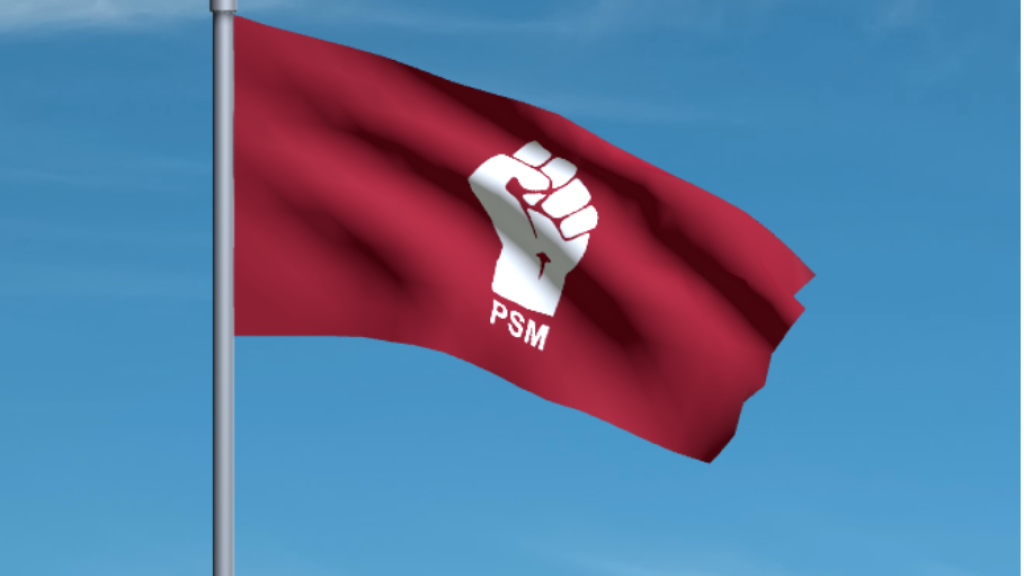
After obtaining registration from ROS as a legitimate political party, PSM faced obstacles from the Election Commission (SPR) to register PSM’s symbol for use on ballot papers. SPR initially tried to delay the registration of PSM’s election symbol, but as a result of persistent pressure, finally PSM’s clenched fist symbol was registered as the symbol to be used by PSM in elections.
PSM continues to lead the Marhaen people’s struggle
Although PSM was denied registration initially, during the 10 years from 1998 to 2008 whilst PSM was not yet legally registered, the activists working on PSM’s establishment continued to be active and even led various grassroots community struggles everywhere. After PSM was legally registered, PSM’s red flag with the left clenched fist flew even more proudly and PSM continued to organise the Marhaen people to fight for collective welfare.
The Marhaen people’s struggle led by PSM contributed to forming the foundation of new politics for further change in our country.
PSM has been involved in dozens of plantation workers’ and urban settlers’ struggles against forced eviction and demanding housing rights. Among the great Marhaen people’s struggles since PSM’s founding include the struggle of Ladang Sungai Rinching workers demanding comfortable housing, the struggle of Guppy Plastic factory workers for trade union establishment, the struggle of Ladang Bukit Jelutong workers who rebuilt houses even though they were demolished 4 times, the struggle of Kampung Chepor settlers for housing rights, the struggle of small farmers in Sungai Siput for cultivation rights, the struggle of Kampung Baru Kuala Kuang residents against a rubber factory emitting foul smells, the struggle of Ladang Kamiri workers for housing rights, the struggle of Ladang Braemer workers for housing rights, the struggle of Kampung Berembang residents against forced eviction, the struggle of Taman Permata Dengkil flat residents, the struggle of Kampung Pinang Pusing residents, the Ladang Midlands struggle, the Kampung Chekkadi struggle, the Ladang Bangi struggle, the Ladang Semenyih struggle, the Ladang Kirby struggle, the Kampung Hakka Mantin struggle, the JTRG (Land, Housing and Stalls Committee) struggle in Cameron Highlands, and many more.
PSM can be said to be a champion in housing rights struggles. Dr. Nasir Hashim, one of PSM’s founders and PSM’s first National Chairman, was the person who introduced the term “urban settlers” as an alternative to the “squatter” label used by the government and developers. From housing rights for plantation workers and urban settlers, to addressing problems faced by flat residents and stopping the auction of Marhaen people’s houses by profit-prioritising banks, PSM is always with the lower classes to fight for comfortable housing to live in.
PSM celebrates World Habitat Day every year by holding actions that highlight Marhaen people’s demands related to housing issues. PSM has achieved many victories in struggles to save Marhaen people’s residential housing and help Marhaen people obtain alternative land or housing. When forced evictions occur, often people will come looking for PSM for assistance.
JERIT
In 2002, PSM activists involved in grassroots community struggle movements reorganised community organising work by establishing the Coalition of the Oppressed (JERIT). JERIT was established as a large umbrella that combined various grassroots movements based on class struggle principles. Grassroots community coalitions allied under JERIT were:
- Plantation Community Support Committee (JSML) – which already existed to unite plantation worker communities fighting for worker rights and housing rights;
- Coalition of Urban Settlers and Housing (GPBP) – which united urban settler communities to fight for housing rights;
- Coalition of Factory Workers and Unions (GPKK) – which was established to organise factory workers;
- Coalition of Youth and Students (GAMP) – which united progressive student and youth groups in our country.
JERIT organised various campaigns and actions to fight for Marhaen people’s rights who yearned for a better life. In 2003, GPKK under JERIT launched a campaign demanding a Minimum Wage Act by organising various activities, including forums, roadshows and postcard campaigns collecting signatures to support the enactment of a Minimum Wage Act. GPKK demanded a minimum wage of RM900 [€180] per month at the time. On 21 September 2006, a massive demonstration was held by GPKK-JERIT in front of the Parliament building to submit tens of thousands of signed postcards to the government. After struggling for almost 10 years, the Malaysian Parliament passed the National Wages Consultative Council Act in 2011 and subsequently the government announced the implementation of minimum wage (RM900 [€180] for Peninsular Malaysia, RM800 [€160] for Sabah and Sarawak [East Malaysian states]) starting 1 January 2013. The implementation of minimum wage was not something that fell from the sky, but was the result of the working class’s continuous struggle in our country. After minimum wage was implemented, PSM and JERIT continued to play an important role in pressing for increases in minimum wage rates to match the rising cost of living, by organising various actions from time to time. PSM was involved in the Coalition Against RM1050 in 2018 when the government at the time only increased the minimum wage rate by RM50 [€10] and a protest was held in front of Parliament on 17 October 2018, resulting in the government increasing the minimum wage rate to RM1,100 [€220].
Another important peak action organised by JERIT was the bicycle campaign in December 2008. From 3 December 2008 to 18 December 2008, for 16 consecutive days, JERIT held a bicycle tour with the theme “People Pedaling Change” to bring 6 people’s demands, namely:
- Enact a Minimum Wage Act and protect workers’ rights;
- Abolish oppressive acts like the Internal Security Act (ISA);
- Comfortable housing for all people;
- Control prices of goods;
- Restore local elections;
- Stop privatisation of basic services like water, healthcare and education.
The JERIT bicycle tour “People Pedaling Change” was divided into two convoys, one from the north (starting from Alor Setar [capital of Kedah state]) and another from the south (starting from Johor Bahru [main city of Johor state]), both heading to Parliament in Kuala Lumpur. The JERIT bicycle convoy faced various obstacles and challenges from the authorities throughout the campaign, resulting in many “interesting” incidents, including cyclists being issued fines by police for bicycles lacking reflectors, bicycles being burned at midnight in Kubang Semang [a town in Penang state] and mass arrests of young people participating in the JERIT bicycle campaign in Rawang [a town in Selangor state]. However, all these obstacles and challenges failed to prevent the JERIT bicycle convoy from submitting a memorandum to the Malaysian Parliament on 16 December 2008.
In January 2017, activists involved in efforts to build a people’s mass movement through JERIT decided to reorganise mass organising work and establish the Marhaen Coalition which encompasses more sectors of society with a new mission. When our country was hit by the COVID-19 pandemic, the Marhaen Coalition organised the online Marhaen Assembly on 12-17 October 2021 to highlight grassroots community grievances and people’s demands for social reform that could guarantee collective welfare.
PSM fights for economic justice
As a left-wing party that prioritises equitable wealth distribution and collective welfare for the entire society, PSM has led various campaigns fighting for economic justice to reduce the economic burden on ordinary people and create an economic structure that truly guarantees societal welfare.
When the government led by Abdullah Ahmad Badawi planned to introduce the Goods and Services Tax (GST) in 2004, PSM (which was not yet legally registered at the time) became the first political party in our country to voice opposition to implementing this regressive tax that impoverished ordinary people. PSM established the Coalition Against GST together with various civil society groups. PSM was the political party that was most vocal, most organised and most brave and willing to take radical action in opposing GST. The Workers’ Day gathering in 2014 with its main demand opposing GST was attended by approximately 30,000 people, making it the largest Workers’ Day gathering organised by the 1 May Committee. On 23 March 2015, more than 100 activists from the Coalition Against GST held an action occupying the Kelana Jaya Customs Complex [in Selangor state] to protest against GST which was about to be implemented at the time. A total of 79 people arrested during the anti-GST action at the Kelana Jaya Customs Complex were charged in court, of which 44 were PSM members. However, the prosecution against the anti-GST action participants was subsequently dropped.
The BN government led by Najib Razak which stubbornly implemented GST on 1 April 2015, ultimately suffered a historic defeat in PRU-14. The highly unpopular GST was abolished after PRU-14. The abolition of GST was the result of people’s struggle in which PSM also played an important role. PSM is firm in fighting for a fair progressive taxation system, where the super-rich should be taxed higher so that the country’s wealth generated by the working class (but hoarded by super-rich corporations) can be redistributed for the welfare of the entire society.
PSM also has a clear and firm position on international economic affairs. PSM opposes free trade agreements based on neoliberal capitalist ideology (which wants to liberalise trade, privatise the public sector and deregulate the economy to maximise multinational corporate company profits). Together with other organisations, PSM opposed the Malaysian government’s plan to negotiate a Free Trade Agreement (FTA) with the US when it was first proposed in 2005.
FTA negotiations between Malaysia and the US were stopped in 2009 but the Trans-Pacific Partnership Agreement (TPPA) was introduced at the time. PSM was involved in the Action Body Against TPPA. Many anti-TPPA actions were held, such as protests at KLCC [Kuala Lumpur Convention Centre] on 11 October 2013 during John Kerry’s (US Secretary of State at the time) visit to Malaysia, protests in front of Parliament on 28 October 2015 and a march action in Kuala Lumpur on 23 January 2016.
TPPA was subsequently rebranded as the Comprehensive and Progressive Agreement for Trans-Pacific Partnership (CPTPP) without US participation, but still carried more or less the same terms. Therefore, PSM continued to be involved in efforts to oppose CPTPP together with the National Sovereignty Coalition.
When most mainstream political parties were so enthusiastic about foreign investment (FDI) as an indicator of economic growth, PSM took a stance that viewed investment and trade from the perspective of humanity and ordinary people’s welfare. PSM opposed all unfair free trade agreements to developing countries, threatening the economic life of local communities and only benefiting multinational giant companies. PSM drafted the People’s Charter on International Trade Agreements to create a more just regional and international economic structure.
After the world and our country were hit by the COVID-19 pandemic, PSM proposed a national action plan to address the country’s economic crisis due to the COVID-19 outbreak on 16 July 2020, subsequently launching an alternative action plan “National Recovery: New Direction for Malaysia” on 9 September 2021 with 5 core demands, namely: strengthen social protection, Job Guarantee Scheme, housing as people’s right, improve public health services and address the climate crisis immediately. These 5 demands were brought in the “People Demand Five” campaign launched simultaneously in 7 places on 22 May 2022.
PSM’s latest campaign launched on 14 April 2023, proposes demands to implement a Universal Senior Citizens Pension scheme starting with monthly pension payments of RM500 [€100] to all Malaysian residents aged 65 and above who do not have any government or private pension, to ensure all senior citizens can live their old age with dignity.
PSM fights for workers’ rights
As a political party established to defend workers’ fate and fight for working class liberation, PSM has been consistently involved in various workers’ struggles. Besides the minimum wage campaign that finally bore fruit in 2013, PSM also mobilised a campaign demanding a Termination Fund aimed at providing assistance to workers who did not receive termination compensation from bankrupt companies. The Termination Fund campaign was launched by PSM on 21 October 2015. As a result of PSM’s persistent pressure without understanding fatigue, the government finally implemented the Employment Insurance System (SIP) starting 1 January 2018 to provide income replacement for workers who lost their jobs.
PSM is involved in various workers’ struggle efforts to establish trade unions. Among the trade union struggles involving PSM activists is the activation of the National Union of Workers in Hospital Support Services (NUWHSAS). NUWHSAS, which organises cleaning workers in government hospitals, has weathered various obstacles and challenges for trade union recognition. Many actions have been held by NUWHSAS, such as protests in front of the Health Ministry on 2 December 2019 to oppose union victimisation, protests in front of Ipoh Hospital [in Perak state] on 5 June 2020 involving the arrest of 5 union activists, and a motorcycle convoy from Bukit Mertajam [in Penang state] to Putrajaya [the administrative capital] on 5-8 February 2022.
PSM also took the initiative to establish the Government Contract Workers Network (JPKK) which actively fights for the abolition of the outsourcing contract system for permanent workers in government buildings.
Joint campaigns with civil society
In 2003, when the imperialist power of the United States (US) planned to invade Iraq with baseless reasons, PSM led efforts to establish the Anti-War Coalition (GAP) which was also joined by various civil society organisations. GAP organised several anti-war actions, including protests in front of the US Embassy in Kuala Lumpur on 15 February 2003 which was part of the largest anti-war protest action in world history!
In 2004, when the government planned to privatise dispensaries in government hospitals, PSM took the initiative to establish the Coalition Against Privatisation of Health Services (GMPPK) with its first action being a protest in front of the Health Ministry headquarters on 23 December 2004. As a result of protests and pressure from GMPPK, the government cancelled its plan to privatise dispensaries in government hospitals.
However, GMPPK continued to be active in various efforts to defend the public health system from being eroded by neoliberal policies brought by the government. GMPPK criticised the problematic national health insurance scheme plan and opposed the Full Paying Patient Services Scheme. GMPPK once organised various protest actions to highlight public health issues. GMPPK’s efforts were subsequently continued through the People’s Health Forum which PSM also joined. PSM is the only political party in Malaysia that is most firm and consistent in fighting for public health issues whilst opposing health tourism concepts that commodify health for buying and selling. PSM is determined to defend the public health system in our country for the welfare of all people, and has many times proposed suggestions to improve the public health system.
PSM was also involved in several other important people’s movements in our country that combined various political parties and civil society organisations, including: the Abolish ISA Movement (GMI) established in 2001 with a massive assembly action on 1 August 2009 in Kuala Lumpur; the Coalition Protesting Oil Price Increases (PROTES) which held many protest actions due to oil price increases burdening ordinary people around 2006 to 2010; and several massive assembly actions organised by the Coalition for Clean and Fair Elections (BERSIH) on 9 July 2011, 28 April 2012, 29-30 August 2015 and 19 November 2016.
Because PSM is a workers’ party with an internationalist spirit and not nationalist-chauvinist ideology, PSM is also very concerned about the fate of migrant workers. PSM participated in the Coalition Demanding Right to Redress for Migrant Workers (Right to Redress Coalition) which presented the important document “Towards a Comprehensive National Policy on Labour Migration for Malaysia” after holding a series of round table discussions with stakeholders from various backgrounds in August-October 2016.
On education issues, PSM firmly stands in defending education as people’s basic rights and should be prevented from being commodified by the capitalist market. PSM’s Socialist Youth led the Coalition Demanding Free Education (GMPP) established in 2010 to fight for free education up to first degree.
Regarding transportation policy, PSM firmly fights for an accessible and sustainable public transport system for all Malaysian people. PSM once organised the National Forum for Public Transport on 3 November 2012 to discuss proposals for improving Malaysia’s public transport system, and submitted a memorandum to the Land Public Transport Commission (SPAD) on 6 March 2015.
PSM fights for environmental justice and food security
PSM’s stance in improving Malaysia’s public transport system is in line with PSM’s vision for environmental justice. PSM launched a call to press for a climate emergency declaration on 21 January 2020, with 10 main demands including: stop construction of fossil fuel power plants, set an end date for closing all coal power plants, stop destructive logging, develop a mass transit bus (BMT) network and others.
PSM is also active in supporting Orang Asli [Indigenous peoples] communities’ struggles to defend customary land rights and forests that are their source of livelihood from threats of unsustainable development, such as excessive logging and mining. PSM was together with the Pos Lanai Orang Asli Customary Land and Territory Action Committee in Pahang [state] in a struggle for almost 4 years (2015-2019) to stop the Telom Dam construction project. The Pos Lanai Orang Asli community continues their struggle to demand customary land rights and prevent the destruction of their customary land until now.
Additionally, PSM is also involved in many small farmers’ and small breeders’ struggles. PSM has played an important role in mobilising small farmers’ struggles, especially in Perak state, with the formation of the Coalition of Farmers on Government Land (GAPETAK) in the 2000s and subsequently the Coalition of Farmers and Breeders of Perak in the 2010s. Many actions have been held by the Coalition of Farmers and Breeders of Perak, such as protests in front of the Perak State Government office and memorandum submissions in Putrajaya. These small farmers struggle against forced eviction without alternative land by either government or developer companies. PSM together with the Coalition of Farmers and Breeders of Perak launched the “Preserve Land for Agriculture” campaign since 2021.
The Breeders Network coordinated by PSM also held many actions to defend the livelihood of cattle and goat breeders, especially small breeders who carry out breeding activities on Sime Darby plantations [a major Malaysian conglomerate].
PSM fights for farmers’ and breeders’ issues not only to defend the livelihood of these local food producers, but also to protect the food security of the entire Malaysian society. The Food Producers Network which is a PSM initiative held a protest action in front of Parliament on 26 July 2022 to urge the government to stop all actions against farmers, rice growers, breeders and fishermen that affect the production of rice, vegetables, fish, milk and local beef.
PSM’s participation in elections
PSM has been involved in elections since 1999 with the aspiration of bringing the voice of Marhaen people and socialist political offerings into the legislative system in our country. Before obtaining legal registration in 2008, PSM contested in the 10th (1999), 11th (2004) and 12th (2008) General Elections (PRU) by creating understandings to borrow logos from the main opposition party at the time.
In PRU-10 in 1999, Dr. Jeyakumar Devaraj contested in the Sungai Siput Parliament constituency as a PSM candidate borrowing the Democratic Action Party (DAP) logo. Dr. Jeyakumar garnered 12,221 votes (equivalent to 40.38%) at the time despite facing an incumbent who was a senior Minister considered a political giant, namely Samy Vellu [leader of the Malaysian Indian Congress].
In PRU-11 in 2004, PSM candidates contested for 4 seats using the People’s Justice Party (PKR) logo, namely the Sungai Siput Parliament seat, Subang Parliament seat, Jalong state assembly seat in Perak and Bukit Lanjan state assembly seat in Selangor. PRU-11 saw a big BN victory. Dr. Jeyakumar who contested for the second time in the Sungai Siput Parliament constituency but using the PKR logo at the time, garnered 8,680 votes (28.37%) in a three-way contest, where the DAP candidate lost their deposit. Dr. Nasir Hashim obtained 17,481 votes (34.67%) in a one-on-one contest with BN in the Subang Parliament constituency. In the Jalong state assembly constituency in Perak, K. Kunasekaran obtained 3,638 votes (21.66%) and placed second in a three-way contest there; whilst in the Bukit Lanjan state assembly constituency in Selangor, V. Selvam obtained 3,121 votes (21.40%) in a one-on-one contest with BN. In the 3-way contests in Sungai Siput and Jalong, PSM got more votes than DAP candidates and placed second because PSM’s grassroots work there was recognised by voters even though they didn’t win.
In PRU-12 in 2008, there was a “political tsunami” that caused BN to lose its two-thirds majority in the House of Representatives and be defeated in 5 states (Penang, Selangor, Kedah, Perak and Kelantan). PSM contested for 4 seats in PRU-12, where 3 seats used the PKR logo (Sungai Siput Parliament, Kota Damansara and Semenyih state assembly seats in Selangor) and one other seat (Jelapang state assembly in Perak) contested as an independent candidate. Dr. Jeyakumar who contested for the third time in the Sungai Siput Parliament constituency successfully made history by defeating Samy Vellu who had held the Sungai Siput seat for 8 terms at the time. Dr. Jeyakumar garnered 16,458 votes (51.50%) compared to 14,637 votes (45.80%) obtained by Samy Vellu, with a majority difference of 1,821 votes in a fierce competition. Dr. Nasir Hashim who contested for the Kota Damansara state assembly seat in Selangor also achieved victory by garnering 11,846 votes (52.38%). S. Arutchelvan garnered 10,448 votes (47.71%) in the Semenyih state assembly constituency, whilst M. Sarasvathy who contested using an independent candidate symbol in the Jelapang state assembly constituency garnered 1,275 votes (6.57%).
In PRU-13 in 2013, PSM still contested for 4 seats. This was the first time PSM contested in a general election after obtaining registration as a legitimate political party under the law. However, because the main opposition coalition at the time (Pakatan Rakyat [People’s Alliance]) refused to give way for PSM to contest using its own logo even though PSM was already legally registered, PSM was forced to contest in the Sungai Siput Parliament constituency and Kota Damansara state assembly using the PKR logo, whilst contesting in the Semenyih state assembly constituency in Selangor and Jelapang state assembly constituency in Perak using PSM’s own logo. Dr. Jeyakumar successfully defended the Sungai Siput seat by garnering 21,593 votes (53.19%). Dr. Nasir lost in the Kota Damansara state assembly constituency because PAS [Pan-Malaysian Islamic Party] placed a candidate to split the Pakatan Rakyat vote and allow the BN candidate to win. Dr. Nasir obtained 14,860 votes (38.33%) and placed second in a 6-way contest in Kota Damansara at the time. Meanwhile, Arutchelvan obtained 5,568 votes (15.19%) in the Semenyih state assembly constituency and M. Sarasvathy obtained 2,568 votes (10.41%) in the Jelapang state assembly constituency.
In PRU-14 in 2018, PSM contested with its own logo for all 16 seats it contested. PSM contested for 4 Parliament seats and 12 state assembly seats: the Parliament seats contested by PSM in 2018 were Sungai Siput, Batu Gajah, Cameron Highlands and Sungai Buloh; whilst the state assembly seats contested were Jelapang, Buntong, Tronoh, Menglembu and Malim Nawar in Perak state, Kota Damansara, Semenyih, Pelabuhan Klang and Kota Kemuning in Selangor state, Jelai in Pahang state, Kota Lama in Kelantan state and Sungai Pinang in Penang state. In PRU-14, PSM did not join Pakatan Harapan [Alliance of Hope] which was the main opposition coalition at the time, and PSM suffered terrible defeats in all constituencies it contested. Dr. Jeyakumar failed to defend the Sungai Siput Parliament seat when he only obtained 1,505 votes (3.52%) in a 4-way contest there. The political atmosphere during PRU-14 was dominated by sentiment to save Malaysia from the kleptocratic BN rule under Najib’s leadership, finally leading to BN’s defeat at the Federal level for the first time in our country’s election history. However, the “first-past-the-post” election system practised in our country all along is indeed not favourable to smaller parties that do not join any major political coalition.
In 2019, PSM contested in the Semenyih state assembly by-election in Selangor by nominating Nik Aziz Afiq Abdul, who was Socialist Youth Chief at the time. Nik Aziz Afiq obtained 847 votes (2.16%) and placed third in a 4-way contest in Semenyih at the time.
In early 2022, PSM contested for the first time in the Johor State Election by placing Arangkannal Rajoo as a candidate in the Kota Iskandar state assembly constituency. Arangkannal Rajoo obtained 997 votes (1.76%) and was in last place in a 5-way contest in Kota Iskandar.
In PRU-15 in 2022, PSM only contested for one Parliament seat and one state assembly seat, namely the Rembau Parliament and Ayer Kuning state assembly in Perak. S. Tinagaran who contested in the Rembau Parliament constituency obtained 779 votes (0.76%), whilst Bawani KS who contested in the Ayer Kuning state assembly constituency in Perak garnered 586 votes (2.50%). Both PSM candidates placed fourth in 5-way contests in their respective constituencies. This result was expected in the atmosphere of fierce competition between three major political coalitions at the time. The PRU-15 results led to the country’s political realignment with the formation of the Unity Government led by Anwar Ibrahim as Prime Minister.
Although it is very difficult for PSM to win seats in elections, PSM’s participation in elections has injected fresh breath in many matters that changed the political landscape in our country.
PSM was a pioneer in transparent political practices in elections. PSM was the first political party in our country where its candidates declared assets when contesting in elections and did so every year after winning. The first election candidate for PSM, Dr. Jeyakumar, began declaring his assets when he contested in PRU-10 in 1999. After Dr. Jeyakumar and Dr. Nasir won in PRU-12 in 2008, they continued to declare their assets every year, whilst submitting annual service reports. The 3 people who were appointed as Council Members in local governments in Selangor state, S. Arutchelvan, A. Sivarajan and V. Selvam, also declared assets every year whilst they held Council Member positions. This practice of election candidate asset declaration was subsequently emulated by other mainstream political parties.
PSM also started the practice where its candidates recited an Anti-Racism Pledge promising not to exploit any racial political issues to gain votes or support from the people.
When Dr. Jeyakumar became Member of Parliament for Sungai Siput constituency and Dr. Nasir became State Legislative Assembly Member (ADUN) for Kota Damansara in Selangor, they used the opportunity as people’s representatives to advance various efforts benefiting Marhaen people. PSM people’s representatives showed examples that people’s representatives should not enrich themselves using their positions, but should use the mandate given by voters to solve people’s problems, empower people’s power and fight for policies that truly guarantee people’s welfare.
Dr. Jeyakumar once tried to table private member’s motions in the House of Representatives regarding many people’s issues, such as land issues, food security, need for humanitarian aid for the Rohingya community, Industrial Relations Act, Social Inclusion Act and others.
On 29 October 2010, Dr. Jeyakumar filed an application for judicial review in the Kuala Lumpur High Court regarding the issue of constituency allocations not given to opposition Members of Parliament. Although initially the High Court allowed the hearing of the case, the Court of Appeal decided on 10 October 2011 that the court could not question how constituency funds were used because it was the executive body’s prerogative. However, Dr. Jeyakumar’s action in bringing this case to court highlighted the issue of injustice and favouritism in the government’s allocation distribution to people’s representatives.
After PRU-13 in 2013, a group of activists and progressive organisations close to PSM realised the great need to create a genuine progressive alternative in Malaysian politics with a clear anti-capitalist stance, then together with PSM to establish the Left Coalition. In 2018, before PRU-14, the Left Coalition presented the “Manifesto For 99%”, an important policy document that listed various proposals on various aspects of state administration and provided a foundation for discussion on important issues for all our futures.
EO6: People’s power saves PSM activists
PSM has gone through various challenges and twists and turns of struggle, but remained resilient and continued to move forward.
One of the greatest challenges ever faced by PSM was the episode of struggle demanding the release of “EO6”. In 2011, when the BERSIH 2.0 Assembly was about to be held, PSM was scapegoated by the authorities as an attempt to break the people’s uprising at the time. However, the attempt failed because of PSM’s quite strong resilience and quite powerful people’s power!
On 24 June 2011, PSM launched the “Enough Already, Retire” tour campaign to highlight shortcomings under the BN Government rule at the time. A bus carrying participants of the “Enough Already, Retire” campaign in the Northern Peninsula was detained in Kepala Batas [a town in Penang state] on 25 June 2011. 30 PSM members and supporters were remanded by police for investigation under Section 122 of the Penal Code, namely the offence of “assembling weapons and so on, with intent to wage war against the Yang di-Pertuan Agong [King], Raja [state ruler] or Yang di-Pertua Negeri [state governor]”, a fabricated reason to frighten people at the time.
On 2 July 2011, 6 of the 30 people arrested in Kepala Batas a week earlier were detained under the Emergency Ordinance (EO). They were detained on the grounds that they were “BERSIH mobilisers”. The 6 PSM activists detained were Dr. Jeyakumar Devaraj, M. Sarasvathy, Choo Chon Kai, M. Sukumaran, A. Letchumanan and R. Saratbabu, who subsequently became known as “EO6”. The detention of EO6 was intended to create an atmosphere of fear in society and prevent people from joining the BERSIH 2.0 Assembly. However, all restrictions created by the authorities failed to prevent 50,000 people from joining the BERSIH 2.0 Assembly in Kuala Lumpur on 9 July 2011 which became an important turning point in the homeland’s political history.
PSM launched a campaign to demand the release of EO6. The campaign received tremendous support from various layers of society. As a result of the amazing campaign, the 6 PSM activists detained under EO were released unconditionally on 29 July 2011, after 27 days detained under EO (34 days in total if added with 7 days remand before that). The EO used to detain PSM activists was abolished not long after when the government announced the abolition of ISA and EO on 15 September 2011, a month and a half after EO6’s release.
The 6 PSM activists who were detained under EO subsequently filed a civil lawsuit against the Government of Malaysia on 23 March 2012 to demand a judgment that EO6’s detention was unlawful and constituted abuse of police power. On 8 October 2013, in a consent judgment at the Kuala Lumpur High Court, the government agreed to pay compensation of RM200,000 [€40,000] to EO6.
PSM continues to struggle with the people
Although PSM is still a small political party, in terms of membership, vote support and reach of political influence, PSM has a big vision, firm stance and far-sightedness to build people’s power for real social change capable of bringing true liberation and guaranteeing collective welfare for all people. PSM’s strength lies in ideological commitment based on socialist struggle and PSM activists who are highly committed to building people’s power from below as well as people’s masses who dare to fight for their rights.
Throughout the past quarter-century, PSM has played an important role in Malaysia’s social struggles. As long as class exploitation and oppression exist under the capitalist system, PSM’s struggle for social justice and Marhaen people’s liberation remains relevant. PSM will continue to bear historical responsibility to build people’s power from below and fight for social change that is truly meaningful for Marhaen people. PSM will remain with the people in efforts to build a more advanced, prosperous, just, prosperous, harmonious, democratic, progressive and inclusive society.