It’s possible that I shall make an ass of myself. But in that case one can always get out of it with a little dialectic. I have, of course, so worded my proposition as to be right either way (K.Marx, Letter to F.Engels on the Indian Mutiny)
Sunday, September 07, 2025
Technocrats As Handmaidens To Authoritarianism – Pt 1
€44bn in tax rises and spending cuts for 2026 that include scrapping two days of national holiday, freezing rises to pensions and social welfare benefits for a year, and requiring a “solidarity contribution”, as yet undefined, from the wealthy.
They claim no doubt that policies are ’neutral’ and unrelated to questions of political power. French political parties are being told to put up with austerity – and to shut up. If the policies fail, or the government collapses then elected politicians will be blamed for not having forced the policy through.
The only beneficiaries of these economic policies – whether they are implemented or not, whether the present government falls or not – are likely to be France’s authoritarians, led by Marine Le Pen and the far-right National Rally Party.
This is a sorry economic state of affairs repeated everywhere authoritarianism is on the rise.
Peep into the austere corridors of any central bank, economics department or finance treasury anywhere in the world, and you will find the real powers behind any throne: technocrats that favour private markets over public markets; that prefer private spending to public spending and austerity over full employment and prosperity.
They proliferate throughout Africa, Latin America and Asia, courtesy of the IMF and World Bank. But they can also be found in all OECD central banks and finance ministries.
Democracy as overrated
Many technocrats are trained by orthodox economists at the Chicago School of Economics, or influenced by the Chicago School.
Like the most prominent monetarist of all – Milton Friedman – most regard democracy as overrated and a potential threat to the efficient functioning of the market order. In fact they owe their power over the global economy to Hayekian and Friedmanite ideology: namely that democracy distorts the capitalist economy; that markets are better at decision-making than democracy; that international trade should be ‘free; that public spending crowds out private spending, and must be slashed to restore stability to the market economy. That monetary institutions should stand aloof from fiscal institutions; that fiscal contraction must be amplified by monetary tightening. Finally that inflation is a dragon that must be slain with deflationary policies, and the way to do that is to ratchet up interest rates – and tighten credit conditions – regardless of the state of the economy and levels of private and public debt.
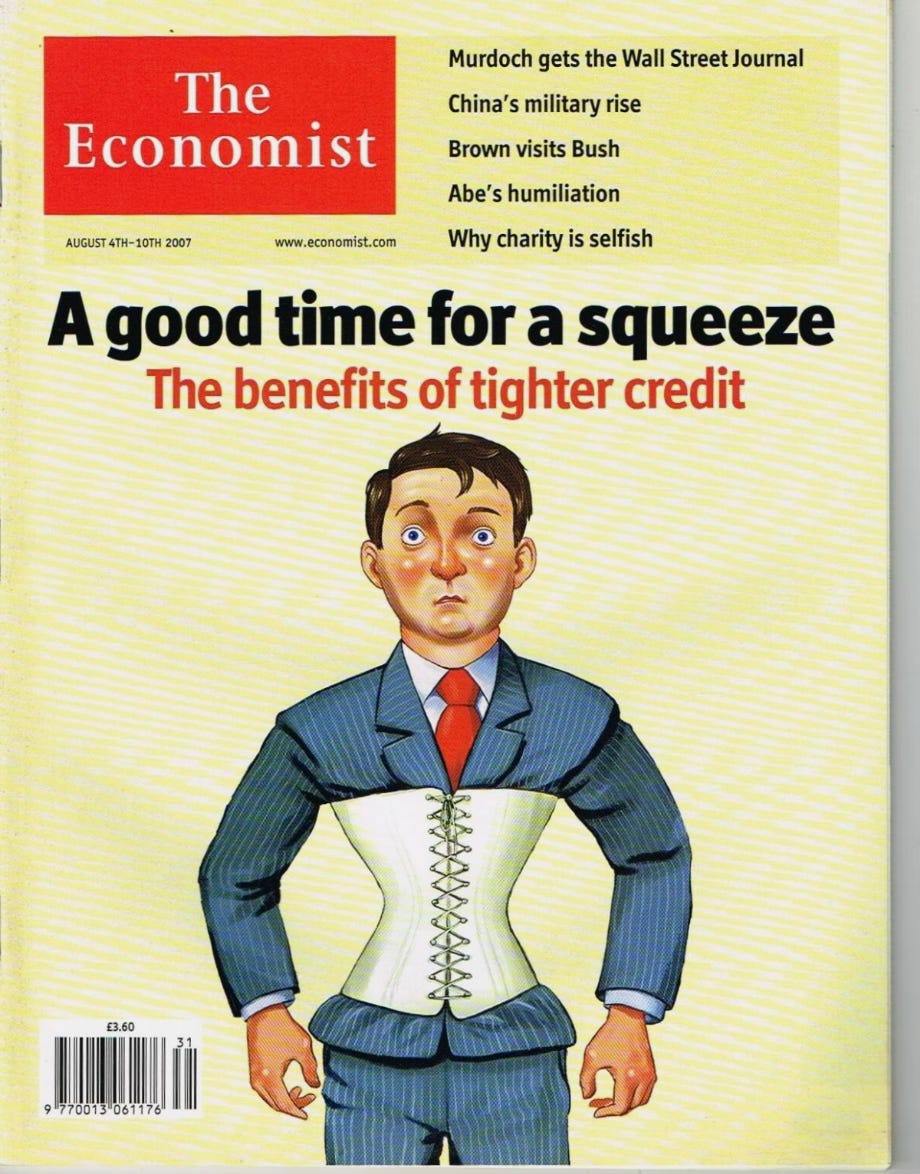
Back in 2007, in its edition for 4-10 August, the Economist’s editorial team shared that perspective.
They were optimistic and upbeat:
Economic fundamentals are all sound; it’s a good time for tighter credit conditions…
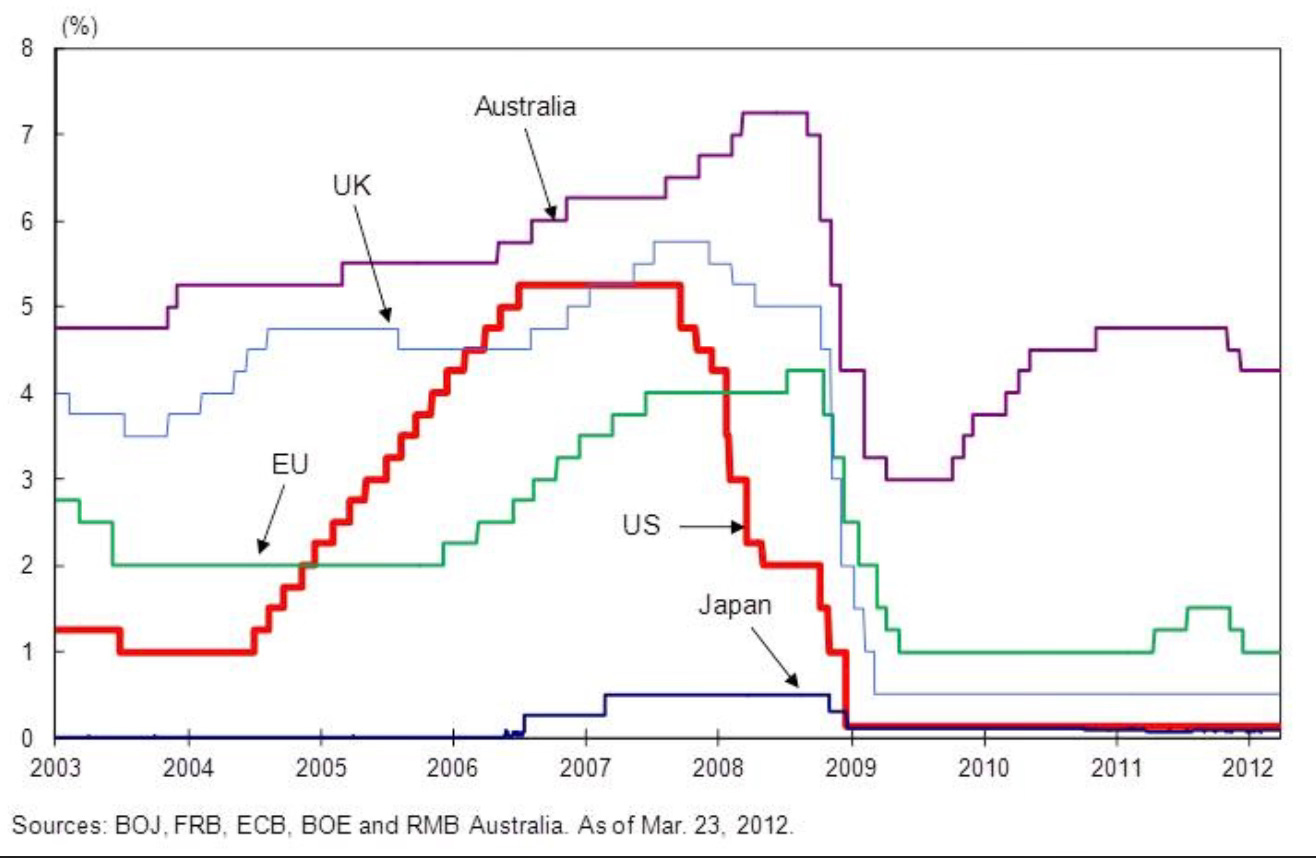
They were not alone. Alan Greenspan and the governors of the Federal Reserve were also tightening credit conditions. Richard Koo, Chief Economist, Nomura Research Institute presented the chart below to an INET conference in April 2012. The red line shows the systematic way in which ‘Maestro’ Alan Greenspan and the Federal Reserve’s Open Market Committee systematically raised interest rates against a vast bubble of US private, sub-prime debt – itself the consequence of ‘loose monetary policy’.
Those hikes were poised – like a dagger – at a debt mountain that was soon to implode and cause catastrophic global economic failure.
On 9th August, 2007 as the Economist magazine with its jolly cover of a technocrat in a corset hit newsagent shelves – inter-bank lending froze and gradually destruction was wrought across the global economy.
Economic fundamentals, it turned out, were not sound.
The power of the technocracy
Economic policies espoused by technocrats at the Economist, Harvard, the LSE and other universities as well as at central banks, had once again blown up the global economy. [In the next post I will share a list of financial crises dating back to 1866 triggered by central bank technocrats that chose to ratchet up interest rates at inappropriate times.]
Tighter monetary policies helped trigger the 2007-9 Global Financial Crisis. In Europe the European Central Bank made a ‘Big Mistake’ as the Global Financial Crisis broke, as James Surowiecki noted in the New Yorker
In July, 2008, on the eve of the biggest financial crisis in memory, the European Central Bank did something both predictable and stupid: it raised interest rates. The move was predictable because the E.C.B.’s president, Jean-Claude Trichet, was an inflation hawk; he worried about rising oil and food prices and saw a rate hike as a way of tamping them down. But the move was also remarkably ill timed. The crisis was already under way, European economic growth had slowed to a crawl, and within a couple of months the global economy had collapsed, inflation had disappeared, and the E.C.B. was forced to slash interest rates, in an attempt to avert economic disaster. That July rate hike was like kicking the economy when it was down.
To prevent further catastrophic failure, central bankers were forced to deploy public monetary and fiscal resources to bail out the entire private, shadow banking and globalised financial system.
Millions of the world’s people lost their homes, their jobs and their small businesses. Many thousands suffered marital breakdowns, depression, anguish and suicide. Wall Street, by contrast, was showered with financial rewards for failure. There was only a feeble attempt at re-regulating the system. Instead the globalised financial system was consolidated – with business-better-than-usual on Wall St.
Whereas before the crisis Wall St banks could be bankrupted – today they are too-big-to-fail and their bosses too-big-to-jail. In May, 2020 Jerome Powell in a CBS interview was asked by Scott Pelley: Has the Fed done all it can do?
Powell replied:
Well, there’s a lot more we can do. We’ve done what we can as we go. But I will say that we’re not out of ammunition by a long shot. No, there’s really no limit to what we can do with these lending programs that we have.
Wall Street took note.
The Global Financial Crisis and the role of Alan Greenspan’s Federal Reserve, both in fueling the crisis through deregulation and the expansion of shadow banking, and then precipitating the crisis with high rates on unsustainable levels of private debt, revealed that central bankers are not detached, objective technocrats, but powerful political actors, whose decisions favour the powerful, and hurt the weak.
Central Bank Independence
The effect of President Trump’s racist and crude attacks on both the governor of the Federal Reserve, and the only black member of the Board, Ms Lisa Cook, has been to galvanise defenders of central bank technocracy, who have rushed to to lionise the governor.
The Economistpromptly obliged with an article on of “the insidious threats to central bank independence” by “meddling politicians”. Andy Haldane – ex-chief economist of the Bank of England, took aim at ‘fiscal populism’ – by which is meant I assume, public political pressure. Haldane raised the scary bogey of ‘fiscal dominance’ which, he argued in the FT
poses an existential threat to central banks’ independence and inflation control. When monetary policy is set to meet fiscal ends, central banks become piggy banks.
Piggy banks for governments in place of piggy banks for the City of London and Wall Street?
Fiscal dominance’ Haldane wrote “is one in which governments’ budgetary needs begin to dictate monetary policy outcomes, either through direct financing of fiscal deficits or artificially low interest rates.” (My emphasis)
Interest rates are not “natural” and cannot therefore be “artificial”. Setting the central bank rate of interest is a political act in that the decision has distributive impacts. Creditors gain from high rates. Debtors – and there are millions of debtors – lose from high rates.
Haldane then declares that “we are in an era of fiscal laxity” – a polite way of attacking democratically elected finance ministers as profligate spendthrifts.
The automatic rise in public debt since both the GFC, and the COVID19 pandemic is a consequence of economic weakness and private sector failure. It is not caused by fiscal profligacy.
High levels of public debt, as Haldane well knows, are a response to private financial weakness and failure, leading to falls in private and public investment, falls in tax revenues, and a rise in public spending to compensate for losses brought on by the ‘polycrises’ of this era. Britain’s risk-averse private sector shows no real sign of investing and expanding economic activity. Nor is the private sector willing to rise to the huge challenges facing governments, including demographic change, climate breakdown and high levels of public and private debt.
If and when the private sector recovers (and it may take more public investment to spur on that recovery) incomes, tax revenues and economic activity will rise and public debt will fall. As night follows day.
Central bank ‘independence’
Trump’s vile attacks will invariably scare financial markets, weaken the US dollar and trigger dangerous volatility. He will then be forced to ‘chicken out’ and withdraw, allowing technocrats at the Fed to tighten control over the public monetary system.
Technocrats govern economies in almost every country of the world. Of the many ways in which this control is consolidated one is through the ideology of ‘central bank independence’ and another, the mantra: “there is no money” for the public sector.
The central bank is a public institution (in Britain it is a nationalised institution) whose staff are on the government’s payroll, and whose leaders are appointed by the government.
It is an institution that gains its power and authority from the economic activities of its citizens and from millions of taxpayers that by law are obliged to pour their taxes into the government’s treasury, stretching way into the future, and providing the Bank of England with extraordinary levels of ‘collateral’ .
That is why central banks cannot be divided from other public institutions, no matter how powerful the ideology of ‘independence’. For while the management of monetary policy is a challenging and difficult skill, requiring specialist economic and statistical expertise, nevertheless monetary and fiscal institutions must work in tandem to support the economy as a whole. When fiscal policy is contractionary, expansionary monetary policy can help make up the difference.
Today the Bank of England operates to undermine the UK treasury, as Professor Daniela Gabor explains:
The Bank is supposed to stay out of fiscal affairs. Yet its invisible hand is now depleting the Treasury coffers to boost commercial bank profits. This is the consequence of the institutional arrangement for quantitative easing, through the Asset Purchase Facility (APF) run by the Bank of England. Unique in the world, the APF has cost the UK Treasury around £38bn in 2023 and a projected £40bn in 2024. The Bank of England has projected that under the “optimistic” scenario, the Treasury will pay the APF around 110bn throughout a 2025-2030 government, and net costs could reach £230bn by 2033, beyond Labour’s wildest green spending dreams.
Technocrats and authoritarianism
The actions of central bank technocrats have always had consequences. The rise of authoritarianism is linked to the contraction of economies and the doubling down by officials of austerity policies. The GFC, the Eurozone debt crisis; the humiliation and disciplining of the PIIGs (Portugal,Spain and Greece) by technocrats at the ECB; the COVID19 pandemic, followed by another run on the shadow banking system and a massive central bank bailout of Wall St., and the City of London. Finally, the application of “tighter credit conditions” as the cost-of-living-crisis bit deep into the world’s economies.
Throughout these crises technocratic central bankers have stood aloof: deaf to growing public anger and despair. Blind to the rise of authoritarianism.
06/07/2024. London, United Kingdom. Prime Minister Keir Starmer holds his first press conference at 10 Downing Street. Picture by Simon Dawson / No 10 Downing Street
As Labour embraces anti-migrant rhetoric, Jeremy Corbyn argues that the government is demonising vulnerable people to distract from its domestic failures.
I have visited Calais many times. On each occasion, I learn more about the meaning of human resilience. Having fled the horrors of war, environmental disaster and destitution, refugees in Calais have gone through hell in search of a place of safety. Upon arrival, their search goes on. Children beg for water, contaminated by faeces. Rats scurry into people’s muddied tents. Mothers cry for the futures their sons and daughters could have had. Evictions are carried out daily by the French authorities; tents, blankets, identity papers, mobile phones, clothes and medicines are confiscated or destroyed.
Those who arrive on our shores are not ‘boat people’. They are human beings, exercising their legal right to asylum. As Warsan Shire writes in her poem Home, ‘no one puts their children in a boat unless the water is safer than the land.’ Imagine living in the conditions I’ve described. Imagine, then, risking your life to make it across the Channel. And imagine ending up in a hotel, looking out the window, and seeing a crowd of people shouting at you to ‘go home’.
In the last month, we’ve witnessed a series of protests outside hotels that are being used to accommodate asylum seekers. Among the protestors were placards reading ‘mass deportations now’, a call that Reform UK’s Nigel Farage has now echoed. Many of us have seen the harrowing images in the United States of people being snatched off the streets by officers. It is, frankly, terrifying to think that such authoritarian cruelty could soon be coming to the UK.
How on earth did we get here? I’ll tell you how: a Labour government that has spent the past year stoking hatred, division and fear. It has been utterly sickening to see Labour post video footage of migrants being detained and deported — a propaganda campaign that Donald Trump would be proud of.
Equally sickening was the sight of police officers having to escort a Deliveroo driver, who was being surrounded by anti-asylum protests, just weeks after the government singled out ‘illegal’ food delivery couriers for deportation. Instead of demonising delivery drivers who may or may not be asylum seekers, why not give asylum seekers the right to work so they can support themselves and contribute to society? Analysis shows that this could bring in £1.3 billion a year and add £1.6 billion to the UK’s annual GDP.
Scapegoating vulnerable people has always been a deliberate ploy by the government to distract from its own domestic failures. Today, it might be asylum seekers. Tomorrow, it could be disabled people. The next day, trans people. Whatever the minority, we are witnessing the demonisation of vulnerable people, to the grave detriment of us all.
The great dividers want you to believe that the problems in our society are caused by minorities. They’re not. They’re caused by a rigged economic system that protects the interests of the super-rich. That’s why 4.5 million children live in poverty. That’s why people’s water bills continue to rise. That’s why tenants in private sector flats are paying well over half their take-home pay to keep a roof over their head.
Labour strategists will tell you that they have no choice but to lean into anti-migrant sentiment to stop the rise of Reform. How’s that working out? Labour could have made the case for a humane immigration system that treats refugees with dignity and respect. Instead, they have fanned the flames of racism and emboldened the far-right up and down the country. When you demonise migrants, the far-right listen. When you post video footage of detaining and deporting migrants, the far-right watch. When you speak of an ‘island of strangers’, the far-right mobilise.
These are not signs of a party reluctantly adopting an electoral strategy. These are signs of a party actively embracing the growth of far-right populism, no matter the electoral cost. These are signs of a country on a slippery slope to fascism. This term should not be used lightly. Many acts are terrifying enough on their own terms without warranting that label. But beware, fascism doesn’t arrive in uniform overnight. It arrives with suited politicians, one piece of legislation at a time.
Indeed, the demonisation of minorities is part of a much wider, full-scale assault on human rights. When the government proscribed Palestine Action, for example, they did not just erode the right to oppose genocide here and now. They set a dangerous precedent, giving confidence to any incoming government that they too could strip away the right to protest in the blink of an eye. Labour is not just appeasing Reform. It is laying out the red carpet, passing dangerous legislation that will be harnessed by those seeking to destroy our rights.
We are at a critical juncture. We need an alternative, now. That’s why we have launched yourparty.uk — and that’s why more than 700,000 have already signed up. We are going to do things differently. We are not going to scapegoat refugees for the ills of society. Instead, we will focus our attention on the real cause: a grotesquely unequal society that concentrates wealth in the hands of the few.
We will not just defend the human rights of refugees. We will defend the human rights of all. That includes disabled people and their right to live in dignity. That includes children in poverty being denied their right to food and clothing. That includes trans people, who face horrific discrimination, hatred, and abuse just for living their lives; trans people are human beings who deserve to live in safety, dignity, and freedom. We must be united against oppression and prejudice in all its forms — and that is what we will be.
Look around you, and you will find proof that a kinder world is possible. From what we see across most of our media, you’d think that there is a consensus that refugees aren’t welcome. This could not be further from the truth. ‘I think we should take care of people who are struggling or that need help.’ That’s what one young woman said in response to protestors in her community in Epping. I speak to people like her every day — ordinary people who support, befriend and reach out to asylum seekers as fellow human beings.
The Prime Minister speaks of an island of strangers. He ignores the kindness of strangers. And that is what gives me hope that, together, we can build a kinder world for all. Email
Jeremy Corbyn is a British politician who served as Leader of the Labour Party and Leader of the Opposition from 2015 to 2020. On the political left of the Labour Party, Corbyn describes himself as a socialist. He has been the Member of Parliament (MP) for Islington North since 1983. Formerly a Labour MP, he now sits as an independent.
Jeremy Corbyn Interview: Why We Launched Your Party
Owen Jones interviews Jeremy Corbyn on founding a new political party and the state of the world in 2025.
In Britain, Criminalizing Dissent Is an Imperial Strategy
Turkey and Israel have long called on their ally Britain to crack down on solidarity groups that threaten their imperial domination. Keir Starmer’s government is increasingly playing along.
Palestine Action activists scaled the rooftop of Elbit System’s client the Good Packing Company in protest of Israel’s airstrikes over Gaza on 8 August 2022
In August, over five hundred people were arrested at demonstrations opposing the British government’s recent decision to list direct-action group Palestine Action as a “terrorist organization.” Peaceful protesters mostly aged in their sixties and seventies were dragged away from the square in front of the Houses of Parliament for the alleged crime of holding placards expressing support for the organization, which was banned even despite its nonviolent tactics.
These unprecedented arrests have been called a “gross abuse of state power,” as participants highlight the overreach through which counterterrorism laws purportedly intended to protect British citizens are instead used to intimidate and jail them. But the arrests are just how imperialist state power is supposed to operate. “People are shocked [by the arrests], but it’s exactly how the law is meant to be used,” a spokesperson for campaign group Defend Our Juries (DOJ), which organized the protests, told Jacobin.
The Palestine Action arrests are just part of a broader strategy. Political diaspora communities and left-wing political movements in the UK face criminalization under what Amnesty International has called one of the world’s toughest anti-terrorism regimes, often due to influence by authoritarian foreign powers. For example, the UK’s highly criminalized Kurdish community experiences repeated detention and interrogation without the right to silence, terror sentences for holding Kurdish flags, and a recent raid on the London Kurdish Community Centre that culminated in the arrest of six community organizers on similarly trumped-up terrorism charges.
Draconian measures deployed against organizations and movements that have never posed a threat to UK citizens are a feature, not a bug, of the British government’s neo-imperialist strategy.
Neocolonial Strategy
Israel and Turkey have long been the UK and United States’ key intelligence and security partners in the Middle East, a role they exploit to safeguard their respective occupations of Palestine and Kurdistan. To understand how these geostrategic relationships relate to domestic repression in the UK, counterterrorism must be seen as an extension of earlier colonial approaches, feeding into Cold War strategies directed against communist and Third World movements. Drawing on racist notions of a civilizational threat to the West, imperial states have entrenched Western power through military intervention and intensive intelligence operations.
Throughout the Cold War, Israel worked hard to represent “terrorism” as irrational and illegitimate — a projectspearheaded by Benjamin Netanyahu himself at the Jonathan Institute, which he founded, naming it after his brother who died during a raid to recover hostages from a hijacking by Palestinian insurgents. The Jonathan Institute held two major conferences on the topic of “international terrorism” in Jerusalem and Washington in the 1970s and ’80s. Israeli politicians, military analysts, and academics represented the Palestinian liberation struggle as uniquely violent and dangerous, erasing the political reasoning behind armed struggle to demonize Palestinian political actors as inherently barbaric.
As Lisa Stampnitzky writes in Disciplining Terror, terrorism was no longer spoken about as criminality but rather as total irrationality. In an increasingly paranoid security landscape, political violence by anti-colonial nonstate actors came to be seen as an existential threat. By the end of the Cold War, these narratives had been fully embraced by US neoconservatives — and would reach their full power following the 9/11 attacks and the United States’ unilateral declaration of a global “war on terror.” Endlessly regurgitated by the ever-growing field of “security experts,” many of whom are employed by arms companies, the war on terror rhetoric also fueled enormous and lucrative growth in military and surveillance technologies.
Terrorists Everywhere
Israel has benefited from this reconceptualization of “terror” to quell global opposition to its genocide. “That ‘t’ word is scary. People think of the 7/7 [2005] London bombings or 9/11. But that’s not what Palestine Action ever was,” the DOJ spokesperson says.
Turkey has also played a crucial role in this process. Notably Ankara has worked hard to expand the war on terror beyond an Islamist threat, positioning regional liberation movements as globally significant “terrorist” actors. Turkey joined NATO in 1952 and has played a linchpin role in entrenching US power across the region ever since, acting initially as a counterweight to Soviet power and subsequently as an enforcer of US interests.
Throughout the Cold War, the United States invested heavily in developing a secretive CIA-led counterinsurgency project in Turkey, specifically targeting left-wing and Kurdish movements. US military support for Turkey has grown year over year since the 1960s. To this day, Turkey commands the second-largest armed forces in NATO and hosts crucial US nuclear assets. Still, the relationship between Turkey and the United States involves more friction than Israeli-US collaboration, and Turkish politicians have spent several decades lobbying for international recognition of Kurdish insurgency as a global terrorist threat. This rhetoric also intensified following 9/11, with Turkish politicians castigating Western powers for not taking Kurdish “terrorism” seriously enough and arguing that the war on terror can only succeed if it combats political violence everywhere — not just that which poses a direct threat to the US.
The result is a political stalemate. The United States, UK, and other Western governments frequently treat support for Palestinian or Kurdish liberation as illegitimate violence outside acceptable political norms, thus shutting down channels for peaceful, political, and nonviolent opposition. Both Turkey and Israel have used the counterterrorism infrastructure of the post-9/11 era to entrench their own positions as part of this supposed “West” threatened by “terrorist” violence. Further, they have strengthened their material relationships with Western allies, deepening intelligence collaboration and receiving increasing military aid from the US while condemning whole populations to permanent criminalization and occupation.
Legal Sledgehammer
The UK’s Terrorism Act was passed in 2000 — already suggesting this power cannot be viewed as a knee-jerk response to post-9/11 counterterror hysteria. “The Terrorism Act is not fit for purpose,” the DOJ spokesperson says. “It’s meant to protect the public from acts of terrorism, but now it’s protecting corporate and foreign state interests.”
While the original act primarily proscribed Islamist groups, it also included the Kurdistan Workers’ Party (PKK), alongside other secular and leftist groups engaged in regional and national liberation struggles, largely based on reasoning derived from secret intelligence. From the outset, laws marketed to the UK public as guaranteeing its “safety” against terrorist attacks have been used to target other secular, national-liberation struggles — rather as the Palestine Action listing was parceled up with the listing of a neo-Nazi fringe organization called “Maniacs Murder Cult” to help push the decision through Parliament.
This has sometimes left the Kurdish movement in a farcical position. For one, the UK admits it does not consider the PKK a threat to British national security. “UK security data shows that even PKK sympathizers in the UK have not engaged in violence there, yet political interests override legal realities,” says Seyid Pirsus of the UK Kurdish Assembly’s Diplomacy Committee. More than that, the PKK itself partnered with the United States to rescue the Yezidi religious minority from genocide at the hands of ISIS, while the PKK’s Syrian affiliates remain allied with the US and UK as part of their ongoing campaign against the Islamic State. UK prosecutors have repeatedly attempted to bring cases against UK nationals joining the fight against ISIS. A judge overseeing one such case stated he was “uneasy” over the prosecution of so-called “acts of terrorism . . . carried out with the support of the RAF [Royal Air Force].” In this case, the Terrorism Act was seemingly used directly against UK security interests.
“On the morning of the raid, myself and another one of the now defendants had been invited to meet the minister for the Middle East at the Foreign Office for a commemoration of Yezidi women murdered by ISIS,” one defendant in the ongoing terror case against Kurdish community organizers in London tells Jacobin:
Instead, that same morning, I was in solitary confinement, being called a “terrorist” by a group of police interrogators. [Kurds] are allies when we enhance their image of defending human rights and “terrorists” when [the UK’s] security partnership with Turkey is becoming more lucrative.
These apparent contradictions make sense once the act is understood not as a neutral piece of legislation open to potential abuse but rather as a sledgehammer in the UK’s neo-imperialist toolkit. It furnishes the UK with a uniquely wide-ranging set of powers used not only to fragment domestic opposition and international solidarity but also to strengthen relationships with its authoritarian partners in the Middle East, while also gathering intelligence on their behalf.
Even as the courts fill up, UK police tactics long deployed against the Kurdish community are used to further repression and surveillance without even needing to proffer a justification for arrest. This includes the “Schedule 7” prerogative, which grants police and border officers the power to interrogate individuals without the right to silence and force access to their phones on pain of a jail sentence. This can be coupled with other repressive measures including stripping individuals of their bank accounts or the imposition of European travel bans on UK nationals to create a broader climate of suppression and surveillance.
“Demanding Kurdish linguistic and cultural rights is met with state violence, both in Turkey and in the UK,” the Kurdish defendant says. “Growing up in London, I saw my community being consistently targeted with raids, arrests, and surveillance, echoing the ways in which the Turkish state has criminalized Kurds for over a century.”
The New War on Terror
In the immediate future, these trends look set to continue. Even as the UK doubles down on its support for Israel, Tel Aviv has threatened to withdraw its intelligence cooperation with the UK over the possibility of British recognition for the Palestinian state. It’s a further reminder of how the West’s authoritarian regional partners advance their own agendas under cover of the UK’s neo-imperialist interests.
The current Turkish government has publicly trumpeted its opposition to Israel’s genocide in Gaza but is thus also seeking ways to reassert its indispensability to Western interests. In particular, like Tel Aviv, Ankara presents itself as a key Western partner against Iran. A general reduction in the United States’ boots-on-the-ground presence in the Middle East will mean increased reliance on Turkey and Israel to further the West’s agenda, in turn enabling both states to demand further concessions from the UK and the US.
Arms companies can profit at both ends of this relationship, perpetuating the Middle East’s forever wars to sell more weapons, while pushing for repression of the protests that have been particularly effective in targeting the military-industrial complex’s UK assets. The Palestine Action proscription came after protesters successfully targeted RAF planes with graffiti. The grubby revelation that a British Army chief successfully lobbied for the group to be proscribed on behalf of his new employers in the US defense industry should come as no surprise.
Similarly, UK Kurdish activists believe their detention and repression often track to freshly inked arms deals between Westminster and Ankara. “Whenever the UK has expectations from Turkey, pressure on the Kurdish diaspora tends to increase, in a pattern repeated over forty years,” Pirsus says, pointing to a meeting between UK foreign secretary David Lammy and his Turkish counterpart in the run-up to the UK Kurdish Community Centre raid. The two NATO partners have just signed a fresh, multibillion-pound fighter plane deal, suggesting more repression lies ahead.
These complex, converging agendas mean well-intentioned moral appeals over the apparent abuse of the UK’s counterterror laws are unlikely to stem the tide. Certainly the Palestine Action proscription and broader anti-genocide movement has catalyzed important coordination between religious, trade union, and other political movements, but this coordination will itself inspire further-reaching repression. “It’s not going to end with Palestine Action,” the DOJ spokesperson suggests. “If [far-right UK political party] Reform comes into power, we will see Greenpeace proscribed [and] trade unions proscribed.”
The Parliament Square protesters were dragged away under the gaze of a statue of Nelson Mandela, who was slandered as a terrorist by a series of British governments before he was elevated to his latter-day status as a human rights icon. The sculpture offers a physical reminder that the “terror” label is never really about protecting the British public — but always deployed to reinforce the continued imperialist commitments of UK foreign policy.
Palestine solidarity
What if Genoa wasn’t an anomaly?
Friday 5 September 2025, by Marco Bertorello The large mobilization for the Global Sumud Flotilla is a barometer of the social climate. And it tells us that there is still room for humanity.
What happened in Genoa in recent days was something rather anomalous, not to say exceptional. A growing movement of international solidarity began with the collection of food supplies and culminated on Saturday evening with a huge march accompanying the departure of the four boats that will participate in the Global Sumud Flotilla. It will attempt to bring humanitarian aid to Gaza and break its isolation.
This is a very partial, immediate account of what happened in my city, which I believe is worth reflecting on. Music for Peace (MfP) is an association that has been collecting food and aid in general for years for people in conflict zones, from Palestine to Sudan, to mention perhaps the most significant, and for the city’s poor. It decided to participate in the flotilla by collecting food aid. Together with MfP, among the first promoters were the dockworkers of Calp (Collettivo autonomo lavoratori portuali, Autonomous Collective of Port Workers). After years of protests against Saudi ships passing through to bring weapons for the war in Yemen, the recent actions against the Chinese ship that was supposed to deliver war material to Israel and yet another Saudi ship, represented a quantum leap.
In both cases, in fact, the dockworkers, with growing public interest, managed to prevent the passage of weapons through the port. That same attention has grown exponentially in recent days. After the MfP appeal to collect 40 tons of food to send to Gaza, the city mobilized in an way we have not seen for some time. Trade unions, neighbourhood committees, associations, scouts, sports clubs, and many individual citizens queued up in front of the Music for Peace headquarters. The collected material reached nearly 300 tons, so much so that the promoters had to call a stop because there was no more space to store the food. Some of the volunteers who showed up to pack and load the food were turned away because there were too many of them and they were getting in the way.
In this climate of growing mobilization, the Saturday evening march took place at 9 p.m. on a Saturday at the end of August. The police said there were about 40,000 people. The city now has less than 570,000 inhabitants. It was a size that I had not seen in Genoa since the G8 summit almost 25 years ago. It was a mix of citizens of all generations, with a rather low average age, which is rare for an old city like Genoa. The organizers had asked people to bring only Palestinian flags. Peace flags were spontaneously added to these. An almost futile appeal: what other flags could represent this people at the moment?
At the end of the march, a former member of parliament from the Democratic Party said: “If this demonstration had been organized by the PD and CGIL, there would have been two hundred of us.” Maybe not two hundred, but perhaps not more than a 1,000.
The mixture of spontaneity and grassroots organization was evident. The decisive factors in such a large mobilization was the concrete goal of aid, as well as the political aim of truly contesting a genocide that too few recognize. People who had not taken to the streets in a long time, chanted “Free Palestine” and sang “Bella ciao.” There were many improvised signs, which were accurate and ironic, as often happens when a mobilization is widespread among large sections of the population. It was a huge march for Genoa, which tells us what had been brewing for some time, at least on this issue, and of the desire or willingness to return together to the streets, to protest, to mobilize in the flesh.
This was a procession with an unusual route. Starting from the MfP headquarters, it went along the elevated road, which is always closed to pedestrians, and arrived at the old port. In the distance, higher up, where trains emerge from two long tunnels, train drivers sounded their horns to greet the demonstrators. On the other side, by the sea, the dockworkers of the GNV shipping group, having finished their evening shift loading ferries, greeted them with their horns. In short, there was a widespread atmosphere of support, which reminded me of the support received in Corso Torino and Corso Sardegna during the last G8 march, the one following the clashes that had set those very streets ablaze. I recall the surprising show of support from the residents who threw water from their windows to cool the demonstrators during those scorching and tragic days of July 2001.
The epicenter these days, however, has been the MfP headquarters, a place between Sampierdarena and the city centre. A place surrounded by traffic, workshops by day and prostitutes by night, now dominated by the arrival of the superstore Esselunga. place that, in its (r)existence A place that, in its (re)existence as a social space within a busy traffic junction, has managed to attract thousands of people from all over the city.
It was impressive to see so many people gathered in such an unusual place. MfP has been organizing its parties there for years, but Saturday’s turnout was undeniably higher than usual.
The march, here is a video, ended in the Old Port, in front of the boats ready to depart. There were many speeches behind a giant Palestinian flag hoisted on the masts of the boats. The audience was large, despite the late hour and the long walk. Among the most appreciated was that of the main animator of Music for Peace, Stefano Rebora, his voice worn out from the fatigue of the last few days. He was followed by port historian Riccardo Rudino, who announced that if the action in support of the Palestinian people is hindered, then the dockworkers will not only block weapons for Israel, but will block everything destined for that country. [1] Mayor Silvia Salis emphasized that a city awarded a gold medal for the Resistance cannot fail to support those who resist.
The representative of the Genoese Curia spoke about how, since the G8 summit in this city, people believe that another world is possible. The finale was left to the artist Pietro Morello, who asked everyone not to remain silent and invited them to sing Bella ciao one last time. Finally, the boats departed, announced by fireworks set off by the Calp dockworkers and followed by an excited and grateful crowd who watched them sail away as far as they could see.
I am writing this article not only because I am excited (you can tell, right?), but precisely because I don’t get excited easily. I think it was an important moment for my city. I don’t know what it might mean for the future and for other cities, but it seems to me to be a possible barometer of the social climate. I hope it is not just a passing anomaly. In difficult times, there is always room for the unexpected, the surprising - in short, for humanity.
1 September 2025
Translated for International Viewpoint by Dave Kellaway from Jacobin Italia.
Marco Bertorello works in the port of Genoa, contributes to Il Manifesto, and is the author of essays on economics, currency, and debt, including Non c’è euro che tenga (Alegre, 2014) and, with Danilo Corradi, Capitalismo tossico (Alegre, 2011) and Lo strano caso del debito italiano (Alegre, 2023).
International Viewpoint is published under the responsibility of the Bureau of the Fourth International. Signed articles do not necessarily reflect editorial policy. Articles can be reprinted with acknowledgement, and a live link if possible.
 The European Central Bank tower in 2016. (European Central Bank / Flickr)