A week into Trump’s illegal war against Iran, the White House released a 42-second video on X, featuring movie scenes spliced with real military footage of strikes in Iran, promising “justice, the American way.” Rather than sober statements about national security or the grim human realities of war, the March 5 video resembled a movie trailer.
The clips stitched together real footage of missile strikes with pop-culture heroes: Russell Crowe in Gladiator, Tom Cruise in Top Gun: Maverick, Robert Downey Jr.’s Iron Man, Keanu Reeves’ relentless assassin in the John Wick films. Even SpongeBob SquarePants made an appearance. The video was immediately mocked for reflecting the militaristic fantasies of teenage boys (see Hegseth, Pete), more than that of the US starting a war.
The editing followed a familiar formula: a heroic movie quote, a dramatic cut to real explosions, then a video-game style victory sound. War, apparently, has become content. Actor Ben Stiller publicly demanded the removal of a Tropic Thunder clip, used without permission, stating, “War is not a movie.”
The controversy over these videos isn’t only about taste or messaging. It’s about something deeper: the way American political culture still equates masculinity with domination and violence. When leaders celebrate military strikes using action-movie heroes and gaming tropes, they reinforce one of the oldest myths about manhood—that men’s strength is proven by crushing enemies.
Criticism of the videos continues for trivializing violence. Coverage from Reuters described them as part of a broader “meme war,” blending Hollywood imagery and gaming culture with real military action.
For generations, boys have been raised on stories where one’s manhood is proven through violence. Movies, video games, and political rhetoric repeat the same narrative: the male hero defeats the enemy through superior power. What do these videos reveal about the way masculinity is still defined in 21st century America?
In this framing, restraint looks weak. Empathy looks soft. Diplomacy looks naïve. Real men strike back.
Really!? A quarter of the way through the new century, the slow, steady gains of an international movement to redefine masculinity still remain beneath the radar.
The White House videos used Hollywood mythology to bolster its geopolitical messaging. Consider the imagery: Maximus in Gladiator embodies righteous vengeance. Maverick in Top Gun represents fearless individualism. Tony Stark’s Iron Man combines technological power with swaggering bravado. The assassin played by Keanu Reeves in John Wick eliminates enemies with unstoppable efficiency.
Psychologist Mary L. Trump—Donald Trump’s niece—has written about how fragile masculinity often masks deep insecurity. In her book Too Much and Never Enough, she describes a family culture in which vulnerability was treated as weakness and domination became the only acceptable form of strength. That dynamic doesn’t stay confined to one family. It echoes through political culture.
When leaders, almost always white and male, celebrate explosions with movie quotes and gaming sound effects, they reinforce a version of masculinity that sees empathy as weakness and violence as proof of strength.
This culture carries real consequences. The overwhelming majority of violence worldwide—from mass shootings to domestic abuse to war—is committed by men. Researchers who study masculinity point to rigid expectations that equate manhood with dominance and emotional suppression.
When political leaders celebrate military violence using the imagery of hypermasculine fictional heroes, they reinforce those expectations rather than challenge them. What’s the message for our sons and grandsons?
Consider what’s missing from the videos: no civilians running from falling bombs. No grieving families. No returning veterans struggling with trauma. War is no longer presented as solemn or ethically complex; it is packaged like a video game. If a podcaster promoted that, we’d be outraged. That our government is doing so demonstrates just how morally bankrupt the Trump administration is.
War appears not as tragedy, but as spectacle.
Across the country—and around the world—men are challenging the old patriarchal script. They are often choosing caregiving over breadwinning, confronting sexism rather than ignoring it, and working to prevent violence in their communities.
Their courage doesn’t appear in action-movie montages, yet it may be far more important. Because the real challenge facing our society isn’t simply defeating enemies abroad; it’s transforming manhood at home.
If we want a safer, more humane world, boys must learn that real courage isn’t measured by explosions or victory screens. It’s measured by the ability to protect life, show compassion, and reject violence—even in a culture that socializes you to believe violence is what makes you a man.
Rob Okun (robokun50@gmail.com), syndicated by PeaceVoice, is editor emeritus of Voice Male, which has long chronicled the profeminist men’s movement. The magazine is now published by the Canadian NGO, Next Gen Men.
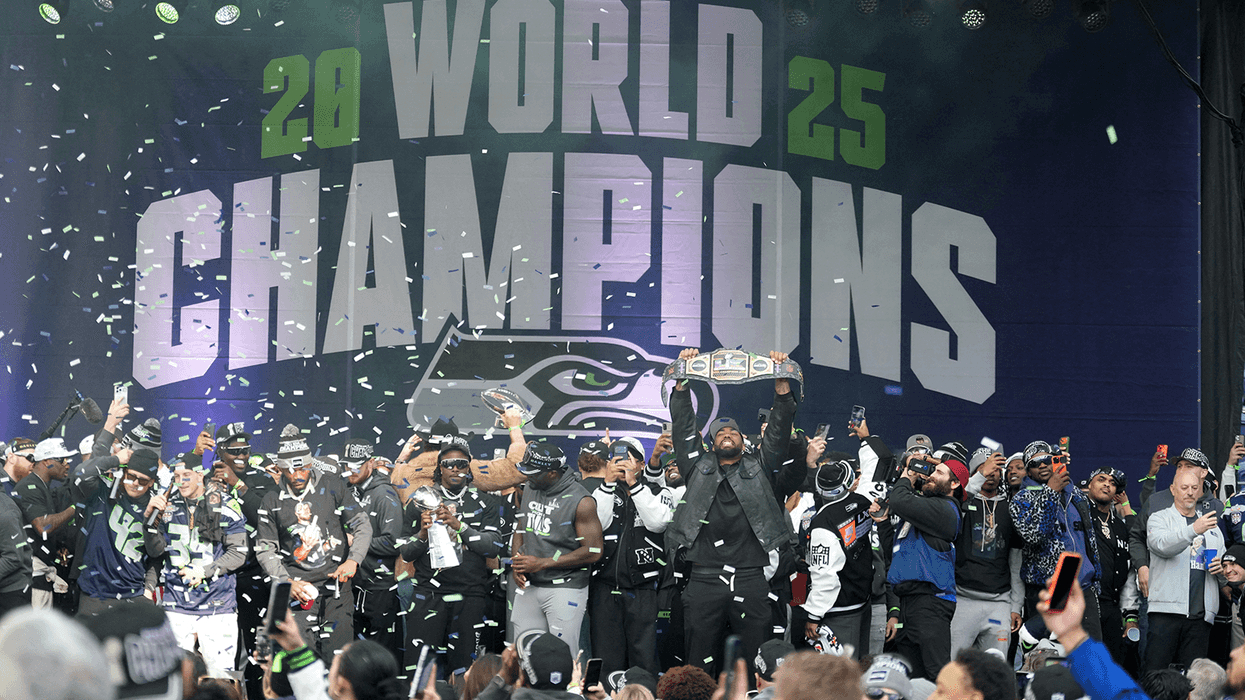
Feb 11, 2026; Seattle, WA, USA; Seattle Seahawks players react during the Super Bowl LX trophy celebration at Lumen Field. Mandatory
The Washington Post spoke to several players featured in a White House created clip that began circulating last week on X. They expressed disgust that their athletic achievements were used to illustrate bombing human beings.
The Trump administration has a long history of using clips and songs to illustrate its points, often despite the objections of the people who created or are depicted in them.
The WaPo cited a recent montage using war movie clips with bits from Ben Stiller's film, “Tropic Thunder,” with Stiller responding that he had “no interest in being part of your propaganda machine.”
In the football clips recently released, Kenny Bell of the University of Nebraska was pictured delivering a block that de-cleated a Wisconsin player during the 2012 Big Ten title game.
Bell, now 34, said he was “disgusted” to be part of the montage, which used music from AC/DC’s song “Thunderstruck” as its soundtrack.
“For that play to be associated with bombing human beings makes me sick,” Bell told The Washington Post. “I don’t want anything to do with images like that.”
The clip was still online as of Thursday morning and has garnered 10 million views on X. The NFL, which is usually aggressive in its protection of its intellectual property, did not respond to the Post's request for comment.
Others depicted in the clip include retired linebacker Ray Lewis and safeties Ed Reed and Kam Chancellor. So far, Reed posted his dismay on X. “I do not approve this message.”
Mason Foster, a former Tampa Bay Buccaneers linebacker, was depicted crashing into a receiver during a preseason game in 2011. That’s followed by a bomb that explodes on a rocky landscape in Iran.
Foster told The Post he was shocked after he was sent the video.
“I’m at a loss for words,” Foster said this week. “It’s a strange feeling, seeing those clips like that. I don’t think anything going on in the world today is as simple as a great football play or a hit. I’m still wrapping my head around it.
“When people are losing their lives, I don’t think it can compare to a game," Foster added.
Bell and Foster both said they want the White House to remove the video.The rightsholders, including the NFL, should use the courts if they don’t, they said.
The White House declined to comment to The Post on the players’ concerns.
Removal may not be easy. Rebecca Tushnet, a First Amendment professor at Harvard Law School, said courts “have historically been hesitant to let copyright owners assert infringement in political ads and political speech,” usually opting for the “fair use” doctrine.
“The argument here seems to be: Sports and killing people are fun things that Americans are good at," Tushnet said. "That is, although repulsive, an argument.”

The White House released a new AI video to promote the war in Iran, depicting the people of Iran as bowling pins and President Donald Trump as the bowling ball.
Adam Boulton, a presenter at Times Radio, called the clip the "most shocking video yet," noting that "MAGA isn't impressed."
"On 28 February at least 168 people, most of them schoolgirls, were killed in an air strike at Shajareh Tayyebeh girls’ primary school in Minab, Iran," he began.
At first, the administration tried to claim that it was Iran who fired the Tomahawk missiles on the school, doing a "double tap" when there were survivors.
“We think it was done by Iran, because they’re very inaccurate with their munitions,” Trump said on March 1.
Iran doesn't have Tomahawk missiles. The U.S. does.
CNN broadcast images of parts of the weapons used on Wednesday, making it very clear that the weapons that hit the school were, indeed, American
Overnight, the official White House account posted a meme video that Boulton said demonstrates "once again the puerile, callous attitude of the administration to this conflict."
"The Iranians are portrayed as angry cartoon bowling pins, marching across a desert brandishing Kalashnikovs and a placard insisting 'We won’t stop making nuclear weapons!'" he wrote in the column. An American bowling hero then throws his ball at the pins with the Lynyrd Skynyrd song "Free Bird" playing in the background. The word "Strike" flashes on the screen like a cartoon. They then cut to the bomb strikes from the U.S. on Iran.
"Just in case you couldn’t believe what you were seeing, the final slate signs off: 'THE WHITE HOUSE President Donald J. Trump,'" Boulton added.
The writer believes that Trump is growing increasingly angry that his own supporters aren't lining up to support his new war. Trump spent 2024 promoting his "America First" agenda and saying that he would end wars, not start new ones. Once entering office, he justified smaller attacks, like the intervention in Venezuela, by saying that his new "Don-roe Doctrine" is to prioritize the Western Hemisphere. Iran doesn't even fit that characterization.
"The bowling meme video, however, doubles down on the Trump administration’s macho, gung-ho approach to his war, epitomised by the boastfully self-styled 'Secretary of War' Pete Hegseth" Boulton continued. "Sure enough, bearing the brunt of Trump’s anger at those who are fleeing from him is a woman: Marjorie Taylor Greene."
New numbers show that MAGA is hemorrhaging women from the coalition it used to win in 2024.
“‘Make America Great Again’ was supposed to be America first, not Israel first, not any foreign country first, not any foreign people first,” Greene said when speaking to The Megyn Kelly Show a few weeks ago.
While Trump tries to turn the war into "flippant online thrills [...] reality is biting," Boulton writes.

No comments:
Post a Comment