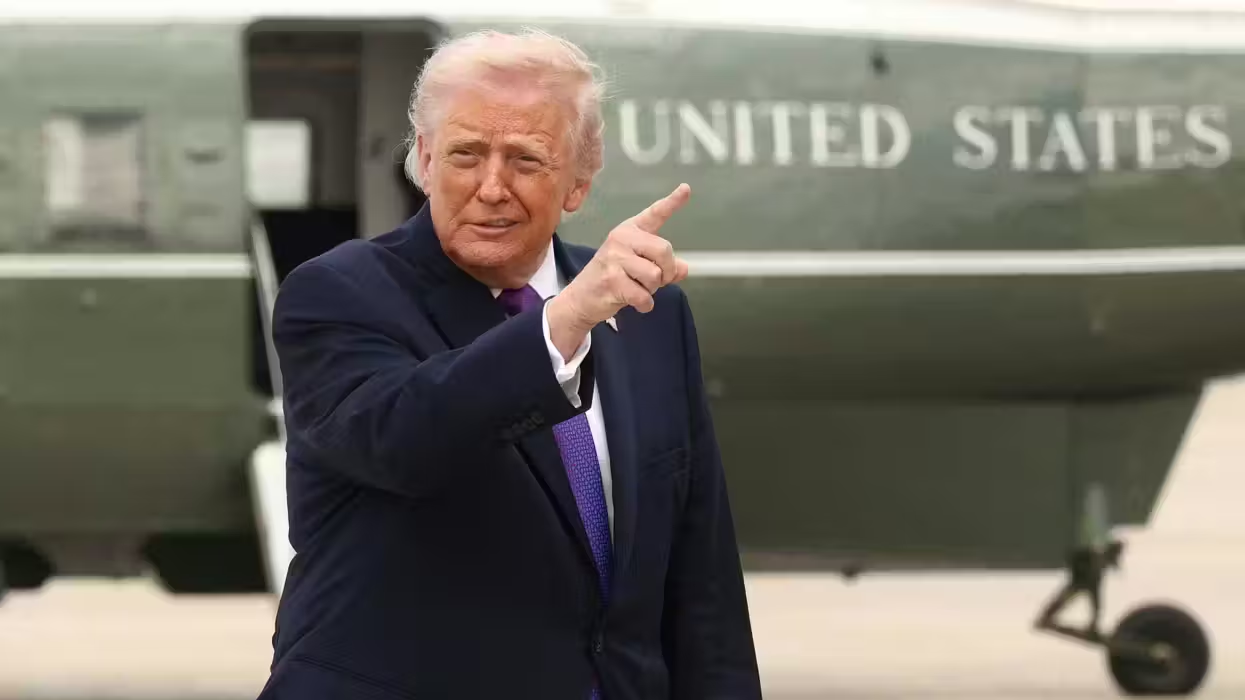
U.S. President Donald Trump gestures at Joint Base Andrews in Maryland, U.S., March 11, 2026. REUTERS/Kevin Lamarque
March 12, 2026
COMMON DREAMS
During an interview with Axios reporter Barak Ravid on Wednesday, March 11, U.S. President Donald Trump insisted that "the war is going great in Iran." But Trump's claim that Operation Epic Fury is a raging success is drawing a lot of pushback.
Sen. Chris Murphy (D-Connecticut), during a March 12 appearance on MS NOW's "Morning Joe," described the war as an "epic disaster" that has "gone off the rails" by spreading to a long list of Middle Eastern countries and resulting in Iran installing a new leader, Mojtaba Khamenei — who, Murphy warned, is even more of a Islamist hardliner than his father, the late Ayatollah Ali Khamenei. And according to The New Republic's Greg Sargent, a "preliminary military report finds that the U.S. was behind the bombing of an Iranian nursery school, killing scores of children."
In an episode of The New Republic's podcast "The Daily Blast" posted on March 12, host Sargent discussed these "brutal revelations" and "damning leaks" with Elizabeth N. Saunders — a political science professor at Columbia University in New York City. And they laid out a variety of ways in which the war in Iran is going from bad to worse.
Saunders, who examined the conflict's effects — from rising oil prices to Iranian military strikes all over the Middle East — in a March 9 article for Good Authority, told Sargent, "So basically, this mess is like turning off the spigot that controls 20 percent of the world's oil flow. It's like you have running water, and then, it's 20 percent less — and it's all because of this choke point in the Strait of Hormuz. The supply is going down and that sends the price of oil up. And it's not like a normal oil shock where the Saudis or OPEC can get together and restart production, because these tankers are stuck inside the Persian Gulf. And the Gulf states have already filled up their storage tanks, so they have to shut down the oil fields, which are not easy to restart."
Saunders continued, "This is one of those shocks that is going to be very hard to get back to any sort of status quo before the war. There's also no end in sight…. You now basically have 20 percent of the world's oil flow held hostage, essentially, by Iran."
Referencing reporting in the New York Times, Sargent lamented that the "crisis" in the Middle East "is putting the U.S. in a bad spot" because "we can't extricate ourselves."
Saunders told Sargent, "We have lost, at Trump and (Secretary of State) Marco Rubio's hand, a huge amount of our diplomatic capacity. We do not have the expertise in the region. We don't have the ambassadors in post in the region…. There's fallout from this terrible strike on the school that looks to be an error. I do believe it wasn't intentional, although the way Trump has handled it has been pretty horrifying. But that will also have raised some concerns and sensitivities in the region — not just in Iran. It's horrific."
The Columbia University political scientist argued that the Trump administration's response to the school tragedy in Iran is only making things worse.
Saunders told Sargent, "On the school — it's a horrendous tragedy, and not to minimize it in the slightest — I do think mistakes happen in war, and this is a particularly brutal and tragic mistake because it involves young, innocent schoolchildren. It makes me shudder every time I even think about it. But as with any situation like this, it's how you handle it afterwards that really is also very important. Not only is he not trying to mitigate the fallout — he's pouring fuel on the fire by implying somehow it was Iran that got Tomahawks. But where would they have gotten the Tomahawks from? It makes no sense."
During an interview with Axios reporter Barak Ravid on Wednesday, March 11, U.S. President Donald Trump insisted that "the war is going great in Iran." But Trump's claim that Operation Epic Fury is a raging success is drawing a lot of pushback.
Sen. Chris Murphy (D-Connecticut), during a March 12 appearance on MS NOW's "Morning Joe," described the war as an "epic disaster" that has "gone off the rails" by spreading to a long list of Middle Eastern countries and resulting in Iran installing a new leader, Mojtaba Khamenei — who, Murphy warned, is even more of a Islamist hardliner than his father, the late Ayatollah Ali Khamenei. And according to The New Republic's Greg Sargent, a "preliminary military report finds that the U.S. was behind the bombing of an Iranian nursery school, killing scores of children."
In an episode of The New Republic's podcast "The Daily Blast" posted on March 12, host Sargent discussed these "brutal revelations" and "damning leaks" with Elizabeth N. Saunders — a political science professor at Columbia University in New York City. And they laid out a variety of ways in which the war in Iran is going from bad to worse.
Saunders, who examined the conflict's effects — from rising oil prices to Iranian military strikes all over the Middle East — in a March 9 article for Good Authority, told Sargent, "So basically, this mess is like turning off the spigot that controls 20 percent of the world's oil flow. It's like you have running water, and then, it's 20 percent less — and it's all because of this choke point in the Strait of Hormuz. The supply is going down and that sends the price of oil up. And it's not like a normal oil shock where the Saudis or OPEC can get together and restart production, because these tankers are stuck inside the Persian Gulf. And the Gulf states have already filled up their storage tanks, so they have to shut down the oil fields, which are not easy to restart."
Saunders continued, "This is one of those shocks that is going to be very hard to get back to any sort of status quo before the war. There's also no end in sight…. You now basically have 20 percent of the world's oil flow held hostage, essentially, by Iran."
Referencing reporting in the New York Times, Sargent lamented that the "crisis" in the Middle East "is putting the U.S. in a bad spot" because "we can't extricate ourselves."
Saunders told Sargent, "We have lost, at Trump and (Secretary of State) Marco Rubio's hand, a huge amount of our diplomatic capacity. We do not have the expertise in the region. We don't have the ambassadors in post in the region…. There's fallout from this terrible strike on the school that looks to be an error. I do believe it wasn't intentional, although the way Trump has handled it has been pretty horrifying. But that will also have raised some concerns and sensitivities in the region — not just in Iran. It's horrific."
The Columbia University political scientist argued that the Trump administration's response to the school tragedy in Iran is only making things worse.
Saunders told Sargent, "On the school — it's a horrendous tragedy, and not to minimize it in the slightest — I do think mistakes happen in war, and this is a particularly brutal and tragic mistake because it involves young, innocent schoolchildren. It makes me shudder every time I even think about it. But as with any situation like this, it's how you handle it afterwards that really is also very important. Not only is he not trying to mitigate the fallout — he's pouring fuel on the fire by implying somehow it was Iran that got Tomahawks. But where would they have gotten the Tomahawks from? It makes no sense."
Trump sparks revolt among MAGA supporters
Alex Henderson
Alex Henderson
March 12, 2026
ALTERNET
Former Rep. Marjorie Taylor Greene (R-Georgia) went from being an aggressive cheerleader for President Donald Trump to being an outspoken critic, arguing that his interventionist foreign policy is a betrayal of his "America First" platform of 2024. And she isn't the only person on the right who feels like way. Libertarian Rep. Thomas Massie (R-Kentucky) also believes that Trump, with his intervention in Venezuela and Iran, has turned his back on the "America First" platform.
In an op-ed published by The Independent in the U.K. on March 12, Ameer Kotecha, a former diplomat, observes that in March 2026, Trump finds himself at odds with his MAGA agenda of the past — especially with the war in Iran.
"There is a good argument that Trump has already torpedoed his foreign policy legacy — and undermined his reputation as the president who would avoid dragging America into forever wars," Kotecha writes. "For there have always been tensions between Trump's America First isolationism and his willingness to intervene assertively abroad. The common thread has arguably been foreign policy as a means to secure commercial advantage and economic gain for Americans back home. For a president whose overseas deal-making and transactionalism have always been framed as serving MAGA's ends, this particular war presents particular risks. So far, the economic impact looks to be all disruption with little sign of upside."
Trump, according to Kotecha, now needs to "defend his actions to MAGA."
"If the U.S. does get pulled into a wider and more sustained campaign," Kotecha says, "it could torch not only the message that Trump ran on, but the story that he likes to tell about himself. There is perhaps a consolation for Trump in all this. If MAGA don't forgive him, Trump can claim to have put the national security of his country and the civilized world over electoral gain."
Former Rep. Marjorie Taylor Greene (R-Georgia) went from being an aggressive cheerleader for President Donald Trump to being an outspoken critic, arguing that his interventionist foreign policy is a betrayal of his "America First" platform of 2024. And she isn't the only person on the right who feels like way. Libertarian Rep. Thomas Massie (R-Kentucky) also believes that Trump, with his intervention in Venezuela and Iran, has turned his back on the "America First" platform.
In an op-ed published by The Independent in the U.K. on March 12, Ameer Kotecha, a former diplomat, observes that in March 2026, Trump finds himself at odds with his MAGA agenda of the past — especially with the war in Iran.
"There is a good argument that Trump has already torpedoed his foreign policy legacy — and undermined his reputation as the president who would avoid dragging America into forever wars," Kotecha writes. "For there have always been tensions between Trump's America First isolationism and his willingness to intervene assertively abroad. The common thread has arguably been foreign policy as a means to secure commercial advantage and economic gain for Americans back home. For a president whose overseas deal-making and transactionalism have always been framed as serving MAGA's ends, this particular war presents particular risks. So far, the economic impact looks to be all disruption with little sign of upside."
Trump, according to Kotecha, now needs to "defend his actions to MAGA."
"If the U.S. does get pulled into a wider and more sustained campaign," Kotecha says, "it could torch not only the message that Trump ran on, but the story that he likes to tell about himself. There is perhaps a consolation for Trump in all this. If MAGA don't forgive him, Trump can claim to have put the national security of his country and the civilized world over electoral gain."

No comments:
Post a Comment