Sunday, September 07, 2025

Veiled Vengeance: From the Death Penalty to the Gaza Genocide


 September 5, 2025

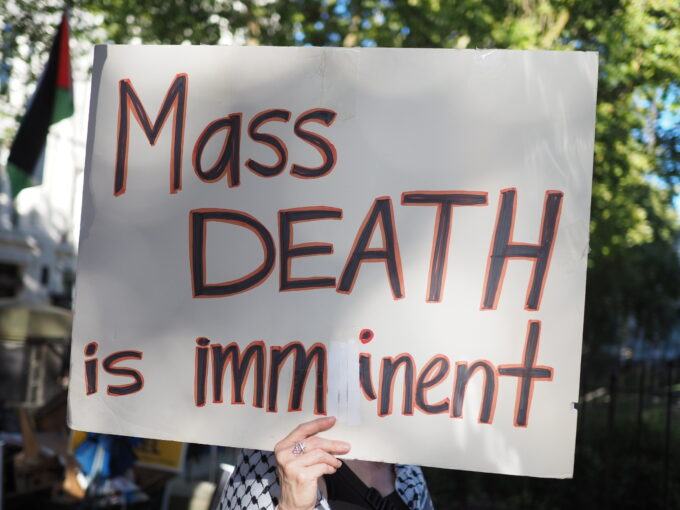
Photograph by Nathaniel St. Clair

Vengeance.

It undeniably infects human affairs.

Parents observe it as their toddlers navigate playground dynamics: one child hits another; the other strikes back. Domestic feuds and old grudges can metastasize into jealousy, schadenfreude, and—if unchecked—retaliation. Belligerent drivers trigger micro-aggressions that can morph into road rage. In the extreme, assault and murder seem to beg for a commensurate response. Intentional harm breeds reciprocal foul. Whether on unabashed display or buried deeply beneath the surface, this base retributive impulse is potent, stealthy, and addictive—a perfect storm for inciting reactive violence. Society, to its peril, severely underestimates its capacity to do irrevocable damage.

Communally, this tit for tat unfolds with lethal consequences. Laws and government policies deftly conceal and enable the visceral thirst for vengeance through various forms of state-sponsored killing. This phenomenon particularly underpins two contemporary polarizing issues: the death penalty and the Gaza genocide. As the famed television personality and death penalty abolitionist Rev. Fred Rogers articulated, any form of the revenge model teaches children the patently hazardous lesson that two wrongs make a right. His wisdom rings true in both these cases.

The urge for retribution is insidious and subtle, often rendering it unrecognizable. It clouds objectivity, stifling judgment and self-awareness. It camouflages as false notions of “deterrence,” “public safety and security,” “justice,” a “Biblical mandate,” and “a lasting peace,” among other rationalizations. Many individuals and societies, therefore, vehemently deny any accusations of vengeful motivation—even for genocide—while unsuspectedly succumbing to its irresistible call.

The Shadow of the Holocaust

I should know. I once unwittingly operated under revenge’s cunning spell. As a third-generation Holocaust survivor, I used to experience the natural desire for vengeance against those who murdered my ancestors in cold blood. For years, that overpowering feeling contributed to my support of capital punishment. If I could not carry out that reprisal with my own hands, then I felt the state should do so by proxy against other murderers. “They should take ‘em out back and shoot ‘em,” some family suggested; “eye for an eye,” the Bible reinforced.

I was not alone among Jews in the wake of the Shoah (Holocaust) who harbored such feelings. Many certainly overcame rage and the urge for recompense, notably Elie WieselMartin BuberHannah ArendtGershom ScholemAlbert Einstein, and Eva Mozes Kor. Other survivors and descendants like me held on to the pain and anger that grew from direct and intergenerational trauma.

A personal experience as recently as 2008 illuminated this reality for me. I was watching Mark Herman’s film adaptation of John Boyne’s fictional Holocaust novel “The Boy in the Striped Pajamas” alongside a child survivor who was also a respected friend. In the climactic scene, the Nazis accidentally gassed to death a concentration camp commandant’s young son, who had befriended the film’s eponymous character. When the bereaved SS officer wept and screamed in agony upon discovering his child among the dead, my friend responded by flatly stating, “Good. Now they know how it feels.” In that fleeting moment, after watching a charged movie that so vividly portrayed the suffering of my ancestors, I agreed. While revenge was neither blissful nor sweet, for those few seconds, it felt bitterly just. Even after that emotion departed from my heart, how could I judge my friend for seeking to avenge his family members whom he had witnessed the Nazis murder, especially when I myself could identify with his reaction? We were only human, after all, living in the shadow of the wholesale mass murder of our people.

Unveiling Vengeance on Death Row

My vengeful impulse shifted later that same year when I started working as a Jewish prison chaplain in Canada with individuals whose convictions would have rendered them eligible for execution in certain United States jurisdictions. I learned what motivated those men and women to commit monstrous crimes, and I saw that many changed over time. They were not inherently evil. On the contrary, many began engaging in sincere repentance while safely incarcerated and no longer a threat to the public.

As I witnessed these human beings transform, so too did my views. My prison experiences unveiled my unconscious bias toward retribution, and I began to see it more clearly for what it was: an understandable wish for payback. In part to help break the cycle of violence into which I was born—and that I had been inadvertently perpetuating—I decided to launch into activism for death penalty abolition.

Since then, as an ordained cantor and co-founder of “L’chaim! Jews Against the Death Penalty,” I have directly communicated for years with scores of condemned Americans— many now executed—as well as some of their victims’ loved ones. I have experienced the impact of government policies that shroud the collective appetite for vengeance in the form of psychologically and physically torturous state-sponsored executions. This pattern invariably repeats, even when murder victims’ family membersexpressly call for mercy. That tragically familiar scene unfurled again just this past week ahead of the United States’ most recent execution of Curtis Windom in Florida, whose governor predictably dismissed all such protests before he put him to death. As before, a political leader submitted to the will of death penalty advocates, many of whom harbor the mentality of “the more suffering, the better,” no matter if the existing execution methods of lethal injection, gassing, and the firing squad are unconscionable Nazi legacies.

Wielding Revenge in Gaza

A similar yearning to fulfill a deep-seated bloodlust has significantly influenced the Israeli government’s response to Hamas’ October 7, 2023, onslaught and the ongoing hostage crisis. That pogrom constituted the deadliest mass killing of Jews since the Holocaust, and the triggering of that historical memory and intergenerational trauma combined with the sheer devastation of the Hamas attack to create an unprecedented stimulus for violent response. Many have understood the incalculable brutality of that unjustifiable act of terrorism by observing that it, too, was in part a vengeful response to decades of suffering that Palestinians have endured since Israel’s 1948 independence, to which much of the Muslim world refers as the Nakba (“catastrophe.”) Since that unfathomable day nearly two years ago, Israeli hostage family members have increasingly demanded that government officials call for a ceasefire in Gaza to bring home their loved ones. Yet, the state has persisted in catering to hardliners who, motivated by vindictive extremism combined with Messianicreligious fundamentalism, use the excuse of Hamas recalcitrance to justify carrying out a genocidal policy of mass killing, destruction of societal infrastructure, and starvation. Pope Leo XIV rightfully labeled the outcome “collective punishment.” The effect strikingly evokes capital punishment, whose “machinery of death” so often overrides the wishes of murder victims’ families.

The terrorist organization Hamas, well-versed in revenge dynamics, strategically releases horrific videos of suffering and emaciated Israeli hostages such as Evyatar David and Rom Braslavski with the intention of stirring the popular bloodlust. On cue, Machiavellian and megalomaniacalleaders like Benjamin Netanyahu and convicted felon Donald J. Trump bow to the will of the riled hoi polloi so that they might hold onto power. Israel, in turn, continues its campaign of obliterating tens of thousands of innocent civilians who become martyrs, thereby playing directly into Hamas’ hands. Meanwhile, my coreligionists who are unable to see beyond vengeance’s capped lens project displaced anger onto those of us who dare to name the genocide that Israel’s government perpetuates.

Let there be no doubt: there is a time for fighting—even killing—to fend off lethal aggressors. The Axis Powers during the Second World War immediately come to mind, among many other examples. In the current human evolutionary phase, nations consequently must maintain strong militaries. Still, there is a time for even the most just wars to end, lest they cross the thin red line into unleashing a disproportionate force that cloaks collective punishment, as the Gaza genocide confirms.

Causality is complex, rarely reducible to a single point. As with any military conflict, multiple other geopolitical and historical factors are at play in the spiraling tempest that is Israel/Palestine. Likewise, various political considerations unrelated to the lex talionis psyche determine a state’s utilization of capital punishment. The carnal drive for vengeance, however, remains integral to both execution chamber protocols and to the policies that have buried countless emaciated children in the Gaza rubble. Neither would exist without the primitive urge of the revenge response that has propelled the cycle of violence and plagued humanity since time immemorial. Restorative justice practices, including harm acknowledgment, repentancerepair, forgiveness, and reconciliation, are the only viable means of breaking this fatal pattern.

“May the killings end.”

It will require vigilance to transcend the insidious fixation on vengeance, but it is indeed possible. Jewish anti-death penalty activism offers one telling model for achieving this. Traditional rabbinic parlance cites a specific posthumous honorific for murder victims who have died as martyrs, particularly in pogroms, genocide, or terrorist attacks. The acronym it adds after each martyr’s name is “HYD,” which derives from the Hebrew letters Hey-Yud-Dalet (×”×™״ד) and stands for “Hashem yikom damam” (”May G-d avenge their blood.”) Members of the “L’chaim!” (”To Life!”) death penalty abolitionist group, however, intentionally never invoke this vindictive formula when they pray for capital murder victims at execution vigils for their condemned assailants. In its place, without exception, they employ the more common refrain “Zichronam Livracha” (”May their memories be for a blessing”). They then conclude with the following prayerful intention for the murder victims:

May their abiding neshamot (spirits) be loving guides for us all.

May their loved ones be comforted among all the mourners of the world.

May no more blood be shed in their sacred names.

May the killings end.

So may it be for the tens of thousands of victims of both the October 7, 2023, barbarity and the resulting Gaza genocide, as well as all targets of vengeful acts—however veiled.

A version of this essay was first published in The Jurist.

ORIGIN OF SOCIAISM OR BARBARISM


REPLACE THE STATE!

Sasha Davis

 September 5, 2025

Image by Hassan Kibwana.

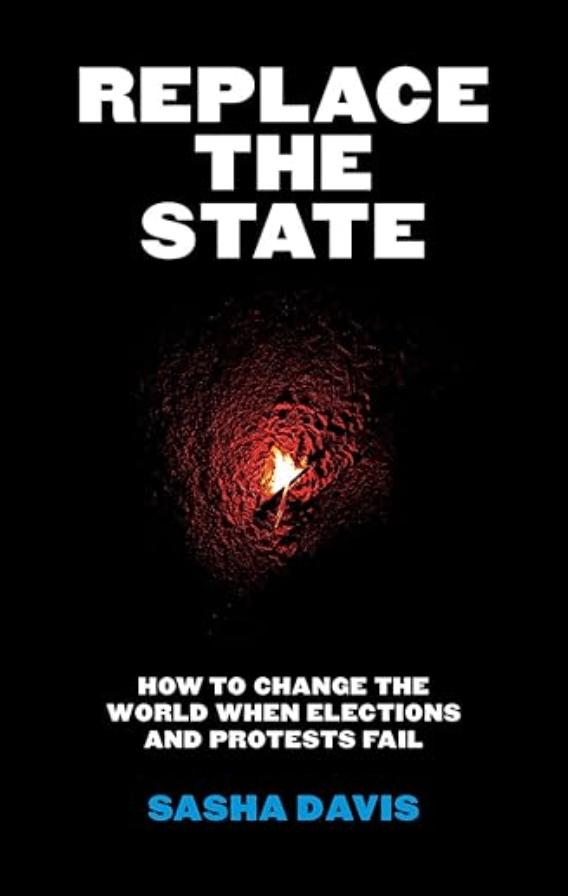
My new book is now out. Replace the State: How to Change the World When Elections and Protests Fail is available now direct from the University of Minnesota Press, Bookshop.org, your local bookstore, or anywhere you buy books. The paperback is $20. The book’s official publication date is August 5, but the distributor has it now and folks who pre-ordered already have their hard copies. It’s nice to see it out in the world!

I wrote this book with the hope that it would be useful for confronting the political challenges we’d be facing when it was published. I confess that as I was continually revising this book over the past several years and shopping it around to different publishers, I had a nagging fear that the book would come out ‘too late’ and no longer be relevant to the urgent political tasks confronting us when it was published. I had to tell myself that it was a book worth writing, even if some of the analyses and suggestions didn’t exactly match the moment when it would see the light of day. One thing I can say today for certain, however, is that this I think the book does speak to the current moment – perhaps depressingly so. As I see more people in despair that traditional techniques for social change have been ineffective, I think that this book has come out at exactly the right time.

In the book, I examine different political tactics that folks use in settings where there has never been much hope that elections or protests are going to protect people’s rights or improve their lives. The examples I draw upon come from colonized, occupied, and marginalized communities (inside the U.S. and outside) where people have long had no real political power, voice, or representation within a federal government that rules over them. These are contexts where folks have rarely had any illusions the state cares about them at all.

There have always been places and people under U.S. sovereign control that have had no ability (or severely restricted ability) to affect policy and governance – think of Puerto Rico, Indigenous lands, people under 18, people without formal citizenship or who have had their voting rights revoked. There are also more informal ways in which all of our political wills have been limited: the disproportionate influence by the rich over legislation due to corporate campaign donations and lobbying, corrupt (or non-existent) primary processes for major political party nominees, gerrymandering, and so on. These restrictions on our political agency have always been there, but today they are expanding even further. In our current situation, techniques for creating social change which may have been somewhat successful at creating minor reforms in the past (like elections and protests), are becoming less and less effective as oligarchical control tightens and authoritarian practices override former democratic norms.

Put simply, more and more of us find ourselves in the place where we have no practical access through the ‘formal channels’ to meaningfully influence the governance we live under. The U.S. government increasingly follows the dictates of a very small class of the wealthy and connected whose values and priorities are completely out of whack with the rest of us. Simultaneously, the government structure is becoming almost impervious to calls by the majority to run the country in ways that actually benefit most of the people living in it. This has gotten worse under Trump, but the pattern long predates him. This book is therefore not an argument in favor of one political party or another. It is instead a deeper critique of long running political processes we need to transform.

What is the value of this book in the current political moment?

When I was finishing the writing for this book, I wasn’t sure who would win the November 2024 election. I did however know one thing: people were likely to be dissatisfied with the result. I think it was predictable that after the election, regardless of the outcome, the U.S. government would turn a deaf ear to people advocating for more meaningful change. Now that we are being smacked in the face by the dangerous police state shitshow that is U.S. politics in 2025, it should be clear to everyone we need to think about different ways to create genuine and effective political influence so we can protect ourselves, our communities, and the environments on which we depend.

The government may be getting completely out of the business of protecting human well-being (by shredding the social safety net, decimating public education, slashing health care access and research, transferring more wealth to the ultra-rich, and supercharging its apparatuses of police surveillance and repression), but let’s face it, the state was only tangentially interested in human well-being before this year. The primary functions of this government have long been to facilitate the ability of capitalist firms to accumulate profits and to protect the unequal property relations of the class of people who set it up (i.e. not you).

While the state may be against most of us, this book emphasizes that is no reason to fall into political paralysis or despair. After all, the state has rarely cared much about human security. Thankfully the state is absolutely not the only institution or scale where we can exert political will and enact different ways of governing ourselves. People enact positive social practices outside the state all the time, and, in this age, we need to do it even more. This book discusses how we can do this – and why we should.

I created this book to be a resource that could shed light not just on histories of political repression, but on the stories of successful and innovative projects aimed at transforming our political relationships with each other and the environments which sustain us. More importantly, I wanted this book to be a resource that could help start conversations about how we can assert our own power and make life better now – whether the government wants us to or not.

I want people to see past the mistaken assumption that the state is the only place where politics happen. We can do things in our communities now that not only model what could be, but which create the structures and practices that can bring change at grander scales. In short, we can develop alternatives that supplant the horrors of the governance being practiced by the existing state.

Now that the book is out, I plan to turn more to local organizing in my own community and to doing talks, interviews, and meetings wherever folks are interested in learning more about these approaches to activism and political transformation. I think these approaches are going to be crucial in the months and years to come as we all try to fight for a different future than the very dark one the government wants for us. Hope to see you out there.

Sasha Davis writes about how to create positive social change – even when elections and protests don’t work. He received a PhD from Penn State. His research focuses on social movements, politics, and environmental issues in the Americas, the Pacific, and Asia. His latest book is Replace the State: How to Change the World When Elections and Protests FailYou can follow his Substack here.

Donald Trump’s Media Domination


 September 5, 2025

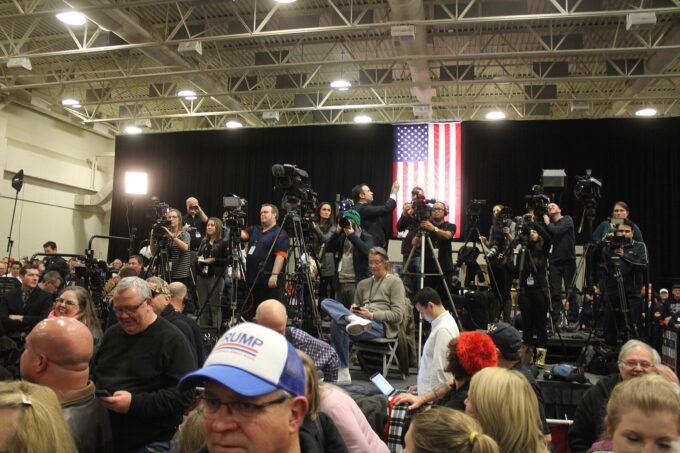
Photograph Source: Matt Johnson – CC BY 2.0

These days when I’m asked how I’m doing, I usually reply, “I’m fine until I start following the news.” It’s all so depressing. Donald Trump is everywhere. On front pages as well as in social media, DJT dominates. A day doesn’t go by without headlines mentioning something involving Trump. Tariffs? Attacks on the Federal Reserve or some other congressionally established institution? ICE? A recent court ruling for or against him? His Nobel Peace Prize quest? One could ask if his omnipresence is intentional. Does he set out to dominate the 24/7 news cycle or is his presence merely a reflection of his frenetic pace? “Attention, not cash, is the form of power that most interests him,” Ezra Klein wrote in the Times. Whether intentional or not, his media presence buries deeper stories. He diverts our attention from anything else. 

Trump stories appear, then quickly disappear. Today’s headlines have their own limited time cycle. We are now focused on Trump’s firings at the Centers for Disease Control and Prevention (CDC) and the fate of Susan Monarez as well as pressure on Jerome Powell and Lisa Cook at the Federal Reserve. What will be next? Will the next Trump headline bury the CDC story or the one about the Federal Reserve? Already we have trouble finding information about what happened to the U.S. Institute of Peace where its president, George Moose, was escorted out by local police. 

Like an avalanche, Trump news gathers speed and buries everything in its path only to pop up in another place. It’s exhausting, and overwhelming. As for intentionality, the former Trump chief adviser Steve Bannon described the strategy in 2018, “The real opposition is the media. And the way to deal with them is to flood the zone with shit.” 

I asked a former CNN executive if true journalism is over with Trump’s domination. This is his response:

“Those believing journalism is on its last legs are mistaken. Certain people will always seek out information from reliable sources. There’s the catch: the seekers are fewer and fewer. There are also fewer and fewer reliable sources, some thriving, others fading away.

It’s true that media houses are distancing themselves from news output. The priority for executives is keeping the cash flowing. Venture capitalists and hedge funders have no interest in sending money to newsrooms. Crypto and AI is far more interesting. Sure, those products may be nothing more than 21st Century buggy whips and hula hoops, but buyers are lined up.

Some observers wax prolific about a declining audience for journalism. The more experienced know the true importance of readers, viewers and listeners who remain supportive of media outlets as opposed to those needing an hourly dose of celebrity, glamor or hate. Some media proprietors have made the lowest common denominator their choice.”

The former CNN executive is optimistic about the future of media, although he has seen and lived through several media outlets disappearing. There are those of us who do believe in fact-based media outlets. But are we enough to keep the media ship afloat? A recent story by David D. Kirkpatrick on “How much is Trump profiting off the Presidency?” in The New Yorker is an excellent example of the kind of long-term reporting that is needed. 

But there is a difference between longer articles in a weekly magazine – even The New Yorker now has a New Yorker Daily – and the 24/7 news cycle which feeds “an hourly dose of celebrity, glamor or hate.” DJT and his people have been able to appeal to a sizeable audience. “We want our news, and we want it now” is the current reality. The 24/7 news cycle gives instantaneous satisfaction; Trump fulfils that need. 

This is how the former CNN executive sees Trump’s relation to the media:

“Donald Trump was chosen by Robert Thomson, chief executive of News Corp. Mr. Thomson understands the media business better than all the rest. Mr. Thomson found a true believer in the power of television with highly addicted viewers, typically those offended by smart people. This was – still is – the Fox audience. The money flowed in from cable TV subscriptions and advertisers selling cheap goods.”

The relationship between Trump and the media is perfectly symmetrical. He wants to be front page every day. The media believes he sells. The result is that the public gets its dose of Trump news daily. So whether or not Trump sets out to headline the daily news, he manages to be there. The media can’t get enough of him – witness Maggie Haberman’s ongoing fascination with DJT in the Times. Nor is this something new. An Axios graphic in September, 2017, showed “The insane news cycle of Trump’s presidency in 1 chart.” 

How to get out of Trump’s dominated news? “How do you push back against a tidal wave?” political communication expert Dannagal Young asked. Besides retreating to some island with no connections, I began an experiment. At social gatherings I count the minutes before the conversation turns to Trump. Talk about the hot weather and climate change? An interesting movie or song that just came out? A book that’s worth suggesting to others? See how long it takes before the subject turns to Trump.

I’m not saying that Trump should be ignored. What I am suggesting is that his media domination is part of his personality and program. Being front and center is essential to who he is and how he functions. “[Trump’s] desire for that attention is so deep, it’s coming from such a deep place, he needs it so pathologically,” observed Chris Hayes, author of The Sirens’ Call: How Attention Became the World’s Most Endangered Resource.  

Ignoring Trump may be one way of countering him and what he stands for. But I cannot promise not to read about him or write about him. What he is doing to the United States and the world cannot be ignored, and that’s not Maggie Haberman-like fascination. 


Daniel Warner is the author of An Ethic of Responsibility in International Relations. (Lynne Rienner). He lives in Geneva.