Saturday, September 20, 2025


Novartis chief eyes ways to end higher US drug prices: media


Geneva (AFP) – Amid a threat of towering US tariffs, Swiss pharmaceutical giant Novartis is seeking ways to enable Americans to pay less for their medicines, its chief said in an interview published Saturday.


Issued on: 20/09/2025 - FRANCE24

Novartis already announced in April that it plans to invest $23 billion in the United States over five years © Fabrice COFFRINI / A

Vasant Narasimhan told the Swiss daily Neue Zurcher Zeitung (NZZ) that his company was "working to eliminate the price gap between the US and other industrialised countries".

"We are working with the government and trying to find constructive solutions so that Americans pay less for their medicines," he told the Swiss daily.

While pharmaceutical products have been spared so far from the tariffs Washington has slapped on its trading partners, US President Donald Trump has threatened to hit the entire sector with tariffs of as much as 250 percent if drug prices do not drop.

Narasimhan suggested it made sense to bring down US prices.


"It is a fact that American patients pay for a large part of the innovations," he acknowledged to the NZZ, insisting that "countries outside the US will have to contribute a larger share in the future".

Pharmaceutical companies are meanwhile facing massive pressure from the Trump administration to move production to the United States.

Novartis already announced in April that it plans to invest $23 billion in the United States over five years.

The goal was "to manufacture the most important products for the American market locally", he said, adding that it would "probably take three to four years to get there".

But he estimated the company could "make significant shifts within the next two years", including carrying out some of the final filling and packaging in the United States.

These efforts, he said, should allow Novartis to weather the situation if pharmaceuticals are hit with the same tariffs Washington has already slapped on other exports from the European countries where it has most of its production.

Washington is currently taxing imports from the EU at 15 percent and from Switzerland at 39 percent.

Novartis's rapid US expansion "should allow us to fully mitigate any tariffs", Narasimhan said.

The company was "more concerned about the tariffs for the entire industry", he acknowledged.

Narasimhan said he was not worried about finding enough workers to staff Novartis's new US factories, anticipating that massive pharmaceutical industry investment pledges would boost the US education system to turn out more specialists.

He added that many pharmaceutical factory processes were "fully automated".

"We only need a total of 1,000 to 1,500 additional workers to operate our planned new factories in the US," he said.

"That's manageable."

© 2025 AFP
Malawi's future hangs in the balance after Trump funding cuts

Issued on: 19/09/2025 - 

From the show


Malawi has been one of the countries hit hardest by the Trump administration's funding cuts and tariff hikes. The stop-work orders issued by Washington in January have frozen several of the country’s key sectors, including health, education and infrastructure. As Malawians vote in the 2025 presidential elections, FRANCE 24 embarks on a journey across the country to assess just how much US policies have impacted one of Africa’s poorest nations. Tom Canetti, Caroline Dumay and Stefan Carstens report.


Malawi is one of the poorest countries in Africa, with 70 percent of the population living below the international poverty line. It is therefore heavily dependent on foreign aid. Over 13 percent of Malawi’s national budget came from the United States – a country that slashed such funding in January after US President Donald Trump took office.

The funding cuts have devastated key sectors, especially those supported by the United Nations and non-governmental organisations. Malawi’s overcrowded Dzaleka Refugee Camp is on the verge of collapse. Clinics serving the LGBT community have shut down or are operating with skeleton staff. Researchers have had their scholarships terminated overnight. Meanwhile, Malawi’s exporters have been hit with US tariffs that make their products uncompetitive.

During the 2025 presidential election campaign, FRANCE 24’s Tom Canetti, Caroline Dumay, and Stefan Carstens spoke with Malawians left isolated in an Africa that has had to adapt overnight to a more self-sufficient reality.


By 

By Reid Standish


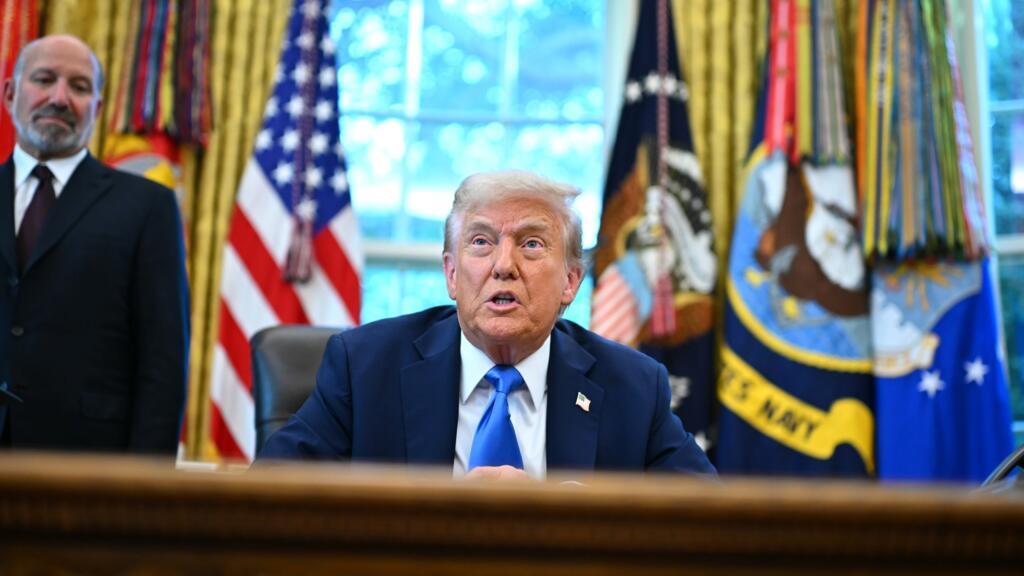
(RFE/RL) — US President Donald Trump said that he wants Bagram air base in Afghanistan returned to US control, in a move that could reignite American involvement in the country and the strategic asset that was lost during the chaotic Western withdrawal four years ago.

Speaking alongside UK Prime Minister Keir Starmer on September 18, Trump suggested that his administration was negotiating with the Taliban for US forces to once again occupy the base outside of Kabul, which was abandoned in 2021 shortly before the Taliban retook control of Afghanistan.

He also said that the base’s strategic location close to nuclear sites in China, which shares a short 92-kilometer border with Afghanistan, made it particularly valuable.

“We’re trying to get it back because they need things from us. We want that base back,” Trump said during the joint press conference in Britain. “But one of the reasons we want the base is, as you know, it’s an hour away from where China makes its nuclear weapons.”

Trump didn’t elaborate on what the Taliban might need from the United States and it is unclear whether he was referring to an actual plan to retake ownership of Bagram or which exact Chinese facilities he was mentioning.


But his comments were the first public acknowledgment that negotiations to reclaim the base and other American military assets that fell into the hands of the Taliban might be underway.

Why Is Bagram Air Base Important?

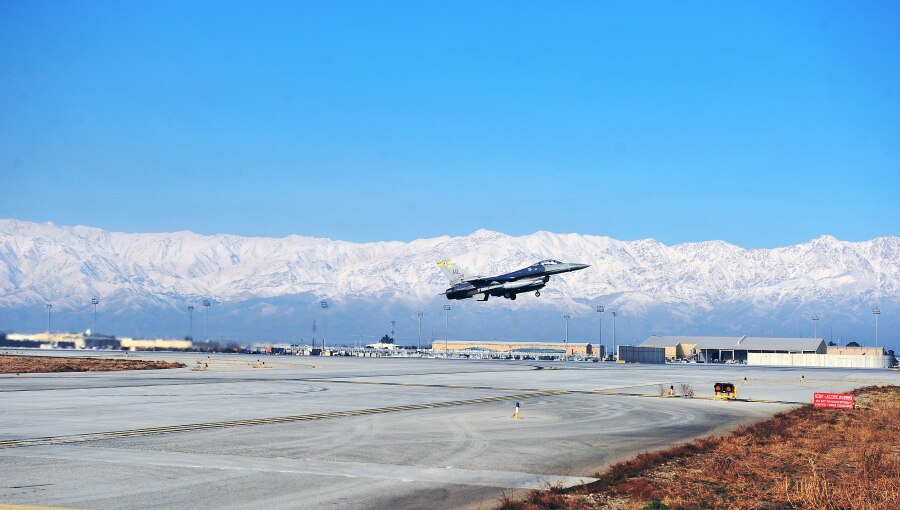
Bagram, which is about 40 kilometers north of Kabul and was built by the Soviet Union in the 1950s, was the largest US base in Afghanistan and served as the central command during its 20-year occupation of the country.

During his September 18 press conference, Trump said that Bagram was one of the largest air bases in the world, with one of the biggest runways constructed of heavy concrete and steel.

The airfield has a 3.6-kilometer runway capable of serving bombers and large cargo aircraft.

Trump had reached an agreement to withdraw from Afghanistan near the end of his first term, but then-US president Joe Biden took over the plans in 2021. Trump has repeatedly criticized his predecessor’s handling of the military pullout, which saw the United States leave behind thousands of weapons and other pieces of military equipment and a sprawling embassy compound that sits vacant in the center of Kabul.

Why Is Trump Focused On China’s Nuclear Weapons?

Trump’s argument that Bagram is an important regional foothold because of its proximity to China is not new.

The US president claimed during his election campaign that Bagram was under the control of China’s People’s Liberation Army (PLA) and during the first cabinet meeting of his second term, he said that in his Afghanistan withdrawal plan, “we were going to keep Bagram … not because of Afghanistan but because of China because it’s exactly one hour away from where China makes its nuclear missiles.

At the time, he claimed that Bagram was “now under China’s influence.”

The Taliban denied the claims and China has no known military footprint at Bagram.

But his comments about Chinese nuclear facilities appear to be referring to the long-standing Lop Nurnuclear test range, some 2,000 kilometers across the border in the northwestern Xinjiang region.

The facility was where China tested its first nuclear bomb nearly 60 years ago and satellite images appear to show an expansion of new buildings and roads around the area since 2017. The site is not known to be where nuclear weapons are manufactured, with Chinese production believed to be concentrated in the center of the country.

This comes as China has been rapidly expanding its nuclear forces in recent years, which has set off some alarm bells at the Pentagon, which said that the PLA had expanded its nuclear stockpile to 600 warheads by mid-2024, a 20 percent annual increase.

Can Trump Gain Control Of Bagram From The Taliban?

Trump did not specify in his recent comments what exactly he envisioned for Bagram, but his remarks come amid increased engagement between the Taliban and US envoys.

Washington has kept a minimal level of public engagement with Afghanistan since the Taliban takeover, restricting it to hostage negotiations. Afghanistan has remained largely isolated on the global stage and its economy is struggling to attract foreign support and private investments.

But in a rare visit last week, Adam Boehler, the Trump administration’s special envoy for hostage response, met with Taliban Foreign Minister Amir Khan Muttaqi in Kabul.

Taliban officials also rejected Trump’s suggestion that the United States might regain control of Bagram, but they left open the possibility of talks to improve ties.

“Without the US having any military presence in Afghanistan, both Afghanistan and the US need to engage with each other, and they can have political and economic relations based on mutual respect and shared interests,” Zakir Jalaly, a Taliban foreign ministry official, said on social media.

“Afghans have never accepted the military presence of anyone throughout history,” Jalaly added. “But for other kinds of engagement, all paths remain open for them.”

Other Taliban officials struck a more defiant tone in their public comments.

Muhajer Farahi, a Taliban deputy minister, posted part of a poem on X: “Those who once smashed their heads against the rocks with us, their minds have still not found peace.”

He ended his post with “Bagram, Afghanistan.”

The State Department and the White House have not provided public comment about Bagram, while Chief Pentagon Spokesman Sean Parnell said in a statement provided to reporters that the Department of War “routinely reviews how the Department would respond to a variety of contingencies across the globe” and that “we are always ready to execute any mission at the President’s direction.”

  • Reid Standish is RFE/RL’s China Global Affairs correspondent based in Prague and author of the China In Eurasia briefing. He focuses on Chinese foreign policy in Eastern Europe and Central Asia and has reported extensively about China’s Belt and Road Initiative and Beijing’s internment camps in Xinjiang. Prior to joining RFE/RL, Reid was an editor at Foreign Policy magazine and its Moscow correspondent. He has also written for The Atlantic and The Washington Post.
RFE RL

RFE/RL journalists report the news in 21 countries where a free press is banned by the government or not fully established.


Taliban releases British couple held for months in Afghanistan on undisclosed charges


Copyright AP Photo

By Gavin Blackburn
Published on 19/09/2025 - EURONEWS

A spokesperson for the Taliban Foreign Ministry said the couple "violated Afghan law" and were released from prison on Friday after a court hearing, but didn't say what law they were alleged to have broken.


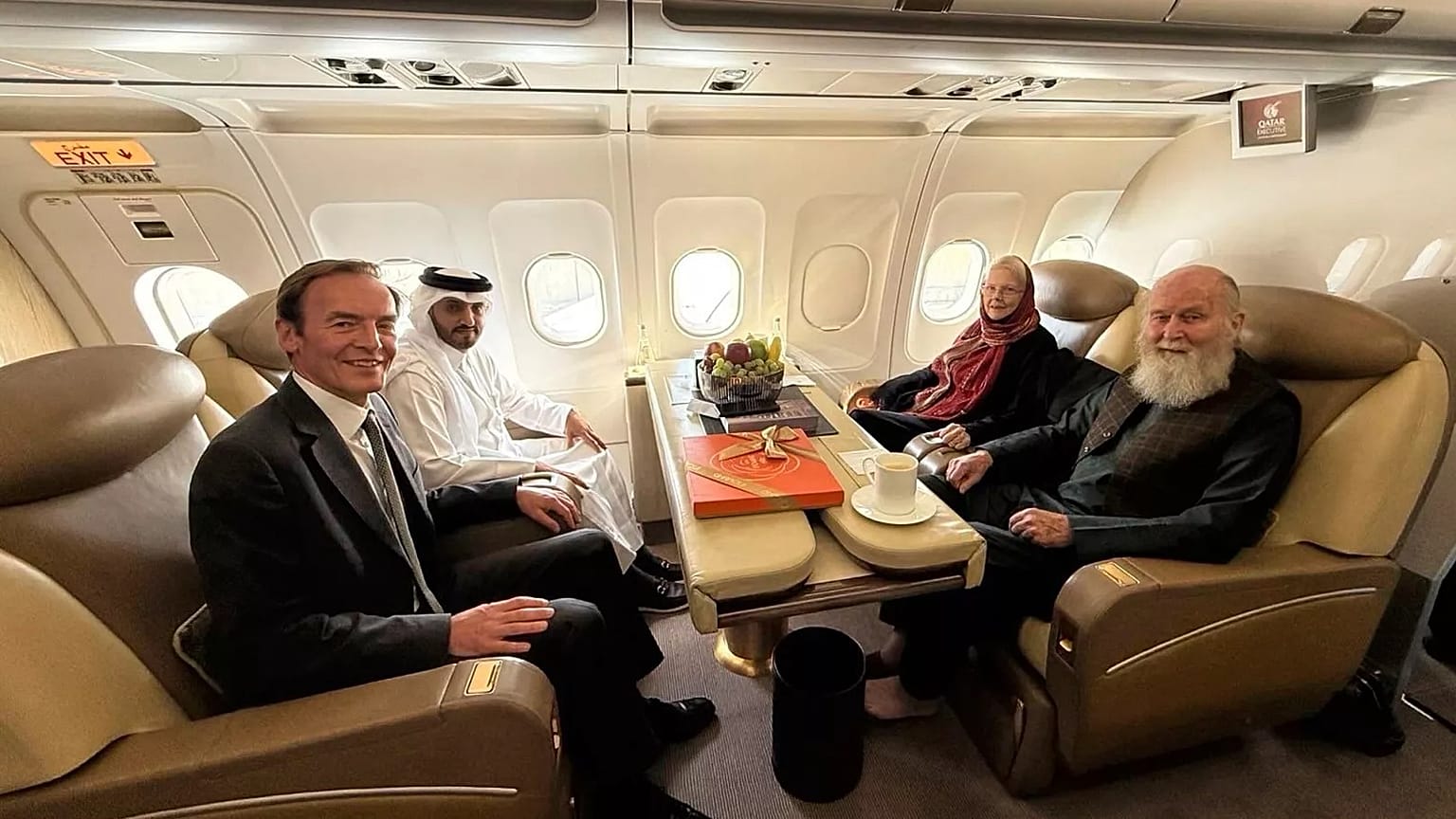
The Taliban released a British couple on Friday who had been held in Afghanistan for more than seven months on undisclosed charges, an official said.

The case of Peter and Barbie Reynolds underlined the concerns of the West over the actions of the Taliban since they overthrew the country's US-backed government in a 2021 lightning offensive.

The Reynolds had lived in Afghanistan for 18 years and run an education and training organisation in the country’s central province of Bamiyan, choosing to remain in the country after the Taliban seized power.

Qatar, an energy-rich nation on the Arabian Peninsula that mediated talks between the US and the Taliban before the American withdrawal, helped in releasing the Reynolds.

The couple left Afghanistan on Friday, a diplomat said. The diplomat spoke on condition of anonymity to discuss the sensitive negotiations in the case.

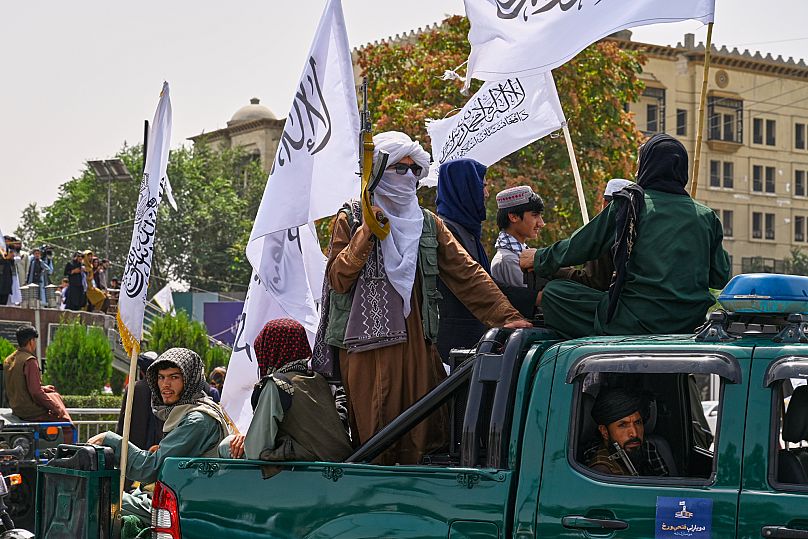
Taliban fighters and supporters during celebrations marking the fourth anniversary of the US withdrawal in Kabul, 15 August, 2025 AP Photo

"God is good, as they say in Afghanistan," Barbie Reynolds said after she arrived at Kabul International Airport to fly out of the country.

The Reynolds' family members in the United Kingdom repeatedly called for the couple’s release, saying they were being mistreated and held on undisclosed charges.

While the Taliban rejected the abuse allegations, they have never explained what prompted their detention.

A spokesperson at the Taliban government's Foreign Ministry, Abdul Qahar Balkhi, said the couple "violated Afghan law" and were released from prison on Friday after a court hearing, according to a statement he posted on X.

His statement did not say what law the couple were alleged to have broken.

Balkhi thanked Qatar for its "sincere efforts and mediation" regarding the couple who, he said, were handed over to Richard Lindsay, the UK’s special envoy for Afghanistan.

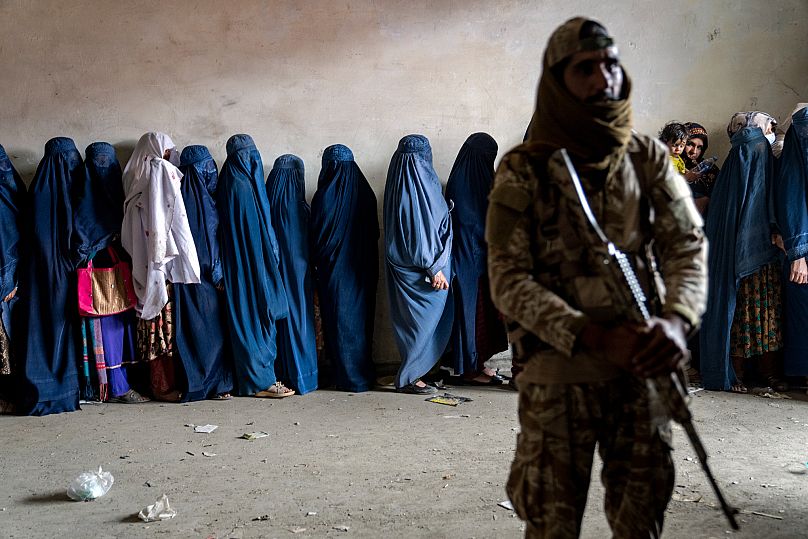
A Taliban fighter stands guard as women wait to receive food rations distributed by a humanitarian aid group in Kabul, 23 May, 2023 AP Photo

British Prime Minister Keir Starmer welcomed the couple’s release, saying he knew "this long-awaited news will come as a huge relief to them and their family."

"I want to pay tribute to the vital role played by Qatar, including the emir, His Highness Sheikh Tamim bin Hamad al Thani, in securing their freedom," he said in a statement.

In July, United Nations human rights experts warned the couple's physical and mental health was deteriorating rapidly and that they were at risk of irreparable harm or even death.

Earlier this month, the Taliban said they had reached an agreement with US envoys on a prisoner exchange as part of an effort to normalise relations.

The meeting came after the Taliban released US citizen George Glezmann in March, who was abducted while traveling through Afghanistan as a tourist.

It remains unclear what, if anything, the Taliban had been promised to see the Reynolds released. However, Afghanistan's list of needs is long.

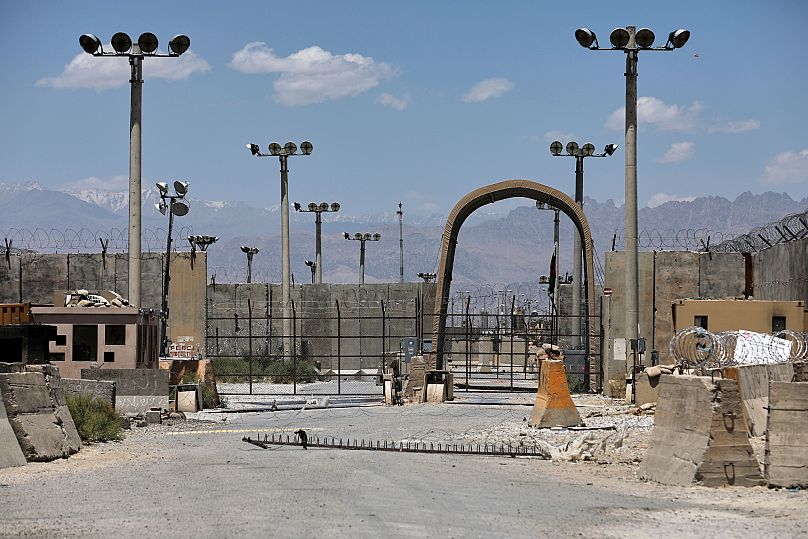
A gate at the Bagram Air Base in Afghanistan, 25 June, 2021 AP Photo

The Western aid money that flowed into it after the 2001 US-led invasion has been severely cut as needs continue to mount, particularly after a devastating earthquake on 31 August.

The country's economy also remains shaky at best.

But Western nations remain hesitant to provide money to the Taliban government, citing their restrictions on women and clamping down on expression and personal freedoms.

Afghanistan also remains a focus of US President Donald Trump for another reason. During his state visit to the UK on Thursday, Trump suggested that he is working to re-establish a US presence at Bagram Air Base in Afghanistan.


However Zakir Jalaly, an official at the Taliban’s Foreign Ministry, dismissed the idea.


Anti-immigration demonstration in The Hague turns violent, weeks before general election


Copyright REGIO8 via AP

By Evelyn Ann-Marie Dom with AP
Published on 20/09/2025 - 


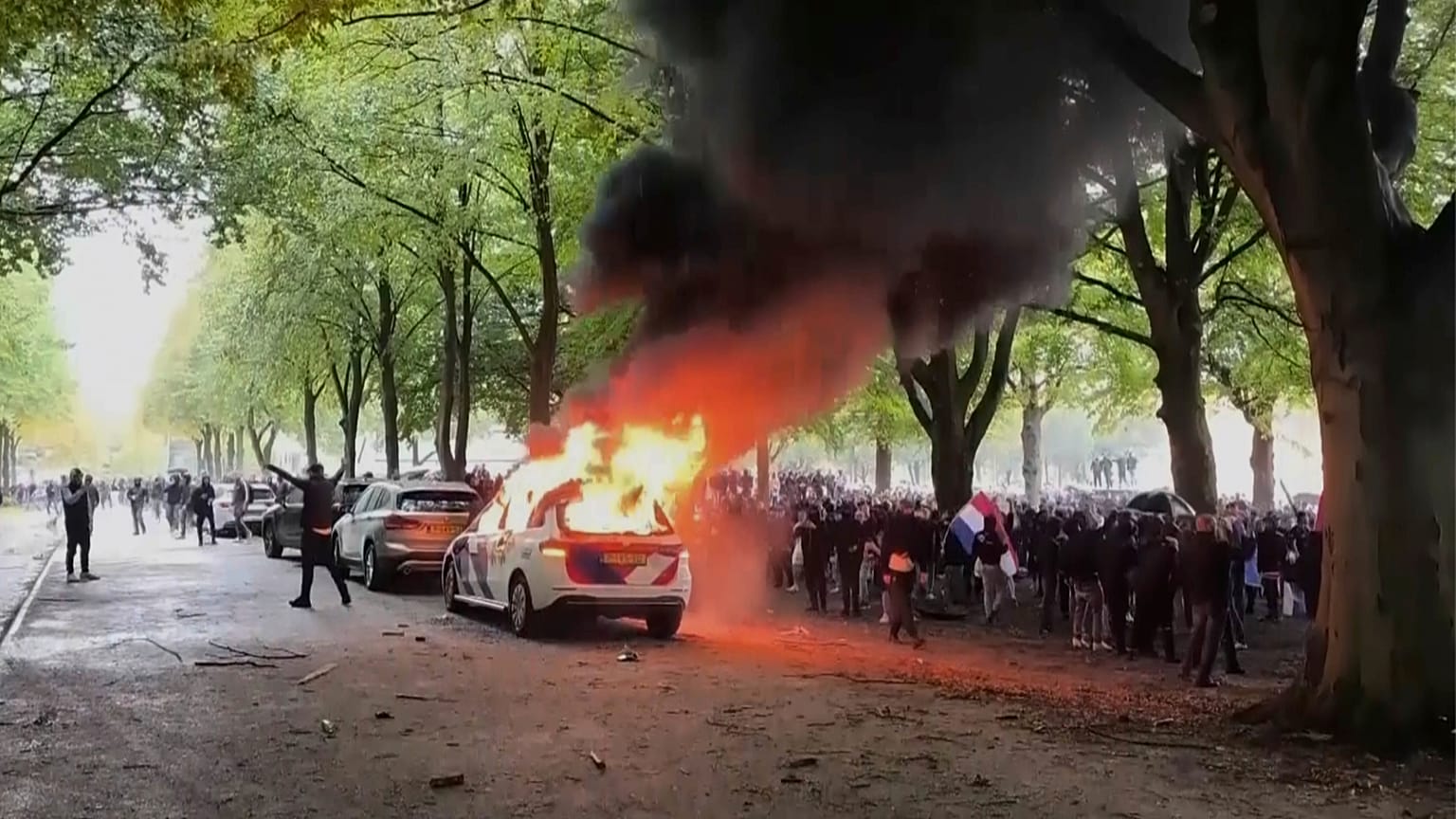
An anti-immigration protest in The Hague, attended by hundreds, turned violent on Saturday as rioters clashed with police, set a car on fire and vandalised a political party's office.

Right-wing protesters clashed with riot police in The Hague on Saturday, as an anti-immigration demonstration attended by hundreds of people turned violent.

Rioters, many wearing black and waving Dutch flags and flags associated with far-right groups, threw stones and bottles at the police and set one of their patrol vehicles on fire. The police, in return, used tear gas and a water cannon to disperse the crowd.

Protesters also briefly blocked the highway and vandalised the office of centre-left political party, D66, smashing several windows, local media reported.

“Scum. You keep your hands off political parties,” the party's leader Rob Jetten wrote on X. “If you think you can intimidate us, tough luck. We will never let our beautiful country be taken away by extremist rioters."

“Shocking and bizarre images of shameless violence in The Hague,” caretaker Dutch Prime Minister Dick Schoof wrote on X, calling the attacks on police and the D66 office “completely unacceptable” and expressed confidence that police and prosecutors would apprehend and prosecute the perpetrators.

"There is always room for demonstrations, never for violence," he concluded.

Hundreds had gathered at the Malieveld in The Hague on Saturday after a young woman, known as "Els Rechts" (translates to "Els Right"), issued a call on social media to protest against immigration and demand stricter asylum laws.

Following the clashes, "Els Rechts" quickly denounced the violence that had erupted.

"I assumed that people came to demonstrate peacefully, but unfortunately, for whatever reason, it turned out very differently," she wrote on X, adding that she would not have organised the demonstration if she had known its outcome.

The protest comes weeks before the Netherlands is set to hold a snap election on 29 October, after the country's ruling government collapsed when far-right Party For Freedom (PVV) leader Geert Wilders withdrew his ministers over disagreements on migration policy.

Wilders, who had declined an invitation to speak at the demonstration, condemned the violence as "unacceptable".
Serbia pairing with Hungary to make EU mischief and buttress Russia’s war effort in Ukraine

Pipeline deal subverting EU energy diversification policy.

Sep 19, 2025

Despite EU efforts to wean itself off Russian energy, Druzhba remains a vital supply conduit for both Hungary and Slovakia, but Ukraine’s leadership suggested that it might target the pipeline. (Photo: gov.ua)

Serbia is a candidate for European Union membership and Hungary has been a full member since 2004, but that hasn’t prevented them from collaborating with Russia to undermine EU cohesion and meddle with efforts to break Europe’s dependency on Russian energy. Ukrainian drones, however, have succeeded in disrupting Belgrade’s and Budapest’s designs.

EU Commissioner for Energy Dan Jørgensen unveiled an ambitious plan in June to stop all Russian oil and natural gas exports to the European Union by 2027. A little over one month later, Hungary and Serbia announced a joint effort to build additional infrastructure that would enable Russian oil exports to reach Serbia via an extension of the Druzhba pipeline. Once built, the pipeline will be able to convey upwards of 5 million tons of oil annually to Serbia. The target completion date is 2027.

A recent analysis published by the Western Balkans Center at New Lines Institute explains how Serbia’s actions are “revealing broader inefficiencies in the EU’s strategy to mitigate external energy influences.”

The analysis states Serbia is pursuing a “deliberate strategy of maneuvering between Russia and China to maximize autonomy while extracting concessions from Brussels. The result is a dual challenge for the EU – Serbia’s continuation of Russian energy dependence that undermines sanctions unity, and resource politics that could anchor Chinese influence at the heart of the Union’s green transition.”

Given Serbia’s EU candidate status, Belgrade’s actions additionally highlight “a broader vulnerability in the EU’s enlargement policy – its inability to prevent candidate states from using external partnerships to evade reform demands necessary for accession.”

As the analysis notes, Serbia’s Druzhba extension plan complicates its negotiations with Brussels on Cluster 4 requirements, which oblige an aspiring member state to harmonize its policies with EU standards concerning the “green agenda and sustainable connectivity.” Among the specific topics that need to be settled are energy supply, infrastructure and the internal energy market. Although the EU opened negotiations with Serbia on Cluster 4 topics in 2021, none of the necessary provisions have been finalized to date.

“The planned pipeline deepens Serbia’s reliance on Russian oil and contradicts EU accession requirements outlined in Cluster 4,” the New Lines analysis states.

In August, Ukrainian drone attacks on the Druzhba pipeline on Russian territory raised questions about the utility of the Serbian pipeline extension plan. The damage done to the Unecha pumping station in one of those strikes caused a disruption to Europe-bound oil shipments, prompting complaints by Hungary and Slovakia. Despite EU efforts to wean itself off Russian energy, Druzhba remains a vital supply conduit for both Budapest and Bratislava.

In the aftermath of the August attacks, Ukraine’s president, Volodymyr Zelensky suggested that Kyiv might target Druzhba again, unless Hungary moderates its stance on hindering EU assistance to Ukraine, including a block on accession. “We have always supported friendship between Ukraine and Hungary. And now the existence of Druzhba [which means 'friendship’ in Ukrainian] depends on Hungary’s position,” Zelensky said. Hungarian leader Viktor Orban, in turn, warned Zelensky that further Ukrainian efforts disrupt the Hungary-bound flow of Russian oil would have big consequences for Kyiv.

Regardless of whether Ukraine mounts new strikes on Druzhba, the proposal of a Serbian pipeline extension presents a serious challenge to the EU’s cohesion, the New Lines analysis underscores.

“Serbian geopolitical maneuvering involving Russia is dangerous to European geopolitical stability and prosperity,” the analysis states. “Russia has historically capitalized on destabilization and conflict in the Western Balkans. This further diverts the region from EU democratic norms and allows Russia to extend its influence in Europe, despite EU sanctions.”

To read the full report, click here.


Eurasianet has an operating agreement with the New Lines Institute, a Washington, DC,-based think tank that fosters “principled and transformative” policy solutions “based on a deep understanding of regional geopolitics and the value systems of those regions.”

Ukraine has 'hit the nail on the head' with strikes on Russian oil industry, economist says


Copyright AP Photo

By Irina Sheludkova & Sasha Vakulina
Published on 19/09/2025 - EUR0NEWS

Kyiv’s strategy to strike the Russian oil industry is “the most efficient thing Ukraine can do” to hurt Moscow's war machine. Still, it will not break the army and will not stop Moscow’s war, Russian economist Vladislav Inozemtsev told Euronews.


Overnight on Thursday, Ukraine struck one of Russia’s largest oil refineries and petrochemical plants in the Bashkortostan Republic, 1,300 kilometres from the front line in Ukraine.

In a separate parallel attack, the Ukrainian Special Operations Forces also reported a strike against an oil refinery in Russia’s Volgograd region.

The Volgograd refinery, about 450 km from the front, plays a key role in supplying fuel to the Russian military, Ukraine’s Special Operations Forces said.

It is the largest producer of petroleum products in Russia’s Southern Federal District and processes 15.7 million metric tons of crude oil annually, accounting for 5.6% of the country’s total refining capacity.

Ukraine has intensified precision strikes on Russia’s oil industry over the past weeks, forcing operational suspension and even triggering a nationwide fuel shortage.

Ukrainian attacks have shut down facilities accounting for at least 17% of Russia's oil processing capacity, or 1.1 million barrels per day (bpd), according to Reuters' calculations.

Russian economist Vladislav Inozemtsev told Euronews that Kyiv’s strategy to hit the Russian oil industry is “the most efficient thing Ukraine can do” to hurt Russia’s war machine.

Fuel for Russia's war machine

The Russian government relies heavily on oil and gas revenue. Oil exports constitute about one-third of Russia's federal budget, making them a critical source of funding for the war in Ukraine.

Targeting Moscow's oil infrastructure was a logical next step for Kyiv, in what Ukrainian President Volodymyr Zelenskyy said was “the sanctions that work the fastest”.

Inozemtsev explained to Euronews that targeting oil refineries has a significantly bigger impact than targeting, for example, drone manufacturing sites.

According to Inozemtsev, it does not take much time to set up or repair a drone factory, which is not much more than “a large assembly shop where components are delivered, assembled, checked and tested.”

“Let’s say a drone attacks a factory like this – it would take three days to rebuild everything. But if you hit an oil refinery - the consequences are much more serious, it would burn for weeks," he told Euronews.

In turn, oil refinery equipment is not only costly, Inozemtsev said, but also almost irreplaceable, given that Moscow is under significant Western sanctions.

“In fact, it is European and American equipment. It is difficult to replace it with Chinese equipment," he explained.

Attacks on the big oil refineries cause a significant drop in production, including petrol.

“A 10% drop in petrol production is clearly a deficit for the economy as a whole, while a 30% drop in diesel is nothing at all," Inozemtsev pointed out.

"And the situation with petrol is noticeable. Everyone is talking about problems with petrol. And this is true, it exists, and Ukrainians have created it.”

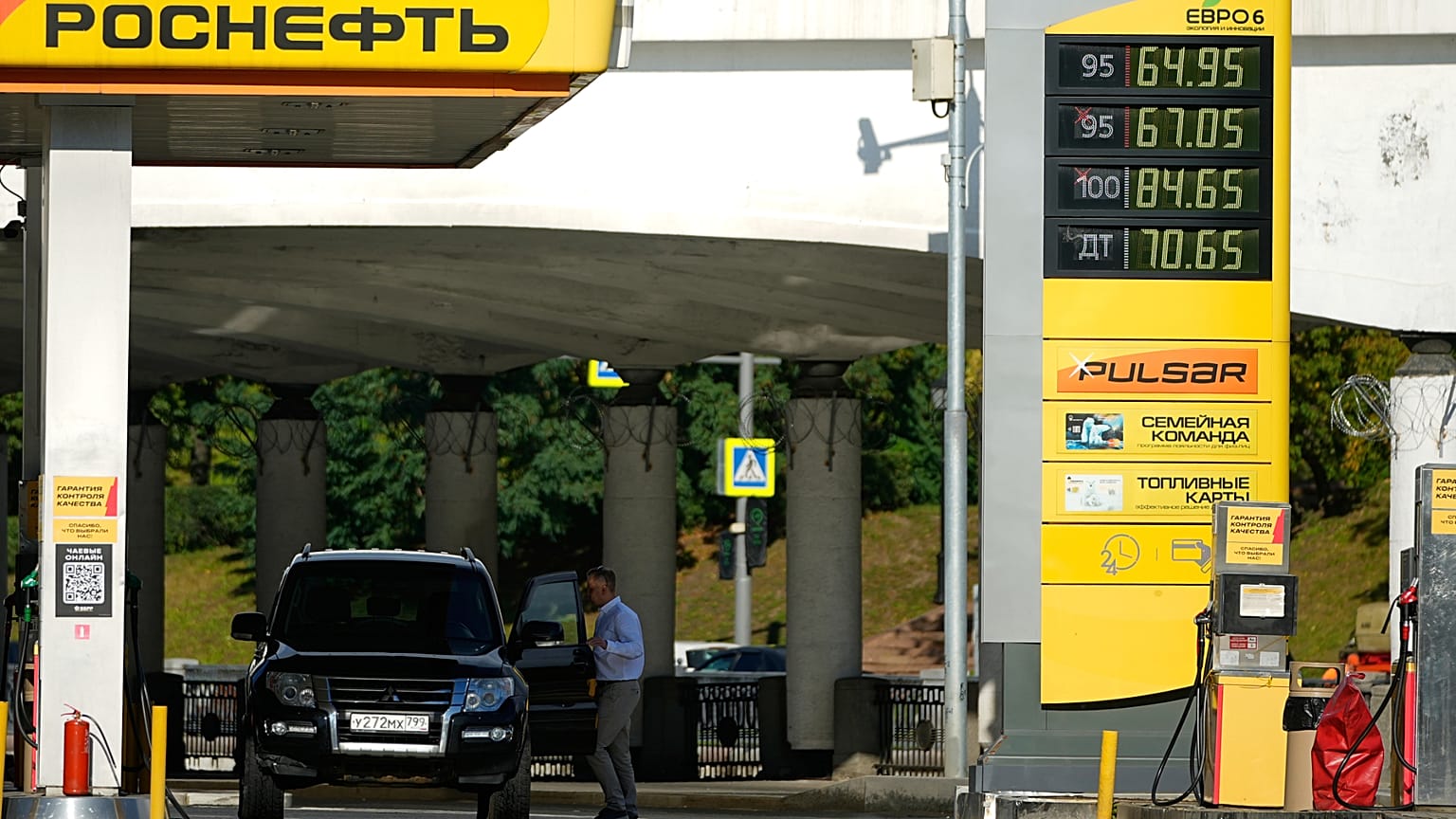
Gas stations have run dry in more regions of the country, with motorists waiting in long lines and officials resorting to rationing or cutting off sales altogether. The shortage has also been spreading to central regions of Russia as fuel prices hit record highs.

“Ukrainians have hit the nail on the head here," Inozemtsev emphasised.

The problem exists, and prices will rise. Supply disruptions are painful because car ownership is high, and practically everyone has a car."

"So when people see that there is nothing at the petrol station, this is one of the three most important irritating factors, in my opinion: lack of petrol, airport closures, and internet disruptions. These are three things that all Russians feel.”

Can Moscow fix it?

Russia remains the world’s second-largest oil exporter, but a seasonal rise in demand and sustained Ukrainian drone strikes have caused major trouble to its oil industry.

In order to ease the shortage, Russia has paused gasoline exports. A full ban has been declared until 30 September, and a partial ban affecting traders and intermediaries until 31 October.

Inozemtsev explained that, to find a more long-term solution, there is already a lot of talk about “the need to create a missile defence system, anti-drone protection around these enterprises, and so on, which would be very expensive.”

In other words, he said, resources will be diverted from the economy for this purpose.

Oil and gas revenues have accounted for between a third and a half of Russia's total federal budget proceeds over the past decade, making the sector the most critical source of financing for the government.

To tackle the current situation, the Russian government is reportedly considering raising the value-added tax (VAT) rate to keep the budget deficit under control and preserve its reserve.

Inozemtsev pointed out to Euronews that the Russian economy is being hit, but the Russian army and Russia’s war remain intact at this stage.

'Putin wants to press on'


Russia's economy has continued to grow despite tightening Western sanctions over Moscow’s war in Ukraine.

But GDP is expected to slow to around 1% from 4.3% last year, and inflation remains above 8% in a country where much of the workforce and 40% of revenues now go to defence and security.

“In principle, this is how we enter a state where, most likely, we will have zero growth in the coming years, but at the same time, there will always be enough for war,” Inozemtsev told Euronews, adding that Ukrainian strikes on the Russian oil industry have a more profound effect.

“If, let’s say, there is some kind of missile hit on - this, in general, only concerns the inhabitants of Voronezh," he explained.

"But Ukrainian strikes are now already happening all over the country. It makes people understand that things are not going ok and that the government cannot do anything about it.”

“Therefore, I believe that yes, there will be an effect. It will lead to an increase in transport costs and it will cause discontent among the population," he explained.

This will also require constant transfer of resources from region to region, Inozemtsev said, but “Putin is not concerned about this.”

"(Putin) is absolutely certain that in a year or two, the West and Ukraine will collapse. He wants to press on," Inozemtsev concluded.


'We really need to act': EU breaks taboo with first-ever sanctions on Russian LNG


Copyright Dmitri Lovetsky/Copyright 2022 The AP. All rights reserved


By Jorge Liboreiro
Published on 19/09/2025 - 
Euronews.

The new package of EU sanctions on Russia contains the first-ever ban on imports of liquefied natural gas. "This will make this phase out of Russian gas in Europe much faster," Commissioner Dan Jørgensen told Euronews.


After more than three and a half years of brutal war in Ukraine, the European Union has broken a long-held taboo: sanctions on Russian gas.

The bloc has long applied sanctions, which require the unanimous approval of all 27 member states, to imports of Russian oil and coal, but has left Russian gas untouched, causing dismay among Kyiv and Eastern European countries.

The thinking changed on Friday, when the European Commission proposed, for the first time, applying sanctions on Russian gas, specifically liquefied natural gas (LNG), which today continues to flow into Belgium, the Netherlands, France, Spain and Portugal.

"So far we have not had sanctions on buying gas from Russia, and this will now change," Dan Jørgensen, the European Commissioner for Energy, told Euronews in an interview.

"The situation is so serious. Putin is refusing to go to the negotiation table. We have Russian drones over member state territory and this, of course, will not stand. It has to have consequences, and this is why we are taking this step."

The Commission previously presented an ambitious roadmap to eliminate all purchases of Russian fossil fuels by the end of 2027 at the latest.

But amid heavy pressure from Donald Trump, who has urged Europeans to cut all energy ties with Moscow, Brussels has taken a step to speed things up. If approved, the package will bring the end of Russian LNG one year earlier to 1 January 2027.

In parallel, Jørgensen explained, legislative work will continue to complete the phase-out, which will gradually remove all purchases of Russian pipeline gas and nuclear fuels.

Last year, the bloc spent an estimated €21.9 billion on Russian energy.

"The bottom line is this will make this phase out of Russian gas in Europe much faster," Jørgensen told Euronews.

While the roadmap, which is trade policy, requires a qualified majority to be approved, the new ban on Russian LNG, which is a sanction, needs unanimous support.

This means that individual governments will be able to derail the measures.
Tough negotiations

All eyes will be on Hungary and Slovakia, which have a long track record of vetoes. The two landlocked countries do not buy Russian LNG but still receive Russian oil through the Druzbha pipeline and Russian gas through the TurkStream pipeline.

Hungary and Slovakia have mounted an opposition campaign against the phase-out of Russian energy, claiming it would endanger national security, raise prices for consumers and prompt multi-billion-euro lawsuits in compensation.

Jørgensen, who has been in touch with both countries to address their concerns, expressed his hope that the ban on Russian LNG would go through.

"I very much hope that all countries in Europe will agree that the situation is even more serious than it has been before and that we really do need to act," he said.

"We've done a lot to make sure that no country, including Hungary or Slovakia, will face problems with security of supply or spikes in prices because we've diversified where we get our gas from, and we are ready and willing and able to do that even more so."

The Commissioner confirmed that the latest sanctions package would not revisit the legal carve-out that has allowed Hungary and Slovakia to obtain crude from the Druzbha pipeline, which Ukraine attacked in August to cripple the Kremlin's war chest.


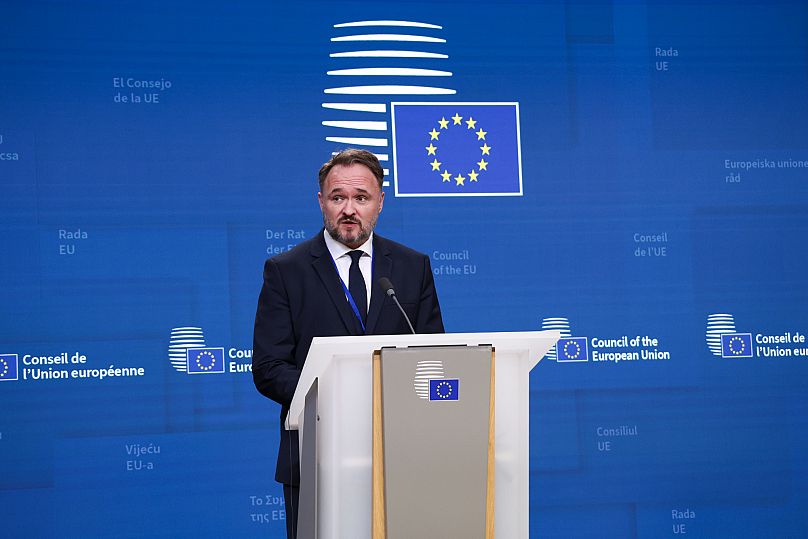
Dan Jørgensen, European Commissioner for Energy. European Union, 2025.

The exemption was granted in mid-2022 amid tense negotiations. Although leaders promised to take a second look down the road, it has remained untouched.

Jørgensen said the phase-out would eventually close the loophole.

"This package is a package that focuses on LNG. And this is new, this is a step forward and a bigger pressure that we put on Russia," he said.

"And with regards to the oil, we already do have sanctions. Two countries have derogations that will still be there," he added.

"But there's also a circumvention of the sanctions, unfortunately, taking place via the 'shadow fleet' of Russia. And the sanctions will also hit them much harder."

Last year, the bloc bought 20.05 billion cubic metres (bcm) of Russian LNG and 31.62 bcm of Russian pipeline gas, representing 19% of total gas consumption.

The bloc has shifted heavily to US-made LNG, leading critics to warn that the historic dependency on Russian energy is being replaced with an American version.


A COUPLE OF BRICS

South Africa, Brazil Sign Landmark Agriculture Cooperation Agreement

September 19, 2025 
By SA News

South African Minister of Agriculture, John Steenhuisen, and the Brazilian Vice Minister of Agriculture and Livestock, Luiz De Alcantara Rua, have signed a landmark Memorandum of Intent (MoI), marking a new era for closer cooperation in the agricultural sector.

The signing ceremony took place on the sidelines of the Ministerial Meeting of the G20 Agriculture Working Group (AWG), currently underway at Somerset West, Western Cape.

Steenhuisen welcomed the agreement, describing it as more than just a formal partnership, but “a testament to our shared vision for a food-secure future.”

“By combining our respective strengths, we can unlock new opportunities, advance technological innovation, and build a more resilient agricultural sector that benefits all our citizens,” Steenhuisen said on Thursday.

The Minister explained that the agreement, which is non-binding, lays the foundation for enhanced cooperation to promote sustainable agricultural production and strengthen food security in both nations.

“The MoI establishes an agenda of mutual advantage and common development in priority areas, such as the exchange of information and expertise, technical tours, training programmes, and joint conferences.

“Under this partnership, we will share best practices in sustainable agriculture, livestock farming systems, and quality assurance, ensuring both consumer safety and product integrity,” the Minister said.

The agreement also provides for strategic trade facilitation, including trade missions and exhibitions, aimed at generating new market opportunities for agricultural products from both countries.

Bilateral agricultural trade relations between South Africa and Brazil have expanded significantly in recent years, rising from R5.4 billion in 2020 to R9.7 billion in 2024 – an increase of 80.5%. South Africa’s agricultural exports to Brazil increased by 92.8%, from R142.6 million in 2020 to R274.9 million in 2024.

Meanwhile, imports from Brazil increased by 80.2%, from R5.2 billion to R9.5 billion over the same period.

South Africa’s top ten agricultural exports to Brazil accounted for 92.3% of the total, amounting to R253.7 million in 2024. Key exports included vegetable seeds for sowing (32.3% or R88.7 million), liqueurs and cordials (22.7% or R62.4 million), wine of fresh grapes (16% or R43.9 million), and dried grapes (6.3% or R17.3 million).

The MoI will remain in force for five years, after which it will automatically be renewed for additional five-year periods, unless terminated by either party.

A Joint Working Group will be established to identify focus areas and prepare a detailed work plan for implementation. This group will oversee planning, monitoring, and evaluation to ensure that the cooperation remains effective and aligned with the strategic priorities of both nations.

Through this partnership, South Africa and Brazil reaffirm their commitment to harnessing their shared expertise and resources to confront the challenges facing global agriculture and to strengthen the sustainability and resilience of livelihoods in both countries.

SA News
Government Communication and Information System (GCIS) established the SA Government News Agency to enable all media locally and abroad to have easy and fast access to fresh government information, news and current affairs at no cost
.