Sunday, September 21, 2025

Palestinian statehood is winning major new supporters at UN – but symbolic action won’t make it happen

Maha Nassar, University of Arizona
Fri, September 19, 2025 
THE CONVERSATION


Pro-Palestinian Americans gather in New York at a march to the U.N. on Sept. 18, 2025. Selcuk Acar/Anadolu via Getty Images

Recognition of a Palestinian state is likely to dominate proceedings at the U.N. beginning Sept 23. 2025, when world leaders will gather for the annual general assembly.

Of the 193 existing U.N member states, some 147 already recognize a Palestinian state. But that number is expected to swell in the coming days, with several more countries expected to officially announce such recognition. They include Australia, Belgium, Canada, France, Portugal and the U.K. – although Britain says it won’t support statehood if Israel takes steps to alleviate the plight of Palestinians in Gaza.

That a host of Western nations are adding their names to the near-universal list of Global South countries that already recognize a Palestinian state is a major diplomatic win for the cause of an independent, sovereign and self-governed nation for Palestinians. Conversely, it is a massive diplomatic loss for Israel – especially coming just two years after the West stood shoulder to shoulder with Israel following the Oct. 7 attack by Palestinian militant group Hamas.

As a scholar of modern Palestinian history, I know that this diplomatic moment is decades in the making. But I am also aware that symbolic diplomatic breakthroughs on the issue of Palestinian statehood have occurred before, only to prove meaningless in the face of events that make statehood less likely.


‘I have come bearing an olive branch and a freedom fighter’s gun,’ PLO leader Yasser Arafat said before the United Nations General Assembly in 1974. Bettmann / Contributor
The non-state reality

The fight for Palestinian statehood can be traced back to at least 1967. Over the course of a six-day war against a coalition of Arab states, Israel conquered and expanded its military control over the remainder of what was historic Palestine – a stretch of land that extends from the Jordan River in the east to the Mediterranean Sea in the west.

At the war’s conclusion, Israel had taken control of the West Bank, East Jerusalem and the Gaza Strip.

Unlike after the 1948 war that led to its independence, Israel opted not to extend Israeli citizenship to Palestinians living in the newly conquered areas. Instead, the Israeli government began to rule over Palestinians in these occupied territories through a series of military orders.

These orders controlled nearly every aspect of Palestinian life – and many remain in effect today. For example, if a Palestinian farmer wants to harvest his olive trees near a Jewish settlement in the West Bank, they need a permit. Or if a Gazan worker wants to work inside Israel, they need Israeli permission. Even praying in a mosque or church in East Jerusalem is dependent on obtaining a permit.

This permit system served as a constant reminder to Palestinians living in the occupied territories that they lacked control over their own daily lives. Meanwhile, Israeli authorities tried to squash the idea of Palestinian nationhood through policies such as outlawing public displays of the Palestinian flag. That, and other expressions of Palestinian national identity in the occupied territories, could result in up to 10 years in prison.

Such policies fit a belief, expressed in 1969 by then Israeli Prime Minister Golda Meir, that there was “no such thing in this area as Palestinians.”
The rise of Palestinian nationalism

Around the same time that Meir made that comment, Palestinians started organizing around the idea of statehood.

Although the idea had been floated before, statehood was codified into official doctrine in a resolution in February 1969 in Egypt. It occurred during a session of the Palestine National Council, the legislative body of the Palestine Liberation Organization, which formed in 1964 as the official representative of Palestinians in the occupied territories.

That resolution called for a free, secular democratic state in Palestine – including all of the State of Israel – in which Muslims, Christians and Jews would all have equal rights.

From that moment on, the Palestinian struggle against Israeli occupation took twin paths: diplomatic pressure and armed resistance.

But events on the ground undermined the idea of a single state for all along the lines envisioned by the Cairo resolution.

The 1973 Arab-Israeli War’s inconclusive ending opened the door to greater diplomacy between Israel and the Arab states. Egypt and Israel decided that diplomacy would help them achieve their aims, culminating in the Egyptian-Israeli peace treaty of 1979. But the treaty also left the Palestinians without unified Arab support.

Meanwhile, throughout the 1970s, the Israeli occupation deepened and entrenched with the building of Israeli settlements, especially in the West Bank.


Yasser Arafat addresses the United Nations General Assembly in 1974. 
Bettmann / Contributor

The PLO responded in 1974 by issuing what became known as the 10-Point Plan, where they pivoted to seeking the establishment of a national authority in any part of historic Palestine that could be liberated.

It was, in effect, a way of threading the needle: It signaled to moderates that the PLO was adopting a more gradualist position, while also telling the group’s rejectionist front – which opposed peace negotiations with Israel – that they were not giving up completely on the idea of liberating all of Palestine.

Then in 1988 – a year into the first Palestinian intifada, or uprising – the PLO unilaterally declared Palestinian independence on the territories occupied in 1967.

The move was largely symbolic – the West Bank, Gaza and East Jerusalem were still under occupation, and the PLO was then in exile in Tunisia.

But it was nonetheless significant. It represented the bringing together of Palestinians in exile – most of whom were from towns and villages that were now part of the State of Israel – with Palestinians in the occupied territories.

The declaration itself was written by Palestinian poet Mahmoud Darwish, who grew up inside Israel, and declared by Yasser Arafat, the PLO leader in exile.

It was also a moment of tremendous hope and possibility for Palestinians. What most Palestinians wanted was for the international community to recognize them as a national body, deserving of a seat at the table with other nation-states.
Compromise and rejection

Yet at the same time, many Palestinians saw the declaration as a huge compromise. The West Bank, Gaza Strip and East Jerusalem comprise about 22% of historic Palestine. So the declaration effectively meant that Palestinians were giving up on the other 78% of what they saw as their land.

Reaction from the international community to the PLO’s declaration was split. Many formerly colonized countries of the Global South recognized Palestinian independence right away. By the end of the year, some 78 countries had issued statements recognizing Palestine as a state.

Israel rejected it outright, as did United States and most Western nations.

Such was Washington’s opposition that the U.S. denied Arafat a visa ahead of his planned address to the United Nations at its New York City headquarters. As a result, the December 1988 meeting had to be moved to Geneva.

While refusing to accept Palestinian statehood, the U.S. and Israel did begin to recognize the PLO as a representative body of the Palestinian people. This was part of the Oslo Accords – a diplomatic process that many believed would outline a road map for an eventual two-state solution.

While some Palestinians saw the Oslo Accords as a diplomatic breakthrough, others were more skeptical. Prominent Palestinians, including Darwish and Palestinian-American professor Edward Said, believed that Oslo was a poison pill: While framed as a step toward a two-state solution, the agreement said nothing about a Palestinian state in the interim. It only said that Israel would recognize the PLO as a representative of the Palestinian people.

In reality, the Oslo Accords have not lead to statehood. Rather, they created a system of fragmented autonomy under the newly created Palestinian Authority that, though meant to be interim, has in effect become permanent.

The Palestinian Authority was allowed only limited powers and deprived of real independence. While it had some say over schooling, health care and municipal services, Israel maintained control of Palestinian land, resources, borders and the economy. That remains true today.

Renewed push for statehood recognition

Disillusionment over the Oslo Accords contributed to the second, far more violent, intifada from 2000 to 2005.

Mahmoud Abbas, the leader of the Palestinian Authority after Arafat, responded by pushing again for international recognition for statehood.

And in 2012, the U.N. General Assembly voted to upgrade Palestine’s status, elevating it from a “nonmember observer” to a “nonmember observer state.”


The Palestinian delegation at the U.N. General Assembly before the vote to upgrade Palestinian status to a nonmember observer state in 2012. Stan Honda/AFP via Getty Images

In theory, this meant Palestinians now had access to international bodies, like the International Criminal Court and the International Court of Justice.

But any meaningful change in the status of Palestinian sovereignty would need to come through the U.N. Security Council, not the U.N. General Assembly.

The U.S. remains opposed to Palestinians gaining statehood independent of the Oslo process. So long as the U.S. has a veto on the Security Council, achieving a truly sovereign Palestinian state will likewise be off the table. And that remains the case, regardless of what individual members – even fellow Security Council members like France and the U.K – do.

In fact, many Palestinians and other critics of the status quo say Western nations are using the issue of Palestinian statehood to absolve them from the far more challenging diplomatic task of holding Israel accountable for what a U.N. body just described as a genocide in Gaza.

This article is based on a conversation between Maha Nassar and Gemma Ware for The Conversation Weekly podcast.

This article is republished from The Conversation, a nonprofit, independent news organization bringing you facts and trustworthy analysis to help you make sense of our complex world. It was written by: Maha Nassar, University of Arizona


Read more:


From resistance to intifada to recognition: the origins of an independent Palestinian state – podcast


Israel’s killing of journalists follows a pattern of silencing Palestinian media that stretches back to 1967


Israel is committing genocide in Gaza, says UN commission. But will it make any difference?


UK, Canada, Australia and Portugal recognise Palestinian state, drawing Israeli fury


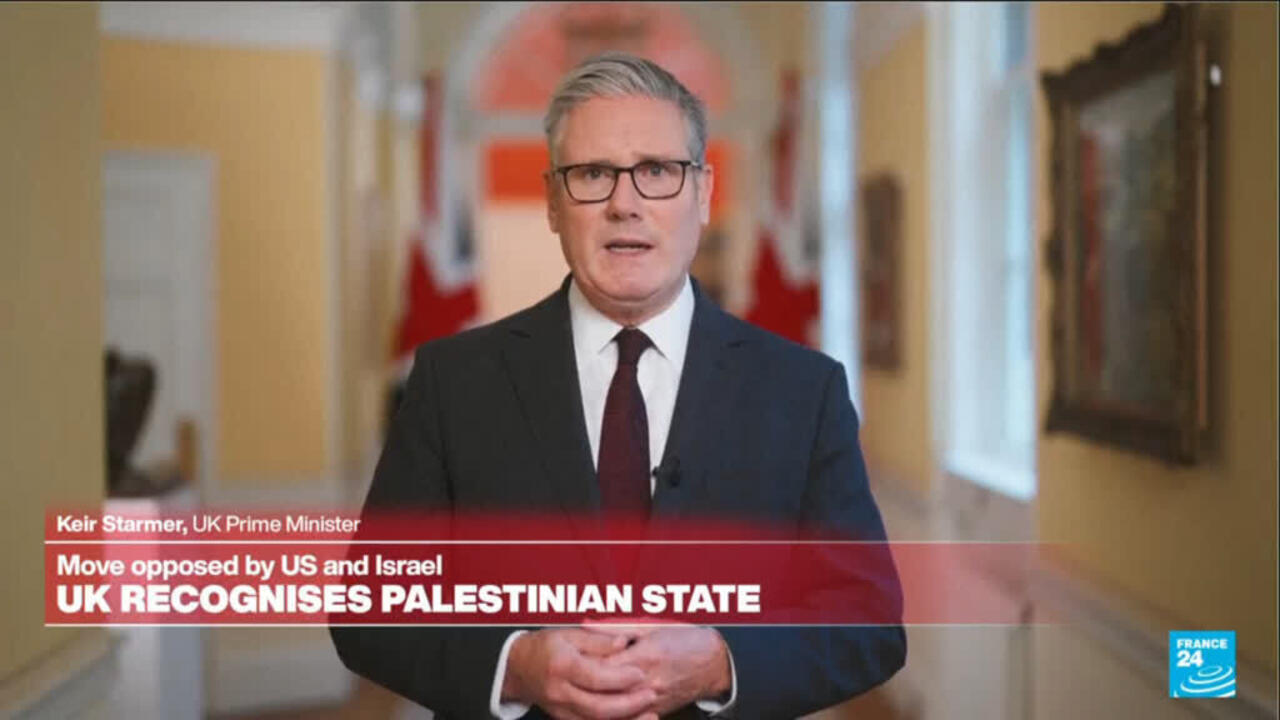
The UK, Australia, Canada and Portugal formally recognised a Palestinian state on Sunday, confirming a major diplomatic shift that has prompted vociferous opposition from the US and Israel. Britain's Prime Minister Keir Starmer said the move aimed "to revive the hope of peace for the Palestinians and Israelis, and a two-state solution."


Issued on: 21/09/2025 - 
By: FRANCE 24
Video by: Leela JACINTO  


File photo: Protesters hold placards and Palestinian flags outside Downing Street after taking part in the "March for Palestine" in London on October 28, 2023. © Henry Nicholls, AFP
07:41


BritainAustraliaCanada and Portugal on Sunday recognised the State of Palestine, a historic shift in decades of Western foreign policy that drew swift anger from Israel.

Though Palestinians in the besieged Gaza Strip welcomed the recognition as a victory, the move drew a furious response from Israeli Prime Minister Benjamin Netanyahu, who vowed that a Palestinian state would never come to pass.

Other countries, including France, are due to follow suit at the annual UN General Assembly opening on Monday in New York.
© France 24
05:48


Israel has come under huge international pressure over its war in Gaza, which has sparked a dire humanitarian crisis in the Palestinian territory.


Netanyahu denounced the push for recognition as "absurd", claiming it would "endanger" Israel's existence.

"It will not happen. No Palestinian state will be established west of the Jordan River," the Israeli premier said.

He later vowed to expand Jewish settlements in the West Bank, which Israel has controlled since 1967 in an occupation considered illegal under international law.

Netanyahu spoke after UK Prime Minister Keir Starmer said Britain was formally recognising the State of Palestine "to revive the hope of peace for the Palestinians and Israelis, and a two-state solution".

The UK and Canada became the first members of the Group of Seven advanced economies to take the step.
'Moral victory'

It is a watershed moment for Palestinians and their ambitions for statehood, with the most powerful Western nations having long argued recognition should only come as part of a negotiated peace deal with Israel.

Three-quarters of UN members now recognise the State of Palestine, with at least 145 of the 193 member countries having done so, according to an AFP tally.

Australia's Prime Minister Anthony Albanese said the move "recognises the legitimate and long held aspirations of the people of Palestine", while Portuguese Foreign Minister Paulo Rangel called the two-state solution "the only path to a just and lasting peace".

On the ground in Gaza, many saw recognition as an affirmation of their existence after nearly two years of war between Israel and Palestinian Islamist group Hamas.

© France 24
07:49


"This recognition shows that the world is finally starting to hear our voice and that in itself is a moral victory," said Salwa Mansour, 35, who has been displaced from the southern city of Rafah to Al-Mawasi.

"Despite all the pain, death and massacres we're living through, we cling to anything that brings even the smallest bit of hope," she added.

Palestinian president Mahmud Abbas hailed the recognitions as "an important and necessary step toward achieving a just and lasting peace".

Although a largely symbolic move, it puts the four countries at odds with the United States and Israel.

US President Donald Trump said last week after talks with Starmer that "one of our few disagreements" was over Palestinian statehood.

French President Emmanuel Macron insisted in an interview with a US TV network that despite France moving to extend recognition, releasing the hostages Hamas captured in 2023 would be "a requirement very clearly before opening, for instance, an embassy in Palestine".

'Special burden'


A growing number of longtime Israeli allies have shifted their long-held positions as Israel has intensified its Gaza offensive, which began with Hamas's October 7, 2023 attack.

Since then, the Gaza Strip has suffered vast destruction, with a growing international outcry over the besieged coastal territory's spiralling death toll and a UN-declared famine.

Read moreMacron says recognising Palestine is the 'best way to isolate Hamas'

The UK government has come under increasing public pressure to act, with thousands of people rallying every month on the streets.

The UK was pivotal in laying the groundwork for the creation of the State of Israel through the 1917 Balfour Declaration.

Starmer said on Sunday that Britain was acting "in the face of the growing horror in the Middle East".

He renewed calls for a ceasefire and again demanded Hamas release the remaining Israeli hostages.
© France 24
08:41

Branding Hamas a "brutal terror organisation", Starmer also confirmed plans to bolster sanctions on the militants, denying recognition was a "reward".

Hamas's attack on southern Israel resulted in the deaths of 1,219 people, most of them civilians, according to an AFP tally of official figures.

Israel's retaliatory campaign has killed at least 65,208 people, also mostly civilians, according to figures from the health ministry in Hamas-run Gaza, which the UN considers reliable.

Many obstacles remain before statehood, including who would run the territory.

(FRANCE 24 with AFP)


UK, Australia and Canada recognise Palestinian state as Netanyahu threatens settlement expansion

UK, Australia and Canada recognise Palestinian state as Netanyahu threatens settlement expansion
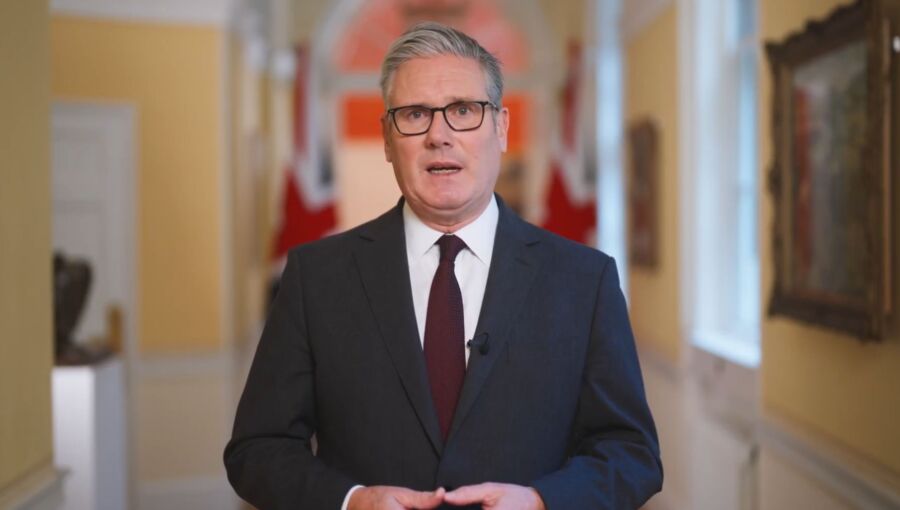
British Prime Minister Keir Starmer, (Screengrab, 10 Downing Street social media). / bne IntelliNews
By bnm Gulf bureau September 21, 2025

The UK, Australia and Canada formally recognised a Palestinian state on September 21, prompting Israeli Prime Minister Benjamin Netanyahu to hint at increased settlement activity in response.

The coordinated initiative from the three Commonwealth nations reflects growing concern at Israel's conduct of the war in Gaza and steps taken by the Israeli government to prevent the creation of a Palestinian state, including continued expansion of settlements in the West Bank and the targeting of Bedouins in Palestinian controlled areas.

British Prime Minister Keir Starmer said the UK's move is intended "to revive the hope of peace for the Palestinians and Israelis" and insisted it was not a reward for Hamas, he added, "Because it means Hamas can have no future."

"Today, to revive the hope of peace and a two-state solution, I state clearly as prime minister of this great country that the United Kingdom formally recognises the state of Palestine," Starmer said.

Canadian Prime Minister Mark Carney said, "The current Israeli government is working methodically to prevent the prospect of a Palestinian state from ever being established. It has pursued an unrelenting policy of settlement expansion in the West Bank, which is illegal under international law."

"It is in this context that Canada recognises the State of Palestine and offers our partnership in building the promise of a peaceful future for both the State of Palestine and the State of Israel," he added.

Prior to the announcement Australian Prime Minister Anthony Albanese said he would meet with the British counterpart in London with his official page writing, "Prime Minister Albanese will then travel to London and meet with United Kingdom Prime Minister Sir Keir Starmer and hold a series of other high level meetings."

Netanyahu responded by saying the establishment of a Palestinian state "will not happen" and that "a Palestinian state will not be established west of the Jordan River."

In a subsequent statement on social media, Netanyahu hinted at increased settlement activity, saying: "For years I prevented the establishment of this terror state facing great pressures, domestic and foreign... Not only that, we doubled the Jewish settlement in Judea and Samaria. The response to the latest attempt to force a terror state on us in the heart of our land will be given after my return from the US Wait."

The UK announcement was widely anticipated after Starmer said in July that Britain would recognise a Palestinian state unless Israel agreed to a ceasefire in Gaza, allowed UN aid delivery and took other steps toward long-term peace.

More countries are expected to join the recognition list at the UN General Assembly this week, including France, which, like the UK, is a permanent Security Council member.

Hamas welcomed the decision while Palestinian President Mahmoud Abbas called the moves "an important and necessary step toward achieving a just peace."


Portugal formally recognises Palestinian state, foreign minister says
Copyright AP Photo

By Euronews
Published on 21/09/2025 - 

Portugal, the UK, Australia and Canada on Sunday joined over 150 countries that now recognise a Palestinian state. The announcements come ahead of the United Nations General Assembly in the week ahead.

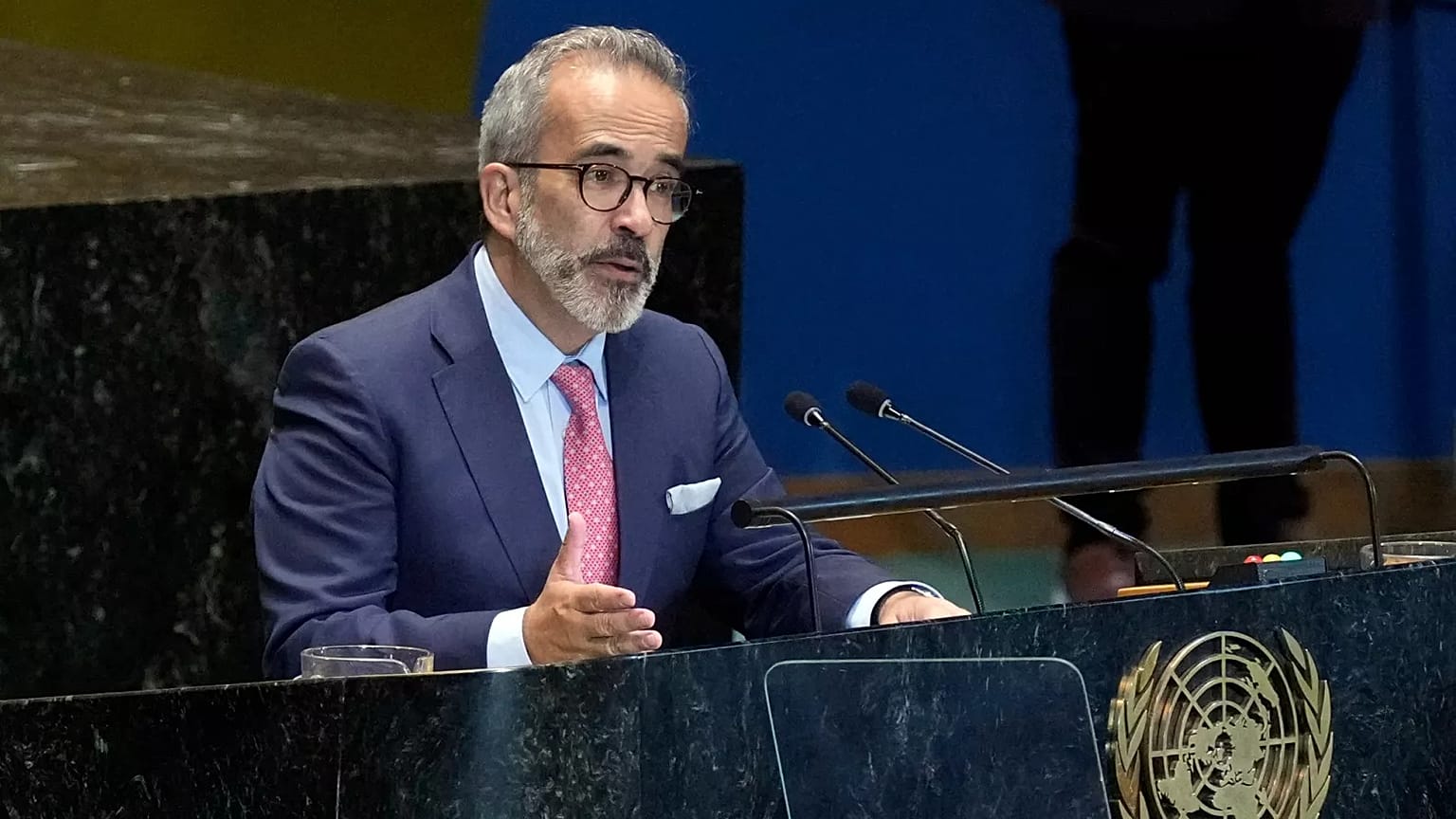
Portugal has officially recognised the Palestinian state, the country's Foreign Affairs Minister Paulo Rangel announced in New York on Sunday.

Rangel stated a two-state solution is "the only path to a just and lasting peace", local media reported.

The government in Lisbon has also reaffirmed "the right of Israel to exist" and its "effective security needs," as well as "condemning once again the atrocious terrorist attacks of 7 October" carried out by Hamas-led militants.

The move came hours after the United Kingdom, Canada and Australia -- all Commonwealth nations -- similarly did so ahead of the United Nations General Assembly, set to open on Tuesday.

“We must channel our efforts, united together in hope, behind the peaceful future that we want to see: the release of the hostages, an end to the violence, an end to the suffering and a shift back towards a two-state solution as the best hope for peace and security for all sides," UK Prime Minister Keir Starmer said on Sunday.

Other countries are expected to join the list recognising a Palestinian state at the UN summit this week, including France. France and the UK are two of the five permanent members of the Security Council.

Israeli authorities condemned the recognition, with Israeli Prime Minister Benjamin Netanyahu repeatedly stating the move will further destabilise the region and embolden Hamas.

Israeli National Security Minister Itamar Ben-Gvir announced that he will raise annexing the West Bank at the next cabinet meeting in response to the recognitions.

“The recognition by the UK, Canada, and Australia of a ‘Palestinian’ state, as a prize for the murderous terrorists, requires immediate countermeasures,” said Ben-Gvir.

Palestinian students’ dreams are shattered after US withdraws visas to study in US

Kylie Atwood, CNN
Fri, September 19, 2025 


A Palestinian student stands on her best friend's balcony, before the war in Gaza began. - Photo shared with CNN by student

A 22-year-old Palestinian student planned to be in the US this month, preparing her dorm room ahead of starting her first semester at an American university. Instead, she is still in Gaza, desperately trying to gather food, water and internet access after being forced to flee her home in Gaza City after Israel launched a ground operation to seize an area where approximately a million people live.

“You’re just escaping and just going to nowhere,” she told CNN by phone this week. “I just wake up crying. I just sleep crying. I was hoping (for) something far away from what I’m living right now and what I’m living right now is like a nightmare.”

In the fall of 2024 the student, whose identity CNN is withholding due to concerns about retaliation, was admitted to study computer science in the US. But her plan was abruptly derailed when the Trump administration introduced a new policy last month to reject all non-immigrant visa requests from Palestinian Authority passport holders.

Her acceptance to an American university was “the light at the end of the tunnel” after living through a nightmare in Gaza.

Just weeks after the latest Gaza war began in 2023 following the October 7 Hamas attack, she found herself next to her brother when an Israeli strike injured him.

“My brother was full of blood, and we were just turning in the streets, and bombs are – everywhere,” she said. “I took them as a fuel, as a fuel to continue, because a stop is never a choice.”

She has prioritized pursuing her education, which was abruptly upended when the war began almost two years ago, and Israeli bombing forced her local university to shutter its doors.

Her acceptance at an American College was the culmination of her efforts as she described ambition being her hobby, even while destruction and devastation dominated her life.

“You don’t have the choice to stop in every moment, and every second. You need to have a plan to the second, to the next second, in your life,” she said.

Some students cried for days feeling their “dream collapsing,” as one other student described, after the new visa policy was put into place. For her, it was another barrier – but not a dead end.

“The suspension hit hard for me, but I was never, never shocked, because what it what else in this world seems realistic? Actually, nothing seems realistic,” she said. “I actually just can’t handle anymore – we Palestinians, especially Gazans, are being forced – with our whole being – and we don’t give up.”

As she embarked this week on a 7-hour journey to southern Gaza, she made sure all of her university application documents were on Google drive. She plans to apply to another university outside the US for next year. But she also hopes there could be a change to the policy so she can come to the US.

The State Department gave no indication they are planning to allow a carve-out of their current policy for students, calling every visa decision a national security decision.

“The Department has paused the processing of nonimmigrant (NIV) visas for individuals traveling on a Palestinian Authority passport while we conduct a full and thorough review of the process and procedures used to vet individuals from Gaza,” a State Department spokesperson told CNN. “We will take the time necessary to conduct a full and thorough review.”

Last year more than 450 American university students held Palestinian passports, according to the Institute of International Education’s Open Doors data.


Tents of displaced Palestinians stand in the Nuseirat refugee camp, in the central Gaza Strip, as plumes of smoke rise during Israeli bombardment above Gaza City on Friday. - Eyad Baba/AFP/Getty Images

Applying ‘could have literally cost me my life’

Applying to American universities during the war meant taking risks that were sometimes life threatening for each of the almost half a dozen Palestinian students who shared their stories with CNN.

“The process of applying for this scholarship and submitting documents could have literally cost me my life every single time,” another Palestinian student who was accepted to pursue a PhD in physics in the US told CNN. “I had to walk for an hour to reach a border area near Egypt just to catch a weak internet signal, because all communications and internet were completely cut off, all while bombs were falling over my head.”

She has two young children and believed that attending an American program could save them – while death has been all around them.

“If the sea were made of ink, it would not be enough to describe the atrocities we are experiencing,” she said, explaining the killing of many loved ones and dozens of forced displacements she and her family have been through.

She is not alone in her determination to advance her education for the sake of her children and their safety.

Another 40-year-old Palestinian pharmacist with three young children told CNN that his children were just as invested in the process as he was.

“My kids were so eager,” he said, “Asking me when we go to the States, we went to the consulate, when will they give you the visa? Oh, my God, who knows.”

But the steps he took in seeking to secure his master’s degree in public and global health in the US were “harsh” and “unimaginable.”

Finding transcripts when schools were shuttered, getting recommendations from former colleagues navigating loss and fleeing their homes due to Israeli bombings and finding internet access made every step of the process treacherous.

He was also trying to contact these people in Gaza while he was in Egypt, having fled with his family during the early months of the war.

“I have a lot of connections in Gaza, in my field – but how could I find some available, who is having, you know, who have a good internet access. And who it would be suitable and convenient for me to ask him such a question while he is in death, let’s say, in hell,” he said.

One of the people who wrote him a recommendation was a doctor who had just gotten out of the hospital himself after being injured. Once he found internet he got the student his recommendation – without any major delay.

But despite his acceptance, the former pharmacist is now facing the heartbreaking reality that his dream will not come to fruition in the near-term due to the new visa policy.

“The harsh reality is that when you just felt that you are arriving – at this summit, let’s say everything has just changed in one second,” he said.


A Palestinian student flees Israel's ground incursion in Gaza City, the same week she expected to be beginning University in the US. - Photo shared with CNN by student


Delaying education for 3 years

Breaking the news to the Palestinian student that they would no longer be able to travel to the US anytime soon after they had finally found a source of hope, was a heavy burden for the activists who were supporting them through the application and visa process.

“It was a very difficult conversation,” said Juliette Majid, the founder of Student Justice Network (SJN), adding that the new blanket refusal policy dramatically complicates their situations.

Dozens of Palestinian students worked with SJN, a pro-Palestinian student group, which has helped them to navigate the complicated logistics of applying to and pursuing an American education while the war continues.

The Trump administration has not provided any direct information to the students about the new visa policy, or the rationale for enacting it.

The sweeping new policy was communicated to US diplomats in an August cable from Secretary of State Marco Rubio, ordering all embassies and consulates to refuse nonimmigrant visas to “all otherwise eligible Palestinian Authority passport holders” who are using that passport to apply for a visa. The posts were instructed to do so immediately.

A State Department spokesperson said that “every visa decision is a national security decision,” without expanding on the rationale for the new policy.

Preventing the students who had been accepted to US universities from traveling take up the places they had worked so hard to earn has meant a loss of three years of education for most students. The last time most of them were in school was during the fall of 2023, and now they are looking elsewhere in the world to find opportunities for the fall of 2026.

“They essentially have to restart the entire university application system from scratch,” Majid said. “These are people who have been trying to finish their education under bombardment, under mass displacement, and it’s absolutely cowardly and disappointing of the administration.”

France's richest man attacks 'far-left', 'pseudo-academic' behind billionaire tax plan

Bernard Arnault, the boss of luxury goods group LVMH and France's richest man, has sparked anger on the French political left by branding the economist behind a hotly debated plan to tax billionaires a "far-left activist" and "pseudo-academic" bent on destroying the French economy. Hitting back at Arnault, Gabriel Zucman mocked the "caricatural nature" of his attack.


Issued on: 21/09/2025 - 
By: FRANCE 24

French economist Gabriel Zucman (left) says a 2% tax on billionaires like LVMH boss Bernard Arnault would help reduce France's budget deficit and address rising inequality. © Joël Saget, AFP

Left-wing figures in France on Sunday reacted with uproar after the country's richest man, luxury goods tycoon Bernard Arnault, described an academic behind a wealth tax plan as a "far-left activist" who wanted to "destroy the French economy".

With France under pressure to erode its growing debt pile and budget deficit, French economist Gabriel Zucman has suggested the ultra-rich pay at least a two-percent tax on their fortune.

The idea has been enthusiastically taken up by the left including the Socialist Party, whose support new Prime Minister Sébastien Lecornu could need to ensure the survival of his government.

Read more‘Zucman tax’: Push to tax the super-rich could make or break France’s next government


But it has been denounced by the right, who fear that such a scheme could force the wealthy to flee France.


"This is clearly not a technical or economic debate, but rather a clearly stated desire to destroy the French economy," said Arnault in a statement to the UK Sunday Times.

Arnault, whose family fortune is currently estimated at $157 billion by Forbes, described Zucman as "first and foremost a far-left activist... who puts at the service of his ideology (which aims to destroy the liberal economy, the only one that works for the good of all) a pseudo-academic competence that is itself widely debated".

Arnault, whose LVMH conglomerate includes brands such as Louis Vuitton, Dior and Moet Hennessy has long underlined the importance of the taxes he pays personally and that his companies pay to the French state.

Hitting back at Arnault, Socialist leader Olivier Faure wrote on X: "What destroys our economy and even more so our society is the absence of any form of patriotism on the part of the ultra-rich who beg for help from the state but refuse to submit to any form of solidarity."

Greens leader Marine Tondelier said: "We're close to the goal and he's getting nervous." She added with irony: "To be fair, he has a big conflict of interest when he speaks on the subject."

The tax, according to Zucman, could raise around €20 billion ($27 billion) per year by targeting 1,800 households.


Zucman himself hit back at Arnault with a long thread on X, saying "nervousness does not authorise slander".

"I was very surprised by the caricatural nature of your attacks. Your remarks targeting me fall outside the realm of rationality and are without foundation," said Zucman, adding he had never been an activist in any movement nor a member of any party.

"You are attacking the very legitimacy of research free from any financial pressure," said Zucman, who has held academic posts in London, the United States and Paris.

Best-selling French economist Thomas Piketty, seen as Zucman's mentor, also stood up for his former student, accusing Arnault of "talking nonsense" and rubbishing the suggestion the tax would "bring the French economy to its knees".

(FRANCE 24 with AFP)


'I don't recognise my country,' says Angelina Jolie


San Sebastian (Spain) (AFP) – American actress Angelina Jolie said Sunday she no longer recognises her country, voicing concern over threats to free expression while presenting her latest film at Spain’s San Sebastián film festival.


Issued on: 21/09/2025 - FRANCE24

US actress Angelina Jolie warned of dangers to free expression in her country at Spain's San Sebastian International Film Festival © ANDER GILLENEA / AFP

Her comments come as worries grow over free speech in the United States, after President Donald Trump's crackdown on critical media and the recent suspension of late-night host Jimmy Kimmel's show over comments on the killing of conservative influencer Charlie Kirk.

"I love my country, but I don't at this time recognise my country," Jolie said when asked if she feared for freedom of speech in the United States.

"Anything, anywhere, that divides or, of course, limits personal expressions and freedoms and, from anyone, I think is very dangerous," she added.

"These are very, very heavy times we're all living in together."

Jolie, 50, was in San Sebastian to promote "Couture", directed by French filmmaker Alice Winocour, which is competing for the festival’s top prize, the Golden Shell.

She plays Maxine Walker, an American film director facing divorce and a serious illness while navigating Paris Fashion Week and embarking on a romance with a colleague, played by French actor Louis Garrel.

The Oscar-winning actress -- honoured in 1999 for her role in "Girl, Interrupted" -- said she related personally to the struggles of her latest character.

Jolie underwent a double mastectomy in 2013 and later had her ovaries and fallopian tubes removed to reduce her high genetic risk of cancer, which claimed the lives of her mother and grandmother.

Visibly moved, she said she thought often of her mother while making the film.

"I wish she was able to speak more as openly as I have been, and have people respond as graciously as you have, and not feel as alone," Jolie said.

"There's something very particular to women's cancers, because obviously it affects us, you know, how we feel as women," she added.

© 2025 AFP

Study identifies hotspots of disease-carrying ticks in Illinois


University of Illinois at Urbana-Champaign, News Bureau
Map of Illinois Tick Incidence, 2018-2022 

image: 

Scientists mapped deer tick, dog tick and lone star tick abundance in Illinois and reported on tick-borne diseases across the state from 2018-2022. 

view more 

Credit: Graphic by Julie McMahon


CHAMPAIGN, Ill. — Scientists analyzed the distribution of three potentially harmful tick species in Illinois, identifying regions of the state with higher numbers of these ticks and, therefore, at greater risk of infection with multiple tick-borne diseases.

The study found that, of the three species tracked, the lone star tick, Amblyomma americanum, is most prevalent in southern Illinois; the black-legged tick or deer tick, Ixodes scapularis, is more common in northern and central Illinois; and the dog tick, Dermacentor variabilis, dominates the central and southern parts of the state. The findings, reported in the journal Ticks and Tick-borne Diseases, include clusters of counties with the highest number of ticks of each species.

All three tick species are likely present in every Illinois county, said Rebecca Smith, a pathobiology professor at the University of Illinois Urbana-Champaign who led the new research with graduate student Abrar Hussain.

“There are some counties where we’ve looked and we haven’t found them, but most counties that have looked for ticks have found all three species,” Smith said. “It’s just that some ticks are more common in the south, some are more common in the north, and the dog tick does better in central Illinois, where there is a lot of grassland and open habitat.”

Each of these ticks can be infected with one or more of several pathogens, and a tick bite can pass along those infections to humans or other animals. Many of these tick-borne diseases undermine human health and some, like the Heartland virus, can be life-threatening.

The lone star tick is a disease vector for ehrlichiosis, tularemia and the Heartland virus, the latter “a condition with low incidence, thankfully, but high mortality,” Smith said. Its bite also can trigger Alpha-gal syndrome, an allergy to consuming mammalian meat.

“It’s not a pathogen at all. It’s just a reaction to a sugar molecule present in the saliva of the tick,” Smith said. “The response can be anything from discomfort to anaphylactic shock.”

Dog ticks can transmit ehrlichiosis, Rocky Mountain spotted fever, tularemia and Powassan virus disease, which in rare cases causes encephalitis. The deer tick can transmit Lyme disease, anaplasmosis, babesiosis and POWV.

For the new study, the researchers gathered tick-occurrence and tick-borne-disease data from several sources, including the Illinois Department of Public Health, the Illinois Natural History Survey Insect Collection, the Global Biodiversity Information Facility, several museum and academy collections, and iNaturalist, a platform that records citizen-scientist field observations. The team focused on five years of recorded observations ending in 2023.

“We knew that tick-borne diseases from the most common, medically important tick species are here in Illinois, so we wanted to see if the hotspots for ticks match with the incidence of diseases transmitted by those ticks,” Hussain said.

 Analyzing the data was tricky, however. Only 80 of 102 Illinois counties collected tick occurrence data during the study timeframe, and some counties had more aggressive tick-sampling initiatives than others, the researchers said.

The data included 1,414 ticks collected through active surveillance in 80 Illinois counties from 2018-2022. The team built spatial statistical models to identify county-level clusters with higher-than-expected tick distributions.

“Hamilton, Pope and Macon counties had the highest tick-collection numbers, each reporting 100 or more ticks,” the researchers wrote. Hamilton, Jackson and Williamson had the highest numbers of lone star ticks. Hamilton, Macon and Pope counties in southern and central Illinois had the most dog ticks; and Macon, Piatt and Kane counties in central and northern Illinois had the highest numbers of deer ticks.

The scientists used two spatial analyses to identify multicounty clusters with high numbers of ticks of a particular species.

The lone star tick was the most prevalent tick species in southern Illinois.

“Ten counties — Union, Johnson, Hardin, Jackson, Williamson, Saline, Franklin, Hamilton, Jefferson and Perry — were identified as spatial clusters” for the lone star tick, they report. “The Illinois Department of Public Health has also classified all ten of these counties as having a high incidence of Ehrlichia chaffeensis,” a pathogen transmitted by this tick. There were 219 reported human cases of ehrlichiosis in Illinois from 2018-2022.

Illinois also “ranks among the top 13 states with increasing incidence of Alpha-gal syndrome,” caused by the bite of the lone star tick, they wrote.

“With 350 cases, southern Illinois has a high incidence of Rocky Mountain spotted fever group rickettsiosis,” which is transmitted by the dog tick, the team reports. Pope and Hardin counties in southern Illinois, and Piatt and Moultrie in central Illinois were identified as hotspots for the dog tick.

Macon, Piatt, Champaign and Douglas counties in central Illinois, and Cook, DuPage and Kendall in northeastern Illinois were identified as clusters for the deer tick.

Between 2018 and 2022, the state recorded “1,728 cases of Lyme disease, 81 cases of anaplasmosis, and 23 cases of babesiosis,” all of which are transmitted by the deer tick, the researchers report.

Illinoisans who don’t live near regional hotspots of ticks are still at risk of tick bites from each of these species, Smith said.

“Just because there isn’t a county-level hotspot near you doesn’t mean that there’s no ticks,” she said. “You can have tick hotspots within counties, too. We just don’t have that level of specification for where the ticks are within a county.”

Smith urges people to protect themselves from ticks whenever they venture out into wild areas, road edges, parks, woodlands or prairies. This includes wearing long pants and light-colored clothing, tucking pants into socks, wearing close-toed shoes, spraying clothes with insecticides and scouring one’s body for ticks at the end of a hike. The insecticide permethrin can be applied to clothing or individuals can buy permethrin-treated clothing, she said.

The new analysis offers insight into some of the areas that are most at risk of tick-borne disease, Smith said, and will allow health and safety officials to concentrate their resources accordingly. The lack of data from 22 Illinois counties may undermine these public health efforts in those parts of the state, however.

Smith also is a professor in the Carl R. Woese Institute for Genomic Biology and the National Center for Supercomputing Applications at the U. of I.


Abrar Hussain, left, Rebecca Smith and their colleagues mapped the distribution of three tick species across the state of Illinois. They compared this distribution to the incidence of tick-borne diseases in the state. 

Credit

Photo by Fred Zwicky


The paper “Spatial distribution and clustering of medically important tick species in Illinois: Implications for tick-borne disease” is available online.

DOI: 10.1016/j.ttbdis.2025.102533