Monday, December 01, 2025

As Public Support for ICE Drops, Women’s March WIN Launches Campaign Urging Agents to Walk Away


Stop Ice Raids. #StopICERaids Info Hotline 646-290-8720. Families for Freedom. ICE-Free NYC. Source: ice raids https://palabrasderesistencia.tumblr.com/post/136541094769/as-ice-raids-targeting-people-who-entered-the-us

As the Trump administration enters its eleventh month pushing aggressive immigration crackdowns, public sentiment appears to be shifting. A new YouGov survey finds growing discomfort with the broad and aggressive methods being employed by the U.S. Immigrations and Customs Enforcement (ICE). According to the poll, a majority (53%) of Americans somewhat or strongly disapprove of how ICE is handling its job, while 39% approve of ICE.

YouGov’s Alexander Rosell Hayes noted that “About half of Americans say that ICE’s tactics are too forceful and are concerned that someone they know could be mistreated by ICE. One half or more of Americans think that ICE wrongfully arrests, deports, and uses unnecessary force against both U.S. citizens and immigrants. Americans are more likely to approve than to disapprove of protests against ICE.”

In recent months, ICE’s increasingly visible raids — including forced entries, collateral arrests, and detentions of families — have sparked demonstrations across the country. Independent voters, immigrant communities, and moderate or liberal-leaning respondents are expressing rising doubts about the administration’s escalated enforcement. A mix of nationalism fatigue, enforcement overreach, and growing public awareness of abuses appears to be weakening prior blanket support for ICE.

While ICE raids will no doubt continue, so will demonstrations against ICE, Women’s March / Women’s March WIN has come up with a new approach; one not aimed at policymakers, but aimed at the conscience of ICE agents. It recently launched a new ad campaign titled “What Will You Say?” that directly targets ICE agents and urges them to “walk away.”

The ad opens on a child greeting her father (an ICE agent) coming home from work, asking “Daddy, how was your day?” Then it cuts to disturbing images — forced-entry raids, families being detained, smashed windows, and similar enforcement scenes. The ad then asks: “What will you say when she asks about your day?”

The narrator warns that “a mask can’t hide you from your neighbors, your children, and God,” and tells ICE officers they can avoid “shame” by leaving the job before “the violence follows you home.”

The ad campaign is explicitly described by Women’s March WIN leadership (via a press release quoted in media coverage) as a conscious effort to counter ICE’s own recruitment pushes and to highlight what the group sees as the moral costs of enforcement.

The ads are airing across multiple channels and streaming platforms — including major news networks and streaming services — in selected markets (e.g. Charlotte, Palm Beach, Chicago).

Since at least 2017–2018, there has been a strong movement advocating for abolishing or radically reforming ICE — typically via protests, legislation, and public pressure. The Women’s March WIN campaign is different in that it targets agency personnel rather than just institutions or policies. Instead of only calling for abolition/de-funding or systemic change, it’s trying to persuade individual agents to leave — reframing the crisis as a moral and personal one, not just political or systemic.

This mirrors somewhat earlier efforts by another activist group, Never Again Action, which offered “career support services” to ICE agents wishing to quit — providing job-search guidance to make leaving the agency more feasible.

Whether this new moral-pressure campaign will persuade ICE agents to resign remains to be seen. But as public opinion increasingly sours on ICE’s tactics — including among some Hispanic voters who backed Trump in 2024 — the political stakes may grow. A question now is whether escalating enforcement will continue to push voters away from the GOP and toward the Democrats.

Bill Berkowitz is a longtime observer of the conservative movement. Read other articles by Bill.
Disability groups hail 'revolution' as France fully reimburses wheelchairs

France has introduced full reimbursement for all wheelchairs, ending what disability advocates long described as an “obstacle course” of partial funding and heavy out-of-pocket costs. The reform is expected to benefit more than a million users but has raised concerns about possible delays and bottlenecks.


Issued on: 01/12/2025 - RFI

Wheelchairs in France will be entirely reimbursed by the public health system from 1 December, 2025. A "first in Europe" according to President Emmanuel Macron. 
© Andersen Ross Photography Inc / Getty Images

From 1 December, France's national health insurance will cover 100 percent of the cost of wheelchairs for people with disabilities or older adults experiences loss of autonomy.

It delivers on a pledge by President Emmanuel Macron at the National Disability Conference in 2023.

“You called on me to tell me the sometimes exorbitant cost you have to pay. It was a huge injustice,” the president said in a video posted on Instagram on Sunday.

According to the presidency the reform is a first in Europe. It covers all wheelchairs adapted to disability-related needs (from birth, acquired or accident-related) or to loss of autonomy associated with ageing.

“It’s a really revolution for people's autonomy, you no longer have to advance a single euro," Pascale Ribes, head of APF France handicap, told RFI.


APF France Handicap has been campaigning for free access to wheelchairs for some 20 years. © Isa Harsin/APF France Handicap

Disability often 'rhymes with poverty'

Ribes has been campaigning for more than 20 years on the cost of wheelchairs.

Until now, reimbursement for the most advanced wheelchairs was extremely low. Active, lightweight models costing up to €10,000 were reimbursed at around €600, while complex electric chairs priced at €40,000 to €50,000 were capped at €5,200.

Users often had to seek top-ups from complementary insurers, departmental disability services, local authorities, associations, relatives or online fundraising campaigns.

Ribes notes that “disability too often rhymes with poverty”, forcing many people to scramble for funding or risk having to abandon essential equipment.

The new system simplifies and centralises the process: users receive a prescription from a doctor or a multidisciplinary team for complex cases, then contact a distributor who handles trials and submits a quote to national health insurance.

A 15-day “silence equals consent” rule – extended to two months for highly specific options – means the chair can then be provided without any advance payment or remaining charge.

According to the ministry responsible for people with disabilities, there are 1.1 million wheelchair users in France. Each year, 150,000 new wheelchairs are acquired.

The Elysée said the move “puts an end to an unjust and intolerable situation”, estimating annual costs could rise from €300 million to “€400 or 500 million”.


Risk of supply shortages


A new national classification imposes price caps across 17 categories, from €360 for standard chairs to €21,000 for electric vertical-standing models.

Early negotiations were “tough” and risked excluding certain models, said Mazhoura Ait Mebarek of the National Union of the Medical Technologies Industry (Snitem), but the sector has since adapted. By late November, more than 430 approval requests had been submitted, with around 120 still pending.

Providers warn, however, that parts of the reform may strain the system. Short-term rental, used for temporary mobility needs and around 500,000 chairs annually, will be restricted to six months, with weekly rates cut from €16 to €11, less than €4 of which will be reimbursed.

“The risk is that, in time, fewer providers will offer rentals because the activity is costly,” said Julia Crépin of the distributors’ union UNPDM.

Long-term rental for people whose conditions progress rapidly, and the refurbishment of second-hand chairs, will not be operational immediately.
Lack of specialists

Technical approvals for some models may also take longer than planned. “The objective will be achieved, but not necessarily by 1 December,” said Nathalie Creveux of UPSADI – a new trade union for small and medium-sized home healthcare providers.

But the biggest constraint could be the availability of specialists. Complex chairs must be prescribed jointly by rehabilitation doctors or assistive-device specialists and occupational or physiotherapists.

“We live in a country with 'medical deserts' at every level,” said Malika Boubékeur of APF France handicap, calling for a national map of qualified centres.

A monitoring committee led by disability minister Charlotte Parmentier-Lecocq will meet monthly to oversee implementation of the reform.

(with newswires)

French energy major sells stake in Nigerian exploration blocks to Chevron

French energy group TotalEnergies announced on Monday that it had signed an agreement to sell a 40-percent stake in two Nigerian offshore exploration licences to Star Deep Water Petroleum Limited, a subsidiary of US oil major Chevron.


Issued on: 01/12/2025 -RFI


View of a Total Nigeria offshore oil and gas production platform at Amenam in the Niger delta 18 May 2005 (illustration) AFP/ Pius Utomi Ekpei

The sale concerns the PPL 2000 and PPL 2001 exploration areas, located in the prolific West Delta basin and covering a combined 2,000 square kilometres.

TotalEnergies obtained the exploration rights in September after winning them in the 2024 licensing round organised by the Nigerian Upstream Petroleum Regulatory Commission.

Under the agreement, which remains subject to regulatory approval and customary conditions, TotalEnergies will retain a 40-percent stake and continue as operator of the two blocks.

Chevron, through its subsidiary, will hold 40 percent, while Nigerian partner South Atlantic Petroleum will maintain its existing 20 percent interest.

“This new joint venture reinforces TotalEnergies’ global offshore exploration collaboration with Chevron,” the French group said, recalling that it had taken a 25-percent stake earlier this year in a portfolio of Chevron-operated offshore exploration blocks in the United States.

Nicola Mavilla, TotalEnergies’ Senior Vice-President for Exploration, said the partnership “aims at derisking and developing new opportunities in Nigeria, in line with the objectives of the country”.

The company described the West Delta basin as a key region for expanding exploration activities in West Africa, where both TotalEnergies and Chevron have long-standing interests.

The agreement marks another step in TotalEnergies’ strategy to optimise its exploration portfolio and strengthen cooperation with major international players in frontier basins.

TotalEnergies and South Atlantic Petroleum had signed a production sharing contract for the two licences on 2 September, formalising rights that could pave the way for future discoveries in the deepwater zone.

The planned stake sale, once completed, will consolidate a trilateral partnership between French, American, and Nigerian energy players as the sector seeks to balance investment opportunities with regulatory and environmental considerations.

(With newswires)
VR headsets take war-scarred children to world away from Gaza

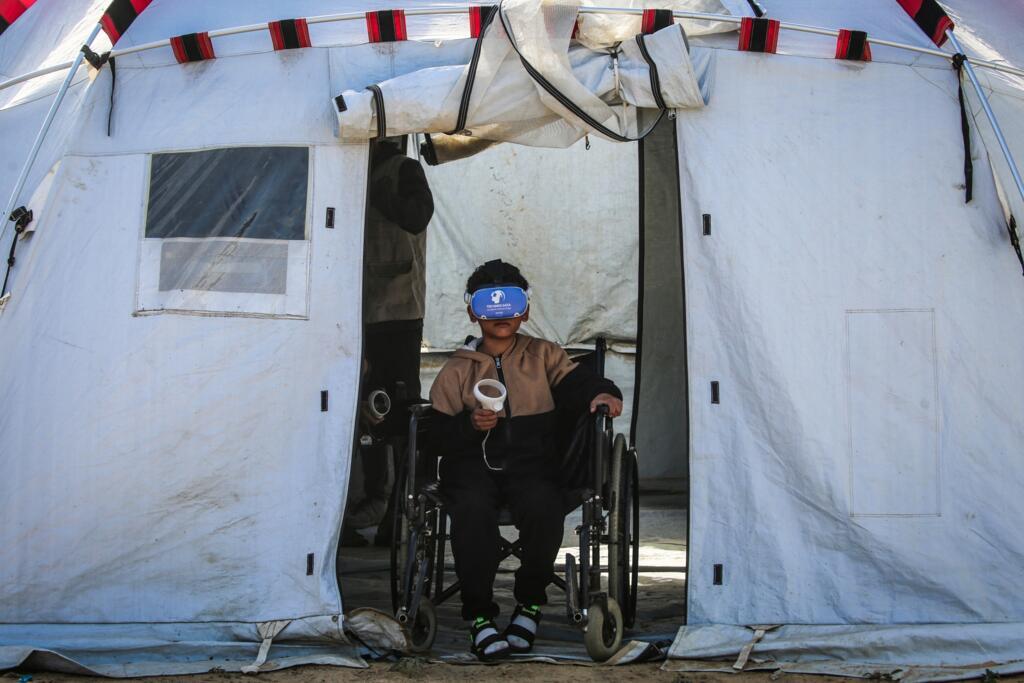
Al-Zawayda (Palestinian Territories) (AFP) – Children scarred by the war in Gaza are undergoing a therapy programme using virtual reality headsets that transport the youngsters to a world far away from the destruction around them.


Issued on: 02/12/2025 - RFI

Palestinian children using goggles and a joystick experience virtual reality as part of a therapy programme © Eyad Baba / AFP

The VR therapy is aimed at improving the children's psychological wellbeing, with operators saying it can achieve results more quickly than traditional therapy sessions.

Inside a white tent pitched on a sandy patch of ground in Al-Zawayda, in central Gaza, excited chatter swelled as five boys roamed around a virtual world.

The youngsters, one in a wheelchair and the others on plastic seats, turned their heads, exploring the new surroundings inside their goggles: a land of green gardens, tranquil beaches and safe cities.

The VR sessions utilise programmes specifically designed for traumatised children © Eyad Baba / AFP

One boy reached out and clapped his hands together, as if swatting a fly. Another, smiling, with his hand held up in front of his face, reached out to touch the scenery.

One said a dog was running towards him, and beckoned to it, calling out: "Come! Come!"

"I see birds," the boy in the wheelchair told an operator, looking around.

One of the operators delicately put the blue TechMed Gaza headset on 15-year-old Salah Abu Rukab, who sustained a head injury during the war, asking if he could see the VR properly as he adjusted the buckles.

A medical technology support team member gets ready to fit the VR headset 
© Eyad Baba / AFP


"We feel comfortable in it, we enjoy it, and through it we enter a garden, we enter spaces with animals and similar experiences," the teenager told AFP.

Asked by the operator what he saw, he replied: "It's all trees. Nothing but trees, grass and flowers."

'Positive results'

Mental health supervisor Abdalla Abu Shamale explained there was more to the VR headsets than simply escape.

"Through programmers, we are able to design games with therapeutic, preventive and developmental goals that help prepare the child or enable them to cope and manage their life more effectively," he told AFP.

The virtual reality programme helps children rebuild positive perceptions of the world © Eyad Baba / AFP


"This method has proven its effectiveness over a full year of working with many children, including war-amputee children, injured children and those exposed to extremely traumatic events."

A fragile ceasefire in the war between Israel and the Palestinian militant group Hamas has held since October 10.

The World Health Organization says conflict-related injuries carry a mental health toll, and survivors struggle with trauma, loss and daily survival, while psychosocial services remain scarce in Gaza.

Jonathan Crickx, spokesman for the UN children's agency UNICEF, told AFP that around one million children, or in other words, "all children in the Gaza Strip, are in need of mental health and psychosocial support after two years of horrendous war".

Inside the VR goggles lies a world of safe cities, mountains and greenery 
© Eyad Baba / AFP


The VR sessions rely on programmes specifically designed for traumatised children, taking into account their physical and psychological condition, and help them rebuild positive perceptions of the world.

Abu Shamale said the children were "treated and accompanied through VR sessions, and when we integrated them into these techniques, they showed a very, very strong response and extremely positive results.

"The speed of treatment, recovery and reaching stability using VR techniques was faster than in regular sessions. In regular sessions without VR, we usually need about 10 to 12 sessions, while with VR we can achieve results in just five to seven sessions," he said.

© 2025 AFP


How South Korea's brief martial law upended lives


Seoul (AFP) – When South Korea's leader declared martial law a year ago, one young woman blocked a tank, a civil servant resigned in protest and a lawmaker switched sides to remove him from office.


Issued on: 02/12/2025 - RFI


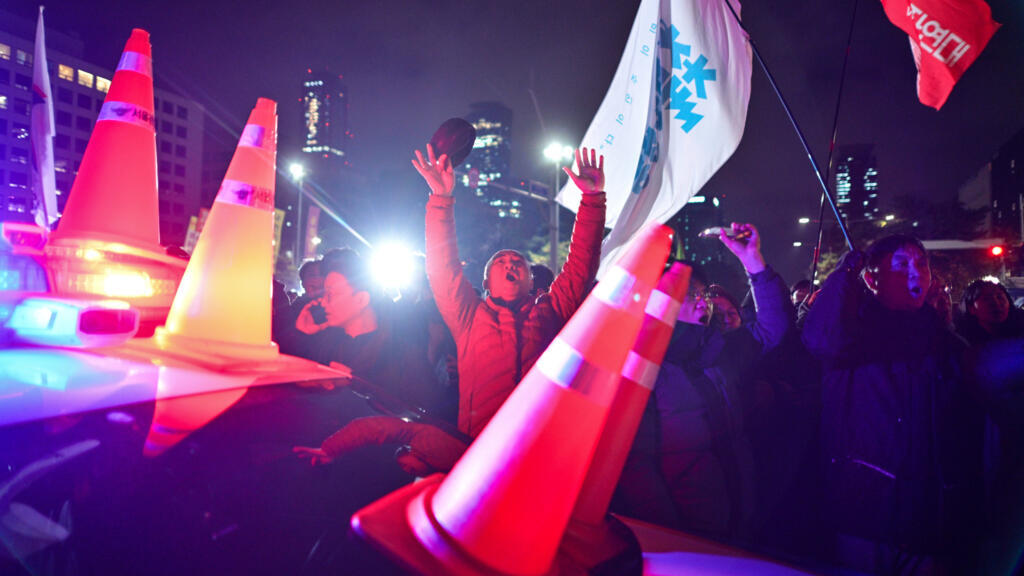
Thousands of protesters, as well as soldiers and tanks, filled Seoul's streets shortly after leader Yoon Suk Yeol declared martial law © Anthony WALLACE / AFP/File

They are among the many South Koreans whose lives were transformed on December 3, 2024.

That wintry night, then-president Yoon Suk Yeol interrupted national television broadcasts to suspend civilian rule for the first time in more than four decades.

Soldiers and tanks deployed in central Seoul. Troops landed by helicopter, smashing windows and storming parliament as lawmakers fought to overturn the decree.

With thousands of protesters filling the streets, the National Assembly voted within hours to nullify Yoon's order.

A year on, AFP spoke to three people who were there fighting to protect democracy, and whose lives will never be the same.
Lawmaker with 'nowhere to go'

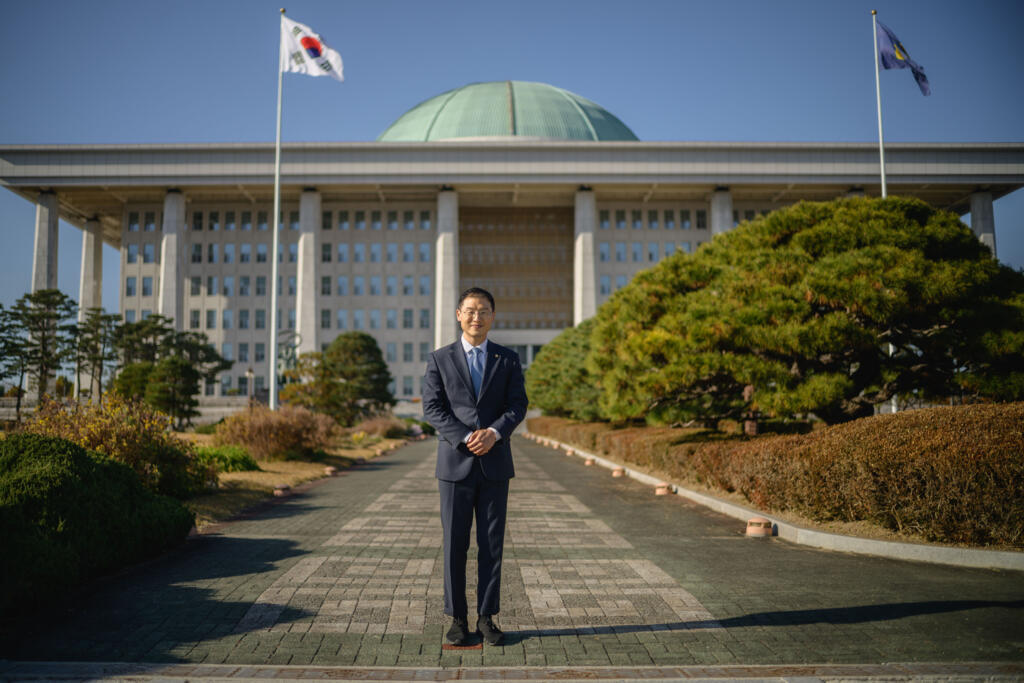
Freshman lawmaker Kim Sang-wook rushed to the National Assembly, where he faced down armed soldiers.


South Korean lawmaker Kim Sang-wook says the short-lived martial law 'gave my life and my politics a direction' © Anthony WALLACE / AFP


"I shouted, 'The National Assembly is not a place for you to enter!'" he told AFP.

Kim was a member of Yoon's conservative People Power Party party, but he felt martial law had to be undone.

After helping to halt the decree in an emergency vote, Kim found himself working with the opposition to impeach the president.

They were eight votes short, and Kim took the lead in persuading his colleagues.

Just over a week after the short-lived martial law, on December 14, a dozen lawmakers from Yoon's ruling party helped pass the impeachment measure.

"The first thought was relief -- we had stopped it," Kim said.

"The next thought was, 'What do I do now, what happens now?'" he added, saying he had "nowhere to go".


South Korean lawmaker Kim Sang-wook sided with the opposition to block his party leader's martial law bid © Anthony WALLACE / AFP


As members of his party stormed out and the opposition cheered, Kim felt he "had been left completely alone in the world".

A photo of him sitting alone and crying in the chamber went viral.

After weeks of reflection, Kim publicly backed opposition leader Lee Jae Myung, who later became president.

Kim then also joined the party he once opposed.

"What happened after December 3 gave my life and my politics a direction," he said.

"I now know clearly where I should go, and for that, I am grateful."
Lone civil servant

Ryu Hyuk, then inspector general at the justice ministry, made his way to the office as soon as he heard Yoon's stunning decision.

Officials had already gathered there to discuss the martial law.


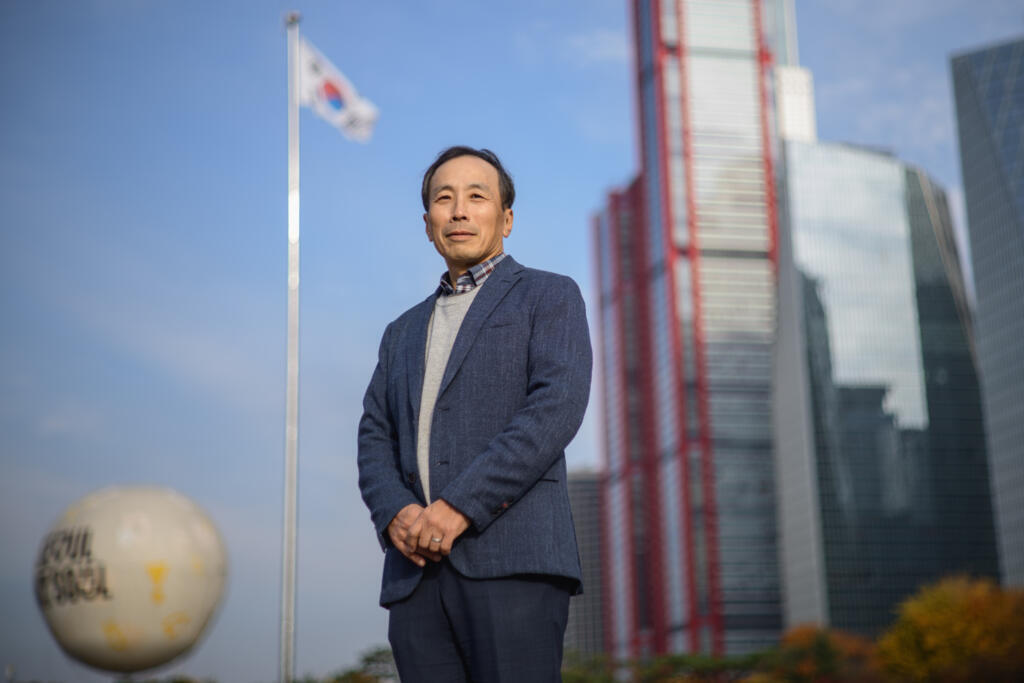
Ryu Hyuk was the first and only civil servant to resign during last year's martial law in South Korea © Anthony WALLACE / AFP


As the ministry's internal watchdog, 57-year-old Ryu told AFP he was convinced "it would not be appropriate to carry out any work related to that declaration".

He decided to quit, and as he scribbled a resignation letter, his anger surged.

Bursting back into the meeting room, he shouted: "No matter your political views, martial law is not acceptable."

He then walked out -- the first and only civil servant to resign during the crisis.

Ryu said with certainty that "if martial law had continued, many public officials would have shared my views".

Nearly a year later, he still has not decided where to turn next.

A registered lawyer, he could reopen his practice, but now usually spends his days scuba diving and running.


The woman who 'wasn't afraid'


When Korean student Kim Da-in saw a military tank turning towards the National Assembly, she ran at it without hesitation 
© Anthony WALLACE / AFP

Kim Da-in had only just learned how to drive but found herself speeding toward the National Assembly with her parents as martial law was declared.

"I think my family felt the weight of what martial law meant," Kim told AFP.

They arrived after parliament had struck it down, but the streets were still in chaos.

The 25-year-old then saw a military tank turning to the National Assembly, and ran towards it without hesitation.

"I wasn't afraid," she told AFP.

After that night, she joined protesters who took to the streets in the freezing cold and rallied outside Yoon's residence.

Seeing "the culture, the energy" that activists had created "made me think they can do anything", Kim said.


"And it made me want to be among them."

As South Korea's president, Yoon Suk Yeol suspended civilian rule for the first time in more than four decades © Anthony WALLACE / AFP/File

She is now preparing to switch from online university studies to a physical campus, where she can attend classes with some of those who had inspired her.

Kim has become known as "the woman who stopped the tank" after a video of her action went viral.

"I didn't think about gender when I stepped in front of the tank," she said.

"What I want to say... is simple: I intend to keep standing my ground."

© 2025 AFP


Hong Kong leader announces 'independent committee' to probe fire


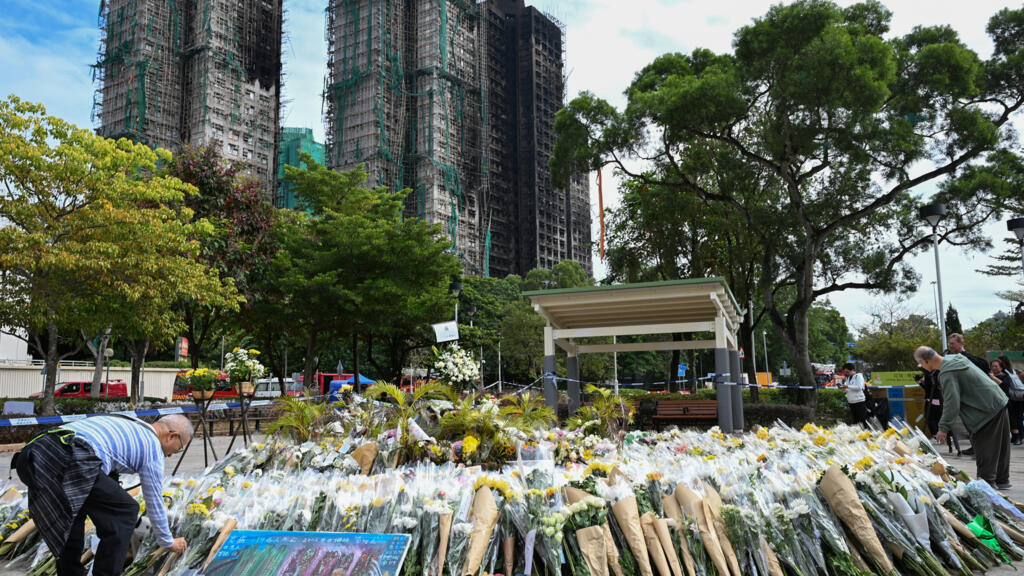
Hong Kong (AFP) – Hong Kong's leader announced Tuesday the creation of a judge-led "independent committee" to investigate the devastating fire at an apartment complex that killed 151 people last week.


Issued on: 02/12/2025 -  RFI

Hong Kong's leader says a judge-led committee will investigate the Wang Fuk Court fire that killed 151 people © Peter PARKS / AFP

Authorities have said the blaze, which was the city's worst fire in decades, spread quickly via netting used on exterior scaffolding that fell short of fire-resistance standards and failed to stop flames from spreading.

"I will establish an independent committee to conduct comprehensive and in-depth review to reform the building work system and prevent similar tragedies from occurring in the future," the city's leader John Lee told a news conference in English, adding that the committee would be led by a judge.

Hong Kong has a legal mechanism to set up "commissions of inquiry", which in the past were usually led by judges to undertake complex fact-finding exercises -- a practice left over from British colonial rule.

Lee used a different term, "independent committee", on Tuesday.

Lee told AFP that authorities had identified several failures, and that reforms would be needed in safety, supervision, construction and maintenance standards.

"We must act seriously to ensure that all these loopholes are plugged so that those who are responsible will be accountable. The shortcomings will be addressed. The bottlenecks will be addressed," he said.

"We will reform the whole building renovation system to ensure that such things will not happen again."

Hong Kong's anti-corruption watchdog and police, running a joint investigation, have arrested a total of 14 people, 13 of them on suspicion of manslaughter over the blaze.

"The responsible culprits tried to mix up substandard net with qualified nets so as to cheat inspection and law enforcement agencies," Lee said, calling the suspects "evil".

The city has seen a massive outpouring of grief as well as calls for accountability, but local media reported the arrests of several people who were calling for answers.

Miles Kwan, a 24-year-old student, was reportedly arrested by police for "seditious intent" after handing out flyers demanding government accountability.

An online petition containing Kwan's four demands, which included calls for an independent probe, gathered more than 10,000 signatures in less than a day before its contents were wiped.

Two other people, including former district councillor Kenneth Cheung, were also taken in by police, according to local media reports.

Asked about the arrests, Lee told AFP that "I will not tolerate any crimes, particularly crimes that exploit the tragedy that we have been facing now".

The world's deadliest residential building fire since 1980 broke out on Wednesday at the high-rises of Wang Fuk Court in the city's northern Tai Po district.

Police completed searches in five of the seven affected towers on Monday, finding the remains of victims in apartments, hallways and stairs.

Some families of victims returned to Wang Fuk Court on Monday to begin traditional funeral rites, which are expected to continue.

© 2025 AFP


Want Of Frigates: Why Is It So Hard For America To Buy Small Surface Combatants? – Analysis

“The last Fleet was lost to me for want of Frigates; God forbid this should.” Lord Horatio Nelson, letter to Viscount Castlereagh, Oct. 5, 1805

By Emma Salisbury

(FPRI) — The US Navy is hitting the reset button on its next round of small surface combatants. In a surprise announcement on social media, Secretary of the Navy John Phelan revealed that the service is stepping back from its Constellation-class frigate program to pursue ships that can be built faster. Under a new dealwith Fincantieri Marinette Marine, the Wisconsin shipyard will finish the first two frigates in the lineup, USS Constellation (FFG-62) and USS Congress (FFG-63). But the four ships that were supposed to follow? Those are getting cut before construction even begins. The Constellation class will follow in the footsteps of the Zumwalt class, cut mid-program and leaving a couple of orphan ships to sheepishly join the fleet.

The Constellation program has been sinking expensively for some time, so cancelling it is probably a good idea. However, the US Navy still has a requirement for 73 small surface combatants. It is reportedly in the middle of a fleet design review to assess how the service will develop these—but given the problems with Constellation and the other recent small surface combatant program, the Littoral Combat Ship (LCS), one would be forgiven for thinking that whatever comes next will struggle to be much better.

The United States is at a point where it hasn’t designed and built a good surface escort ship since the Arleigh Burke, at a time when its navy needs more and fast. The US Navy decommissioned the last of its previous frigate class in 2015 and is already retiring some of its LCS fleet after considerable operational problems. With no obvious small surface combatant to fill this gap on the horizon, America needs to figure out a new plan before the US Navy suffers from the same want of frigates as plagued Nelson.
Franken-FREMM

What began as a promising leap forward for the US Navy slowly took on the shape of yet another cautionary tale in American shipbuilding. The Constellation-class frigate was supposed to be a smart, streamlined answer to the US Navy’s need for a reliable small surface combatant—fast to build, packed with modern systems, and rooted in a proven European design. Its name echoed that of the original USS Constellation, the first ship ever commissioned in the U.S. Navy, and the program carried a similar sense of optimism: a vessel built for the complex maritime threats of the 21st century, balancing adaptability, stealth, and cutting-edge technology. But somewhere between that elegant vision and the stacks of revised design documents now crowding shipyard floors, the program began to list heavily to one side.


The idea behind the Constellation class was deceptively simple. Rather than reinventing the wheel—a habit that had often cost the US Navy dearly in time, money, and credibility—the service selected the FREMM, a highly regarded European frigate already in production. This was supposed to be the antidote to decades of acquisition headaches. Start with a proven design, add only what’s absolutely necessary to meet American requirements, and deliver the first ship in a reasonable timeframe. By tapping Fincantieri Marinette Marine in Wisconsin to build the ships, the US Navy would also strengthen a domestic industrial base hungry for stable work. On paper, the plan was a model of restraint and common sense.

In reality, that restraint didn’t last long. The US Navy began its modifications to the original design and the changes snowballed. Today, the number of alterations sits at more than 500. Commonality with the FREMM has dropped from the intended 85 percent to a mere 15 percent. The ship is now 23 feet longer, 500 tons heavier, and years behind its original schedule. A program designed to avoid the pitfalls of its predecessors had, instead, tripped headfirst into familiar ones.

The program’s turbulence has been driven less by technology or a lack of shipbuilding capacity than by chronic indecision, which is especially striking given the origins of the program. When the FFG(X) effort kicked off in 2017, the US Navy was trying to learn from the bruising experience of the LCS, a much-hyped vessel whose two variants were plagued by mechanical issues, overruns, and unmet expectations. Eager to avoid that fate, the service adopted a “parent design strategy”—in this case, leaning heavily on the FREMM to sidestep expensive development cycles. But as design reviews unfolded, the service kept adding “just one more” improvement. Metrics meant to track progress failed to flag growing complexity. And with pressure mounting to begin construction, work on the lead ship started before the design was anywhere near stable, the shipbuilding equivalent of laying a house’s foundation while still rearranging the blueprints.

Predictably, the consequences spiralled outward: components didn’t fit, systems interfered with each other, and the ship’s weight crept upward in increments that eventually reached more than 10 percent, a particularly dangerous margin for a vessel that needs both speed and upgrade capacity over its lifetime. That weight increase forced the US Navy to consider shedding propulsion capability just to keep the ship within survivable limits—a compromise that could reduce top speed and operational flexibility. The irony is painful: the US Navy pursued additional capability only to risk undermining the ship’s performance in ways reminiscent of the very problems they tried to escape after the LCS era.

The Constellation class was supposed to be a triumph of disciplined design and pragmatic acquisition. Instead, it has become a lesson in how quickly good intentions can be swamped by shifting requirements and institutional habits. The FREMM was chosen because it worked. The Navy believed it could take that reliability, add a handful of American enhancements, and field a frigate suited for modern maritime competition. What it got instead was a ship that barely resembles its parent with a construction timeline drifting steadily into decades. And now, it will only have two of them.


Where Now?


The vision behind FFG(X) wasn’t wrong. The US Navy genuinely needs a capable, cost-effective frigate to fill the widening gap between small patrol ships and large destroyers. It needs a vessel that can operate independently or as part of a larger group, armed with the sensors, weapons, and endurance demanded by a more contested and technologically sophisticated ocean. But visions require discipline to become reality, and discipline is what the Constellation-class program has lacked.

The question now is what next? The options depend on what Phelan and his team saw as the real problem with Constellation. If he disagrees with the concept of buying a design and wants an American-designed small surface combatant, that process will need to be completed swiftly and efficiently so that shipyards can start churning them out. However, given the US Navy’s poor record on designing its own ships over the past couple of decades, the smart money would be on this path leading to another long-overdue design plagued by cost overruns and operational problems. More budget, more time, and more little crappy ships.

If Phelan wants a frigate that works, cheaply and quickly, then the best option is to buy off the shelf again, but to stop the US Navy messing with the design beyond what is absolutely necessary for American requirements. Whether that involves going back to the 15 percent commonality version of the FREMM or picking another of the several decent frigates that exist (the British Type 26, the Spanish F110, or the South Korean FFX, to name only a few) as the parent design, the basic premise of the Constellation program can be resuscitated if design discipline can be held.

For once, the problem is not shipbuilding capacity. The core issue is whether the US Navy can be prevented from shooting itself in the foot for a third time. America’s ability to get the small surface combatants it needs depends solely on the US Navy’s willingness to pick a design and leave it alone long enough for a shipyard to actually build it. This should not be such a difficult task to accomplish.


About the author: Dr. Emma Salisbury is a Non-Resident Senior Fellow in the Foreign Policy Research Institute’s National Security Program, an Associate Fellow at the Royal Navy Strategic Studies Centre, and a Contributing Editor at War on the Rocks.


Source: This article was published by FPRI


Published by the Foreign Policy Research Institute

Founded in 1955, FPRI (http://www.fpri.org/) is a 501(c)(3) non-profit organization devoted to bringing the insights of scholarship to bear on the development of policies that advance U.S. national interests and seeks to add perspective to events by fitting them into the larger historical and cultural context of international politics.
The Fugitive Oligarch, The Cryptocurrency, And A ‘Wild’ Kremlin-Blessed Sanctions Evasion Scheme – Analysis


The Russian State Financial Network Behind A7A5: The A7A5 stablecoin is backed by a network of Russian state-owned banks, with Promsvyazbank (controlled by former spy chief Mikhail Fradkov's son) holding ruble reserves for the token. The scheme involves sanctioned entities including crypto exchanges Garantex and Grinex, and appears designed to facilitate cross-border payments while circumventing international sanctions. Graphic: RFE/RL Graphics, Source: Media reports


December 2, 2025 
RFE RL
By Mike Eckel and Ernist Nurmatov

What do a fugitive Moldovan tycoon and a Kyrgyz-based cryptocurrency have to do with Russia’s efforts to evade Western war sanctions and build an entirely new financial system separate from the West?

Russian President Vladimir Putin provided a clue in early September when he attended a virtual ribbon-cutting ceremony for the opening of a financial services company’s new branch in the Pacific port city of Vladivostok.

It’s not the type of event Putin typically attends. Newly launched battleships? Yes. Kremlin medal-award ceremonies? Yes. Branch openings? Not so much.

But the company, A7 LLC, is not your typical financial services firm.

Its top executives include Ilan Shor, a fugitive oligarch implicated in what’s been called the “theft of the century”: a scandal involving more than $1 billion stolen from Moldova, one of the poorest countries in Europe. His co-executive heads Russia’s eighth-largest bank, closely tied to Russia’s military-industrial complex — and happens to be the son of a former Russian prime minister and former intelligence director.


In short speeches to Putin via video link, the two boasted of how much money their company had handled in the 11 months since A7’s establishment: more than 7 trillion rubles ($12.4 billion).

If true, that’s a lot of money: as much as 12 percent of the foreign trade of all Russian businesses taken together, according to one calculation.

And then there’s the cryptocurrency A7 launched in January.

Called A7A5, the coin recorded $41.2 billion in total transfers by July; by August, it was up to $51.2 billion. As of November, A7A5 — which is the world’s first ruble-pegged stablecoin — had reported some $79 billion in volume since its launch, according to Chainanalysis, a New York-based firm that has done extensive research on A7.

“That is a phenomenal amount of money. That is enormous, for an organization that didn’t exist a year ago,” said Elise Thomas, an Australian researcher and author of multiple reports by the Center for Information Resilience, a London-based NGO that focuses on rights abuses and war crimes. “That’s wild. The scale of it is really significant.”

“The personal involvement of Putin in opening their Vladivostok office, that shocked me as well, that he was sort of willing to personally put his face in connection with the opening of A7,” she said in an interview.

With a thread running from Moldova to the glittery skyscrapers of Moscow’s Federation Tower to Kyrgyzstan, whose leaders want the small Central Asian country to be a mecca for crypto innovation, A7A5, Western and Moldovan officials say, is key to the Kremlin’s efforts to blunt Western sanctions imposed following Moscow’s 2022 all-out invasion of Ukraine.

“The A7A5 token…is a unique sanctions evasion tool,” said Andrew Fierman, head of national security intelligence at Chainanalysis.

And not just sanctions evasion. The Kremlin’s wider goal is to build a parallel financial system, experts say, outside the existing networks where Western banks and the US dollar dominate.

“It’s a big deal because of who Ilan Shor is, and the fact this is designed…to try to operate outside of the reach and influence of the US-dollar denominated, traditional financial systems,” said Carole House, who has served as White House national security council adviser for cybersecurity policy.

“It’s wild to see that kind of support coming directly from the government, but also not surprising given the objectives they want, to offset the impact of sanctions,” she said.

The efforts have not gone totally unnoticed in the West.

On October 23, the European Union announced sanctions against A7A5, A7, and related companies, calling the cryptocurrency “a prominent tool for financing activities supporting [Russia’s ] war of aggression.”

Neither A7 nor A7A5 responded to e-mails sent by RFE/RL seeking comment. Shor did not respond to an interview request.
A Central Asian Mecca For Crypto

Since at least 2021, the government in Bishkek has tried to turn Kyrgyzstan into a cryptocurrency hub, seeking to attract investors, miners, and exchanges. As of 2025, it reported at least 13 crypto exchanges registered, and it has laid the groundwork for a national cryptocurrency called USDKG.

Corporate registry documents obtained by RFE/RL from the Kyrgyz Justice Ministry show that the issuer of the A7A5 stablecoin is a Kyrgyz company called Old Vector, which was first registered in December 2024. The documents also show that the company providing the coin to Old Vector is A7-Kyrgyzstan LLC.

Between January and July, the registered headquarters for Old Vector was a small, ramshackle house surrounded by newer, more upscale buildings and single-family homes.

In July, when RFE/RL reporters visited the house, which is set back from the dirt road behind a rusting blue metal fence and concrete blocks, two young boys who answered the door said they were unaware of any company that was registered at their address. A next-door neighbor said there was no company by that name at that address.

About a month later, Old Vector’s corporate headquarters moved to a different address on the outskirts of Bishkek, a multistory building called South Park made up mainly of apartments.

A7 itself has registered a number of interrelated companies in Bishkek, according to Justice Ministry documents obtained by RFE/RL.

A7-Kyrgyzstan, which was registered on January 17, is housed on the upper floors of a complex that used to be a major shopping center. RFE/RL reporters tried to access the floor where the offices were reported to be, but security guards blocked them from entering.

Another Shor-related entity called Evrazia has also registered trademarks for several similarly named companies in Bishkek. Established in Moscow as a nonprofit organization, Evrazia has been implicated in a range of activities aimed at destabilizing elections in Moldova. The European Union hit Evrazia with sanctions in October 2024.

Though launched in January, A7A5 itself did not begin trading publicly until February, when it appeared on a Moscow cryptocurrency exchange called Garantex.

“Garantex had drawn scrutiny for years from Western law enforcement, which alleged it served as a conduit for funds used in money laundering, ransomware, computer hacking, and sanctions violations. The exchange was popular because, among other things, it allowed an easy way to exchange cryptocurrencies for more popular stablecoins like USDT, which is pegged to the dollar, making it easier to cash out for less volatile currencies.

In 2022, the US Treasury Department hit Garantex with financial sanctions. But it wasn’t until three years later that the exchange shuttered operations after two of Garantex’s principal operators were indicted by a US grand jury for money laundering. US authorities seized several Garantex websites. German and Finnish agencies confiscated servers hosting Garantex’s operations. More than $26 million in cryptocurrencies that officials said was used for money laundering was also seized by the US Secret Service.

In the weeks immediately preceding and following the March 2025 seizure, analysts said billions of A7A5 coins were shifted away from Garantex to a new exchange called Grinex, which was first registered in Kyrgyzstan the previous December. The vast majority of A7A5’s transactions now occur on Grinex and a smaller exchange called Meer.kg.

The connection between Grinex and A7 is unclear. A Kyrgyz man named in Justice Ministry filings as the founder of Grinex refused to comment to RFE/RL on whether his company is related to the crypto exchange of the same name.

US financial investigators, however, say Grinex was created specifically to help traders whose funds were frozen when Garantex was shut down recoup their money — using A7A5.
A Tug-Of-War In Chisinau

Moldova has been at the center of a tug-of-war between Europe and Russia for years.

The 2020 election of Maia Sandu, a Western-trained economist who worked at the World Bank, tilted the scales to the West. Shor wants to tip the scales back toward Russia.

In 2014, Moldova was roiled by a massive bank fraud that resulted in more than $1 billion being siphoned out of the country — nearly one-eighth of its gross domestic product (GDP). Authorities accused Shor of being the mastermind of the “theft of the century” and he fled the country in 2019, splitting his time between Israel, then Moscow. He was sentenced in absentia to 15 years in prison in 2023 by a Chisinau court; his eponymous political party has been banned.

Over at least three election campaigns, Moldovan and Western officials say Shor has repeatedly sought to buy votes, spread disinformation, and even recruited and trained young Moldovans to stoke unrest and provoke police. Among the schemes officials say they uncovered involved money transfers to Moldovans using bank cards issued by Promsvyazbank, the state-owned Russian bank that Shor has partnered with.

Shor worked with “Russian individuals to create a political alliance to control Moldova’s parliament, which would then support several pieces of legislation in the interests of the Russian Federation,” the US Treasury Department said in October 2022, when he was first sanctioned.

In the run-up to last year’s presidential election, Moldovan authorities accused Shor of orchestrating a scheme that funneled more than $15 million from Russian banks to the accounts of more than 130,000 Moldovan citizens.

The scheme included sending pre-loaded bank cards, using the Russian “Mir” card payment system, to people who could travel to the breakaway Transdniester region to withdraw cash. Officially part of Moldova, Transdniester operates in a legal twilight zone, with close economic ties to Moscow.

Shor’s Moscow-based nonprofit group Evrazia also recruited hundreds of young Moldovans to participate in an outreach program, offering free trips to Russia, fine dining, and a shot at millions of rubles in grants.

Moldova’s prime minister later said Russian agents spent nearly $220 million in total trying to influence the 2024 vote, which Sandu won with about 55 percent of ballots cast. A simultaneous referendum asking Moldovans about joining the European Union passed but was far closer than predicted.

Days before September’s parliamentary elections, Moldovan authorities said they had uncovered another destabilization campaign and conducted raids at scores of locations around the country, arresting more than 70 people. Some of those arrested had allegedly traveled to Bosnian and Serbian camps for training to confront and provoke police. The campaign, Moldovan authorities said, used “the Shor group’s network and external resources.”

“The sanctions evasion and the [Moldovan] political interference, I don’t think they are directly connected,” Thomas said. “I think the sanctions evasion is the main game at the moment. Having said that, obviously, Shor has significant personal stakes in Moldova and probably cares about it a lot at a personal level.”

“What Shor’s doing, it’s not just a Moldovan problem,” said one Moldovan official who spoke on condition that he not be named. “He provides Russia with a service, to evade sanctions, and he makes money off of it.”

Promsvyazbank did not respond to messages seeking comment.
‘An Infrastructure Resilient To Any External Influences’

Since around 2022, much of Russia’s banking system has been isolated from Western financial networks, in response to the Ukraine war. The banking sector has been cut off from SWIFT, the messaging system that is essential for global banking operations, while Visa and Mastercard have cut off Russia from their payment systems and Western banks have frozen Russian government accounts.

As a result, Russian authorities have tried to build a parallel financial system. Other countries have signaled support for the effort, including China, Brazil, India, and other major economies.

“The development of the A7A5 token appears to be the next logical step in Russia’s efforts to develop alternative payment systems to circumvent sanctions,” Fierman said.

As Putin watched at the September 4 event in Vladivostok, Shor appeared nervous, shifting from side to side as he described the goals of the “financial hub” called the Far Eastern International Financial and Settlement Center.

“To date, in 10 months of operation, we have conducted more than 7.5 trillion rubles worth of transactions,” he said. “Today, given that more than 50 percent of all our settlements are made to Asian countries, we have decided to open a financial hub here.”

Standing alongside Shor was his co-executive: Pyotr Fradkov, who has headed the Moscow-based Promsvyazbank since 2018. His father is Mikhail Fradkov, Putin’s prime minister from 2004-2007 and director of the Foreign Intelligence Service for nine years after that.

Known as PSB, Promsvyazbank was nationalized by the Russian government that same year amid a banking crisis and repurposed to serve Russia’s growing military industrial sector. In 2022, PSB was hit by Treasury sanctions, as was Pyotr Fradkov.

Promsvyazbank holds 49 percent of A7. The rubles the A7A5 coin is pegged to, making it a stablecoin, are deposits held by the bank.

A7 is housed in the gleaming new modern skyscrapers of Moscow’s Federation Tower — the same location Garantex was registered at, along with several companies alleged to be tied to notorious ransomware schemes.

A7 is also making its own push to become a “brick-and-mortar” company by opening up branches for customers to make deposits, withdraw cash, trade cryptocurrencies, and make cross-border payments. Aside from Moscow and Vladivostok, the company says it is setting up branches in cities abroad such as Harare, Zimbabwe, and Lagos, Nigeria.

In July, A7 announced that PSB clients would be able to buy A7A5 tokens using PSB bank cards.

That same month, the European Union targeted A7 for the first time, saying it was “linked to efforts to influence the presidential elections and the 2024 constitutional referendum on EU accession.”

Around the same time, the number of A7A5 coins in circulation surged by more than 240 percent, according to Elliptic, an analytics firm, with over $1 billion in daily transfers of A7A5.

Chinese companies and individuals are reported to be the largest user of A7 payment platforms to date, according to corporate marketing documents published online and highlighted by the Center for Information Resilience.

Western authorities are struggling to keep up.

In mid-August, about three weeks before Shor and Fradkov appeared in the video conference with Putin, US and British authorities hit A7 and more than a half dozen interrelated companies, including Grinex and Old Vector, with more sanctions.

A month later, however, A7A5’s total market capitalization — essentially, the value of all the coins in circulation — skyrocketed by nearly 250 percent, making it the largest stablecoin not pegged to the US dollar.

“We have already proven that a national digital currency can be not only an alternative to the dollar but also a driver of global change,” A7A5 said in a triumphant post to Telegram.

The European Union then responded on October 23 with more sanctions targeting Russian-linked crypto assets and its second round targeting A7.

In a post to Telegram, A7A5 mocked the announcement.

“What will this change? Nothing!” the company said. “Because from the very beginning, we built an infrastructure that was resilient to any external influences and restrictions.”


Senior International Correspondent Mike Eckel reported from Chisinau and Prague. RFE/RL Kygyz Service Correspondent Ernist Nurmatov reported from Bishkek.


RFE RL

RFE/RL journalists report the news in 21 countries where a free press is banned by the government or not fully established.


ALASKA

Pebble Mine, Halted By EPA Order, Gets Support From National Development Groups

Kaskanak Creek in the Bristol Bay’s Kvichak watershed is seen from the air on Sept. 27, 2011. The Kvichak watershed would be damaged by the Pebble mine project, the Environmental Protection Agency has determined. (Photo provided by Environmental Protection Agency)

December 2, 2025 

 Alaska Beacon
By James Brooks

(Alaska Beacon) — Developers’ efforts to overturn the cancellation of a vast gold and copper mine planned for southwest Alaska are getting a boost from national mining and pro-business groups, including the U.S. Chamber of Commerce.

On Nov. 24 and Nov. 25, the Chamber and the National Mining Association filed separatefriend-of-the-court briefs in the lawsuit brought by the developers of the proposed Pebble Mine against the Environmental Protection Agency, which vetoed the mine.

Neither group has intervened in the case against the EPA, but the briefs represent the groups’ support for the proposed mine and offer legal arguments that Judge Sharon Gleason could consider as she debates whether to move the project forward.

In 2023, the EPA invoked a rarely used “veto” clause of the Clean Water Act to say that there was no way that the proposed Pebble Mine could be developed without significant harm to the environment. The large mineral deposit is located at the headwaters of Bristol Bay, the most abundant sockeye salmon fishery in the world.

The administration of Gov. Mike Dunleavy, which supports the project, and the proposed mine’s developers, filed separate lawsuits in federal court to overturn the rejection, as did two Native corporations that work as contractors for the developers. Those cases have since been combined.

The U.S. Supreme Court declined to hear the case directly, which has left the issue in front of Judge Sharon Gleason in the U.S. District Court for the District of Alaska.

Another lawsuit filed by the state claims that if the veto is upheld, the federal government will owe Alaska $700 billion, the state’s estimate for the value of the mine if built as planned. That case has been put on hold until the District Court rules.

In July, the administration of President Donald Trump indicated that it might try to settle the suit and withdraw the veto. If that occurs, it could come before Jan. 2, when the EPA is slated to file a written response to the plaintiffs’ motions for summary judgment.

If the EPA continues to fight the case, the last written arguments are scheduled to be finished by the end of February. Any oral argument would take place afterward.

If the federal government drops the case, it doesn’t mean a free path for Pebble: Several environmental organizations, fishing groups, tribal organizations and Bristol Bay locals have also intervened in the case and intend to fight in court.

The Alaska Legislature is also expected to consider a bill that would block both Pebble and any successor projects that might emerge.

In its brief, the National Mining Association — joined by the American Exploration and Mining Association and the Alaska Miners Association — call the EPA’s veto “overly broad” and say that if it is upheld, the act “will almost certainly chill investment in domestic mining activities” because other proposed mines could also be subject to a veto.

The Chamber of Commerce, which has backed the Pebble Mine project since at least 2022, said that if the veto is upheld, it has the potential of encouraging other vetoes, which would “disrupt important industries in which many of the Chamber’s members participate.”


Alaska Beacon

Alaska Beacon is an independent, nonpartisan news organization focused on connecting Alaskans to their state government. Alaska, like many states, has seen a decline in the coverage of state news. We aim to reverse that.
Tehran Chokes As World’s Most Polluted City, A Deadly Price For Regime Neglect – OpEd


File photo of pollution in Tehran, Iran


December 2, 2025 
By Shamsi Saadati


While millions of Iranians gasp for breath, the clerical regime has turned the nation’s cities into toxic death traps. In recent days, Tehran has earned the disgraceful title of the world’s most polluted city, surpassing even New Delhi, forcing the shutdown of schools and businesses across 14 provinces. The regime’s own media outlets describe the capital as being “lost in smog” and “trapped in a cage of pollution,” a grim acknowledgment of a crisis that is spiraling out of control.

This environmental catastrophe is not a natural disaster or an unfortunate byproduct of development. It is a crime, meticulously engineered by the corrupt ruling theocracy under Supreme Leader Ali Khamenei. The poisoned air choking Iran’s citizens is the direct result of systemic corruption, criminal negligence, and a conscious policy that prioritizes the enrichment of regime mafias and the funding of terrorism over the lives and health of the Iranian people.
The deadly toll of a man-made catastrophe

The human cost of the regime’s policies is staggering. According to the regime’s own Deputy Health Minister, 58,000 Iranians die prematurely from air pollution-related illnesses every year—a figure more than double the fatalities from road accidents.

This is a public health emergency by any measure. Official reports reveal that air pollution is responsible for:24% of all lung cancer deaths in the country.

28% of all fatal strokes.

30% of deaths from heart attacks.

In total, an astonishing 15% of all deaths in Iran are attributable to the toxic air, a rate significantly higher than the global average. This slow-motion massacre also carries a devastating economic price tag. The World Bank estimates that pollution costs the Iranian economy over $23 billion annually, wiping out nearly 5% of the nation’s GDP through healthcare costs and lost productivity.
An engineered crisis: regime mafias and criminal neglect

The regime publicly blames factors like the “dilapidated vehicle fleet,” but fails to mention that this fleet is the product of a corrupt automotive mafia controlled by Khamenei and the IRGC. These entities intentionally produce substandard vehicles that consume over 10 liters of fuel per 100 kilometers, double the rate of standard foreign cars, to maximize their profits at the expense of public health.

Even more sinister is the regime’s reliance on burning mazut, a highly toxic fuel oil banned in much of the world. In a nation sitting on vast natural gas reserves, the regime has allowed its refinery infrastructure to decay and now forces power plants to burn this poison. This year alone, officials admit to distributing nearly 300 million liters of mazut, deliberately prioritizing power plants near major cities like Tehran, Isfahan, and Karaj. The regime’s claims of using “low-sulfur” mazut are a transparent deception; the supply is grossly insufficient, and the Ministry of Oil has been granted a legal waiver to continue violating standards until early 2027, effectively sanctioning the poisoning of its own people.

This crisis persists not because of a lack of solutions, but, as one state-affiliated expert admitted, a “lack of political will.” The “Clean Air Act,” on the books since 2017, remains completely unimplemented. This deliberate inaction is the regime’s core policy.
A clear choice: terror and repression over people’s lives

While Iranians choke on poisoned air, Khamenei plows billions of dollars into his true priorities: the machinery of domestic repression, the illicit nuclear program, ballistic missile development, and funding terrorist proxies across the Middle East. The regime has the resources to fix this crisis but chooses not to. Other countries like China and South Korea have made significant strides in curbing air pollution through political will and investment, proving it is a solvable problem.

Under the presidency of Masoud Pezeshkian, who has been in office for over a year, the situation has only deteriorated. The number of “unhealthy” days in Tehran this year has increased by a staggering 40% compared to the same period last year. This demonstrates that no faction within the despotic regime offers a solution; they are all complicit in this crime against the Iranian people.

The toxic smog engulfing Iran’s cities is a physical manifestation of the regime’s corrupt and destructive nature. For the people of Iran, the fight for clean air is inseparable from the fight for freedom. The air will only become breathable when the nation is cleansed of this murderous theocracy.

Shamsi Saadati writes for the PMOI/MEK.