Thursday, February 26, 2026

From Jim Ratcliffe to the Ballot Box: How offshore billionaires still shape British politics

21 February, 2026 
Right-Wing Watch


There’s little surprise that Ratcliffe and Farage harbour respect for each other. As well as both loathing immigration, Reform's top donors use similar offshore arrangements, 75% of their funding comes from just three mega wealthy men with offshore ties.



When Sir Jim Ratcliffe, the Monaco-based billionaire and co-owner of Manchester United, pronounces that Britain is being “colonised by immigrants,” it’s worth asking not only what he means, but what influence men like him wield over the country they no longer fiscally support.

His remarks came just as parliament began considering one of the most significant reforms to Britain’s electoral system in years.

A long-overdue clean-up, but is it enough?

On February 12, MPs gave a first reading to the Representation of the People Bill, landmark legislation designed to reform how elections operate. While headlines focused on extending the vote to 16 and 17-year-olds, a provision that aims to tighten the rules around political donations gained less attention.

The bill would block companies from donating to political parties unless they have genuine British ownership or generate sufficient revenue in the UK. That change could prevent overseas billionaires from funnelling money into British politics through UK subsidiaries, a route that, until now, has remained open. It aims to stop foreign companies offering high-value gifts to MPs, who will not be able to accept them unless they are below £2,230. There will be no cap on donations by eligible individuals and corporations.

Given that in late 2024 Nigel Farage suggested that tech billionaire Elon Musk was giving “serious thought” to donating up to £100 million to Reform UK, a donation that could have been legal under existing rules, the new legislation can’t come soon enough.

Local government secretary Steve Reed, described the bill as ushering in “a new era for our democracy – one that protects against foreign interference and empowers young people.”

But does it go far enough?

The mega-donor problem

Anti-corruption campaigners argue it doesn’t. Transparency International UK has welcomed the closure of shell-company loopholes but warns that without caps on individual donations, the outsized influence of mega-donors will persist.

Its research found that 66 percent of private political donations in 2023 came from just 19 individuals. Meanwhile in the 2024 general election, parties collectively spent a record £92 million, highlighting the ever-increasing reliance of mega donors on election campaigns.

Duncan Hames of Transparency International UK argues this must change: “MPs now have a choice: settle for half-measures or use this bill to set a meaningful cap on individual donations, reduce campaign spending limits, and fully restore the independence of the Electoral Commission. If the government is serious about restoring trust, this is the moment to prove it.”

Without those changes, the super-rich can still legally purchase disproportionate access and influence. Prem Sikka, Labour member of the House of Lords makes such warnings. In a column for Left Foot Forward, he warns the new bill merely tweaks the current system and that it regularises bribes disguised as political donations.

“… political donations enable the super-rich to buy access to policymakers and shape public policies. Their interests are prioritised. The consequences for the rest are dire.

“Some of the reforms are welcome but they won’t end political corruption. The super-rich would continue to buy political influence.”


Tax exiles with political voice


The timing of the new bill is pertinent. Failsworth-born Jim Ratcliffe, whose fortune was built through his chemicals giant INEOS, moved his tax residence to Monaco in 2020. Residents in the tax haven city state don’t have to pay any income or property taxes. The decision is expected to make him £4 billion in tax savings. Once among Britain’s largest taxpayers, he no longer appears on tax contribution lists, though his wealth, estimated at around £17 billion, keeps him near the top of rich lists.

Compare Ratcliffe’s £0 in personal income tax in the UK to skilled worker migrants, who pay a median of around £9,100 a year in income tax, while health and care workers pay a median of roughly £3,500, according to government PAYE figures, These figures exclude national insurance, council tax, VAT and other levies, meaning total tax contributions are even higher.

“Immigrants are contributing much more to the economy than Jim Ratcliffe,” said Ala Sirriyeh, a senior lecturer in sociology at the University of Lancaster. “And so, I would just say: get your house in order before you start commenting on other people’s contributions.”

To rub salt in the wound, just weeks before his inflammatory immigration comments, during which is also falsely claimed the UK’s population had grown by 12 million since 2020, Ratcliffe secured £120 million in UK state support for INEOS operations.


His remarks were widely condemned. Outside Manchester United’s Old Trafford stadium, a billboard reads:

“Immigrants have done more for this city than billionaire tax dodgers ever will.”

Fans scarcely need reminding that without its foreign-born players, United’s starting eleven, and even its bench, would be threadbare. The global character of the game is obvious on the pitch every week. Why it appears not to be so to its billionaire co-owner is harder to understand or to reconcile with his anti-immigrant rant.

Predictably, Ratcliffe has also expressed admiration for Farage, describing him as “an intelligent man” with “good intentions.” Farage returned the regard, insisting that “Jim Ratcliffe is right” and repeating claims about immigration and public services to his 497,000 YouTube subscribers.

“And then you look at parts of London, for example, where the road names, the Underground signs, aren’t just in English, they’re in a foreign language as well. One million people in this country don’t speak any English at all, four million people living in this country barely speak passable English,” he said, adding:

“And that’s the point that he [Ratcliffe] was making – that big areas of our towns and cities have been changed into something completely different from what they were. And I don’t really care if Number 10 is in uproar or if much of mainstream media find his comments too difficult – I believe, firmly, that Jim Ratcliffe is right.”

This is how influence operates in modern politics.

The Populist Decoder offers a brilliant analysis of the danger of all this, arguing that “Ratcliffe’s colonised” framing isn’t accidental. It’s the great replacement narrative dressed in establishment respectability. When a £29bn fortune and a Manchester United owner says it, suddenly it’s not fringe conspiracy, it’s “legitimate concern” about demographic change.

“Farage’s defence completes the laundering: acknowledge the language was “clumsy,” then insist the substance was “fundamentally right.” This is textbook populist legitimisation—use an elite figure to test inflammatory rhetoric, then amplify it whilst maintaining plausible deniability through the “just raising concerns” shield.””

Offshore money and party funding

Then again, there’s little surprise that Ratcliffe and Farage harbour respect for each other. As well as both loathing immigration, Reform’s top donors use similar offshore arrangements, 75% of their funding comes from just three mega wealthy men with offshore ties.

A report from the Good Law Project shows, the largest portion of this comes from the British technology investor Christopher Harbourne, who lives in Thailand and has donated £13.7m to Reform.

A huge chunk of donations has also come from Jeremy Hosking, co-founder of Marathon Asset Management, who has given Reform £2.4m. The company has a subsidiary based in the Cayman Islands and is ultimately controlled by a firm based in Jersey.

And then there’s Richard Tice, a property tycoon and deputy leader of Reform UK, worth a reported £40 million. According to the Good Law Project, Tice as put millions of pounds worth of shares in his property empire into an offshore account. So much for his pledge to “take back control of our money.”


But this pattern is not new. A 2019 investigation by the Times found that the Conservative Party had received over £1 million before the 2017 general election from Britons based in tax havens or their UK-registered companies. Donors included Belize-based peer Michael Ashcroft, Monaco-resident property magnates David Reuben and Simon Reuben, and Michael Platt, Britain’s wealthiest hedge fund boss, who has lived in Switzerland and Jersey during this time.

Campaigning costs money. But surely a democracy cannot thrive if political competition depends on cultivating a handful of ultra-wealthy patrons, particularly those who have structured their affairs to minimise their own contribution to the public purse.

Half-measure or turning point?

The Representation of the People Bill is a step forward. Closing shell-company loopholes matters. Preventing foreign money from being laundered through UK subsidiaries matters.

Yet without caps on donations, tighter spending limits, and stronger oversight, Britain risks entrenching a system where politics is shaped not by citizens collectively, but by billionaires individually.

As Electoral Reform wrote in response to the Times’ report: “Now, no one denies that campaigning costs money. But politicians need to show some respect to their own profession by having an open and transparent funding regime: one which allows them to focus on their policy differences – not who has the largest number of rich friends based in tax havens.”

Which brings us back to Sir Jim Ratcliffe.

When those who have relocated their tax base abroad retain both a megaphone and the means to influence domestic politics, reform cannot stop at technical fixes. If the government is serious about restoring trust, it must ensure that political power in Britain flows from voters, not from offshore fortunes.


Gabrielle Pickard-Whitehead is author of Right-Wing Watch
Unite the union slams BAE systems for making ‘obscene’ profits while offering a raw deal to workers

20 February, 2026 
Left Foot Forward


'Without the skilled work of our members, the company doesn't make money."


Unite the union, the country’s leading trade union for defence and aerospace, has slammed military-industrial giant BAE Systems for making obscene profits while at the same time refusing to pay its workers a fair wage.

The union has also criticised BAE for attempting union-busting high court injunctions to prevent strikes.

The latest financial results show BAE’s full year operating profits increased by 12% to £3.32 billion. Meanwhile skilled workers at their Lancashire factories in Warton and Salmesbury are being forced to take industrial action due to a poor pay offer and assault on their terms and conditions.

Unite general secretary Sharon Graham said: “These profits are nothing short of obscene. BAE is making billions from government contracts and yet refuses to pay our members what they are worth. This is completely unacceptable – without the skilled work of our members, the company doesn’t make money.”

Additionally, it’s most recent trading statement shows that BAE Systems shareholders received £1.5bn in dividends in 2025.

In 2025, workers had a pay deal of 3.6 per cent imposed against their will, which was below the rate of inflation, and which represents a real terms pay cut.

Staff who work within the professional services areas of BAE Systems including aerospace engineers are furious that this is also below a pay offer made and accepted by BAE Systems shop floor colleagues, who received 4.5 per cent increase and an additional day of annual leave.

Unite regional officer Ross Quinn added: “Our members are furious at the lack of a decent offer; thousands of members crashed the company IT as they all tried to vote to reject the latest one as soon as the ballot opened. They will continue to demonstrate their anger on the picket line this month.

“BAE Systems continues to act in bad faith and with no real desire to resolve this dispute. Their actions mean workers’ anger continues to grow. This won’t end until BAE Systems come to their senses.”

Basit Mahmood is editor of Left Foot Forward
UK

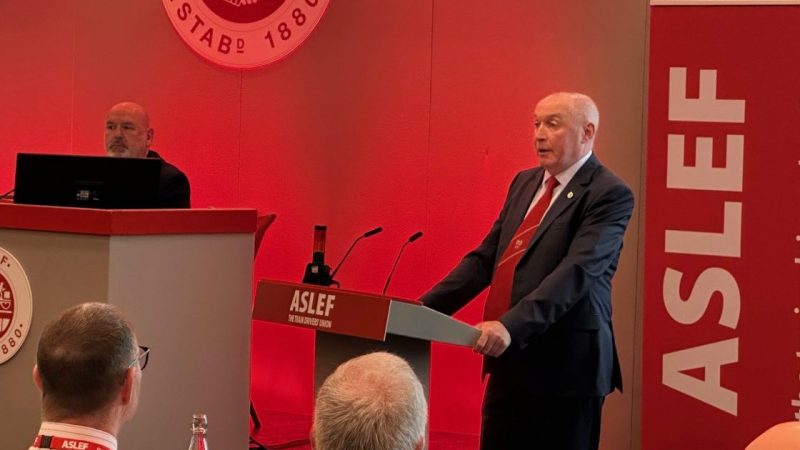
Meet ASLEF’s new general secretary, Dave Calfe

23 February, 2026 
Left Foot Forward


Dave Calfe speaks with Left Foot Forward about fully nationalising the railway, the Employment Rights Act and the Birmingham bin strikes


Forty-one years ago last week, Dave Calfe started out as a British Rail trainee train driver. On his first morning at the Carlow Street training school in Camden, he joined ASLEF union. The new intake, which was overwhelmingly male back in the 1980s, filled out their membership forms together and then listened to an initiation speech from the branch secretary.

Joining ASLEF was the done thing then, and apparently still is now. Today, ASLEF represents 96% of train drivers in England, Scotland and Wales. Meanwhile, Calfe is its newly elected general secretary, but insists this was not part of his grand plan when he joined the union as a shy 17-year-old.

Minimum age for train drivers

Calfe says ASLEF’s high uptake is down to the wins it delivers for workers. “We’re most definitely doing a lot right,” he says. Recent successes include resolving ASLEF’s two-year pay dispute when Labour was elected in 2024. The deal secured a 5% pay rise for train drivers in 2022-23, 4.75% for 2023-24 and 4.5% for 2024-25.

Since taking over from Mick Whelan on 5 January, Calfe has already secured an early win: the lowering of the age at which people can train to be a driver. After a seven year campaign by the union, the government will lower the age from 20 to 18 in July 2026, so that young people can enter the profession straight after leaving school. With around 40% of train drivers set to reach retirement age in the next five years, the change is hugely welcome.

Nationalising the railway

Over lunch with Left Foot Forward and a couple of other reporters, Calfe outlined his demands for this government. He wants to see a fully nationalised railway.

“We believe that all train services, freight and passenger should be nationalised in Great Britain, for the benefit of the taxpayer because money is leaking out of the system left, right and centre and it’s quite a bizarre way to run the railways,” he says.

Calfe says Labour should also bring the trains back into public ownership.


The three main Rolling Stock Companies (ROSCOs), Eversholt Rail, Porterbrook and Angel, lease out trains out to operators. In 2022/23, the companies, which are owned by investment management firms, paid out over £400 million in dividends to shareholders.

Calfe said the ROSCO system is “bizarre” not just because of the “onerous costs”, but because when operators want to make changes to a train, “you have to go back to the ROSCO and renegotiate with them to make a change to a train you’re paying for”.

In the Scottish Parliament last year, ASLEF urged the government not to use ROSCOs when replacing old ScotRail trains.

“Instead of governments going to ROSCOs and sort of mortgaging the rolling stock, they should raise the money through green bonds,” he says.

Calfe pointed to Merseyside as a successful example of direct ownership, where Labour Mayor Steve Rotheram has bought the Merseyrail trains outright. “They pay for themselves in a very short space of time,” Calfe says.

An Employment Rights Act “part two”


Asked about the Employment Rights Act, Calfe would be supportive of building on it with a “part two”. Though Calfe acknowledges that some parts of the act were dropped following lobbying from employers and the legislation going back and forth between the Lords and the Commons, he still describes it as the most “major change to employment legislation in a long time”.

One compromise watered down unfair dismissal rights from day one to a six-month qualifying period. “We could have perhaps waited longer for perfect, or we accept good. I think for the people it’s going to make a difference to, good is a good place to be,” Calfe says, adding that ASLEF will lobby Labour “to bring further improvements that got dropped off the bill for whatever reason and go in a future act.”

ASLEF’s relationship with Labour

Calfe recently signed the Restore Labour Democracy letter along with other trade union leaders and left-wing Labour MPs calling for an end to the factionalism under Keir Starmer’s leadership.

The general secretaries of Unite and Unison, Sharon Graham and Andrea Egan also signed the letter, as well as the Communication Workers’ Union and Fire Brigades Union.

Graham and Egan have already indicated that their unions could reconsider their affiliation to Labour.

However, Calfe said that at ASLEF, which has been affiliated to Labour since 1903, “we will continue to work with the government and make improvements not only for our own industry but for working people across the board”.

Regardless of what he thinks, he made clear that members would have to vote on affiliation at ASLEF’s conference.

When we spoke about the letter, Calfe seemed less concerned about the issues outlined in it. He said that the Labour movement “can get really wrapped up in a lot of things that working people don’t care about,” including who leads the party.

He said that Labour instead needs to focus on what people care about, including tackling insecure work and rebalancing the economy.
Reform

While most politicians and union leaders are alarmed by Reform’s lead in the polls, Calfe offers a more measured perspective.

He says that “Where Reform are is more a reflection of how disaffected people are with politics in this country. I don’t think it’s because they see Reform as some sort of saviour.”

Calfe seems optimistic that Labour can turn things around. “Three and a half years is a long time before the next election,” he says. He thinks that if Labour focuses on making working people better off, Reform may not maintain the lead it has now.


Birmingham bin strikes


There are some issues Calfe disagrees with Labour on. Much like Whelan, his predecessor, Calfe sees workers’ struggles as struggles that are shared across the union movement. Whelan was vocal about how doctors deserve to be paid more. Calfe, who has been to Birmingham to join workers on the picket line, said the bin strikes “have been made difficult when they don’t need to be difficult”.

Last week, the chancellor Rachel Reeves said the bin workers should get back to work. Labour-run Birmingham City Council got a court injunction banning people from protesting outside bin depots. Calfe has called on the government to step in and get Birmingham City Council back round the table with Unite.

“What you need to do is sit round a table and reach a resolution. Going to the courts does not resolve disputes,” Calfe warns.

The bin workers are being threatened with significant cuts to their pay. “None of us would accept it, would we, if someone came in and just said we’re going to take £8,000 a year off you,” he says.

“If we live in a democracy, the right to withdraw your labour is a fundamental part of living in a democracy and those workers have been balloted more than once, have returned to strike action in the same way that we went on strike to resolve our national dispute,” he says.

Olivia Barber is a reporter at Left Foot Forward
Young Britons signal overwhelming support for reversing Brexit
22 February, 2026 
Left Foot Forward

“The kids are alright…”


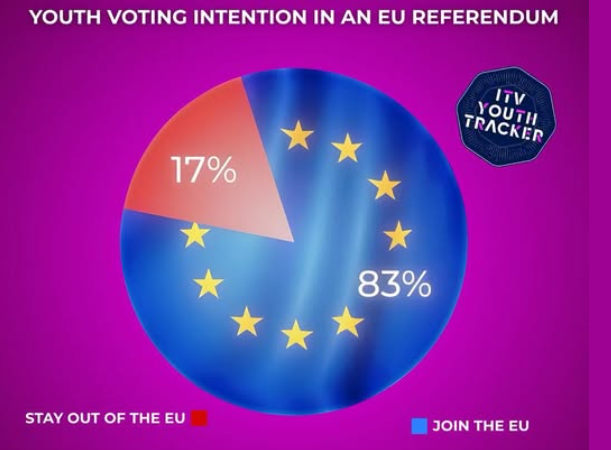
An overwhelming majority of young people in the UK say they would vote to rejoin the European Union if another referendum were held, according to new polling. The findings suggest that Britain’s youngest voters remain firmly pro-European nearly a decade after the Brexit vote.

The survey, conducted by Savanta for ITV’s Youth Tracker, sampled 1,040 UK-based 16- to 25-year-olds. It found that 83% would back rejoining the EU in a future referendum

Campaign groups were quick to respond. European Movement UK said the results demonstrate the need to take young people’s views seriously: “Young people are the future – it’s time we listen to them and ensure that future generations are not held back by the disastrous decision to cut our ties with the EU.”

Leeds for Europe said: “The kids are alright…”

Others commenting on the findings argued that the numbers reflect not only strong pro-European sentiment among young voters but also shifting demographics more broadly. Some pointed out that many older voters who backed leaving the EU in 2016 will be no longer alive, suggesting that the balance of opinion in the country may now look very different, and that the case for another referendum is strengthening.

Yet the poll’s findings are unlikely to be welcomed by the pro-Brexit press, which has recently intensified its criticism of Keir Starmer over his efforts to reset relations with Brussels.

This week, the PM urged for closer links with the EU, saying Britain is “turning its back” on the Brexit years.

He warned that the split with the EU had left the UK unable to use its influence internationally.

Speaking at the Munich Security Conference, Starmer said: “That has seen a Britain that has turned inward, a Britain that has not been able to assert itself and influence others on the world stage or the European stage.”

He also said the UK should more closely align with the EU economically as well as on defence.

He argued the UK should “move closer to the single market” in certain markets, where it was in the interest of both sides.

Predictably, parts of the right-wing press reacted with panic.

‘PM secretly plotting to lock us back into EU,’ splashed the Express’s front page on February 17.

It follows a series of recent Express front pages, squawking alarm over a potential EU return.

“PM wants to ‘rewind’ freedom Brexit gave us,” the front page screamed on February 2, implying Brexit delivered concrete freedoms, and Keir Starmer is now plotting to snatch them away.

We’ve said it before and we’ll say it again; the newspaper didn’t earn its “Brexpress “ nickname for no reason.

And no wonder they’re panicking, as Britain’s younger generation, those who will live longest with the consequences of Brexit, appear overwhelmingly open to reversing it.

Image credit: ITV Youth Tracker – Facebook screen grab
Reform UK admits plan to scrap Labour’s employment rights

24 February, 2026 
Left Foot Forward

'Reform have formally declared war on British workers.'


So much for caring about working people. Reform UK are set to confirm today what many of us have expected for a while, that they don’t give a toss about working people and want to erode their rights.

Deputy leader Richard Tice will today unveil the policy in a major speech setting out the party’s approach to growing the economy.

Tice will pledge to bring in a Great Repeal Bill to scrap new employment rights rules introduced by Labour, as well as pledging to get rid of the government’s pledge to achieve Net Zero by 2050 and improved rights for renters.

Labour chair Anna Turley said: “Reform have formally declared war on British workers. Nigel Farage and his cronies want to rip up hard-won workers’ rights on parental leave, sick pay, and would cut up to a million clean energy jobs in the process.”

The Employment Rights Bill introduced by the Labour government gives workers day one rights, bans zero hour contracts, and makes it easier for workers to campaign for better pay and conditions.

If Reform really cared about working people, they wouldn’t be repealing it. Then again, millionaire Nigel Farage doesn’t care about working people.

Basit Mahmood is editor of Left Foot Forward

Unison slams Reform UK for ‘disastrous plans’ to scrap employment rights

24 February, 2026 
Left Foot Forward


“The millionaires calling the shots in Reform don’t think those putting in a hard day’s graft deserve basic rights or fair pay."


Unison, which is one of the country’s largest trade unions, has slammed Reform UK and said Nigel Farage’s party is no friend of working people, after the party pledged to scrap employment rights if elected to office.

Deputy leader Richard Tice will today unveil the plans in a major speech setting out the party’s approach to growing the economy.

Tice will pledge to bring in a Great Repeal Bill to scrap new employment rights rules introduced by Labour, as well as pledging to get rid of the government’s pledge to achieve Net Zero by 2050 and improved rights for renters.

Labour chair Anna Turley said: “Reform have formally declared war on British workers. Nigel Farage and his cronies want to rip up hard-won workers’ rights on parental leave, sick pay, and would cut up to a million clean energy jobs in the process.”

The Employment Rights Bill introduced by the Labour government gives workers day one rights, bans zero hour contracts, and makes it easier for workers to campaign for better pay and conditions.

Commenting on Reform’s proposals, UNISON general secretary Andrea Egan said: “The mask’s off. Reform UK has shown what it really thinks of working people.

“The millionaires calling the shots in Reform don’t think those putting in a hard day’s graft deserve basic rights or fair pay.

“The party’s out-of-touch MPs have consistently voted against every measure to improve fairness and rights at work.

“But these new changes are popular with the public and could improve the lives of millions. Scrapping them would be a huge mistake.”

Reform also plans to introduce inferior pensions for council staff.

“Attacking the pensions of council staff is a disastrous move. Employees would be denied a secure retirement income and it would worsen the recruitment crisis in local government”, said Egan.

“Whether it’s targeting low-paid staff or demonising anyone from overseas, Reform has little interest in helping workers or strengthening public services.”

Basit Mahmood is editor of Left Foot Forward


Matt Goodwin said that Reform wants to put unions ‘under review’


23 February, 2026 
Left Foot Forward

"Reform UK can talk all it likes about being the "voice of workers", but putting public sector unions “under review” tells you exactly who they are."


Reform’s Gorton and Denton by-election candidate has said that the party would put public sector unions “under review” if it came to power.

Matt Goodwin made the comments in a speech in early December, just before the by-election was called.

As reported by the Financial Times, Goodwin said “[Reform] will place public sector trade unions under review”.

The Reform candidate made the comments in a speech at the “Battle for the Soul of Europe” conference organised by Mathias Corvinus Collegium (MCC), a private college and think tank linked to the Hungarian far-right prime minister Viktor Orbán.

The event took place in Brussels on 3–4 December last year.

Former Tory MP Danny Kruger, who was previously in charge of developing Reform’s radical proposals for government reform, said there “will need to be a programme of change around civil service unions”.

“It will not be acceptable for unions . . . to invoke their own independent political judgment to frustrate what ministers are requiring,” he said, but did not elaborate on what this meant.

GMB Union London reacted to Goodwin’s comments, saying: “Reform have spent months acting like they’re on workers’ side.

“Now they’re talking about putting trade unions “under review”. You can’t pose for photos with union members one minute and threaten their rights the next.

“Workers aren’t stupid, we see what this is.”

Steve Wright, general secretary of the Fire Brigades Union, wrote on X: “The mask slips.

“Reform UK can talk all it likes about being the “voice of workers”, but putting public sector unions “under review” tells you exactly who they are.

“That means attacking the organisations that defend pay, safety and conditions. And they’re open about going after public sector pensions too.

“Firefighters and other public servants won’t be fooled.”

Olivia Barber is a reporter at Left Foot Forward


Reform UK slammed over plan to scrap the Renters’ Rights Act


24 February, 2026 
Left Foot Forward


Reform’s plans would be "a gift to unscrupulous landlords"


Reform UK is set to pledge that it will scrap the Renters’ Rights Act if the party wins power.

Reform’s deputy leader Richard Tice is expected to claim scrapping the legislation will “boost the economy” by lowering inflation and creating jobs. It is unclear how weakening renters’ rights would benefit the economy.

The Act, which passed into law last October and will begin to come into effect this May, gives renters essential protections, including banning no-fault evictions.

It will also ban bidding wars, by requiring landlords to request an asking price and not accept offers above that.

Generation Rent has called the legislation “the largest set of changes affecting private rented homes since 1988”.

The law faced significant backlash from landlords. Tice, who has said he wants to scrap the “daft regulations”, has a multi-million pound property portfolio and a stake in multiple property development companies.

Danny Kruger MP, who recently defected to Reform, also owns a London rental property and earns over £10,000 a year from it with his wife.

Ben Twomey, Chief Executive of Generation Rent, which campaigns on private renters’ rights said: “Reform UK had nothing to say at the debates about the Renters’ Rights Bill when it was passing through Parliament.

“They also haven’t spoken to renter groups like us about their plans, which would be a gift to unscrupulous landlords who are responsible for the poor conditions renters face right now.

“Renters have fought for decades for laws that give people greater security in their jobs and homes. The public widely supports the new laws to protect us, so we urge Reform UK to show renters more respect and think again about what they are offering voters.”

Clara Collingwood, director at the Renters’ Reform Coalition, has pointed out that over 70% of the public support an end to section 21 evictions.

Collingwood said: “Scrapping the basic protections in this Act would be a huge setback for millions of renters, driving up homelessness and making life harder particularly for those on lower incomes – Reform should think again.”

Olivia Barber is a reporter at Left Foot Forward


Keir Starmer slams Reform’s plans to scrap Equalities Act as anti-British and shocking

19 February, 2026 
Left Foot Forward

'This is decades of protection, it goes to basic values, one of which is should women be treated as equal as men'


Prime Minister Keir Starmer has slammed Reform’s plans to axe the Equalities Act as “shocking” and anti-British.

It comes after Suella Braverman, who recently defected to Reform and is the party’s new education, skills and equalities spokeswoman, said that Britain is being ‘ripped apart by diversity, equality and inclusion’. The Equality Act is a key piece of legislation that prevents against discrimination in Britain.

The Equality Act 2010 is a UK law that legally protects people from discrimination, harassment, and victimisation in the workplace and wider society.

The act prevents discrimination against those with protected characteristics, including: age, disability, gender reassignment, marital status, pregnancy and maternity, race, religion or belief, sex and sexual orientation.

Braverman described protected characteristics as being “pernicious” and “divisive” and pledged to repeal the act on the first day of a Reform government.

The Prime Minister slammed the plans as “shocking” and un-British, warning legislation that has provided decades of protection for women would be ripped up.

During an appearance on BBC Breakfast, the Prime Minister said: “This is decades of protection, it goes to basic values, one of which is should women be treated as equal as men. That is core. That is British. That is something that was fought for and for Reform to say no more, under them we are to go back to old days when women not treated equally … I shudder to think what women think of anyone who wants to rip up that proposition.”

Basit Mahmood is editor of Left Foot Forward
Majority of Brits have a negative view of Trump’s ICE agency, YouGov poll finds

Yesterday
Left Foot Forward

Brits don't want ICE in the UK


Over half of Brits have a very or fairly negative view of Donald Trump’s Immigration Customs Enforcement (ICE) agency.

Trump came into office promising mass deportations, and his ICE agency has detained tens of thousands of migrants since.

At the beginning of the week, Reform UK’s Zia Yusuf pledged to bring a version of ICE to the UK.

Yusuf said in a speech in Dover on Monday that the UK’s ICE equivalent would have the capacity to detain 24,000 migrants at a time.

However, polling carried out by YouGov on Tuesday suggests that Brits do not approve of ICE.

The figures show that 63% of people in the UK have a very or fairly negative view of the immigration enforcement agency.

Only 11% of respondents said that they had a very or fairly positive view of it.

ICE has been condemned for its violent tactics, including recently fatally shooting unarmed citizens, Alex Pretti, Renée Good and Keith Porter.

Responding to the poll, internationalist campaign group, Best for Britain, said: “Two-thirds of Brits have a negative perception of ICE in the USA. Brits do not want ICE in our country.”

“We do not want communities ripped apart, violence in the streets, or identity being used as a weapon of an oppressive government.”

Olivia Barber is a reporter at Left Foot Forward

A terrifying prospect: Reform pledge to create ICE-style agency


23 February, 2026 
Left Foot Forward

Reform has gone full 
Trump


TweetShareWhatsAppMail


While scenes from America of ICE agents shooting U.S. citizens would’ve shocked most ordinary people, Reform have pledged to create a similar ICE-style agency in the UK.

The party’s spokesperson for Home Affairs, Zia Yusuf, has said that Reform will create a UK Deportation Command’, which would have capacity to detain up to 24,000 migrants at any time and will run five deportation flights a day if Reform wins power, the party will announce.

Reform have also said that they will end the indefinite leave to remain (ILR) status, should it come to power. The Labour Party has condemned the plans saying that they are divisive and show that Reform was planning “to deport people who have followed the rules, worked hard and built their lives here – our friends, neighbours and colleagues”.

The Labour party’s chair, Anna Turley, said the policies were “a direct attack on settled families and fundamentally un-British”. She added: “Britain is a proud, tolerant and diverse nation, which stands in opposition to the kind of divisive politics stoked by Reform.”

Yusuf has said that the ICE-style deportation agency will deport up to 288,000 annually on five flights a day.

Shocking images of violence and killings carried out by ICE officers in the U.S. have made headlines in recent weeks.

In one of the most recent incidents, federal agents shot and killed an intensive care unit nurse who had joined protests against an immigration crackdown.

Alex Pretti, a US citizen who lived in Minneapolis and worked as a nurse, became the second person to be fatally shot in the city during the Trump administration’s immigration enforcement crackdown this month.

Pretti is understood to have joined protests after Renee Good, also 37, was shot dead by an Immigration and Customs Enforcement (ICE) agent in her car earlier this month.

Bystander videos showed Mr Pretti with a phone in his hand, and his family insist he was not holding a gun when shot.

Despite most people being shocked at the violence, Reform it seems are keen to replicate an ICE-style agency in the UK.

Basit Mahmood is the editor of Left Foot Forward
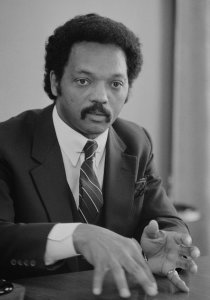
Jesse Jackson (1941-2026): An Assessment of a Civil Rights Icon

Monday 23 February 2026, by Malik Miah


JESSE JACKSON’s DEATH has brought about a look back at his life and what it shows about progress and retreat for civil rights and freedom. [1] Jackson was a bridge from the civil rights icon Martin Luther King, Jr, to today’s activists against the Trump MAGA white nationalist movement.

Today the victories of the civil rights revolution of the 1960s — the winning of civil rights (1964), Voting Rights (1965) and other laws ending legal segregation and discrimination — are being reversed. We are experiencing a counterrevolution against equality for peoples of color, with African Americans a special target.

Black history is denied. Confederate flags rise again in military bases. Is the return of Jim Crow segregation next?

The counterrevolution, which began in full throttle in the 1980s, continues to unfold under Trump’s authoritarian regime.

Born in Jim Crow South

Jackson was born in South Carolina, in the Jim Crow South. He became a close associate of King. We recall the iconic photograph of the civil rights leaders standing on the balcony where King was assassinated the next day. That was when King had gone to Memphis, Tennessee in 1968 to support striking sanitation workers.

King always spoke out for labor rights as well as civil rights. He was criticized by others in the movement who thought he went too far. Most major voices criticized King for speaking out against the Vietnam War in 1967, so soon after President Johnson signed the civil and voting rights acts.

King always argued legal equality was not enough for Blacks after centuries of super exploitation and oppression. He always compared Blacks starting a track race as being 50 yards behind better off whites. Affirmative action programs were necessary to move toward full equality. Today affirmative action lives on as Diversity, Equity, Inclusion (DEI) programs, programs that the Trump government strongly opposes.

Jackson identified with King’s determination and militancy. King appointed him to lead the Southern Christian Leadership Conference (SCLC) office in Chicago.

In 1971 Jackson set up in Operation PUSH (People United to Save Humanity) after leaving SCLC over differences with King’s replacement. PUSH continued the civil rights agenda that King had founded.

In 1984, Jackson set up the Rainbow Coalition as he prepared for a run for the presidency as a Democrat. His Rainbow Coalition campaign was based on the concept of a country based on hope (popularized by Barach Obama who was elected the first Black president 20 years later). The Rainbow Coalition represented ethnic diversity and stood against white nationalism.

Between his Operation PUSH to his presidential campaign in the 1980s, Jackson remained an outspoken critic of racist politics, even endorsing independent Black politics while supporting former comrades running for office in the Democratic Party. He demanded the hiring and advancement of Blacks in industry, banking and higher education, all institutions that in the Jim Crow era had been off limits.

Unlike many other civil rights leaders at the time, Jackson said African Americans might vote for Republican candidates if the Democratic Party did not work for its rights. His framework was always protecting the rights and well-being of African Americans. That’s why during his 1984 presidential campaign Jackson spoke up for Gay and Lesbian rights and for women’s equality.

Like King on Vietnam, Jackson spoke on international issues. He praised the Sandinistas after the 1979 Nicaraguan revolution, went to Cuba to help free some detained Americans and met with Cuban President Fidel Castro.

Jackson backed the anti-apartheid movement against South Africa and later met Nelson Mandela.

He voiced support for the freedom for the Portuguese colonies of Angola Mozambique and Gunia Bissau. He did so while official U.S. policy backed the military junta in Portugal.

Jackson’s activism stayed within the framework of the capitalist system. He supported building a strong Black middle class and threatened Wall Street firms that did not take affirmative steps of inclusion. He drew on the boycott tactic adopted during the Jim Crow era as a silent club against the big companies.

Independent Black Politics

While nodding to independent Black politics, King rejected that path. After his assassination, it was still not clear if Black participation in the political system was possible. There were few Black elected officials.

The left wing of the Black Power and civil rights movement (Black Panthers, League of Revolutionary Black Workers and African nationalists openly spoke against capitalism) advocated an independent Black freedom movement and party.

An important gathering occurred in Gary, Indiana, in 1972. Gary had elected one of the nation’s first Black mayors, Richard Hatcher. Many future Black elected officials and leaders came to the convention. Many on the left were also present, including myself. Some 10,000 delegates attended.

Jackson attended and gave a fiery speech. He spoke out even if the Democratic Party did not.

Jesse Jackson was a hero to millions. Even those of us on the socialist left praised his integrity and outspoken views on issues like Black Lives Matter and police violence.

Jackson was a living link to two periods. The first covered the legal segregation of the first 200 years of a country that never was the true democracy it proclaimed. The founding fathers (a majority of whom were slave owners) only considered that whites were U.S. citizens.

The second period only comes in the second half of the 20th century, with the passage of civil rights legislation. That’s when the country became a true capitalist democracy. It discarded legal segregation and belatedly began to recognize the talents of African Americans and other people of color. It is the 50 years of integration that Trump as an authoritarian ruler seeks to reverse.

Within the framework he accepted, Jackson’s life story represents what’s possible in a life dedicated to winning equality and freedom.

Source: Against the Current->https://againstthecurrent.org/jesse-jackson-1941-2026-an-assessment-of-a-civil-rights-icon/].

Footnotes

[1See also Joanna Misnik, 1988 “What Jesse Jackson Built — And Didn’t”.

USA

Nurses Leading the Class Struggle and Resistance to ICE


Sunday 22 February 2026, by Dan La Botz


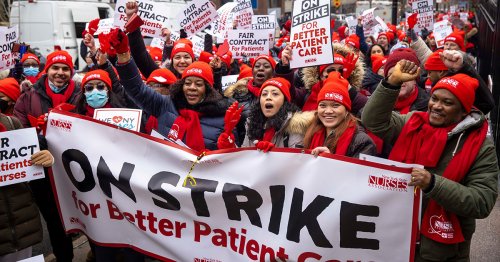
Nurses in the United States, overwhelmingly women and in our big cities predominantly Black, Latin, and Asian, are both leading the fight for higher wages and better working conditions and the resistance to the Trump administration’s attack on immigrants. Some 15,000 nurses in New York City struck several hospitals in New York City in January and February, staying out for weeks to win higher wages and safer staffing levels.


As Nancy Hagans, the president of the New York State Nurses Association (NYSNA) said, “For a month and a half, through some of the harshest weather this city has seen in years, nurses at NYP showed this city that they won’t make any compromises to patient care.”

And across the country, another union, National Nurses United, a union with 225,000 members has carried out mass protests at health centers in many cities calling for the abolition of the Immigration and Customs Enforcement (ICE) agency.”

The New York Nurses’ Strike

In New York City, after weeks on strike, NYSNA won wage gains of 12% over the next three years, maintained health insurance benefits, and improved staffing levels, so that nurses are only responsible for a reasonable number of patients. The new contract also calls for protecting nurses from workplace violence, such as violent attacks by deranged patients, and greater protection for immigrant patients and nurses. Gema Demayo Medina, at Presbyterian, said, “We were waiting for this for forty days in rain and snow.” Fifteen days in January were at or below freezing, one of the coldest winters in memory.

A remarkable 99% of union members voted to approve the new contract. The strike by 15,000 nurses was one of the largest and longest in U.S. history. In the middle of the negotiations, nurses at New York Presbyterian hospital, carrying signs saying “I’m Rank and File and I’m Voting No,” did vote at first against ending the strike and demonstrated against their union leaders, calling for Hagans resignation, and in the end won an improved agreement.

Nurses Protecting Patients, Resisting ICE

National Nurses United (NNU), calling ICE and Customs and Border Patrol (CPB) “the country’s greatest public health threat,” carried out a countrywide protest against ICE on February 19. NNU calls for the abolition of ICE.

“We are way past the point of ‘reform,’” said Mary Turner, an intensive care unit RN from Minneapolis, Minn. who is president of National Nurses United. “Reform only works when you care about abiding by and enforcing the law. Nurses make professional assessments and this is what we conclude: ICE and border patrol are violent, cruel, lawless, and racist organizations that the Trump administration is using as a paramilitary force to ultimately quash the American people’s opposition to his fascist takeover of our democracy. Our hospital CEOs are at fault, too, for enabling Trump by doing nothing. We all need to wake up and shut ICE down now before it is too late.”

In San Diego, California, where I’ve been for the last few weeks, nurses demonstrated at several hospitals, calling for the abolition of ICE, which they say is necessary for the health and safety of their patients and of local communities. ICE agents have beaten and gassed both immigrants and their supporters, and killed nurse Alex Pretti in Minneapolis.

A nurse in San Diego, Kendle Hargrove said, “ICE is a public health crisis because patients are afraid to seek care because they’re afraid to go outside. People in the hospital should feel like they can seek care and not be in fear of persecution,” she said. Missing their medical appointments can lead to sickness or even death.

Turner, NNU’s president, said, “We are turning out on Feb. 19 to demand that Congress abolish ICE now, or face electoral consequences.”

22 February 2026