Friday, February 27, 2026

CLIMATE REVANCHISTS

Italy calls for suspension of EU carbon market

Minister of Business and Made in Italy Adolfo Urso attends the Teha (The European House Ambrosetti ) economic forum in Cernobbio, Como Lake, Italy, Saturday, Sept. 7, 2024.
Copyright AP Photo / Luca Bruno

By Marta Pacheco
Published on 


The Italian Minister said the Emissions Trading System (ETS) has a "perverse effect" and is condemning European companies from being competitive with other countries, urging other member states to back the suspension.

Italy's Industry minister Adolfo Urso urged the European Union to suspend its carbon market until the bloc presents a revised proposal due this summer, citing the hardship faced by European businesses because of high power and carbon costs.

The Emissions Trading System (ETS) is the bloc’s mechanism for making companies pay for their pollution, with the dual aim of reducing emissions and encouraging industry to invest in more sustainable alternatives.

In Europe, the ETS currently covers heavy industries, power plants as well as airlines and shipping. Additional sectors such as international aviation, landfills and incinerators will be included in the upcoming review by the European Commission.

But Urso said the ETS is to blame for Europe's competitiveness problems because the bloc's climate policy tool has a "perverse effect" and is preventing European companies from competing with China and the United States.

"We are all aware that the mechanism of the ETS, as it is currently drafted, is only a tax, a tariff on the energy-intensive companies that struggle to remain competitive," Urso told reporters on the sidelines of a gathering of industry ministers in Brussels on Thursday. “It is necessary - we are all aware - to review it in a substantive way."

"To do this properly, it is necessary to suspend the ETS mechanism while awaiting a reform that must necessarily be comprehensive," Urso added.

Urso added: "If we are in the face of the collapse of the European chemical industry and the crisis of European ideology, we cannot wait for the time of negotiations within the European Union to find a solution."

The Italian minister said that in the meantime, "we are looking for an effective organic solution," adding that he will ask the European Commission to suspend the ETS.

Italy's plea joins that of industry leaders who have recently asked the EU to urgently act to reduce energy and carbon costs. German Chancellor Friedrich Merz has recently touted the same idea, driving down carbon market prices, only to backtrack on it a few days later.

Nordic business leaders back ETS

In a letter sent to Commission President Ursula von der Leyen and EU Climate Commissioner Wopke Hoekstra, a group of Nordic industry associations representing Finland, Sweden, Denmark and Norway urged the EU to maintain the ETS, highlighting its role as a key European advantage and as a source of certainty for investments in clean technologies.

They backed the ETS as a "market-based and technology-neutral policy instrument" that helps reduce carbon dioxide emissions.

"Reforming the system must be done carefully, because it has such a significant impact on the economy and competitiveness, in addition to the climate," the Nordic leaders suggested.

The four industry associations argued that future prosperity in the EU is linked to the ETS since its revenues can bring about decisive investments in clean energy production, critical infrastructure, electrification, and ultimately the decarbonisation of industry.

"Efficient use of the EU's own resources is central to achieving almost all the Union's major strategic aims, and these efforts require reliable access to both public and private financing," reads the letter dated 23 February and seen by Euronews.

Since its inception in 2005, the ETS has slashed emissions by 39%, with revenues exceeding €260 billion, according to the EU data.

Hindering technological innovation

Carlo Carraro, President Emeritus and Professor of Economics at Ca' Foscari University of Venice, criticised the Italian government’s stance on the ETS, saying the attack risks weakening a policy that has proven effective in reducing emissions in regulated sectors.

"Innovation and competitiveness are now inextricably linked to decarbonisation," Carraro said. "Hindering the transition exposes businesses to increasing technological and financial risks and makes the country less competitive".

Similar thoughts were voiced by Chiara di Mambro, Director of Strategy Italy and Europe at the environmental think tank ECCO.

"Suspending the ETS as proposed today or subsidising gas, as envisaged in the Government’s recent decree, would move Italy in the opposite direction (higher energy prices): weakening the price signal, increasing market uncertainty, and ultimately delaying the transition away from expensive fossil fuels," di Mambro said.

Italy is already on track to overhaul its electricity market, which would strip carbon costs from power bills. Instead, Di Mambro suggests using fiscal revenues or dividends from energy companies to reduce the burden of levies on electricity bills.


‘This reform is a disaster’: Climate groups slam Germany for scrapping renewable heating law
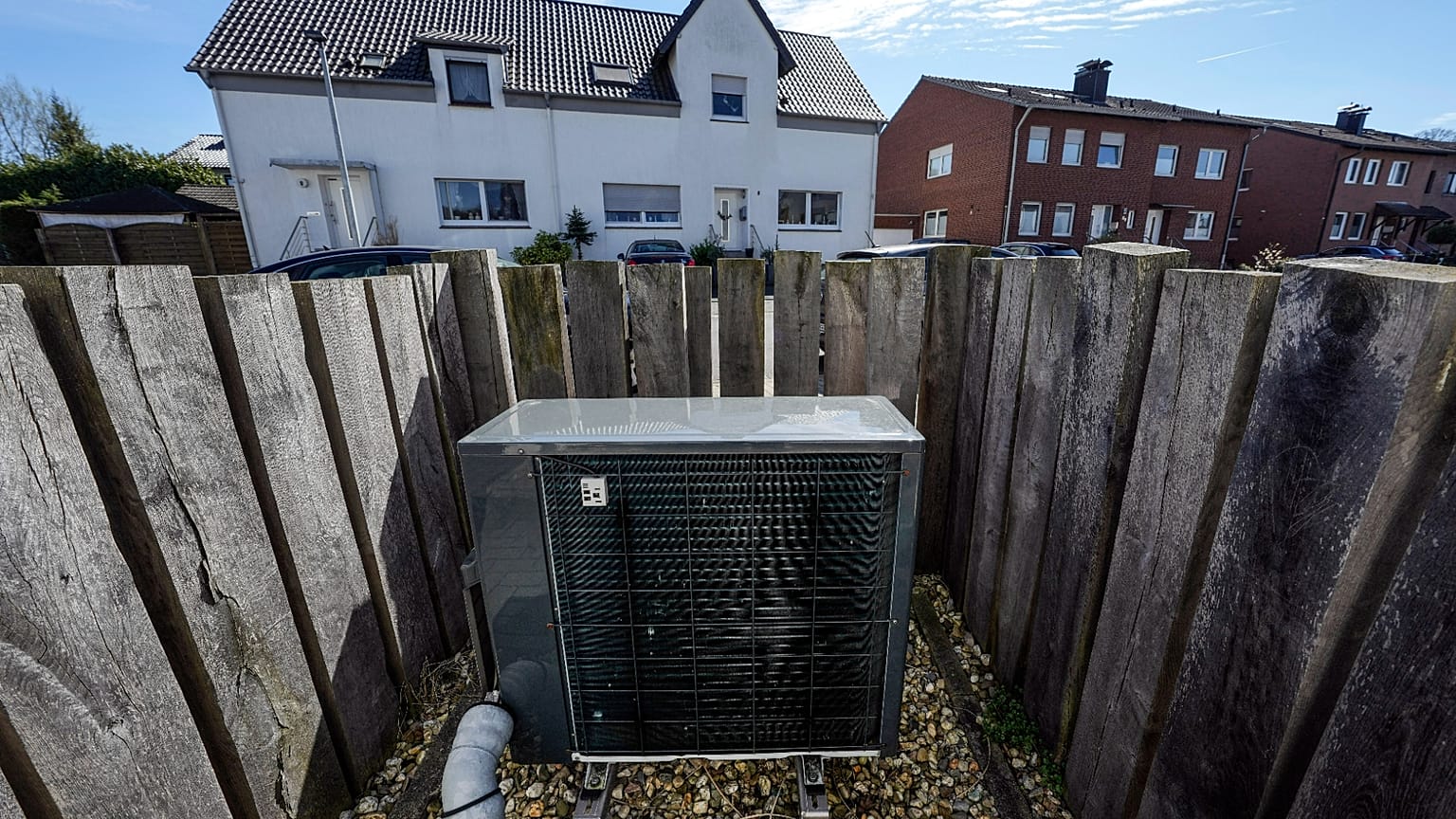
An air-to-water heat pump system is installed at a suburb new housing estate in Marl, Germany.
Copyright Copyright 2023 The Associated Press. All rights reserved.

By Rebecca Ann Hughes
Published on 

A revision of an existing law will now allow homeowners to use oil and gas as heating fuel instead.

Germany’s government has drawn heavy criticism from environmental groups after it agreed to remove parts of a controversial law on heating homes.

The legislation previously stated that newly installed heating systems were required to use at least 65 per cent renewable energy - such as a heat pump.

The reform will now allow homeowners to use oil and gas instead.

One critic has called the move "an unconditional fulfilment of all the wishes of the fossil fuel lobby".

Germany scraps renewable heating mandate

The law on renewable heating sources was passed in 2023, and hailed by climate experts as one of the most ambitious goals of the centre-left-led government in power at the time.

But critics pointed to the challenges presented by rising inflation, with one newspaper calling the bill “Habeck’s heating hammer”, referring to the legislation’s author, Robert Habeck of the Green Party.

The right-wing, climate-denying Alternative für Deutschland slammed the law’s promotion of heat pumps, accusing the Green Party of “forcing” households to make costly interventions and removing their freedom of choice.

Germany’s government has now agreed to scrap the renewable heating mandate, as well as the requirement for expert consultation when installing a new system.

‘This reform is a disaster’

The centre-right Christian Democratic Union (CDU) maintains that the modifications to the legislation will still align with the target to cut CO2 emissions from buildings, among the major sources of planet-warming pollution, while giving households greater choice as to which technology to use.

Proponents say the legislation plans for a greater use of ‘green’ fossil fuels.

Economy Minister Katherina Reiche said homeowners would be able to choose sources including “hybrid models, biomass; yes, even gas and oil heating, but with an increasing proportion of biogas or bio-oil”.

The ‘green’ credentials of biomass and biogas are highly debated as their production and combustion can lead to significant carbon emissions and ecosystem damage.

Campaigners have accused the government of abandoning its climate goals - which include hitting net zero emissions by 2045.

"This reform is a disaster," Green Party parliamentary group co-leader Katharina Dröge told the German Press Agency (dpa).

"The CDU and SPD [Social Democratic Party] have today made it abundantly clear: climate protection is completely irrelevant to this coalition,” she added. “The federal government has abandoned the achievement of the climate targets."

The managing director of the German Environmental Aid Association (DUH), Barbara Metz, described the revised law as "an unconditional fulfilment of all the wishes of the fossil fuel lobby".

‘An enormously expensive gas cost trap’

Germany is the biggest greenhouse gas emitter in the EU, with the nation still relying on oil and gas for nearly 80 per cent of its heating.

Despite the promise to switch to ‘climate-friendly’ fossil fuels, critics have pointed to the scarcity and rising cost of sources like biomethane on global markets.

Dröge criticised the government of “driving people into an enormously expensive gas cost trap" with the legislation reform.

Heat pumps cost more than gas boilers to buy and install, but they are more economical to run.

Germany subsidises 30-70 per cent of the cost of a new heat pump, funding that will continue to be offered until at least 2029 under the revised law.

“Especially in light of Trump, global crises and fossil fuel dependencies, this [legislation change] is short-sighted and dangerous," Julian Joswig, a Green Party politician, wrote on X.


 

‘It’s a real New Zealand duty to save these birds’: Berry harvest brings hope for beloved kakapo

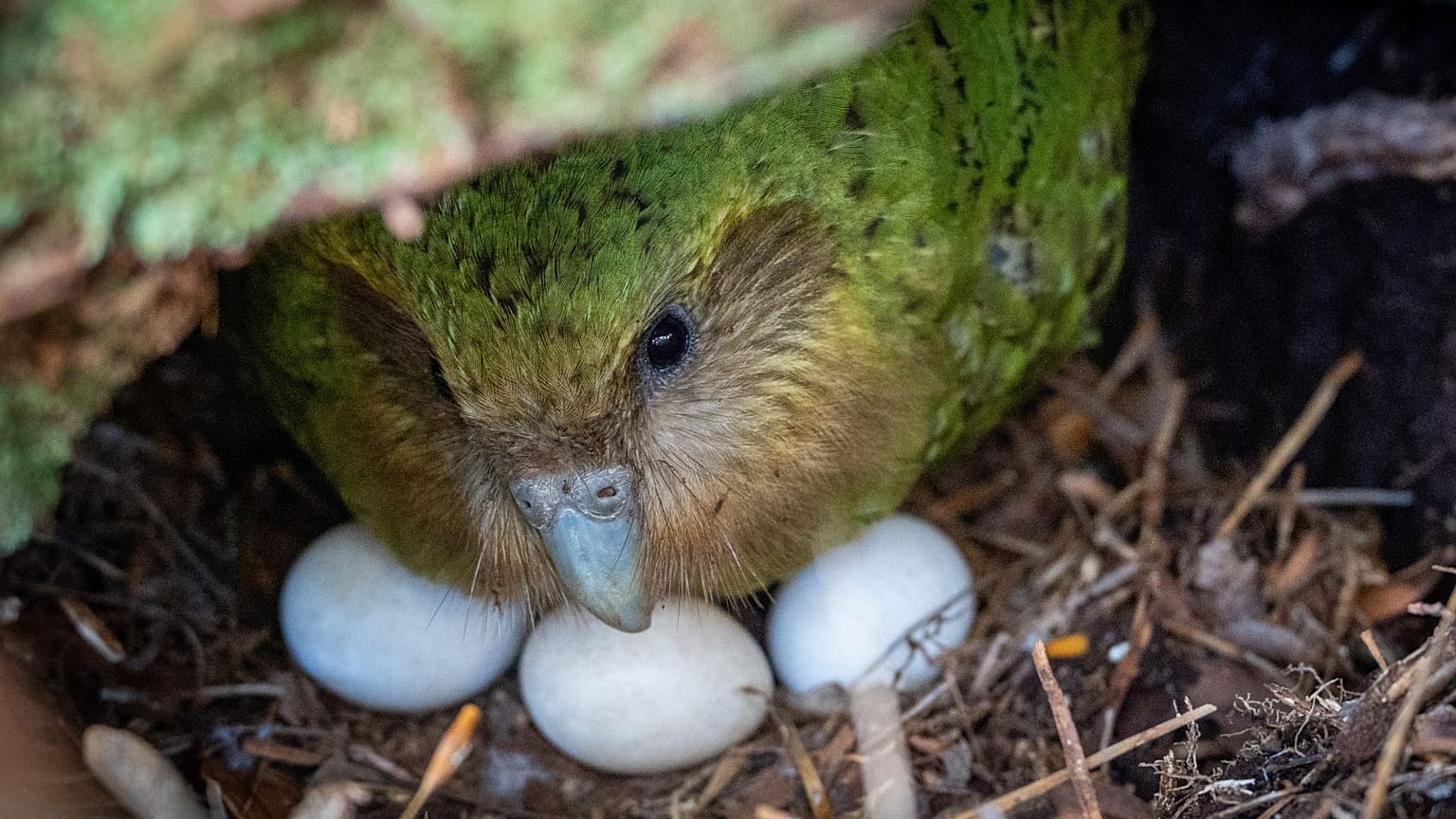
Kohengi sits with her three eggs, on Anchor Island, Pukenui, New Zealand, Feb. 3, 2026.
Copyright Andrew Digby/Dept. of Conservation, New Zealand via AP


By Charlotte Graham-McLay with AP
Published on 

'We don’t have the Eiffel Tower or the pyramids, but we do have kakapo," says New Zealand Department of Conservation’s Deidre Vercoe.

The world’s only flightless parrot species was once thought to be doomed by design. The kakapo is too heavy, too slow and, frankly, too delicious to survive around predators, and takes a shamelessly relaxed approach to reproduction.

But the nocturnal and reclusive native New Zealand bird's fate is teetering toward survival after an unlikely conservation effort that has coaxed the population from 50 to more than 200 over three decades.

This year, with a bumper crop of the strange parrot’s favourite berries prompting a rare enthusiasm for mating, those working to save the birds hope for a record number of chicks in February, which would move the kakapo closer to defying what was not long ago believed to be certain extinction.

Kakapo live on three tiny, remote islands off New Zealand’s southern coast and chances to see them in the wild are scarce. This breeding season has launched one of the birds to internet fame through a livestreamed video of her underground nest, where her chick hatched on Tuesday.

A Dept. of Conservation staff member holds Kakapa chicks Tiwhiri A1 and Tiwhiri A2 on Anchor Island Pukenui, New Zealand, Feb. 2026. Dept. of Conservation, New Zealand via AP

Smelly parrots the size of small cats

The kakapo is a majestic creature that can live for 60 to 80 years. But they’re undoubtedly weird to look at.

The birds can weigh over 3 kilograms. They have owllike faces, whiskers, and mottled green, yellow and black plumage that mimics dappled light on the forest floor.

That’s where the flightless parrot lives, which has made its survival complicated.

“Kakapo also have a really strong scent,” says Deidre Vercoe, the operations manager for the Department of Conservation’s kakapo program. “They smell really musky and fruity – gorgeous smell.”

The pungent aroma was bad news for the parrots when humans arrived in New Zealand hundreds of years ago. The introduction of rats, dogs, cats and stoats, as well as hunting by people and destruction of native forest habitats, drove species of the country’s flourishing flightless birds – the kakapo among them – to near or complete extinction.

By 1974, no kakapo were known to exist. Conservationists kept looking, however, and in the late 1970s, a new population of the birds was discovered.

Reversing their fortunes hasn’t been simple.

A Dept. of Conservation staff member checks the size of a Kakapo egg on Whenua Hou Island, New Zealand, Feb. 2026. Dept. of Conservation, New Zealand via AP

Birds wait years or decades to breed

One reason the kakapo population has grown slowly is that its breeding is, like everything about the birds, peculiar. Years or even decades can pass between successful clutches of eggs.

A breeding season only happens every two to four years, in response to bumper crops of fruit from the native rimu trees the parrots favour, which last happened in 2022. A huge food source is needed for chicks to survive but it’s not known exactly how adult birds become aware of an abundant harvest.

“They’re probably up there in the canopy assessing the fruiting,” said Vercoe. “When there’s a large crop developing, they somehow tune into that.”

That’s when things get really strange. Male kakapo position themselves in dug-out bowls in the ground and emit sonorous booming sounds followed by noises known as 'chings', which sound like the movement of rusty bedsprings.

A Dept. of Conservation staff member holds an egg for candling of a Kakapo egg on Whenua Hou Island, New Zealand, Feb. 2026. Dept. of Conservation, New Zealand via AP

The deep booms, which on clear nights can be heard across the forest, attract female kakapo to the bowls. Females can lay up to four eggs before raising their chicks alone.

Since January, admirers of the birds have had a rare glimpse into the process through a livestream showing the underground nest of 23-year-old kakapo Rakiura on the island of Whenua Hou, where she has laid three eggs, two of them fertile. So precarious is the species’ survival that the eggs were exchanged for fake replacements while the real ones were incubated indoors.

A technician on 24 February replaced the fake eggs with the first near-hatching egg. The kakapo kept her distance while the switch was made but quickly returned to the nest, seemingly unperturbed. The chick hatched just over an hour later. The second real egg was expected to be added within days.

Native birds are beloved in New Zealand

Perhaps the only thing stranger than the kakapo is the lengths to which New Zealanders have gone to save it. Quadrupling the population over the past three decades has required their relocation to three remote, predator-free offshore islands and the micromanaging of the parrots’ every romantic entanglement.

“We do what we can to make sure we don’t lose any further genetic diversity,” Vercoe says. “We manage that carefully through having the best matches possible on each island.”

Each bird has a name and is monitored by a small backpack tracker; if a bird vanishes, they’re nearly impossible to find. With the kakapo still critically endangered, there’s little prospect of conservation efforts ending anytime soon, although those working with the birds are easing their hands-on management each breeding season.

The painstaking work to preserve the species might seem odd to outsiders, but the parrot is just one of many spirited and strange avians in a country where birds reign supreme. The only native land mammals are two types of bat, so New Zealand’s birds, which evolved eccentrically before human and predator arrival, have become beloved national symbols.

“We don’t have the Eiffel Tower or the pyramids, but we do have kakapo and kiwi,” Vercoe says. “It’s a real New Zealand duty to save these birds.”

What's the real environmental and financial impact of artificial snow?

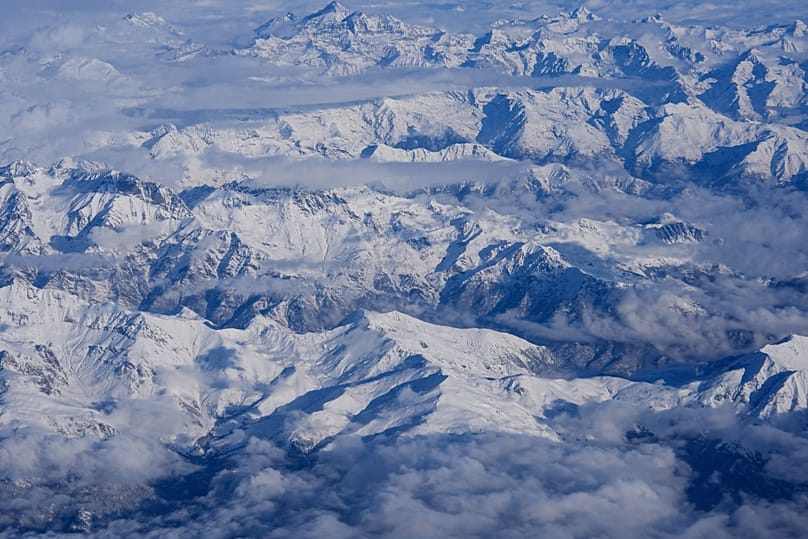
The Alps seen from the sky AP/Julia Demaree Nikhinson

By Alessio Dell'Anna 
Published on 

By the end of the century, all ski resorts across the Alps may be forced to use snow cannons, with dire consequences for local nature.

Could the 2026 Milano-Cortina Winter Olympics be the last held on natural snow?

The Games were widely hailed as a success, but also drew criticism for their heavy reliance on artificial snow: around 1.6 million cubic meters, according to the organisers.

That's roughly equivalent to around 640 Olympic-sized swimming pools.

Like it or not, rising winter temperatures could make artificial snow a non-negotiable necessity for future Winter Games — at least on the Alps.

Artificial snow keeps winter sports industry afloat

By the end of the century, snowfall across the mountain range, which spans eight countries, is predicted to decline by between 25% and 45%.

This is based on a joint study by King's College, the University of Oxford, and the University of Trento called "The snow must go on: Theorising the climate innovation conundrum in expiring industries".

Globally, the industry is projected to grow at an annual rate of 4.4% between 2025 and 2032. But researchers warn that by 2050, ski resorts below 1,200 metres may have to endure snow-free winters.

So far, the winter sports sector has seen off the threat and managed to stay in good health, also thanks to the use of artificial snow, much like the recent Winter Olympics.

According to the study, some 90% of Italy's ski resorts already rely on artificial snow, compared to 70% in Austria and 54% in Switzerland.

"Once seen as a temporary fix, technical snowmaking is now a structural necessity, enabling resorts to remain operational even in low-snow years," the study says. "The widespread adoption of snowmaking reflects the growing consensus that natural snowfall alone cannot sustain snow tourism."

One of the few exceptions in Italy is the ski resorts near the highest glaciers. For example, the Marmolada — at 3,343 metres — which is nonetheless projected to vanish by 2040.

What's the financial, energy and environmental cost of artificial snow?

The use of artificial snow may save winter holidays, but for the environment, it's a problem, scientists say.

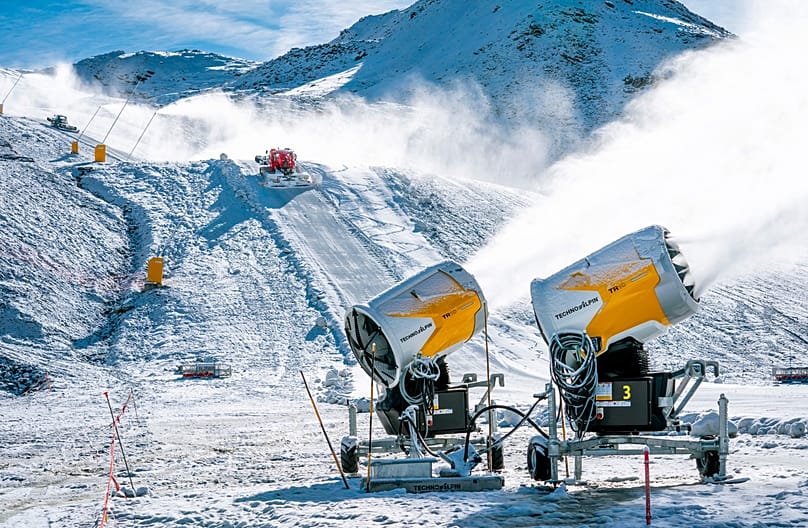
Snow cannons need a massive amount of water to blanket the slopes with snow.

Covering just one hectare (or 0.01km²) with 30 centimetres of artificial snow requires around 1,000 cubic metres of water — roughly 20 backyard swimming pools.

The water is pumped from nearby rivers and lakes — draining local resources — or drawn from artificial basins, which is no less impactful, as it requires extensive land work.

By 2023, the industry created "142 such basins" in Italy alone, covering more than one million square metres.

On top of that, fake snow is also denser and harder. It melts more slowly, leading to soil compaction and delayed plant growth.

Snow cannons spray snow at the finish area of the new four-kilometre ski slope "Gran Becca", in Cervinia, Italy AP/Maxime Schmid

'Delaying a local problem while intensifying it globally'

Its carbon footprint is significant too: in Italy, for example, "electricity-related emissions from snow production alone amount to 24 kt CO₂ eq, projected to rise by 24% and 30% with +2°C and +4°C warming, respectively", according to the King's College, Oxford and Trento study.

Ultimately, the cost is not to be overlooked, ranging from €3.50 to €5 per cubic metre.

"Artificial snow making exemplifies the tension between short-term economic resilience and long-term environmental sustainability", tells Europe in Motion Juliane Reinecke, one of the study's authors.

"For resort managers, snowmaking is about survival. It is a rational and necessary adaptation to climate risk. But snowmaking raises long-term sustainability concerns: it is water- and energy-intensive and requires intensive snowmaking infrastructure".

"As temperatures rise, even more snow must be produced until even that may no longer be sufficient to guarantee season-long snow cover."

"Firms are incentivised to prioritise operational continuity and short-term resilience. Societies, by contrast, have to worry about long-term decarbonization and ecological limits. When adaptation technologies are energy- and resource-intensive, they may solve (or delay) one problem locally while intensifying it globally. That is the paradox we are trying to highlight".

Global deforestation slows but losses persist in South America and Africa - OWID

Global deforestation slows but losses persist in South America and Africa - OWID
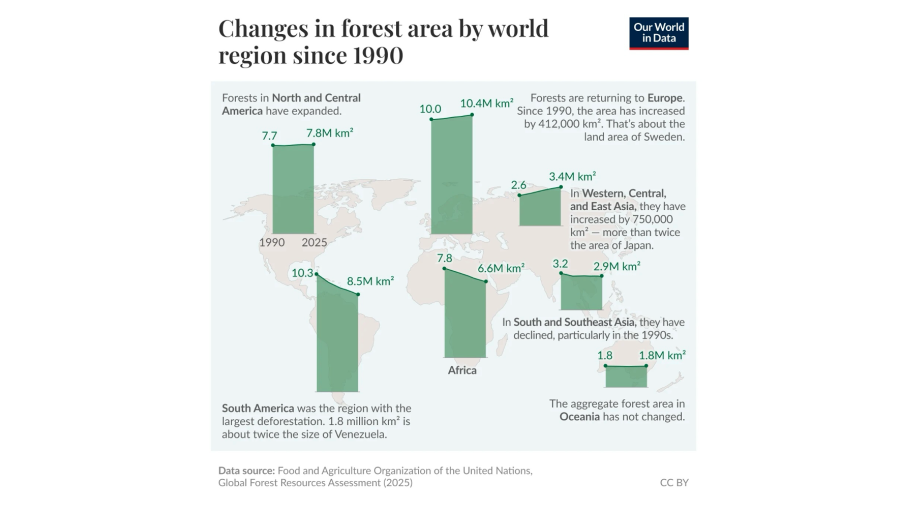
Since 1990, global forest trends have diverged, with continued losses in South America and Africa offset by expanding forest cover in Europe, North America and parts of Asia. / bne IntelliNews
By bne IntelliNews February 27, 2026

In the past, forests around the world were cut down on a massive scale. We lost some of the world’s richest ecosystems, Our World in Data  (OWID) reports.

In recent decades, the picture has become more complex. Deforestation has not ended, but it is no longer happening everywhere. Since 1990, some regions have continued to lose large areas of forest, while others have slowed this long-run trend — and even reversed it.

The map shows regional changes in forest area based on the latest data from the Food and Agriculture Organization of the United Nations.

Deforestation has been particularly large in South America and Africa. At the same time, the forested area has expanded in Europe, North and Central America, and large parts of Asia.

These gains show that deforestation is not inevitable. When pressure on land falls, forests can return.

I previously wrote about why deforestation is happening, and what we can do to bring the long history of deforestation to an end.


LATAM BLOG: Mexico's rise to the top of US trade exposes the stakes of Trump's USMCA gamble

LATAM BLOG: Mexico's rise to the top of US trade exposes the stakes of Trump's USMCA gamble
Integration between Mexico and the US runs much deeper than trade statistics capture. / unsplash
By bnl editorial staff February 26, 2026

For at least 34 years, Canada held an unbroken grip on the top spot in US trade. In 2025, Mexico ended it, and the timing could hardly be more consequential.

According to reports from Bloomberg and Forbes, Mexico finished 2025 as the leading destination for US merchandise exports, the largest source of US imports and, by extension, the dominant overall US trade partner  a clean sweep no country has achieved since Canada managed it in 2006. It accounted for 15.6% of total US two-way goods trade, more than double China's 7.4%, in a transformation that has unfolded remarkably quickly. Five years ago, as USMCA was being implemented, China led all US trading partners with nearly 15% of total trade. Today, the Asian superpower ranks third.

The numbers alone tell only part of the story. The top US exports to Mexico  refined petroleum, motor vehicle parts, computer components, computers and semiconductors  reflect an industrial relationship built around shared supply chains under the nearshoring model rather than simply consumer demand. On the import side, four of the five biggest categories are tied to the North American automotive industry. Mexico is not so much a trading partner as a production partner.

Yet the relationship faces its most fraught political test in years. US President Donald Trump has reportedly asked aides why he should not withdraw from USMCA, the trade agreement he championed in 2020, ahead of the treaty's mandatory six-year review deadline of July 1. He could technically do so with six months' notice. Bloomberg columnist Juan Pablo Spinetto argues this would amount to a self-inflicted wound: abandoning USMCA would disrupt supply chains, threaten American manufacturing jobs, push up import prices on everything from cars to avocados and trigger backlash from the US Chamber of Commerce and bipartisan Congressional supporters of the pact.

The peso barely moved after reports of Trump's deliberations emerged, suggesting investors assign low probability to a full withdrawal. But the uncertainty itself carries costs, potentially dampening investment flows into Mexico and prolonging the kind of instability that has already weighed on the country's 0.8% GDP growth in 2025.

Integration between the two countries runs much deeper than trade statistics capture. Mexicans living in the US send home more than $60bn per year in remittances. Mexico is the top foreign destination for American tourists. In New Mexico, California and Texas, Latinos are now the largest population group. In parallel, a growing wave of American expats relocating to Mexico is reshaping neighbourhoods from Baja California to Mexico City.

The strategic logic, Spinetto argues, is difficult to escape. If Washington is serious about decoupling from China, reindustrialising its economy and securing critical supply chains, Mexico is not the obstacle, but rather a central part of the solution. Mexico's share of US trade has more than doubled relative to China's in five years, driven not by political goodwill but by geography, manufacturing integration and demographic reality. Those are not conditions that dissolve overnight when a trade agreement is threatened.

Whether that case gets made clearly in the White House, or gets lost in the noise of erratic tariff threats and negotiating posture, may be the defining question of the USMCA review.