Tuesday, March 24, 2026


China Warns of “Uncontrollable” Escalation as Hormuz Crisis Deepens

  • China warns the Hormuz crisis could spiral into an uncontrollable regional conflict threatening global energy supplies.

  • Beijing is maintaining “strategic neutrality” while quietly ensuring continued oil flows, particularly from Iran.

  • Prolonged disruption risks undermining China’s economy and its vast trade and infrastructure investments across the Middle East.

China has warned of an "uncontrollable situation" amid the escalating Strait of Hormuz crisis and urged all sides to halt military operations as the war involving Iran enters a critical phase and threatens global energy supplies.

On March 21, US President Donald Trump issued Tehran a 48-hour ultimatum to lift its partial closure of the Strait of Hormuz, a narrow Gulf passage that carries about 20 percent of global oil and gas supplies, or face potential strikes on its key energy infrastructure.

Chinese Foreign Ministry spokesman Lin Jian told reporters in Beijing on March 23 that the ongoing conflict and the situation around Hormuz has threatened global energy security as well as China's oil supplies and the "use of force will only lead to a vicious cycle."

"If the war expands further and the situation deteriorates again, the entire region could be plunged into an uncontrollable situation," Lin said, when commenting on President Trump's threats.

Beijing maintains ties with Iran, which has been targeted by US-Israeli strikes since late February, but has said it does not support Tehran's attacks on Gulf countries hosting US bases and has called for a cease-fire.


Trump, who had planned to visit Beijing this month but postponed the trip to focus on the war, has urged China and other nations to help restore access through the Strait of Hormuz.

China has not yet responded to that appeal, though it has tried to play a mediating role in the Middle East by dispatching its special envoy, Zhai Jun, on a regional tour to push for de-escalation.

Chinese officials have stepped up diplomatic engagement in recent weeks, holding talks with Iran and regional states to ensure at least partial oil and gas flows continue through Hormuz.

Even as broader shipping has all but ground to a halt in the Strait of Hormuz, some tankers, particularly those linked to China, have continued to transit the waterway under special arrangements, reflecting Beijing's leverage with Tehran.

Despite its political support for Iran, Beijing has been hesitating to offer military backing to Tehran and has also criticized Iranian attacks on neighboring Gulf states.

Chinese Foreign Minister Wang Yi warned earlier this month that the conflict risks destabilizing the entire international system.

"The war should not have happen, and the use of force will only deepen hatred and conflict," Wang said.

China's cautious response reflects what analysts describe as a policy of "strategic neutrality" -- maintaining relations with all sides while avoiding entanglement in the fighting.

Beijing's Strategic Dilemma

China is the world's largest importer of crude oil and remains the biggest buyer of Iranian oil, much of it sold at discounted prices due to Western sanctions.

Analysts say Beijing may be better positioned than many countries to absorb short-term shocks. China holds large strategic oil reserves that could help cushion the immediate impact of supply disruptions.

However, economists warn that prolonged instability in the Gulf could threaten China's broader economic outlook.

Chinese trade data for January and February, before the war began, showed that the country's economic growth has been driven largely by exports and international trade, leaving it vulnerable to disruptions in global shipping routes.

Beijing maintains extensive economic ties not only with Iran but also with Saudi Arabia, the United Arab Emirates, and other Gulf states. In recent years, Chinese companies have invested billions of dollars in ports, energy facilities, and logistics hubs across the region.

The Middle East is a key corridor in China's Belt and Road Initiative, which connects Asia with Europe and Africa through a network of infrastructure projects and trade routes.

By RFE/RL


IRGC Demonstrates Administrative Control Over the Strait of Hormuz
Selen
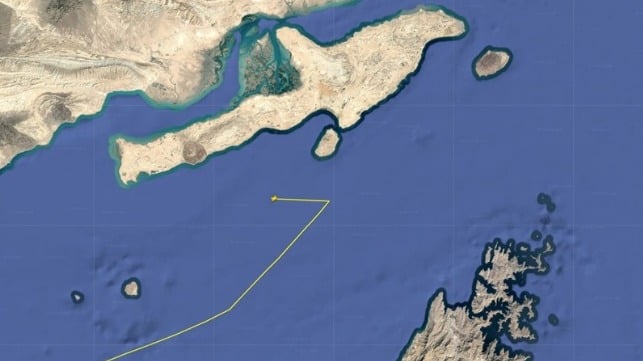
Container ship Selen diverted from the IRGC-controlled traffic lane and went to anchor off Qeshm (Pole Star Global)

Published Mar 24, 2026 7:56 PM by The Maritime Executive


Iran has declared its intention to manage the "open" navigation of the Strait of Hormuz in perpetuity, and taken steps to put its plan into action. "Non-hostile" vessels may arrange passage with Iranian authorities, coordinated in advance (and in some cases, paid-for); vessels associated with Israel, the U.S. and other parties linked to the conflict are prohibited. The Islamic Revolutionary Guard Corps (IRGC) exercised this newfound authority in an administrative capacity for the first time on Wednesday, refusing passage to a container ship attempting to transit out from the Gulf to Pakistan. 

On March 24, the 6,800 dwt container feeder Selen attempted to make the crossing from the Arabian Gulf to the Gulf of Oman, bound for Karachi and broadcasting "Food for Pakistan" in her AIS destination signal. AIS data provided by Pole Star Global shows that the vessel approached the Iranian-controlled traffic lane near Qeshm, but at 1000 GMT, she reversed course and went to anchor just off the southwestern coast of the island. Selen remained in place as of 2330 hours GMT. 

In a statement, the commander of the Islamic Revolutionary Guard Corps' navy confirmed that the boxship had been refused permission to pass - the first time that the IRGC had claimed an administrative rejection under its formalized Strait of Hormuz control protocol. Previous IRGC enforcement actions employed lethal force to disable or destroy any unauthorized vessels, without warning. 

"The container ship Selen was turned back by the IRGC Navy due to failure to comply with legal protocols and lack of permission to pass through Strait of Hormuz," the IRGC said. "The passage of any vessel through this waterway requires full coordination with Iran's maritime authority."

Iranian management of the strait is a de facto reality on the ground, and is the key priority in negotiations with Iran over a potential end to the conflict. Iranian control of the waterway is unacceptable to U.S. partners in the Gulf.

"The Strait of Hormuz is not a bargaining chip, nor a tool of pressure. It is an international passage that must remain open without condition or restriction, under any circumstance," said former Qatari Prime Minister Sheikh Hamad bin Jassim bin Jaber Al Thani. "Any attempt to impose unilateral control over it, or to turn it into a tool of extortion, represents a direct threat not only to the Gulf Cooperation Council states and the region, but to the global economy as a whole."


Report: Two Types of Iranian Mines Detected in Strait of Hormuz
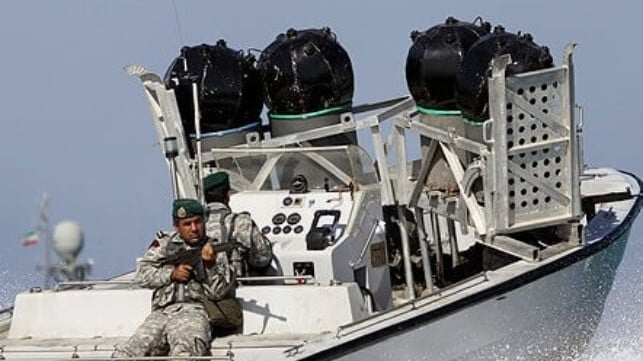
A small craft for deploying floating mines (Islamic Revolutionary Guard Corps)

Published Mar 23, 2026 7:20 PM by The Maritime Executive


Reports of Iranian mines in the Strait of Hormuz have circulated for weeks, but the most detailed signal yet comes from CBS, which now reports that U.S. intelligence has detected at least a dozen advanced mines of two types in the waterway. 

U.S. officials who are familiar with the latest intelligence told CBS that there are two types of Iranian mines emplaced in the strait. The first is an update on a familiar but deadly design: the buoyant, moored, high-explosive mine, which floats below the surface waiting for a passing ship. The Iranian variant, known as the Mahan 3, is a 300-kilo mine with acoustic sensors to detect passing ships. According to open-source munitions database Collective Awareness to UXO (CAT-UXO), it can pick up the signature of a nearby vessel from a distance of about 10 feet away. As it is acoustically activated, a nonmagnetic hull can still set it off.  

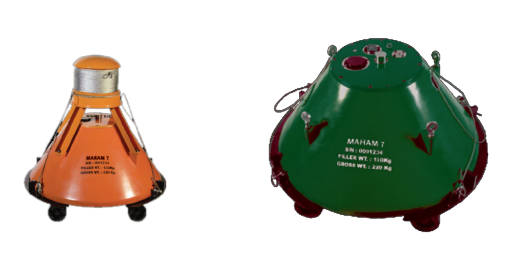
The second device believed to be present in the strait is a 220-kilo bottom mine, the Maham 7, which can be deployed by small craft or helicopters. The device is intended for targeting smaller vessels, like landing craft or patrol ships, and can be installed in waters as shallow as 10 feet of depth (or as deep as 300 feet). Iran has previously offered the Maham 7 for export sale, and has published specifications and images (below). 
Previously, President Donald Trump has said that there are "no reports" of Iran mining the strait, while insisting that Iran must remove any mines if in fact it has laid them without the knowledge of U.S. forces. 

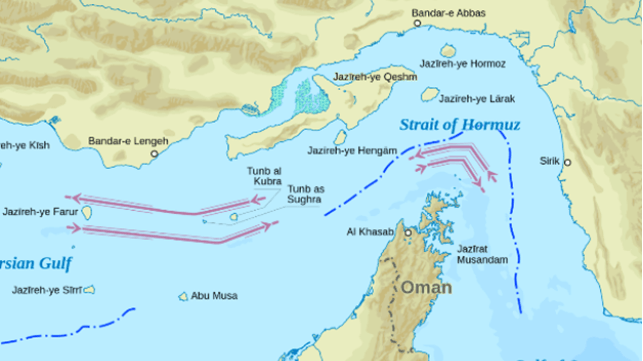
In response to escalating threats from the White House, Iran has threatened to "fully close" the strait using unspecified means. For now, Iran's foreign ministry says, "non-hostile ships" may use the waterway so long as they participate in an Iranian-controlled tolling system. In practice, traffic through the strait has slowed to a trickle; a small number of vessels are using a lane between Iran's islands of Qeshm and Larak, passing well within Iranian waters.

Countering the mine threat

U.S. Central Command has been actively engaged in a campaign to destroy Iran's minelaying capability before it deploys by targeting Iranian naval forces, including smaller craft. The command has begun using Apache helicopters and A-10 close air support planes to support that objective, suggesting confidence that slow-moving, non-stealthy aircraft can now operate in the Strait of Hormuz. 

Once deployed and activated, sea mines are a serious threat to shipping and are difficult to remove. There are few assets available: the U.S. Navy recently decommissioned and shipped home four Avenger-class minesweepers from the Gulf, and two of Central Command's three Independence-class LCS mine countermeasures hulls have been spotted in Southeast Asia, thousands of miles from the strait. Naval analysts suggest that Iranian antiship threats would have to be thoroughly reduced before beginning minehunting, as vessels engaged in the task are vulnerable to attack due to the slow nature of their work. 

"I think the worst case now would be if we’ve found positive evidence of the Strait being mined," former Central Command chief General Joseph Votel told TWZ last week. "That would really extend out the time [for reopening]. We probably have to assume that there are mines in there right now. But a serious mining effort by Iran could really complicate and slow things down."


Little Change at Strait of Hormuz After Trump's 48-Hour Threat
Strait of Hormuz TSS

Published Mar 22, 2026 5:26 PM by The Maritime Executive


President Donald Trump has given the Iranian government until Monday evening to reopen the Strait of Hormuz, which he has previously said that the U.S. does not need. If Iran does not reopen the strait, Trump said, the U.S. will "obliterate" Iran's electrical power plants.  

For its part, Iran claims that the strait is already open - for the right ships. A trickle of tonnage is getting past, according to tracking services, most of it using an Iranian-controlled lane past Qeshm and Larak. Iranian state media claims that negotiations are under way with multiple nations on terms for safe passage, including India and China. Iran's own tankers continue to load at Kharg Island and transit the strait, enabled by the U.S. decision to allow free passage for Iranian vessels and (as of Friday) to lift sanctions on Iranian oil sales. 

Iran has refused to comply with Trump's new 48-hour threat, and has promised to retaliate with strikes on neighboring states' critical infrastructure if its power grid is hit. Traffic at the strait remained light as of Sunday; the Combined Maritime Forces Joint Maritime Information Center (JMIC) counted one vessel transit on March 22, down from historical average of 138 per day. 

"If Iran's fuel and energy infrastructure is attacked by the enemy, all infrastructure of energy, information technology, and desalination facilities belonging to the US and [Israeli] regime in the region will be targeted," an IRGC spokesperson warned. 

In the past week, Iran has destroyed approximately six percent of global LNG liquefaction capacity, damaged oil infrastructure infrastructure on the Saudi Red Sea coast, and attempted a strike on the U.S.-UK base at Diego Garcia - more than 2,000 miles away from the combat zone. Dozens of oil and gas sites, ports and ships around the Gulf have been hit in the conflict so far, from Kuwait to Oman. 

Multiple analysts assess that the likely near-term outcomes include U.S./Israeli strikes on the Iranian power grid; Iranian retaliatory strikes on high-value infrastructure in neighboring states; continued Iranian control of the Strait of Hormuz, pending further developments; and continued pressure on the global supply of oil, gas and refined products, particularly affecting the Asian markets that depend on Mideast oil. 

"Iran will not reopen the Strait of Hormuz. That’s not going to happen. In the coming days, we can expect Tehran to threaten to 'set the Gulf on fire,' especially if the U.S. strikes critical infrastructure," said former Israeli Defense Intelligence Iran chief Danny Citrinowicz. "Such rhetoric [U.S. threats] will not shift Iran’s position; instead, it forces [Trump] to choose: escalate and follow through, risking broader war, or back down and further erode U.S. deterrence."

 

Libya Attaches Towline to Drifting Russian-Flagged Gas Carrier

towline attached to gas carrier wreck
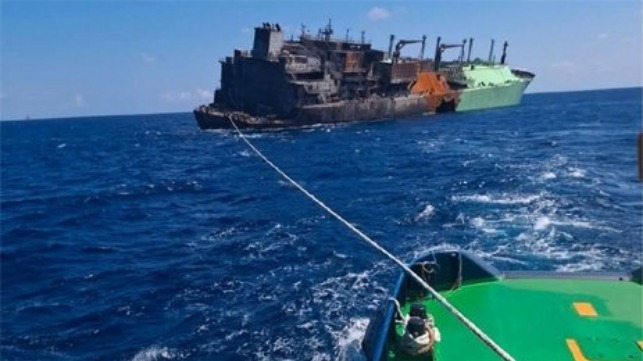
Libya attached a towline on Tuesday to the drifting wreck (Libyan News Agency)

Published Mar 24, 2026 1:40 PM by The Maritime Executive


Libyan officials on Tuesday, March 24, posted pictures showing a towline secured to the burnt-out gas carrier Arctic Metagaz. Multiple agencies in Libya reported they are monitoring the operation as they worked to quell fears, but it is unclear what the plan is for the vessel.

Some reports indicate that one of the tugs from the oil platforms reached the vessel and put a towline to the hulk, while others said that one of the local factions intervened with its tug and experts in an effort to stabilize the situation. The National Oil Company had announced on Sunday that it was hiring international experts in conjunction with Italy’s Eni, but other reports are saying they have seen no action.

Local protestors reportedly went to the offices of the government-controlled Mellitah Oil & Gas Company seeking clarification on the plan. Other reports have said the various local entities are demanding that the ship not be brought into their areas due to the ongoing dangers. The oil company reportedly said the vessel would not enter Libyan waters.

The vessel was originally about 150 miles north of the Libyan coast near the city of Sirte in central Libya when the explosion and fire occurred on March 3. It at various times drifted to the north and west, approaching both Malta and several smaller islands controlled by Italy before resuming a course toward the Libyan coast late last week.


The latest reports from the control room in Libya established to monitor the situation placed the hulk of the Arctic Metagaz anywhere from 44 to 65 kilometers (approximately 28 to 40 miles) from the coast, near the Zwara Municipality to the west of Tripoli. The reports indicated that the tug was moving the vessel, possibly to the northwest, to increase the distance from Libya’s offshore oil and gas platforms. Currents and winds had been moving the vessel to the southwest.

Images show the Libyan-flagged tug Assameeda at the wreck site. Other reports said the Navy and Coast Guard have sent vessels to the area. The National Oil Company had noted that it would be a complex towing operation due to the two large breaches in the hull. The vessel is sitting low in the water and listing.

The Misrata Free Zone authority said it had sent a tug and experts out to the vessel. It said it would provide additional technical expertise and operational capacity to the efforts.

The challenge remains that the vessel has approximately 700 tons of fuel aboard and an undetermined amount of LNG. Two of the tanks are thought to have survived the explosion and fire, but with the vessel dead in the water, conditions have not been maintained in the tanks. There could be a buildup of gas that could be released or explode, environmentalists are warning.

Coast Guard Investigates Fatal Confined-Space Accident on Alaskan Barge

 NEVER ENTER A CONFINED SPACE TO RESCUE A FELLOW WORKER

File image: Starry2018/CC BY SA 4.0

Published Mar 23, 2026 8:11 PM by The Maritime Executive


The U.S. Coast Guard has named two tugboat crewmembers who passed away in a confined-space incident aboard a barge near Ketchikan earlier this month. 

On March 15, the tug Chukchi Sea was operating about 25 miles to the northwest of Ketchikan with the barge Waynehoe, a deck barge with landing ramps and a crawler crane. At about 0915 hours that morning, the Coast Guard's Sector Southeast Alaska command center received a mayday call reporting that the tug crew had lost contact with four crewmembers who had gone into a confined space on the barge. 

The command center dispatched a rescue boat with volunteer firefighters augmenting the boat crew to respond to the scene. While they were en route, Chukchi Sea's remaining crew managed to extract two survivors from the confined space. They also recovered the body of one unresponsive crewmember, who was later pronounced deceased.

Another tug company provided a tow to move the Waynehoe to a pier in Ketchikan. After the vessel was safely moored at the pier, responders went below into the confined space and recovered the body of the second deceased crewmember. 

The Coast Guard identified the victims as Ben Fowler, a crewmember; and Sidney Mohorovich, an equipment mechanic for the tug's operating company. 

Mohorovich's father, Todd Mohorovich, told the AP that the Coast Guard had informed him after the casualty that there was a high level of methane in the compartment. He had no further details on the sequence of events. 

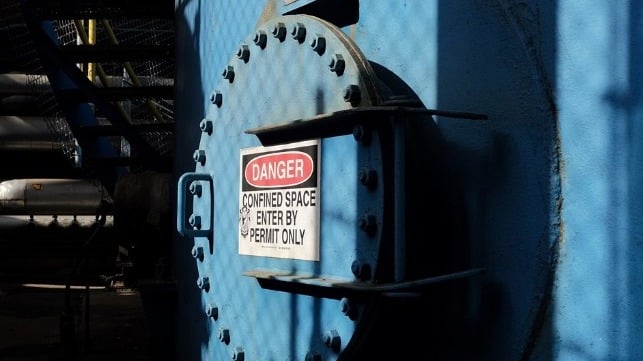
Confined space casualties are often serial, as crewmates who respond to the scene may not have full information and sometimes enter the space in order to carry out a rescue - without first checking to see if the atmosphere is dangerous. If oxygen levels in the compartment are low, asphyxiation and unconsciousness can follow rapidly. The U.S. Coast Guard is investigating the circumstances of the case, and has not released any details of its findings. 

"This is a heartbreaking reminder that confined spaces on vessels can contain extremely dangerous, invisible hazards," Coast Guard Capt. Stanley Fields said in a statement. "The Coast Guard is committed to a thorough investigation to understand what happened and prevent a tragedy like this from occurring again."

Top image: Starry2018/CC BY SA 4.0


Blast Shakes Valero's Port Arthur Refinery

Port Arthur
Image via social media

Published Mar 23, 2026 11:04 PM by The Maritime Executive


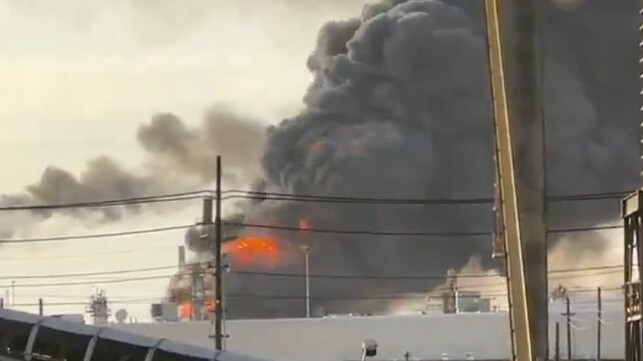
On Monday, an explosion and fire hit the Valero refinery in Port Arthur, Texas, rattling windows and startling nearby residents. The refinery is one of the 10 largest in the United States, and any outage could have an effect on refined product prices during a period of peak global demand. 

The blast was reported at about 1700 hours at a processing unit inside of the plant, followed by flame and heavy smoke. The City of Port Arthur issued a shelter-in-place order for residents up to 10 miles away, as far south as Sabine Pass. 

The cause of the incident is under investigation, but the Port Arthur sheriffs' office told local media that an industrial heater was the suspected source. 

The Valero Port Arthur refinery has a nameplate capacity of 435,000 barrels per day, and is designed to handle heavy sour crude - notably Venezuelan grades. Valero acquired the plant through the purchase of independent refiner Premcor in 2005, and has since invested heavily in upgrades. 

U.S. gas and diesel prices are at multiyear highs, driven upwards by the oil crisis in the Arabian Gulf. Average diesel prices in California are nearing the $7 per gallon mark, approaching record levels. The Trump administration has temporarily waived the Jones Act for coastwise tanker shipping, hoping to ease flows of fuel from the Gulf Coast's refiners - including Valero Port Arthur - to West and East Coast markets. 


Grounding of the Ever Given: When Hydrodynamics Turns Into Financial Risk

Ever Given aground
Courtesy BlackSky

Published Mar 24, 2026 3:12 PM by Capt. Volodymyr Smirnov


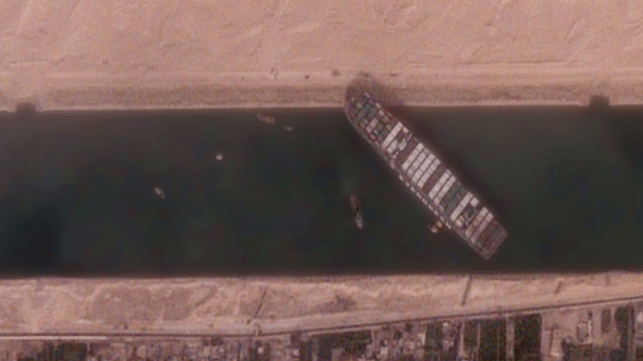
On March 23, 2021, the ultra-large container vessel Ever Given grounded in the Suez Canal during sandstorm conditions, blocking one of the world’s most critical trade routes.

Public discussion often framed the casualty as a case of human error. From an operational risk perspective, however, the more relevant question may be different: Did nonlinear hydrodynamic forces in a confined channel create a loss-of-control scenario before the bridge team fully recognized it?

The Environmental Setup

The vessel entered a narrow, shallow canal under strong crosswinds. In such waterways, large ships are simultaneously affected by three interacting forces:

• Bank suction – a low-pressure effect pulling the stern toward the bank

• Bow cushion – high-pressure water build-up pushing the bow away from the bank

• Squat – increased draft and reduced under-keel clearance as speed increases

Individually, these forces are manageable. Together, in confined waters, they become highly sensitive to speed, water depth and distance from the banks.

For ultra-large vessels with substantial block coefficient and significant windage area, like an ultra-large container ship, even moderate speed can disproportionately amplify these effects.

Wind, Drift and Early Instability

Strong crosswinds act primarily on the vessel’s large exposed container stacks, generating lateral drift. The bow begins to move off the intended track. To counter this, rudder is applied.

However, in shallow water, squat reduces under-keel clearance and diminishes rudder effectiveness. At the same time:

• Bow cushion may push the bow further away from the bank

• Bank suction pulls the stern toward the opposite bank

This combination creates a pivoting moment, increasing yaw. At this stage, the vessel may still appear controllable. Heading is being corrected. Rudder angles respond. The situation does not yet look critical.

But hydrodynamic forces may already be entering a nonlinear regime.

The Nonlinear Threshold

In confined waters, there is often a critical combination of speed, position and environmental force. Below this threshold, corrections stabilize the vessel. Beyond it, corrections may amplify deviation.

If speed remains too high relative to wind and channel geometry:

• Squat increases;

• Rudder efficiency decreases;

• Bank suction intensifies;

• Wind continues to generate lateral force.

More rudder is applied to compensate. Yet as stern suction strengthens, corrective inputs may increase yaw instead of reducing it. This is the transition point — where controllability shifts from stable to unstable.

From the outside, it can appear sudden. Operationally, it is the cumulative effect of interacting forces.

The Point of No Return

Once lateral deviation exceeds a recoverable margin — in angle or distance from the centerline — the ship's own inertia becomes dominant.

Even if engine power is reduced:

• The vessel’s mass maintains forward momentum;

• Hydrodynamic asymmetry persists;

• One end of the vessel may strike a bank while the other swings across the channel.

At that moment, grounding becomes highly probable. 

This sequence is not necessarily the result of a single error. It may be the predictable outcome of operating a very large vessel within tight environmental margins.

How It Could Be Mitigated

The purpose of this analysis is not to assign fault, but to highlight systemic prevention.

Three practical barriers are essential:

• Explicit Pilot–Master agreement on maximum safe speed under crosswind conditions;

• Predefined abort thresholds (yaw rate, lateral deviation, wind limits);

• Active bridge team monitoring rather than passive pilotage.

Most confined-water casualties do not originate from one dramatic mistake. They develop progressively — until recovery is no longer possible.

Why This Matters to Maritime Executives

Every bridge decision carries financial exposure. When ultra-large vessels operate within legacy infrastructure designed for smaller tonnage, new risk regimes emerge. Hydrodynamic margins narrow. Consequences expand.

Operational risk becomes strategic risk.

For shipowners and operators, the lesson is not simply “reduce speed.” It is to integrate hydrodynamic risk awareness into voyage planning, pilotage procedures and executive-level safety policy.

In modern shipping, vessel size magnifies both efficiency and vulnerability. And in confined waters, small deviations can evolve into nonlinear events with global financial consequences.

Volodymyr Smirnov is a Master Mariner with over 25 years of experience on large ocean-going vessels, including more than 18 years in command with senior operational accountability. His professional focus includes operational risk management, bridge team decision-making, and confined-water navigation strategy.

The opinions expressed herein are the author's and not necessarily those of The Maritime Executive.


116 Migrants Rescued From Offshore Gas Platform in the Med

Migrant rescue
Courtesy SOS Mediterranee

Published Mar 24, 2026 6:20 PM by The Maritime Executive


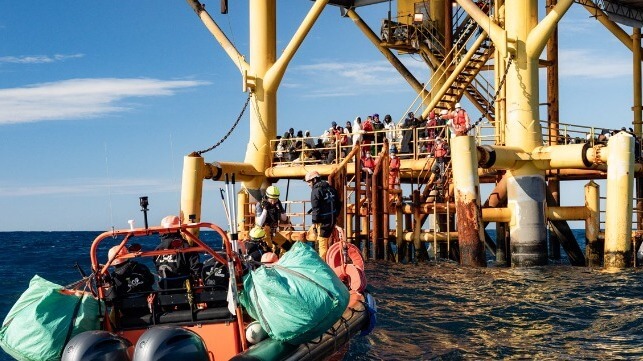
Last week, the humanitarian rescue NGO SOS Mediterranee saved 116 people from the Miskar gas platform, an offshore facility in the Tunisian search and rescue area. 

The survivors - including 39 minors and 13 women - had climbed aboard the lower boarding deck on the platform jacket to escape their boats. They had been at sea for two nights in two small craft, and had gotten hit by a storm, they told rescuers. Some of those who set out did not make it and were lost over the side, they said; the survivors had been stranded on the platform - which is itself inhabited by offshore workers - for four nights. Platform employees did what they could to assist the survivors on deck while they awaited evacuation, the charity said. 

"Every party responsible for their safety knew about their situation. However, competent States, such as Malta, did not take action," SOS Mediterranee said in a statement. "Following an urgent request . . . the UN Human Rights Committee issued interim measures yesterday, urging relevant authorities to ensure rescue and safe disembarkation."

As of March 23, the survivors had disembarked safely at Marina di Carrara, Italy. 

Miskar is located in the Gulf of Gabes off the coast of Tunisia, and it was developed by BG Group, now part of Shell, and has proven reserves of 1.5 trillion cubic feet. It is about one-third of the distance from Tunisia to Malta; the platform is not a typical destination for maritime migration.  


Carbon Storage Developers Complete Applications in UK’s Second CCS Round

Teeside industrial region UK
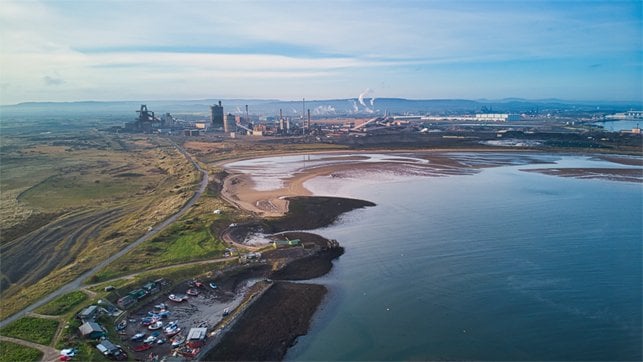
Teesside is one of the industrial areas the UK plans to involve in its offshore carbon storage efforts ( Northern Endurance Partnership)

Published Mar 24, 2026 8:58 PM by The Maritime Executive


The UK’s North Sea Transition Authority received bids for more than two million acres of seabed in its second carbon storage licensing round. Bidding closed on March 24 after having opened in December 2025 and follows the first four licenses, which were awarded in 2023, which have already begun efforts testing the injection process. A total of 21 licenses were awarded in the first round.

The authority had reported strong initial interest before beginning the solicitation, and it now says that the applications pave the way for further carbon storage efforts in the UK. It highlights the sustained progress in the sector, saying the first projects could be operational in 2028.

It highlights that two of the previously awarded projects, both located in Track 1, are among the most advanced in the UK and likely to be the first in operation. The second round offered 14 locations, which NSTA said could provide up to 2 gigatonnes of additional CO2 storage capacity

The Northern Endurance Partnership (NEP) is designed to transport and store CO2 captured from industrial clusters in Teesside and the Humber, and is being led by partners including BP, Equinor, and TotalEnergies. It recently started drilling an appraisal well and, in January, signed a lease with The Crown Estate for what is being called the UK’s first and largest commercial-scale CO? transportation and storage asset. A saline aquifer located about 90 miles offshore in the southern North Sea, together with nearby stores, provides NEP with access to up to 1 billion tonnes of CO2 storage capacity.

The HyNet Alliance was awarded three storage permits. It is moving forward with Eni’s Liverpool Bay Carbon Capture and Storage (CCS) as its first element. Construction was beginning in 2025 on the project, which consists of a network of new and repurposed pipelines that will transport carbon dioxide (CO?) emissions from industry to a storage location under the seabed in Eni’s depleted wells.

During the first round in 2023, Perenco UK was also awarded a license to operate The Poseidon Project, a carbon storage project in the Leman gas field located in the southern North Sea sector of the UK Continental Shelf. It is a depleted gas reservoir that could have an ultimate capacity of 40Mtpa. It started its first tests in February 2025 and said it expects to commence operations in 2029.

The Bacton CCS project would be located in the Hewett field, in the southern North Sea, off the coast of Norfolk. Eni proposed using Hewett as a carbon storage site servicing the Thames Estuary. It began drilling a test well in October 2025.

The NSTA reports it has demonstrated support for the industry with a series of initiatives, including publishing maps highlighting areas of future carbon storage appraisal potential and issuing a set of stewardship expectations to help licensees. It will now scrutinize the applications received in this second round and work with the applicants and other stakeholders, including The Crown Estate and Crown Estate Scotland, and other marine sectors, before deciding on whether or not to award licenses. It is expected to announce its decision in early 2027.


Sea Cargo Charter Calls on Owners to Stay the Course on Decarbonization

Press handout courtesy Klaveness Combination Carriers

Published Mar 24, 2026 11:19 PM by The Maritime Executive


The leaders of a prominent pro-decarbonization industry platform are asking shipowners to stay the course on the green transition, despite the unpredictable mood in the international regulatory environment. 

Owners have reason for pause when it comes to speaking up about reducing CO2. The U.S. is attempting to remove carbon incentives from the IMO's Net-Zero Framework, putting the agreement's future in doubt. Energy prices are soaring amidst geopolitical uncertainty, drawing the industry's attention away from green-fuel goals.   

But the chair and vice-chair of the Sea Cargo Charter - Engebret Dahm, CEO of Klaveness Combination Carriers, and Christian Bonfils, head of the Copenhagen Commercial Platform - say that decarbonization must still happen, and that the enterprises that embrace it now will do better tomorrow. 

"We find ourselves more convinced than ever that stepping back right now would be a mistake that our industry as a whole, and individual companies, will come to regret," Dahm and Bonfils wrote. 

The Sea Cargo Charter is a mechanism for charterers and owners to track and report their emissions, allowing them to demonstrate transparency and  improvement over time. Participation is voluntary, and more than 30 owners and charterers have joined, including Cargill, Equinor and Maersk Tankers, among others. In addition to reporting, the group is a forum for experience-sharing, and members are encouraged to use their reported emissions data to drive internal improvements. 

These voluntary efforts continue despite the lack of a global consensus on carbon rules, and the SCC's leaders suggested that the work will pay off in time. "The companies building data systems, internal capabilities, governance structures, and disclosure practices today will be far better positioned when regulatory requirements tighten," Dahm and Bonfils said.