Tuesday, March 24, 2026

BAN DEEP SEA MINING

Deep Sea Minerals seeks exploration license 


Stock image by allexxandarx.

Deep Sea Minerals (CSE: SEAS) announced Tuesday that it has submitted an application to the US National Oceanic and Atmospheric Administration (NOAA) pursuant to the Deep Seabed Hard Mineral Resources Act (DSHMRA). 

NOAA, which regulates mineral exploration and recovery by qualified US entities in international waters, recently pledged to speed up its review process, saying it would “provide the necessary resources for license and permit reviews to ensure that those reviews go forward without undue delays.” 

Last year, US President Donald Trump signed an executive order aimed at boosting the deep-sea mining industry, marking his latest attempt to boost US access to nickel, copper, manganese and other critical minerals. 

The application, submitted through Deep Sea Minerals’ US subsidiary, American Ocean Minerals Corp. seeks an exploration license for polymetallic nodules in a defined area of the Clarion-Clipperton Zone in the Pacific Ocean, the company said.  

The submission includes technical, environmental, and operational information required under NOAA’s regulations, including baseline environmental data, proposed monitoring, and mitigation measures, and a description of planned exploration activities with associated expenditures. 

“This submission represents an initial step in the regulatory process under DSHMRA,” Deep Sea Minerals’ CEO James Deckelman said in a news release.

“We have structured the application to align with NOAA’s requirements and to outline a phased approach that includes environmental data collection and ongoing evaluation. We look forward to NOAA’s review and to engaging as part of that process.” 

LI

Zijin’s Congo lithium mine set to be among world’s biggest

Aerial view of the Manono lithium project in the DRC. (Image courtesy of AVZ Minerals.)

The lithium mine Zijin Mining Group Co. plans to open this year in the Democratic Republic of Congo is set to be one of the world’s biggest suppliers of the battery metal.

The Chinese company – which has grown at breakneck speed to become a top producer of copper and gold – has been developing the Manono lithium project in southeastern Congo since it secured the prized deposit in 2023.

The mine, which Zijin aims to commission this June, will be able to supply 130,000 tons of lithium carbonate equivalent a year once it reaches full capacity, according to a report the company released on March 20.

That “would put Manono in the highest echelons” of hard-rock lithium assets, with only a couple of giant mines in Australia having the capacity to produce more, said Martin Jackson, head of battery materials markets at consultancy CRU Group.

While the report didn’t specify how long it will take for the mine to hit full capacity, it will be a significant contributor to global production of the metal used in electric vehicles and energy storage systems. At full tilt in 2028, Zijin’s new operation would account for 5% of mined lithium supply, according to Jackson.

The Manono project has a complicated history because another company, Australia’s AVZ Minerals Ltd., still claims the rights to the area Zijin will soon start mining. Congo revoked AVZ’s license three years ago – after the Perth-based firm had found Manono to contain one of the largest hard-rock lithium deposits in the world – before awarding the northern portion of the concession to the Chinese miner.

AVZ has initiated arbitration proceedings against the Congolese state as part of efforts to recover the entire permit. The southern section of Manono has also caught the attention of KoBold Metals Co. – an AI-driven exploration startup whose backers include billionaires Bill Gates and Marc Andreessen – as American investors try to capitalize on a US-Congo minerals partnership signed in December.

During a meeting at the White House earlier this year, Trump administration officials urged an AVZ executive to sell his firm’s interest in Manono to a US company, which could then develop a second mine, Bloomberg reported.

Zijin’s mine – which the report said is costing $1.4 billion to build – will likely produce between 850,000 and 875,000 tons of lithium concentrate a year at full capacity, according to Jackson and Chris Williams, an analyst at industry consultancy Adamas Intelligence. Lithium concentrate is a semi-processed material that is refined into higher-value battery-grade compounds.

A smelter that the company intends to finish by the end of the year will process about 500,000 tons of concentrate a year into an intermediate lithium sulfate product, according to its own report.

The Chinese firm owns almost 55% of the Manono project, with the Congolese state holding the rest of the shares. Zijin has additional interests in two copper mines in the Central African nation, including a 39.6% stake in the massive Kamoa-Kakula complex.

An aggressive acquisition strategy has also transformed Zijin into a top-five gold producer, with mines spread across China, Central Asia, Africa, Australasia and South America.

Africa – led by Zimbabwe – has rapidly emerged as a major source of lithium for China’s dominant battery industry. Ganfeng Lithium Group Co.’s Goulamina mine in Mali would end up even larger than Zijin’s Congolese operation if it completes an expansion project, according to Adamas Intelligence’ Williams.

In the near term, however, a recent ban by Zimbabwe on exports of lithium concentrate means Manono’s upcoming entry into production “comes at a very tight moment for the market,” said CRU’s Jackson.

(By William Clowes)

CU

Prolonged Iran war would hammer top copper miners

Anti Iran war protest, London, March 2026. (Photo by Julian Stallabrass. Flickr Commons | License CC BY-NC 4.0.)

A prolonged Iran conflict could push copper into surplus and sharply cut earnings for major producers, according to Bloomberg Intelligence.

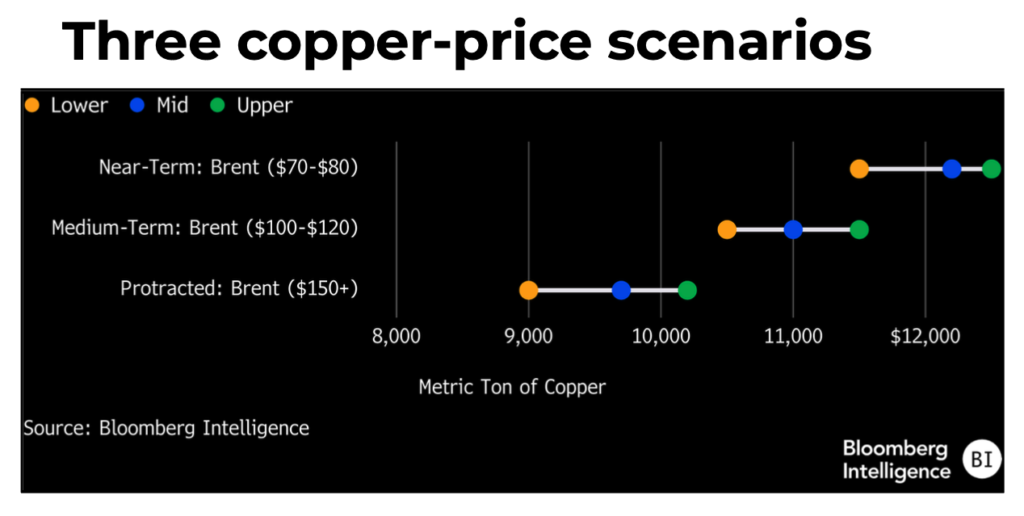
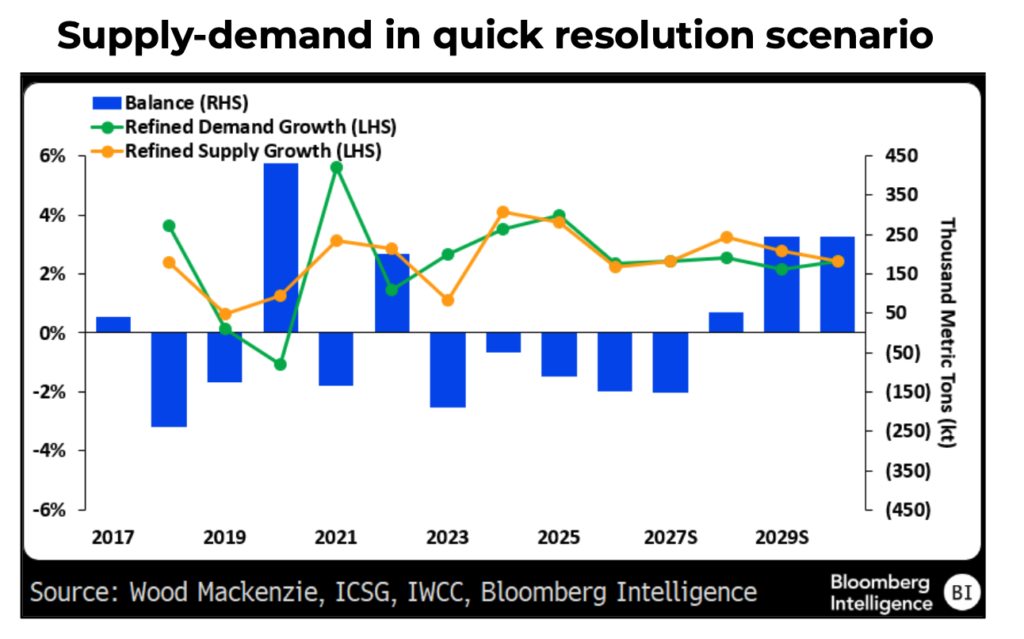
Oil above $150 a barrel in a drawn-out war that disrupts Strait of Hormuz flows would likely slow global growth and cap copper demand at about 0.5%–1%, driving prices below $10,000 a tonne and leaving a refined surplus of 100,000–200,000 tonnes, BI analysts said. 

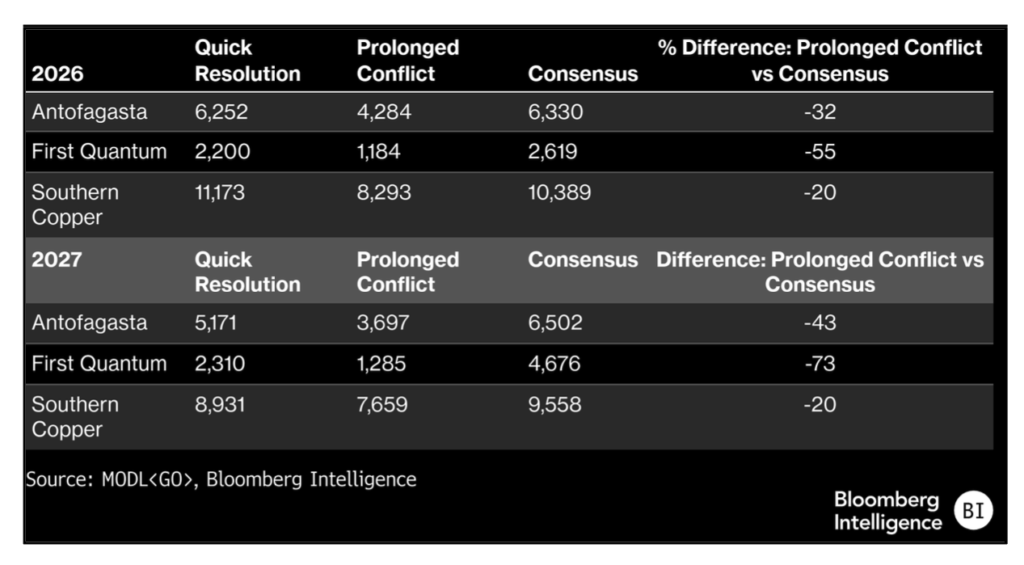
Under that scenario, earnings could fall about 20% at Southern Copper (NYSE: SCCO), 32% at Antofagasta (LON: ANTO) and as much as 55% at First Quantum (TSX: FM), reflecting higher costs and weaker pricing than consensus forecasts assume.

Southern Copper appears best positioned in a downside scenario due to its low-cost base, while First Quantum faces the greatest risk given its higher cost profile and uncertainty around the restart of Cobre Panama, which consensus expects to contribute meaningfully by 2027.

If the war extends beyond a year and Hormuz flows remain constrained, cooling demand would expose the cost curve and leave higher-cost producers most vulnerable.

“While copper’s long-term fundamentals remain intact, near-term pricing and margins are highly sensitive to energy-driven inflation and supply disruptions,” Grant Sporre, global head of metals and mining at Bloomberg Intelligence, said.

The outlook underscores how geopolitical risk in the Middle East could ripple through commodity markets, with copper caught between slowing demand and constrained supply inputs such as sulfur. Even as the global economy becomes less dependent on oil, higher energy prices would likely revive inflation, delay rate cuts and weigh on industrial activity, limiting copper’s upside while tightening margins across the mining sector, analysts warn.

Multi-month scenario

A multi-month conflict would be less damaging, with copper markets roughly balanced in 2026 and prices in the $10,500–$11,500 range, while a quick resolution could restore a modest deficit and support prices near $12,000. Rising inventories, now near 1.4 million tonnes, signal weaker demand and a buyer’s market, suggesting any rally may be capped until stockpiles normalize.

BI analysts had already expected slower global demand growth of 2%–2.3% in 2026 as high prices curb affordability, and warn it may be difficult to lift mined supply even with a 1.1 million-tonne disruption allowance as stoppages persist at major operations.

Supply risks could partially offset the downside. Disruptions to sulfur shipments from the Gulf may constrain output in the DRC, where 50%–60% of production depends on sulfuric acid, limiting the scale of any surplus. 

Persistent mine disruptions and tight concentrate markets could also make it difficult to lift supply meaningfully in 2026.

Higher costs remain a central concern. BI estimates a prolonged conflict could lift unit costs by 10%–20%, with sulfuric acid and other inputs driving broader inflation. High-cost producers may see margins compress to about 40% in 2026 from roughly 70% in 2025, with all-in margins nearing long-run averages, raising the risk of reduced capital spending and delayed project approvals.

The China factor

China’s demand outlook adds further uncertainty. BI’s proxy for Chinese copper demand fell to a multiyear low late last year, pointing to growth of just 0.5–1% in 2026, well below 2025 levels, as property weakness and softer industrial activity weigh on consumption.

The broader takeaway is that copper’s structural deficit story may be delayed rather than derailed, as short-term geopolitical shocks reshape demand, costs and investment timelines across the industry.


Rio Tinto expects Resolution Copper mine to open by mid-2030s


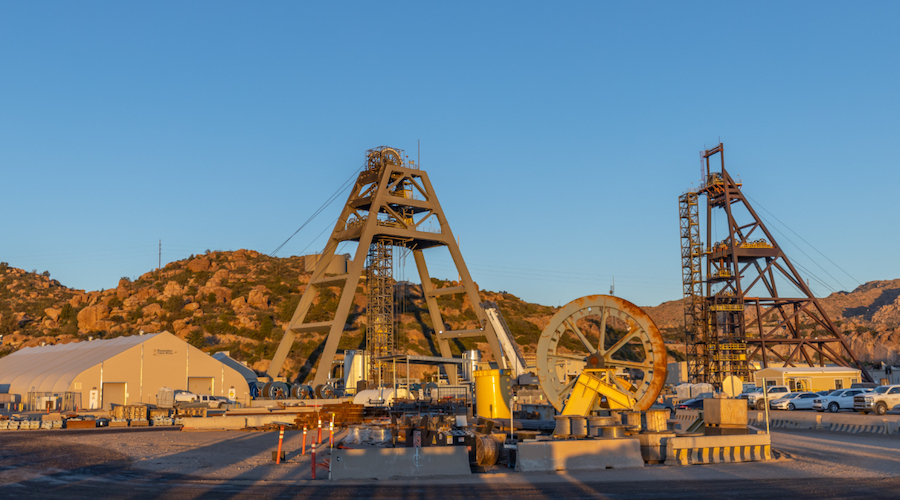
The Resolution underground mine could meet 25% of the US domestic copper needs. (Image courtesy of Resolution Copper.)

Rio Tinto aims to open Arizona’s Resolution Copper mine by the mid-2030s but may need to export some of its copper concentrate due to the challenging economics of smelting in the US, a senior executive told Reuters on Tuesday.

The Anglo-Australian mining giant this month gained control of acreage needed to build one of the world’s largest copper mines after a years-long court fight in which rising US demand for the red metal clashed with the religious rights of the San Carlos Apache people.

“We are quite committed to bringing copper on as quickly as we can,” Katie Jackson, head of Rio’s copper business, told Reuters on the sidelines of the CERAWeek by S&P Global conference in Houston. “This is something we want to do in the early- to mid-2030s.”

The Resolution project is slated to produce more than 40 billion pounds (18.1 million metric tons) of copper over its life and supply more than a quarter of US demand.

With control of the acreage, Rio has now begun a $500 million drilling campaign to study the 30% of the deposit it previously could not access.

Refining uncertainty

Resolution will produce copper concentrate that must be smelted into a form known as cathode that can be used to make wires and other products.

Rio executives have said for years the company aims to keep all of Resolution’s copper inside the United States. Jackson on Tuesday, though, said “it’s too early to say” whether all of the copper would remain.

Rio operates Utah’s Kennecott copper mine and smelter and Freeport-McMoRan operates the other US copper smelter.

Jackson said that Rio has not shifted its policy on keeping Resolution copper in the US but noted that smelting in the US has become unprofitable.

Smelters make money by turning copper concentrate into metal for fees known as treatment and refining charges (TC/RCs), but those charges have turned negative in recent years due to a shortage of copper concentrate, meaning smelters are paying to process copper supplied to their plants.

Rio has been telling US policymakers “that the current set of mechanisms and tariffs around copper don’t solve that problem,” Jackson said.

The Trump administration last year imposed a 50% tariff on semi-finished copper products, but left out copper input materials such as ores, concentrates, and cathodes.

Jackson said possible policy solutions could involve Washington setting a price floor for TC/RC charges, imposing a tariff on copper cathode, or blocking exports of copper concentrate.

“The current structures don’t support the Kennecott smelter,” said Jackson.

Kennecott to stay shut for weeks

Rio shut down part of Kennecott’s mine operations this month after a worker died, the second death at Rio’s operations this year.

Jackson, who plans to visit Utah later this week, said the company is investigating the death and that Kennecott’s underground mine will remain closed for a few weeks.

“We will never be able to make mining a zero-risk business, but we should be able to make it a zero-harm business,” Jackson said.

Mongolia negotiations

In Mongolia, Jackson oversees the Oyu Tolgoi copper and gold project. The country’s government, which owns 34% of the project to Rio’s 66%, is seeking to renegotiate what it has called the “unfair” ‌commercial terms.

Mongolia took a multibillion-dollar loan from Rio Tinto to fund its share of the mine’s development. Rio also charges management fees.

Jackson, who was in Mongolia earlier this month, said Rio is open to reducing its management fees and the interest rate on the loan, but noted that the loan is unsecured and that Rio is guaranteeing the project’s finances.

“There is a very real and significant risk that we are carrying as a company,” said Jackson. “We have been negotiating in good faith for some while, and we are keen to get something done.”

(By Ernest Scheyder; Editing by David Gregorio and Sonali Paul)


Port of Baltimore Had Second Best Year as Recovery Continues

Port of Baltimore
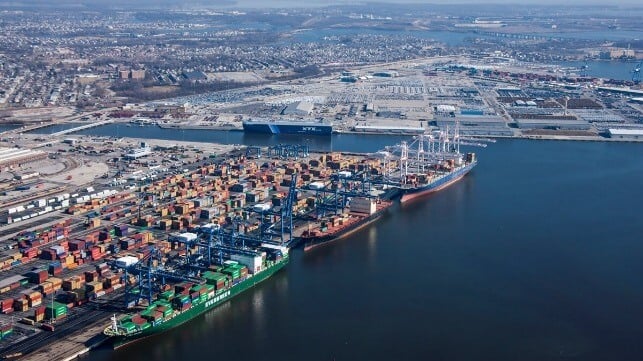
The Port of Baltimore posted strong results in 2025 in segments from containers to breakbulk and RoRos (Maryland Port Administration)

Published Mar 24, 2026 7:59 PM by The Maritime Executive


The Port of Baltimore reported its second-best year ever in 2025 as it continues to recover from the devastation of the Francis Scott Key Bridge collapse. Marking the second anniversary of the allision, which destroyed the bridge and closed most parts of the port for weeks, Maryland Governor Wes Moore announced that the combination of public and private terminals that comprised the Helen Delich Bentley Port of Baltimore handled approximately 50 million tons of cargo in 2025 and is poised to show strong growth this year.

“Once again, Maryland’s Port of Baltimore proves it is one of our nation’s top economic assets as it continues to rebound from the collapse of the Francis Scott Key Bridge in 2024,” said Gov. Moore. “With an annual economic value of $70 billion and more than 273,000 jobs in Maryland tied to the port, our state is stronger with a successful Port of Baltimore.”

The total cargo handled last year had a value of $65.6 billion—the third-highest value in the port’s history. The 2025 total exceeded Baltimore’s 45.9 million tons of cargo handled in 2024, finishing only behind 2023’s record of 52.3 million tons. 

The port had a long list of achievements during 2025. Overall, Baltimore finished 10th among all U.S. ports for foreign cargo value ($65.6 billion) and 11th for foreign cargo tonnage (49,983,622 tons).

The Port of Baltimore set records for containers and total cargo ship visits. The container terminal handled 1.1 million TEU and 2,223 vessels last year—a 21 percent increase over 2024. It also saw an increase in its weekly container services from 12 in 2024 to 15 in 2025. The port handled about 11.1 million tons of autos, farm and construction machinery, containers, forest products, and breakbulk at its public terminals, which was the third-largest amount in the port’s history. 

RoRo volume continues to be a significant part of the port.  The port handled 887,513 tons of roll-on/roll-off farm and construction equipment in 2025—a six percent increase over 2024 and the highest among all U.S. ports. The Port of Baltimore also handled 728,225 autos and light trucks in 2025—second overall in the U.S. and the 13th consecutive year exceeding 700,000 units.

Other key areas included 1.1 million tons of forest products (rolled paper and wood pulp), which placed Baltimore first among all ports in America. It was second in the U.S. for exported coal and imported aluminum, gypsum, salt, and sugar.

In addition to its cargo business, the Port of Baltimore has evolved into a popular cruise homeport. In 2025, 413,639 passengers took a cruise from Baltimore, ranking in the top 10 of passenger counts in the port’s cruise history.

Officials note that the Port of Baltimore’s container business will be enhanced in 2026 with the completion of the $518 million CSX Howard Street Tunnel Project. The project includes modernizing the 130-year-old Baltimore freight tunnel and making clearance adjustments at 22 points between Baltimore and Philadelphia, allowing for double-stacked container trains to travel to and from the port. The project is expected to increase the port’s business by approximately 160,000 containers annually and generate nearly 14,000 jobs. 

The results come as efforts are getting underway to build a replacement bridge. Initial contracts have been awarded, but late last year, Maryland officials announced that the projected cost had more than doubled, to an estimated $4.3 billion to $5.2 billion. They anticipate the new bridge will be completed by late 2030.


Scenic Cruise Picks Kongsberg Maritime Package for Polar Expedition Vessel

Kongsberg Maritime

Published Mar 24, 2026 10:10 PM by The Maritime Executive


[By: Kongsberg Maritime]

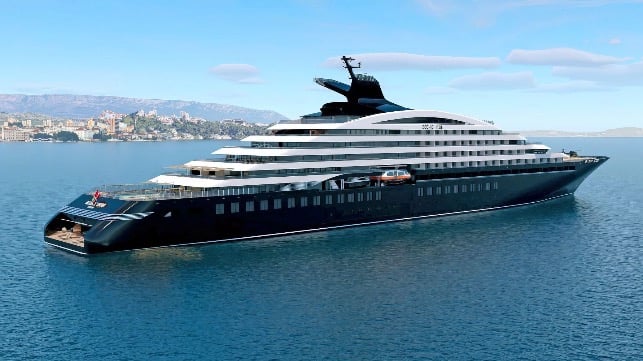
Kongsberg Maritime has won a contract from MKM Yachts to supply an extensive package of equipment for the Scenic Ikon polar expedition vessel under construction for Scenic Cruise.

The Scenic Ikon, the latest in a series of luxury expedition vessels for Scenic Cruise, features a hybrid electric propulsion system from Kongsberg Maritime, to enable emission-free operation in environmentally sensitive areas.

The new 203-metre vessel will be the first in the series to feature Kongsberg Maritime Elegance Pods for main propulsion. The Elegance Pod boasts several advanced features that set it apart from traditional propulsion systems. Three key factors define the performance: low noise, high efficiency, and excellent manoeuvrability.

A spokesperson for MKM Sasa Cokljat, said: “MKM Yachts has selected Kongsberg Maritime as a key supplier due to their state-of-the-art technology and innovative solutions that greatly enhance the value and performance of our vessel. Our cooperation with Kongsberg Maritime has been very positive and based on mutual professionalism and trust. In addition, we maintain a very good collaboration with Navis Consult, a Kongsberg Maritime company, in the development of documentation.”

Halvard Foss, Sales Director at Kongsberg Maritime, said: “Scenic Cruise’s once-in-a-lifetime, luxury travel experiences, are based on innovative design and state-of-the-art technology. We are extremely proud to have been selected by MKM Yachts to supply our full range of products, to provide clean and efficient operation for this stunning new cruise ship.”

“With growing demand for electric propulsion and clean sailing, particularly in the cruise market, our Elegance Pods and Energy Storage Systems are designed to offer unparalleled efficiency, manoeuvrability, and environmental benefits. We look forward to working with MKM Yachts and Scenic Cruise on this exciting project.”

Two Elegance 1230 pods, rated at 3340KW will be installed. The pods use a Permanent Magnet (PM) electric motor, known for its robustness, compactness, and high efficiency. This motor, combined with a fixed-pitch propeller, ensures optimal hydrodynamic performance.

Hybrid power will be supplied through the Energy Storage System (ESS), where batteries can provide emission-free power for propulsion and hotel consumption. Other equipment includes bow thrusters, electric drives, retractable stabilising fins and a range of deck machinery. 

Kongsberg Maritime will also supply the navigation system fully integrated with dynamic positioning, manoeuvring control and a forward-looking sonar. Additionally, the integrated automation including energy management system, as well as ESD and Safety Management System are also included in the fully integrated package.

The Scenic Ikon is being built at the 3 Maj Shipyard, in Rijeka, Croatia, and due to be delivered in 2027.

The products and services herein described in this press release are not endorsed by The Maritime Executive.


Bureau Veritas to Class New Generation of All-Electric Trimarans

Bureau Veritas Marine & Offshore

Published Mar 24, 2026 9:58 PM by The Maritime Executive


[By: Bureau Veritas Marine & Offshore]

Bureau Veritas Marine & Offshore (BV) is pleased to class two next-generation, all-electric high-speed trimarans for Brim Explorer, marking a significant step forward in zero-emission maritime transport.

The trimarans will be constructed at Herde Kompositt in Hardanger, with outfitting carried out by Horten Skipsreparasjoner. The vessels have been developed by Brim Tech, the technology arm of Brim Explorer, following nearly six years of operational testing and optimization using the company’s existing vessels as test platforms in Northern Norway and Oslo.

Purpose-built for electric propulsion, the trimarans are the result of extensive real-world testing in Arctic conditions, fjords and open sea. The vessels incorporate lightweight structures and highly optimized hull developed by WIND Naval Architects to minimize energy consumption. Each vessel will accommodate up to 180 passengers and is expected to achieve a range of approximately 100 nautical miles at 20 knots on a single charge.

By classing these innovative vessels, Bureau Veritas will support the safe integration of advanced technologies while contributing to the development of sustainable maritime solutions. Once delivered, the vessels will operate quiet, zero-emission sightseeing tours in Norway’s spectacular fjords, further demonstrating the potential of electric propulsion for passenger transport.

The products and services herein described in this press release are not endorsed by The Maritime Executive


Japan Certifies Its First RoRo with Autonomous Navigation

domestic Japanese RoRo
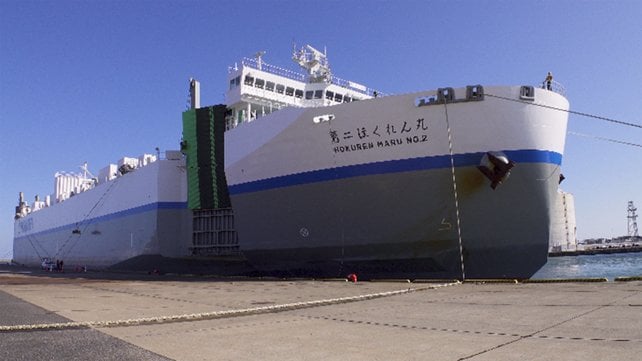
Japan's domestic RoRo became the first of its kind to be certificated for autonomous operations (K Line)

Published Mar 24, 2026 5:54 PM by The Maritime Executive


A RoRo that operates on a domestic route in Japan recently became the first vessel of its kind to complete the licensing requirements to conduct fully autonomous navigation during commercial operations. It was the latest step in an ongoing project sponsored by The Nippon Foundation to advance the development of autonomous ship operations.

The 6,890-dwt RoRo Hokuren Maru No. 2, owned and operated by Kawasaki Kisen Kaisha, Ltd. (“K” LINE), completed a series of certifications in January and February on its way to becoming the first autonomous RoRo. Built in 2016, the vessel is 173 meters (567 feet) in length and operates transporting trucks loaded with raw milk and other agricultural products between Kushiro Port on the northern island of Hokkaido and the Hitachi Port in central Japan north of Tokyo. The ship was selected for the project both because of the critical importance of RoRos in the Japanese economy and because it travels a route that is busy with fishing vessels and subject to rough weather and fog.

The vessel was retrofitted with sensors that feed data to the system to determine navigation. The working group, which consisted of K Line, Japan Radio, and YDK Technologies, started in 2023 and conducted its first tests aboard the RoRo in October 2023. They reported the system achieved an average operational rate of 96 percent in the sea area during its first tests. They continued to enhance the system, including in 2025, working on improvements in the fully autonomous ship technology and the development of an automatic vessel speed control system, before additional demonstration tests.

ClassNK (Nippon Kaiji Kyokai) issued the vessel certification for autonomous shipping to the RoRo on January 27, 2026. The ship passed its statutory ship inspection by Japan’s Ministry of Land, Infrastructure, Transport and Tourism on February 9. It has now completed all the required steps needed to operate autonomously during commercial operations.

The Nippon Foundation launched the project in 2020, known as MEGURI2040, with the goal of achieving 50 percent unmanned operation of domestic vessels by 2040. The motivation was to address Japan’s declining and aging population of seafarers, reduce the workload for seafarers, and prevent accidents at sea due to human error. 

During the first phase of the project, they demonstrated systems for key elements of operations. This included tests in Tokyo Bay as an example of a congested shipping area, a distance test of nearly 500 miles, and an endurance test lasting more than 18 hours. Elements of operations, such as berthing, were also demonstrated.

The Hokuren Maru No. 2 is the third demonstration vessel in the project to achieve the autonomous ship classification. Last December, a RoPax ferry was the first vessel to receive the certification. The project has also developed a domestic containership, Genbu (8,597 dwt / 140 TEU), which was built for autonomous operations. 

The Nippon Foundation expects to obtain valuable data from these vessels as it seeks to commercialize the technology. A consortium of 53 companies is participating in the project, which they hope will provide stability to the country’s supply chains. They are also contributing to the overall development of the global standards for autonomous ship operations.


Call for Germany to Implement National Maritime Service to Grow Seafaring

German flag on stern of a ship
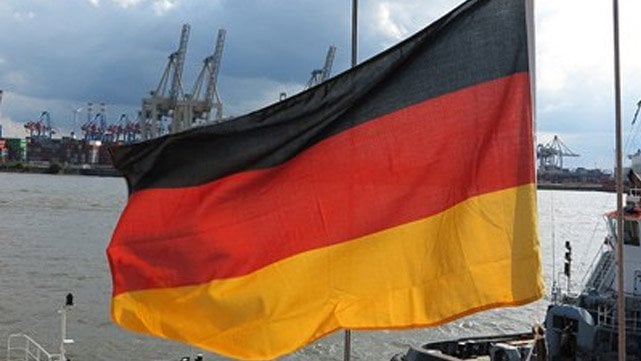
The German Shipowers' Association is proposing that seafaring should become a national service (VDR)

Published Mar 24, 2026 6:54 PM by The Maritime Executive


Faced with the same challenges that many nations are facing of a dwindling national merchant marine, the German Shipowners’ Association (Verband Deutscher Reeder - VDR) is proposing a novel approach to continue the recent trend it has seen in the growth in the number of young people joining the seafaring profession. During its annual event in Hamburg, the association proposed making sea service in the merchant marine an option in voluntary military service and as an alternative should Germany reinstate compulsory military service in the future.

“The Iran war demonstrates how closely geopolitical conflicts and global supply chains are intertwined,” said VDR President Gaby Bornheim. “Around two-thirds of our foreign trade is conducted by sea. For an export nation like Germany, the protection of merchant shipping is therefore of strategic importance.”

VDR reports that more young people are joining the profession, with enrollment numbers at their highest levels in more than a decade. Since 2023, VDR reports the number of recruits at sea has risen from 418 to 537. It is an increase of almost 30 percent, and the highest figure since 2012. It highlights that this includes the nautical and technical officer career paths, as well as the training to become a ship engineer.

They note that the increase in the number of young seafarers is critical to maintaining and growing the German merchant marine. Germany, VDR calculates, has 1,716 ships in its registry, representing 46.7 million gross tons. It reports that Germany has the seventh-largest merchant marine, trailing behind countries including China and Greece. In container shipping alone, they point out that Germany has 30.4 million gross tons and has surpassed China to be the second largest country. Switzerland (home to MSC Mediterranean Shipping) is the largest, with 41.2 million gross tons.

Martin Kröger, Managing Director of the VDR, adds, “In the long term, we need an even larger national personnel base. In a real crisis, we mustn’t be caught off guard, but rather be prepared.”

VDR is proposing making sea service in the merchant shipping industry available as part of the new military service. It says the aim is to establish a civilian maritime reserve whose members can contribute to maintaining maritime supply in emergencies after their service, as well as providing an entry point into the shipping industry. They note that the trainees would gain practical experience on board and acquire training qualifications that could be credited towards later vocational training.

“Sea service would be a civilian option within the framework of military service and would simultaneously help to further develop maritime expertise, which is indispensable for Germany's supply and maritime transport,” urges VDR.

The association notes that until military conscription was suspended in 2011, active seafarers could be deferred from military service based on the essential nature of their work. VDR proposes that if compulsory military service were to be reinstated in the future, sea service could be performed as a civilian alternative in the merchant marine. 

It is a unique approach while other countries look at different means of enhancing their merchant marine. Australia has proposed a government program to build a national fleet, while the Trump administration proposed a broad plan to rebuild U.S. shipbuilding and the merchantmarine,e in part by taxing foreign ships and requiring a portion of U.S. goods to travel on American-flag ships. The plan also calls for an investment in training programs. Japan, on the other hand, is pushing forward with autonomous shipping for its domestic shipping operations to address its aging and declining population of seafarers.


Maersk’s APM Becomes Minority Shareholder in North Vietnam Terminal

Hai Phone Vietnam
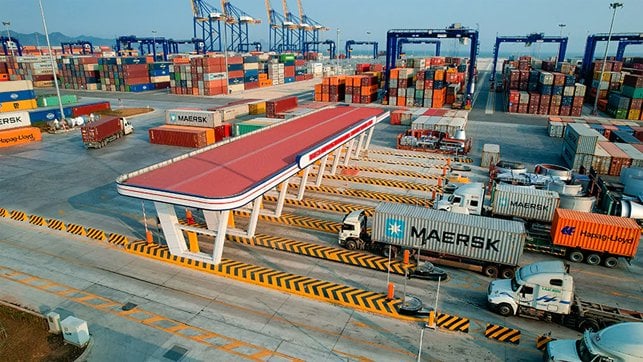
Maersk's APM is becoming a minority investor and operator at the northern Vietnam terminal (APM)

Published Mar 23, 2026 7:40 PM by The Maritime Executive


Maersk’s APM Terminals is taking a 49 percent minority shareholder and operating partner position in the Hai Phong International Container Terminal in North Vietnam. The company notes the strategic location of the operation and its rapid growth while announcing it has also been chosen as part of the Gemini Cooperation’s East-West network.

The terminal is located within the Lach Huyen port in Haiphong City, in the north of Vietnam. It is close to Hanoi and has strong access to the industrial regions in the north. They report it has already demonstrated its access and ability to facilitate direct import and export since the operation was dedicated in July 2025.

Officials noted that the port has been developed in just 30 months. It is reported to already be delivering on the highest berth productivities in the Port of Hai Phong. 

APM initially announced its partnership with Vietnam’s Hateco three years ago in March 2023 for a project to develop two new deep-water berths. As part of the strategic partnership, APM Terminals agreed to provide financial, operational, and technical support to Hateco. The project called for two berths with a total length of 900 meters (450 meters each), capable of accommodating container vessels of up to 18,000 TEUs capacity. In the initial phase, the facility was designed for five ship-to-shore (STS) cranes and 14 rubber-tire gantry (RTG) cranes.

It becomes the second major Vietnam terminal, with APM also involved in the Cai Mep International Terminal. It is located in the south near Ho Chi Minh City. Furthermore, it can also handle 18,000-plus TEU vessels with up to 214,000 dwt. Cai Mep has a capacity of 2.1 million TEU.

It is the latest in a series of strategic terminal investments recently announced by AP Moller Maersk. It reported that in 2025, its Terminals sector achieved its strongest financial performance ever with record volumes, revenue, and EBIT. Maersk told investors that revenues from terminals increased by 20 percent, propelled by record-high volumes from strong demand, improved rates, and higher storage revenue. It said it continued to strengthen its position as a global leader in terminal operations and critical port infrastructure.


Dominion’s Coastal Virginia Offshore Wind Delivers First Power  

DESPITE TRUMP


offshore wind farm
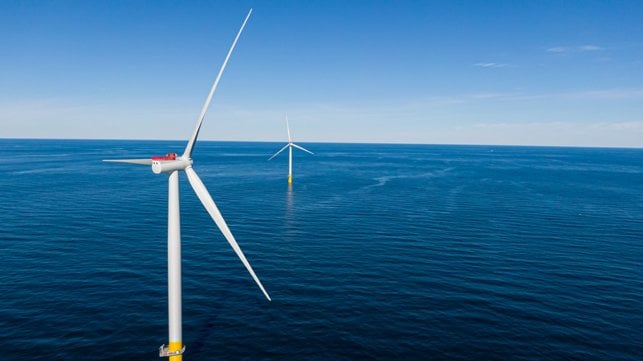
Dominion Energy achieved first power from its offshore wind project (Dominion Energy)

Published Mar 24, 2026 3:57 PM by The Maritime Executive


Coastal Virginia Offshore Wind, which is the largest commercial-scale offshore wind project in the United States, marked a key milestone on March 23 as it delivered its first power to the grid. It comes approximately two and a half years after construction began and after more than a decade of planning.

“This achievement marks another important step forward, adding much?needed electricity to help meet the fastest?growing power demand in the country… I am so proud of the team making this progress possible—and excited about what’s ahead,” wrote Robert Blue, Chairman, President, and Chief Executive Officer of Dominion Energy, in an online posting.

Last month, the company told investors the project was over 70 percent complete and moving forward on schedule. It was delayed in December and January until the company received a preliminary injunction against the Trump administration’s stop-work order. After resuming work, the first turbine installation was completed in January.

Dominion has reported that all 176 monopiles were installed between May 2024 and October 2025 and that, as of February, it was ahead of schedule on the installation of the transition pieces. The third of the offshore substations was installed in late February, and the media reports indicated that the first three turbines have now completed installation.

The company said it was “deliberately moving more slowly” with the first turbine installations to ensure it was working correctly and learning from the installation process. As of late February, it said 70 percent of the towers and nacelles and 30 percent of the blades had been fabricated.

As of the end of 2025, the company said it has invested approximately $9.3 billion in the project with an estimated total budget of $11.5 billion. That included, as of February, $580 million of actual and estimated expenses due to the Trump tariffs and an added cost of $228 million associated with the month-long work suspension due to the stop-work order from the Bureau of Ocean Energy Management. Dominion told investors it had $155 million in an unused contingency in its budget for the offshore wind project.

CEO Robert Blue continues to assert that the project represents the “fastest and most economical way” to deliver nearly 3 GW to Virginia’s grid. The company has asserted to the Trump administration that it is facing increased demand and that the additional power is critical to its service area, which includes key military installations, the shipbuilding industry, and growing AI and data center development.

Dominion Energy initially installed two prototype wind turbines in 2020, each of which generates 6 MW, as it was exploring offshore wind energy. It gained the lease for the offshore area in 2013. 

When completed, Coastal Virginia Offshore Wind is slated to provide 2.6 GW with its 176 turbines. They will continue to commission turbines as work continues, and the company has said the project should be completed in early 2027.