Mirror and mismatch: China and the global politics of the far-right
First published at Transnational Institute.
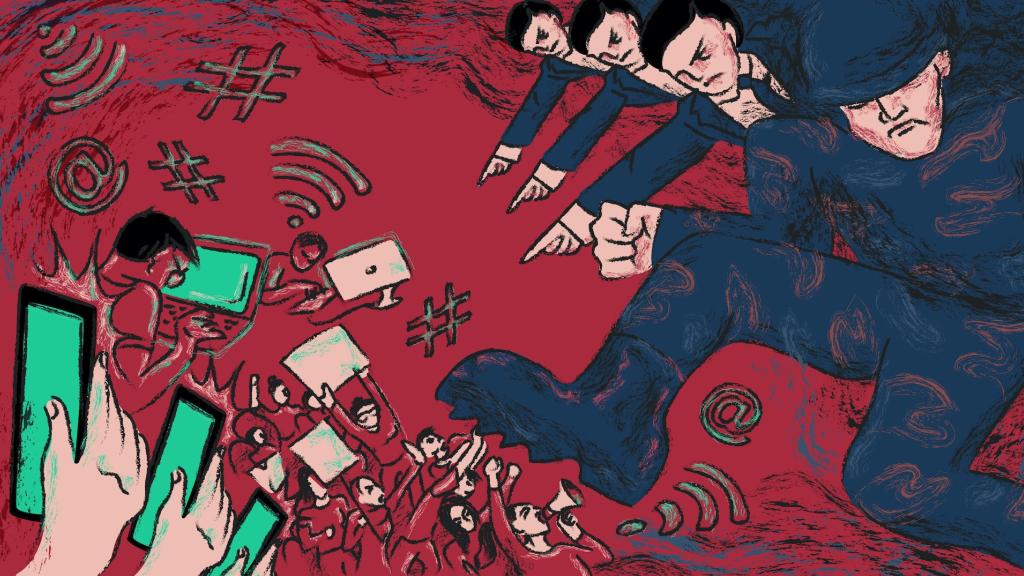
The far-right label is not easily applied in China, but nevertheless there is a rising tide of xenophobia, militaristic nationalism, racism, anti-feminism, and social conservatism in Chinese online discourse and sometimes within the state. The global fight against fascism requires movements worldwide to connect with grassroots activists within China and among the diaspora pushing for liberatory futures.
Is there a far right in China? What are its characteristics? How does it coincide with or differ from the far right elsewhere?
It can be tricky to talk about ‘left’ and ‘right’ as ideological labels in China because of the political and moral baggage associated with them. As the ruling party is nominally ‘communist’ and has historically referred to dissidents as ‘rightists’ (youpai 右派), the public tends to use ‘left’ and ‘right’ as a shorthand for describing attitudes towards the regime: ‘left’ as supporting the establishment and ‘right’ as being against it, such as the liberal intellectuals (ziyoupai 自由派) advocating constitutionalism and liberal democracy.
Members of the Chinese intelligentsia and the wider online public, however, increasingly recognise that both pro-regime and anti-regime camps are themselves divided into left and right orientations. The debate among intellectuals about Trump and Trumpism, broadly described as ziyoupai, in particular revealed the schism between left-leaning and right-leaning liberals. This has led some observers to identify a far-right (jiyou 极右) current within Chinese dissidence, characterised by racism, libertarianism and the rejection of progressive social movements.1
Academic discussions usually describe xenophobia, militaristic nationalism, Islamophobia, racism, anti-feminism, and social conservatism as right-wing. However, given the baggage of ‘left’ and ‘right’ in Chinese political culture, supporters of the regime rarely consider themselves to be ‘right-wing’, even if their views are overtly racist, misogynistic, chauvinist, and xenophobic. Anti-Americanism is typically considered to be on the ‘left’ given the anti-imperialist association. For example, known for his hawkish stance towards the US and Japan, Ai Yuejie, formerly a professor of military thought, is revered among some online communities self-identifying as ‘far left’ (jizuo 极左) or ‘Maoist left (maozuo 毛左). One of his best-known quotes, which his fans cite as a motto, encapsulates the principle of ‘might makes right’: ‘Dignity lies only at the tip of the sword; truth exists only within the range of artillery’. This means that those who are labelled as ‘far left’ in popular culture may in fact espouse militaristic, ultranationalist, and authoritarian ideologies more commonly associated with the right.
Interestingly, while conservative Chinese nationalists are unlikely to self-identify as right-wing, many are now comfortable with describing themselves as ‘conservative’. In other words, ‘progressive’ and ‘conservative’ are generally used in line with international conventions.
So, after this lengthy preface, yes, there are far-right discourses and ideological currents in China, both among nationalists and dissidents, even though supporters of the regime may consider themselves to be leftists. Like the far right elsewhere, these coalesce around racial nationalism and the backlash against social-justice movements. For conservative nationalists, feminism, LGBTQ movements, labour movements, and other forms of human rights activism are also de-legitimatised as instruments of ‘Western imperialism’, exemplifying the appropriation of the anti-imperialist language. This is not limited to China, but also seen in other countries in the Global South, and indeed in the Global North as well.2 In my forthcoming book, I highlight the transversal convergence across not only conventional geopolitical, but also ideological, boundaries in the post-liberal conjuncture, where we often see ideological cross-fertilisation in any number of ways.3
Reactionary politics everywhere do not have a coherent agenda. They may be rejecting similar things (whether immigrants or ‘wokeism’) but with very different proposals. Compared to the traditionalists or libertarians who have a stronger influence in the US, Chinese conservative and authoritarian techno-nationalist discourse is less concerned with safeguarding ‘traditional values’ than with upholding techno-scientific reason against the chaos and moral decay attributed to ‘postmodernism’, while remaining favourable towards globalisation and state capitalism. If the Silicon Valley techno-libertarianism is about ‘the government should do nothing to hinder technological progress’,4 then for the Chinese techno-authoritarians, the government should do everything to pursue and guide technological progress. They share a common aversion to democratic processes and progressive movements, along with various forms of racism and misogyny. However, both official and popular nationalisms in China are rooted in postcolonial developmentalism, where political sovereignty is most important, and the ethics of cultivating a neoliberal and entrepreneurial self is tied to the project of national development.
How about the Chinese state? And how is this influenced by what’s happening elsewhere in the world?
This is another reason for why it is difficult to talk about China in discussions of the far right. The Chinese state presents itself as anti-imperialist and, of course, socialist. The fact that there are no elections and no political movements allowed outside the official apparatus also contributes to China’s marginalisation in far-right studies, which tend to prioritise electoral politics. In a wonderful article on the global politics of the far right, Anievas and Saull talk about a set of ‘common enabling conditions’ that ‘laterally connect Modi’s India and Bolsonaro’s Brazil with the “UKIPisation” of Britain and ‘Trumpification’ of America insofar as the neoliberal-driven de-industrialisation of the “advanced” capitalist powers was internationally entwined with the large-scale processes of “accumulation by dispossession” most dramatically experienced by such “late” state-led industrialisers like the BRIC states and, most notably, China’.5 The article and the special issue it introduces, however, engage little with China itself beyond how its portrayal as a threat enable far-right politics in the US. Unlike Modi-ism or Erdoğan-ism, the one-party system and the socialist state probably make the usual frameworks and languages of analysis inadequate or a poor fit when it comes to China's relationship with the global politics of the far right.
We can indeed situate Xiism within broader contestations of the ‘liberal international order’ from other emerging powers such as India and Türkiye.6 Rather than being an external challenger, China has been integral to both the relatively stable hegemony of global neoliberalism in the 1990s and 2000s, and to the intensification of the post-liberal contestations we now witness. This represents a partial and selective rejection of some aspects of the liberal international order, such as the normative hierarchy that tends to stigmatise or impose ‘symbolic disempowerment’ on nations or subjects considered illiberal,7 which co-exists with embracing other aspects, such as globalisation, multilateralism, and the United Nations (UN) system. In contrast to the anti-globalism of the Western far right, Kumral notes that for emerging powers, neoliberal globalisation continues to be seen as ‘opportunities for upward mobility for national economies in international stratification’.8 She argues that Modi and Erdoğan synthesise neoliberalism with developmentalism, offering ‘selective redistributionist policies that target the poorest sections’, providing the rising middle class with a ‘master development narrative of a rising Turkey/India in a period of global hegemonic transformation’ and a re-imagining of past empires.9 Xiism runs parallel to these projects in many aspects, being embedded in the ‘common enabling conditions’ mentioned earlier, including the shifting economic power relations and capitalism’s ‘spatial fix’ of manufacturing jobs, which has contributed to different attitudes towards globalisation in the North and the South. As Eli Friedman puts it, if the social ‘dissolution wrought by neoliberal capitalism has revitalized fascism in the West, it has been similarly important in the rise of ethnonationalist dictatorship in China’.10
Intersecting with these economic processes is postcolonial identity politics, which often takes the form of civilisational discourses that assert one’s identity and cultural particularities against ‘Western hegemony’ or ‘cultural imperialism’. This is not particularly new. For example, the Guomindang’s (the Nationalist Party) conservative revolution in the 1930s was doing very much the same: justifying authoritarianism and social conservatism through claims about cultural authenticity and resistance to Western imperialism.11 However, in contemporary China and shaped by the post-Cold War international order, we also see arguments about security in addition to those about authenticity. Certain values or movements are framed both as ‘not ours’ (not Chinese) and as instruments of regime-change attempts threatening national security. Among the cultural elites, conservative intellectuals in China have been influenced by figures such as Samuel Huntington and Carl Schmitt in their articulation of China as a ‘civilizational state’. Drawing heavily on Huntington and in an explicitly gendered language, Gan Yang, a prominent conservative philosopher based at Tsinghua University, characterised the earlier pursuit by Türkiye and Russia of ‘Westernised’ modernisation as ‘self-castration’, whereby they lose their own racial-civilisational identity.12 Jiang Shigong, another state-adjacent intellectual and a Schmittian legal theorist, argues that the prevailing discourse of ‘integrating with the world’ in the 1990s and 2000s means that ‘we’ have lost ‘our civilisational impulse and political will to defend ourselves’.13 Ironically, again, these prominent intellectuals of conservative civilisationism, such as Gan Yang, Jiang Shigong, and Zhang Weiwei, are known as the ‘new left’ despite their affinities with European and US conservative thought.
As I have recently argued,14 civilisational discourse becomes a vehicle for claiming difference internationally and suppressing difference domestically. At the international level, Xi’s ‘Global Civilisation Initiative’ advocates diversity and warns against ‘imposing one’s values and models onto others’. Domestically, assimilationist ethnic policy is accompanied with the re-centring of zhonghua minzu (Chinese nation or race-nation)15 and zhonghua wenming (Chinese civilisation) as key concepts in the country’s political discourse. Under the slogan of ‘forging a strong communal consciousness of the Chinese nation’, assimilationist policies seek to erase and securitise difference, while turning a depolitcised, exoticised version of ethnic difference into resources for tourism and consumerism. These policies scale back a range of preferential policies that ethnic minorities used to enjoy, infringe on cultural and religious rights, and remove minority languages as medium of instruction in formal education.16 At the same time, we see abundant scenes of minority ‘singing and dancing’ in domestic and external propaganda as a display of ‘diversity’ and ‘unity’, which reduces living religious and cultural traditions to exoticised patriotic performances.17 With the rise of ecotourism, as Guldana Salimjan argues, the rebranding of Indigenous lands as Han ecotourist destinations to appreciate ‘untainted nature’ is marked by land dispossession and labour injustice.18
What about in terms of social media and internet discourse? Do we see similar threads of xenophobia, misogyny, and reactionary social violence in Chinese social media that we see in other parts of the world?
Absolutely. My previous work has focused extensively on the transnational circulation of far-right narratives and tropes in the digital sphere.19 A lot of this is misinformation and conspiracy theories about demographic and cultural crises of ‘the West’. So, when internet users in China deploy the same imaginaries about ‘Western civilisation’ being undermined by ‘non-white’ immigrants and ‘woke’ ideologies as Western far-right actors, it’s about the decline of ‘the other’, told as a cautionary tale with a sense of geopolitical Schadenfreude. The cautionary tale serves to bolster ethnonationalist anxieties and delegitimise domestic social movements in a fashion of “this must never happen in China’. We have seen the rise of grassroots Islamophobic influencers or muhei (穆黑), who mobilise both globally, circulating scripts of Islamophobia, and more locally rooted patterns of prejudice.20
Many of the anti-immigration narratives are about portraying crises of ‘the other’, although they sometimes extend to China’s own immigration policy (statistically China has one of the lowest shares of foreign-born residents worldwide). The online backlash against the new regulations on foreigners’ permanent residency in 2020 provides one such example. Apart from ‘racist coverage of African immigrant communities in Guangzhou’,21 the backlash also features themes that reflect certain locally specific grammars of grievance. This includes the longstanding perception that foreigners get special preferential treatment, and the discontent with unequal status among Chinese citizens themselves due to the hukou system — which produces an unequal citizenship regime that disadvantages rural migrant workers, who are often excluded from urban social citizenship and welfare provisions or included but on a differential basis.22 While this institution is unique to China, it is commonly observed in the affective politics of right-wing populism that grievances about inequalities or marginalisation are weaponised and channelled towards hatred against the ethnocultural other. Han supremacist narratives online also frequently frame ethnic minorities in China as undeservingly privileged and Han males as being victimised.23
In the more recent backlash against China’s newly introduced K-visa, which is intended to attract talent in the fields of science, technology, engineering and mathematics (STEM), we also see that blatant racism is entangled with socioeconomic anxieties. Ultranationalist influencers are spreading a wave of misinformation that claims that Indians were already ‘studying the visa’ and would come to China in large numbers, taking an already shrinking number of graduate jobs. These online posts reproduce racist stereotypes about Indians having ‘fake diplomas’ or ‘lack of hygiene’, while also tapping into widespread anxieties about economic slowdown and the lack of job opportunities. On the previous point about ideological fusion, some defenders of the Chinese regime on X (formerly Twitter) use an apparently socialist rhetoric to justify anti-immigration ethnonationalism, claiming that China is a socialist ‘ethno-state’, and that multiculturalism and immigration are the products of neoliberalism.24
Feminism has emerged as one of the most powerful mobilising issues in China’s digital sphere. Like reactionary movements elsewhere, the rise of misogyny and anti-feminism is a reaction to the growing influence of feminism and gender-related debates in public discourse. Some online communities known as the Chinese manosphere, and the techno-nationalist discourse I discussed earlier, have a strong misogynist undertone. Furthermore, anti-feminism is often geopoliticised. Feminists are stigmatised by anti-feminist nationalists as agents of ‘foreign hostile forces’ or as ‘connected to Islamists’,25 exemplifying the kind of right-wing intersectionality26 that fuses different and often contradictory talking points (Islamophobia and anti-feminism) that we also see elsewhere.
An interesting political slur that has gained currency among nationalist influencers in recent years is zhiren 殖人, supposedly meaning a colonial or ‘mentally colonised’ person. Critics of the regime in general, but feminists and queer activists in particular, are often labelled zhiren. It is of course a longstanding and widespread phenomenon to discredit social groups who hold dissenting political views by calling them traitors, collaborators, or otherwise ‘anti-national’. However, I read the explicit invocation of colonial here as symptomatic of a newly emerging and distinctively post-liberal sensibility (different from, say, anti-imperialism in the Maoist era) as the moral authority of the liberal order erodes. Rather than (or in addition to) denouncing perceived external hierarchies, the accusation of coloniality is turned inwards to target the internal other, whose identification with progressive values is recast as colonial subservience and national betrayal.27
How does Chinese popular discourse and the official state discourse respond to the demonisation of China by some elements of the right in the West?
Demonisation feeds into victimhood nationalism, which is useful in distracting attention from debates on concrete issues to moralised narratives about injury and humiliation.28 However, popular or official nationalism does not consider demonisation to be only from elements of the right. Sinophobia from the right tends to more blatant forms of racism, as seen in Trump’s rhetoric about ‘kung flu’ and ‘China virus’ during the COVID-19 pandemic. This of course invited strong reactions and led to the a ‘narrative battle’ of blame games with US and China accusing each other of causing the virus.29 But nationalists equally resent ‘demonisation’ from the centre and progressive liberals, which is seen as condescending and rooted in a sense of moral superiority. Some might regard this as more despicable than animosity based on straightforward racism or strategic calculation. Indeed, conservative nationalists largely favoured Trump over the Democratic candidate in both the 2016 and 2024 elections.30 In a global survey conducted by the European Council on Foreign Relations after Trump’s re-election but before he assumed office, more Chinese respondents saw his return a ‘good thing’ for US citizens, for the world and for China than those who saw it a ‘bad thing’ or were neutral.31
For conservative nationalists, apart from ideological affinities regarding gender and ethnicity, it is believed that since both US parties are anti-China, Trump is at least less interested in ‘preaching’ liberal values abroad or funding the ‘zhiren’ in China (a talking point used by some nationalist influencers during the 2024 US election). Trump’s newly released National Security Strategy in fact echoes Chinese techno-nationalist views in this respect: it criticises the liberal universalist agenda of promoting democracy and no longer approaches the US–China rivalry through the framework of democracy versus authoritarianism, but as a matter of strategic and geo-economic calculus.32 The competition might be ruthless, yet they share the same post-liberal political sensibilities.
Samuel Huntington, a US conservative, and John Mearsheimer, an International Relations (IR) neo-realist, have both been highly influential in shaping Chinese international thought in both intellectual and popular spaces. Convinced that all US actors are ‘anti-China’ anyway, Chinese nationalists consider strategic competition (realist IR) or ‘clashes of civilization’ (Huntington) to be more reasonable and honest grounds for hostility than the neoconservative or liberal internationalists’ moralised interpretation of world order. Leaving aside the factor of great power rivalry, far-right European leaders are well-regarded in popular and official discourse. Victor Orbán is a clear example, and Georgia Meloni has also been given favourable coverage in both state and social media.
Is there resistance to these trends of reactionary nationalism? What form does it take?
Yes. Resistance comes from a range of different positions: progressive liberals, feminists, queer activists, anticolonial internationalists, dissident Marxists, or dissident Maoists who speak an older form of Maoist language.33 As I mentioned before, digital feminism has been thriving within China’s online public sphere even though the space for offline mobilisation has diminished. Feminist discourses in China are extremely diverse, including currents that are, for example, neoliberal, trans-exclusive, or classist. There is no monolithic picture. However, feminist voices form one of the most distinctive digital counter-publics that offer an alternative to state-sanctioned or grassroots narratives of masculinist nationalism. One of the surprisingly lively spaces is podcasting. Some of the most successful podcasts are led by women who are critical and culturally progressive. Their popularity among younger and well-educated urban women have also brought commercial sponsorship and partnerships.
Despite stringent censorship, the digital ecosystem remains decentralised, allowing the existence of anonymous, informal, and non-institutionalised forms of publication. Yawen Li has, for example, detailed some of the initiatives of anticolonial internationalists in China, who run publications or WeChat accounts focused on colonialism, patriarchy, capitalist exploitation, and resistance across the world.34 From Ukraine to Palestine, Chinese internationalists refuse to align their expression of solidarity with the geopolitical interests of either China or ‘the West’. Jing Wang has written about how Chinese Muslims strategically voice dissent online in the shadow of both censorship and anti-Muslim sentiments.35 For many ordinary internet users, non-engagement with such racist, misogynist, and ultranationalist messaging is also a form of resistance.
There is also the incredible growth of diaspora Chinese communities engaged in feminist, anti-racist, decolonial, and anti-authoritarian activism, especially after the ‘whitepaper movement’ of late 2022.36 These growing spaces of transnational activism draw on feminist ethics of care and solidarity, challenging and critiquing patriarchal power structures and the dualistic geopolitical imaginary of ‘authoritarian China’ versus the ‘free world’ that shaped earlier forms of pro-democratic advocacy among the diaspora.37 In an ongoing project on digital counter-publics and transnational Chinese feminism, my collaborators and I have been working with queer feminist Chinese organisers across Europe, Japan, and North America to understand how they theorise and practise transnational solidarity beyond binaries and rooted in the interconnections of different structures of domination. Chinese diaspora activists have also done extraordinary work in mobilising for Palestine’s liberation and against genocide through collectives such as the Palestine Solidarity Action Network (PSAN). Their work provides a transnational analysis of connections between settler-colonial violence in Palestine and Xinjiang, standing against US imperialism without glossing over Chinese authoritarianism and colonialism.
How can we build global alliances against the far right that better integrate Chinese perspectives?
I think it’s essential to build global alliances that better integrate Chinese perspectives. The starting point would be listening to and building alliances with grassroots organisations from within China and in the diaspora. As I have said, there are many creative forms of resistance to authoritarian and conservative nationalism within China and among the diaspora. The Western left space is not particularly used to hearing voices that are critical of both Western imperialism and non-Western authoritarianism, as well as drawing linkages between them. Sometimes, the concern about racism and not wanting to encourage imperialist foreign policies leads to an unwillingness to engage with criticisms of the Chinese state, including those from Chinese nationals and from minoritised groups in China.
Yao Lin conceptualises this as what he calls ‘interregimatic missolidarisation’. By this he means an ostensibly supportive relationship that does not really correspond to struggles against injustice or oppression within a different regime. This is not only due to cultural or linguistic distance, but also because of the ways in which different structures give rise to different forms of injustice, creating both experiential and discursive barriers to transnational solidarity.38 Our conversations with diaspora Chinese organisers engaged in anti-racist, queer, feminist, and decolonial work reflect this. Their lived experiences are often exoticised or dismissed by ‘mainstream’ civil society, and they find it easier to connect with or be understood by other immigrant groups.
This also brings to mind Shadi Mokhatari’s critique of the ‘uncritical anti-imperialist solidarities’ and the victimhood politics of the ‘anti-imperialist-branding states’. Here again, allegedly anti-imperialist actors mis-solidarise with the oppressor, conflate the state with citizens at large, as well as essentialist notions of culture, and disregard the agency of the oppressed.39 A particular strand of decolonial discourse has been characterised by this kind of misguided anti-imperialism and cultural essentialism. In The Politics of Decolonial Investigations, for example, Walter Mignolo argues that countries like China and Russia are leading the process of ‘de-Westernization’ and ‘civilizational resurgence’ against ‘neoliberal globalism.40 This vision of the so-called ‘multipolar civilizational order’ bears a disturbing resemblance to that of the European far right, where racial-civilisational categories are defined in terms of ontological and epistemological difference and ‘indigenous’ civilisational identity is placed in opposition to the ‘globalist’ order.41
For me, then, solidarity requires calling out this misplaced equation of geopolitical opposition with decolonisation or emancipation. It requires listening to and understanding the lived experiences of activists from across the Global South who are organising against authoritarianism and imperialism. Historically speaking, and in the aftermath of 1989, overseas Chinese pro-democracy politics tended to be aligned with the right in Europe and the US. But this is changing. Younger diaspora groups are now looking for new languages and imaginaries, creating decentralised spaces of resistance and solidarity. They are already building transnational alliances against the far right in many ways. What remains is for established left-wing movements to recognise, engage with, and support these emergent transnational practices.
- 1
Wang, D 王大卫. (2023) ‘当代中国极右、中右、中左、极左的相互关系 [The relationship between the far right, the centre right, the centre left, and the far left in contemporary China]’. 中国民主季刊 China Journal of Democracy. https://chinademocrats.org/?p=945
- 2
Zhang, C. (2023) ‘Postcolonial nationalism and the global right’. Geoforum, 144: 103824; Altinors, G., Chacko, M. D., Davidson, M., Kazharski, A, Valluvan, S. and Zhang, C. (forthcoming) ‘The uses and abuses of the anticolonial in global reactionary politics.’ International Political Sociology.
- 3
Zhang, C. (2026, forthcoming) Easting the West: Theorizing the postliberal conjuncture from China. Oxford: Oxford University Press.
- 4
Bronzwaer, S. (2025) ‘Het Westen Is Superieur En Moet Altijd Winnen, Vindt Palantir. Zo Kijkt Dit Invloedrijke Techbedrijf Naar de Wereld.’ NRC Handelsblad, 10 October. https://www.nrc.nl/nieuws/2025/10/10/het-westen-is-superieur-en-moet-altijd-winnen-vindt-palantir-zo-kijkt-dit-invloedrijke-techbedrijf-naar-de-wereld-a4908882
- 5
Anievas, A. and Saull, R. (2023) ‘The far-right in world politics/world politics in the far-right’. Globalizations, 20(5): 715–30, p. 721.
- 6
Borrowed from Møller Mulvad, Xiism can be understood as an emergent and contested hegemonic project reflecting the current approach of China’s party-based power bloc to global order and domestic politics. See Mulvad, A. (2019) ‘Xiism as a hegemonic project in the making: Sino-Communist ideology and the political economy of China’s rRise.’. Review of International Studies, 45(3): 449–70. Broadly speaking, this includes further concentration of power, a shift from integrating into the existing capitalist world system to actively reshaping it, and a re-assertation of ethno-civiliszationism that I will turn to below.
- 7
Bettiza, G., Bolton, D., & Lewis, D. (2023) ‘Civilizationism and the ideological contestation of the liberal international order.’ International Studies Review, 25(2), viad006.
- 8
Kumral, S. (2023) ‘Globalization, crisis and right-wing populists in the global south: The cases of India and Turkey’. Globalizations, 20(5):752–781, p. 754.
- 9
Ibid., p. 774.
- 10
Friedman, E. (2024) ‘The cost of China’s prosperity’, Boston Review, 24 September. https://www.bostonreview.net/articles/the-cost-of-chinas-prosperity/
- 11
Tsui, B. (2019) China’s Conservative Revolution. Cambridge: Cambridge University Press.
- 12
Gan, Y. 甘阳 (2008) ‘如何避免‘自宫式’的现代化 [How to avoid self-castration style modernisation]’, 9 June. https://www.aisixiang.com/data/19119.html
- 13
Jiang, S. 强世功 (2022) 中國香港:文明視野中的新邊疆 [China’s Hong Kong: The new frontier between civilizations]. Hong Kong: Joint Publishing, p. 328.
- 14
Zhang, C. (2025) ‘(Un)Civilizing the Paris Olympics opening ceremony: Competing narratives of civilization, “coloniality,” and transversal alignment’. Global Studies Quarterly, 5(3). https://doi.org/10.1093/isagsq/ksaf098
- 15
Leibold, J. and Chen, J. (2025) ‘Han-centrism and multiethnic nation-building in China and Taiwan: A comparative study since 1911’. Nationalities Papers, 53(5): 983–1000.
- 16
Roche, G. and Leibold, J. (2020) “‘China’s second-generation ethnic policies are already here’.” Made in China Journal, 5(2): 31–35.
- 17
Anonymous. (2021). ‘You shall sing and dance: contested ‘safeguarding’of Uyghur Intangible Cultural Heritage’. Asian Ethnicity, 22(1), 121-139.
- 18
Salimjan, G. (2023) ‘Ecotourism as racial capitalism: Ecological civilisation in settler-colonial Xinjiang’. Inner Asia, 25(1): 91–110.
- 19
Zhang, C. (2020) ‘Right-wing populism with Chinese characteristics? Identity, otherness and global imaginaries in debating world politics online’. European Journal of International Relations, 26(1): 88–115; Zhang, C. (2024) ‘Race, gender, and occidentalism in global reactionary discourses’. Review of International Studies, 1–23. https://doi.org/10.1017/s0260210524000299
- 20
Stroup, D. R. (2024) ‘Loathsome Hui parasites: Islamophobia, ethnic chauvinism, and popular responses to the 2020 Wuhan coronavirus outbreak’. Ethnic and Racial Studies, 47(5): 1057–1084.
- 21
Speelman, T. (2023) ‘How China’s online nationalists constrain policymaking – the case of foreigners’ permanent residency reform’. Journal of Contemporary China, 32(144): 879–896.
- 22
Zhang, C. (2018) ‘Governing neoliberal authoritarian citizenship: Theorizing Hukou and the changing mobility regime in China’. Citizenship Studies, 22(8): 855–881.
- 23
Zhang, C and Zheng, M. (forthcoming) ‘The tyranny of meritocratic nationalism: unpacking the online backlash against a Tibetan cyberstar’. Nationalities Papers.
- 24
- 25
Huang, Q. (2023) ‘Anti-Feminism: four strategies for the demonisation and depoliticisation of feminism on Chinese social media’. Feminist Media Studies, 23(7): 3583–3598.
- 26
Ravecca, P., Schenck, M., Fonseca, B., & Forteza, D. (2023) ‘What are they doingright? Tweeting right-wing intersectionality in Latin America’. Globalizations, 20(1), 38–59.
- 27
Zhang, ‘(Un)Civilizing the Paris Olympics’.
- 28
Zhang, C. (2022) ‘Contested disaster nationalism in the digital age: Emotional registers and geopolitical imaginaries in COVID-19 narratives on Chinese social media’. Review of International Studies, 48(2): 219–242.
- 29
Jaworsky, B. N., & Qiaoan, R. (2021) ‘The Politics of Blaming: the Narrative Battle between China and the US over COVID-19’. Journal of Chinese Political Science, 26(2): 295–315.
- 30
Hernández, J. C., & Zhao, I. (2017) ‘‘Uncle Trump’ Finds Fans in China’. The New York Times, 9 November. https://www.nytimes.com/2017/11/09/world/asia/trump-china-fans.html(external link); Qian, Z. K., & Pun, N. (2025) ‘Mirror China: Chinese nationalism, American populism and their ideological transference’. Inter-Asia Cultural Studies, 26(3): 439-455.
- 31
Ash, T. G., Krastev, I., & Leonard, M. (2025) ‘Alone in a Trumpian world: The EU and global public opinion after the US elections’. European Council on Foreign Relations (ECFR), 14 January. https://ecfr.eu/publication/alone-in-a-trumpian-world-the-eu-and-global-public-opinion-after-the-us-elections/
- 32
National Security Strategy of the United States of America. November 2025. https://www.whitehouse.gov/wp-content/uploads/2025/12/2025-National-Security-Strategy.pdf
- 33
Self-identified Maoists or maozuo may be pro-regime or dissident. The pro-regime ones are sometimes labeled “royalist” (baohuangpai 保皇派). The aforementioned Ai Yuejin, for example, was adamant that he was a royalist. Dissident Maoists consider the CCP today to be revisionist, counterrevolutionary, and imperialist. The “royalists” have pushed back against the “China is imperialist” thesis (known as zhongdilun 中帝论) and sought to frame grassroots labour and feminist movements in China as an instrument of capitalist imperialism.
- 34
Li, Y. (2024) ‘Spectres of Anticolonial Internationalism in Contemporary China’. Made in China Journal, 9(1): 60–67.
- 35
Wang, J. (2024) ‘Networked Islamic counterpublic in China: Digital media and Chinese Muslims during global pandemic of COVID-19’. new media & society, 26(6): 3068-3087.
- 36
The ‘white paper movement’ refers to a wave of protests in late 2022, in China and across the Chinese diaspora, in which participants held up blank sheets of paper to call for an end to stringent zero-COVID policies. Some of these protests also voiced broader demands for freedom and democratic rights.
- 37
Li, P. (2021) ‘From the “Chinese national character” debates of yesterday to the anti-China foreign policy of today’. Made in China Journal, 6(3): 47–53.
- 38
Lin, Y. (2025) ‘Interregimatic solidarity and antiauthoritarian resilience’. International Feminist Journal of Politics, 27(4): 761-784.
- 39
Mokhtari, S. (2025) ‘The Reverse Savages, Victims, Saviours metaphor of human rights’. Review of International Studies, 1-22.
- 40
Mignolo, W. D. (2021) The politics of decolonial investigations. Duke University Press.
- 41
Davidson, M. (2025) ‘On the concept of the pluriverse in Walter Mignolo and the European New Right’. Contemporary Political Theory, 24(3): 469–489.