Friday, April 10, 2026

The Anti-Fascist and Anti-Imperialist Conference in Porto Alegre: Great achievements, challenges and opportunities (plus statements)

First published at Fourth International.

The First Anti-Fascist Conference for the Sovereignty of Peoples was a unique experience, nowhere else on the planet has anything like this been achieved. It represented a broad anti-fascist and anti-imperialist front, going far beyond revolutionary organizations. ⁠Nevertheless, it had limitations, stemming from the difficulties faced by internationalist resistance movements.

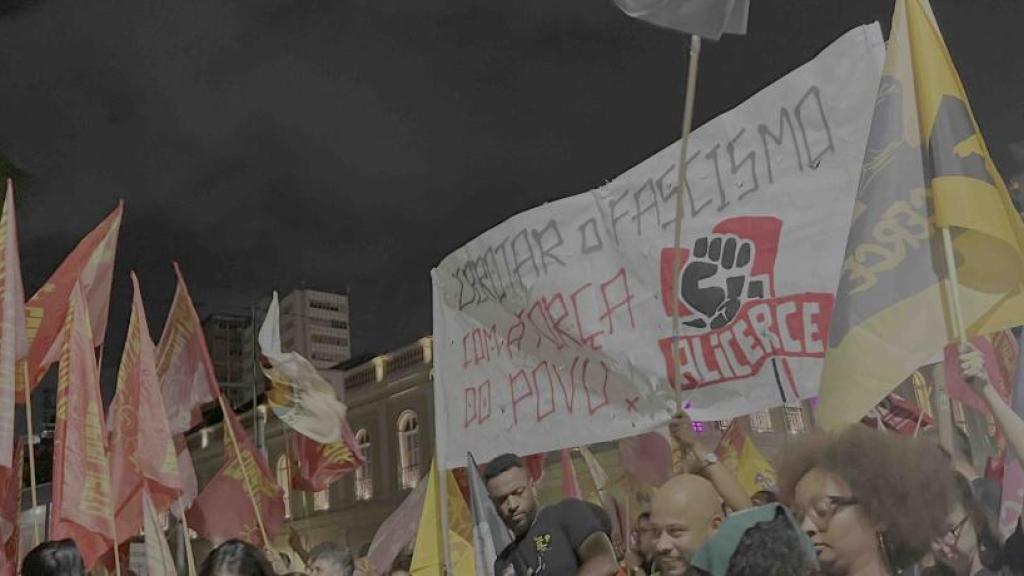
Nearly 7,000 people took part in the opening demonstration, with a significant presence of Fourth International organizations. We witnessed the militant fervour of the World Social Forums of the heyday and of the 2003 anti-war movement, in which thousands of people from very different backgrounds come together and discuss everything. These are the kind of militant moments in which shared understandings and common objectives are forged, and in which the consciousness of the militant vanguard is shaped.

From outside Brazil, the Argentine delegation was the largest, with 200 people, many of whom had travelled by coach, including our comrades from Marabunta. Comrades came from Africa (South Africa, Mali, Congo, Kenya, Ivory Coast, Morocco) and Asia (India, Pakistan, the Philippines, etc), particularly through the CADTM (the Committee for the Abolition of Illegitimate Debt, which played a central role in organizing along with the Local Organizing Committee of the conference). 

Delegations from imperialist countries (the United States, Canada, Australia and European countries such as Belgium, Denmark, France, Italy) were, of course, present. There were important delegations of Ukrainian and Russian activists.

The conference proceedings

Following a “parliamentarians’ panel” and an “elected representatives’ panel” which highlighted an essential link with actions taken within institutions, several thousand people took part in numerous debates on a variety of topics: analysis of the rise of the far right, the struggle against Milei, the resistance to Trump in the US centring on Minneapolis, the specific nature of struggles in the world of work, the situation in Brazil, the Palestinian resistance, the climate crisis, feminism, education, and many different forms of international solidarity.

In addition to taking part in the eleven plenary sessions of the “official” programme, organizations and activists of the Fourth International proposed a number of self-organized activities, among the 150 scheduled. Our comrades played a significant role in these, particularly through a presentation of our Manifesto for an Ecosocialist Revolution — Break with Capitalist Growth, which was attended by over 600 people. This meeting was led notably by Michael Löwy, one of the main drafters of the Manifesto, and Penelope Duggan, who represented the Fourth International.

We also organized or contributed significantly to debates on the anti-racist and anti-capitalist struggle, solidarity with Ukraine, with Russian prisoners, the situation in France and solidarity with migrants. The first of these in particular brought together several hundred people.

Important activities were organized by CADTM on immigration, Gen Z mobilizations, the hoarding of wealth, the grabbing of natural resources of Ukraine, DRC and Venezuela, the situation in Africa, and others.

The Fourth International distributed a statement, “Against Neo-Fascist Authoritarianism and All Forms of Imperialism”, (see statement below) to the conference participants in four languages.

The final declaration

The conference’s final declaration summarizes the broad agreements that made its organization possible: a reminder of the major mobilizations against Milei, against the far right in Britain, the No Kings! mobilizations in the United States, and solidarity with Cuba. 

It also sets out a series of social, environmental, anti-racist, feminist, and LGBTIQ+ demands, and of course demands against imperialism. It states clearly: “We oppose all imperialisms and support the struggle of peoples for their self-determination, by all necessary means.” In particular, the declaration opposes the genocide in Palestine, the attacks on Lebanon and Iran, as well as the invasion of Venezuela and the threats against Cuba. 

This broad consensus brought together extremely diverse organizations, which contributed to the conference’s success.

Limited mobilization by mass workers’ organizations

The great success of the conference does not blind us to some significant limitations. These were apparent during the preparation of the conference, and we tried, with limited success, to address them.

One was the lack of active participation from traditional mass organizations both in Brazil and elsewhere. While the conference secured the formal participation of both the Workers’ Party, and of the majority of the PSOL nationally, as well as the CUT Brazil, CTB Brazil, and other teachers and trade unions, these contributed little to the building of the mobilization outside the state of Rio Grande do Sul where Porto Alegre is situated. The Andes teachers’ union and the Communist Party of Brazil (PCdoB) had a larger militant presence. 

In fact, our organizations — in particular the MES, a tendency within the PSOL that is particularly strong in Rio Grande do Sul — made up a large part of the attendance: on the one hand, this is something to be proud of, but on the other, it reflects the fact that the struggle for unity, for building a mass movement alongside reformist organizations and the trade unions, still lies ahead of us.

From outside Brazil the conference was also supported by La France Insoumise (LFI), and a series of trade-union organizations notably from the Spanish state and Latin America.1 In the run-up to the conference, repeated attempts were made to convince many other organizations of the conference’s importance for their movements, but this struggle for the broadest possible unity within the movement must continue to be waged with the utmost determination.

Opposing all imperialisms

Another was the almost exclusive focus in practice on imperialism as US imperialism alone, despite the final statement’s opposition to “all imperialisms”. Thus, under the influence of the “campist” sectors of the conference, there was no condemnation of Putin’s Russia’s invasion of Ukraine, nor a clear stance on the nature of the dictatorial regime in Russia. 

This is a serious problem and potential obstacle to joint activity with anti-fascists from Russia and Ukraine. Russia is undoubtedly one of the regimes that most closely resembles fascism, whilst the Ukrainian people — and the Russian people too! — are suffering under this regime through deprivation and hundreds of thousands of deaths.

The presence of Russian and Ukrainian comrades, and the workshops organized with the support of the Fourth Internationalists giving a voice to Russian oppositionists, and a Ukrainian delegation of two leading trade unionists and a representative of Sotsialnyi Rukh, was an important counterweight. This was welcomed by the delegations concerned and in the words of the European Network for Solidarity with Ukraine (ENSU) representative: 

The presence of Ukrainian comrades, as well as that of Russian socialist opposition figures, was highlighted […] particularly during the conference’s closing session led by Roberto Robaina. They were also able to speak with activists from Brazil and other countries. And they gave interviews and filmed videos which are currently being circulated amongst left-wing organizations. 

They hope to build on this to broaden solidarity for their struggles, notably in Latin America. (See ENSU statement to conference below).

In several plenaries, Fourth International comrades (Penelope Duggan from the FI leadership, Rafael Bernabe from Puerto Rico, Sushovan Dhar from India,...) and others (Patricia Pol from ATTAC France and LFI) also spoke against these positions, defending Russian prisoners and oppositionists in exile, the right to self-determination of Ukraine and the battle of the Ukrainian people against the Russian invasion and the neoliberal and anti-democratic policies of their own government, and in support of the Iranian women’s and democratic movement. 

Our stance is for the right to self-determination of all the peoples of the world by their own action and not by aligning with any government, but it is clear that this fundamental battle was not fully resolved at the conference. In the self-organized workshops several FI comrades speaking (André Frappier from Canada, Eric Toussaint from Belgium, Bruno Magalhães from Brazil) also condemned the Russian invasion of Ukraine and supported the right of Ukraine self-determination.

Mixed message on Iran

Although the final statement “upholds the self-determination of the Iranian people”, an unofficial representative of the Islamic Republic of Iran was present and justified — in very moderated tones — the regime’s policies. 

While we defend the Islamic Republic’s right to defend itself against imperialist aggression, and wish for the defeat of this attack, we fully support the social movements in Iran, particularly the feminist movements, which have nothing to do with the representatives of the Shah sponsored by the United States and Israel.

Strengthening democracy in the movement

It was undoubtedly inevitable in a conference of thousands of activists that there was the lack of real forums of debate among the participants, both on the political topics discussed in the central plenary sessions (the self-organized workshops were different), and in particular on the final statement and what it proposed. 

While we all agree with building the initiatives enumerated and the Fourth International will be present at them all, the organizing nucleus must be broadened and develop mechanisms of democratic accountability. This is important both in terms of political representativity but also — as had been pointed out in the international organizing committee — gender parity. 

Moreover, while we can note a presence of women speakers in all the panels, the problematics of feminism were largely absent from the official panels, although of course present in a number of self-organized workshops.

Let us continue the struggle

In conclusion, the conference is an extremely important step forward in the battle against fascism and imperialism: let us not forget that it has been years since any social forum brought together so many people.

The practices of building international and internationalist movements have been lost and must be rebuilt.

The decision to seek a united anti-fascist and anti-imperialist front entailed some loss of clarity in the common statements, given that understanding on the left and among popular sectors regarding such basic questions as who are the fascists or neo-fascists, or who are the imperialists, vary greatly. 

Thus, the decision that guided the organization of the Conference — and which was also the position of the Fourth International — was that it was important to hold the conference, even at the cost of a significant loss of clarity. The only alternative would have been not to hold the Conference, to renounce the possibility of bringing together thousands of activists to discuss points of agreement and disagreement and commit to the ongoing struggle against fascism and imperialism.

Political battles are fought in practice, by participating in the movements that actually exist; we can only exert influence if we participate fully. The organization of this conference, and the series of pre-conferences notably in Brazil that were an important aspect of mobilizing for the conference, relied largely on activists from the Fourth International, particularly our organizations in Brazil — notably the MES, Centelhas and Ecossocialistas — our comrades involved in broad-based organizations and associations, and other internationalist, anti-colonial and anti-imperialist organizations.

There is no doubt that the debates and struggles will continue, and the next events are already set: the G7 counter-summit in France and Switzerland in June 2026, the anti-NATO gathering in Turkey in July 2026, and the World Social Forum in Benin in August 2026. Also proposed are continental conferences, notably in North and South America, as well as the Ecosocialist Encounters in May in Belgium.

It is through all these events that the alliances necessary to counter fascism and imperialism are being forged. It is up to us to involve the trade unions, human rights organizations, feminist and LGBTQI+ movements, anti-racist organizations, those campaigning for Palestine, and those standing in solidarity with the Ukrainian and the Iranian people. It is in this way — and by defending our eco-socialist revolutionary perspectives — that we will build the movement needed to change the world.

Manuel Rodriguez Banchs, Penelope Duggan, Israel Dutra, Antoine Larrache, João Machado, Reymund de Silva and Eric Toussaint are members of the Fourth International Bureau and International Committee.


Against neo-fascist authoritarianism and all forms of imperialism

Declaration of the Fourth International at the 1st International Anti-Fascist Conference for the Sovereignty of Peoples

Unite the anti-fascist struggle throughout Latin America! For a global anti-fascist and anti-imperialist front! 

Donald Trump's second term, with its far-right agenda, has brought about a shift in the international situation. In his eagerness to reaffirm a hegemony as weakened as his economy, he tramples on the United Nations Charter and the sovereignty of peoples with a foreign policy of recolonization and war.

Together with his partner in massacres, Netanyahu, Trump is bombing Iran to ensure complete domination of the oil and gas market. This comes after the genocide of the people of Gaza, the invasion of Venezuela, the attempt to strangle Cuba, and threats to annex Greenland.

The tyrant is striving to normalize genocidal language, blackmail, and interventionism, as well as racism, misogyny, and hatred of migrants — attempting to expel millions of workers from the United States. He supports Bolsonaro, Milei, Bukele, and the "patriotic" (read: far-right) European parties.

Bloody authoritarianism is the central instrument of imperialism in our time, because it needs to impose policies of hunger, the proliferation of ecocidal technologies and practices, the excessive power of Big Tech, the dispossession of natural and energy resources from all peoples, and increased military spending. If it is not defeated, Yankee imperialism will embark on a blind march toward ecological disaster.

The peoples of the US, Argentina, and India show the way

But imperialism's march is already beginning to encounter tremendous obstacles. The victorious struggle of the people of Minneapolis/Saint Paul and of all the community and popular resistance in the United States to the persecution of migrants points the way to defeating the extreme right. Only the combination of the international struggle of the peoples with a defeat of Trump on his own turf can stop their joint project.

The same is true of the working classes in Argentina against Milei and the peasants in India against Modi's policies. In Argentina, Milei faced the fourth general strike, now against labour reform, in an example of unified struggle that has the left as one of its pillars, with 90% of the population opposed to this measure. In Brazil, the victory of the indigenous resistance struggle against Cargill and the privatization of large Amazonian rivers points to hope and paths forward.

A united front of the exploited and oppressed!

There is an urgent need for a united front of the exploited and oppressed, free from subordination to governments and parties, capable of acting with full independence to confront the new faces of fascism with mobilization and coordination among the oppressed.

This 1st International Anti-Fascist Conference for the Sovereignty of Peoples is an extraordinary opportunity to deploy across the globe, starting with the American continent, a strong united action by the forces present here against hegemonic imperialism. New conferences and meetings must be held on other continents and in other major regions: the United States, Europe, Africa, Asia. Let us make this meeting a modest but strong starting point for an international campaign that serves the struggles and, at the same time, the construction of an alternative program to that presented to us by the representatives of capital.

The far right is growing by presenting itself as a radical alternative to the status quo, its elites, and its parties. We know that it does so demagogically to defend the system it claims to challenge, but there is a key lesson here: in order to grow, resistance must also be a radical alternative to the crisis of the prevailing system, its policies of hunger and repression, its worn-out institutions, and its parties.

The crisis of capitalist civilization (economic, political, ecological, climatic) raises the possibility and necessity of linking immediate concerns, including the anti-fascist struggle, with the need to overcome capitalism. A set of demands is needed that, based on the most urgent popular concerns, leads to the questioning of private control of production and to an understanding of the need to place it under the democratic control of working people and their communities.

No illusions in capitalist ‘models’

Trump's national security strategy states: 

The disproportionate influence of the largest, richest, and strongest nations is an immemorial truth of international relations. 

It is, quite simply, an invitation to divide the world among the most powerful.

There is no room for illusions here. Neither the European Union or its components, nor the governments of Russia or China represent an alternative or a wall of defense against US imperialism — as their sterile actions in the face of US attacks on Venezuela, Cuba, and Iran have shown us.

China has become a capitalist power more interested in consolidating its business and its own areas of military (in Asia) and economic (Eurasia, Africa, and Latin America) influence. More regional in nature, Putin's Russia seeks to reestablish what was once the Tsarist empire, with a militarized economy and an increasingly authoritarian regime. In this context of tensions between old and new or aspiring powers, the task of the left cannot be to celebrate the multipolarity resulting from the confrontation between capitalist projects.

Solidarity with the oppressed of the world!

To Trump's supposed "immemorial truth" of the domination of the powerful, we oppose three orientations: the defense of the right of all peoples to self-determination, solidarity with the exploited and oppressed in all countries, and therefore opposition to all forms of imperialism.

We reject the United States' aggression against Venezuela and the kidnapping of its president and former deputy, and we also reject the Russian Federation's aggression against Ukraine. We recognize the right of Venezuela, Cuba, Iran, and any country attacked by the United States to defend itself, including militarily, and to seek the material means necessary for that resistance wherever they can find them, and we recognize the same right for Ukraine, which is under attack by Russian imperialism.

We denounce and combat anti-immigrant, xenophobic, and Islamophobic policies in the United States and Western Europe. We take the same stance toward the Chinese government's repression of various peoples and ethnic groups.

We repudiate the persecution, repression, and censorship in the United States, the United Kingdom, Germany, and other countries of protests against the genocide in Palestine, and we also denounce the repression and imprisonment in Russia of opponents of the war of aggression against Ukraine.

We do not support the Maduro government. We denounce its anti-democratic and anti-worker actions. But no objectionable action by the Maduro government can validate the United States' aggression against Venezuela. We therefore demand the withdrawal of the US from Venezuela and the release of former deputy Cilia and President Maduro.

We propose the dissolution of NATO, as well as the Collective Security Treaty Organization. We do not support the Zelensky government in Ukraine. We denounce its anti-worker, corrupt, anti-democratic, and chauvinist policies. But no questionable policy of this government justifies the Russian invasion and bombing. Therefore, we organize our solidarity with the Ukrainian people.

Reject intervention, support the struggles

Bourgeois governments refuse to recognize that popular mobilizations against them are the result of deep social contradictions. Typically, they attribute them to the action of internal or external “agents”. We cannot accept this conspiracy conception of history. Undoubtedly, imperialism and its agencies try to take advantage of struggles, such as that of the Iranian people against authoritarian theocracy, but that does not reduce those struggles to an operation of imperialism. We must oppose such intervention, while continuing to support those struggles.

Preaching to the people that they must accept dictatorships that oppress and mistreat them as the “lesser evil” turns those who do so into promoters of resignation and submission. Oppressed peoples will have little interest in anti-imperialism or geopolitical analysis that excludes their most pressing democratic and economic demands. It is up to us to ensure that activists see our anti-imperialism as their ally, or that, tragically, they will find encouragement and support only in the camp of imperialism that seeks to exploit them.

Universal demands of the working class

Historically, US and NATO imperialism have acted in the name of freedom, democracy, etc. The left is not fooled by these proclamations. But we must be consistent. The same is true of rival imperialisms: we must explain how, in the name of multipolarity, anti-hegemony, rejection of the hypocritical model of Western democracy and Eurocentrism, attempts are made to justify the denial of democratic rights to the working class, women, religious minorities and LGBTTQI+ people.

In the face of cultural relativism tailored to authoritarian governments (in Russia and China, among others), we affirm that trade-union rights, women’s rights, freedom of expression, assembly, and association, and the election and recall of rulers are not “Western values” or “liberal models” or Eurocentric ideas that imperialism seeks to impose: they are historical demands of the international working class. That is why we defend them throughout the world, in all countries, without exception.

We reject the blackmail that any criticism or demand made of progressive governments, or those that proclaim themselves progressive, is destructive and favorable to imperialism. What weakens the struggle is not criticism and debate, but their suppression.

The hypocrisy of the West and consistent anti-imperialism

We are familiar with the hypocrisy of Western imperialism when it denounces repression in Iran or the invasion of Ukraine. What moral authority can the accomplices of genocide in Gaza claim? What respect can those who have just kidnapped the president of Venezuela deserve? But denouncing the hypocrisy of the West and its crimes cannot become our silence on the abuses of the governments of Putin or Xi Jinping, or the idea that these abuses are “inventions of imperialism.”

We do not oppose the double standards of Western imperialism with another double standard, but with the rejection of all those who exploit and oppress.

Today more than ever, we must practice consistent internationalism, a solidarity without borders that encompasses the struggles of workers, the oppressed, and for self-determination in all countries of the world, without exception. It is a policy that opposes all forms of imperialism. It does not subordinate the struggle in any country to that of another country. It is the policy that corresponds to the slogan Workers of the world, unite!

For solidarity without borders! For internationalism without exceptions! 


Antifascism must fight all tyrannies

Statement by the European Network for Solidarity with Ukraine for the 1st International Anti-Fascist Conference for the Sovereignty of Peoples.

The European Network for Solidarity with Ukraine (ENSU) strongly supports the goal of this conference, namely “to confront the expressions of the far right and fascism and put into practice solidarity among resisting people.”

In championing the national and social rights of the Ukrainian people, our network of social movements, trade unions, solidarity groups and political parties from Eastern and Western Europe also shares the internationalism and anti-imperialism this goal expresses. As ENSU’s founding statement says, 

we fight for peace and equality, democratic freedoms, social and climate justice through cooperation and solidarity between peoples.

We believe that antifascism must oppose every violation of human rights by regimes and rulers that elevate maintaining their own power above everything else, including the rights of peoples to determine their future. For ENSU, “from Ukraine to Palestine, occupation is a crime” and the Ukrainian people must be recognised as a resisting people fully deserving of solidarity in the face of terrible aggression.

Over the last four years, the Russian armed forces implementing the Kremlin’s “special military operation” against Ukraine have: illegally occupied 20% of internationally recognised Ukrainian territory; unleashed a murderous campaign to destroy Ukraine’s energy and water supply infrastructure and freeze the population into submission; bombarded the country’s schools, hospitals and residential districts; deported thousands of Ukrainian children from the territories occupied by Russia (a crime for which Vladimir Putin has been charged by the International Criminal Court); imposed a campaign of compulsory Russification in these regions; targeted cultural sites as part of a deliberate policy of erasing Ukrainian culture and language; imprisoned tens of thousands of non-combatant Ukrainian citizens, and used assassination, torture and sexual violence to compel obedience from an occupied population. All this after years of abuses against the Crimean Tatars, including forced disappearances.

But despite this wave of genocidal crimes, Ukraine survives, and not only through the efforts of its armed forces but because of the persistent self-organisation of its civil society — the trade unions, community, neighbourhood and veterans’ organisations, women’s and LGBTIQ+ collectives and environmental and civil liberties associations.

Putin’s ‘antifascist’ holy war

There is, however, a feature of Ukraine’s resistance that differs from that of other peoples fighting for freedom: the Russian aggressor brands Ukraine’s defensive struggle as itself “fascist” and defines its own goal as “eliminating the neo-Nazi regime in Kyiv” (Putin). In short, the Kremlin invokes antifascism … to justify its own war crimes.

This cynical manipulation of the concepts of “antifascism” and “anti-Nazism” is best analysed in the Rosa Luxemburg Foundation’s publication Putin’s Four Antifascist Myths — How Russia Uses ‘Antifascism’ to Justify the War in Ukraine, by Anastasia Spartak

It explains how the present rulers in the Kremlin converted the original antifascism, born of the heroic anti-Nazi resistance of the peoples of the Soviet Union, into exaltation of Russia as a historic power destined to “embrace” the peoples around its borders. Those like the Ukrainians who opposed this imperial project became “fascists” and “Nazis” — irrespective of the real presence of the far right within their societies.

As for those brave people inside Putin’s Russia who have denounced his criminal invasion of Ukraine and sought to maintain genuinely democratic and antifascist values — they have been murdered, jailed, locked up in psychiatric “hospitals”, exiled or ostracised as “foreign agents” and “undesirables”.

Behind the smokescreen of its annual UN General Assembly motherhood resolution against Nazism, the Russian Federation has implemented a domestic policy of setting far-right gangs against democrats and leftists and a foreign policy of giving lavish support to xenophobic outfits like the French National Front (now National Rally).

Russia has become central to a reactionary international alliance that includes Trump’s USA, Orban's Hungary, Le Pen’s National Rally, the Alternative For Germany and Reform UK. This league of ethno-nationalist, anti-democratic authoritarians is opposed to everything this conference stands for. All of them seek to deflect responsibility for Putin’s invasion onto Ukraine or “the collective West”, an alert to anti-fascists as to the true nature of the Russian imperial project.

No to an imperialist ‘peace’

The “antifascism” of a regime dedicated to Making Russia Great Again has many sinister parallels with the operations of Putin’s “partner” (his term) Trump. The bomber of Iran endlessly pressures Ukraine to agree to a ceasefire on Russia’s terms, cynically cancels agreed embargoes on Russian oil and gas exports, and has his envoys check out opportunities for “deals” with Putin and his oligarch mates.

If forced on Ukraine, the outcome of this sort of imperial “peace”, would be to perpetuate the cruel injustice and suffering the country has experienced, with no guarantee that Putin would not restart hostilities when he judges he could get away with it. The only acceptable ceasefire is one Ukraine itself can negotiate and its people support.

Support Ukraine as a sovereign nation, its people and its working class

Let’s never forget that the only way the concept of antifascism can strengthen the interests of oppressed peoples is if it is applied without exception. If a blind eye is turned to the oppression of any people or nation it will serve the interests of their oppressor — even if unintentionally. Moreover, if the antifascist movement neglects the rights, suffering and struggles of any one people, its action in support of other oppressed peoples will lose credibility and the power that comes from mutual solidarity.

Give unreserved support to Ukraine’s resistance struggle! This does not in any way entail supporting the undemocratic neoliberal policies of the Ukrainian government. Indeed, ENSU has supported all the struggles of Ukraine’s workers, students, feminists, LGBTI+ collectives and civil rights organisations against the government’s attempts to impose a radically pro-corporate economic policy, cut back the rights of workers and their unions, and protect the corrupt within its own ranks from investigation by the country’s independent anticorruption agencies.

Again, if you want to understand this experience, please take time to speak with the representatives of Ukrainian trade unionism and the Ukrainian left present at this conference. Their fight should also be yours.

For the European Network in Solidarity with Ukraine, the only possible position for a consistent antifascism is to support Ukraine’s right to self-determination and self-defence; to demand the removal of all Russian forces from its internationally recognised territory; to support the return of its kidnapped children and other civilian prisoners; and to call for full reparation for the damage inflicted by the Russian invasion and accountability in international law for those who initiated it.

  • 1

    Including the two main Basque trade unions ELA and LAB, the Intersindicals of Valencia, Galicia and Catalunya, CTA A Argentina, CTA TT Argentina, PIT CNT Uruguay, SME Mexico, CUT Chile, CUT Colombia.

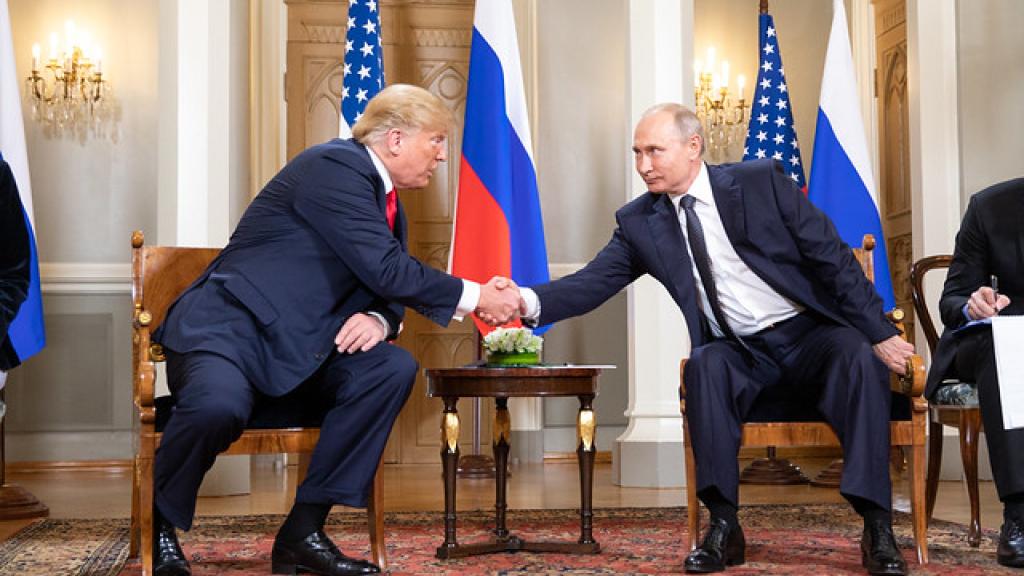
 

Trump, Putin and Ukraine: Towards a division of spheres of influence at the expense of the people


Trump White House Archived

First published at CADTM.

Since the start of his second term, Donald Trump has been redefining US international strategy according to a brutal logic of power relations between major powers. Whilst stepping up aggressive policies in the Middle East and the Americas, his administration has embarked on a strategic repositioning vis-à-vis Russia.

Far from being presented as the central enemy of the world order, Moscow is now treated as a secondary adversary with whom an arrangement might be possible. Washington’s objective is clear: to prevent Russia from further strengthening its alliance with China, regarded as the United States’ main systemic rival. This marks a departure from his first term and from that of Joe Biden from 2021 to 2024.

Strategic documents published by the Trump administration between December 2025 and early 2026 confirm this shift. Russia is described therein as a “persistent but manageable” threat, whilst European leaders are accused of exaggerating the danger it poses and harbouring unrealistic expectations regarding the outcome of the war in Ukraine. At the same time, Washington claims it wants to negotiate a swift end to the war under its auspices.

This shift paves the way for a scenario with far-reaching consequences: a deal between imperialist powers — the United States and Russia — that will be at the expense of the Ukrainian people.

Trump’s policy towards Russia

Since the start of his second term, Donald Trump has secured an agreement from Vladimir Putin that, beyond verbal protests, he will not react to acts of aggression and war perpetrated by Washington against Moscow’s allies, be it Venezuela or Iran, or in relation to the total blockade of Cuba in place since late January 2026.1 Trump has marked a shift from the policy adopted during his first term, in which he treated China and Russia as equals, viewing them as adversaries seeking to challenge the Washington-dominated international order.

Trump is sending a message to Putin that he is prepared to accept Moscow’s use and abuse of force in its geographical sphere, particularly in Ukraine, just as Washington does in the Americas, the Middle East and elsewhere. Trump asserts his right to use force anywhere in the world and effectively recognises Putin’s right to do the same within a more limited sphere corresponding to part of the territory of the former Russian Empire of the Tsarist era and the former Soviet Union. This follows the classic logic of an implicit division of spheres of influence between major imperialist powers.

Trump has reduced direct US military support for Ukraine by shifting the burden of this support to his Western European allies within NATO. In January 2026, he invited Moscow and its allies in Belarus and Hungary to join his World Peace Council.

On 5 March 2026, Trump announced that he was temporarily allowing Russia to export its oil to India without sanctions, with India either consuming it or re-exporting it to other parts of the world, including Europe. One of the unspoken reasons is to persuade Russia to confine itself to issuing verbal protests against the massive aggression by Washington and Israel against Iran, its ally.

Trump in full

Trump reveals a number of positions regarding Europe, Russia and Ukraine in the document on the new national security strategy released on 3 December 2025. He considers that the EU and the UK “enjoy a significant hard power advantage over Russia by almost
every measure, save nuclear weapons”2 and that European leaders are exaggerating the threat posed by Russia.

The Trump administration’s document continues:

As a result of Russia’s war in Ukraine, European relations with Russia are now deeply attenuated, and many Europeans regard Russia as an existential threat.

From the way the text is written, one can infer that Trump is telling European governments that Russia does not pose an existential threat to them. On certain occasions, Trump has described Russia as an existential threat, but this is not the case in either the National Security Strategy published in December 2025 or the National Defence Strategy published in late January 2026.

Trump believes that the EU and the UK must adopt a different approach to that taken so far in negotiations with Russia regarding the latter’s demands. This is particularly clear in the following passage:

The Trump Administration finds itself at odds with European officials who hold unrealistic expectations for the war perched in unstable minority governments, many of which trample on basic principles of democracy to suppress opposition.

It should be noted that Trump claims that European governments are suppressing patriotic parties, i.e. the neo-fascist far right.

Trump’s text continues:

A large European majority wants peace, yet that desire is not translated into policy, in large measure because of those governments’ subversion of democratic processes.

And he adds:

This is strategically important to the United States precisely because European states cannot reform themselves if they are trapped in political crisis.

This means that Trump is declaring that it is in the United States’ interest for patriotic parties (i.e. far-right and neo-fascist) to be in government, which, according to the current administration, would resolve the political crisis.

There is, of course, in the passage above, a very clear rejection of the German, French, British, Spanish, Danish, Polish and other governments. Conversely, this strengthens the position of Hungarian Prime Minister Viktor Orbán and Slovak Prime Minister Robert Fico, whom Marco Rubio, the US Secretary of State, visited in February 2026 following the Munich Security Conference. It should be noted that both these governments are in favour of easing sanctions against Putin’s Russia and have expressed their support for Trump.

Regarding relations between the EU, the UK, Russia and Ukraine, it is clear that Trump wants to remain at the centre of the diplomatic game:

Managing European relations with Russia will require significant U.S. diplomatic engagement, both to reestablish conditions of strategic stability across the Eurasian landmass, and to mitigate the risk of conflict between Russia and European states.

It can also be inferred from the previous passage that, given the military superiority of the EU countries and the UK over Russia, the rebalancing should be in Russia’s favour. The same idea is found in the following passage:

It is a core interest of the United States to negotiate an expeditious cessation ofhostilities in Ukraine, in order to stabilize European economies, prevent unintended escalation or expansion of the war, and reestablish strategic stability with Russia, as well as to enable the post-hostilities reconstruction of Ukraine to enable its survival as a viable state.

In the passage above, Trump reaffirms that he wants a swift end to hostilities and puts pressure on the EU, the UK and Ukraine to make concessions to Russia, all under Washington’s auspices.

Trump’s policy towards Ukraine

Trump has no regard for the Ukrainian people’s right to defend their sovereignty. Yet if the February 2022 invasion was largely thwarted, it is because the Ukrainian people resisted and demonstrated their commitment to their country’s sovereignty. Had the Ukrainian people not overwhelmingly supported the resistance, the arms sent by Western powers to the authorities in Kyiv would not have been enough to thwart Putin’s initial plan, which was to march his army into Kyiv, change the regime and seize a significant portion of Ukrainian territory, starting with the east of the country. 

Stating this must go hand in hand with a critique of the neoliberal and chauvinistic nationalist policies of Volodymyr Zelensky’s right-wing government, and with a condemnation of NATO and the imperialist ambitions of Trump and the Europeans regarding Ukraine. It is also important to point out that Ukraine is not an imperialist power.

Trump couldn’t care less about international law and believes he can use force to seize control of Venezuela’s or Iran’s oil resources after launching a military attack on those countries. He believes that Putin’s Russia, within its immediate sphere of influence, can do the same as long as it does not harm US interests in Eastern Europe. Trump is prepared to strike a deal with Putin at the expense of the Ukrainian people. 

Putin may retain or seize control of part of Ukraine’s territory, population and natural resources if US companies secure corresponding benefits in the rest of Ukrainian territory. On this condition, Washington would be prepared to protect the weakened Ukrainian authorities and the territory over which they retain control, provided that the authorities in Kyiv allow US companies to amass maximum profits

What Trump is proposing is an agreement between two predatory imperialist powers, the US and Russia, which agree to flout the right of peoples to self-determination and to exercise sovereignty over their territories and the natural resources found therein. The European imperialist powers are largely sidelined by Trump, even though they too seek to promote their own interests and those of their large private corporations, which covet Ukraine’s natural resources, land and market.

Trump’s stance on Russia

Trump believes that previous administrations made the mistake of encouraging the formation of an alliance between Russia and China, which has strengthened China’s position. Trump wishes to separate Russia from China or, at the very least, weaken the ties between these two powers. 

Washington, which identifies China as its primary and systemic adversary, is therefore attempting to reduce Russia’s inclination to strengthen its ties with China.3 The 2025 NSS regards Russia as a serious but strategically secondary military adversary, to be contained without elevating it to the status of a civilisational enemy, in order to concentrate US resources (military and economic) on combating China.

The Kremlin’s reaction to the publication of the NSS 2025

Dmitry Peskov, the Russian president’s spokesperson, commented on the National Security Strategy document during an interview on 7 December 2025 with the Russian state journalist Pavel Zarubin for the Rossiya 1 channel, which was widely reported by Russian media outlets such as Interfax, Fontanka and TASS: 

The adjustments made to the US national security strategy largely correspond to our vision.

The full press release published by the Russian online media outlet Fontanka.ru on 7 December 2025 states:

Peskov commented on the new US national security strategy. The adjustments made to the US national security strategy largely correspond to the Russian government’s vision. This is how Dmitry Peskov, the Kremlin spokesperson, commented on the update to the document to journalist Pavel Zarubin. The President’s spokesperson expressed the hope that the new strategy would enable Washington and Moscow to continue their constructive collaboration on the Ukrainian issue. The updated strategy was published on Friday 5 December by the administration of US President Donald Trump. Relations with Europe and the conflict in Ukraine feature prominently in the document. It is also emphasised that NATO must not be an “endlessly expanding alliance”. Peskov stressed that the implementation of this concept must be closely monitored.

The Interfax news agency, for its part, wrote on 7 December 2025:

The Kremlin has welcomed the wording regarding NATO in the US National Security Strategy. Medvedev sees the new US National Security Strategy as an attempt to improve relations with Russia. The Kremlin welcomes the wording in the updated US National Security Strategy concerning the freeze on NATO enlargement, but will closely monitor the practical implementation of this document. 

It should be noted that Dmitry Medvedev is Deputy Chairman of the Russian Security Council and Chairman of the ruling United Russia party.

The shift in Washington’s characterisation of Russia between Trump I and Trump II

In the National Defence Strategy 2026 published at the end of January 2026 (NDS 2026), Russia is identified as “a persistent but manageable threat” to NATO, a shift in Russia’s favour compared with the more alarming characterisations in previous documents, which described Russia as a “revisionist power” during Trump’s first term in 2017, and as an “immediate threat to the international order” and an “acute threat” in 2022, during Joe Biden’s presidency. The Biden administration’s 2022 NSS asserted that Russia “has shattered the peace in Europe”.

In the strategic language of the US government, “revisionist power” refers to a state seeking to alter the rules, institutions or balance of power of the existing US-dominated international order. In documents from the first Trump administration and the Biden presidency, Russia and China were portrayed as revisionist powers.

Here are some extracts from the NDS 2026 concerning Russia:

the Russian military threat is primarily focused on Eastern Europe’, ‘Moscow is in no position to make a bid for European hegemony. European NATO dwarfs Russia in economic scale, population, and, thus, latent military power... 

Fortunately, our NATO allies are substantially more powerful than Russia — it is not even close. Germany’s economy alone dwarfs that of Russia.

Common ground between Trump and Putin

Despite their geopolitical rivalries, Donald Trump and Vladimir Putin share a significant set of ideological and political positions.

Both are characterised by staunch anti-Communism and unreserved support for the capitalist system, including its most brutal forms of exploitation of labour and natural resources.

Trump and Putin are nationalists who assert the primacy of the rights of the dominant nation to which they belong. Trump supports white supremacists and asserts the primacy of US interests over those of foreign nations, which he does not hesitate to treat in racist terms. Putin espouses Great Russian chauvinism and denounces Lenin for the ‘creation’ (sic) of Ukraine and the recognition of its right to secede from the USSR in the early 1920s.

They also advocate an energy policy based on the intensive exploitation of fossil fuels, thereby contributing to the worsening of the ongoing global ecological catastrophe.

On the social front, their positions converge towards homophobic stances and hostility towards the rights of LGBTQIA+ people, accompanied by the promotion of conservative values underpinned by a reactionary vision of Christianity.

On the international stage, both Trump and Putin favour the use of military force to impose their political and economic objectives, in defiance of international law. This approach is accompanied by determined support for the rapid and massive expansion of the arms industries, as well as the increased use of military power.

Their foreign policies are also based on the repeated use of questionable or unfounded pretexts to justify the use of force. Furthermore, both cultivate a great-power chauvinism and an exaggerated nationalism, characteristics of authoritarian political projects.

Furthermore, they maintain close ties with European far-right forces, which in turn express strong sympathy towards them.

Trump offers full support to the Israeli government led by Benjamin Netanyahu, who is a neo-fascist and responsible for genocide in Gaza. Putin, for his part, maintains cordial relations with Netanyahu and continues Russian exports to Israel — coal, oil and grain — without calling into question existing trade agreements.

Putin has also agreed in principle to the creation of a World Council chaired by Trump and wants Russia to be a member. In this context, he is calling on the United States to lift the freeze on Russian assets so that Russia can pay the $1 billion membership fee required to become a permanent member of this body, which is entirely illegitimate.

Both Trump and Putin make extensive and controversial use of the term ‘genocide’, whilst refusing to acknowledge or condemn the genocide of the Palestinian people. Trump thus claims that the government in Pretoria is responsible for a ‘genocide of whites’ in South Africa, whilst Putin maintains that the government in Kyiv is carrying out genocide against the Russian populations in Ukraine.

Beyond these ideological and geopolitical convergences, Trump and Putin also display marked similarities in their approach to exercising and conceiving of power. Both favour a highly personalised style of leadership, centred on the figure of a leader presented as the direct embodiment of the nation and its will. Their political discourse regularly relies on rhetoric pitting ‘the people’ against political, media or economic elites, accused of betraying national interests. 

In this context, they display marked distrust of multilateral institutions and international law when these are perceived as obstacles to their strategic objectives. Furthermore, their political practices are accompanied by constant criticism of media deemed hostile and intensive use of communication strategies aimed at circumventing or delegitimising institutional checks and balances. These elements contribute to embedding their political projects within a highly personalised, imperialist and neo-fascist authoritarian conception of power.

What are the differences between Trump and Putin?

One difference worth highlighting lies in their approach to war and the direct use of military force. Trump is convinced that it is possible to win conflicts without committing US troops to the ground for any length of time, by prioritising technological superiority, strikes from a distance and military operations of limited duration, with virtually no US casualties. Trump’s illusion was shattered in his war against Iran in February–April 2026.

Conversely, Putin chose a different strategy with the massive military invasion of Ukraine in 2022, involving the deployment of very large ground forces and resulting in extremely high human casualties on both the Russian and Ukrainian sides.

Another fundamental difference concerns the position of their respective states within the global hierarchy of capitalism. Trump leads the world’s principal capitalist and imperialist economic and military power, the US. Putin, for his part, heads a secondary capitalist imperialist power, one that is weakened and in relative decline, but which remains a major strategic player due to its possession of a nuclear arsenal broadly comparable to that of the United States.

Finally, their geopolitical ambitions differ in the scale of their intervention. Trump’s imperialist policy targets the entire globe, while Putin’s focuses primarily on the post-Soviet space and its immediate periphery, even though Russia has attempted to extend its influence into other regions, such as Syria — where it has, however, suffered a setback with the fall of Bashar al-Assad’s regime.

Do Trump and the US military-industrial complex have an interest in a swift end to the war in Ukraine?

At this stage in 2026, contrary to his claims during the election campaign or at the start of his term, ending the war in Ukraine is not a priority for Trump, for several reasons.

Indeed, the continuation of the war lends greater credibility to the US argument for persuading its European NATO allies to continue significantly increasing their military spending, which boosts arms exports by major US private companies.

Furthermore, Washington has secured an agreement with European NATO countries that is highly favourable to its interests. These countries purchase from the US the weapons they supply to Ukraine, which are being used at an intensive rate for as long as the active conflict continues. Trump has virtually brought an end to new direct arms supplies to Ukraine.

The continuation of the war also partly diverts attention from the aggressions perpetrated by the United States under Trump’s command in the rest of the world.

The continuation of the war in Ukraine and the strain this places on the Russian economy and its population prevents Putin from deploying military forces to other continents, except in a few African countries in the form of a Russian private army.

Finally, on 5 March 2026, Trump eased sanctions against Russia regarding oil sales. When combined with the rise in global fuel prices resulting from the war in the Middle East instigated by Washington and Israel, Putin’s Russia is seeing an increase in its export revenues, which helps sustain the war of aggression against Ukraine.

Conclusion

Ultimately, Trump’s policy towards Russia follows the classic logic of great-power rivalry: to curb the growing rapprochement between Moscow and China, to keep the United States at the centre of the diplomatic arena, and to make European countries bear the main cost of the war in Ukraine. Behind the official rhetoric calling for a swift end to hostilities, Washington does not necessarily have an interest in an immediate peace.

In this context, the prospect of a deal between Washington and Moscow at the expense of the Ukrainian people cannot be ruled out. The ideological and political similarities between Trump and Putin — a commitment to authoritarian capitalism, great-power nationalism, aggressive military imperialism, contempt for international law and proximity to far-right forces — facilitate such a logic of power relations between states.

Beyond their rivalries and differences in power, the two leaders share the same worldview. In such a scenario, the peoples — and in particular the Ukrainian people — risk becoming the main victims of a new geopolitical balance based on the division of spheres of influence.

But we must not rule out a possible shift in Trump’s stance in the future. If he fails to achieve his aims in negotiations with Putin, he is capable of adopting a much tougher stance and portraying Russia as a far more serious threat than is suggested in the documents we have just analysed.

What is certain is that the negotiations between Trump and Putin do not take into account the interests and rights of the people. We must build solidarity between peoples from the ground up in order to strengthen resistance to the rise of neo-fascism and the increase in imperialist aggression, wherever it comes from.

The author would like to thank Sushovan Dhar, Antoine Larrache and Maxime Perriot for proofreading this text.

  • 1

    Russia sent an oil tanker to Cuba, which arrived at the port of Matanzas in late March 2026 with a cargo of oil sufficient to meet the country’s needs for around a fortnight. It is the first oil tanker to reach Cuba since January 2026. Trump allowed this to happen despite the total embargo imposed on oil deliveries to the island’s authorities. This is likely a gesture by Trump towards Moscow in connection with the ongoing war in the Middle East.

  • 2

    Extract from the National Security Strategy document published in December 2025, p. 25 (NSS 2025). https://www.whitehouse.gov/wp-content/uploads/2025/12/2025-National-Security-Strategy.pdf?internal=true

  • 3

    Since the start of the war in Ukraine, Russia has become increasingly economically dependent on China, particularly for its energy exports and technology imports, casting doubt on Washington’s objective of weakening the Moscow-Beijing alliance.

Kyiv books tentative diplomatic coup with Iran war forays

Kyiv (Ukraine) (AFP) – When the US-Israeli war with Iran began at the end of February, it was widely assumed that Moscow would be one of the conflict's key winners.


Issued on: 10/04/2026 - RFI

Zelensky has sought to clinch security deals and exchange Ukrainian drone expertise for air defence missiles © Handout / UKRAINIAN PRESIDENTIAL PRESS SERVICE/AFP

Higher oil prices, a distracted Washington and a sudden need for Western air defence systems in the Gulf were seen as a boost to Moscow's four-year invasion of Ukraine.

But in Kyiv, officials and analysts say a flurry of high-level visits by President Volodymyr Zelensky and the inking of security accords across the Middle East amount to a diplomatic coup that have given the embattled country outsized clout in a region recently seen as aligned with Russia.

"Ukraine is for the first time -- and to some countries' surprise -- acting as a state that can provide security services, that can, as experts say, export defence and security expertise," Volodymyr Fesenko, a respected political observer in Kyiv, told AFP.

That is a marked turnaround from 2022 when an under-equipped Kyiv went on bended knee to the United States and Europe to appeal for sophisticated air defence systems, advanced battle tanks, and as many artillery shells as they could get their hands on.

The rapid proliferation of drones has made many of those weapons less relevant, and spurred Ukrainian rag-tag arms producers to become global leaders in drone warfare and anti-drone systems.

'Moscow extremely upset'

Kyiv's forces neutralise hundreds of the Iranian-designed drones launched by Russia every day, and as Iran started firing off drones across the Middle East in retaliation for the US-Israeli attacks, Zelensky quickly deployed more than 200 of his anti-drone experts to at least four states.

Zelensky himself paid high-profile visits to Saudi Arabia, the United Arab Emirates, Qatar, Jordan and Syria -- becoming one of the first foreign leaders to visit the region during the war.

"Moscow is extremely upset with Ukraine's rapid strengthening of ties with the Gulf countries in the wake of Iranian air terror," Ukrainian Foreign Minister Andriy Sybiga said on social media.

"They understand that Ukraine's unique experience has dramatically changed its role in the region," he added.

Sybiga said Russia and its close ally Iran had taken to spreading disinformation about Ukrainian anti-drone units to undermine Kyiv's diplomatic reach -- like that Iran had struck a depot housing Ukrainian anti-drone systems in the United Arab Emirates.

Despite Ukraine managing to give itself a surprise role in the conflict, the question remains what material benefit it can extract besides some good publicity.

"Frankly, in the Gulf countries you can simply ask for money," political analyst Taras Zagorodniy suggested to AFP in a telephone interview.

"This is a way to scale our own technologies and attract additional resources, because we need money to support our technologies and investments," Zagorodniy, Managing Partner of the National Anti-Crisis Group think tank, added.

Details of the defence agreements struck with several states in the region have not been made public.

Zelensky had previously proposed swapping Ukrainian drone warfare technology for the advanced air defence missile ammunition -- though that idea appeared to gain little traction.

No 'breakthrough'

The Ukrainian leader has also suggested that improved ties with the Gulf could help place broader pressure on Russia to halt its invasion.

But analysts have warned that these overtures do not amount to a breakthrough -- yet.

For one, the impact of the two-week truce agreed between the United States and Iran is unclear.

Zelensky has said Ukrainian anti-drone units will remain in the Middle East but the long-term demand for Ukrainian war tech remains in question.

The region has largely refrained from criticising Russia's invasion and has not hit Moscow with sanctions. Many states seek good relations with both sides to play a mediating role -- hosting talks or brokering the return of children.

"It is premature to speak of a breakthrough. This is not even a step -- rather a first cautious move in the right direction," former Ukrainian diplomat Vadym Triukhan wrote in a recent analysis.

To be a "game changer" for Kyiv, the pace of engagement needed to be kept up.

"If this tempo is not lost, then within a few months it will be quite realistic to reach multi-year, multibillion contracts," Triukhan wrote.

© 2026 AFP


Ukrainians shot down Iran's drones in the Gulf — what does Kyiv get in return?


By Sasha Vakulina
Published on 

Ukraine’s president announced that Ukrainian experts in the Middle East have already shot down Iranian drones in “several countries” with domestically produced interceptors.

Ukrainian military personnel have already successfully shot down Iranian Shahed-type drones targeting countries in the Middle East, President Volodymyr Zelenskyy revealed in his first public acknowledgement of Kyiv's specialists' first results in the Gulf region.

Zelenskyy said Ukrainian experts on the ground are part of a broader Kyiv’s effort "to help partners counter the same weapons used by Russia in Ukraine."

Ukraine’s president made these remarks to reporters on Wednesday, but the briefing content was embargoed until Friday.

Zelenskyy said Ukrainian forces took part in active operations using domestically produced interceptor drones.

"We sent our military experts to the Middle East, including specialists in interceptor drones and electronic warfare. We demonstrated to some countries how to work with interceptors," he said, revealing for the first time Kyiv’s strategy following the cooperation agreements with the Gulf countries.

"Did we destroy Iranian Shaheds? Yes, we did. Did we do it in just one country? No, in several. And in my view, this is a success."

Zelenskyy said Ukraine’s military presence on the ground is "not about a training mission or exercises, but about support in building a modern air defence system that can actually work."

"In those countries that opened up their air defence systems to us, our experts were able to very quickly advise how to make those systems stronger."

"In some cases, we directly shared our experience in actual defence. In any case, all of this has had a very positive outcome, and it commands respect for Ukraine," Zelenskyy stated.

Ukraine’s agreements with the Gulf states

Kyiv signed 10-year agreements with three Gulf countries: Saudi Arabia, the UAE and Qatar, where Ukrainian companies will work with the armed forces of these countries to protect specific facilities, Zelenskyy said at the Wednesday briefing.

"My task is to negotiate volumes, services, and types of weaponry," he stated.

Zelenskyy also confirmed that the talks are currently under way with Oman, Kuwait and Bahrain.

In return for Kyiv’s support and expertise, Ukraine will receive "various things," according to Zelenskyy.

"In some cases, it involves interceptors to protect our energy infrastructure; in others, there are financial arrangements."

He said that ultimately these agreements will strengthen Ukraine’s energy stability.

"There are also supplies of oil and diesel for Ukraine. In some cases, we receive crude oil that will be delivered to refineries in Europe for processing. In others, we are talking about finished products – diesel," Zelenskyy explained.

“So in essence, we are helping strengthen their security in exchange for contributions to our country’s resilience – and this is far more than simply receiving money.

Zelenskyy said earlier that Ukrainian military personnel are also participating in consultations on the functioning of the Strait of Hormuz.


Zelenskiy proposes a new European version of NATO

Zelenskiy proposes a new European version of Nato that includes
As NATO weakens, Ukrainian President Volodymyr Zelenskiy has proposed the creation of a new European security structure that would include Ukraine. / bne IntelliNewsFacebook
By Ben Aris in Berlin April 10, 2026

Ukrainian President Volodymyr Zelenskiy has proposed the creation of a new European-centred security bloc that would include Ukraine, the EU, the UK, Turkey and Norway, as concerns mount over the future of US support for Nato.

US President Donald Trump has threatened to take the US out of Nato twice in the last month, after he called on Nato allies to join his armada in the Gulf to open the Strait of Hormuz by force and was rebuffed. As IntelliNews reported, that has brought Nato to the brink of breaking up. Trump claims that he has the authority to nix US’ membership in the alliance, but under US law only Congress can vote to exit the treaty.

Speaking amid reports of a potential US withdrawal from the alliance, Zelenskiy said Europe needed to take greater responsibility for its own defence. He suggested that a broader coalition, anchored by Ukraine’s military capabilities, could provide a credible deterrent against Russia.

“Without Ukraine and Turkey, Europe will not have an army comparable to the Russian one. With Ukraine, Turkey, Norway, and Britain, you will control security at sea – and not just one,” Zelenskiy said. He added that he remained confident Ukraine would ultimately join the EU.

Since taking office, Trump has aggressively pushed for European Nato allies to increase their spending from 2% of GDP mandated by the Welsh Nato summit in 2015 to 5% by 2035 agreed at the Nato summit in the Hague last year. This year all Nato members reached the 2% of GDP spending level for the first time with Poland spending the most, 4.3% of GDP, as it attempts to build the largest conventional army in Europe.

Despite the pledges, the US has withdrawn from supplying Ukraine with weapons directly under the Trump administration and Europe has been unable to offset the end of US weapons deliveries to Ukraine which fell in the last year. The US now provides Ukraine with weapons under the Prioritised Ukraine Requirements List (PURL) programme, where Europe pays for them.

The proposal for a new Nato comes as Kyiv seeks strong security guarantees as part of the ongoing ceasefire talks with Russia. The White House has offered a US security deal, but Trump made it explicit this month, the deal won’t go through until Bankova gives up the remaining parts of the Donetsk region in the Donbas that the Armed Forces of Ukraine (AFU) still control. That is a red line for Zelenskiy, who continues to refuse until not only the US deal is signed, but also ratified by Congress, giving it the status of an international treaty the president can’t undo.

Ukrainians have become more ambivalent towards membership in the alliance, torn between the need for security assurances and lingering scepticism about the bloc’s effectiveness. According to a recent poll, 68.9% of Ukrainians support joining Nato, but only 54.7% say they trust the alliance, while 41.5% express distrust. Support for the idea of reacquiring nuclear weapons has also begun to rise, as another way to prevent Russia’s re-invasion in the future.

Survey findings suggest that perceptions of Nato are closely tied to its tangible actions during the war. Some 18.5% of respondents said their level of trust depended primarily on the practical assistance provided by the alliance. Other significant factors included protection for Ukraine, cited by 13.3%, and the provision of security guarantees, identified by 11.8%.

At the same time, dissatisfaction with Nato’s conduct during the conflict remains a key driver of scepticism. As IntelliNews reported, the strategy from the start has been “some, but not enough” supplies to ensure Ukraine doesn’t lose the war, but not enough so it can actually win. That formula has perpetuated the war and ensures the maximum casualties. It also means that the Western allies have withheld supplies of their most powerful weapons, long-range missiles like Germany’s Taurus in particular. Many Ukrainians view the alliance as having acted too slowly and indecisively, and as failing to do enough to counter Russian aggression.

Zelenskiy has long lobbied for Nato membership, but has been repeatedly rebuffed, most notably at the Nato summit in Vilnius in July 2023. He also put Nato membership at the top of his “victory plan” list in December 2024 to the outgoing Biden administration, but was ignored again.

As part of the 27-point peace plan (27PPP) thrashed out at the  Moscow meeting on December 3 last year between Russian President Vladimir Putin and the US envoys, it was proposed that Ukraine join the EU in 2027 as a compromise. The EU founding treaty also contains a collective security clause, Article 42/7, that requires all members to come to the military assistance of any member that is attacked. However, most EU members have rejected the idea of an accelerated membership of Ukraine in the EU.

Zelenskiy’s remarks highlight a growing debate in Europe over the continent’s long-term security architecture and the extent to which it can rely on transatlantic support