Friday, April 10, 2026

After Iran: Is This the Unraveling of the US-Israeli Order?

 April 10, 2026

Image by Hasan Almasi.

The knives are out—and this time, they are not aimed at Tehran, but at Donald Trump and Benjamin Netanyahu.

Even the ever morally flexible Chris Christie moved quickly. The former New Jersey governor and longtime Republican insider, speaking on CNN, did not merely criticize Trump; he used the moment to indict establishment Republicans for enabling him in the first place. What was once quiet discomfort has now hardened into open political distancing.

CNN, for its part, framed the outcome through a language of selective humanitarian concern—invoking the plight of the Iranian people as victims of their own government, even as it criticized Trump’s failure. The contradiction is telling: a posture of moral superiority that condemns mismanagement, yet stops short of rejecting the underlying logic of war itself. In this framing, aggression is not questioned—only its effectiveness.

Across the Arab world, particularly within Gulf establishment circles, the reaction has been sharper—and deeply revealing. The familiar charge of “cut and run” has returned, recalling the criticism directed at Barack Obama during the US withdrawal from Iraq and the pivot to Asia.

The contradiction is striking: many of the same voices that claimed to oppose the Iraq war were equally outraged when the United States withdrew from it. Then, as now, Washington is faulted not for war itself, but for failing to see it through to a decisive conclusion.

According to Axios, Trump’s decision to pursue a settlement with Iran was made in defiance of strong opposition from key regional allies. Netanyahu resisted. So did several Arab governments whose strategic calculations depended on the continuation—and success—of the war. The pressure was not marginal; it was central. Yet it was overridden.

Netanyahu’s anger is not merely emotional—it is strategic. He understands what is at stake. If this ceasefire holds, and especially if it matures into a permanent agreement between Washington and Tehran, then his long-constructed vision of a “new Middle East” does not simply stall—it collapses.

The conditions that made this war possible—its timing, its alignments, its assumptions—are unlikely to be recreated. This was not just another confrontation. It was a convergence of political opportunity, regional ambition, and ideological fixation. And that moment has now passed.

But this raises a more uncomfortable question: why are Arab governments not welcoming this outcome?

If the war ends, their oil infrastructure is safer. Their economies are more secure. The immediate risk of regional escalation diminishes. By all conventional metrics, this should be a relief.

And yet, it is not.

To understand why, one must look beyond the war itself and into the political architecture that has been taking shape in the region for years. A quiet but powerful convergence has defined Middle Eastern politics: an Israeli-Arab alignment built around the shared objective of containing—and ultimately eliminating—the perceived Iranian threat.

This was not rhetorical. It was financial, political, and strategic.

Hundreds of billions of dollars flowed into Trump’s orbit from regional allies who viewed him as the leader willing to “finish the job.” These same actors deeply resented Barack Obama—not for his militarism, but for what they saw as his failure to go far enough against Iran.

Trump, in their view, represented correction, decisiveness, escalation, and resolution.

They elevated him accordingly, treating him less as a political leader and more as a guarantor of regional transformation. But internal chaos in Washington, followed by the transition to Joe Biden, changed the dynamics entirely.

Still, before leaving office, Trump—guided heavily by his son-in-law, Jared Kushner—engineered one of the most consequential shifts in modern Middle Eastern politics: normalization agreements between Israel and several Arab states.

These agreements did more than normalize relations. They formalized an open alliance—not only against Iran, but also against the Palestinian people and their resistance. They reshaped the region’s political logic.

For a moment, expectations surged. A new Middle East seemed within reach—one aligned with Israeli strategic priorities, one that would position Netanyahu not just as Israel’s leader, but as a central architect of regional order.

Then came October 7.

The Palestinian operation—and the subsequent Israeli genocide in Gaza—did not simply disrupt this trajectory. It exposed its fragility. While the Israeli-Arab alignment did not collapse, its momentum stalled, its legitimacy was questioned, and its future became uncertain.

The Biden administration, along with Secretary of State Antony Blinken, attempted to salvage the framework. The strategy was clear: contain Israel’s battlefield failures while using limited concessions to reignite normalization.

Under Trump’s second administration, this effort intensified. Arab-backed UN initiatives on Gaza—most notably United Nations Security Council Resolution 2803—laid out a framework for post-war governance, including the establishment of the so-called “Board of Peace” as a transitional authority.

Crucially, the resolution also authorized the deployment of an International Stabilization Force (ISF), tasked with securing the territory, overseeing demilitarization, and effectively disarming Palestinian resistance. Together, these measures pointed to a renewed push to impose a regional order from above.

It was within this context that the US-Israeli war on Iran must be understood.

For Netanyahu—and for several Arab governments—it was not optional. It was necessary. As long as Iran remained intact, its network of regional alliances—the axis of resistance—would continue to obstruct the realization of this ‘new Middle East’.

Some Gulf states were initially cautious, not out of restraint, but because they believed they had already secured key strategic gains they could not afford to lose. Syria had been stabilized under a pro-US president. Hezbollah appeared weakened, entangled in internal Lebanese dynamics. Ansarallah was largely held at bay. Gaza, despite its pride and defiance, was being “managed.”

But war changes calculations.

When Iran responded decisively, raising the stakes across the region, the risks became immediate and undeniable. If the war ended without Iran’s defeat, the consequences would be profound: a more emboldened Iran, a recalibrated regional balance, and expectations of major change.

It was then that hesitation gave way to advocacy. Reluctant actors became proponents of escalation—often more so than Trump himself. For them, a ceasefire is not neutrality. It is defeat.

And then Trump unraveled the narrative.

Unable to justify the war, he escalated it—threatening to erase Iranian civilization overnight. This was not bluster but a dangerous extension of an already destructive campaign, invoking the logic of total annihilation and raising the specter of catastrophic escalation.

He boxed himself in with deadlines—issuing them, breaking them, then replacing them with new ones. Each cycle weakened his position further.

The longer the war dragged on, the clearer the reality became: this was not a controlled operation, but a deteriorating campaign.

When Trump escalated his language, he did not project strength—he revealed a loss of control. The illusion of a quick, decisive victory evaporated. In its place emerged a familiar pattern: prolonged conflict, strategic drift, and diminishing returns.

This is Iran’s terrain—not America’s.

Yet two actors ultimately proved decisive: the Iranian people and the American public.

Inside Iran, the anticipated internal collapse never materialized. Instead, society consolidated. Despite immense pressure and loss, public cohesion strengthened the state’s ability to endure. The expectation—shared by Washington and Tel Aviv—of internal unrest simply did not materialize.

At that point, Trump’s rhetoric shifted again—from claiming to “save” Iranians to threatening their annihilation. This was not strategy. It revealed a profound loss of judgment.

In the United States, the outcome was equally significant. At no point did the American public demonstrate sustained support for the war. Poll after poll failed to produce the desired shift. Opposition remained consistent—and deepened, particularly against any prospect of ground invasion.

This cannot be overstated. Without public backing, prolonged war becomes politically unsustainable.

Under these conditions, the question of who “won” is, at this stage, premature—and perhaps beside the point.

Iran did not initiate the war. It remained in a position of self-defense—and succeeded in preserving its territory, its people, and its resources.

The same cannot be said for Trump or Netanyahu.

For Netanyahu in particular, the stakes were existential. This was meant to be the decisive confrontation—the moment that would eliminate his strongest adversaries, secure Israeli supremacy, and give substance to his long-articulated vision of a “Greater Israel.”

That project is now under strain.

The coming days and weeks are decisive, for an outcome of this magnitude cannot pass without major geopolitical consequences—regionally and globally.

Israel and the US will attempt to reinterpret events to save face and revive their project of dominance. Arab media—particularly in the Gulf—will work to minimize what Iran sees as victory.

But in the final analysis, none of that will matter.

What will matter is what history records:

Israel and the US failed to defeat Iran.

They failed to achieve regime change.

They failed to destabilize the country from within.

They failed to fracture the axis of resistance.

They failed—even—to impose their will by force in the Strait of Hormuz.

The question that remains is unavoidable: will Arab governments continue to anchor themselves to a failing Israeli-American project?

Or will they recalibrate—before the region is reshaped without them, and a new Middle East emerges not as Netanyahu envisioned, but as defined by the endurance of its people—from Gaza to Beirut to Tehran, to Sanaa?

Dr. Ramzy Baroud is a journalist, author, and the editor of The Palestine Chronicle. He is the author of six books. His new book, Before the Flood: A Gaza Family Memoir Across Three Generations of Colonial Invasion, Occupation and War in Palestine was published by Seven Stories Press. His other books include “Our Vision for Liberation,” “My Father was a Freedom Fighter,” and “The Last Earth.”  Baroud is a Non-resident Senior Research Fellow at the Center for Islam and Global Affairs (CIGA). His website is www.ramzybaroud.net    

When Will the Trump Nightmare End?
Have Too Many Thresholds Already Been Crossed?


Daniel Warner
April 10, 2026


Photograph by Nathaniel St. Clair

Donald Trump continues to undermine the U.S. Constitution, reject democratic culture, violate international law, strain relationships with allies, and threaten adversaries with bombing them back to the Stone Age. The obvious question is: When will this end? Even as immediate issues are being raised about the reasons behind the U.S.–Israeli war against Iran and the exact nature of the ceasefire, we should keep asking: When will Trump’s nightmarish influence stop?

But the real question may not be when it ends. It may be whether the United States can ever return to what it was before Trump. Have too many thresholds already been crossed to return to a pre-Trump era? Have too many structures and relationships been damaged to imagine life as it was before January 2025?

To paraphrase Thomas Wolfe: You can’t go pre-Trump [home] again.

Consider one example: The New York Times recently announced that it will increase its coverage of the Supreme Court and the broader U.S. legal system. The “paper of record” said it would “assign a team of four reporters to cover the Court,” expanding from the previous single-reporter model.

Yet while the Times sees journalists and the courts as guardians of democracy, Trump’s ambitions raise doubts about whether journalists and institutions can safeguard the rule of law. At the same moment the Times enlarged its legal coverage, rumors spread that Trump is considering ways to alter the 2026 midterms and is “thinking about” an eventual third term or even never leaving the Oval Office. What will the Times correspondents and courts do if Trump ignores legal and historical precedent?

Both symbolic and structural damage matter in the short and long term. If Trump’s influence fades, will Trump-era names eventually be reversed? Will the Donald J. Trump U.S. Institute of Peace return to simply the U.S. Institute of Peace? Will the President Donald J. Trump International Airport in West Palm Beach revert to Palm Beach International Airport?

There are historical precedents. Institutions once named for Andrew Jackson, the seventh president, have been renamed, reflecting changing attitudes toward his legacy of the Trail of Tears. The prestigious Princeton University Woodrow Wilson School of Public and International Affairs was renamed in 2020 the Princeton School of Public and International Affairs, removing the name of the former president of that university as well as the former president of the United States, because of concerns about his racist views and policies.

And what about physical changes? Some physical changes are reversible. Will a future president restore the East Wing and remove Trump’s golden ballroom? Will some future leader eliminate the gold fixtures he has displayed throughout the White House? Remember how First Lady Jacqueline Kennedy elegantly redecorated the White House.

But when the democratic culture that underpins democracy erodes, that damage may be irreversible in the long term. At some point, a threshold is crossed—and no amount of renaming or redecorating can restore the pre-Trump state of things.

The term “ratcheting up” is helpful here. A ratchet allows motion in one direction while preventing backward movement. Each click moves the mechanism forward, creating a new position that cannot easily return to the previous one. In politics, the metaphor describes changes that accumulate gradually but become structurally difficult to undo.

Over the past decade, American political life has increasingly taken on this ratchet-like quality. Norms once assumed to be stable—respect for election outcomes, limits on executive authority, the independence of courts, presidential demeanor—have been pushed forward, one notch at a time. Each step may appear reversible in theory, but in practice the system rarely moves back to where it once stood.

This expansion assumes that courts, as powerful institutions, can check executive overreach and preserve the rule of law. The Times expanding Supreme Court coverage is an example of that liberal thinking. But the ratchet metaphor warns us that even if reporters scrutinize every decision, norms that have been eroded—once crossed—may not snap back. Each step forward in institutional damage sets a new baseline, making a return to pre‑Trump norms ever more difficult.

The United States has rebuilt institutions before. Even catastrophic rulings like the 1857 Dred Scott decision—which denied Black Americans citizenship and struck down congressional limits on slavery—were eventually overturned by the Fourteenth Amendment.

But rebuilding democratic culture is far harder to reconstruct than repairing legal structures. Once political actors learn that norms can be broken without consequence, the incentive to respect them weakens permanently. This is the deeper meaning of a political ratchet. The system moves forward to a new baseline of behavior. The threshold, once crossed, becomes part of the accepted norms.

How else to understand President Trump’s pardoning of the January 6 invaders of the Capitol who attempted to disrupt a constitutional process?

The question, then, is not only when the current political storm will end chronologically, but whether the ratchet will click again—and what shape the next notch will take. Each shift reshapes expectations, modifies what is considered possible, and tests the resilience of the institutions and civic activities that hold a democracy together.

When democratic norms are sufficiently ignored, there may be no turning back. At some point, a threshold is crossed—and no renaming or redecorating can restore the pre-Trump situation. And the same question now looms over international institutions. Can NATO allies ever trust the United States to honor Article 5 after Trump dismissed the alliance as a “paper tiger”? Several multilateral bodies, the United Nations included, face the same uncertainty.

In the end, the survival of a true democracy depends less on laws than on the actions of the citizens who live within it. All civil societies must choose to defend norms, enforce limits, and demand accountability. If that vigilance fades, the ratchet will click forward, notch by notch, until the foundations of democratic governance are irreparably weakened. As Thomas Wolfe warned in another context, there may be no going back, and the Trump nightmare continues.


Daniel Warner is the author of An Ethic of Responsibility in International Relations. (Lynne Rienner). He lives in Geneva.
USA

Round Up on the 3rd No Kings Day

Friday 10 April 2026, by Against the Current Editors


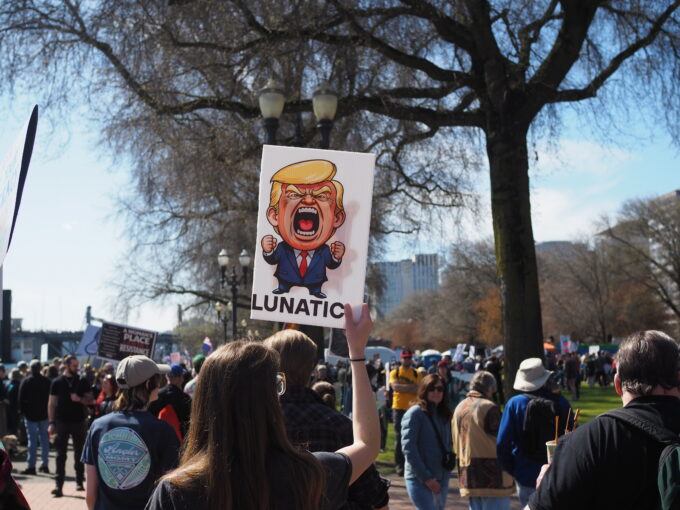
Eight million people took to the streets across the United States on 28 March, marching, rallying and picketing in over 3,300 sites. They came out to support their neighbors and coworkers who are threatened by masked and armed men. They opposed the authoritarianism of the Trump team with humor in their signs and costumes, but at the same time they can joke, they are willing to stand firm.

How did the March demonstrations differ from the two held last year? They were larger and more diverse, but still uneven. In some places there were union contingents but in other areas, only visible in a handful of union hats. Minneapolis, where the crowd was somewhere beyond 100,000, and perhaps as many as 200,000 the union presence was strong. But in the downriver Detroit area, where ICE has purchased a warehouse to house more than 1500 immigrants, UAW Local 900 sponsored a No Kings event. Their members are part of the movement to prevent ICE from opening a concentration camp right on their doorstep.

Montpelier, Vermont rally.
Just as there is unevenness in who shows up to participate, there is unevenness in how different constituents and different issues are welcomed. In general, demonstrators are able to raise a broad range of demands against both the war at home and the war abroad, in a few cases a tight-fisted organizing committee has banished some issues or failed to reach out to the most vulnerable communities.

Whatever the difficulties, it is good to see how people manage to find a way to raise their issues!

The bullies in Washington, backed by the bullies of Wall Street, think they are playing a video game in which there are no rules. They believe in citizenship of the elite.

With May Day just a month away, it’s clear that the task is to build for an even broader mobilization around the celebration of the historic fight for the eight-hour workday (1886). From Minneapolis, the call is “No work, no school, no shopping!” Let’s do what we can to move toward that call.

Austin, Texas:

Tens of thousands rallied in Austin, although estimates varied widely from 5,000 (NPR affiliate) to 40,000 (CBS affiliate). I’m not sure it was quite that much, but 5,000 is a gross underestimate. The stage was far more interesting than at the previous two No Kings rally. Instead of being dominated by tedious Democrats and mostly bland local politicians, there was a lot of music including a fantastic Spanish language ska band called Los Kurados. Speeches were pleasantly short.

The crowd, as with the others, was colorful with mostly homemade signs. Also like the others, the racial demographics were a bit weak. I saw few Black folks and not too many more Latinos. The organizers did ok up front though — the stage was a better representation than the crowd. Women comprised the majority of attendees. There was a good mix of ages as well.

Chicago: a personal note.
On the explicit political front, the stage was uninteresting, to no one’s surprise. A few leftist groups were in attendance. DSA had two booths; PSL had a large one; and FRSO had one.

There was some anti-war sentiment, but not as much as we would hope for.

The local CLC had a booth, and I also saw banners or t-shirts from NALC, AFSCME and the IBEW.

On the fringes of the demonstration, literally and metaphorically, were three or four people under an “Iron Front” banner. I assumed from their appearance that they were fascists, but it seems the Iron Front was an SDP outfit in the Weimar years geared at fighting Communists and Nazis.

Bay Area, California:
San Francisco had a No Kings Day turnout of 100,000 with a labor and anti-war contingents. David Bacon, photographing the march, reported that it took an hour to walk from the front of the march to the end!

Attended a demonstration in Napa (50 miles northeast of San Francisco) that had 4,000 people. There was a rally and then a visibility march downtown which stretched for blocks with many cars honking in support. There were dozens of different actions all over the Bay Area.

Union City: poking fun at a dick.
Lots of student and Chicano participation in this Union City, a smaller city in the East Bay. This one was organized by “Union City Resists!” Other East Bay demos were in nearby Fremont and Hayward. In Oakland, after a kickoff rally, about 20,000 marched from City Hall to Lake Merritt.

Chicago, Illinois:
Multiple No Kings Day rallies and marches occurred in the Chicago region, including a main rally and march at the city center along Lake Michigan, events in city neighborhoods, and others in towns and suburban centers in the six-county Northeastern Illinois region (a population more than 9 million). A labor rally and feeder march which began around 11:30 AM, preceded the main rally/march, which started after 1 PM and wound up around 4:30.

In the city center, a small (75-100 folks) but noisy labor rally and feeder march called by the Chicago Federation of Labor and the Chicago Teachers Union (CTU) took place within eyeball distance of five large hotel towers, to highlight Unite Here’s call for workplace actions this fall. (Chicago’s tourist and conference industry is enormous, and a large employer, and now more than 50 large hotels are Unite Here shops.)

The rally featured a Unite Here speaker, a local AFGE official from TSA, and reps from other unions, and included a mention of planned May Day actions. Though few CTU members attended, the half-mile march to the main No King rally grew larger (more than doubling in size) and noisier as others spontaneously joined.

The main event featured speeches by official supporters (ACLU, Indivisible, Latina community leaders, Trans activists), and youth activists, and was chaired by official reps from Mayor Johnson’s administration. The mayor was one of only two elected officials to speak — his remarks included a mention of planned May Day events. The other was the DP senate candidate Stratton, who is to replace the powerful but now retiring Dick Durbin, who appeared on stage (but did not speak) along with many local and state party officials. (Stratton loudly claimed not to take PAC money, but in reality, was elected with millions donated by billionaire IL governor Pritzker.) No labor leaders spoke, and no speaker was identified from the stage as DSA.

The rally included no mention of Palestine, Israel/AIPAC, or Cuba; only a brief generic mention of labor, a slightly less generic opposition to Iran and war spending; and many angry references to health care inequalities and ICE and Trans repressions. Small socialist contingents and tabling crews were evident, mainly PSL and DSA — Indivisible had the largest visibility. Attendees were predominantly white, some Hispanic, very few African Americans, and skewed older. Crowd size safely exceeded 25,000, with many unverified claims of 100,000 participants. The march circled the eastern edge of the Chicago City center on a crisp sunny photogenic day.

NK day was an official event, made evident by the organized DP stage presence, the mayor’s speech and rally chairs from city hall, and the police-friendly march route. Consequently, some local left liberals and socialists made the what-was-the-point argument, perhaps a useful sentiment when organizing for May Day 2026.

Detroit, Michigan:

Thousands flooded Grand Circus Park in downtown Detroit on a sunny but cold Saturday afternoon and spilled over to nearby streets. With eight rallies from downriver to downtown Detroit, it is estimated that about 25,000 people were demonstrating against the war abroad and the war at home.

Since Detroit is a border town, ICE and Border Patrol are ever present in the city. Through People’s Assembly many whistle kits and mutual aid has been distributed. Several teenagers have been picked up by ICE, even those who have work permits.

Teachers have been particularly concerned about the well-being of their students, who have been picked up by ICE and sent to the nation’s only family detention center, Dilley Immigration Processing Center, in South Texas. Although federal regulations recognize that children should not be detailed, the Trump administration is seeking to end that restriction. Meanwhile the agreement is being violated and children, including teenagers, are harmed.

Houston, Texas:

According to the Houston Chronicle over 20,000 people participated in the march following the No Kings demo in front of City Hall. I did not stay until the march but spent several hours at the demo, where I saw probably about 3k+ people, but there could have been feeder marches later that I was not aware of. As for the last No Kings, there were a number of smaller events in Katy, Cypress, Sugarland and other suburbs of Houston.

The weather was perfect for an outdoor event and people were spirited. Speakers focused on local themes such as holding the mayor and city council members responsible for continued cooperation between Houston Police Department and ICE. and exerting more pressure on them. However, some took a much broader view and condemned the war with Iran, for example. As at previous No Kings, there were a number of stalls present, ranging from Indivisible to the local Food not Bombs chapter. PSL, YCL and local mutual aid groups were also represented. A local Socialist Alternative leader spoke.

Tabled for the local DSA chapter and got to know some YDSA folks who had their own stall right next to us. We were circulating a pro-immigrant rights petition for signatures that also seeks to hold local city council members accountable when it comes to immigrant rights.

Manhattan, New York:

Since the march is just a phrase “No Kings” and no specific demands like “End the War” or “Medicare for All,” people made up their own slogans and posters — very creative.

This march was a qualitative change from prior demonstrations. Many more people of color and many more young people. A friend says it was the same in the Brooklyn march. I don’t know about the marches in the other parts of the city.

A march organizer told me the estimate was 200,000. I think it was at least that. I’ve never been to a march where it went down two avenues — 7th Avenue and Broadway–at the same time. (Broadway combined with 7th avenue after marching 11 blocks from 59 to 48th street).

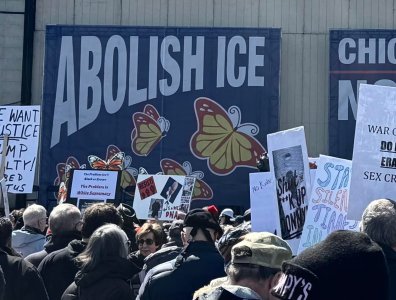
Manhattan: war crimes and sex crimes, part of the same matrix.
ICE was clearly the main issue. I was surprised how few signs about the war in Iran. Many about Epstein.

I didn’t see the whole march and couldn’t even hope to report on who was there and who wasn’t, but it did strike me that there was a lot less labor participation than in the past. I saw the NY nurses, two locals of SEIU (1199 and 32BJ), Teamsters 804, Laborers (didn’t catch the local) and UFT. Missed others, like Teamsters, UAW, AFSCME, who could have been there. Time for the labor movement to get moving!

Actually, all five boroughs held No Kings marches and rallies. It was a great day. TV news reports demos in all 50 states! Let’s hope the growing involvement of Black and Brown folks continues.

Milwaukee, Wisconsin:

Milwaukee: before the march.
It was reported in the press there were over 100 “No Kings” demonstrations in Wisconsin on March 28th. The largest may have been in Madison. In Milwaukee there at least six protests, the largest of which drew over 5000 participants. Speakers at that event included the vice president of the Milwaukee teachers’ union and a national board member of the NAACP.

Several socialist groups had organized contingents behind banners in the two-mile march through the community that followed the rally, including Democratic Socialists of America, Solidarity, Party for Socialism and Liberation and Freedom Road Socialist Organization.

Ohio:

Mansfield: — 10 AM: I traveled here with three others and was excited to see what we estimated to be 300 people (organizers estimated to be 400) at the peak of the event. For a city of less than 50,000, that was more than the last No Kings in Mansfield. Though I was happy to see so many people, the speeches left me underwhelmed.

The speakers included a community member who wrote a letter to the paper after the killing of Renee Good and Alex Pretti, and an Ohio Democrat who was also a union leader. It seemed very much a Democratic party event, not a coalition with multiple organizations and issues coming together for a change kind of event.

The crowd was all different ages, although mostly white people in attendance, it was nice to see that some folks of color felt safe enough to be out demonstrating with us!

War monuments in the location we met in and the thin blue line memorial across the street really gave the whole thing a sort of eerie feeling to me.

Galion: noon: The smallest demonstration of the day, but perhaps the most impactful. About 20 of us gathered in the square for the first ever No Kings event in rural Galion. Except for two Black men, it was an all white group of different ages.

Reactions were mostly neutral from passers-by, but far more positive responses than negative ones. However, almost as soon as we gathered, police drove by in cruisers and kept up observing us.

This wasn’t an officially registered event and had no rally, but we listened to antiwar music and talked. The sentiment was mostly anti-Trump sentiment, but the few were interested in deepening the conversation and talked about the problem being systemic. We also talked about the possibility of building a May 1st event.

Statehouse Rally in Columbus, Ohio — 4 PM: organizers of this protest are reporting 20,000 people in attendance, it felt like standing room only!

The best part of this event was meeting a gay couple from the Galion and Mansfield area. They said they fled to Columbus years ago due to political safety concerns. They were ecstatic to hear of the work we’re doing there now, and it felt like a full circle moment.

We exchanged contact information and connected on social media, so I’m looking forward to the connection that blossoms from this encounter. I think this is the kind of human moment that demonstrates the power of No Kings.

Overall, I have concerns that the No Kings movement may be co-opted by establishment Democrats. But this fear does not outweigh my willingness to capitalize on No Kings momentum as a revolutionary socialist, and I hope other comrades feel similarly. No Kings is a step in the right direction. We flexed our muscles on Saturday, and now it’s time to commit to building the better world we know is possible. I’m looking forward to May 1st.

Olympia, Washington:

About 7,000 turned out in Olympia. Great spirit, great cross section of ages, cultures, interests. A great many homemade signs like ” Not enough cardboard to list the reasons I’m here today.”

Pittsburgh, Pennsylvania:

Over 15,000 people gathered at the city-County building for a “No Kings” rally in downtown Pittsburgh on a sunny but very cold day. Ghadah Makoshi, a community organizer with the American Civil Liberties Union, summarized the rally’s central message as being “no to authoritarianism in all of its forms.”

While many issues were raised by the signs and speakers, there was a focus on ICE, evident by the number of people who came equipped with whistles. Matthew Jordan, a representative from Casa San José, called for an end to police cooperation with ICE. Recently, two young men, aged 18 and 20, were stopped by police for a traffic violation on their way to work and turned over to ICE.

About a dozen other No Kings rallies took place in nearby towns, including McCandless, Penn Hills, Sewickley, Mt. Lebanon and more distant such as Clarion and Zelienople.

Romulus, Michigan:

ICE warehouse (in background) with State Representative Dylan Wegela speaking.
Around 350-400 people came to Romulus, Michigan on No Kings Day. Many had been to demonstrations at nearby sites, including UAW Local 900.

On the sunny afternoon a crushed ice station provided snow cones to demonstrators, and if they were like me, they too relished what sunshine melted the ice.

We gathered at 7525 Cogswell St., home to an idle warehouse that has been purchased by DHS for $34.7 million — 57% more than the previous sale price — and purchased without the knowledge of city officials. ICE is planning a detention center housing hundreds and one that is close to the Detroit airport. We call it a concentration camp and are organizing to make sure it never opens.

Demonstrators occupied the grassy area between the sidewalk outside the facility and the road, holding up signs that creatively expressed discontent with the current situation. Cars and trucks passing by honked their support of the action.

Given the logistics, the parking operation alone was a feat: roughly 260 cars packed tightly into a grassy area with a narrow entry point across the street from the facility.

In Romulus, the rumor is circulating that opponents of the ICE plan are paid to leaflet and demonstrate.
When Congresswoman Rashida Tlaib arrived, noticing the warehouse entry was blocked by cones, her security got out to move a cone — only to be quickly stopped by federal agents who keep continuous watch on the property. After that ordeal, Rashida then proceeded to lead chants in tandem with a young boy in attendance, “Show me what democracy looks like! This is what democracy looks like!”

Other rally speakers included Dylan Wegela, State Representative for Romulus and surrounding areas and member of DSA and Alyssa Loucks, a Romulus Middle School teacher who eloquently spoke to the particularities of U.S. authoritarianism. The Resistance Singers taught the crowd group songs from Minneapolis, and a Solidarity member and long-time union activist addressed union members, pointing out that this struggle can build union power.

The Coalition to Shut the Camps organized the Romulus No Kings event. It has garnered the support of 33 organizations in a “regulatory punch list” targeting Great Lakes Water Authority (GLWA), Wayne County, City of Romulus, DTE, and Michigan Department of Environment, Great Lakes, and Energy (EGLE), demanding full disclosure of all proposals and the opportunity for public meetings before any approval of ICE plans.

The coalition plans to continue meeting at 3 pm at 7525 Cogswell every Saturday.

Salt Lake City, Utah:
The “No Kings” demonstration in Salt Lake City began with a rally of 8,000 at downtown Washington Square Park before participants marched a mile+ uphill to the State Capitol for the main rally. Several thousand more went directly to the Capitol. The March demonstration was larger than the 10,000 who rallied last October, and more diverse.

St. Paul:
The turnout exceeded the organizers expectations!
In fact, the first speaker at the Capitol rally was Jeanetta Williams, president of the Salt Lake NAACP. There were 18 No Kings’ rallies and marches in the state.

St. Paul, Minnesota:
The turnout at the Capitol in St. Paul was somewhere between 100,000-200,000 people and included impressive union contingents.

Traverse City. Michigan:
No Kings 3 march. I’d say 2,000-3,000 people.

Vermont:
At the 50 NKD sites that we know of in Vermont we’ve counted 29,441 participants so far. DSA and the Vermont May Day Strong coalition distributed some 3000 May Day fliers plus another 1500 of our Solidarity School fliers at 10 of the larger sites.

Politically it was a mixed bag. For example, in Montpelier Migrant Justice spoke and I was asked to speak to an Indivisible meeting about the May Day Strong organizing. While in Burlington Indivisible is run by liberal Democratic Party Zionists who refused to allow Migrant Justice, labor, or Palestinian solidarity activists to speak. There we had our own May Day Strong feeder march with some 1000+ participating, and held our own rally with Migrant Justice, labor and Palestinian voices speaking before we joined Indivisible’s rally.

Thanks to Alex, Chris, Dawn, Dianne, Eric F, Eric S, Folko, Giselle, Heidi, Jody, Johanna, Linda, Paul, Peter, Randy, Traven and Wendy.

Source: Soldarity