Friday, April 10, 2026

Ceasefire or Pause? The Gulf Held Hostage

April 10, 2026
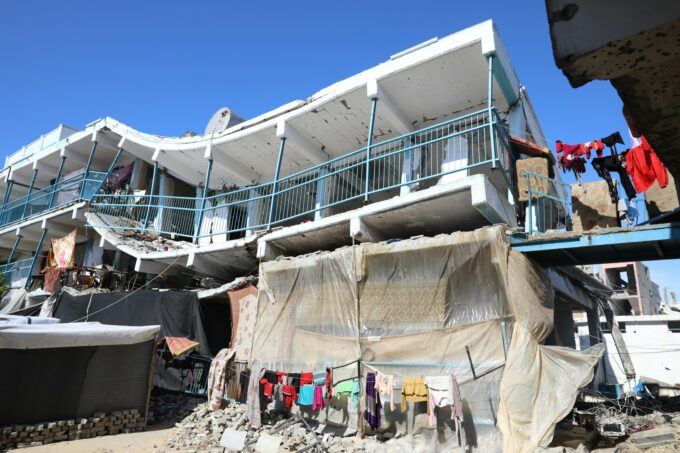
Image by khalid kwaik.

The ceasefire offered a much-needed breather for the Arab Gulf states. Donald Trump’s threat to attack Iranian civilian infrastructure could have unleashed a human catastrophe across the region with the potential to spiral into an uncontrollable conflagration.

Trump’s shift from threat to ceasefire appears deliberate. In my view, it was part of the phone call with Benjamin Netanyahu on Sunday, April 5. Netanyahu was likely reluctant, possibly seeking to delay any ceasefire long enough to allow Israel to strike economic targets inside Iran. Trump, however, cornered by his deadline threat, seems to have pushed back. As inferred in his comments in the April 6 press conference, Trump might have boasted about his support for Israel, reminding Netanyahu that “if we didn’t do that… Israel would’ve been extinguished.”

By all indications, Netanyahu had little choice but to comply, accepting a halt to attacks on April 7—just minutes before Trump’s ultimatum expired.

The real question now is not whether the ceasefire will hold, but how—and when—Israel will move to break it, whether against Iran, Lebanon, or Yemen. I wrote the previous sentence just hours before finalizing this article. Shortly thereafter, Israel committed massacres launching unprecedented attacks blowing up residential towers murdering more than 250 civilians throughout Lebanon. As in Gaza, the reality is undeniable: ceasefires are reduced to one-sided compliance allowing Israel to violate it with total impunity.

Nothing in this episode suggests that the Israel-first grip on American foreign policy has weakened. The subordination of U.S. policy in the Middle East to Israeli strategic priorities did not begin with Trump. It took shape under Lyndon Johnson and was entrenched during the Nixon years, when Henry Kissinger surrendered American Middle East peace policy to Israel. In the decades that followed, neoconservative and Israel-first pundits expanded that doctrine, steering the U.S. into wars that served Israeli interests only. The invasion of Iraq, under a pretense fabricated by Israel-first American Zionists, stands as a clear example. Today’s confrontation with Iran follows the same trajectory.

What distinguishes this war from previous made-for-Israel wars, it is not contained. The stakes are global. The Gulf is not a peripheral theater, but a lifeline of the world’s energy supply and a cornerstone of global economic stability. Entire economies depend on its oil, and global markets depend on its uninterrupted flow. To hold the Gulf hostage in Netanyahu’s war against Iran is, in effect, to hold the global economy hostage.

Netanyahu’s fixation on Iran is not new. For three decades, he has cried wolf that Iran is perpetually on the verge of becoming a nuclear power. The irony is inescapable: Israel, refuses to allow the International Atomic Energy Agency (IAEA) access to its nuclear facilities, while it cries foul invoking existential threats from a country that has been under IAEA Additional Inspection Protocol for decades.

Meanwhile, Trump’s threats to expand the war to target civilian infrastructure exposes the vulnerability of the Arab Gulf states. They rely on U.S. security guarantees, yet remain, more than the U.S. and Israel, geographically and economically exposed to the outcome of a war they did not choose. In practice, they are not bystanders, they are on the frontline.

More alarming still, when Trump nonchalantly threatened to obliterate Iran’s civilization, he showed little understanding of what civilization is, and no concern for likely retaliation against his supposed Gulf allies in a war with no credible exit strategy. While retaliating against civilian infrastructure in countries that were not directly involved in the war would be unwanted, it is equally naïve to expect that states hosting military bases for the aggressor can remain insulated from its consequences.

Trump’s threat to send Iran back to the stone age is a page from an Israeli playbook. Targeting civilian infrastructures has long been an integral component of Israeli military canon. For Israel, power plants, water systems, roads, ports, and communication networks are not indirect casualties—they are the intended targets. Israel’s wars always aim to impose systemic pressure on entire societies by dismantling the conditions necessary for civilian life.

The above was evident in Gaza, the West Bank, and Lebanon, and traces back to earlier wars with Egypt and Syria. In Gaza, the infrastructure has been systematically destroyed: roads torn apart, water and sewage systems dismantled, power grids disabled, and universities and hospitals reduced to rubble. This is not conventional warfare. It is the calculated destruction of a society’s foundations to force political outcomes through collective pressure.

Israel wanted Trump to deliver Iran as part of this strategy.

Under such conditions, Gulf states risk finding themselves abandoned after bearing the economic brunt of the conflict, left to contend with a prolonged and antagonistic relationship with a historic and permanent neighbor. Whether under the current Iranian government—or even in the unlikely event that Netanyahu succeeds in his regime change obsession—there is little reason to expect a stable or friendly future. In either case, it is the Gulf states that will carry the enduring burden of living next to Iran, not the United States, and certainly not Netanyahu.

Trump’s true dismissive views of his Gulf allies and their religion were made evident in his Easter message. In his April 5 Easter message, where he invoked “Praise be to Allah” in a derisive manner, underscored a broader disregard for the cultural and religious sensibilities of his Gulf allies. This was not a lapse in judgment; it reflected a deep-rooted willingness to weaponize religious language to inflame the hateful sentiment of his political base. For Gulf nations, whose societies are deeply rooted in Islamic identity, such language from their benefactor in this war should not be dismissed lightly.

In the end, the Arab Gulf is not merely caught in the crossfire; it is the war’s primary theater—a buffer zone for Israel, a staging ground for U.S. forces, and a cost bearer for a conflict it neither initiated nor controlled. When Israel restarts another war, as its history suggests it will, the direct impact will not be borne in Washington or Tel Aviv. In this context, Gulf Arab states must begin to think independently and act strategically—particularly by reassessing their alliance with the U.S., which has repeatedly shown a clear disposition to use their land to launch wars on behalf of a third party: Israel.

This latest conflict should serve as a “bellwether,” warning against being drawn into a catastrophic war designed by and for Israel, and the resulting risk of having their infrastructure, economies, and long-term stability held hostage by the wars of others on their territories. It would leave them to bear the consequences of Netanyahu’s aggression against their neighbors long after the architects of these hostilities have moved on.

Jamal Kanj (jamalkanj.com) is the author of Children of Catastrophe: Journey from a Palestinian Refugee Camp to America, and other books. He writes frequently on Palestine/Arab world issues for various national and international publications.

Trump’s Persian War


 April 10, 2026

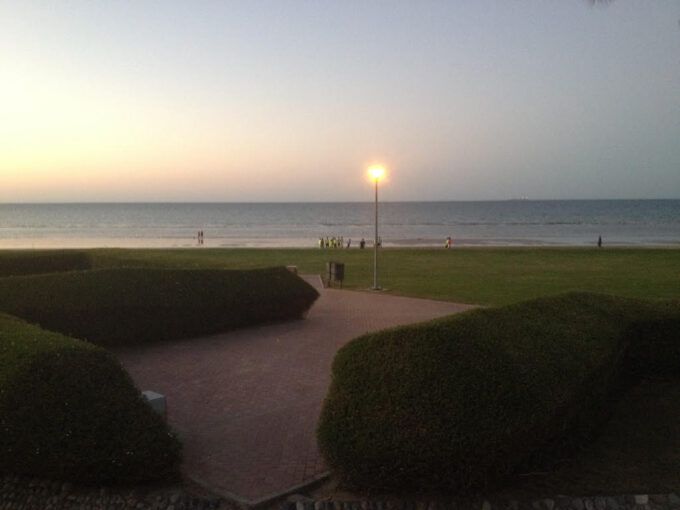
The Gulf of Oman near the Strait of Hormuz. Photo by Matthew Stevenson.

I don’t think there is anything that gives Donald Trump quite so much pleasure as failure, perhaps one of the reasons why he is so enjoying blowing through $50 billion in taxpayer money on his way to numerous defeats in the Strait of Hormuz.

I realize Trump has taken out primetime copyrights on various brands of success—all those “arts” of the deal—but at the end of the day what Trump likes most is to measure himself by the size of his failures (no doubt the only time his remote father ever paid him much attention).

Maybe in the 1980-90s he got a rush from screwing over plumbers in Atlantic City or bilking Wall Street investors on their bonds, but now he needs a little more skin in the game. (A whole civilization will die tonight, never to be brought back again…”)

After a lifetime of bankruptcies, failed ventures, sexual transgressions, and Wall Street con jobs that bled dry various banks and investors, how nice for Trump that he can cap his career with (to paraphrase Saddam Hussein, who also foundered in the Persian Gulf) “the mother of all defeats.”

+++

Imagine the good fortune of the Iranians emerging from their bomb shelters amidst the rubble only to find that Trump has declared a cease fire based on Tehran’s ten-point program, which reads as though the Islamic Revolutionary Guard Corps had landed long boats in the Chesapeake and marched overland to Washington to burn the Capitol.

As a premise to the negotiations, the Iranians get to keep their enriched uranium, evade all sanctions, and charge $2 million for every ship transiting the Strait of Hormuz. Advising the Iranians might well be Napoleon himself, who was known to quip: “Never interrupt your enemy when he is making a mistake.”

The self-defeating Trump also agreed to 1) peace talks in Islamabad, Pakistan’s capital and 2) the appointment as his chief negotiators three men of stunning incompetence: Jared Kushner (Trump’s son-in-law, who has no role in the U.S. government); Steve Witkoff (an inside-trading crypto Trump buddy and real estate developer, also without a government portfolio); and Vice President JD Vance (fresh from barnstorming for the Hungarian fascist and Russian stalking horse, Viktor Orbán). 

The only reason to send property promoters Kushner and Witkoff to Islamabad is to come away with a few golf courses on Kharg Island.

+++

If Trump had any hopes for the Iranian peace talks to succeed, the last person on earth he would send to head up the U.S. delegation would be the papal nuncio (and U.S. Vice President) JD Vance, who otherwise only gets a mention these days in the context of invoking the 25th Amendment and removing Trump from the presidency on the grounds of insanity. But you only send Vance to Islamabad to be done with him.

Note the long report in the New York Times that takes readers on a tour of the White House situation room as Trump and his inner circle debate whether to attack Iran (imagine Kremlin heads nodding da”…). 

In the Times piece, the heaviest leaking comes from the office of the vice president, who is in paragraph after paragraph is described as warning Trump that the Iranian invasion is a mistake (although he still supports and loves his dear leader). 

No doubt the leaking was done to bolster Vance’s presidential chances in 2028, especially with the isolationist, Tucker Carlson wing of the (moribund) Republican Party. 

Even the demented Trump would have been able to figure out from the piece that it was a vice-presidential letter opener that was being plunged into his back. Hence Vance’s one-way ticket to Islamabad in the company of two Gulf state remittance men.

+++

If there is anyone planning a Trump victory parade for the Hegseth Legions returning from the Persian wars, it has to be the Russian president Vladimir Putin, for whom the showdown at the Hormuz Corral arrived as manna from heaven.

Before Trump fell on his sword in Isfahan, Putin’s Life Guards and North Korean Cossack regiments were getting unceremoniously thrown out of Ukraine and the Russian economy was reverting (at least for non-oligarchs) to its bread lines.

As if on orders from Karla (John le Carré’s Soviet spymaster), Trump then rolled back the sanctions against Russia and encouraged Putin to sell his oil at new (extortionate) world market prices—while ignoring the fact that the Kremlin was assisting Tehran in targeting Americans in the Middle East. (Treason anyone?)

Even better for Russia is that Trump has broken with NATO and is restoring Russia’s lost influence in Tehran, such that Trump called the proposed Strait of Hormuz shipping toll booths (no doubt run by Moscow) “a beautiful thing.” 

I can only assume that the Vance mission to Budapest (grotesque at many levels) was to inform various Kremlin cutouts of Trump’s progress in dismantling western civilization.

+++

To date, the United States has spent about $1 billion a day on its “short-term excursion” in Iran, and at this juncture there’s no way out.

The US can agree to Iran’s ten-point plan for American surrender or it can fight on until— sooner rather than later—the war stores of the American arsenal run dry. (So much for Trump “rebuilding” the army.) For the moment all the king’s horses and all of his B-1 bombers haven’t figured out how to prevent Iranian drones from closing the Strait.

Or the United States can follow an earlier Trump model and convert this string of defeats into a new reality show. This one can be called “The Commander” and it will feature a tough-talking Trump in his many situation rooms (alongside co-stars Pete Hegseth and Benjamin Netanyahu) vowing to “take out” whomever is in his way. 

The camera can cut to American hostages in Tehran (I know, dated, but it’s about all we have) or oil tankers riding at anchor outside the blocked Strait of Hormuz. Trump can be shown shouting: “Open the Fuckin’ Strait, you crazy bastards, or you’ll be living in Hell – JUST WATCH!”, or Hegseth can be filmed firing a few of his black generals.

The drama of “The Commander” isn’t that Trump saves Israel from marauding Iranians or restores the price of gasoline to $2 a gallon; the point is to show that the world must take note of Fred Trump’s abused little boy who seems only to live for what might be called the attention of failure.

Matthew Stevenson is the author of many books, including Reading the RailsAppalachia SpringThe Revolution as a Dinner Party (China throughout its turbulent twentieth century); Biking with Bismarck (France during the Franco-Prussian War); and Our Man in Iran. Out not long ago were: Donald Trump’s Circus Maximus and Joe Biden’s Excellent Adventure, about the 2016 and 2020 elections, and The View From Churchill, about the places that shaped the life of the British wartime prime minister. His next books are Playing in Peoria (by bike across the American Mid-West) and Friends of Kind, a literary travel history of World War I.