Friday, April 10, 2026

Harriet Tumbled: Now I Know Why Brits Love and Fear for Their NHS

 April 10, 2026

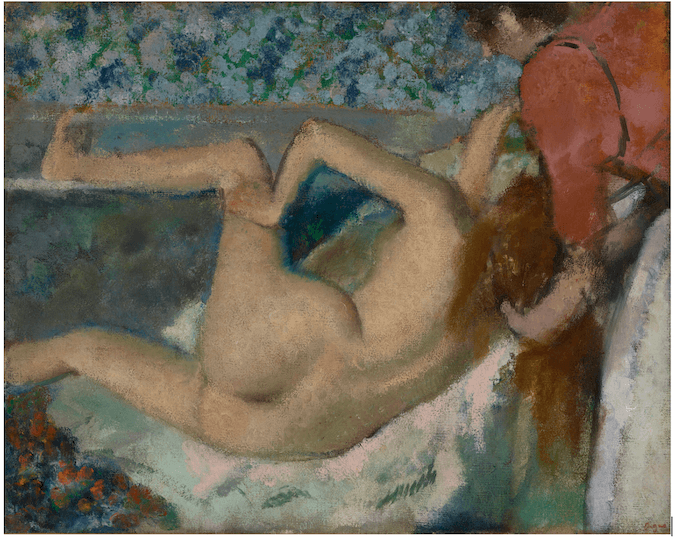
Edgar Degas, After the Bath, c. 1895. Los Angeles: J. Paul Getty Museum (Public Domain).

The fall

The Twineham Ward of Princess Royal Hospital, Haywards Heath, Sussex, U.K., consists of six bays of patients to the left, multiple offices to the right and a long corridor in between. But to call it a corridor isn’t quite right; it’s more like a spine because it’s the nerve center where senior nurses direct junior nurses and aids, doctors review patient records, and visitors enter and leave. It’s also a rehab space where elderly patients with frames (“walkers” in American dialect) shuffle up and down, exercising repaired or replaced hips.  I was there because my wife, Harriet – at 60 the baby of the ward – tumbled when stepping out of a bathtub in a Brighton hotel room that had a nice view of the English Channel.

After hearing her scream, I opened the bathroom door and saw Harriet in a pile in front of the tub, naked except for a towel around her middle. I thought of Degas’ painting of a woman with one leg propped on the rim of a bathtub and the rest of her naked body below. “Did you fall?” I stupidly asked. “Are you hurt?” She replied through gritted teeth with a cliché of her own: “I think I’m ok.” I knew she wasn’t. Refusing to believe she’d seriously hurt herself, Harriet scuttled across the bathroom floor like T.S. Eliot’s crab, then across the carpet and somehow up on the bed. I dialed 999, the U.K. emergency services number. That’s when I discovered a major flaw of the National Health Service, established in 1948 by Aneurin Bevan, Minister of Health under Labor Prime Minister Clement Attlee – ambulance wait times. My conversation with the dispatcher was roughly as follows:

“My wife has had an accident and we need an ambulance.”

“May I speak to her?”

“Sure, here she is.”

“Is there any bone protruding through the skin?”

“No.”

“Were you unconscious at any time after your fall? Can you stand up or walk?”

“No and no.”

“Ok, we’ll send an ambulance for you.”

I came back on the line: “About how long will that be?”

“Our average wait time is between one and four hours, but the latter is an outlier. We’ll send one as soon as we can.”

Two hours ticked by. I called again and had roughly the same exchange. At three hours, 20 min, Harriet grimaced, moaned, then screamed in agony and began shaking uncontrollably. I knew what shock looked like, so I bundled her up in blankets, encouraged her to breathe slowly and deeply and called another NHS dispatcher:

“No, my wife cannot speak to you because she’s in too much pain. She’s going into shock. You must raise the level of urgency to one or two and send somebody at once.” In the hour since my previous call, Gemini AI (my new buddy) told me that every ambulance summons, save imminent death, rates an “urgency level” of three or four from the NHS. My words had the desired effect.

“I’ll send an ambulance right away.”

45 minutes later, help arrived in the form of two diminutive, bespectacled, white men, 40ish, with working-class accents and calm demeanor. They finished each other’s sentences like Rosenkrantz and Guildenstern – but were kind and competent. They quickly gave Harriet laughing gas (nitrous oxide) to reduce the pain while checking her vitals. Then they hoisted her onto their gurney and took her down the elevator, past hotel reception, and into a night that smelled like the sea. In a minute, we were swallowed by the waiting ambulance. That’s when I deployed the second set of magic words, I learned that night, courtesy of Gemini:

“Harriet has a probable neck of femur fracture, and I want her taken to the nearest hospital with fast-track treatment.”

“Let me call…” one said…

“Princess Royal Hospital in Hayward’s Heath” the other continued, “and see if she is eligible for that program.”

She was. So that’s where they drove, carefully but at speed.

The National Health Service, neo-liberalized

Almost from the beginning, the NHS has been treated like a piggy bank.  Three years after its founding, the Labour government, wanting money to pay for British participation in the U.S. war against North Korea, cut funding for the NHS. Bevin quit his post to protest charges for dental work, eyeglasses, and prescription drugs. (These costs remain in effect.) More cuts were mandated by the Guillebaud Committee report in 1953, but it wasn’t until the Margaret Thatcher years (1979-90) that the NHS was looted, albeit surreptitiously.

Like her American friend, President Ronald Reagan, the U.K. Prime Minister believed that the invisible hand of the marketplace could better direct the allocation of resources than any elected parliament, council or parish. In her laissez-faire utopia, the heads of businesses, and especially large corporations, would comprise a clerisy that supplanted leaders in education, religion, science, politics, and the arts. Universities, hospitals, and even museums would be privatized and rationalized, that is, made subservient to market discipline. Labor unions, especially, were viewed by Thatcher with suspicion or worse. They must be enfeebled for profits to grow and investment to occur. Indeed, any accommodation to workers’ wants or public needs distorts the iron logic of supply and demand.   In the U.S. “Reaganomics” followed the same course and had similarly dire outcomes for health and safety, income inequality, and national infrastructure.

In 1982, Thatcher and her chancellor, Geoffrey Howe, clandestinely proposed abolishing the NHS in favor of compulsory enrollment in private insurance.  Opposition by ministers prevented the rollout of the program, but not before leaks fueled a press and public firestorm.  In response, Thatcher claimed, duplicitously, “the NHS is safe with me.” Thatcher and her team’s subsequent assault on the NHS proceeded along two tracks. The first entailed splitting off long-term care from acute care, and the second introduced competition among hospitals for scarce resources, along with cuts to local councils under the rubric of “fiscal discipline”.

When elderly or disabled patients were discharged from hospitals, under the new system, they could no longer move seamlessly and without charge to long-term care homes or rehabilitation facilities. Nor could they be assured of free, at-home visiting nurse services. Instead, they had to pay for most after-care themselves, or if they could not afford to (after liquidating their assets, including homes), line up for subsidized care financed by their local Councils. The cunning of it was to present the change as a progressive reform that would liberate patients from large and dehumanizing care homes and direct them to better, smaller facilities close to or within their own communities. The formula was the same as that used by neo-liberal advocates for the de-institutionalization of the mentally ill in the U.S., beginning in the late 1960s. (That’s been a major factor in the American homelessness crisis.)

When Westminster began starving local Councils for cash beginning in 1980 – what Thatcher called “fiscal discipline” — care services began to be rationed and their quality diminished. The same market logic now began to govern all parts of the NHS, not simply long-term care and rehabilitation. Hospitals were made to compete for funds, leading to perverse incentives and poorer patient outcomes. Everything – from food preparation to nursing – was opened to competitive tenders. Further cuts (or rises below the level of inflation) under successive coalition and Tory regimes from 2010 to 2024 made matters worse.

“Austerity” has become a dirty word in the U.K., but the new Labour government under Keir Starmer and Health and Social Care Secretary Wes Streeting has done little to address the healthcare crisis that helped elect them. They have boosted grants to local councils by some £800 million, but that’s not enough even to cover minimum wage increases and mandated higher National Insurance Contributions. In 2028, an independent commission is due to issue a report on the establishment of a National Care Service with low cost to patients and high standards of service.  The idea was first proposed by Labor PM Gordon Brown in 2009.

Meanwhile, privatization of healthcare continues apace, further undermining the strength of the NHS. When wealthy patients seek treatment in the private sector, the NHS is left caring for older, poorer and sicker patients. And since the NHS pays hospitals based on the average price of a treatment or procedure, sicker patients needing more expensive care are a financial strain. In addition, low NHS salaries and difficult workloads have enabled the private sector to siphon off some of the best young doctors and nurses, leaving staffing shortages that again reduce the quality of care and increase waiting times for medical services. The queue for elective procedures can be years long. In addition, with fewer hospital beds available, hospitals must slow their emergency room intakes – thus the long wait for ambulances, as my wife and I discovered last week!

Saving the NHS will require the current Labour government, or any successor, to resist creeping privatization and undertake much more significant investments than have been considered so far. Paying for them will require some combination of the following: imposing new wealth, corporate and estate taxes, forgoing nuclear modernization, and resisting other large defense expenditures.  At the moment, the Green Party is the most likely vehicle for delivering those changes. But the Labor Party, which created nationalized care in the U.K. and is currently struggling in the polls, may yet recognize that rebuilding the National Health Service is its best hope of electoral salvation.

Back in the ward – first the good news

My wife’s care at Princess Royal Hospital, thanks to the “fast track” service, was excellent. Once Harriet arrived at the hospital – about 10 p.m. on a Tuesday night – she was quickly taken into a quiet area with just one or two other patients nearby, several nurses, and a presiding Urgent Care physician.  She was given strong painkillers (blessed Morpheus!), rushed to x-ray, and prepped for surgery, scheduled for 9 a.m. the next morning. The procedure, called Open Reduction and Internal Fixation, took about 3 hours and entailed inserting a titanium rod in her femur and fixing the broken section to it with a series of screws. I waited in a quiet, glass-walled hallway near Twineham. At noon sharp, I heard the “whoosh/bump–whoosh/bump” of a gurney wheeled across linoleum tiles, and saw Harriet, doped up but happy, on her way to the ward. I took her hand and accompanied her.

The next four days were blessedly uneventful. Harriet experienced the expected pain and other minor symptoms, but was out of bed walking slowly two days after surgery. On day four, we informed doctors and physiotherapists that we would be leaving on day six at the latest. They said they would have to evaluate, but we said no, we’d be out on Sunday, come what may.

We had no cause for complaint. The nurses couldn’t have been kinder or more attentive. The surgeons were a bit grandiose – that comes with the territory – but not so much that they wouldn’t answer questions. The attending physicians were competent, concerned and engaging – and almost always available. The ward itself was incommodious – six patients in a bay the size of an average American living room, with translucent windows on one side only. Beds were separated by curtained partitions kept open except when intimate ministrations were performed by nurses or doctors. Harriet didn’t mind the lack of privacy; in fact, there were spells of garrulousness that reminded us of scenes from Dennis Potter’s BBC series The Singing Detective(1986). But that wasn’t enough to keep us in the ward, if Harriet could possibly manage to get out.
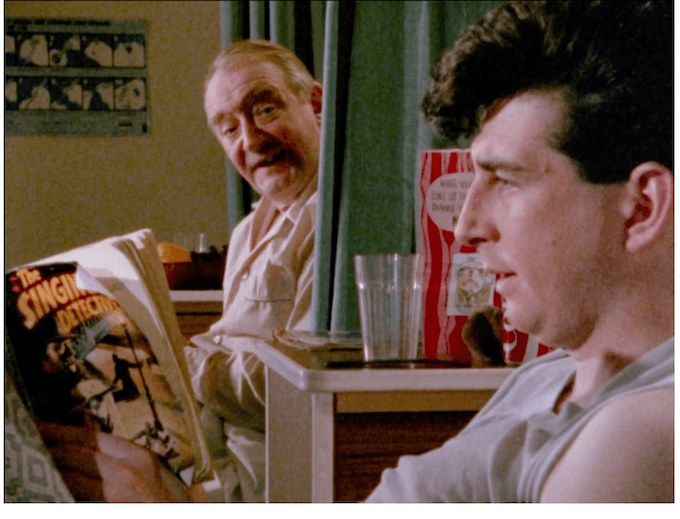
David Ryall and Gerald Horan in The Singing Detective, written by Dennis Potter and directed by Jon Amiel, BBC production, 1986. Screenshot.

And now the bad news

Far more often than gay, the atmosphere in Harriet’s bay and the other five I saw was grim despite the best efforts of staff and doctors. The other five women in Harriet’s section were in their 80s or older and had no place to go because of NHS and government failure to provide adequate social care. The woman to Harriet’s right had been in the hospital for six weeks, after four in a different hospital. Her fracture was healed, but there was no place for her to go and no chance for extended home care. Now she suffered from multiple, hospital-caused maladies, including bed sores and could barely raise her head above her sheets. She told Harriet that her two children lived far away and couldn’t look after her. She was well looked after at Princess Royal and expected to die there, perhaps soon.

Directly across from Harriet was a woman in her late 80s (at least) with rosy cheeks and rheumy eyes. She spent much of her time crying. The nurses would come and ask her why, but she could not answer. One male nurse managed to get her to smile by putting his face close to hers and allowing her to explore it with her fingers. But a few hours later, she began quietly whimpering. She probably suffered some degree of dementia, but there was as yet no available placement for her either.

In the opposite corner, closest to the window, was a handsome woman in her early 80s who spoke with composure and clarity. She said she had been in the ward for 4 weeks, and was well healed from hip replacement surgery, but her local Council and NHS had not yet been able to set up the twice-a-week, at-home support she needed. They offered instead to send her to a nursing home 50 miles away, but that was too far from her daughter, and besides, she didn’t want to live in such a place. She hardly got out of bed in the five days we saw her, jeopardizing her recovery. We shared some crisps one day – the lowly potato chip is much prized in hospital wards — and she told me how much she wanted to leave but simply couldn’t figure out how. She knew she was growing weaker and more depressed each day.

Dr. Raju Dey, a well-credentialed geriatric orthopedist, was frequently in attendance while we were at Princess Royal Hospital. He’s a young, dashing man with a sweep of jet-black hair that drapes over his forehead. He’s also patient, thoughtful and committed to his profession. I asked him about the long-term patients in his ward. “They’re the majority of patients here,” he said. “We do the best we can for them, but a hospital ward like this is no place for long-term rehabilitation. Many have been here for months but can’t find a social care placement.” I asked him about the cost of it all: “The average cost per patient per day in this specialized facility is over £1,000…” I finished his sentence, having recently looked up the figures, “whereas the most luxurious care home in London or elsewhere is about £400. A less fancy place is half that.”  We couldn’t understand how a government led by intelligent people couldn’t figure out a way to shift resources from one sector to another – never mind raising new money – to improve patients’ well-being and extend their lives. It’s nothing less than madness, but it will continue until there is enough public demand for it to stop.  The best Harriet and I could do was get out of there fast and tell about the experience.

Stephen F. Eisenman is emeritus professor at Northwestern University and Honorary Research Fellow at the University of East Anglia. He is the author of a dozen books, the latest of which (with Sue Coe), is titled “The Young Person’s Illustrated Guide to American Fascism,” (OR Books, 2014). He is also co-founder of Anthropocene Alliance. Stephen welcomes comments and replies at s-eisenman@northwestern.edu

CAPPLETALI$M

The Age of the Gilded Apple


April 10, 2026

Photo by JK Sloan

Half a century is plenty of time for an Apple to stay fresh, or to rot.

The New York Times’s Kalley Huang (“For Employee No. 8, Many Changes in Apple’s 50-Year History,” April 2) traces the evolution of Apple Inc. from a “scrappy start-up that assembled computers by hand” — and whose organic name was a natural fit for an environment in which “Silicon Valley’s fruit orchards hadn’t yet been taken over by office parks” — to one which “has come to define how to be a global technology company.”

In a 2014 Bloomberg interview, Steve Wozniak recalled how he had “given away my designs for the Apple-1 for free,” leaving it to Steve Jobs to take projects the other Steve had “designed for fun” (while being “totally aware that a revolution was close to starting”) and “somehow turn them into some money for both of us.” The sum of their money would become so enormous that Chris Espinosa, who admits that having “had no college degree and … only worked at one company” since 1976 doesn’t sound like much of a résumé, owns what Huang estimates is well over $100 million worth of the corporation that makes a thousandfold of that in profit every year.

Craig Newmark’s op-ed “Craigslist Made Me Rich. Giving the Money Away is Easy” might have included Espinosa as evidence for how “making money isn’t proof to me that I know something any better than someone else” but of being “in the right place, at the right time” to apply common sense to a new field, if it hadn’t gone to print in the same day’s edition of The New York Times.  Newmark doesn’t propose any political program, keeping his distance even from any endorsement of “left-wing nonprofits” and instead promoting such voluntary philanthropic efforts as the Giving Pledge. Still, the public souring on the information industry, as captured by such titles as Douglas Rushkoff’s Throwing Rocks at the Google Bus and Tripp Mickle’s After Steve: How Apple Became a Trillion-Dollar Company and Lost Its Soul, might seem the inevitable result of it enabling such outsized yet largely fortuitous accumulations in the first place.

The Giving Pledge cofounder Bill Gates owes much of his fortune to emulating Apple. The video game Halo was first showcased at MacWorld by Jobs before it became an exclusive killer app for Microsoft’s Xbox. Gates’s Windows operating system tapped the talent of Macintosh’s iconic icon designer Susan Kare. And yet the broader impact of Apple’s innovations is hardly confined to such sheerly financial windfalls.

This is not just because Apple efforts like the HyperCard which made creating and viewing multimedia straightforward, the Pippin which brought built-in Internet access to a video game console, and the Newton which pioneered the personal digital assistant were influential on later developments without managing to become profitable products for them or anyone else.

Indeed, much of the creativity that spread from Apple’s roots in Cupertino, California to cyberspace is closer in spirit to Wozniak than Jobs. It was entirely typical for Stephen D. Young and Debra Willrett’s Backgammon, programmed for the Apple Macintosh in the same non-Orwellian year 1984 during which the desktop model was introduced, to give out a postal address for users who “enjoy it and would like to see more ‘freeware'” to “please send whatever you think it’s worth” … and permission for them to disseminate the software itself.

Huang notes that Apple’s current survival requires not just satisfying customers but withstanding “tariff whiplash, antitrust scrutiny and geopolitical turmoil.”  Consumer sovereignty and cooperative networking can tame such seemingly relentless forces — and make the fruits of tech’s golden geese as common as dirt.

Josh Schlossberg is a writer, investigative journalist, and recovering activist hiding out in the foothills of the Colorado Rockies. He’s the host of the Green Root Podcast, a quest to uncover the roots of the modern ecological crisis. You can find him on Twitter at @JoshSchlossberg or email him at greenrootpodcast@protonmail.com.  

Confronting Both Zionism and the Antisemitism It Welcomes

April 10, 2026

Image by Levi Meir Clancy.

There is no more room left to mince words in the name of political correctness or anything else, for that matter. Israel has become a menace of downright international proportions, and the world must come together to confront and destroy it without conditions. Part of this proclamation has always been true. Israel has always been a menace, a hyper-colonialist killing machine founded on the principles of racial supremacy. It is only the international part of my opening statement that I might have rolled my eyes at until relatively recently.

As despicable as the Zionist cause has been from the very beginning, I have always found the notion of Israel pulling all the levers of a globalist power structure to be silly and at times downright offensive. The United States, in conjunction with a rapidly disintegrating British Empire, created Israel to be a beachhead for Atlantist Pax-American expansion into the Middle East. Israel may have built itself a formidable and influential lobby within the United States, but the notion of a quisling calling the shots has long been patently absurd.

That is, until the American Empire crossed the Rubicon into mid-century England-grade decline during the last decade. Just look at the White House if you don’t believe me. The last three presidential administrations have been helmed by two barely sentient syphilitic sexual predators, men that no healthy empire would ever sponsor to run a bingo, let alone serve as the face for a global imperial hegemon.

Meanwhile, Israel has been rapidly expanding its theater of influence to include most of the Middle East and in the process committing the most brazen and well-publicized genocide against their hostages in the Gaza Strip with total impunity not to mention gorging itself on larger and larger swaths of its neighbor’s territory, and manipulating Donald Trump into embracing a politically suicidal war with Iran that is quickly unraveling into an international disaster likely to irreparably destroy America’s imperial reputation with its allies in both Europe and the Persian Gulf.

Long story short: America is crashing while Israel is rising, and what was once a welfare scrounging Wall Street colony looks poised to become a major power broker in what very much appears to be an increasingly post-American world order. This cannot be allowed to stand. Not Again. Much like the now collapsing American behemoth, Israel is a European colony designed explicitly for genocide, and their epic slaughter-thon bears a rather uncanny resemblance to the Manifest Destiny that made Jamestown the new Rome.

The Zionist State celebrated its independence in 1948 with the slaughter of 15,000 Palestinians, most of them civilians, and then forced the removal of another 750,000 to glorified Indian reservations in the desert, under the threat of genocide. Much like its American cousin, the Nakba never stopped (about 134,000 Palestinians were slaughtered between 1948 and 2022), but it is currently expanding and accelerating at a terrifying pace.

Using the easily preventable attacks on October 7th as an excuse, Israel, under the helm of the increasingly despotic Benjamin Netanyahu, has effectively conquered the Gaza Strip, killing at least 75,000 while forcing over a million more into crowded camps with barely enough food and water to survive. All while Donald Trump’s heinously titled Board of Peace draws up plans to Disneyfy the rubble with the full support and cooperation of every other nation in the region, who all seem to value their cut of the spoils over their hollow bromides to Arab solidarity.

This happened while the entire world watched, while even westerners in unprecedented numbers demanded their leaders put an end to a bloodbath that smartphones and social media made impossible to sanitize. And now, Netanyahu is doing it again, the exact same thing, in South Lebanon, as we speak. His regime has openly announced its intentions to conquer Lebanon up to the Litani River and completely empty the region of its primarily Shia population in order to create what they refer to as a buffer zone. Or in other words, the gangsters have taken the Sudetenland, and now they want Poland too.

This is not a nation that deserves to exist. In fact, this is not a nation we, as a species, can even afford to allow to exist. These psychopaths have picked a fight with the entire neighborhood and used the pedo honeypot they established with Jeffrey Epstein to convince Donald Trump to throw away what’s left of America’s influence just to hold Iran back while they do it again. If it works, Israel just keeps on killing like the UK and the US before it. If it fails, Israel commits nuclear suicide with its illegal stash as instructed by the Samson Option, possibly taking down the entire planet with it.

So, I will say it again, once more with feeling, this is not a nation the world can afford to allow to exist. A single state(less) solution is the only solution. The planet simply cannot endure a third Cromwell Dynasty in an era of hydrogen bombs and hypersonic missiles.

For this observation and many others, I will undoubtedly be roundly condemned as an antisemite; however, this couldn’t be farther from the truth. In fact, I am actually quite terrified that Israel’s very necessary collapse might come at the expense of a wave of genocidal antisemitism that could easily put the Third Reich to shame, and I do not believe this to be a coincidence. I have come to believe that Israel knowingly invokes the antisemitic menace by committing such well-publicized atrocities in the name of all Jewish people as a sick kind of blackmail against the Chosen. Call it a second Samson Option.

And signs of an international backlash, while grossly exaggerated and exploited, are also growing and expanding day by day. We are seeing acts of rage provoked by Israeli war crimes being committed against innocent Jewish civilians in places as far-flung as West Bloomfield, Michigan, and Sydney’s Bondi Beach. We are also seeing hugely popular voices within the MAGA movement itself, like Tucker Carlson and Candace Owens, openly toying with brazenly antisemitic rhetoric and only becoming more influential in the process.

We must all confront Israel, but we must also confront this toxic runoff along with it, and we must confront them both simultaneously with the weapon of history. The Jews are not the problem here; Zionism is, and Zionism has absolutely nothing to do with Judaism or the Semitic people. In fact, Zionism is really just another malignant cell of white supremacy, and it has long disdained both Judaism and most people of Semitic descent.

Zionism emerged from central and eastern Europe during the mid-19th century as a distinctly secular strain of the same European national swamp that would fester into fascism and national socialism, and it caried many of the same characteristics too; devotion to such toxically contrived notions as ‘blood and soil’ and scientific racism, not to mention a pronounced disdain for the east, including the Jews who once closely identified with it.

This is made very clear by some of the movement’s ideological architects, like Ze’ev Jabotinsky, who once proudly proclaimed that “We are going to Palestine first for our national convenience, (second) to sweep out thoroughly all trace of the Oriental soul.” A point reiterated by Israel’s own founding father, David Ben-Gurion, when he stated, “We do not want the Israelis to become Arabs. It is incumbent upon us to struggle against the spirit of the Levant, which corrupts individuals and societies.”

It is precisely this kind of pompously garish line of thinking that led to most Jews in the 19th and early 20th centuries to view Zionists as whack jobs and heretics. In fact, many Orthodox Jewish leaders of the time viewed Judaism to be a fundamentally spiritual tradition and rejected any attempt to transform it into a political nationality as an attempt to replace Jehovah with the state.

Even most secular Jews of this era rejected Zionism, often in favor of movements like Bundism and Yidism, which promoted a kind of radical Jewish cultural autonomy within Europe with a school of largely stateless nationalism much closer to Malcolm X than Menachem Begin.

The tide only shifted after the collective trauma of the Holocaust and the various Red Terrors, when the Zionists managed to leverage the horrors of the bloodlands to stifle any voice of reason that attempted to remind the Jews that these were the very same Ashkenazi supremacists who had in fact quite openly collaborated with the regimes of Hitler and Stalin in reckless attempts to achieve their shared goal of removing the Jews from Europe and using them to Europeanize the Middle East.

This is why German Zionist organizations were the only Jewish orders not banished by the Nazi’s 1933 Nuremberg Laws, and this is why those same Zionists collaborated with the Third Reich on the Haavara Agreement, which brazenly broke the international boycott on Hitler’s regime in exchange for the Nazis compensating German Jews to emigrate to Palestine. A Faustian bargain that saw 60% of all foreign capital invested in Jewish Palestine between 1933 and 1939 coming directly from the Third Reich.

The Zionists continued in this spirit long after their Nazi pals stabbed them in the back to the tune of 7 million Jews and built a distinctly white supremacist colony in Israel made for the Ashkenazi elite by the Ashkenazi elite. In fact, they only invited the Arab Jews, still quite happily strewn across Africa and the Middle East, because the European colonialists lacked the numbers necessary to expel the indigenous Palestinian population alone.

However, they invited these Jews with bombs, launching false flag attacks against synagogues belonging to the regions oldest continuous Jewish population in Iraq in order to stampede terrified Arab Jews into a state that unceremoniously labeled them Mizrahim or “Eastern Dwellers” before stripping them of their diverse cultures through a variety of so-called “national projects” which included involuntary detention in “absorption camps” and removing newborn babies from the arms of their Arab Jewish mothers.

Perhaps the sickest irony of this often-overlooked chapter of history, though, is that those so-called Mizrahi Jews likely have far more in common with the Palestinians they were corralled to wipe out than they do with their paler tribesmen. Many Israeli historians and geneticists now believe that today’s Palestinians were actually the original Jews of Biblical times before converting to Islam or Christianity, and that the sainted Ashkenazi were in fact merely European converts originating from the Kazar Empire of the Caucasus region.

Tragically, Israel succeeded in making the Mizrahim white the same way America did the Irish, by siccing them on their own in a genocidal contest for survival. Netanyahu’s Likud built its rise to power on the backs of the Mizrahim by promising them land and fortune in the illegal settlements of the West Bank. Within decades, these Jews who David Ben-Gurion once referred to as “rabble” had become the shock troops of Greater Israel, clearing the desert plains for the not-so-Semitic Ashkenazi elite.

However, outside the gates, the influence of the fumes produced by generations of Zionist indoctrination wanes among the faithful. Young Jews are once again forming the backbone of the western flank of the anti-Zionist movement, with organizations like Jewish Voice for Peace picking up where the Bundists left off. This is way more than just pissed-off kids rebelling against Hebrew school. This is a reawakening of the true spirit of the Jewish people. One defined by anti-authoritarian resistance and egalitarianism. One defined by proud Jewish fire breathers like Emma Goldman, Abbie Hoffman, and Murray Rothbard.

These people are not our enemies. They are our hope, and any attempt to tar them with the same brush as the usurpers they righteously rail against must be confronted not just as bigotry but as downright counterrevolutionary.

We must all confront both Zionism and antisemitism, and we must confront them both at the same time for the same reason. They are both tools of the Anglo-Saxon Atlantist global order, and they are both being exploited by a burgeoning Zionist empire looking to hijack this sinking ship. We must ensure that this ship finally does indeed go down, and we must ensure that Israel isn’t allowed to take all Twelve Tribes down with them.

Nicky Reid is an agoraphobic anarcho-genderqueer gonzo blogger from Central Pennsylvania and assistant editor for Attack the System. You can find her online at Exile in Happy Valley.