Friday, April 10, 2026

Malcolm X, Noam Chomsky, Sexual Predator Associations and Legacy Twists

 April 10, 2026

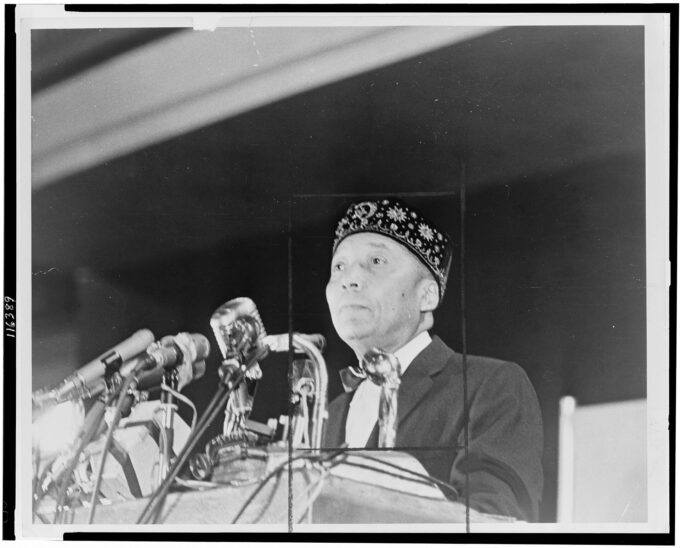
Elijah Muhammad standing behind microphones at podium / World Telegram & Sun photo by Stanley Wolfson.

“An extraordinary and twisted man, turning many true gifts to evil purpose. . . . Malcolm X had the ingredients for leadership, but his ruthless and fanatical belief in violence . . . set him apart from the responsible leaders of the civil rights movement and the overwhelming majority of Negroes.”

New York Times, February 22, 1965 (one day after Malcolm X’s assassination)

“Malcolm X had been a pimp, a cocaine addict and a thief. He was an unashamed demagogue. His gospel was hatred.

Time, March 5, 1965

“I can assure you he [Noam Chomsky] is not as passive or gullible as his wife claims. He knew about Epstein’s abuse of children. They all knew. And like others in the Epstein orbit, he did not care. . . . His association with Epstein is a terrible and, to many, unforgivable stain. It irreparably tarnishes his legacy.”

— Chris Hedges, “Noam Chomsky, Jeffrey Epstein and the Politics of Betrayal,” February 8, 2026

Malcolm X was far more deeply involved with a sexual predator—his superior, Elijah Muhammad, leader of the Nation of Islam (NOI)—than Noam Chomsky was involved with Jeffrey Epstein. However, Malcolm X’s association with Muhammad has had virtually no effect on Malcolm’s legacy, which has skyrocketed among the general public since his death.

In “This American Life: The Making and Remaking of Malcolm X” (New Yorker, 2011), David Remnick writes, “In 1992, Spike Lee set off a bout of ‘Malcolmania,’ with his three-hour-plus film. In its wake, people as unlikely as Dan Quayle talked sympathetically about Malcolm. . . . Bill Clinton wore an ‘X’ cap.” In 1999, 34 years after Malcolm X’s 1965 assassination (which at the time was applauded by most of U.S. society), the U.S. post office issued a Malcolm X stamp. This elevation, for labor and socialist activist Ike Naheem (“To the Memory of Malcolm X: Fifty Years After His Assassination,” 2015), has unfortunately come at the expense of Malcolm X being: “transformed by ‘mainstream’ forces into a harmless icon, with his sharp revolutionary anti-imperialist and anti-capitalist political program diluted and softened,” which for Naheem, “is a travesty of the actual Malcolm X and his actual political and moral trajectory.”

What about Malcolm X’s deep association with Elijah Muhammad? Malcolm X’s biographer, Manning Marable, concludes Malcolm should have known that Muhammad was a sexual predator well before Malcolm publicly acknowledged it, however, he stayed in denial because of powerful psychological forces. Marable was a great admirer of Malcolm, but his love for him does not prevent Marable from being highly critical of Malcolm’s flaws and blind spots:

“Yet the central irony of Malcolm’s career was that his critical powers of observation, so important in fashioning his dynamic public addresses, virtually disappeared in his mundane evaluations of those in his day-to-day personal circle.” —Manning Marable, Malcolm X: A Life of Reinvention (2011)

The initial psychological attractiveness for Malcolm X to Elijah Muhammad’s NOI is understandable, as it validated Malcolm’s feelings about the illegitimacy of white authority, offered him a strong community, and provided the previously criminal and selfish Malcolm with a spiritual path to care about something larger than himself. Malcolm put all his trust and faith in Elijah Muhammad; however, no different than Epstein, Muhammad was not only a sexual predator but a consummate exploiter of people, and he used Malcolm X’s charisma, speaking talents, and organizing skills to greatly expand his power.

Ultimately, Malcolm X publicly acknowledged that Elijah Muhammad was sexually involved with several young NOI secretaries and had fathered children with them. The African American Historical Society reports that Elijah Muhammad “impregnated seven women, including several of his teenage secretaries, and fathered thirteen children outside of his marriage.”

When should Malcolm X have known that Elijah Muhammad was a sexual predator? When did Malcolm acknowledge it to himself, and when did he acknowledge it to the world? What psychological forces kept Malcolm in denial, and then what political forces did Malcolm have to transcend for him to publicly acknowledge it?

To answer these questions, I am not alone in trusting Manning Marable. Cornell West says of Marable and his biography of Malcolm X: “Manning Marable is the exemplary black scholar of radical democracy and black freedom in our time. His long-awaited magisterial book on Malcolm X is the definitive treatment of the greatest black radical voice and figure of the mid-twentieth century.”

Marable tells us, “The revelations [about Elijah Muhammad] should not have been a complete surprise to Malcolm, who first heard hints about Muhammad’s sexual misconduct in the mid-1950s. Yet for years, it had been impossible for Malcolm to imagine that . . . [Muhammad] was using his exalted position to sexually molest his secretarial staff.” By late 1962, Marable notes that tales of Muhammad’s “sexual adventures had reached New York City and the West Coast. . . . [but] Malcolm pretended that he knew nothing about the rumors, desperately hoping that somehow they would go away.”

However, when Malcolm was told in 1963 by one of Elijah Muhammad’s sons, Wallace, that the rumors were true, Malcolm sought proof. Malcolm met with three of Elijah Muhammad’s former secretaries, and all had similar stories, which were even uglier than sexual misconduct alone. Malcolm learned, as Marable reports, “Once their pregnancies had been discovered, they had been summoned before secret NOI courts and received sentences of isolation. Muhammed provided little or no financial support for his out-of-wedlock children.” Malcolm was both shaken and appalled, and in 1964, Malcolm X would expose this to the general public.

Today, Malcolm is deeply admired as a truth teller—not only of racial and political truths but of truths about his own failings. A major reason that Malcolm X is forgiven by his admirers for his denial of the horrors of Muhammad is that in that brief period between Malcolm’s acknowledgement and his assassination, Malcolm was able to be bluntly honest about his own failings with profound humility. In an interview, he described his psychology of denial:

When you understand the makeup of the Muslim movement and the psychology of the Muslim movement, as long as . . . if I tie myself in by having confidence in the leader of the Muslim movement, if someone came to me and I had no knowledge whatsoever of what had taken place, and they told me what I’m saying [about Muhammad’s predatory behavior], I would kill them myself. The only thing that would prevent me from killing someone who made a statement like this [is that] they would have to be able to let me know that it’s true. Now if anyone had come to me other than Mr. Muhammad’s son, I never would have believed it even enough to look into it. But I had been around [Elijah Muhammad] so closely I had seen indications of it . . . the reality of it, but my religious sincerity made me block it out of my mind.

Even after Malcolm X was no longer in denial of the reality of the monstrous behavior of Elijah Muhammad, Malcolm describes the existential quandary he experienced as to whether or not to reveal it: “The only reason that I didn’t make this public knowledge was I knew the implications, and I felt that if the Muslims who were in the Nation of Islam knew it, that which enables them to be so strongly religious and exercise moral discipline, [they] would be shattered, and it would cause all of them to go right back and start doing the things that they had been doing previously.”

Malcolm felt strongly about the value of NOI in building self-respect, dignity, and empowerment for African Americans, and he knew that a major part of followers’ belief in the teachings of NOI had to do with their faith in Elijah Muhammad, and so he felt a need to, as he put it, “protect Mr. Muhammad himself primarily because the image that he had created was the image that enabled his followers to remain strong in faith . . . and I didn’t want to see any adverse effect or negative result developed in the faith of all of his followers.”

Ultimately, Malcolm’s passion for truth prevailed. When he exposed the ugly truths about Elijah Muhammad, he knew full well that doing so would likely cost him his life. During that brief period after Malcolm X parted from NOI and before his assassination, Marable reports that Malcolm intellectually liberated himself from NOI policies. Elijah Muhammad had opposed involvement in politics, but Malcolm transformed himself into a political thinker who before his life was cut short, Marable notes, “publicly made the connection between racial oppression and capitalism.”

Malcolm X admirers can thank an incompetent FBI in part for Malcolm’s positive legacy. The FBI, along with other law enforcement agencies, would have loved to see Malcolm discredited or even killed (there is evidence that the FBI and other law enforcement agencies knew about Malcolm’s impending NOI assassination but did nothing to stop it). The FBI likely knew about Elijah Muhammad’s predatory behaviors, and the FBI could have exposed it before Malcolm did and then accused Malcolm of covering it up. If the FBI had done so prior to Malcolm himself having confirmed Muhammad’s predatory behaviors, Malcolm’s distrust for the FBI and law enforcement agencies would have certainly resulted in him attacking the FBI and defending Muhammad. And in such a hypothetical scenario, given that the entire mainstream media despised Malcolm X, when he finally did acknowledge that Muhammad was a sexual predator, there likely would have been a chorus of: “I can assure you Malcolm X is not gullible. He knew about Elijah Muhammad’s sexual predatory behaviors. Everyone in the Nation of Islam knew. They all knew. And like all of them, Malcolm X did not care.”

Ultimately, Malcolm X’s capacity for brutal self-honesty, humility, self-correction and redemption enabled him to evolve into one of the most extraordinary anti-authoritarians in U.S. history.

The trajectory of Malcolm X’s life is Shakespearean in the sense of high-stakes drama, life-and-death power struggles, tragically misplaced trust, heroic redemption, and assassination. And the psychological sources of his denial and the political reasons for his delay in exposing the monstrous reality of Elijah Muhammad are also epic.

In contrast to the Shakespearean arc of Malcolm X’s life, the trajectory of Noam Chomsky’s life is quite pedestrian. And so the possible psychological sources for Noam Chomsky’s denial of the monstrous reality of Jeffrey Epstein would also be quite pedestrian.

Just as Manning Marable tells us that Malcolm X should have known that Elijah Muhammad was a sexual predator and a monster, Noam Chomsky should have known that Jeffrey Epstein was a sexual predator and a monster. However, in contrast to what Marable and many of us conclude about Malcolm, Chris Hedges concludes that Noam not only should have known the truth of Epstein but did know and did not care.

Noam certainly should have known. By 2015, the time Valéria Chomsky reports when the Chomskys were first introduced to Epstein, it was widely known that Epstein was not simply a convicted sex offender who made a mistake, but that he had long been—and continued to be—an unrepentant scumbag who traveled in circles with other arrogant sleazebags.

In June 2008, Epstein plead guilty to one count of soliciting prostitution and one count of soliciting prostitution from someone under 18, but in a “sweetheart deal,” he was sentenced to serve most of his sentence in a work-release program that allowed him to leave jail during the day; and under a secret arrangement, the U.S. attorney Alexander Acosta agreed not to prosecute him for federal crimes. In November 2018, the Miami Herald did a series of stories focusing partly on Acosta, who had become the labor secretary in Trump’s first administration; and this Miami Heraldcoverage intensified public interest in Epstein. On July 6, 2019, Epstein was arrested on new sex trafficking charges brought by federal prosecutors in New York, and on August 10, 2019, Epstein was found dead in his jail cell in New York (officially ruled suicide but believed by some, including Epstein’s brother, to have been murder).

The slew of email exchanges between Jeffrey Epstein and Noam Chomsky released on January 30, 2026 provided shocking revelations that have now been widely reported: With the walls closing in on Epstein prior to his 2019 arrest for child sex trafficking, Epstein asked Chomsky for advice, and in response, Chomsky emailed him what amounts to crisis management ideas and sympathized with the “horrible way you are being treated in the press and public”; Chomsky flew on Epstein’s infamous private jet nicknamed the Lolita Express; Chomsky accepted invitations to stay at Epstein mansions; Chomsky met not only with Epstein but with Steve Bannon and Woody Allen; and Noam Chomsky and his wife Valéria were clearly appreciative of Epstein as a friend and advisor.

Noam Chomsky, now 97, suffered a debilitating stroke in 2023 leaving him unable to speak, but Valéria Chomskyreleased an official statement on February 9, 2026 that attempted to explain his relationship with Epstein. She statedthat “Epstein’s 2008 conviction in the state of Florida was known by very few people, while most of the public—including Noam and I—was unaware of it. That only changed after the November 2018 report by the Miami Herald.”

The truth is that long before the Miami Herald story, it was widely known that Epstein was a sleazebag. Even in 2006, prior to Epstein’s initial 2008 conviction, Epstein was seen as notorious enough for Eliot Spitzer, then running for governor of New York, to return a $50,000 Epstein contribution to his campaign. Spitzer, as did many others, would have known that in July 2005, Epstein had retained a high-profile legal team, including Alan Dershowitz and Ken Starr, to defend him against charges of soliciting prostitution; and all of this was reported by the New York Times in 2008 following Epstein’s conviction. And in 2015, the Guardian reported that three charities, including New York City’s Mount Sinai hospital, would not accept any more gifts from Epstein.

Valéria Chomsky stated, “Only after Epstein’s second arrest in [July] 2019 did we learn the full extent and gravity of what were then accusations—and are now confirmed—heinous crimes against women and children. We were careless in not thoroughly researching his background.”

In response to Valéria Chomsky’s statement, Chris Hedges essentially calls her a liar. As noted, Hedges stated, “I can assure you he [Noam Chomsky] is not as passive or gullible as his wife claims. He knew about Epstein’s abuse of children. They all knew. And like others in the Epstein orbit, he did not care.”

If Hedges is correct that Noam “knew about Epstein’s abuse of children” and “he did not care,” then Noam is simply a despicable human being. For Hedges, it does not seem possible that Noam Chomsky could be so stupidly in denial when it came to Epstein. In other words, it does not seem possible to Hedges that the brilliant Noam Chomsky could be as humanly psychologically flawed as the brilliant Malcolm X.

What creates the conditions for denial? It is obvious in the case of Malcolm X that supreme intelligence is no antidote to denial, and in fact such intelligence can be used to justify and rationalize denial. The conditions for denial include arrogant ego attachments, including to one’s beliefs, as well as overwhelming emotions, especially to emotions one may be unaccustomed to experiencing.

While I have my own speculations for the sources of Noam’s possible denial—speculations based on my dive into the released emails, my clinical experience, and previous research on him—these are only speculations, and my hunch is that the best answers will come one day from Noam’s children Aviva, Diane, and Harry, but they have made no public statement. They are probably wise to be silent in the current climate, as their explanation for their father’s awful behavior would likely be condemned as a defense of it.

So what were Noam Chomsky’s ego attachments and overwhelming emotions he was likely unaccustomed to experiencing? We can only speculate.

Noam has long taken unpopular stands, and he has perhaps been even ego attached to being fearless in this regard. He has a history of being highly critical of any type of interference to free thought and free speech, and he was increasingly critical of what has come to be called “cancel culture”; this could was likely have been exploited by Epstein. Chomsky justified having a relationship with Epstein with this rationalization: “What was known about Jeffrey Epstein was that he had been convicted of a crime and had served his sentence. According to U.S. laws and norms, that yields a clean slate.” Chomsky was too arrogant to put in the small effort required to discover that Epstein had not just been convicted of a crime and served his sentence, but that he was an unrepentant sleazebag.

There may well have been an even more important fuel for Noam Chomsky’s denial. Emails between Noam and his children reveal an emotional state that Noam had perhaps never navigated before. Noam was extremely upset about being confronted by his children regarding Valéria and Noam’s increase in spending since Noam’s remarriage (his children emailed him: “Your spending has increased dramatically and unexplainably since you got married and this unprecedented outflow is placing your financial future at risk”); as well as Noam having been upset by conflicts with his children over a trust fund (for which Noam and Valéria sought Epstein’s advice and help). In one email to his son, Noam states, “I’m more than sorry, not just about the conversation. Worst thing that’s ever happened to me. Could never have imagined that this would happen in my late years.”

Such an emotional state will subvert critical thinking, including one’s capacity to recognize that such a state renders one vulnerable to exploitation. Valéria forwarded the correspondence between Noam and his children to Epstein, who appeared to inflame the conflict and then used it to deepen his bond with the Chomskys.

To be clear, I am only speculating. Maybe Chris Hedges turns out to be right that Noam Chomsky “knew about Epstein’s abuse of children” and “he did not care.” However, I consider it to be arrogance on Hedges’s part to be so certain of the truth of his speculations about Noam Chomsky’s state of mind; and while money is certainly a root of evil, so too is arrogance. Arrogance was a major root of the evil of both Jeffrey Epstein and Elijah Muhammad, as it was for other infamous sexual predators, including Bill Cosby, Bill Clinton, Donald Trump, and Harvey Weinstein.

One does not have to be a clinical psychologist to observe tragic denials in many intelligent and otherwise highly ethical people, just as one does not have to be a historian to recognize that denial has long occurred in brilliant and otherwise admirable famous people. And most of us—at least those with any degree of humility—will acknowledge having experienced some type of “stupid” denial in our lives.

Bruce E. Levine, a practicing clinical psychologist, writes and speaks about how society, culture, politics, and psychology intersect. His most recent book is A Profession Without Reason: The Crisis of Contemporary Psychiatry—Untangled and Solved by Spinoza, Freethinking, and Radical Enlightenment (2022). His Web site is brucelevine.net

Was there Transgressive Old Master Art in Venice?


David Carrier

April 10, 2026


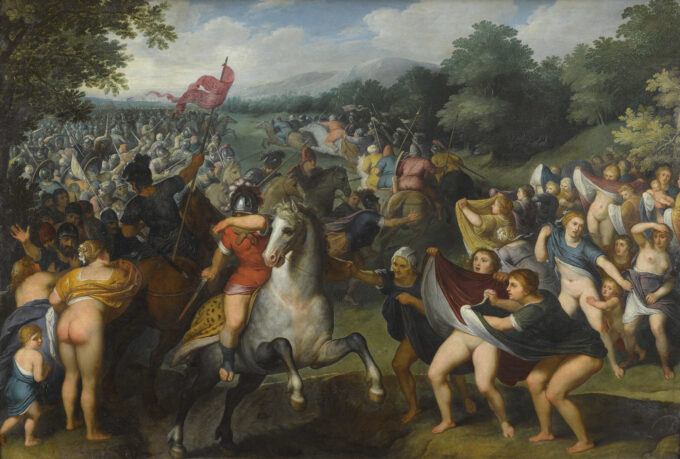
The Persian Women by Flemish artist Otto van Veen, created between approximately 1597 and 1599.

Viewing a pictorial scene that you didn’t think possible is a startling, often revealing experience. You ask yourself, should you believe your eyes. Maybe, you conclude, you are having a hallucination. A few years ago, in Venice, I went to review an exhibition, “Corpi Moderni: The Making of the Body in Renaissance Venice” at the Academy. And there I found Otto van Veen’s large history painting, Persian Women (1597–99), which shows a group of young women raising their skirts to show their naked bottoms to the men, who are terrified. Had I found this picture in a show of contemporary artworks, I would not have blinked. Our artists love to deal in erotic shock. But in a pre-modern art world where Nicolas Poussin (1594-1665) defined the ideals of decorum in his history paintings, Persian Women was surprising indeed. What, indeed, would he have made of this picture. And while any well trained old master had the skill required to paint this picture, the subject seems in that culture unimaginable. That’s why the picture looks surprising. We can readily imagine some minor follower of the modernist Surrealist Paul Delvaux painting this fantasy scene. But how surprising to learn that it’s a late seventeenth-century work.

In our visual culture, which is permeated by psychoanalytic thinking, everyone can easily explain the Freudian implications of this picture. Whatever you think about Sigmund Freud, even if you haven’t read Three Essays on Sexuality, you cannot help knowing in a general way about his accounts of gender. And, I hasten to add, nowadays also to know also at least in a vague way the many feminist critiques of his analysis. That means that it’s impossible nowadays not to look at Persian Women without a certain self-conscious irony. That the man in the foreground and his horse appear to be shocked by the genitals of the women, what are we to made of that? The people I asked said that the picture was funny, as if the artist was oddly naive.

It can be revealing to discover what artists choose not to do, for that reveals the implicit rules of their art world. Often, Venetians hung carpets from their window. Venetians admired Islamic textiles, and as a great trading culture with Muslims, they had ready access to these artifacts, which were often collected. The Venetians used these precious rugs without concern for their role in Islamic culture. And so a painter who loved color would naturally take an interest in them. Indeed, Lorenzo Lotto sometimes depicted carpets in his altarpieces, rugs dubbed ‘Lottos’ in his honor. St Antoninus giving Alms (1542) shows a splendid carpet in the center. And so, these Islamic carpets were often depicted in their paintings of domestic interiors. But the Venetian artists were not inspired to model their own paintings on these carpets. Not until the time of Henri Matisse, when Western art had evolved dramatically, did European artists do that. Jorge Luis Borges’ short story “Averroes’s Search” (1947) imagines an Arab translator of Aristotle who puzzles over that writer’s description of the theater. In a culture without theaters, that analysis seems incomprehensible. And yet, Borges observes with fine irony, the Muslim children are play-acting games which, had the translator only observed, would resolve his puzzles. We are very familiar with political protest paintings, with subjects that were never found in Venetian old regime paintings. In old regime Venice, painting had to serve the political goals of the state. Just as it would be hard to translate Aristotle’s Poetics in a society without theater performances, so it’s difficult to imagine history painting playing with Freudian concepts of gender in a pre-modern culture.

One additional bit of information may change how you see Persian Women. In fact, this artist, Otto van Veen, was not especially imaginative. Not when we learn that, like most old master history paintings, his images were based upon classical literature. And this painting is based upon a text from Plutarch. By frightening the men, the women inspire them to fight. Like Poussin, van Veen thus was a literary history painter. Only he chose an odd, relatively unfamiliar text. Now, of course, after Surrealism, Persian Women look different. But it would never had occurred to any Venetian artist to paint such a Surrealist scene. No more than gay Venetians would have marched to protest their lack of rights. Or Venetian feminists would have demanded a female doge. There were no movements for Venetian Jews or Muslims seeking political rights. Such ideas, so familiar nowadays, were simply over the horizon. And although there were some Black people, most of them slaves, in Venice, as we can see in Titian’s Diana surprised by Actaeon and in Tiepolo’s frescoes, there was no movement to liberate them. The Venetian Republic had moral problems, but no significant art was devoted to criticizing its institutions. Van Veen, I should add, was a very minor artist.

Imagine that in 1550 some unusually imaginative pupil of Titian was called upon to make an artwork that would, so it is demanded, ‘catch the public’s eye’. And she was given a church in which to display her work. Knowing the recent paintings by her master, and recalling the great earlier works by Giorgione and the Bellinis, this young woman faces a very demanding situation. What can she do to rival Tempest or one of the ‘sacred conversations’ of Giovanni Bellini? Inspired, she boldly breaks the church’s delicate floor tiling and labels the piles of rubble The Consequences of Sin.

In fact, there is a real Venetian work just like this, but it’s recent. In 1993, at the Biennale, Hans Haacke’s Germania trashed the floor of the German pavilion, leaving it smashed to pieces. And he included a photograph of Adolf Hitler meeting Benito Mussolini in 1934, at an earlier iteration of that institution. Look it up online! Haacke drew on a long tradition of politically critical installation art. But in Titian’s era such a gesture would be thought the act of a madman. Philip II, an historian of Venetian painting, remarks, was a patron of discernment, who was prepared to support his chosen painter (Titian) “even into the strange pictorial explorations of his old age.” But not this far! The Consequences of Sin would have been incomprehensible in 1550.

Note:

On carpets in Venetian art see Patricia Fortini Brown, Private Lives in Renaissance Venice: Art, Architecture, and the Family (2004), 59-67

A more general analysis of carpets in paintings appears in Joseph Masheck, The Carpet Paradigm ( 2010).

The source of examples like The Consequences of Sin is Arthur Danto’s aesthetics.


David Carrier is a philosopher who writes art criticism. His Aesthetic Theory, Abstract Art and Lawrence Carroll (Bloomsbury) and with Joachim Pissarro, Aesthetics of the Margins/ The Margins of Aesthetics: Wild Art Explained (Penn State University Press) were published in 2018. He is writing a book about the historic center of Naples, and with Pissarro he conducted a sequence of interviews with museum directors for Brooklyn Rail. He is a regular contributor to Hyperallergic.

Harriet Tumbled: Now I Know Why Brits Love and Fear for Their NHS


 April 10, 2026

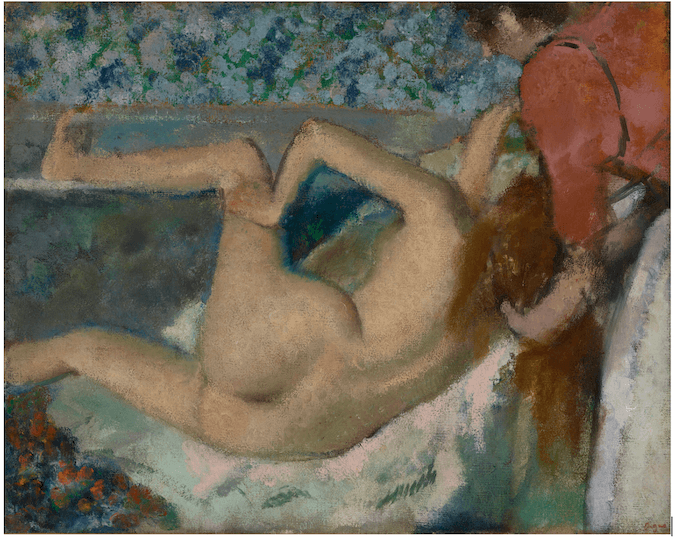
Edgar Degas, After the Bath, c. 1895. Los Angeles: J. Paul Getty Museum (Public Domain).

The fall

The Twineham Ward of Princess Royal Hospital, Haywards Heath, Sussex, U.K., consists of six bays of patients to the left, multiple offices to the right and a long corridor in between. But to call it a corridor isn’t quite right; it’s more like a spine because it’s the nerve center where senior nurses direct junior nurses and aids, doctors review patient records, and visitors enter and leave. It’s also a rehab space where elderly patients with frames (“walkers” in American dialect) shuffle up and down, exercising repaired or replaced hips.  I was there because my wife, Harriet – at 60 the baby of the ward – tumbled when stepping out of a bathtub in a Brighton hotel room that had a nice view of the English Channel.

After hearing her scream, I opened the bathroom door and saw Harriet in a pile in front of the tub, naked except for a towel around her middle. I thought of Degas’ painting of a woman with one leg propped on the rim of a bathtub and the rest of her naked body below. “Did you fall?” I stupidly asked. “Are you hurt?” She replied through gritted teeth with a cliché of her own: “I think I’m ok.” I knew she wasn’t. Refusing to believe she’d seriously hurt herself, Harriet scuttled across the bathroom floor like T.S. Eliot’s crab, then across the carpet and somehow up on the bed. I dialed 999, the U.K. emergency services number. That’s when I discovered a major flaw of the National Health Service, established in 1948 by Aneurin Bevan, Minister of Health under Labor Prime Minister Clement Attlee – ambulance wait times. My conversation with the dispatcher was roughly as follows:

“My wife has had an accident and we need an ambulance.”

“May I speak to her?”

“Sure, here she is.”

“Is there any bone protruding through the skin?”

“No.”

“Were you unconscious at any time after your fall? Can you stand up or walk?”

“No and no.”

“Ok, we’ll send an ambulance for you.”

I came back on the line: “About how long will that be?”

“Our average wait time is between one and four hours, but the latter is an outlier. We’ll send one as soon as we can.”

Two hours ticked by. I called again and had roughly the same exchange. At three hours, 20 min, Harriet grimaced, moaned, then screamed in agony and began shaking uncontrollably. I knew what shock looked like, so I bundled her up in blankets, encouraged her to breathe slowly and deeply and called another NHS dispatcher:

“No, my wife cannot speak to you because she’s in too much pain. She’s going into shock. You must raise the level of urgency to one or two and send somebody at once.” In the hour since my previous call, Gemini AI (my new buddy) told me that every ambulance summons, save imminent death, rates an “urgency level” of three or four from the NHS. My words had the desired effect.

“I’ll send an ambulance right away.”

45 minutes later, help arrived in the form of two diminutive, bespectacled, white men, 40ish, with working-class accents and calm demeanor. They finished each other’s sentences like Rosenkrantz and Guildenstern – but were kind and competent. They quickly gave Harriet laughing gas (nitrous oxide) to reduce the pain while checking her vitals. Then they hoisted her onto their gurney and took her down the elevator, past hotel reception, and into a night that smelled like the sea. In a minute, we were swallowed by the waiting ambulance. That’s when I deployed the second set of magic words, I learned that night, courtesy of Gemini:

“Harriet has a probable neck of femur fracture, and I want her taken to the nearest hospital with fast-track treatment.”

“Let me call…” one said…

“Princess Royal Hospital in Hayward’s Heath” the other continued, “and see if she is eligible for that program.”

She was. So that’s where they drove, carefully but at speed.

The National Health Service, neo-liberalized

Almost from the beginning, the NHS has been treated like a piggy bank.  Three years after its founding, the Labour government, wanting money to pay for British participation in the U.S. war against North Korea, cut funding for the NHS. Bevin quit his post to protest charges for dental work, eyeglasses, and prescription drugs. (These costs remain in effect.) More cuts were mandated by the Guillebaud Committee report in 1953, but it wasn’t until the Margaret Thatcher years (1979-90) that the NHS was looted, albeit surreptitiously.

Like her American friend, President Ronald Reagan, the U.K. Prime Minister believed that the invisible hand of the marketplace could better direct the allocation of resources than any elected parliament, council or parish. In her laissez-faire utopia, the heads of businesses, and especially large corporations, would comprise a clerisy that supplanted leaders in education, religion, science, politics, and the arts. Universities, hospitals, and even museums would be privatized and rationalized, that is, made subservient to market discipline. Labor unions, especially, were viewed by Thatcher with suspicion or worse. They must be enfeebled for profits to grow and investment to occur. Indeed, any accommodation to workers’ wants or public needs distorts the iron logic of supply and demand.   In the U.S. “Reaganomics” followed the same course and had similarly dire outcomes for health and safety, income inequality, and national infrastructure.

In 1982, Thatcher and her chancellor, Geoffrey Howe, clandestinely proposed abolishing the NHS in favor of compulsory enrollment in private insurance.  Opposition by ministers prevented the rollout of the program, but not before leaks fueled a press and public firestorm.  In response, Thatcher claimed, duplicitously, “the NHS is safe with me.” Thatcher and her team’s subsequent assault on the NHS proceeded along two tracks. The first entailed splitting off long-term care from acute care, and the second introduced competition among hospitals for scarce resources, along with cuts to local councils under the rubric of “fiscal discipline”.

When elderly or disabled patients were discharged from hospitals, under the new system, they could no longer move seamlessly and without charge to long-term care homes or rehabilitation facilities. Nor could they be assured of free, at-home visiting nurse services. Instead, they had to pay for most after-care themselves, or if they could not afford to (after liquidating their assets, including homes), line up for subsidized care financed by their local Councils. The cunning of it was to present the change as a progressive reform that would liberate patients from large and dehumanizing care homes and direct them to better, smaller facilities close to or within their own communities. The formula was the same as that used by neo-liberal advocates for the de-institutionalization of the mentally ill in the U.S., beginning in the late 1960s. (That’s been a major factor in the American homelessness crisis.)

When Westminster began starving local Councils for cash beginning in 1980 – what Thatcher called “fiscal discipline” — care services began to be rationed and their quality diminished. The same market logic now began to govern all parts of the NHS, not simply long-term care and rehabilitation. Hospitals were made to compete for funds, leading to perverse incentives and poorer patient outcomes. Everything – from food preparation to nursing – was opened to competitive tenders. Further cuts (or rises below the level of inflation) under successive coalition and Tory regimes from 2010 to 2024 made matters worse.

“Austerity” has become a dirty word in the U.K., but the new Labour government under Keir Starmer and Health and Social Care Secretary Wes Streeting has done little to address the healthcare crisis that helped elect them. They have boosted grants to local councils by some £800 million, but that’s not enough even to cover minimum wage increases and mandated higher National Insurance Contributions. In 2028, an independent commission is due to issue a report on the establishment of a National Care Service with low cost to patients and high standards of service.  The idea was first proposed by Labor PM Gordon Brown in 2009.

Meanwhile, privatization of healthcare continues apace, further undermining the strength of the NHS. When wealthy patients seek treatment in the private sector, the NHS is left caring for older, poorer and sicker patients. And since the NHS pays hospitals based on the average price of a treatment or procedure, sicker patients needing more expensive care are a financial strain. In addition, low NHS salaries and difficult workloads have enabled the private sector to siphon off some of the best young doctors and nurses, leaving staffing shortages that again reduce the quality of care and increase waiting times for medical services. The queue for elective procedures can be years long. In addition, with fewer hospital beds available, hospitals must slow their emergency room intakes – thus the long wait for ambulances, as my wife and I discovered last week!

Saving the NHS will require the current Labour government, or any successor, to resist creeping privatization and undertake much more significant investments than have been considered so far. Paying for them will require some combination of the following: imposing new wealth, corporate and estate taxes, forgoing nuclear modernization, and resisting other large defense expenditures.  At the moment, the Green Party is the most likely vehicle for delivering those changes. But the Labor Party, which created nationalized care in the U.K. and is currently struggling in the polls, may yet recognize that rebuilding the National Health Service is its best hope of electoral salvation.

Back in the ward – first the good news

My wife’s care at Princess Royal Hospital, thanks to the “fast track” service, was excellent. Once Harriet arrived at the hospital – about 10 p.m. on a Tuesday night – she was quickly taken into a quiet area with just one or two other patients nearby, several nurses, and a presiding Urgent Care physician.  She was given strong painkillers (blessed Morpheus!), rushed to x-ray, and prepped for surgery, scheduled for 9 a.m. the next morning. The procedure, called Open Reduction and Internal Fixation, took about 3 hours and entailed inserting a titanium rod in her femur and fixing the broken section to it with a series of screws. I waited in a quiet, glass-walled hallway near Twineham. At noon sharp, I heard the “whoosh/bump–whoosh/bump” of a gurney wheeled across linoleum tiles, and saw Harriet, doped up but happy, on her way to the ward. I took her hand and accompanied her.

The next four days were blessedly uneventful. Harriet experienced the expected pain and other minor symptoms, but was out of bed walking slowly two days after surgery. On day four, we informed doctors and physiotherapists that we would be leaving on day six at the latest. They said they would have to evaluate, but we said no, we’d be out on Sunday, come what may.

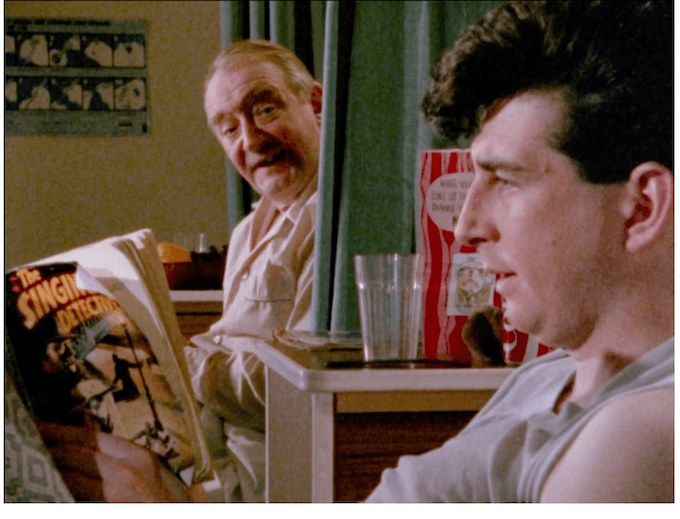
We had no cause for complaint. The nurses couldn’t have been kinder or more attentive. The surgeons were a bit grandiose – that comes with the territory – but not so much that they wouldn’t answer questions. The attending physicians were competent, concerned and engaging – and almost always available. The ward itself was incommodious – six patients in a bay the size of an average American living room, with translucent windows on one side only. Beds were separated by curtained partitions kept open except when intimate ministrations were performed by nurses or doctors. Harriet didn’t mind the lack of privacy; in fact, there were spells of garrulousness that reminded us of scenes from Dennis Potter’s BBC series The Singing Detective(1986). But that wasn’t enough to keep us in the ward, if Harriet could possibly manage to get out.

David Ryall and Gerald Horan in The Singing Detective, written by Dennis Potter and directed by Jon Amiel, BBC production, 1986. Screenshot.

And now the bad news

Far more often than gay, the atmosphere in Harriet’s bay and the other five I saw was grim despite the best efforts of staff and doctors. The other five women in Harriet’s section were in their 80s or older and had no place to go because of NHS and government failure to provide adequate social care. The woman to Harriet’s right had been in the hospital for six weeks, after four in a different hospital. Her fracture was healed, but there was no place for her to go and no chance for extended home care. Now she suffered from multiple, hospital-caused maladies, including bed sores and could barely raise her head above her sheets. She told Harriet that her two children lived far away and couldn’t look after her. She was well looked after at Princess Royal and expected to die there, perhaps soon.

Directly across from Harriet was a woman in her late 80s (at least) with rosy cheeks and rheumy eyes. She spent much of her time crying. The nurses would come and ask her why, but she could not answer. One male nurse managed to get her to smile by putting his face close to hers and allowing her to explore it with her fingers. But a few hours later, she began quietly whimpering. She probably suffered some degree of dementia, but there was as yet no available placement for her either.

In the opposite corner, closest to the window, was a handsome woman in her early 80s who spoke with composure and clarity. She said she had been in the ward for 4 weeks, and was well healed from hip replacement surgery, but her local Council and NHS had not yet been able to set up the twice-a-week, at-home support she needed. They offered instead to send her to a nursing home 50 miles away, but that was too far from her daughter, and besides, she didn’t want to live in such a place. She hardly got out of bed in the five days we saw her, jeopardizing her recovery. We shared some crisps one day – the lowly potato chip is much prized in hospital wards — and she told me how much she wanted to leave but simply couldn’t figure out how. She knew she was growing weaker and more depressed each day.

Dr. Raju Dey, a well-credentialed geriatric orthopedist, was frequently in attendance while we were at Princess Royal Hospital. He’s a young, dashing man with a sweep of jet-black hair that drapes over his forehead. He’s also patient, thoughtful and committed to his profession. I asked him about the long-term patients in his ward. “They’re the majority of patients here,” he said. “We do the best we can for them, but a hospital ward like this is no place for long-term rehabilitation. Many have been here for months but can’t find a social care placement.” I asked him about the cost of it all: “The average cost per patient per day in this specialized facility is over £1,000…” I finished his sentence, having recently looked up the figures, “whereas the most luxurious care home in London or elsewhere is about £400. A less fancy place is half that.”  We couldn’t understand how a government led by intelligent people couldn’t figure out a way to shift resources from one sector to another – never mind raising new money – to improve patients’ well-being and extend their lives. It’s nothing less than madness, but it will continue until there is enough public demand for it to stop.  The best Harriet and I could do was get out of there fast and tell about the experience.

Stephen F. Eisenman is emeritus professor at Northwestern University and Honorary Research Fellow at the University of East Anglia. He is the author of a dozen books, the latest of which (with Sue Coe), is titled “The Young Person’s Illustrated Guide to American Fascism,” (OR Books, 2014). He is also co-founder of Anthropocene Alliance. Stephen welcomes comments and replies at s-eisenman@northwestern.edu