Haiti: Solidarity in a World at War
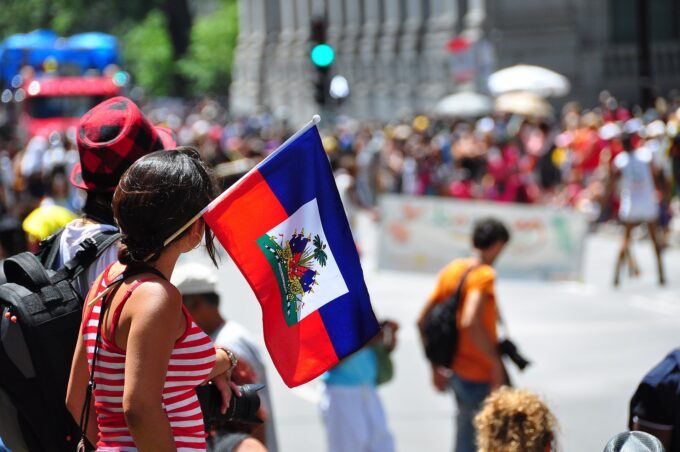
Photograph Source: abdallahh – CC BY 2.0
As the world reels from the devastating U.S.-Israel war on Iran and Lebanon, and as the U.S.-backed Israeli genocide continues in Gaza and the West Bank, the Trump Administration’s plan to assert its dominance over the Americas is also moving forward at an unprecedented pace. Having kidnapped Venezuelan President Nicolas Maduro and his wife and colleague, Cilia Flores, and taken control over Venezuela’s oil reserves, the U.S. is now salivating over the prospect of toppling the socialist government of Cuba. On March 16, Trump announced that he “could take Cuba whenever I want” and that Cuban President Miguel Diaz-Canel “would have to go” if Cuba wanted to negotiate its survival with the U.S. administration.
It could not be clearer. Old-fashioned U.S. imperialism, with no cover, is back in force. And it isn’t just words: the U.S. has ratcheted up its blockade of Cuban ports, strangling the island nation by attempting to eliminate its fuel supply. Over 15,000 U.S. troops are now stationed throughout the Caribbean, with a concentration in Puerto Rico. The infamous Roosevelt Roads Naval Base has been reactivated, threatening any Caribbean or Latin American nation that dares to defy the U.S. As of March, the long-standing supply of Venezuelan oil to the Cuban government has ceased. Even Cuba’s vaunted medical support for countries in the Americas has come under withering attack. One example: the government of Jamaica has canceled its decades-long medical collaboration with Cuba, despite that collaboration having saved countless Jamaican lives.
None of this is a slam-dunk for the U.S. Despite proclamations of victory in the Iran war, it is clear that the U.S. and Israel are facing unforeseen consequences, and were unprepared for the level of Iranian self-defense, which has rattled the world economy and sent shock waves throughout West Asia. And let’s not forget that the U.S. has been attempting to destroy Cuba ever since the Cuban Revolution in 1959, without success. But as history has shown, an empire in crisis can and will unleash terror around the world.
The Crisis in Haiti
For Haitians, this is an all-too-familiar scenario. The kidnapping of President Maduro and his wife followed the script of the 2004 U.S.-orchestrated coup against the democratically elected progressive government of President Jean-Bertrand Aristide. On February 29, 2004, U.S. Marines kidnapped President Aristide and his wife and colleague, Mildred Aristide, and deposited them at a French military base in the Central African Republic, leading eventually to a seven-year forced exile in South Africa. In the aftermath of the coup, thousands of Haitians were killed, raped, or terrorized into exile. Reinforced by a violent UN military occupation, the coup brought in a series of corrupt, drug trafficking right-wing governments eager to sell the country’s land and resources to multinational corporations. These U.S.-imposed governments, and the tiny Haitian elite they serve, were responsible for empowering paramilitary death squads, called “gangs” in the U.S. media, to wipe out opposition and protect their assets, plunging Haiti into an ever-deepening crisis.
Haitian Civilians: Caught Between A Rock and A Hard Place
In the last year alone, approximately 8100 people have been killed in Haiti– primarily by paramilitary violence. Armed groups operate with near-total impunity, wreaking havoc on civil society. For example, in late March, the “Gran Griff” death squad, part of the Viv Ansamn paramilitary federation, massacred over 80 people in the Artibonite region, which has long been Haiti’s agricultural center. Roads throughout the country remain blocked, people cannot access markets, and close to 1.4 million people (out of a population of 12 million) have become internal refugees. Hospitals have been forced to close after being targeted by paramilitaries. A cholera epidemic hit in 2025. Sexual violence against women and children has become the norm. According to United Nations statistics, some 5.7 million Haitians are facing what is euphemistically called “high levels of acute food insecurity”, including more than 1.2 million children under age 5. This is why Fanmi Lavalas, the people’s party founded by former President Aristide, has labeled this a “slow-motion genocide.”
In the name of fighting the paramilitaries, the current Haitian government recently signed a 10-year multi-million dollar contract with Erik Prince’s infamous mercenary group, Vectus Global. Formerly known as Blackwater, it was responsible for the Nisour Square Massacre in 2007 during the Iraq War, in which 17 Iraqi civilians, including a 9-year-old boy, were killed and over 20 others were injured. True to form, Vectus Global is now carrying out “anti-gang operations” with Haitian police that have resulted in the killing of over 1100 people, many of them civilians, in densely populated sections of the capital, Port-au-Prince. Haiti’s government has also signed an $85.4 million contract with foreign private for-profit prison firms to build three new prisons, an ominous sign of even more repression to follow, in a country that needs money for health care and education, not more prisons.
So now, Haitians stand between a rock and a hard place: on the one hand, emboldened and well-connected paramilitary death squads determined to have their share of power, and on the other, a government dominated by the business elite that is ratcheting up its repressive apparatus and using its police powers and foreign mercenaries to wreak havoc on civilians.
As of February 7, 2026, a temporary presidential council has been dissolved, leaving only a U.S.-backed prime minister, Alix Didier Fils-Aime, in charge of the nation. When widespread opposition to Fils-Aime surfaced within Haiti, Secretary of State Marco Rubio warned Haitians that there would be “grave consequences” if Fils-Aime were removed from power. With a U.S. warship off the coast of Haiti and a U.N.- organized multinational force of 5,500 troops gearing up to deepen the occupation of Haiti and oversee new elections, we can expect a fraudulent selection aimed at installing a more permanent regime beholden once again to the United States. This fits snugly into the Trump Administration’s strategy to dominate all of Latin America and the Caribbean, and is a stark reminder of what is at stake throughout the Americas as the U.S. asserts its hegemony.
Envisioning a New Haiti
Haitians have always resisted tyranny, from the time they overthrew slavery, defeated Napoleon’s army, and declared the world’s first Black republic in 1804. Today, communities have risen to defend themselves from paramilitary attacks, despite the high-powered weapons in the hands of the death squads. Women’s groups have mobilized to provide support for the survivors of gang rapes. The University of the Dr. Aristide Foundation (UNIFA), taken over by the U.S. military after the 2004 coup and reopened when the Aristides returned to Haiti in 2011, continues to graduate doctors, nurses, lawyers, agronomists, dentists, engineers, and physical therapists amid daunting challenges. UNIFA has now opened a teaching hospital at a time when many hospitals in Haiti have been shuttered due to death squad violence. Throughout the country, activists are operating at the local level, building capacity and resistance. A new Haiti can be envisioned through the prism of these grassroots efforts.
Defend Haitian Refugees
Haitians living within US borders are also in the crosshairs. Throughout their 2024 election campaign, Trump and Vance demonized Haitians, going so far as to falsely accuse Haitians in Springfield, Ohio, of eating their neighbors’ pets. This outrageous, racist lie fueled anti-Haitian attacks throughout Ohio. Shortly after Trump’s 2025 inauguration, the Department of Homeland Security attempted to end Temporary Protective Status (TPS) for over 350,000 Haitians now in the United States. This, despite the State Department issuing travel warnings telling Americans not to travel to Haiti due to dangerous conditions there.
On March 6, 2026, the U.S. Court of Appeals for the D.C. Circuit upheld a ruling that the termination of TPS for Haiti was unlawful and based on “racial animus”. This ruling allows beneficiaries to maintain their status and keep their work permits for the moment. But the Trump Administration has already filed an emergency appeal to the Supreme Court, which has ruled against migrants over and over again. In response, supporters of Haitian migrants in Congress have put forward an initiative aimed at extending TPS for Haitians for another three years.
This is a moment when activism in support of Haitian migrants and the grassroots movement in Haiti is critical. We hope you will join us in this fight.
From Haiti to Venezuela to Cuba and Puerto Rico – One Struggle/One Fight
For more information, please check out Haiti Action Committee’s website: www.haitisolidarity.
To contact us, please email us: action.haiti@gmail.com
To support grassroots projects in Haiti, please donate to the Haiti Emergency Relief Fund: www.