Friday, April 10, 2026

Russia bans Nobel-winning rights group, raids independent newspaper, in one day

By AFP
April 9, 2026


One protester stood outside the supreme court with a placard reading 'Hands off Memorial. Freedom to politial prisoners' - Copyright AFP Dimitar DILKOFF

Russia banned the Nobel Prize-winning human rights group Memorial and raided the offices of the independent newspaper Novaya Gazeta Thursday, in fresh blows to already diminished civil liberties in the country.

Memorial and Novaya Gazeta, both founded around the collapse of the Soviet Union, are Russia’s two most reputable and renowned organisations reporting and documenting human rights abuses.

Since sending troops against neighbouring Ukraine four years ago, the Kremlin has not only suppressed opposition to the war, but also launched a wider crackdown on dissent, something unseen since Soviet times.

Memorial was founded in the late 1980s to document victims of Soviet-era political repression during which millions of people perished in the Gulag penal system.

Under pressure from the government almost since its birth, it was formally liquidated by Russia’s Supreme Court in 2021 and since then has largely operated from abroad.

Thursday’s court ruling to label Memorial as “extremist” effectively outlaws any cooperation with the rights group and makes its supporters subject to prosecution.

Novaya Gazeta, established in 1993, was for years Russia’s leading independent outlet and was targeted heavily for its critical reporting and investigations into rights violations and corruption.

On Thursday, Russian law enforcement agents raided its offices and detained one of its top investigative journalists, the outlet said.

The paper, which used to be published several times a week, cut down production inside the country after the war began, but its online version was still available despite court orders.

Some of its staff were forced into exile and founded the online outlet Novaya Gazeta-Europe.


– Symbol of hope –


Memorial’s first chairman was the Nobel Prize-winning Soviet dissident Andrei Sakharov and the group established the largest publicly available database on Gulag victims.

A symbol of hope during Russia’s chaotic transition to democracy in the 1990s, it has since documented the country’s slide into authoritarianism under President Vladimir Putin.

It has listed hundreds of political prisoners in modern Russia, among them critics of Putin and opponents of the Ukraine war.

Memorial has also documented rights violations linked to Russia’s brutal wars in Chechnya and Syria, the plight of Ukrainian prisoners of war and kept a list of prisoners persecuted for their religion, including more than 200 Jehovah’s Witnesses.

It counts more than 1,000 political prisoners in Russia as of 2026 — up from 46 in 2015, amidst a crackdown on dissent during the Ukraine war.

The head of Memorial’s legal department, Natalia Sekretaryeva, told AFP the Supreme Court’s ruling was “absurd” but expected.


– ‘Lawlessness’ –


Novaya Gazeta was founded by Dmitry Muratov, its long-standing editor-in-chief who jointly won a Nobel Peace Prize in 2021.

He had to formally step down from the post two years later after being declared a “foreign agent,” a label akin to being an enemy of the state.

One of the early investors in the newspaper was Mikhail Gorbachev, the last leader of the USSR and the father of the perestroika liberal reforms.

After Thursday’s raids, which started in the morning were still ongoing well into the night, the police detained one of the paper’s top investigative reporters on alleged illegal personal data use, Novaya Gazeta said.

The journalist, Oleg Roldugin, reported on corruption in Russia’s top brass, including former President Dmitry Medvedev and the influential head of the Chechen Republic, Ramzan Kadyrov.

“We are concerned about the condition of our colleagues and demand an end to this lawlessness!” the paper said on social media.

Several Novaya Gazeta reporters have been murdered in killings widely seen as retribution for their work.

They include Anna Politkovskaya, who spent years investigating allegations of abuses by Russia’s military during its campaigns in Chechnya.

She was found dead in her apartment block on President Vladimir Putin’s birthday in October 2006.

Russian police raid independent Novaya Gazeta media outlet


By AFP
April 9, 2026


Russian police raid independent Novaya Gazeta media outlet - Copyright AFP Igor IVANKO

Russian law enforcement agents on Thursday raided the offices of the Novaya Gazeta independent media outlet, the paper said, adding that a reporter was being questioned by the police.

Novaya Gazeta was for years Russia’s leading investigative independent outlet and was targeted heavily for its critical reporting and investigations into human rights abuses.

“At around 12.00 pm (0900 GMT), security officers in masks started carrying out investigative actions at the editorial office of Novaya Gazeta,” the outlet said on social media.

“We don’t know the reason. The outlet’s lawyers are not being allowed into the office, where some staff members are also present.”

Russian state news agencies reported, citing anonymous law enforcement sources, that the raid was related to one of the paper’s top journalists Oleg Roldugin.

Novaya Gazeta said that “after morning searches in his flat, he (Roldugin) was taken to Moscow’s main investigative directorate of the ministry of internal affairs for questioning” without a lawyer. It said it could not confirm whether the raid on the outlet’s office was linked to Roldugin.

The investigative journalist reported on corruption in Russia’s top brass, including former President Dmitry Medvedev and the influential head of the Chechen Republic, Ramzan Kadyrov.

An AFP reporter in Moscow saw two vans of Russia’s Investigative Committee parked in a yard outside the offices and staff stood inside the entrance foyer.

The paper’s then editor-in-chief, Dmitry Muratov, jointly won the Nobel Peace Prize in 2021 for his “efforts to safeguard freedom of expression” at the helm of the paper.

Several Novaya Gazeta reporters have been murdered in killings widely seen as retribution.

They include Anna Politkovskaya, who spent years investigating allegations of abuses by Russia’s military during its campaigns in Chechnya.

She was found dead in her apartment block on President Vladimir Putin’s birthday in October 2006.

The paper, which used to be published several times a week, cut down production inside the country after Russia introduced military censorship at the start of its offensive on Ukraine in 2022.

Why Trump’s Cuba Plan Won’t Work


by  | Apr 10, 2026 | 

It is clear that the US wants to conduct some kind of regime change operation in Cuba, egged on by Republican and Democratic hawks, though polling indicates it is not popular within the US, Cuba, or the international community. Figures like Marco Rubio have said that Cuba will need to open their economy up, in a nod to when the island was a completely deregulated vassal for US casino companies, ruled by a pro-US brutal dictator, Fulgencio Batista, who was deposed by the Cuban Revolution led by the Castro brothers and Che Guevara.

The US has been applying maximum pressure on Cuba and negotiating like it did in Venezuela to put a new leader compliant to US interests, perhaps even one of the Castros, reportedly.

The Trump administration says it is getting closer to a “deal” as Venezuela has stopped its partnership with Cuba and Mexico has, according to the White House, stopped sending oil shipments. However, Mexico is still sending some oil and aid, Russia is sending more, and China has also sent help. China’s sustained attacks on the Cuban campaign have brought it diplomatic capital. The narrative of a collapsing support network for Havana is wishful thinking.

Conditions on the island are dire thanks to the US blockade, in place since 1958 but increased by Trump. There are rolling blackouts lasting up to 20 hours a day. Hospitals are shutting down wings, and patients have died because respirators lost power. Food is spoiling due to lack of refrigeration, pushing child malnutrition rates to levels not seen since the 1990s. But despite the suffering, Cuba has not budged. Negotiators have said they are “not going anywhere.”

Cubans are reminded daily of what subjugation under the US’s thumb was like, and they see a live demonstration in Venezuela, where the US extracts resources with no regard for the local population. No matter how much the US pushes, Cubans may only be urged to rebel further.

There have been massive youth protests in Cuba, but notably, they rebuke the US and the blockade, throwing out the possibility of an inside coup. Progressives in the US have pushed back, and Cuba’s young population has lost more than 1 million people to emigration (10 percent of the population), which has slowed the economy and decreased the risk of an insurgency. Rich right-wing Cubans are in South Florida. An older, more ideologically-committed population remains.

The history of American interference in Cuba is long and bloody. There was the failed Bay of Pigs invasion in 1961. There have been hundreds of assassination attempts against Fidel Castro. There is the ongoing blockade, codified by the Helms-Burton Act. For six decades, Washington has used OFAC to seize Cuban assets. Every tool in the regime change toolbox has been used. None have worked.

What Cuba hawks like Trump, Rubio, Ted Cruz, Maria Elvira Salazar, and Mario Diaz-Balart want is not new. All come from wealthy conservative families, with Rubio, Cruz, and Salazar being of Cuban descent, and they have a personal and ideological vendetta against socialist Cuba – many of their families held positions within the old Batista regime.

They want a throwback to the old pro-US regime that will do the bidding of American corporations and the military. The island is a strategic base for other operations. Washington wants Guantánamo not just for detention but as a staging ground for airstrikes against fishing boats in the Caribbean – strikes that are war crimes according to international law.

Cuba is an older, more resilient regime than the ones the US has successfully toppled. Cuba was the main socialist revolution that spurred anti-colonial revolts throughout Latin America, Europe, and Asia. The Cuban revolutionary government, while blockaded and sanctioned, helped socialist movements in Angola, Bolivia, Syria, Libya, Venezuela, El Salvador, Granada, Colombia, Ethiopia, Congo, Mozambique, Vietnam, Laos, Cambodia, Nicaragua, and elsewhere.

Unlike some of these projects, Cuba’s Communist Party has a deep bench of leadership and a command economy designed to withstand siege. Their universal programs in healthcare, education, and housing have been massive improvements, though the state is deeply authoritarian. The Cuban state has gone through much worse, including the collapse of the Soviet Union in 1991, which wiped out 80% of its economy overnight and left Cuba vulnerable to a coup. Still, the island survived.

Currently, the Trump administration is distracted and bogged down. Washington is managing simultaneous military campaigns in Ukraine, Ecuador, Gaza, Iran, Somalia, Venezuela, and elsewhere, and has signaled it could invade Greenland and Canada. Historically, overstretched empires lose. The idea that the US could focus its full weight on Cuba alone is fantasy.

Cuba has more allies today than in the 1990s, partly due to its medical and security diplomacy. After the earthquake in Haiti, Cuban doctors took the lead when cholera broke out. During COVID, Cuba sent doctors to Italy, South Africa, and Mexico when wealthy nations restricted vaccines and the US tried to block them. That diplomatic capital buys loyalty. Russia is sending oil. China is sending food aid and investment. Canada continues to send tourists and aid. Even Gulf states, US allies, have maintained trade ties. The Cuban revolutionary state is much stronger than hawks project.

Crucially, there are no natural resources worth invading for. Cuba’s main exports are sugar, tobacco, nickel, and biotech. Its main economic sector is tourism. None of these are strategic enough to justify a war. Unlike Iraq, Iran, or Venezuela, Cuba does not possess a resource that would make American corporations lobby hard for intervention.

Finally, there is no popular right-wing opposition backed by US politicians and capital, unlike in Venezuela. In Cuba, the dissident movement is minuscule, not credible, and mostly foreign. There is no right-wing in Cuba. Even within the regime, there seems no interest in a negotiated takeover. If the Castro family – who engineered the socialist revolution in Cuba and others like it – is the Trump admin’s best shot, then they have no shot.

As things stand, the American strategy is based on a fantasy of a compliant vassal state that the Cuban people do not want. The blockade will continue to cause suffering, but it will not bring about surrender. Only diplomatic partnership and humanitarianism can bring lasting progress for the Cuban people.

Joseph Bouchard is a PhD candidate, journalist, and researcher from Québec covering security and geopolitics in Latin America. His articles have appeared in Reason, The Diplomat, The National Interest, Le Devoir, and RealClearPolitics, among others.


When Flotillas Fight for Life, Not Empire


April 10, 2026

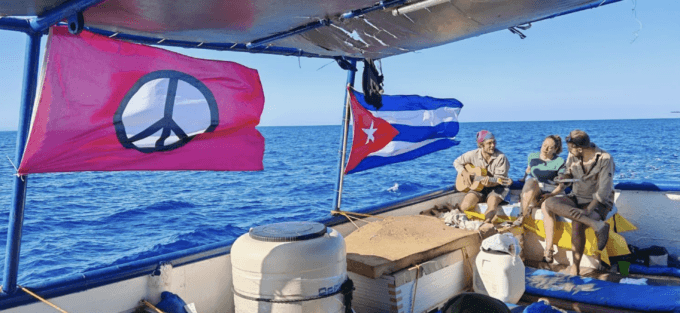
Image courtesy of CodePink.

Flotillas have historically been fleets of military vessels—tools of empire designed for swift offensive or defensive operations at sea. The images they evoke are ones of imperial power and looming violence. Just look at the massive US naval buildup that surrounded Iran as part of the recent US attacks.

But peace activists have also developed a new kind of flotilla.

Instead of instruments of war, flotillas have become symbols of peace—acts of humanitarian direct action, civil resistance, and cross-border solidarity. Take the flotillas that have tried to reach Gaza, like the Global Sumud Flotilla. Even though they have been illegally intercepted by the Israeli military, they have educated millions of people worldwide about Israel’s atrocities, activated entire cities to shut down, and offered a beacon of hope to the beleaguered people of Gaza.

As U.S. policy continues to sanction and blockade Cuba—causing immense hardship for the Cuban people—I, along with many others, felt compelled to escalate our own tactics of solidarity by joining the recent flotilla to Cuba as part of the Nuestra América Convoy. Our boat carried 15 tons of aid, part of the more than 40 tons delivered by the convoy.

The United States is currently imposing some of the harshest sanctions on Cuba in recent history, compounding a 67-year blockade that has restricted access to medicine, fuel, and food. But in recent months, the US added another dimension: a naval blockade to severely limit fuel imports, leading to a humanitarian crisis.

In an ideal world, we wouldn’t need fossil fuels—we would already have made a just transition to renewable energy. And while Cuba is working at lightning speed to expand solar power, the current reality is stark: people still need fuel to cook, to transport food, to operate ambulances, to power hospitals, and to keep ventilators running.

The international community has responded to this escalation in U.S. economic warfare with intensified solidarity. Hundreds of thousands of people around the world have been mobilizing to send aid and condemn the US blockade. In March, Progressive International, CODEPINK, and The People’s Forum launched the Nuestra América Convoy, bringing together over 600 people from 33 countries. We came with millions of dollars’ worth of aid—from urgently needed medical supplies to longer-term solutions like solar panels.

While many of my friends boarded planes to Havana, packing every inch of their luggage with medicine, hygiene products, vitamins, and art supplies, I traveled to Mexico to meet the flotilla crew. We spent four days at sea together—activists, journalists, organizers. Some had helped organize the Gaza Sumud Flotilla; others had taken part in mass protests in solidarity with Palestine.

Our goal was to deliver much-needed aid to the people of Cuba. But just as important was challenging the dominant narrative—that Cuba’s suffering is the result of its own government, rather than decades of U.S. cruel policy.

Even though the boat was full of journalists documenting the trip, their cameras could not fully capture the sense of community among strangers united by a shared mission. I remember being nervous about the cold and the possibility of seasickness, but within minutes, people were offering ginger chews, acupressure bracelets, and rain gear.

Our departure was delayed due to weather, boat repairs, and the logistics of loading the aid. In the meantime, we stayed with supporters in Mexico who couldn’t join the voyage but found other ways to contribute. We shared a send-off dinner at an Egyptian restaurant whose owner had followed the Gaza flotillas. He told us how proud he was to see a flotilla to Cuba leaving from his small town.

On the boat, we shared cooking, dishwashing, and night watch shifts—standard practice in occupations, encampments, and direct actions where resources are limited but creativity and collaboration are abundant. At sea, a simple breakfast of rice, beans, eggs, guacamole, and toast tastes like a feast. We slept under galaxies of stars, woke to sunrises on the horizon, and at sunset made music with whatever we had—a guitar, a bucket drum, water bottles filled with dry beans.

Meanwhile, I stayed connected to those traveling by plane, watching group chats fill with photos of carefully packed bags and urgent questions: Who can fit more supplies? How many solar batteries can we carry on? The coordination was constant, collective, and inspiring.

The blockade severely limits what goods can reach Cuba. While US citizens can still travel there under certain categories, they face restrictions and often risk questioning upon return. But solidarity is not tourism. It is not about swooping in, taking photos, and leaving. It is about building relationships, listening, and committing to ongoing struggle from our home countries.

We had a beautiful reception from the Cuban people when we landed, and then had the opportunity to speak directly with community groups about current conditions.I learned how they overcome so much by placing value in community over the individual.

The US empire is indeed dying, and it is up to us to not just reimagine the better world we need and want, but to actually put that world into practice. Reflecting on my experience, I started thinking — if we can turn flotillas from a force of evil into vessels of hope and solidarity, then what else can we change? What if we built schools around the world instead of sending bombs? What if, like the Cubans, we funded healthcare over warfare and sent doctors to cure people instead of soldiers to kill them?

You don’t have to board a boat with humanitarian supplies to show solidarity. Flotillas are one tactic, but we need a variety and diversity of tactics right now, and always. You can move forward by showing solidarity to your neighbors at home, as well as to our neighbors 90 miles off our shores. Because what we build together, in community—whether through a peace flotilla or local mutual aid—is stronger than anything built through force.

Olivia DiNucci is an anti-militarism and climate justice organizer based in Washington DC.


Russia deputy FM hails ‘special’ relations 

on Cuba visit


By AFP
April 10, 2026


Havana's communist authorities have said exiled Cubans can invest on the island to help its ramshackle economy but the idea is being met with caution in Florida. A coconut water stall is seen on a street in Havana with a sign reading "Ice-cold coconut water," on March 16, 2026. Cubans living abroad and their descendants will be able to invest and have their own businesses on the island, the communist government announced on March 16, 2026, at a time when the country’s economy is almost paralyzed by the energy blockade imposed by Washington. 
— © AFP YAMIL LAGE

Russian Deputy Foreign Minister Sergei Ryabkov hailed the “special nature” of relations with Cuba on a visit Thursday, where he met President Miguel Diaz-Canel as tensions simmer between Washington and energy-starved Havana.

“Russia is not going to leave the western hemisphere, no matter what they say in Washington,” Ryabkov told a press conference after the meeting, according to Russian state news agency TASS.

“Our relations with Cuba are of a special nature… We can’t just betray Cuba, it’s completely out of the question, we can’t leave it to its fate.”

The meeting, confirmed by Diaz-Canel’s office on X, came 10 days after a Russian oil tanker arrived in Cuba despite a de facto US fuel blockade.

“We take this opportunity to send a hug to our dear friend, President Vladimir Putin,” Diaz-Canel said in the meeting, according to his office.

Ryabkov said Cuba’s economic issues, including its energy security, were among the main topics of discussion, TASS reported.

Under President Donald Trump, the United States has threatened tariffs on any country that attempts to sell oil to Cuba, resulting in an energy crisis on the communist island that has worsened since January.

The US labels Cuba a threat to US national security, and Secretary of State Marco Rubio, who is of Cuban descent, has demanded changes to the island’s leadership.

Earlier on Thursday, Diaz-Canel told US-based NBC News that he would not resign under US pressure.

Rubio has denied calling for Diaz-Canel’s resignation.

“At the present moment, Russia is one hundred percent in solidarity with Cuba; despite the complexity the country is going through, we are by your side, said the deputy foreign minister,” the Cuban president’s office wrote on X on Thursday.


Latin America and the new US colonialism

APRIL 10, 2026

Trump is presenting his increasing interference in Latin America as part of his administration’s ‘war on drugs’. It’s not – and there are growing signs of resistance, argues Mike Phipps.

Last December, the United States published its new National Security Strategy. The document says: “The United States will reassert and enforce the Monroe Doctrine.”

Originally declared in 1823, the Monroe Doctrine holds that any intervention in the political affairs of the Americas by foreign powers is a potentially hostile act against the United States. Now Trump has added a significant Corollary to the Doctrine, asserting US predominance in the whole of the Western Hemisphere. It’s in this context that Trump’s demand to take control of Greenland can be understood.

But it is in Latin America that the new approach is having most impact. Witness the bombing and killing of more than 150 fishermen in the Pacific and Caribbean. “This murder spree,” says Amnesty International, “is unconscionable and illegal.”

The New Year began with the kidnapping of President Nicolás Maduro in Venezuela. The operation, a blatant violation of international law and transparently aimed at controlling Venezuela’s oil, resulted in at least 100 fatalities. Following Maduro’s seizure, the official State Department X account wrote, “This is OUR Hemisphere and President Trump will not allow our security to be threatened.”

Trump came to the support of the right wing Milei government in Argentina during last year’s parliamentary elections, by making a $20 billion financial assistance package available to the economically beleaguered regime mid-campaign.

Cuba has been the object of a harsh blockade, which imposes heavy tariffs on “any other country that directly or indirectly sells or otherwise provides any oil to Cuba.” The embargo has led to electrical blackouts across the entire country and hospital generators almost running out of fuel. There is every likelihood that Trump will increase further pressure on the island once the war on Iran dies down. “I can do anything I want with it,” Trump said last month.

In El Salvador, the US has worked closely with President Nayib Bukele over the Trump administration’s mass deportation of migrants from various Latin American countries and their warehousing in El Salvador’s overcrowded prisons. El Salvador’s four-year “State of Exception” and its multiple violations of basic liberties has been the subject of more than two dozen human rights investigations by national and international organisations.

In October 2025, Trump accused Colombian President Gustavo Petro of being an “illegal drug dealer” and simultaneously cut off diplomatic aid to the country. Many of the US attacks on fishing boats have been near Colombia’s coastline. When asked if he was considering a military strike in Colombia, Trump said, “It sounds good to me.”

A ‘war on drugs’

Indeed, much of the US expansion into Latin America has been in the guise of fighting a ‘war on drugs’. Last month, a US-backed crackdown on supposed drug cartels along the Ecuador-Colombia border sparked accusations that security forces bombed farms, burned homes and detained and abused villagers. The operation left at least 27 people dead.

On March 24th, the New York Times alleged that Ecuadorian soldiers had set fire to and then bombed a dairy farm near the border, according to local workers. Jahiren Noriega Donoso, a lawmaker in Ecuador’s National Assembly, posted: “Unequivocally, the war that [President] Daniel Noboa has launched is not a war against crime. It is a war against the poorest among us.”

“There are 27 charred bodies, and the explanation provided is not credible,” Colombia’s President Petro wrote on social media. “Bombs lie on the ground in close proximity to families — many of whom have peacefully chosen to replace their coca leaf crops with legal crops.”

US forces were also involved in Bolivia last month in the capture of a leading drug trafficker. The country’s new right wing President is an ardent Trump supporter. On taking office last year, he proposed cutting public spending by 30%, eliminating a range of taxes on the wealthiest and setting up at least ten ‘truth commissions’ to investigate the activities of previous left-led governments – a device aimed at barring them from office in future.

US Administration officials are clear that their control of Latin America is a top priority and the ‘war on drugs’ is the spearhead. “We are not going to cede an inch of territory in this hemisphere to our enemies or adversaries,” White House security adviser Stephen Miller said last month, adding the US was “using hard power, military power, lethal force, to protect and defend the American homeland.”

In one week alone last year, the US secured military deals with Paraguay, Ecuador, Peru and Trinidad and Tobago, following earlier agreements with Guyana, the Dominican Republic and Panama. The agreements range from airport access to the temporary deployment of troops. “And this has nothing to do with drugs,” says Jorge Heine, a former Chilean ambassador and a research professor at Boston University’s School of Global Studies.

That was underlined by Trump’s pardoning last year of Juan Orlando Hernández, the former president of Honduras who was serving a 45-year prison sentence in the US on drug trafficking and weapons charges. Trump backed his right wing party colleague Nasry Asfura for the Honduran presidency and threatened to withhold much-needed aid if he lost.

America’s new colonialism takes other forms. On March 10th, Paraguay’s Congress “approved a bill that extends diplomatic immunity to all US military and civilian defence personnel,” writes Forrest Hylton. “It allows them to wear US military uniforms and carry US weapons, and travel the country’s roads with US drivers’ licences. US citizens will be subject to US, not Paraguayan law. The US had a similar deal in Iraq, as did the British in 19th-century China. It will be a first in South America.”

Plenty of precedents

Many see the behaviour of the Trump administration as a new form of fascism. As Professor Dan Hicks argued on this site recently, it might be more fruitful to analyse it as an enduring corporate-militarist colonialism.

On this basis, recent US interventions in Latin America are not so unprecedented. The US first destabilized and then promoted a coup to bring down the popular Arbenz government in Guatemala in 1954.  The coups in the southern cone in the 1970s – Chile, Uruguay and Argentina – all had direct US backing. In 1983, the US invaded Grenada to topple the government and throughout that decade the Reagan administration funded the terroristic contras in Nicaragua, partly with money made from covertly selling arms to… Iran. In1989 the US militarily toppled the government of Panama, killing over 500 people. But in 1961, when the ‘liberal’ President Kennedy sent 1,400 CIA-trained Cuban exiles to bring down Fidel Castro’s revolutionary government, the attempted Bay of Pigs invasion ended in fiasco.

Weakened though the economy is by the US-led decades-long embargo, there is every sign that Cubans will fight to defend their sovereignty today. And despite the rising tide of conservative Trump-loving populists across the continent, there are also encouraging signs of pushback against the new colonialism. In Ecuador, voters rejected an attempt by the right wing President Daniel Noboa to allow the return of US military bases to the country by a hefty two-thirds margin – and voted too against other attempts to dismantle the country’s progressive constitution.

Not all left wing governments have been extinguished. Gustavo Petro in Colombia, Claudia Sheinbaum in Mexico and Lula in Brazil are in charge of three of the region’s largest countries. Trump has been unsuccessful in trying to get Brazil’s previous President, the right wing Jair Bolsanaro, freed and has been forced to negotiate, while backtracking on tariffs and sanctions against a Brazilian Supreme Court judge.

Last month Trump hosted a ‘Shield of the Americas’ summit in Florida, with 13 heads of state present – and, significantly, the three above-mentioned countries absent. An assessment from Chatham House  – hardly a left wing body – disparaged the lack of detail in the official announcement at the end of the event, which failed to “address the root causes of insecurity and crime – poverty, weak states and corruption.” No new money was earmarked for the project, whose “openly partisan nature… hobbles it at the outset.”

On the ground, there are further signs of resistance. Chile may have elected its most right wing President since the Pinochet dictatorship, but within two weeks of Kast taking office, thousands of high school students have taken to the streets to protest against fuel price hikes and attacks on public education. Similar protests against fuel price rises have taken place in Bolivia.

Solidarity is urgent

It takes courage to stand up to Trump and his acolytes in countries riven by poverty and inequality, with limited access to world markets and where state violence is an everyday reality. Those who resist face the full wrath of the world’s mightiest superpower, led by a President who revels in war crimes and destruction. What kind of international solidarity should be on offer to those who put themselves in the firing line?

In the coming months, Latin America’s social movements and political activists will need the widest possible solidarity from supporters of democracy, human rights and progress in the West against the imperial ambitions of the Trump administration. Such solidarity should not be based on allegiance to particular regimes, which often brandish their anti-imperialist credentials while displaying the very authoritarian tendencies which undermine a genuine popular defence of their countries’ sovereignty. Instead, international solidarity needs to be based on the principles of national sovereignty, democratic and human rights and anti-colonial independence from external interference. A broad internationalist movement of real people-to-people solidarity will need to be built  – and time is short.

Mike Phipps’ book Don’t Stop Thinking About Tomorrow: The Labour Party after Jeremy Corbyn (OR Books, 2022) can be ordered here.

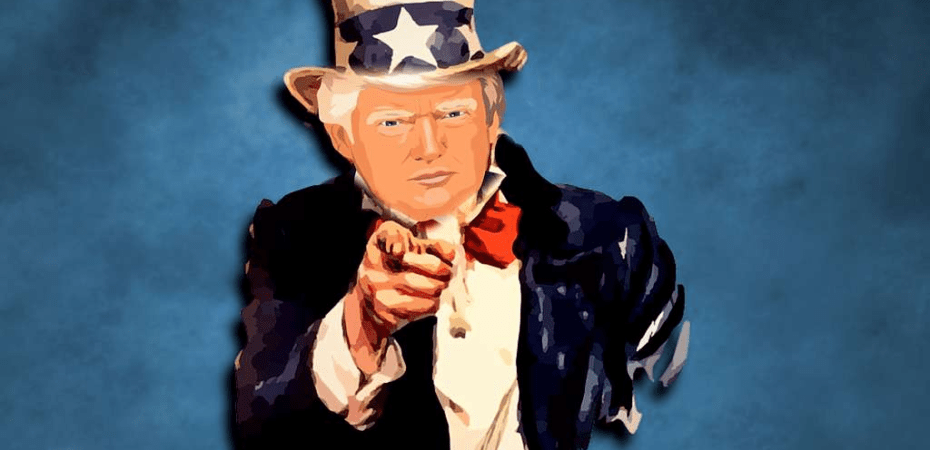
Image: https://picryl.com/media/trump-uncle-sam-bcd82e. Licence: Public Domain Mark 1.0 Universal PDM 1.0 Deed