Saturday, April 11, 2026

Trump Reportedly Agreed to Include Lebanon in Ceasefire But Lied About It Anyway


The death toll from Israel’s massive, 10-minute blitz on Lebanon on Wednesday has surpassed 300 people.

By Sharon Zhang , 
April 10, 2026

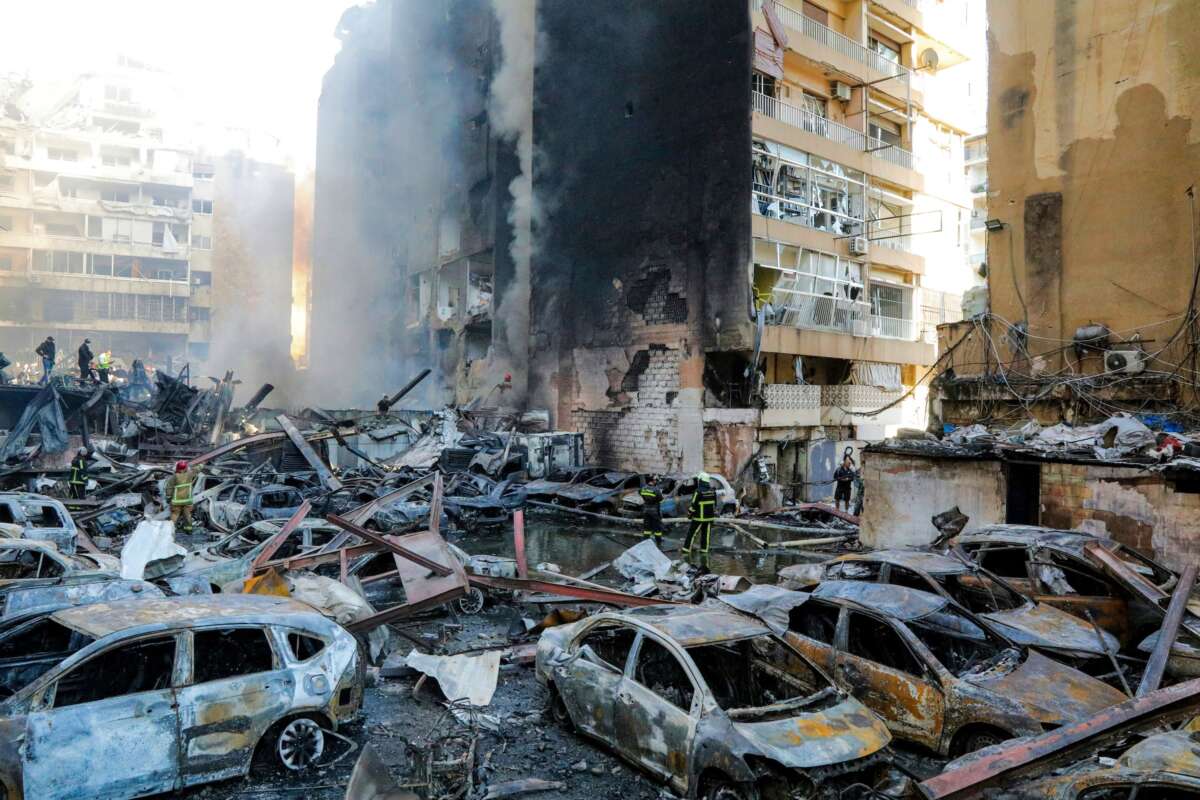
Firefighters attempt to extinguish a fire following an Israeli strike at the Corniche al-Mazraa neighbourhood of Beirut on April 8, 2026. Around 2:00 pm, a series of Israeli strikes slammed into the Lebanese capital without warning, triggering scenes of panic.Ibrahim AMRO / AFP via Getty Images

The Trump administration is lying about Lebanon’s inclusion in the Iran ceasefire deal that officials agreed to on Tuesday, as new reporting finds that U.S. President Donald Trump agreed to pause bombardments on the country before Israel launched a horrific wave of airstrikes just hours after the ceasefire went into effect.

CBS reported on Thursday, citing “multiple diplomatic sources,” that Trump was told of and agreed to Lebanon’s inclusion in the ceasefire — and that it would in fact encompass the entirety of the Middle East, including the Gulf countries that Iran has launched retaliatory strikes on.

This reporting sharply contradicts statements from various figures within the Trump administration that were made after Israeli forces bombarded Lebanon, evidently in violation of the agreement.

Vice President J.D. Vance said on Wednesday that the dispute over whether Lebanon was included “comes from a legitimate misunderstanding. I think the Iranians thought that the ceasefire included Lebanon, and it just didn’t,” he told press. Trump and White House Press Secretary Karoline Leavitt also said that Lebanon wasn’t included.

Despite this assertion being, evidently, a lie, Vance went as far as to say that it would be “dumb” if “Iran wants to let this negotiation fall apart” because of Israel’s attack. “We think that would be dumb, but that’s their choice,” he said.


Israel Carpet Bombs Lebanon After Announcement of Iran Ceasefire
Israeli forces announced on Wednesday that it struck 100 sites in Lebanon over 10 minutes. By Sharon Zhang , TruthoutApril 8, 2026


The comment came on Wednesday, less than a day after the ceasefire went into effect, after Israeli forces carpet bombed Lebanon, including the capital of Beirut, in an operation the military dubbed “Eternal Darkness.” The deluge of strikes, which came over the course of just 10 minutes, destroyed buildings across the country, collapsing residential buildings with no warning.

As of Thursday, the death toll from the strikes had surpassed 300, according to Lebanese health officials, with 1,150 injured. Hospitals have been unable to cope with the load, with patients dying as they await care.

Israel has a long history of violating ceasefire deals, especially right as they are announced.

CBS’s report lines up with what Iranian officials have said about Lebanon’s inclusion in the deal, as well as officials from Pakistan, which served as the key mediator for the negotiation of the deal.

“I am pleased to announce that the Islamic Republic of Iran and the United States of America, along with their allies, have agreed to an immediate ceasefire everywhere including Lebanon and elsewhere,” wrote Pakistani Prime Minister Shehbaz Sharif on Tuesday, announcing the agreement.

Earlier that day, Sharif had posted a statement about a progressing ceasefire deal on X that was reportedly directly approved by the White House.

Iranian politicians have sharply criticized the U.S. for excusing Israel’s wanton violence in Lebanon.

“The Iran–U.S. Ceasefire terms are clear and explicit: the U.S. must choose — ceasefire or continued war via Israel. It cannot have both,” said Iranian Foreign Minister Seyed Araghchi.

Araghchi went on to suggest that the U.S. is bending over backwards for Israeli Prime Minister Benjamin Netanyahu’s benefit.

“Netanyahu’s criminal trial resumes on [Sunday]. A region-wide ceasefire, incl in Lebanon, would hasten his jailing,” said Araghchi in a post on Xreferencing Netanyahu’s penchant for using military action to postpone proceedings on his criminal trial.

“If the U S. wishes to crater its economy by letting Netanyahu kill diplomacy, that would ultimately be its choice. We think that would be dumb but are prepared for it,” Araghchi went on, in a jab at Vance.

Vance also said on Wednesday that Israel had agreed to step down its attacks, which Trump repeated. However, Netanyahu contradicted them, saying in an address on Thursday: “There is no ceasefire in Lebanon. We continue to strike Hezbollah with full force.”

‘Nightmare for Civilians’: Israel Inflicts 1,400+ Casualties on Lebanon War’s Deadliest Day


“Civilians in Lebanon are already paying an unbearable price with children, health workers, and journalists amongst those killed—the latest attacks will only escalate this devastating human toll,” said one campaigner.



A woman injured in an Israeli airstrike arrives at a hospital in Nabatieh, Lebanon on April 8, 2026.
(Photo by Chris McGrath/Getty Images)

Brett Wilkins
Apr 09, 2026
COMMON DREAMS

Humanitarian campaigners, civil rights defenders, and progressive members of Congress were among those calling on the Trump administration to pressure Israel to stop bombing Lebanon after Israeli airstrikes killed or wounded more than 1,400 people—many of them civilians—on Wednesday.

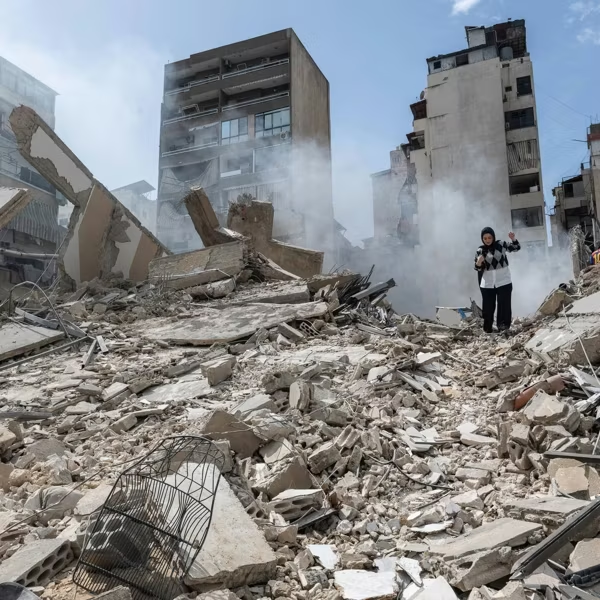
In what Amnesty International called an “unprecedented escalation,” the Israel Defense Forces said it carried out the “largest coordinated wave of strikes” of its renewed war on Hezbollah in Lebanon. Around 100 sites in the country were bombed in one 10-minute period alone in what the IDF dubbedr “Operation Eternal Darkness.”


As in Gaza, Israel’s ‘Deliberate’ Bombing of Lebanese Civilians Takes Heavy Toll



Despite Ceasefire With Iran, Israel Pummels Lebanon With ‘Apocalyptic’ Strikes

Lebanese officials said that at least 303 people were killed and 1,165 others wounded by Israeli strikes on Wednesday, the deadliest day of attacks since Israel resumed bombardment of Lebanon and likely since it started bombing its northern neighbor after the Hamas-led Palestinian attack of October 7, 2023.

While Lebanese authorities do not break down casualties according to combatant status, officials and residents of the capital city of Beirut said that civilians were the main victims of Wednesday’s bombings, which targeted apartment towers and other civilian structures in numerous densely populated urban areas.


One witness, a woman named Fatima, told Amnesty International what she saw in the immediate aftermath of an IDF strike on a building across the street from her home in Beirut’s Salim Salam neighborhood.

“It was apocalyptic,” she said. “Bodies on the ground. Blood everywhere. I saw countless wounded adults and children. I walked further but it was the same scene in the other neighborhoods too. I did not know where to go. I just walked aimlessly trying to get as far as possible. It was a nightmare.”

Dr. Firass Abiad, a surgeon and wformer Lebanese health minister, told The Guardian that American University of Beirut Medical College, where he works, received about 70 patients at the same time, a situation he said was intentionally caused by Israel “to flood the health system.”

“There was a 90-year-old who I just left a bit ago. He passed away from his wounds,” he said. “There was nothing we could do. These are civilians who, without any warning, their whole apartment building was flattened. So you can imagine the severity of injuries that we’re getting.”


Shaden Fakih, a 24-year-old calisthenics trainer, described trying to find his friend who was inside a building when it was bombed. He couldn’t locate his friend, but he was seen carrying an elderly woman from the rubble.

“There’s no Hezbollah here, the Israelis are just getting happy when they bomb people, it’s not about Hezbollah,” Fakih said in an interview with The Guardian. “Just stop bombing us. If you want to kill Hezbollah, go for it, but don’t kill civilians, because you’re creating anger in us against Israel and we will have to act like Hezbollah just to defend our country. But I don’t want to do that, I just want to live in peace.”

“It’s been the worst day since the war started,” he added. “And what I’m most sad about is that my pretty Lebanon, our beautiful Lebanon, soon it will all be brought down to the ground.”

As Common Dreams reported, Israeli strikes have wiped out entire families in Lebanon and Iran. In Gaza, more than 2,700 families have been erased from the civil registry.

Responding to Wednesday’s attacks, Amnesty International Middle East and North Africa regional director Heba Morayef said that “just hours after the world cautiously welcomed news of a US-Israeli ceasefire with Iran, in Lebanon the nightmare for civilians has become more terrifying.”

“Even before today’s attack... more than 1,500 people had been killed and over a million people displaced from their homes across the country,” Morayef continued, referring to Israel’s bombardment of Lebanon after Hezbollah began launching rockets and drones southward in solidarity with Palestinians in Gaza. Israel’s genocidal assault on Gaza has left more than 250,000 Palestinians dead, injured, or missing.

“Civilians in Lebanon are already paying an unbearable price with children, health workers, and journalists amongst those killed—the latest attacks will only escalate this devastating human toll,” Morayef added. “These attacks are a reminder that states must immediately halt the transfer of arms and weapons to Israel given the overriding risk that they will be used to commit serious violations of international humanitarian law.”

The Washington, DC-based Council on American-Islamic Relations (CAIR) said in a statement late Wednesday, “Once again, Israel’s genocidal government is trying to derail a ceasefire and ensure peace does not succeed by slaughtering innocent civilians.”

“The Trump administration must stop them from carrying out this brutal plan,” the group added. “Israel has demonstrated time and again that it cannot be trusted to abide by peace agreements. It is time for our government to cut all support for Israel’s atrocities.”

These and other groups, as well as governments in the Mideast and beyond, and US progressives, are demanding that Lebanon be included in the ceasefire. Although Israel agreed to the truce, the government of Prime Minister Benjamin Netanyahu—who is wanted by the International Criminal Court for alleged crimes against humanity and war crimes in Gaza—asserts that the deal does not include Lebanon.

Iran categorically rejects Israel’s claim and is using its leverage over the Strait of Hormuz to pressure Israel to reconsider its stance.

Some US progressives called for President Donald Trump to pressure Israel to stop attacking Lebanon, and for a suspension of American arms transfers to the IDF.

“It is unconscionable we continue to provide aid to Israel as they continue to murder civilians and violate international law in Lebanon, Gaza, and the West Bank,” Rep. Ilhan Omar (D-Minn.) said Thursday on Bluesky. “No more money to Israel’s genocidal apartheid regime.”
In Yet Another Industry Handout, Trump EPA ‘Just Took a Sledgehammer’ to Coal Ash Rules

“Ultimately, if this rule is finalized, human health will suffer, and taxpayers will be left with the cost of cleaning up their rivers and drinking water.”


A worker moves coal refuse to be prepared for transport at a land reclamation project site in Center Township, Pennsylvania, with the shuttered Homer City Generating Station in the background, on June 12, 2024.
(Photo by Scott Lewis for The Washington Post via Getty Images)


Jessica Corbett
Apr 09, 2026
COMMON DREAMS

Amid mounting calls for the removal of US Environmental Protection Agency Administrator Lee Zeldin, the EPA chief on Thursday announced proposed changes to coal ash rules, which critics blasted as another gift to polluters at the expense of public health.

Officially called coal combustion residuals (CCR), “coal ash—the toxic byproduct of burning coal—contains hazardous pollutants, including arsenic, boron, cadmium, chromium, lead, radium, and selenium, which are linked to serious health harms such as cancer, heart disease, and brain damage, among other lasting impacts,” noted the Natural Resources Defense Council (NRDC).

Specifically, as The Associated Press reported, the EPA “proposed easing standards for monitoring and protecting groundwater near some coal ash sites, rolling back rules forcing the cleanup of entire coal properties instead of just places where ash was dumped. The revisions would also make it easier to reuse coal ash for other purposes.”

While Zeldin claimed the “commonsense changes to the CCR regulations reflect EPA’s commitment to restoring American energy dominance, strengthening cooperative federalism, and accommodating unique circumstances at certain CCR facilities,” Environmental Protection Network’s Marc Boom responded that “letting companies avoid cleaning up waste sites that may be leaching toxic metals into groundwater and nearby waterways, while weakening protections and accountability, is not common sense.”

“EPA’s top priority should be protecting people’s health, not sacrificing it for corporate expediency,” argued Boom, senior director of public affairs at the group, which is made up of former agency staff. “EPA may call these safeguards ‘impractical,’ but anyone living downstream of coal ash sites holding thousands of tons of waste knows that requiring cleanup and monitoring is a necessary and basic standard.”

NRDC senior attorney Becky Hammer called the pending rollback just “the latest in a long, long, line of Trump administration giveaways to fossil fuels industries,” which have also included repealing EPA rules that targeted chemical pollution from coal-fired power plants, declaring a national energy emergency, and scrapping the 2009 “endangerment finding” that underpins all federal climate regulations.

Other advocacy organizations were similarly critical of Thursday’s announcement. Daniel Estrin, Waterkeeper Alliance’s general counsel and legal director, pointed out that “coal ash is contaminating water at nearly every active and retired coal plant in the US.”

“By gutting these safeguards, EPA is abandoning its duty to protect impacted communities by allowing preventable contamination of our rivers, lakes, streams, and groundwater,” he said. “The longer the coal industry is allowed to delay closing and cleaning up its toxic waste sites, the more difficult and costly it becomes to fix the damage. By failing to enforce the law, EPA is letting polluters continue harming people and wildlife without accountability.”

Like Estrin and Hammer, Earthjustice senior counsel Lisa Evans framed that proposal as “yet another handout to the coal power industry at the expense of our health, water, and wallets,” and warned of the dangers of delaying closure and cleanup. She said that “ultimately, if this rule is finalized, human health will suffer, and taxpayers will be left with the cost of cleaning up their rivers and drinking water.”

Although “the Trump administration just took a sledgehammer to the health protections in place for toxic coal pollution,” Evans added, “Earthjustice has successfully defended these safeguards in court and will do so again.”

Nick Torrey, senior attorney at the Southern Environmental Law Center, which has secured commitments to clean up over 270 million tons of coal ash in US communities, similarly said that “doing the bidding of industrial polluters instead of protecting ordinary families and clean water is shameful, but we are ready to keep fighting against coal ash pollution.”

“Letting coal-burning utilities set the agenda has been a disaster for communities across the South, resulting in coal ash spills and hundreds of families forced to live on bottled water for years under the threat of coal ash pollution,” Torrey highlighted. “The Trump administration and coal ash polluters want to take us back to the bad old days of arsenic, lead, and mercury from coal ash contaminating our water.”

In addition to facing a flurry of lawsuits over policies prioritizing the climate-wrecking fossil fuel industry—whose campaign cash helped President Donald Trump return to the White House last year—the administration has recently been hit with demands to remove Zeldin from more than 160 advocacy groups and nearly 300 health experts.

“This EPA’s actions to put polluters first, at the expense of our health, are dangerous and will be deadly,” states the health experts’ open letter, organized and released Thursday by the Climate Action Campaign. “Administrator Zeldin has abandoned his sworn duty and must be held accountable for his agenda.”


As Zeldin Embraces Climate Crisis Deniers, 290+ Health Experts Demand His Removal

“We cannot tolerate an EPA administrator who treats our families as expendable.”


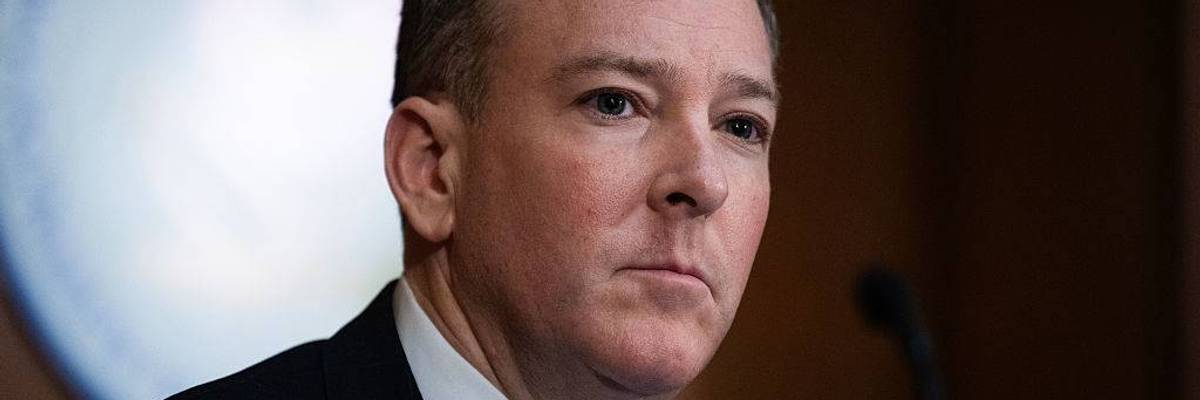
US Environmental Protection Agency Administrator Lee Zeldin participates in a discussion at the EPA in Washington, DC on April 2, 2026.
(Photo by Tom Williams/CQ-Roll Call, Inc. via Getty Images)


Brad Reed
Apr 09, 2026
COMMON DREAMS

Hundreds of health experts are demanding the removal of Environmental Protection Agency Administrator Lee Zeldin over his gutting of key regulations that they say will endanger Americans’ livelihoods.

letter released Thursday by Climate Action Campaign outlines Zeldin’s threats to public health and explains why he should not be serving as the top US environmental regulator.
RECOMMENDED...


‘Game Over Zeldin’: 160+ Climate and Health Groups Say EPA Chief Must Go


“Administrator Zeldin is pursuing a deregulatory agenda that will result in a massive increase in health-damaging air pollution, toxic chemicals, and climate-heating greenhouse gases,” says the letter, which is signed by nearly 300 medical experts, including physicians, nurses, and public health researchers.

“And just last month, the administration laid bare its decision to no longer count the economic value of health benefits when setting Clean Air Act rules,” the letter adds, “refusing to acknowledge the value of lives saved, hospital visits avoided, and lost work and school days prevented.”

The letter also points to the EPA’s February decision to revoke the so-called “endangerment finding,” which gave the agency authority to regulate greenhouse gases as threats to public health.

Repealing this finding, the letter contends, “will increase the frequency and severity of climate disasters.”

According to a Wednesday report from The Associated Press, Zeldin celebrated the EPA’s revocation of the finding while delivering a keynote address at the Heartland Institute, a right-wing think tank that has long pushed climate denialism.

“Today is a moment to celebrate,” Zeldin said at the event. “It is a day to celebrate vindication.”

Margie Alt, director of the Climate Action Campaign, said her group decided to organize the letter among medical experts because “Lee Zeldin is too dangerous to ignore.”

“When health experts—the people who see the effects of pollution on their patients every single day—say enough is enough, the rest of us need to pay attention,” said Alt. “Zeldin is not just failing Americans. He is actively endangering us. We cannot tolerate an EPA administrator who treats our families as expendable.”

This is the second “Game Over Zeldin” letter, following another from over 160 advocacy groups, including Climate Action Campaign and Moms Clean Air Force, last month.
As Mexico Enacts Universal Healthcare, Advocate Says Insurers’ ‘Stranglehold’ Is Moving US in ‘Opposite Direction’

Medicare for All advocate Wendell Potter said it’s “both inspiring and frustrating” to see other nations advance their public healthcare systems while the US dismantles its own.


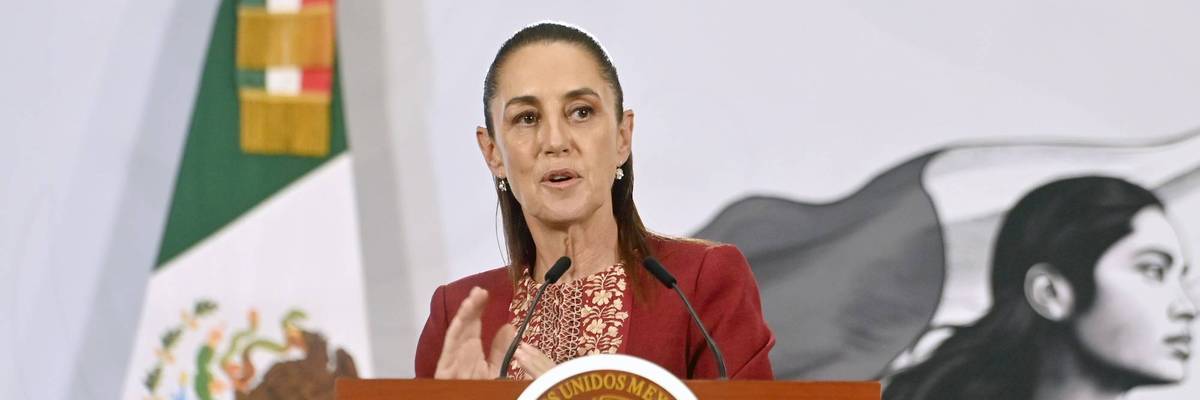
Mexican President Claudia Sheinbaum speaks during the daily morning briefing at Palacio Nacional on April 7, 2026, in Mexico City, Mexico.
(Photo by Jeannette Flores/ObturadorMX/Getty Images)

Stephen Prager
Apr 10, 2026
COMMON DREAMS

As Mexican President Claudia Sheinbaum moves forward with a plan to enact universal healthcare for her country’s more than 130 million people, a longtime advocate for Medicare for All in the US called the development “both inspiring and frustrating.”

“Inspiring because it shows what is possible,” Wendell Potter, a former insurance company communications director who has become a leading critic of the industry, told Common Dreams. “Frustrating because here in the US we are going in the opposite direction.”


Millions of Americans Joining the Ranks of the Uninsured Thanks to Trump-GOP Cuts in 2025


Earlier this week, Sheinbaum announced a decree that she called “a historic step” for Mexico.

Beginning in 2027, her government plans to unify Mexico’s public health institutions into a single Universal Health Service, allowing patients across the country to receive care from the Mexican Social Security Institute (IMSS), the Social Security Institute and Social Services of Workers of the State (ISSSTE), and the IMSS‑Bienestar program, which provides free services to those without employer-provided insurance.

According to TeleSur, universal access would be rolled out gradually, with universal emergency care and continuity of treatment, free of financial constraints, beginning in January. Specialized services such as radiotherapy, laboratory tests, and imaging studies would be phased in later that year, and universal prescription fulfillment and hospitalization would also be added to the program in 2028.

“The goal is that when we leave the government [in 2030], any Mexican man or woman can go to any health institution for treatment for any ailment and be received,” Sheinbaum said.


Mexico has expanded its annual healthcare budget in recent years, but Sheinbaum’s government hopes that consolidating all of Mexico’s health services into a single program will eliminate bureaucratic bloat and create a more cost-effective system that saves money over time.

Potter described the plan as “just another example of countries around the world lapping the US when it comes to healthcare policy.”

While tens of millions more previously uninsured Mexicans have become eligible for free care under the healthcare expansion efforts of Sheinbaum and her predecessor, Andrés Manuel López Obrador, the US under President Donald Trump is in the process of shredding public healthcare programs and subsidies.

Following the One Big Beautiful Bill Act, signed into law by Trump last year, 11.8 million Americans are expected to lose Medicaid and other coverage, and more than 20 million are projected to see higher premiums after insurance subsidies under the Affordable Care Act were allowed to expire.

“Due to the stranglehold Big Insurance has on too many politicians in this country, instead of expanding care and lowering costs, we are simply helping Big Insurance make more and more money,” Potter said. “It is totally backwards.”

“We must continue to keep Medicare for All as our north star here. But also acknowledge the reality that we need to change so much about our current political environment to make it possible,” he said. “And that has to start with breaking up Big Insurance’s stranglehold on Washington.”
Oxfam Warns Trump Foreign Aid Cuts Could Help Kill More Than 9 Million People by 2030

“Governments must restore their aid budgets, and shore up the global humanitarian system that faces its most serious crisis in decades,” said an advocate with the international charity Oxfam.


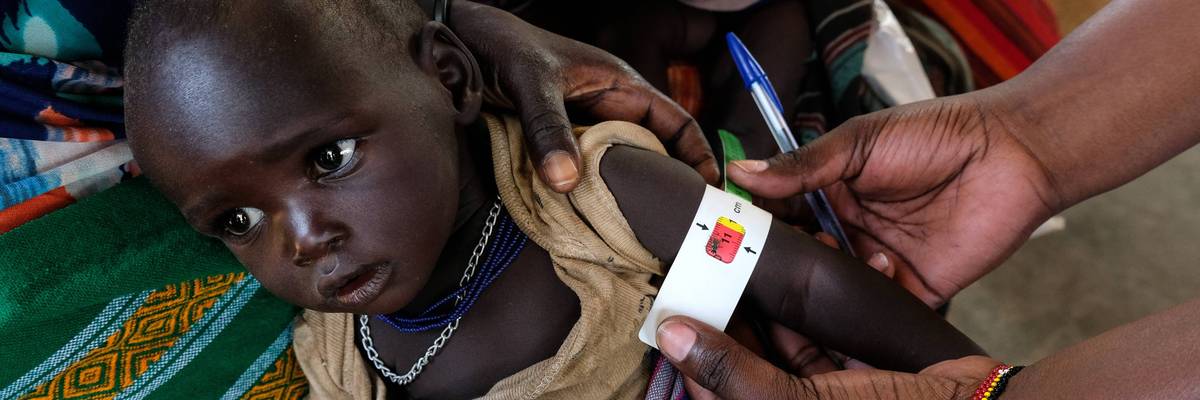
A health worker measures a child’s arm circumference during a nutrition screening on July 23, 2025 in Karamoja region, Uganda.
(Photo by Hajarah Nalwadda/Getty Images)

Julia Conley
Apr 10, 2026
COMMON DREAMS

The global anti-poverty group Oxfam International warned this week that US President Donald Trump’s decision to slash foreign aid by more than half could kill nearly 10 million people by the end of the decade.

Responding to new data released Thursday by the Organization for Economic Cooperation and Development (OECD) showing the largest annual drop in the history of official development assistance, Oxfam said “wealthy governments are turning their backs on the lives of millions of women, men, and children in the Global South.”

The OECD released preliminary data on international aid that was provided last year by member countries of the organization’s Development Assistance Committee (DAC), finding the largest annual drop in the history of official development assistance.

OECD member countries provided $174.3 billion in aid last year, according to the new data, representing 0.26% of the countries’ combined gross national income.

In 2024, the countries sent $215.1 billion, or 0.34% of their gross national income to developing countries, including across the Global South—helping to provide nutritional assistance and healthcare initiatives among other programs.

US foreign aid spending dropped by 56.9% after Trump dismantled the US Agency for International Development, cut smaller aid programs, and pushed Congress to rescind previously approved foreign assistance.

“At a time when aid cuts are already driving instability and fostering greater inequality, government donors are cutting life-saving aid budgets while financing conflict and militarization.”

Overall, wealthy OECD countries provided 23.1% less in foreign aid last year than they did in 2024—a greater decline than what the Institute of Global Health in Barcelona projected in February when it released a study in The Lancet, evaluating the impact of development assistance funding declines around the world.

The institute found that aid cuts in 2025 alone, which it assumed would represent a 21% decrease in funding, would lead to 695,238 excess deaths. If cuts continued at the same rate, an estimated 9,416,417 people could die of preventable diseases like malaria and AIDS, starvation, and other impacts by 2030.

The drop in foreign aid spending would suggest even more people could be killed by the cuts over the next four years.

“We are in a time of increasing humanitarian needs; strong pressures on the poorest and most fragile countries; and facing growing global uncertainties and massive insecurity,” said Carsten Staur, chair of the OECD’s Development Assistance Committee (DAC), which compiled the data. “In this situation, the world needs more ODA, not less—to help fight extreme poverty, improve resilience, and mobilize more private resources.”

Trump’s cuts helped make Germany the largest provider of development assistance for the first time ever, providing $29.1 billion to countries in need. The US sent $29 billion while the United Kingdom provided $17.2 billion, Japan sent $16.2 billion, and France sent $14.5 billion. All five of the top ODA providers reduced their foreign aid spending, accounting for 95.7% of the total decline.

Eight out of the DAC’s 34 member countries either maintained or increased their development aid spending, and four countries—Denmark, Luxembourg, Norway, and Sweden—exceeded the United Nations’ target of spending 0.7% of their gross national income on ODA.

Didier Jacobs, development finance lead for Oxfam, emphasized that while “recklessly” cutting foreign aid, “the Trump administration has been preparing to ask Congress for tens of billions in additional funding for bombs, ammunition, and other military equipment relating to its unlawful war against Iran.”

“At a time when aid cuts are already driving instability and fostering greater inequality, government donors are cutting life-saving aid budgets while financing conflict and militarization. Cuts from donors including Germany, France and the UK will be felt by the world’s poorest,” said Jacobs.

In addition to slashing military spending instead of crucial foreign aid, he said, “there are other ways to find tens of billions, such as by taxing the $2.84 trillions of dollars that the super-rich hide in tax havens.”

“Governments must restore their aid budgets,” he said, “and shore up the global humanitarian system that faces its most serious crisis in decades.”


Human Rights Groups Denounce Trump Plans to Send Cubans Fleeing Impacts of Blockade to Guantánamo

“The continued use of Guantánamo Bay, which has an extensive history of abuse and torture, is horrific and unconscionable.”


Cubans ride electric tricycles and bicycles during an anti-imperialist march amid ongoing shortages and prolonged power outages, as the island faces deepening economic strain under the decades-long United States embargo in Havana, Cuba on April 2, 2026.
(Photo by Juancho Torres/Anadolu via Getty Images)

Stephen Prager
Apr 10, 2026
COMMON DREAMS

Dozens of human rights organizations sent a letter to Congress on Friday, decrying threats by US military officials to detain Cubans who flee to the US to escape President Donald Trump’s crushing economic blockade at Guantánamo Bay.

The 86 groups, which include the Center for Constitutional Rights, the Center for Victims of Torture, the International Refugee Assistance Project, and Refugees International, zeroed in on remarks made by US Marine Corps Gen. Francis Donovan, the commander of the US Southern Command (SOUTHCOM), during a Senate Armed Services Committee hearing last month about how the military would respond to the mass influx of Cuban refugees to the United States.

The risks of a refugee exodus from Cuba were sparked in January after Trump tightened the already brutal regime of economic sanctions by threatening to slap harsh tariffs on any nation that provided oil to Cuba. The result has been a crippling fuel shortage that has caused routine blackouts and disrupted every facet of daily life, from hospital care to food cultivation.

Trump enacted the fuel blockade in what he has described as an effort to coerce the government to step down from power and make way for one more amenable to the interests of American companies. With Cuba in a weakened state, he has threatened to “take” the island outright using American military force.

The United Nations has warned that if the blockade is prolonged, it could bring about a total “humanitarian collapse.”

Asked by Sen. Tom Cotton (R-Ark.) about what would be done if this caused a mass influx of Cuban refugees to the US, Donovan said they had an executive order that would involve coordinating with the Department of Homeland Security to handle a “mass migration event.”

Donovan said it would include using the US military base at Guantánamo Bay, “where we would set up a camp to deal with those migrants or any overflow from any situation in Cuba itself.”

“Given the well-documented history of abusive and unlawful detention at Guantánamo, any proposal to use the base for additional detention is deeply troubling and unacceptable,” the organizations wrote on Friday,

They note the prison’s history as a site used for extrajudicial torture during the global War on Terror and as a holding facility for other migrant groups, including Haitian refugees and asylum seekers who fled a military coup in the 1990s, many of whom were subjected to substandard living conditions.

“Time and again, we have seen the US government try to use Guantánamo as a legal black hole to mistreat migrants, subjecting them to inhumane conditions and interfering with both their right to seek protection in the United States and their right to counsel,” said Pedro Sepulveda, a litigation fellow for the International Refugee Assistance Project.

Despite pledges from multiple presidents to close the camp for good, it remains open more than two decades after former President George W. Bush began using it to detain hundreds of terrorism suspects without trial.

Trump has expanded its use during his second term, using it to temporarily hold more than 700 migrants since February 2025—including dozens of Cubans rounded up by immigration agents.

Trump’s use of the camp marks the first time it has been used to hold people detained in the continental United States. A Washington Post investigation from February found that those in the facility were subject to weeks-long periods of isolation, invasive strip searches, and denied contact with lawyers.

The human rights groups called on Congress to block any funding that could be used to detain Cubans fleeing Trump’s blockade and to shut down Guantánamo Bay for good.

“The president has held Guantánamo detention as a threat over the heads of migrants in the United States and now threatens the same over Cubans who may be forced to flee their homes as a result of his own actions,” said Michael Galant, the senior research and outreach associate at the Center for Economic and Policy Research.

Yumna Rizvi, a senior policy analyst for the Center for Victims of Torture, said, “If the Trump administration is worried about Cuban migration, the solution is simple: Stop intentionally impoverishing the Cuban people through an embargo and fuel blockade.”


A Public Health Emergency: How Abortion Bans Are Fueling Maternal Deaths in America

People living in states that have banned abortion are nearly twice as likely to die during pregnancy, childbirth, or soon after compared with those in states where abortion remains legal and accessible.


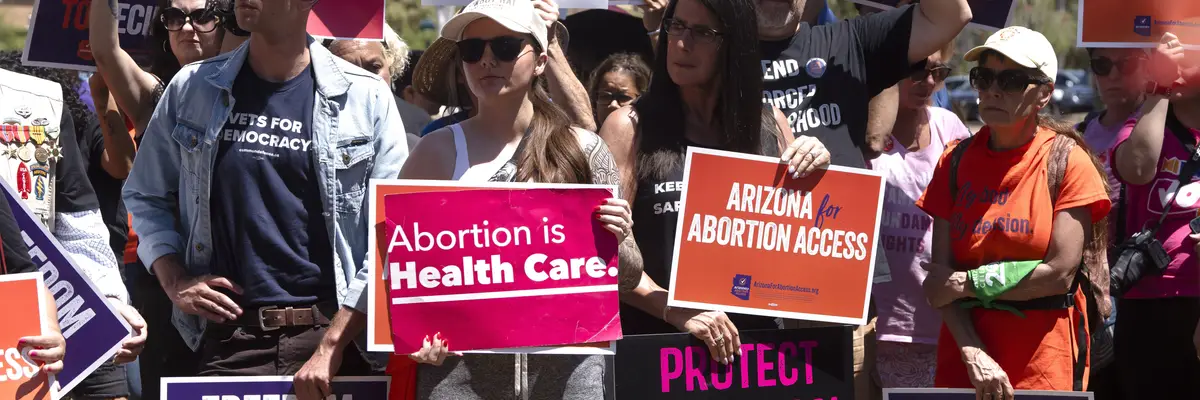
Members of Arizona for Abortion Access, the ballot initiative to enshrine abortion rights in the Arizona State Constitution, hold a press conference and protest condemning Arizona House Republicans and the 1864 abortion ban during a recess from a legislative session at the Arizona House of Representatives on April 17, 2024 in Phoenix, Arizona.
(Photo by Rebecca Noble/Getty Images)

Sylvia Ghazarian
Apr 10, 2026
Common Dreams

The maternal mortality crisis in the United States is a national embarrassment, and it’s unfolding in real time. The US continues to have one of the highest maternal death rates among high-income countries, and the situation is getting worse, not better. Behind this trend is a growing body of research showing that state abortion bans directly contribute to increased maternal mortality, especially in communities already burdened by systemic inequities.

Maternal mortality has traditionally reflected deep structural problems in a healthcare system that fails to serve all people equally. In 2024, the US maternal mortality rate ticked upward again, reversing a brief decline and demonstrating that the crisis is far from over. Experts point to a range of causes, including reduced access to prenatal care, maternity care deserts, and strained hospital systems, all problems intensified in states with abortion restrictions and in states with increased Immigration and Customs Enforcement (ICE) agents.

A comprehensive analysis from the most recent Centers for Disease Control and Prevention (CDC) mortality figures shows that people living in states that have banned abortion are nearly twice as likely to die during pregnancy, childbirth, or soon after compared with those in states where abortion remains legal and accessible. What’s more, in supportive states where abortion has remained legal, maternal mortality has declined by about 21% since 2022, suggesting that access to comprehensive reproductive care saves lives.

Restricting abortion does more than eliminate a medical procedure; it forces people to carry pregnancies that pose very real health risks. Childbirth has inherent dangers from hemorrhage and infection to hypertensive disorders and cardiac events, and the risk of death from pregnancy is at least 44 times higher than from abortion. When abortion is inaccessible, people are compelled to continue unwanted or medically unsafe pregnancies. That dynamic alone drives increased deaths that could otherwise have been prevented.

Bans do not reduce the prevalence of abortion; they reduce its safety, push people into riskier medical scenarios, and leave pregnant people with fewer options even when their health is at stake.

Racial and socioeconomic disparities in maternal mortality did not begin with the reversal of Roe v. Wade. Black birthing people in the US have long faced significantly higher death rates than white birthing people, a symptom of deep structural racism in healthcare, poverty, and chronic stress. But abortion bans have exacerbated these inequities.

In states with abortion bans, Black birthing people are more than three times as likely as white birthing people in those same states to die from pregnancy-related causes. Those figures make crystal clear that when we talk about maternal mortality, we are talking about a crisis of racial inequity, class inequity, and political neglect. States with the worst maternal health outcomes, including Louisiana, Mississippi, and Texas, are predominantly in the South and have enacted some of the most restrictive reproductive laws.

These disparities compound with other conditions such as limited access to early prenatal care—which the CDC reports has declined across the country, with the steepest drops among Black mothers. Delays in early care are associated with worse outcomes for both mother and baby and are worsened by the closure of maternity care facilities in rural and under-resourced areas.

For undocumented and immigrant communities, the maternal mortality crisis is layered with additional barriers. Fear of immigration enforcement, including ICE, deters people from seeking care, even in emergencies. Clinics in border states with large immigrant populations were already medically underserved before Dobbs, and abortion bans have deepened that inaccessibility. Many undocumented people lack insurance, fear reporting, or face economic barriers that make traveling for care impossible. These structural obstacles do not just delay care, they can literally cost lives.

Immigrant and mixed-status families are disproportionately concentrated in states with abortion bans, like Texas, Arizona, and Florida, meaning that people who already face the greatest systemic barriers to healthcare are also the most likely to lack access to safe abortion or comprehensive maternal services. This intersection of racist policy, reproductive restriction, and anti-immigrant enforcement creates a perfect storm that pushes already vulnerable people further to the margins and deeper toward harm.

Critics of abortion argue from moral or ideological positions, but the evidence shows that access to abortion care is fundamentally a matter of public health. Bans do not reduce the prevalence of abortion; they reduce its safety, push people into riskier medical scenarios, and leave pregnant people with fewer options even when their health is at stake.

We are now witnessing a preventable loss of life, and the window to act is closing.

We know how to prevent many maternal deaths: Expand access to comprehensive reproductive care (including abortion), strengthen prenatal and postpartum support, increase Medicaid coverage, invest in maternity care infrastructure, and dismantle the historic and systemic inequities that predict who lives and who dies. We know these interventions work because states that have protected reproductive rights are already seeing declines in maternal mortality.

To ignore this crisis is to ignore evidence, dignity, and the lives of pregnant people, especially those in Black, Indigenous, immigrant, and economically disadvantaged communities.


Our work is licensed under Creative Commons (CC BY-NC-ND 3.0). Feel free to republish and share widely.


Sylvia Ghazarian
Sylvia Ghazarian is executive director of the Women’s Reproductive Rights Assistance Project (WRRAP).
Full Bio >
We Must Fight Fossil Fuel Oligarchs to Save Democracy

It’s no coincidence the fossil fuel industry has lined up behind racist, belligerent, and authoritarian leaders like Trump.


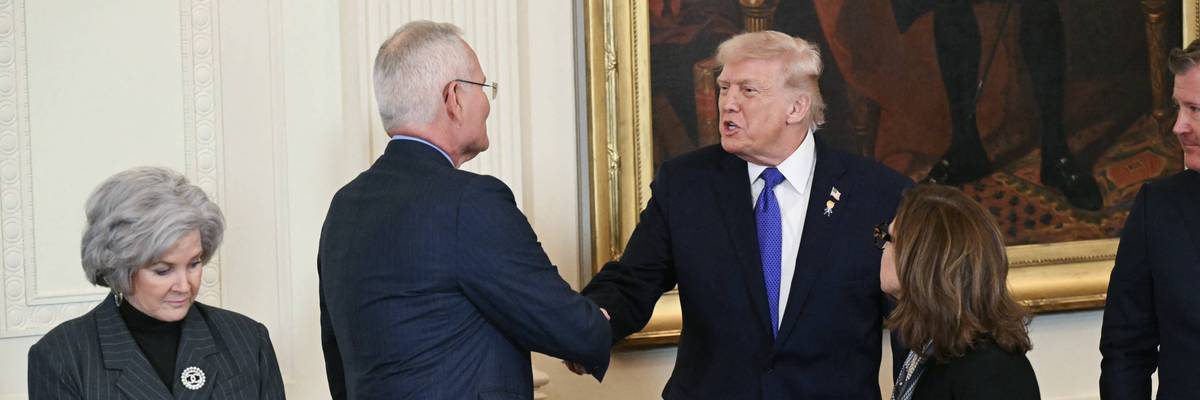
US President Donald Trump shakes hands with ExxonMobil CEO Darren Woods during a meeting with US oil company executives in the East Room of the White House in Washington, DC on January 9, 2026.
(Photo by Saul Loeb / AFP via Getty Images)

Basav Sen
Apr 10, 2026
Common Dreams

The second Trump administration has been an unrelenting assault on democracy.

Basic democratic rights are disappearing. Unarmed people have been executed in the streets and smeared as “terrorists” by the government. Entire families are being kidnapped and denied basic rights in inhumane detention centers. And journalists are being arrested for doing their jobs.

Against this backdrop, working for climate justice might seem like a distraction.

But a clear-headed look at how we ended up in this grim situation in the first place shows that the movement for climate justice, far from being a distraction, is an essential part of the fight to defend and deepen democracy.

We cannot defeat authoritarianism without breaking the stranglehold of the fossil fuel industry on our economy and our political system.

The Trump administration has received major political backing from fossil fuel oligarchs—in response, in fact, to Trump’s open solicitation to trade favors for their support. The government has subsequently followed an energy and environmental policy agenda that benefits the industry.

The administration has expanded the industry’s access to resources at home through leases and permits for drilling in public lands and waters. It has attacked Venezuela, kidnapped its president, and is attempting to open up the country’s oil reserves to US corporations.

And of course it launched an unprovoked war on Iran, sending the price of oil skyrocketing—and leading to genocidal threats from the president against Iran unless the country reopens the Strait of Hormuz, through which Gulf oil passes.

Meanwhile at home, the Trump administration has weakened environmental standards, including mercury pollution standards for power plants. By attacking motor vehicle fuel economy standards, it has effectively grown the captive market for the industry’s products. And it has abused the federal permitting process to try to kill the fossil fuel industry’s main competitors, wind and solar energy.

This is not merely a case of an administration that supports the fossil fuel industry and also happens to be authoritarian. The industry directly supports and benefits from an authoritarian government that curtails democratic rights and silences dissent. It also benefits from a government that upholds white supremacy and enforces racial hierarchy.

Several years ago, a report I worked on for the Institute for Policy Studies documented how the fossil fuel industry has used its money and influence to push for state-level legislation to criminalize protest against fossil fuel infrastructure projects. These so-called “critical infrastructure laws” are now on the books in 19 states. The industry has also used strategic lawsuits against public participation (SLAPPs) to intimidate and silence critics.

This is a predictable response of a powerful, politically connected industry that is under assault on two fronts.

First, competition from cheap, widely available wind and solar energy poses a serious economic threat to the industry. Renewable energy is cheaper than fossil fuels in most of the world, and new generation capacity is dominated by renewables.

Simultaneously, the industry faces serious political and reputational threats. Growing numbers of people worldwide are experiencing extreme heat, wildfires, storms, floods, and toxic air and water pollution attributable to the industry’s activities. Many of them are connecting the dots, and refusing to be passive victims of a powerful industry and its political backers.

Social movements against particular fossil fuel projects, or against the industry more broadly, have multiplied on every continent. What’s more, they are already winning. The industry faces restrictions in several political jurisdictions, and likely recognizes that it could even be expropriated in the not so distant future.

Faced with these twin crises, the fossil fuel industry is increasingly resorting to relying on the repressive apparatus of state violence to crush dissenting voices and maintain its dominance.

The industry has also historically benefited from a racially and economically unequal society. The lack of political power of Indigenous, Black, and other racially marginalized communities, and of poor communities of every race, has enabled the industry to locate polluting infrastructure in these communities, treating them as sacrifice zones. This has let the industry avoid the protracted zoning and legal battles they would have to contend with if they tried to locate their infrastructure in more privileged communities, greatly reducing the cost and lead time for their projects.

In recent years, the growing strength of the environmental justice movement has threatened the ability of the industry to continue to reap the benefits of racial and economic stratification. It is therefore no surprise that the industry is supporting an openly white supremacist political agenda that seeks to bring old racial hierarchies back and eliminate the very concept of environmental justice.

In sum, the far-right agenda in the US is deeply intertwined with the political and economic objectives of the fossil fuel industry that is at the root of climate change. We cannot defeat authoritarianism without breaking the stranglehold of the fossil fuel industry on our economy and our political system.

Finally, it is worth pointing out that these observations are mainly based on US politics, but are applicable to many parts of the world. Fossil fueled fascism has become a global phenomenon, and our resistance to the fossil fuel industry must be similarly global in scale.


Our work is licensed under Creative Commons (CC BY-NC-ND 3.0). Feel free to republish and share widely.


Basav Sen
Basav Sen is the climate justice project director at the Institute for Policy Studies (IPS) and writes on the intersections of climate change and social and economic justice. Prior to joining IPS, Basav worked for 11 years as a campaign researcher for the United Food and Commercial Workers.
Full Bio >
Trump Weighs Ultimate Gift to For-Profit Insurance Industry: Medicare Privatization

“They want to remove the guarantee of Medicare,” one advocate said of the Trump administration’s floated plan to automatically enroll seniors in Medicare Advantage.


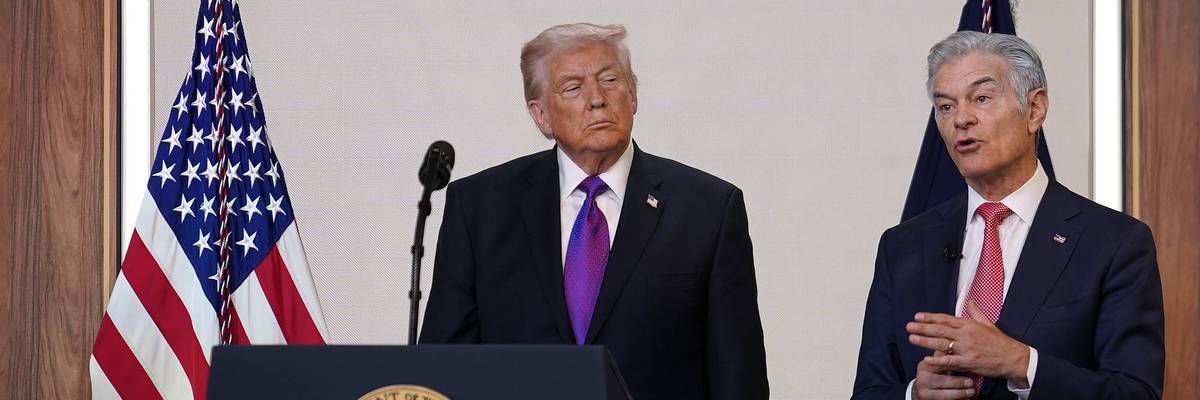
Centers for Medicare and Medicaid Services Administrator Mehmet Oz speaks as President Donald Trump looks on during an event on February 5, 2026.
(Photo by Nathan Howard/Getty Images)

Jake Johnson
Apr 10, 2026
COMMON DREAMS

The Trump administration is considering enacting a policy that would automatically funnel seniors into for-profit Medicare Advantage plans—which critics say would set Medicare on the path to full-scale privatization.

Chris Klomp, the Trump administration’s director of Medicare and deputy administrator of the Centers for Medicare and Medicaid Services (CMS), told STAT last month that enrolling seniors in Medicare Advantage (MA) plans by default “is something that we’re thinking through.” MA plans are funded by the federal government and run by private insurance companies such as UnitedHealthcare and Humana, both of which have been accused of improperly denying necessary care to patients and overcharging taxpayers.

The default enrollment scheme was floated in the far-right Project 2025 agenda that President Donald Trump has repeatedly tried to disavow. Currently, older Americans who have received Social Security benefits for at least four months before they turn 65 are automatically enrolled in traditional Medicare, and they can choose to enroll in an MA plan as an alternative.

“Another bad idea straight from Project 2025,” Rep. Mark Pocan (D-Wis.) said in response to Klomp’s comments on the proposed default enrollment change. “Medicare Advantage is private, for-profit insurance that overcharges American taxpayers by billions every year and regularly denies seniors the care they need.”

“Making Medicare Advantage the default option hurts patients and taxpayers,” Pocan added, “but it will make insurance execs a lot of money.”

“With Mehmet Oz running the agency, they can move incredibly quickly to make that happen, and they are.”

Klomp said no plans have been finalized, but defenders of traditional Medicare warned that CMS—headed by Mehmet Oz, who during his 2022 US Senate run backed a plan entitled “Medicare Advantage for All”—could try to swiftly ram the change through without public input.

“With Mehmet Oz running the agency, they can move incredibly quickly to make that happen, and they are,” Alex Lawson, executive director of the progressive advocacy group Social Security Works, told Common Dreams on Friday. “They will not explain it to the people, because the people hate the idea. Instead, they say ‘change the default option’ and other policy jargon to try and hide the fact of what they are doing, privatizing Medicare.”

“They want to remove the guarantee of Medicare,” warned Lawson, “and replace it with the same private insurance giants that make billions denying healthcare, especially to those who need it the most.”

Experts say making Medicare Advantage plans the default enrollment option for seniors would likely decrease traditional Medicare enrollment dramatically.

Given massive overpayments to Medicare Advantage plans—potentially $1.2 trillion over the next decade, according to one independent estimate—a large increase in MA enrollment would be sure to drive up costs and monthly premiums across the board. A report released last month by the congressional Joint Economic Committee estimated that MA overpayments led to premium hikes of $212 per Medicare Part B enrollee last year.

“Since 2016, MA overpayments have added an estimated $82 billion to Part B premiums,” the congressional report found. “[Traditional Medicare] beneficiaries, who are not enrolled in MA, bore roughly $6 billion of that burden.”

Under one scheme floated last year by Rep. David Schweikert (R-Ariz.), eligible Medicare recipients would be automatically enrolled in the “MA plan with the lowest premium available,” unless they actively decide to opt out. Once enrolled in an MA plan, individuals would be unable to switch plans for three years.

Wendell Potter, a former health insurance executive who now champions Medicare for All, warned Friday that under Schweikert’s plan, “seniors would be locked in a plan that the government chose for them, that has a limited network of doctors and hospitals, that makes them pay the entire bill for services they might receive outside of that network, and that denies coverage for medically necessary care far more than traditional Medicare—for three years.”

In addition to weighing the default enrollment change, the Trump administration has recently delivered smaller-scale but significant victories to MA insurers, including by boosting federal payment rates—bowing to a massive industry lobbying blitz—and easing rules around the marketing of MA plans.

David Lipschutz, co-director of law and policy at the Center for Medicare Advocacy, said Thursday that the latter move represents “a rollback of consumer protections, which gives in to pressures from the insurance industry and those who sell their products.”
DNC Half-Measures Condemning Dark Money Won’t Cut It, Says Sanders as He Demands Total Ban

“Billionaire-funded super PACs—AIPAC, AI, crypto, and others—are spending hundreds of millions to defeat any candidate who crosses them. They should be banned from Democratic primaries. Period.”


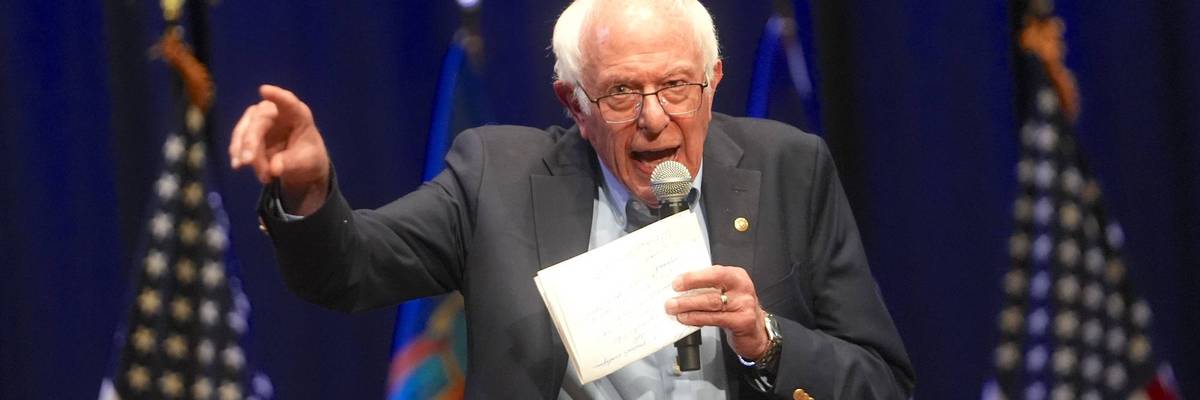
US Sen. Bernie Sanders speaks at Brooklyn College, his alma mater, in New York City on September 6, 2025.
(Photo by Selcuk Acar/Anadolu via Getty Images)


Brett Wilkins
Apr 10, 2026
COMMON DREAMS

Independent Sen. Bernie Sanders on Friday called for a total ban on dark money a day after the Democratic National Committee voted down a resolution that would have condemned the leading US pro-Israel lobby, which has spent nine figures on US elections over the past five years.

The DNC Resolutions Committee rejected the resolution, which condemned “the growing influence” of dark money and corporate-backed outside spending on Democratic races, specifically calling out the American-Israel Public Affairs Committee. United Democracy Project, AIPAC’s dark money arm, unleashed a $100 million blitz targeting progressives during the 2024 election cycle.

When combined with other pro-Israel lobby groups, like GOP megadonor Miriam Adelson’s Preserve America PAC, that figure soars to over $200 million, according to the public interest group AIPAC Tracker.

Instead, the DNC panel opted for a broader resolution decrying the influence of dark money—defined as undisclosed independent campaign contributions—in the 2026 Democratic primaries.

“The DNC just passed a resolution condemning dark money,” Sanders (Vt.) said Friday on X. “That’s a start, but not enough.”

“Billionaire-funded super PACs—AIPAC, AI, crypto, and others—are spending hundreds of millions to defeat any candidate who crosses them,” the senator added. “They should be banned from Democratic primaries. Period.”

Sanders campaigned twice for president, centering his opposition to the Supreme Court’s 2010 Citizens United v. Federal Election Commission ruling, which effectively ushered in the modern era of secret unlimited political spending.

According to the Brennan Center for Justice, dark money spending in federal elections has skyrocketed from negligible amounts before 2010 to over $1.9 billion in the 2024 cycle alone, with over $4 billion in total undisclosed outside financing following the high court’s contentious ruling.

Polling has repeatedly affirmed that support for Israel—which stands accused in the International Court of Justice of committing genocide in Gaza and has already been found by the ICJ to be illegally occupying Palestine under apartheid rule—is detrimental to Democrats.

The DNC’s own suppressed postmortem of the 2024 presidential election also showed that former President Joe Biden and Vice President Kamala Harris’ unconditional support for Israel cost Harris votes.

As AIPAC has grown more toxic to US voters amid a litany of Israeli atrocities in Gaza and the West Bank under the government of Prime Minister Benjamin Netanyahu—who is wanted by the International Criminal Court for alleged crimes against humanity and war crimes in Gaza—a growing number of Democrats, including some who once welcomed the group’s support, are turning their backs on the lobby.

“AIPAC really is not an organization that I think today I would want any part of,” Illinois Gov. JB Pritzker said last month after affiliated groups poured $22 million into House races in his state.

While AIPAC cash was instrumental in unseating congressional progressives including former Reps. Jamaal Bowman (D-NY) and Cori Bush (D-Mo.), its largesse failed to oust others, including Reps. Summer Lee (D-Pa.), Ilhan Omar (D-Minn.), and Rashida Tlaib (D-Mich.).

Sanders wasn’t the only one to criticize the DNC’s rejection of the anti-AIPAC resolution.

“The American people are clear: They want our government to invest in life and stop funding the bombs that are destroying lives in Palestine, Lebanon, and Iran,” Jewish Voice for Peace political director Beth Miller said Friday.

“The DNC‘s failure to pass this simple resolution condemning the outsized spending of an extremist and Republican-funded group like AIPAC in Democratic primaries shows how wildly out of touch the party is with its base,” Miller added.


Democrats Reject Resolution Condemning AIPAC Money in Primaries

“Democrats chose genocide over winning in 2024,” one Palestinian rights advocate said. “When does this stop?”
April 10, 2026

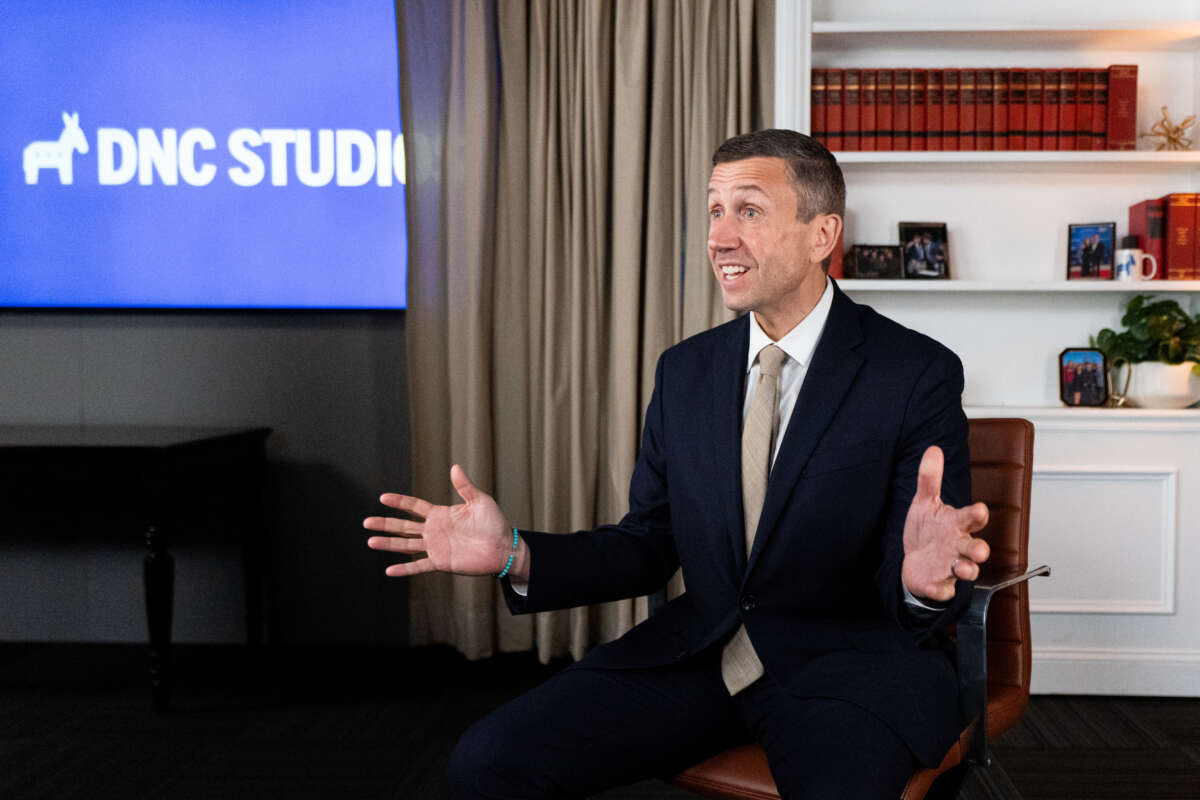
Ken Martin, chair of the Democratic National Committee, speaks during an interview at DNC headquarters in Washington, D.C., on November 2, 2025.Bill Clark / CQ-Roll Call, Inc via Getty Images

Democratic Party leaders had a chance this week to push back against Israel’s violent expansionism and the Israel lobby’s massive political spending in the United States.

Once again, Democrats chose instead to punt the issue despite plummeting public support for Israel, both among their base and the wider U.S. public, ahead of the midterms.

At a meeting in New Orleans on April 9, members of the Democratic National Committee (DNC) voted down a symbolic resolution to limit the “growing influence” of dark money and corporate outside spending on Democratic races, particularly the American Israel Public Affairs Committee (AIPAC), which recently pumped tens of millions of dollars into Democratic primaries in New Jersey and Illinois.

A draft of the resolution stated that “massive outside spending” by groups on candidates based on “positions regarding international conflicts or foreign governments” raises concerns about undue influence on debate and policy making, potentially “constraining elected officials’ ability to represent the views of their constituents.” The resolution specifically called out AIPAC by name.

The DNC Resolutions Committee also tabled a pair of resolutions to recognize a Palestinian state and support restrictions on aid to units in the Israeli military accused of war crimes. Those resolutions were referred to the party’s nascent Middle East Working Group, which was created last year as it became increasingly clear that public opposition to Israel’s genocide in Gaza cost Democrats votes in the 2024 elections.

DNC members also sent to the working group a resolution calling for an end to the U.S.-Israeli war on Iran and pointing to potential war crimes in the suspected U.S. strike on a girls’ school in Minab that killed at least 175 people, most of them children, on February 28.

The Middle East Working Group, which includes members with diverging views on Israel, held its fourth meeting this week but has been slow to agree on an agenda. Hamid Bendaas, communications director at the Institute for Middle East Understanding (IMEU) Policy Project, said the group does not appear on track to accomplish much before voters go to the polls in November.

“The Democratic Party seems asleep at the wheel and is not responding to this very quick and very influential public opinion shift on Israel.”

“The Democratic Party seems asleep at the wheel and is not responding to this very quick and very influential public opinion shift on Israel,” Bendaas told Truthout in an interview.

However, some Democrats know that the party cannot forever avoid either U.S. financial and military support for Israel’s expansionist conquests or the influence of AIPAC. One DNC member speaking on the condition of anonymity said they had received direct calls about the resolutions from “two presidential aspirants who would have to answer for the DNC’s positions on Israel and AIPAC if they run,” according to Politico.

Meanwhile, Israel’s violent apartheid and ethnic cleansing, perpetrated with U.S. weapons and funding, continues unabated, according to the American Friends Service Committee’s Just Peace Global Policy Director Mike Merryman-Lotze.

“The failure of the DNC to take even minimal action in the face of ethnic cleansing and genocide is shameful,” Merryman-Lotze said.

Merryman-Lotze said the DNC’s tabling of the resolutions on a Palestinian state and military support to Israel came as the Israeli government announced 34 new settlements in the occupied West Bank, where extremist settlers are violently forcing Palestinians from their homes with support from the Israeli government and military. The DNC resolutions reaffirm that such settlements are illegal under international law.

“The approval of these new settlements follows a year of extreme violence by the Israeli military and settlers in the West Bank that has killed hundreds of Palestinians and displaced tens of thousands from their homes,” Merryman-Lotze said in an email. “Despite the six-month-old ceasefire, Israel has bombed Gaza on 36 of the last 40 days, killing at least 107 people.”

In a memo urging DNC members to adopt the resolutions on Palestine and AIPAC, IMEU pointed to polls showing the vast majority of Democrats (77 percent in August 2025) agree with leading human rights groups that Israel is committing the crime of genocide in Gaza. Support for providing U.S. military aid to Israel has plummeted across the political spectrum, including among Republicans and especially younger voters.

New polling found notably strong support for Palestinian rights in Texas, a historically red state. According to a poll released on April 6 by the IMEU Policy Project and conducted by Data for Progress, 76 percent of voters in the March 3 Texas Democratic Senate primary agree that Israel is committing genocide, and 80 percent support ending weapons funding to Israel.

Nationwide, a Pew Research survey released on April 7 found that 80 percent of Democrats and Democratic-leaning independents hold unfavorable views of Israel, compared to 69 percent in 2024 and 53 percent in 2022.

Bendaas said IMEU consulted with Democrats on the party’s own autopsy of the 2024 elections. That autopsy concluded that Kamala Harris lost significant support in the presidential race due to the Biden administration’s policy of providing seemingly limitless funding for Israel’s genocide in Gaza.

“We are just not seeing any movement from the Democratic Party leadership to adjust from this reality,” Bendaas said. “There’s no urgency to react to what will clearly be an issue for many of their own voters in the November midterms.”

DNC Chair Ken Martin touted a resolution passed on April 9 that condemns the “corrosive influence” of dark money on Democratic primaries but does not single out AIPAC or any other specific interest group.

“We had various resolutions that focused on different industries and groups, and instead of going one-by-one, we passed a blanket repudiation,” Martin said on social media, adding that he supports an end to dark money in politics.

Brian Romick, president and CEO of Democratic Majority for Israel, applauded the DNC for rejecting a “set of divisive, anti-Israel resolutions.”

“These measures would be a gift to Republicans, would further fracture our party, and do nothing to bring Israelis and Palestinians closer to peace,” Romick said in a statement that did not mention AIPAC by name.

However, Bendaas said that Democrats face intense pressure from powerful lobbyists at AIPAC to take positions that do not align with their own voters. AIPAC is funded by Republican billionaire mega-donors such as Miriam Adelson and Paul Singer, and in 2024 the group was the largest source of GOP donations funneled into in Democratic elections. AIPAC’s $100 million in campaign spending in 2024 exceeded the spending of any organization in a single cycle in U.S. history.

“They are invested in defeating Democrats, and they are also flooding money into Democratic elections to support people who do not have voter support otherwise,” Bendaas said. “And this is an existential risk for Democratic Party if you are being propped up by the opposition.”

Bendaas said there appears to be an intentional strategy among AIPAC and its mega-donors to weaken and hollow out the Democratic Party as its voter base increasingly turns against Israel.

“Democrats chose genocide over winning in 2024,” Bendaas said. “When does this stop?”