Monday, April 13, 2026

Negotiating With Bombs

 April 13, 2026

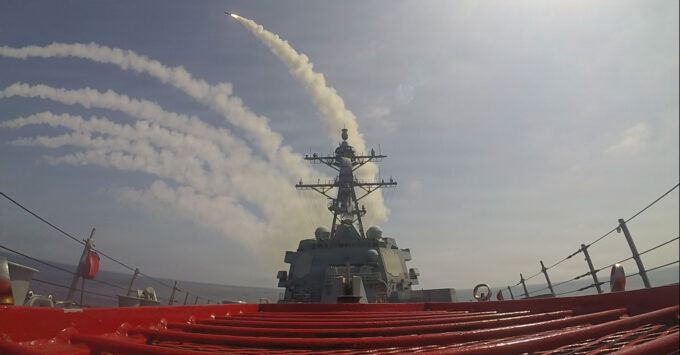
Arleigh Burke-class guided-missile destroyer USS Frank E. Petersen Jr. (DDG 121) fires a Tomahawk Land Attack Missile during operations in support of Operation Epic Fury, Feb. 28, 2026. Photo: U.S. Navy.

Before he became one of the great diplomats of the twentieth century, Henry Kissinger wrote his dissertation about the Austrian statesman Klemens von Metternich. Kissinger closely studied how European diplomats like Metternich constructed a new regional order after the defeat of Napoleon. Metternich was an early expert in the art of herding cats, with the felines being powerful European leaders.

Drawing on those insights during his stint as national security advisor under Richard Nixon, Kissinger famously orchestrated the U.S. détente with China and a raft of arms control treaties with the Soviet Union. He also introduced “shuttle diplomacy” in his successful efforts to reduce animosities in the Middle East. He shared a Nobel Peace Prize for his part in the negotiations to end the Vietnam War.

Kissinger was no peacenik. He was involved in any number of military interventions and morally indefensible actions, such as destabilizing Chile under socialist Salvador Allende and supporting Pakistan in its genocidal campaign against Bengalis. In the case of the Vietnam War, he was a key architect of the secret bombing campaign in Cambodia and Laos, an involvement that calls into question the legitimacy of his Nobel Peace Prize. He was both a master diplomat and a war criminal.

The United States has long operated in these two registers: deploying overwhelming military force and using its diplomatic skills to broker peace deals. The two strategies have often gone hand in hand, as they did with Kissinger.

But what was once a matter of some sophistication—if often wrapped in secret violence—has now simply become heavy-handed and transparently brutal. The Trump administration has touted a series of peace deals that, at least in their sheer quantity, rival the successes of Henry Kissinger. Examined more carefully, however, those deals are either premature, non-existent, or largely a function of showmanship. The “peace deal” in Gaza, for instance, was hastily assembled and poorly thought-through; it’s no wonder that it hasn’t gotten to its second stage.

At the same time, Trump and company have embarked on a series of military campaigns that have culminated in the current Operation Epic Fury against Iran. Here, too, Trump toggles back and forth between war and peace, sometimes in the same remarks to the press. He promises an end to the war, whether Iran agrees to a deal or not, and then threatens to blast “Iran into oblivion or, as they say, back to the Stone Ages!!!”

Ophir Falk, foreign policy adviser to Benjamin Netanyahu, put the matter succinctly when answering a question from National Public Radio about whether the Israeli prime minister supported Trump’s peace overtures to Iran.

“We’re negotiating with bombs,” Falk said.

The utter absurdity of this statement didn’t give him pause or elicit any reaction from the NPR interviewer. In its way, though, the brief statement encapsulates the approach of both Netanyahu and Trump. They are not interested in diplomacy, even when they talk about the value of talks. Negotiations, which require time and a certain amount of delicacy, are a waste of energy.

They prefer to change facts on the ground through sheer force.

Israel has never claimed the mantle of master negotiator or nimble mediator. But the United States has long claimed to have the experience, the relationships, and the economic and military leverage to make deals. The United States has played key roles in resolving conflicts in Northern Ireland, in the former Yugoslavia, between Egypt and Israel, and so on.

Superficially, Trump promises to continue that tradition. He is, of course, the self-proclaimed master of the “art of the deal.”

The truth is, however, that Trump was never a great dealmaker. He was famous for ripping off his business partners. His career is littered with failed businesses like Trump Airlines, Trump University, and Trump Magazine. Many of his biggest deals—the West Side of Manhattan, Trump Tower Tampa—fell through. He famously endured six bankruptcies.

It’s not just that Trump’s diplomatic deals are similarly fake. Rather, he is threatening to put U.S. diplomacy as a whole into receivership.

After his decision to attack Iran in the middle of negotiations with the country – not just once but twice! – there is no good reason for any country to trust what U.S. diplomats say to them. Diplomacy, after all, is all about trust. In this way, Trump has squandered what remains of U.S. diplomatic capital.

Looking to the future, Trump has also eviscerated the cadre of diplomats that could bring about some return to the previous status quo. Last July, the administration fired 1,300 State Department workers, including nearly 250 foreign service officers. That included staffers focused on the Middle East who were responsible for working out scenarios if the Strait of Hormuz were closed. U.S. overseas aid has been effectively dismantled. The latest budget would reduce State Department and foreign operations by another 22 percent.

Alongside these reductions, Trump increased military spending to $1 trillion and has requested another 50 percent hike to $1.5 trillion. This is the fiscal equivalent of “negotiating with bombs.” After all the staff and budget cuts at the State Department, practically the only thing left that the United States possesses with which to do diplomacy are bombs.

The evisceration of U.S. diplomacy is not exactly a tragedy. U.S. diplomatic activities have always reflected naked self-interest. And other countries can certain step in as mediators: the European Union, China, Oman.

The tragedy lies elsewhere. As long as the United States is no longer pursuing real diplomatic options—in contrast to the Three Stooges method of conflict resolution where Trump bangs together the heads of the primary combatants—it will continue to rely on force as the first resort. Washington will talk in the future almost exclusively with bombs. It will be Kissinger without the diplomatic knowledge. It will be all sticks, no carrots.

Thanks to Trump, the United States has become a thug nation. The only remaining question is whether the rest of the world can somehow preserve the art of diplomacy—as Pakistan has done to avert the latest threats of escalation in the Iran War—and reverse the current trend of using bombs to negotiate.

John Feffer is the director of Foreign Policy In Focus, where this article originally appeared.

Irish government announces tax cuts after fuel cost protests


ByAFP
April 12, 2026


Last week's protests started with go-slow convoys on motorways - Copyright AFP Paul Faith

Ireland’s government announced fresh tax cuts on petrol and diesel at an emergency cabinet meeting Sunday after fuel cost protests that had threatened the functioning of the country’s emergency services.

Since Tuesday, hauliers and agricultural contractors have launched a series of protests over spiralling petrol and diesel prices in the wake of the Middle East war.

“As a Government, we hear you,” Finance Minister Simon Harris said at a news conference. “We have acted and we are taking further action today,” he added.

The cuts announced include a 10-cent reduction per litre on both diesel and petrol — and a planned increase on carbon tax will be postponed from May until the Budget in October.

Last week’s protests grew from slow-moving convoys on motorways and restricted access to Dublin’s busiest streets, to a part blockade of Ireland’s only oil refinery and restricted access to at least two other fuel depots.

Some protests were still going for sixth day Sunday.

Earlier, the government had urged the public not to panic-buy as pumps at many fuel stations ran dry.

Police on Saturday with the support of the armed forces deployed public order units to clear the blockade at Whitegate Refinery in southern Ireland.

Irish police chief Justin Kelly said the action was taken as a last resort.

He condemned the refinery blockade as “illegal activity” by people determined to “hold the country to ransom”.

The blockading of “critical national infrastructure” had “resulted in fuel shortages that are directly impacting on emergency services such as hospitals, the ambulance service, and the fire service”, he said.

Elsewhere, police dismantled a makeshift barrier erected by protesters blockading western Galway docks.

A late-night operation also targeted the blockade of the capital Dublin’s main thoroughfare O’Connell Street after multiple vehicles including tractors and lorries were removed.

Justice Minister Jim O’Callaghan warned earlier that the continued protests were “unacceptable”.

“While we all acknowledge the impact of higher fuel prices, and seek to minimise that impact, no groups are entitled in our republic to hold our people to ransom in such a manner,” he said.

In March, Dublin announced a 250 million-euro package to reduce fuel costs, notably including a diesel rebate for road haulier.

The Fuel Protests: Blame The Government Not the Protesters


Monday 13 April 2026, by People Before Profit


Back the basic demands. Defend the right to protest. Oppose the frauds on the far-right and discuss the protest leaders, but let’s keep coming back to the real issue of unbearable price increases and where they come from. Workers, unions- let’s deepen the movement for a country we can all live in. [1]

The basic demand is right!

For several days Ireland has seen some of the most militant protests in years: roads blocked, fuel depots and the Whitegate refinery targeted, fuel supplies thrown into chaos. The government is under real pressure because the core demand is right and massively popular: price caps on fuel during a cost-of-living crisis that is crushing ordinary people. We have been calling for such caps for years.

Because the government has failed to act we have a cost of living crisis on top of a cost of living crisis. Since Covid prices have gone up by 25% but basics such as food and energy by a lot more. Wages have been cut in real terms. In the last budget the government gave massive tax breaks to developers and fast food chains and took support away from households.

Around 320,000 households are in arrears on electricity and gas bills. Barnardos say that two in five parents had reduced portion sizes, skipped meals or gone without food to feed their children. No wonder people are angry.

The government’s cuts to excise duty three weeks ago were tokenistic, wiped out almost immediately by the scale of the global commodity crisis. People were told to be grateful for scraps while costs kept rising. In many working class communities, these protests are popular for exactly that reason.

Defend the right to protest

The government’s decision to call in the army to Whitegate today is an attack on the right to protest, and we condemn it without reservation. At Whitegate, protesters were pepper sprayed and the Defense Forces were deployed to clear vehicles. This is the state using force against people exercising a democratic right. Protest to be effective must be disruptive and polarising but as James Connolly surmised, it is the “incarnation of progress” - strikes, protest and civil disobedience have been central to every social advance we have ever made, from the right to vote to rights in the workplace.

This repression cannot be allowed to stand as a precedent. Repressive powers used here will be used again: against workers taking industrial action, against housing movements, against Palestine solidarity protesters, against anyone who seriously challenges the interests this government protects. The right to protest is not a privilege the state grants when it is comfortable. It is a right that must be defended regardless of whether you agree with the demands of those on the streets.

Who is in this movement and why

We also have to be honest about the class character of these protests. This movement is led by people who own companies, employ workers and have access to expensive machinery. Though workers and farmers are present in numbers, they are not dictating the pace or demands at this stage.

Some of the most visible leaders have made racist, misogynistic and homophobic statements publicly.

But that is not the whole story. There is a real mix of people in and around this movement, including many working class people looking on sympathetically, in some cases inspired by the militancy of the protests. This has happened because the movement of organised workers, the trade union movement, has completely failed to give any lead on the cost-of-living crisis. In that vacuum, people will turn to whoever appears willing to fight.

Where soaring costs actually come from

Soaring fuel costs are driven by energy company profiteering, but also by Trump and Israel’s war on Iran. The Irish government refuses to act. It still allows the United States to use Shannon Airport like a military airfield, waving US warplanes through even as some NATO allies have refused. That is cowardice from Micheál Martin and this government, and it directly feeds the crisis hitting people at the pumps and on their bills. It is impossible to detach the fight for peace and justice in the world from the fight for dignity and social justice at home.

The far right are frauds on this issue

Some of the loudest figures attaching themselves to these protests are cheerleaders for Trump, for racism, and in some cases for Israel. They want to blame migrants, LGBT people or whoever else is convenient, instead of the profiteers, war-makers and politicians actually responsible. The people who gave Paul Murphy and People Before Profit hassle on O’Connell bridge this week were not farmers defending their livelihoods. They were political grifters trying to drag this movement in a poisonous direction. To anyone attacking us for standing with LGBT people or Palestine: it was not a trans person or a migrant who started bombing Iran. Working class power comes from working class unity and militancy - if we allow racism or homophobia room to breathe, we turn our backs on some of the most militant people in Irish society and we divide the working class as a whole.

A bigger movement is needed

This crisis also exposes something deeper. Fossil fuel dependence leaves workers exposed every time there is a global shock. We need a just transition, but one that lifts workers up rather than punishing them. The government and the Greens have tried to make ordinary people carry the burden through carbon taxes and higher bills, while corporations keep polluting and data centres consume electricity at cheaper rates than households. Those data centres are on course to consume 30% of all electricity in Ireland by 2030. Homes and businesses are being squeezed while a handful of tech giants are handed cheap power at scale. That has to end.

Time for workers and unions to act!

The anger on the streets is real and justified. But a movement dominated by small business owners and owner-drivers, with far-right figures hovering at its edges, cannot win the demands that working people actually need.

We must demand that our unions enter the fight. Workers did not cause this crisis. Energy companies, war-makers and a government that serves corporate interests did. The unions have the membership, the resources and the leverage to force real change on the cost of living. It is time to use them. Every trade union branch, every shop steward, every community organisation should be discussing what action can be taken and building for it now.

Our demands

While we support the demand for price caps we also want to go further. People Before Profit is calling for immediate action on the cost-of-living crisis:

- mmediate price caps on fuel and energy
- Windfall taxes on energy companies making record profits from this crisis
- €500 energy credit for all households, with €400 cost of disability payment
- Double payments for those on social welfare
- Free public transport to reduce costs for commuters and demand for fuel
- Ramp up retrofitting to reduce energy costs
- End the sweetheart electricity deals for data centres; make them pay household rates
- Ban the construction of new data centres
- US military out of Irish Airports and skies - Defend our neutrality.
- No carbon taxes on ordinary households - make the real polluters pay!

Our position

The central lesson here is simple. When workers are hit by a cost-of-living crisis and unions fail to lead, people look to whoever is willing to fight. The answer is not to sneer at that militancy. It is to deepen it, broaden it, root it in working class demands, defend it from repression, and stop reactionaries from hijacking it. We should take inspiration from the fact that the current disruption is forcing the government to act.

People Before Profit supports these protests, defends the right to protest, and is committed to building a deeper movement for a country we can all live in. We initiated the Affordable Ireland Campaign and will be talking to others in the Campaign about the steps necessary to build that movement now.

We will be on the streets next Saturday opposing Trump’s and Israel’s war, the main cause of the current crisis, and demanding an end to our government’s complicity with the war. We need a huge turnout to send a message that ordinary people want an end to the war and cost of living crisis that it has caused.

12 April 2026

Source: People Before Profit.

Footnotes

[1Photo: Tractors on a quiet O’Connell Street Saturday 11 April with the Jim Larkin Statue GPO and Spire in the background.


Nuclear Myths Continue To Fuel Neocon Fantasies

by  | Apr 13, 2026 |

Reprinted from The Realist Review.

In a recent televised rant on the Fox News Channel, the neoconservative publicist Mark Levin made the eye-opening claim that the current US-Israeli War on Iran is “every bit as important as World War Two.” Still more, according to Levin, the specter of an Iranian nuclear weapon (for which there is approximately zero evidence), requires us, as good citizens to rally around the President and the military. Not surprisingly, Levin also noted that President Truman’s decision to use atomic weapons against Japan saved “a million men” by forestalling a US invasion of the Japanese Home Islands (the inference being: Trump should do likewise). Truman’s decision to incinerate Hiroshima and Nagasaki with atomic bombs remains a topic (among a number of others) with which we Americans largely deal in the counterfeit currency of myths.

Despite the conclusions of the US Bombing Survey, that “certainly prior to December 1, 1945, and in all probability prior to November 1, Japan would have surrendered even if the atomic bombs had not been dropped, even if Russia had not entered the war, and even if no invasion had been planned or contemplated,” few myths are as entrenched in the psyche of America’a media and political elites as the claim that Truman’s decision (invariably valorized as “brave”) to incinerate a quarter of a million civilians – mainly women, children, and elderly – in Hiroshima and Nagasaki won the war in the Pacific.

The claim that Truman’s decision saved countless American lives has grown to proportions that would have surprised, if not shocked, Truman’s own military high command. President George H.W. Bush, himself a veteran of the Pacific campaign, claimed that the atomic bombs saved the lives of half-a-million US servicemen.

The record, however, rebuts the myth.

Truman’s military advisers disagreed with Truman. Five-star Navy Admiral William Leahy, who served as Roosevelt and Truman’s chief of staff, felt that the bombs were “of no material assistance in our war against Japan.” The Japanese, said Leahy, “were already defeated and ready to surrender.” Leahy believed Truman’s decision to use nuclear weapons had “adopted an ethical standard common to the barbarians of the Dark Ages.” Likewise, Admiral William F. Halsey, Commander of the Pacific Fleet, noted that, “the Japs had put out a lot of peace feelers throughout Russia long before” Truman decided to drop the bombs. Two weeks after the nuclear attacks, General Curtis LeMay publicly criticized the decision, saying, “The war would have been over in two weeks. . . . The atomic bomb had nothing to do with the end of the war at all.”

The myth that the bombs “saved” a million US servicemen who would have otherwise perished in the invasion of the Home Islands came from the pen and imagination of the man who would become among the most infamous strategists and apologists for the War in Vietnam, McGeorge Bundy.

Born in 1919 to an upper-class family from Boston, Bundy was a graduate of Yale who served as an Army intelligence officer during the war. His father, Harvey Hollister Bundy, was a close associate of FDR’s Secretary of War, Henry Stimson. After the war, McGeorge was hired to ghostwrite Stimson’s memoirs. It was just around that time that journalists and a number of former high-ranking military officials began asking uncomfortable questions about whether it was necessary to use the atomic bomb against the Japanese.

Stimson and Harvey Bundy viewed the growing criticism with alarm, and so, McGeorge was given a second assignment, which was to help Stimson write defense of Truman. That spirited and wholly dishonest apologia appeared on the February 1947 cover of Harper’s magazine. The article, which heavily relied on material provided by Harvey Bundy, said that the atomic bombs were “our least abhorrent choice,” despite the fact that the Japanese had been actively suing for peace. The Harper’s article also included the entirely made up claim that an invasion of the Japanese Home Islands would have come at the cost of a million US casualties.

As Robert Oppenheimer’s biographer, Kai Bird, later noted, Bundy’s essay, “Would stand for at least two decades as the definitive explanation of the decision to use the atomic bomb. Even today, it remains the orthodox view.” Six years after assuming the role of national security adviser, Bundy would depart the White House in disgrace, reviled for his role in perpetuating and defending the war in Vietnam. There is a certain symmetry to his public career, which began as it ended: In the retailing of lies.

Alarmingly, those very lies are now being repurposed by fools like Mark Levin and his Israel First supporters within the Trump administration to justify a nuclear attack on Iran.

James W. Carden is the editor of The Realist Review.  He is a columnist and former adviser to the US-Russia Bilateral Presidential Commission at the U.S. Department of State. His articles and essays have appeared in a wide variety of publications including The Nation, The American Conservative, Responsible Statecraft, The Spectator, UnHerd, The National Interest, Quartz, The Los Angeles Times, and American Affairs.


America Needs a Regime Change

by  | Apr 13, 2026 |

The American people need the Iran war like a fish needs a bicycle. For our politicians and permanent bureaucrats, it’s a different story.

The political class, adrift after the Soviet Union fell, needed a new animating mythos. Neoconservatives taught them to experience preemptive war against tinpot tyrants as a civilizational crusade. The Middle East – where America’s “greatest ally” faced existential threats – offered the ideal stage for the clash between order and barbarism.

Here was the role of a lifetime: to call the shots on a world-historical mission that cast unilateral hard power as virtue. No wonder they cling to it, even after every failed​ regime-change war.

President Donald Trump’s vow that he would never allow Iran to have a nuclear weapon was one of the few moments to draw bipartisan applause during his recent State of the Union address. So what if the geopolitical center of gravity now lies in the Indo-Pacific? On February 28, our leaders reached for another bloody encore in the desert, another stab at playing Wyatt Earp.

Like every functioning addict, America’s ruling class has enablers. Defense contractors monetize its messiah complex, the media industry mythologizes it, and a pro-Israel advocacy network leverages it by converting Israeli geopolitical ambitions into U.S. military imperatives.

When Israel decided to attack Iran, it should have been a time for choosing. Instead, the Trump administration treated U.S. participation as inevitable. The only choice we had was the timing. We could either join Israel’s opening blow or wait until Iran retaliated against U.S. forces before initiating hostilities. America’s terms of entry into the Iran war demonstrate “alliance entrapment,” regardless of whether Secretary of State Marco Rubio conceded it or not.

The first rule of a war of choice is to sell it as a necessity. In the absence of a direct attack on the homeland, the White House has cycled through several rationales. These include preventing an “imminent” nuclear threat (of which no public evidence has been produced), destroying Iran’s missile arsenal, liberating Iranians from tyranny, protecting Israel, and demanding the Islamic regime’s “unconditional surrender.” Ultimately, it settled on an official justification that is nearly verbatim from a memo by the Foundation for Defense of Democracies – a leading Iran-hawk think tank created to “enhance Israel’s image in North America.”

Since the war began, thirteen U.S. troops have been killed and 381 wounded, while the reported death toll across the Middle East is now in the thousands. If Trump opposed the 2003 Iraq War, why is he sacrificing blood and treasure in a strategically unwinnable regime-change operation? It appears that he objected to the outcome of that war and not the ideology that led to its failure. The “axis of evil” morality play always seduces those desperate to feel consequential.

The loudest case for Trump’s pursuit of glory in Iran was made by Israeli Prime Minister Benjamin Netanyahu. After all, dismantling the Shia theocracy and its proxy network would shift the regional balance of power in Israel’s favor. Media mogul Rupert Murdoch and “some conservative commentators” also reportedly pushed the President toward war. Given who the White House is now lionizing, it would be safe to infer that the latter includes big-name neocons Mark Levin and Ben Shapiro.

Contrary to what the Murdoch media entities and neocon cheerleaders claim, American tactical victories have not translated into functional success. Iranian missiles and drones still regularly strike U.S. bases, energy facilities, and civilian areas in our allied Gulf states. The Islamic regime remains intact and it has effectively closed off the Strait of Hormuz. Many of our Asian partners are reeling from the consequent oil and gas supply disruption.

Corroding Pax Americana is a small price for the ruling class to feel like history’s heroes. As the hostilities grind into a war of attrition, Taiwan and our other allies fear that the ongoing diversion of U.S. military forces from the Indo-Pacific will create an opening for Chinese adventurism.

But at home, defense industry-funded think tanks are marketing the conflict as if it closes that opening. Analysts from the Hudson Institute, for example, claim that the Iran war is the first act of a grand strategy to weaken China. They exaggerate China’s ties with Iran and overlook the U.S. military’s inability to conduct protracted wars in multiple theaters. This enabling narrative flips what is a strategic self-own into a 4D chess move.

America’s post-Cold War political elites have an unbroken record of acting out messianic fervor without accounting for its costs or leveling with the public. This pathology is often misdiagnosed as a society-wide symptom of late-stage capitalism or American imperial decline. But it is peculiar to the governing ecosystem. Nowhere is its totalizing influence more evident than in the devolution of MAGA into a personal loyalty creed.

The Trump movement made “America First” its rallying cry. Putting America first demands that American power serve American interests on American terms. Nowhere is this more violated than when Americans are asked to kill and be killed for a foreign country’s hegemonic agenda.

That which cannot be repaired must be replaced. The regime that needs changing is in Washington, D.C. It will take a gray swan event – like an avertible catastrophic war.

Meg Hansen directs the U.S. Chapter of the Indo-Pacific Studies Center. She was a 2023–24 Senior Fellow in the Budapest Fellowship Program and a Visiting Fellow at the Danube Institute.