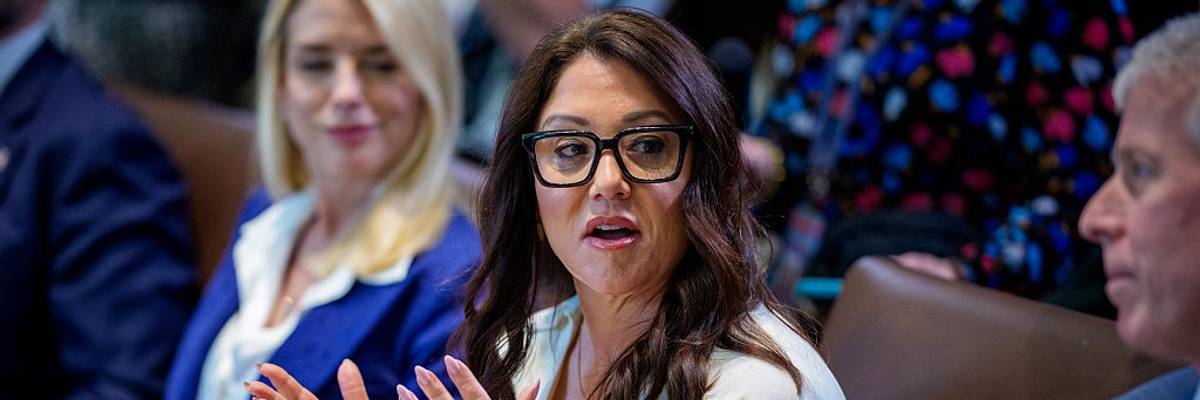
Wednesday, April 22, 2026

AOC Renews Call to Oust Trump After Report on His Exclusion From Situation Room


“In some ways, you kind of want this guy on a golf course more,” Rep. Alexandria Ocasio-Cortez lamented.

April 21, 2026

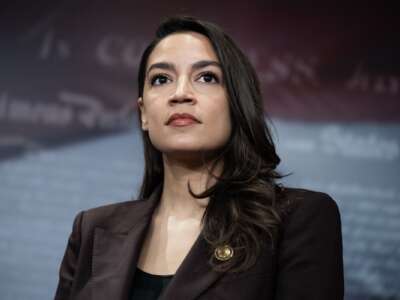
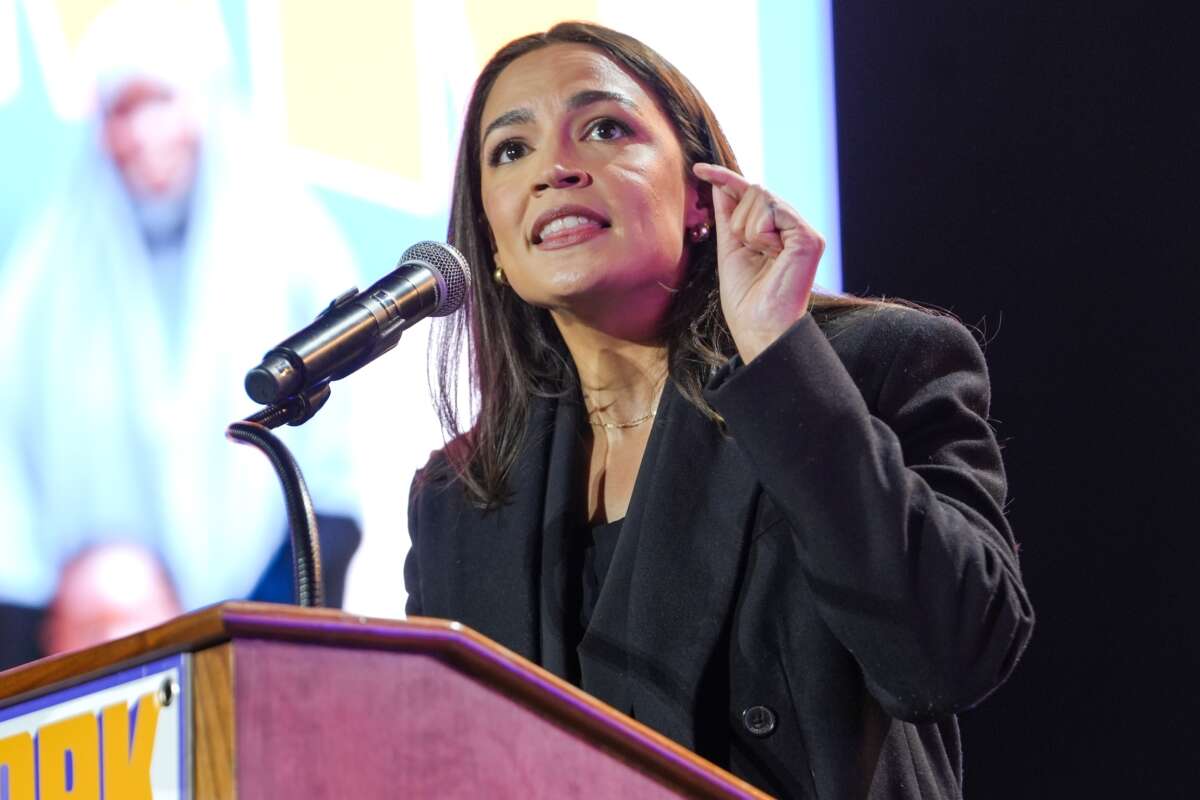
Rep. Alexandria Ocasio-Cortez (D-New York) speaks during a at Forest Hills Stadium 
Stephani Spindel/VIEWpress via Getty Images


Truthout is an indispensable resource for activists, movement leaders and workers everywhere. Please make this work possible with a quick donation.

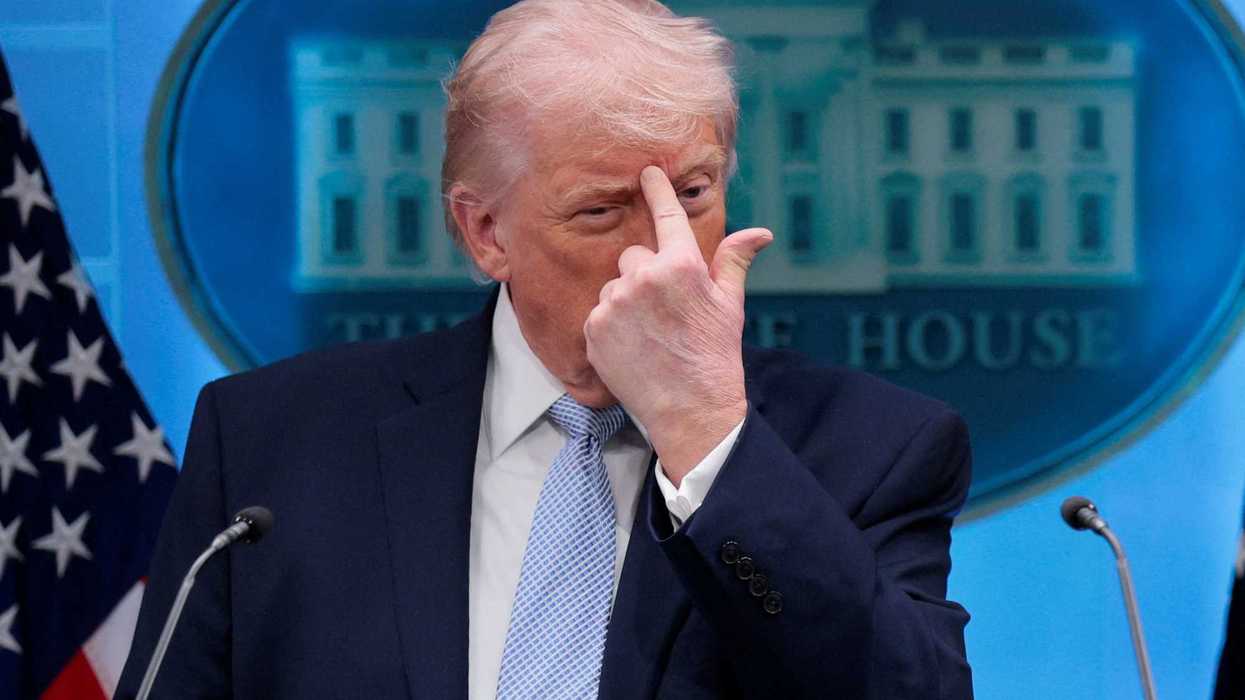
Congresswoman Alexandria Ocasio-Cortez (D-New York) is suggesting that a recent report on President Donald Trump’s involvement in the Situation Room (or lack thereof) during the extraction of U.S. military airmen in Iran should prompt his cabinet members to consider removing him from office.

The Wall Street Journal report in question details that Trump, upon learning that the two airmen’s plane had been shot down, reportedly screamed at his aides for many hours and was later kept from receiving real-time updates on the situation while his staff was given updates.

While senior aides like Vice President JD Vance and chief of staff Susie Wiles were included in Situation Room briefings, Trump was only updated “at meaningful moments” on the phone, The Wall Street Journal reported.

Trump was kept out of the room because aides “believed his impatience wouldn’t be helpful,” a senior official told the publication.

The White House has denied the report’s accuracy, with one spokesperson describing it as “fake news.”


AOC: Iran Deal “Changes Nothing” on Need to Impeach Trump for Genocidal Threat
Trump “threatened a genocide against the Iranian people, and is continuing to leverage that threat,” she said.  By Sharon Zhang , Truthout  
April 8, 2026

When asked about Trump’s frequent visits to the golf course as the war in Iran wages on, Ocasio-Cortez cited the report and suggested that it might be good that Trump was kept away from his presidential duties.

“We’re already seeing that some of the most important military decision-makers in the country are trying to keep him out of consequential decisions, so in some ways, you kind of want this guy on a golf course more than you want him in the Oval Office,” the New York Democrat said while speaking to reporters earlier this week.


“That also calls into question the 25th Amendment,” Ocasio-Cortez added, “because if the determination is that Donald Trump cannot be trusted in the Situation Room, then he’s not fit to be president.”

Section 4 of the 25th Amendment outlines a process for removing the president when it’s deemed that they’re no longer fit to serve. The process requires the majority of the president’s cabinet, along with the vice president, to deem the chief executive “unable to discharge the powers and duties of his office,” at which point the vice president assumes presidential responsibilities.

The president can challenge that determination, after which, if the cabinet and vice president persist in their demands for the president to be removed from power, the issue goes to Congress. Two-thirds of both houses must agree with the cabinet’s determination in order for it to stay in place.

The current political climate makes it highly unlikely that Trump could face a 25th Amendment challenge, as Vance has made no indication that he would back the idea and Trump has filled his cabinet with people loyal to him. The fact that Republicans have a narrow majority in Congress also makes it next to impossible that two-thirds of the House and Senate would vote to remove him.

Still, Democrats have increased their calls for Trump to be removed from power, especially following his Truth Social post earlier this month calling for genocidal action against Iran if the Strait of Hormuz wasn’t reopened, stating that “a whole civilization will die” if his demands weren’t met.

“We need to invoke the 25th Amendment and remove Trump. Threatening war crimes is a blatant violation of our Constitution and the Geneva Conventions,” Rep. Ro Khanna (D-California) said in response to Trump’s post.

“This is not ok. Invoke the 25th amendment. Impeach. Remove,” Rep. Ilhan Omar (D-Minnesota) said.

No major poll has asked voters their views on invoking the 25th Amendment against Trump, but other surveys regarding his removal suggest that a large portion of Americans would support such a move. A Free Speech for People poll earlier this month found that 51 percent of Americans backed impeaching Trump, with only 40 percent against the idea.
Hungarian Prime Minister-Elect Says Country Will Arrest Netanyahu If He Visits

Peter Magyar said the country will halt its withdrawal from the ICC that was initiated by his predecessor, Viktor Orbán.
April 21, 2026

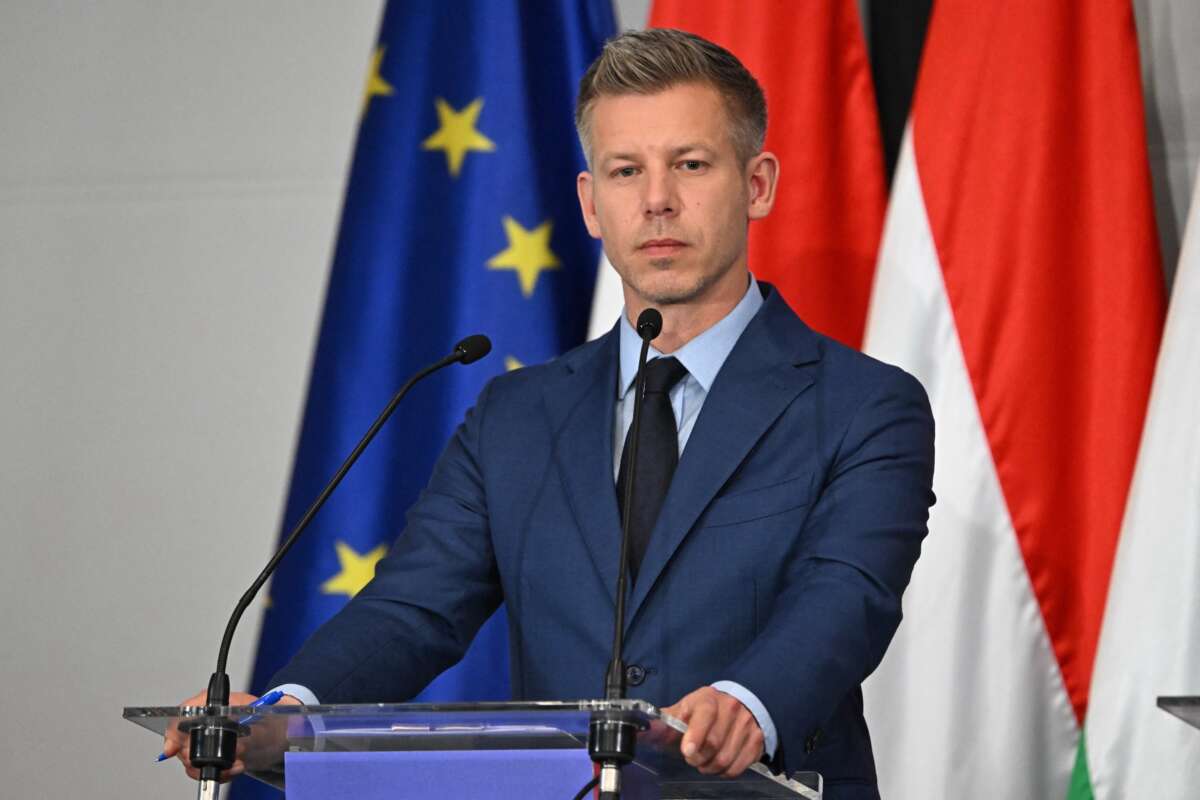
Election winner and leader of Hungary's TISZA party Peter Magyar answers journalists' questions during a press conference following the first official meeting of TISZA's new parliamentary group in Budapest, Hungary, on April 20, 2026.
Attila KISBENEDEK / AFP via Getty Images

Hungarian Prime Minister-elect Peter Magyar said that his government will arrest Israeli Prime Minister Benjamin Netanyahu if he steps foot in the country, joining roughly a dozen other European countries now off-limits for the man wanted by the International Criminal Court (ICC) for crimes against humanity in Gaza.

Magyar, who takes office next month, said that he is ending the country’s withdrawal from the ICC and, as a result, will carry out its obligations as a party to the ICC statute.

“I made myself clear to the Israeli prime minister,” said Magyar, per a translation by Al Jazeera. “If someone is a member of the ICC, and a person who is wanted enters our country, then they must be taken into custody.”

Never miss another story

Get the news you want, delivered to your inbox every day.

Email*


He said that his government can simply halt the process of withdrawal before it becomes official in June.

Magyar is a center right politician who won in a shock defeat of longtime far right dictatorial Prime Minister Viktor Orbán, earlier this month. The pledge to arrest Netanyahu is a huge departure for Hungary, as Netanyahu and Orbán were close allies.

Related Story
News Analysis |
Human Rights
Orbán Faces ICC Investigation After Refusing to Arrest Netanyahu in Hungary
As a party to the ICC’s Rome Statute, Hungary is obliged to arrest suspected war criminals and send them to The Hague.
By Marjorie Cohn , TruthoutApril 22, 2025

Netanyahu, like President Donald Trump, had endorsed Orbán in the election, calling him a “true friend of Israel.” The politicians share a commitment to nationalist political views.

Netanyahu visited Orbán in Hungary last year, during which time the Hungarian government announced that it was exiting from the ICC in reaction to the arrest warrant issued for Netanyahu and former Israeli Defense Minister Yoav Gallant in late 2024.

Magyar’s announcement appeared to confirm that Israeli officials were lying when Israel’s ambassador to Hungary, Maya Kadosh, said that Magyar invited Netanyahu to visit Hungary during an upcoming commemoration of the 1956 Hungarian revolution.

Magyar said that other leaders were invited, but that “we have a legal obligation to enforce the court’s rulings, and I’m sure [Netanyahu] knows this.”

Ahead of Magyar’s announcement, human rights advocates had called for Hungary to arrest Netanyahu if he were to visit the country.

“Despite its move to leave the ICC, Hungary is still a member country and is still obligated to arrest and surrender individuals wanted by the court,” said Alice Autin, an international justice researcher for Human Rights Watch, in a statement. “By flouting this obligation, for the second time in less than a year, Hungary would further entrench impunity for serious crimes in Palestine and once again betray victims who have been denied justice for far too long.”

Though the ICC has 125 member states, not all of them have committed to enforcing the ICC’s arrest warrant against Netanyahu and Gallant.

The U.K. is a member state but reportedly threatened to defund the ICC if it followed through on threats to issue the arrest warrant against Netanyahu, according to the ICC’s prosecutor Karim Khan. French officials issued a statement shortly after the warrant was issued suggesting that Netanyahu has immunity because Israel is not a party to the Rome Statute, which established the ICC.

An u
Op-Ed

Trump Administration Is Using Christianity to Justify Murder and Empire


There is no love of the stranger in Trump, Vance, and Hegseth’s embrace of imperial Christianity.
April 21, 2026

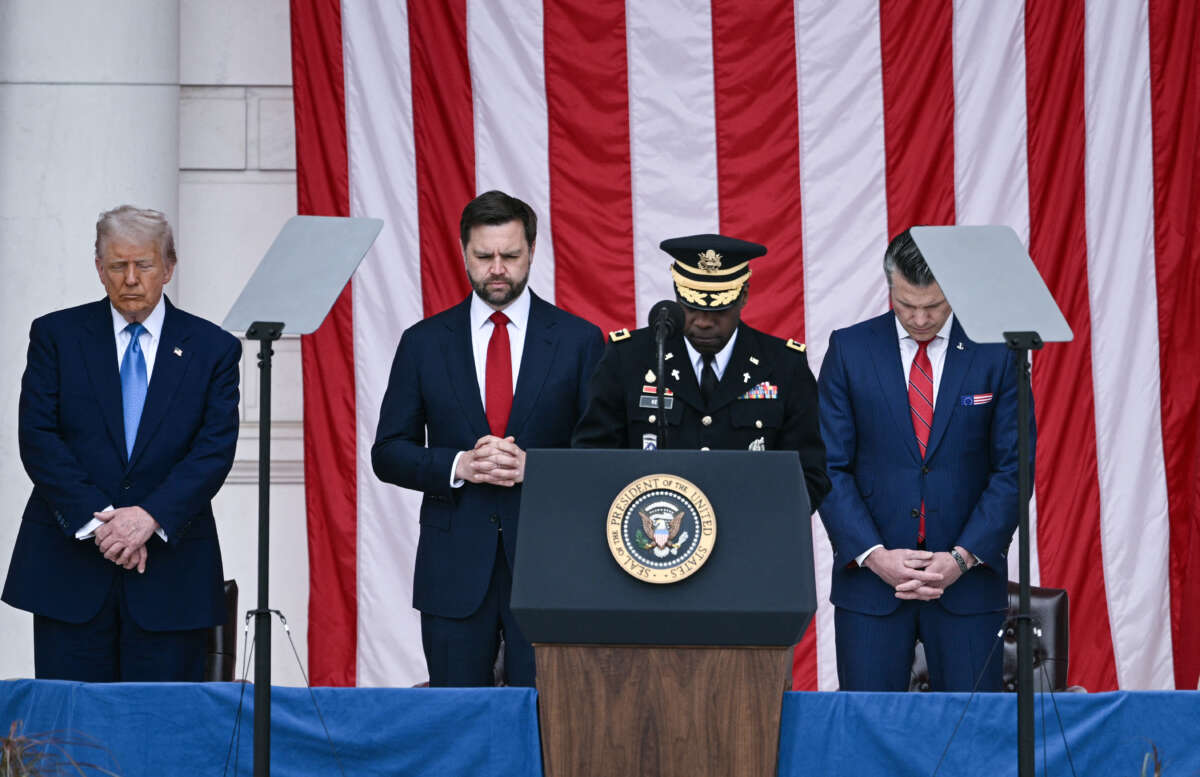
President Donald Trump, Vice President JD Vance, and Secretary of Defense Pete Hegseth bow their heads during the invocation the amphitheatre at the Tomb of the Unknown Soldier in Arlington National Cemetery in Arlington, Virginia, on Memorial Day, May 26, 2025.
BRENDAN SMIALOWSKI / AFP via Getty Images


As a philosopher, I am known for bringing a deeply uncomfortable truth to bear upon the hegemonic, hierarchical, and privileged embodied reality of whiteness. My aim has been to shape a critical discourse and produce a body of philosophical writing that reveals the ways in which whiteness functions as a mask, as a veil, to cover over the history of its violence. It does this through acts of denial, bad faith, and what philosopher Charles W. Mills terms an epistemology of ignorance, which produces “the ironic outcome that whites will in general be unable to understand the world they themselves have made.”

My aim has been to show white people to themselves with no chaser, and to attempt to free them from forms of evasion that result in the illusion that whiteness constitutes a site of “innocence.” Whiteness is not innocent; it is a structural and embodied lived reality that is predicated upon violence against those who have been constructed (such as Black people) in their very being as wretched. In short, to be Black is precisely to be not human, not moral, not civilized, not intelligent. It is this “not” that underwrites and renders legible the idea of whiteness as “supreme.” But whiteness is parasitic upon Blackness, which functions as its host. James Baldwin powerfully argued that Black people “have functioned in the white … world as a fixed star, as an immovable pillar.” It is this reality that generates a profound question that reveals the fundamental instability of whiteness: Without a dehumanizing concept of Blackness, what would happen to whiteness? My hope is that it will crumble. To inflect Michel Foucault’s provocative words, “One can certainly wager that [whiteness] would be erased, like a face drawn in sand at the edge of the sea.”

Bear in mind that my target of analysis is whiteness as a form of structural violence that white people perpetuate through their complicity. We must call into question the idea that white people are pre-social neoliberal subjects who exist beyond the messiness of racist practices and assumptions that are fundamentally linked to being white. In her book, Being White, Being Good, Barbara Applebaum argues that a pedagogy of white complicitly “addresses ideologies and the ontological, epistemological and ethical frameworks that support and maintain racial injustice.” This hard truth means that the most “radically” anti-racist white person remains tied to those historical struts and girders of white supremacy, even if only unconsciously, and is thereby ethically and socially implicated in the perpetuation of whiteness as structural violence.

I am less well-known for writing about my Christian sensibilities. I suspect this is due to a problematic tendency — something learned early in my philosophical training — to keep my personal faith private, lest I be dismissed as someone lacking “serious” philosophical grounding. As a graduate student at Duquesne University, I took a graduate seminar that explored various important developments within the area of liberation theology, including the work of both Leonardo Boff and Gustavo Gutiérrez, who are two prominent pioneers of the movement. Years later, after speaking with the professor about my religious Christian sensibilities, she said, “But I thought that you were an atheist.” However, my critical work on whiteness hasn’t strayed far from my religious sensibilities. For example, I have edited Christology and Whiteness: What Would Jesus Do? (2012), Buddhism and Whiteness: Critical Reflections with Emily McRae (2019), and In Sheep’s Clothing: The Idolatry of White Christian Nationalism with Bill Bywater (2024).

For these reasons and more, I was honored recently when asked by Dr. Greg Forster, who is a senior fellow and affiliate professor of biblical and systematic theology at Trinity Evangelical Divinity School and editor of Faith & Flourishing, about my thoughts regarding cultural diversity in higher education from a Christian perspective, which I see as linked to celebrating the other — not effacing the stranger. I am now more open to lay bare my own Christian identity — one couched in radical love — especially when inundated with the toxicity and perversity of white Christian nationalism and those, like U.S. Defense Secretary Pete Hegseth, who shamelessly invokes the name of Jesus Christ to wage wars. I am sickened by the implications. To this perverted understanding of Christianity, I want to shout: “Not in my name!” Imagine thanking Jesus for the horrible murder caused by the U.S. strike on a school in Minab, Hormozgan Province, in Iran that killed 168 people, including over 100 children. Think of the obscenity of thanking Jesus for the violent dismemberment of Iranian children. I reject Hegseth’s warmongering and idolatrous interpretation of the historical Jesus who preached love, even of one’s “enemies.” So there is a throughline in this article that allows me to reflect theologically on the theme of cultural diversity and also critique those machinations that I see as anti-theological, anti-Christian, and indeed, idolatrous.
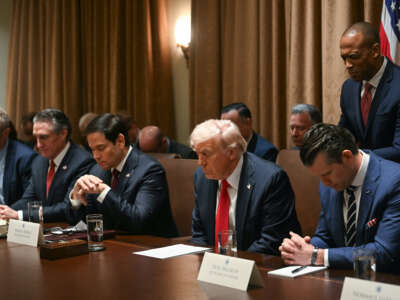

Christian Nationalists in US Government Push Attacks on Iran as Holy War
With Pete Hegseth leading the Department of Defense, the line separating church and state is increasingly blurred. By Sara Gabler , Truthout April 2, 2026

Forster asked me: “Almost no topic produces a higher ratio of heat to light than cultural diversity in higher education. What distinctive contribution can Christians make to help academic communities, and society at large, develop a sustainable approach to these difficult issues?”

To answer this question, it is important to mention that I am racially embodied as Black. This lived experience shapes how I think about questions regarding justice, diversity, equity, and inclusion. It means that the question of cultural diversity isn’t an abstraction for me, especially given the reality of anti-Black physical violence and epistemic violence regarding the historical denial of the value of Black life and the denial of knowledge produced by Black people. Given the history of the transatlantic slave trade, Black Codes, Jim Crow segregation, lynch mobs, police violence, and mass incarceration, I literally have skin in the game of this discussion. I am also what I call a hopeful Christian theist, which means that hope, that sense of being unfulfilled, sustains my longing for the Divine, which points to that which is transcendent. It isn’t a form of hope that simply fills the gaps of failed proof for the existence of God. My hope embodies commitment to and striving for a promise that is theologically rich and inextricably linked to the practice of chesed, agape, social justice, and kindness. It is also a hope that yearns for the truth of a certain philosophical anthropology — one that grounds our existential mystery, our being in the cosmos, in the Imago Dei (image of God), and speaks to the character of our nature as transcendent through a Divine act of love.

My understanding of cultural diversity is informed by the idea that education is not about cultural arrogance, political hegemony, and the silencing of diverse voices. Metaphorically, the root meaning of education (educere — to lead out) implies movement, change, and transformation. It is a form of transformation that involves the process of engaging in critical thinking, daring, and courage. It means being vulnerable, capable of being “wounded,” which means being open to hearing about forms of injustice that touch your being at its core, that forces you to rethink your own “innocence” and “ethical purity.” It means to listen to and be touched by the stranger.

To embody the opposite of this is to pretend invulnerability; it is to relate to others through an attitude of imperial hegemony; it involves silencing others. Theologically, to silence the other is a failure or refusal to recognize the existential and spiritual integrity of others, to appreciate their existence as a gift. Critiquing how the power of the state usurps the prophetic message of Christianity, Cornel West writes, “Most American Constantinian Christians are unaware of their imperialistic identity because they do not see the parallel between the Roman Empire that put Jesus to death and the American Empire they celebrate.” For me, genuine education is diametrically opposed to the formation of an imperialistic identity, which seeks to dominate dialogical spaces that are meant to invite and cultivate epistemic humility. Left unchecked, such identities prioritize flags and missiles over love, inclusive fellowship, and reconciliation.

There are times when my students are clearly troubled, in a generative way, as we critically discuss, with as much honesty as possible, issues about what it means to contribute to injustice and political hegemony; and what it means to face one’s own complicity in perpetuating racism, sexism, and other oppressive hierarchies that do violence to other human beings or even the Earth itself. Within this context, love is inextricably linked to outrage, both of which are what I want my students to feel, to express. As a member of the academic community, one that is made up of a diversity of human beings who are always in process, finite and fallible, I encourage my students to feel outrage when it comes to forms of learning that are designed to create lockstep conformity. It is that kind of conformity that fears difference, that abhors those who don’t look like “us,” or those who come from countries that are deemed “ersatz,” “racially problematic,” or “uncivilized.”

As a Black philosopher, I share with my white students what it means to be deemed “racially other” and thereby excluded from the normative status of whiteness. I share with them how whiteness is itself a site of privilege and how, when left unchallenged, these students unconsciously reap the benefits of that privilege. This awareness is often painful as they have been taught, even if only implicitly, to think of whiteness as a site of “innocence.” But as James Baldwin wrote, “It is the innocence which constitutes the crime.” Given my own sense of ethical fallibility, which follows from my hopeful Christian theist positionality, I too cannot claim “innocence.” I too perpetuate forms of injustice. This way of demonstrating vulnerability within the context of my classroom helps me and my students to acknowledge and embrace a space of collective responsibility, even as that responsibility is distributed differently according to other factors like whiteness. There is the mutual understanding that even though I am the teacher, we all share in the process of “leading out,” of becoming more than we were before entering the classroom together. As Rabbi Abraham Joshua Heschel reminded us, “We must continue to remind ourselves that in a free society all are involved in what some are doing. Some are guilty; all are responsible.”

This sense of responsibility isn’t easy to carry. Yet, it is required of each of us. Within the context of cultural diversity — especially within our current political climate of unabashed toxicity of xenophobia and the erasure of cultural diversity — I pedagogically encourage my students to rethink the meaning of “neighbor.” Indeed, I invite them to explore the often-hidden assumptions and biases that they harbor that lead them to feel that sense of irrational unease where the “neighbor,” the “stranger” is a Black person, an undocumented immigrant, a Palestinian, a Haitian, a Somalian, a queer person. As a hopeful Christian theist, I take it as an act of love to show kindness to the least of these. What is this but the parable of the Good Samaritan? Indeed, it is an act of caritas, an act of what I would call un-suturing, where one opens oneself to the other and refuses to seek shelter (or walk away as fast as possible) in fear or refuses to look the other way. In this case, one stops in their tracks and refuses to mark the other as “unclean,” “abominable” and existentially nugatory. In this case, we accept the presence of the other as a gift, as an opportunity to demonstrate love and kindness.

I teach my students that we bring our entire complex selves to the university classroom, including our arrogant selves, our myopic selves, and our intolerant selves. Accordingly, what we deem “deviant” and “strange” within those classrooms is what we have already marked as such within the “outside world.” It is our broken selves that preexist the classrooms that we later come to inhabit. Hence, we must look to transform both spheres, and ourselves within each, as they are connected. Moreover, the creation of this transformative space isn’t simply about epistemic and cultural tolerance. After all, tolerance needn’t radically move the heart. Additionally, neoliberal forms of marketing “cultural diversity” can function as forms of superficial propitiation by, for example, giving false representations (or overrepresentations) of racial diversity in the form of brochures that are designed to sell an image as opposed to reality.

Through the lens of hopeful Christian theist sensibilities, and an understanding of the embodied love of the historic Jesus, it is important that we cultivate forms of love that radically dismantle structural and psychic barriers that render some people ungrievable while others are deemed grievable. Rabbi Heschel challenged us where he wrote, “Daily we should take account and ask: What have I done today to alleviate the anguish, to mitigate the evil, to prevent humiliation?” I would add: What have we done to eliminate the fear that keeps us apart, to eradicate the hatred, to open ourselves to those voices that have been historically marginalized, to listen with patience, to hear the plight of Palestinian and Iranian children, to hear the pain of those in poverty, to create a place in our hearts for those innocent children who need our loving kindness as they are driven from war-torn countries or are torn to pieces after being bombed by warhawk and self-serving “leaders” who initiate wars of choice? As I bear witness to the U.S.’s bloodlust in the form of murdering Iranian children, I know that the United States is in desperate need of a radical transformation. Christian ethics calls for drawing others near — not to inspect them or prejudge if they are “fit” or, as Donald Trump said, “to unleash hell” upon them. Unlike Pete Hegseth, who prayed violence against those “who deserve no mercy,” Christian ethics embodies mercy. Christian ethics refuses prayers of “overwhelming violence” in the name of Jesus Christ. Just imagine the scene for a moment, imagine the grotesqueness of this prayer spoken by Hegseth. As a ritual, it is dangerous and idolatrous; it distorts, flattens, and does violence to the memory of the historic Jesus, the one who said, “Blessed are the peacemakers.” This is the message of Pope Leo XIV to Trump: “God does not bless any conflict. Anyone who is a disciple of Christ, the Prince of Peace, is never on the side of those who once wielded the sword and today drop bombs.”

As we know, Trump, by his own words, is derelict when it comes to being a peacemaker. After all, it was just on April 7 that he threatened on social media that “a whole civilization will die tonight, never to be brought back again.” This is the same Trump who didn’t flinch when it came to posting an AI image of himself as Jesus. The contradiction and decadence in both cases are palpable. So, Trump’s threat is to commit the unconscionable act of genocide against over 93 million Iranians? Surely, they too, are created in the image of God, and one would think that Hegseth and JD Vance are aware of this theological faith claim as they both identify as Christians. But the problem is that Hegseth and Vance are both invested in weaponizing, instrumentalizing, and cheapening the concept of God as a tool for “justifying” the murder of other human beings. And the image of a white Jesus is itself deeply problematic, with, as Richard Dyer points out, “the gentilising and whitening of the image of Christ and the Virgin [Mary] in painting.” The image of Trump as Jesus borders on the sacrilegious, especially as it depicts angelic-like figures and his “supernatural” powers to heal. And even if we grant that he thought that it was an AI image of him as a “healer,” a healer doesn’t threaten genocide, a healer doesn’t threaten that “all Hell will reign down” on other human beings and then add, “Glory be to GOD!” In the midst of human carnage, a healer doesn’t talk about using bombs “just for fun.” Under this imperial Christianity, Hegseth does not pray to God that Iranians are kept safe from Trump’s war of choice.

What I counterpose to imperial Christianity is Christian love. As James Baldwin writes, “Love takes off the masks that we fear we cannot live without and know we cannot live within.” To be open to cultural diversity and yet to wear this mask is mutually exclusive. The latter must be torn from our eyes and ripped from our hearts. If one claims to be a Christian, then there must be the belief that each one of us embodies the gift of the Imago Dei, which many have covered over because of our fear, divisiveness, and fanaticism. Embracing cultural diversity is easy when it fails or refuses to ask anything radical from us. Christianity asks for more; it asks that we be more, and to be more without the machinations of safety, but by the fragility of hope.


This article is licensed under Creative Commons (CC BY-NC-ND 4.0), and you are free to share and republish under the terms of the license.
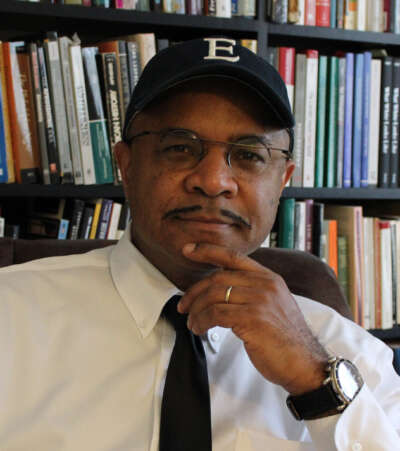

George Yancy


George Yancy is the Samuel Candler Dobbs professor of philosophy at Emory University and a Montgomery fellow at Dartmouth College. He is also the University of Pennsylvania’s inaugural fellow in the Provost’s Distinguished Faculty Fellowship Program (2019-2020 academic year). He is the author, editor and co-editor of over 25 books, including Black Bodies, White Gazes; Look, A White; Backlash: What Happens When We Talk Honestly about Racism in America; and Across Black Spaces: Essays and Interviews from an American Philosopher published by Rowman & Littlefield in 2020. His most recent books include a collection of critical interviews entitled, Until Our Lungs Give Out: Conversations on Race, Justice, and the Future (Rowman & Littlefield, 2023), and a coedited book (with philosopher Bill Bywater) entitled, In Sheep’s Clothing: The Idolatry of White Christian Nationalism (Roman & Littlefield, 2024).
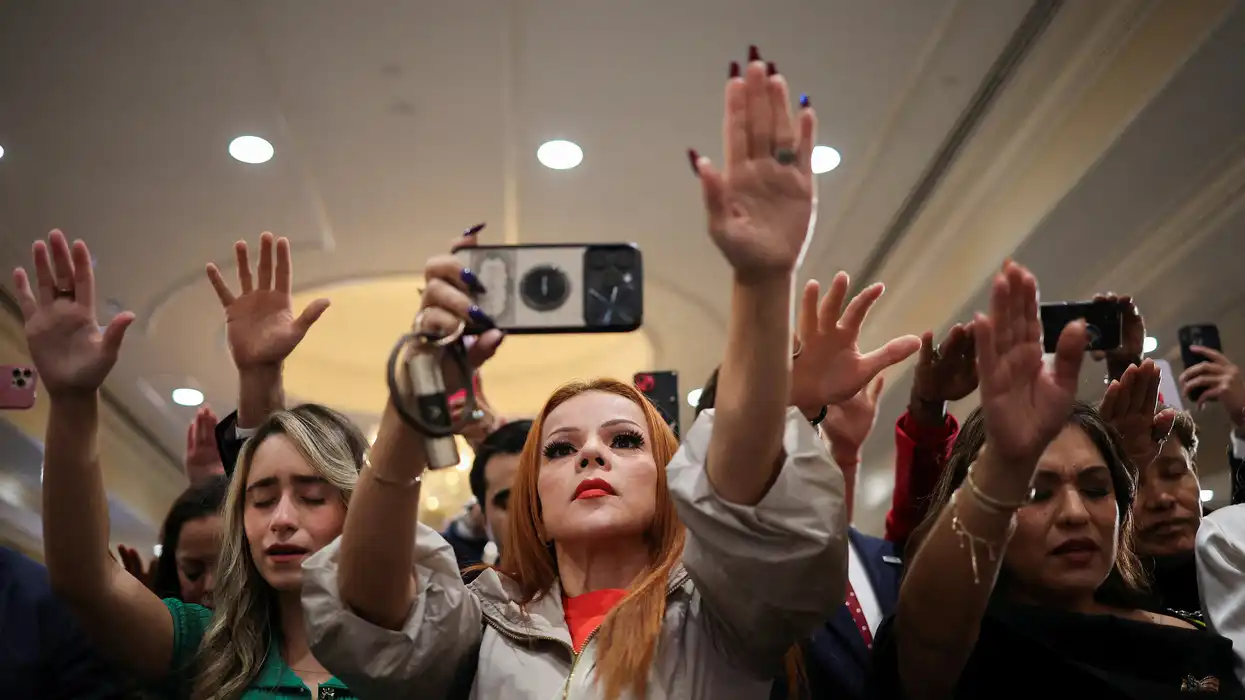
Evangelicals forced into a reckoning — thanks to Trump


(REUTERS)

April 21, 2026 
ALTERNET

Since the beginning of President Donald Trump’s political career, writes the Nation, “pundits and religious observers have been asking themselves…just how a thrice-married casino owner who mocks opponents, savors vengeance, and revels in cruelty could become the hero of millions of devout Christians.” In 2016, he won 81 percent of the white evangelical vote — higher than George W. Bush, Mitt Romney, or John McCain in the preceding elections. Then in 2020, Trump secured 85 percent of Americans who both self-identified as evangelicals and attended church regularly. Finally in 2024, he yet again took over 80 percent of the evangelical vote.

Now in recent weeks, amidst Trump’s bizarre fight with the Pope, “Trump’s Christian right supporters have had to reckon anew with the fact that their purported values and those of their president are deeply misaligned.” From his decidedly un-Christian actions, to his beef with the Pope, to sharing photos of himself as Jesus, Trump “is a man who believes he is above faith and superior to those who profess it.”

What explains this “cognitive dissonance” on the part of evangelicals who profess Christian values on one hand but vote for a man who flaunts them on the other? “Trump is the ultimate American televangelist,” who “seized on a central truth about evangelism in the postmodern age: It is a style, not a theology.” This attracted a Christian audience that had been fed on flashy televangelism for decades.

As the Nation explains, Trump appeals to the same 20th-century revivalist landscape that produced the likes of Oral Roberts, Billy Graham, and now White House senior faith advisor Paula White-Cain: ministers who leveraged spectacle, cultural grievances, the defeat of enemies, and promises “that material success signaled divine favor” to draw evangelical masses raised on TV and consumerism. The future president took these lessons and applied them to his political rallies.

“Trump does not argue policy. He does not try to persuade with logic. He uses repetition over explanation and emotional intensity over coherence,” explains the Nation. “He regularly warns of an imminent apocalypse. He demands loyalty. He testifies. He reassures the devout…He also names his enemies, who happen to be the same groups that have dogged televangelists through the modern era.”

While some have argued the novelty of his “presidential bully pulpit,” the Nation notes that “Trump did not invent a new political style; he refashioned a religious style to transform politics. He merged his idiosyncratic form of pseudo-populist authoritarianism with classic revivalist evangelicalism. He has perfected the evangelical style in American politics” to the point where the two are indistinguishable.

Judging by the backlash against his AI-Jesus photo, says the Nation, “Donald Trump may have erred in promoting himself as a latter-day messiah,” but one thing is hard to deny: “he is the televangelist meme incarnate.”


Top historian says Trump is committing 'superpower suicide'

REUTERS/Evan Vucci
April 21, 2026  
ALTERNET

Over the course of President Donald Trump’s second term, the United States and the entire world have been thrust into chaos by the administration’s erratic actions. While many have speculated about what pushed the U.S. to elect its highly disruptive leader, renowned historian Timothy Snyder has a theory: it’s an attempt at “superpower suicide.”

“I’ve been thinking about how best to characterize what the United States is doing to itself on the scale of the world,” said Snyder on his Substack, “and I think ‘superpower suicide’ is probably the best term.”

There are a handful of points that drove him to this conclusion.

“To be a superpower, you have to be a power, and to be a power, you have to be a state,” he explained. “And I think the way we’re being governed now is inconsistent with statehood. The way we’re being governed now — or rather ruled — seems to have to do with the enrichment and the wealth of the president himself and the people immediately around him. It seems to involve the cult of an individual and his eternal power rather than the continuity of institutions that belong to everyone.”

That brought him to matters of succession, or the lack thereof, and the future in general.

“By calling into question past and future elections,” said Snyder, “the President of the United States is undermining…the principle of succession, which is fundamental to being a superpower” — the idea that a country will continue beyond its present leadership. What’s more, Snyder claimed that Trump lacks a coherent ideology to carry forward, saying, “What is the future of this country? I don’t think the people in power are able to give any of that a name. There is no idea of the future. There’s just day-to-day enrichment.” On top of that, the U.S. is “pursuing policies that are inconsistent with there being a future.” He explained that global powers rise and fall based on their energy policy, and Trump’s decision to double down on oil and gas while ceding green energy development to China simultaneously cedes the future to Chinese leadership.

On that note, Snyder argued that “a superpower would be able to deal with its adversaries, and we seem completely unable to do so.” Over the course of the past year, Trump has declared and quickly lost a trade war with China, then a war with Iran, and a consequence of both has been the enrichment of Russia. At the same time, Trump has made it clear that he’s not only uninterested in collaborating with allies, but happy to shred essential alliances.

Finally, Snyder suggested that “a superpower of the future…would be caring about education and science, which is what we’re not doing.” To the contrary, under Trump, the U.S. is decimating its K-12 and university systems. Science has become politicized, while students and researchers from abroad are now looking elsewhere to bring their smarts and expertise.

All of this, concluded Snyder, comes down to an act of "superpower suicide." But he didn’t end on an entirely dire note.

“To make things a little bit more hopeful,” said Snyder, it’s an “attempted suicide, because none of this has to happen. It could all be changed. But that would depend on the choices we make.”
Trump's China strategy torn apart by GOP tax gurus following evidence of failure

April 21, 2026
ALTERNET


President Donald Trump’s image is indelibly linked to that of American business, from branding a real estate empire with his name and giving business advice in his ghostwritten-book “The Art of the Deal” to starring in the business-themed reality TV show, “The Apprentice.” Yet a nonprofit that exists to promote free markets and low taxes, two policy staples of the American business community, accused Trump on Tuesday of failing American business against its main foreign competitor, China.

“Government reviews have repeatedly documented the ongoing failure of Section 301 tariffs to change China’s behavior,” wrote Bryan Riley, director of the Free Trade Initiative for a 501(c)(4) called the National Taxpayers Union. “Ways and Means and Finance Committee Members may want to ask Amb. Greer why we should expect new Section 301 actions launched by USTR to fare any better.”

The “Amb. Greer” in question is U.S. Trade Representative (USTR) Jamieson Greer, who is scheduled to speak before both the Senate Finance Committee and the House Ways and Means Committee about Trump’s trade policies.

“In light of USTR’s recent announcement of new Section 301 trade investigations, those committees may want to follow up on his statement to the House Appropriations Committee last week,” Riley wrote. “‘In President Trump’s first term, the Section 301 tool was used to great effect.’ His comment referred to tariffs imposed following a 2017 Section 301 investigation into China’s Acts, Policies, and Practices Related to Technology Transfer, Intellectual Property, and Innovation. The goal of the investigation was to reduce or eliminate China’s unfair practices in these areas.”

Yet Riley insisted that “subsequent reviews cast substantial doubt on the effectiveness of this action,” ticking off as evidence data from a 2018 USTR update on Section 301, a 2019 Economic Report of the President on Chinese retaliatory tariffs, a 2021 Report of the U.S.-China Economic and Security Review Commission and President Biden’s 2024 four-year review of the Section 301 tariffs.

“China has not eliminated many of its technology transfer-related acts, policies, and practices. Instead of pursuing fundamental reform, the Chinese government largely took superficial measures aimed at addressing negative perceptions of its technology transfer-related acts, policies, and practices,” Biden’s report started per Riley. “At the same time, China has persisted and even become more aggressive, particularly through cyber intrusions and cybertheft, in its attempts to acquire and absorb foreign technology, which further burden or restrict U.S. commerce.”

Although Trump imposed tariffs on a wide range of products at the start of his second term, the Supreme Court famously ruled Trump had abused his power by incorrectly claiming he could levy tariffs unilaterally. The tariffs are also exacerbating inflationary pressures at a time when Trump’s ongoing war against Iran, which prompted Iran to raise gas prices by closing the Strait of Hormuz, has made his tariffs increasingly unpopular."These ‘economists’ are idiots,” White House spokesman Kush Desai
told AlterNet earlier this month. He was referring to a pair of economists, Richard Wolff and Ed Gresser, who had criticized Trump’s senior counselor for trade and manufacturing Peter Navarro for arguing the Iran war will lower gas prices. “Peter Navarro is an American Patriot whose loyalty to the President and the American people is unimpeachable.”

EARTH DAY APRIL 22 RON COBB CARTOONS


Why Earth Day Matters More Than Ever

The environmental movement has already shown what collective action can achieve. The question now is whether we are prepared to use that power again.


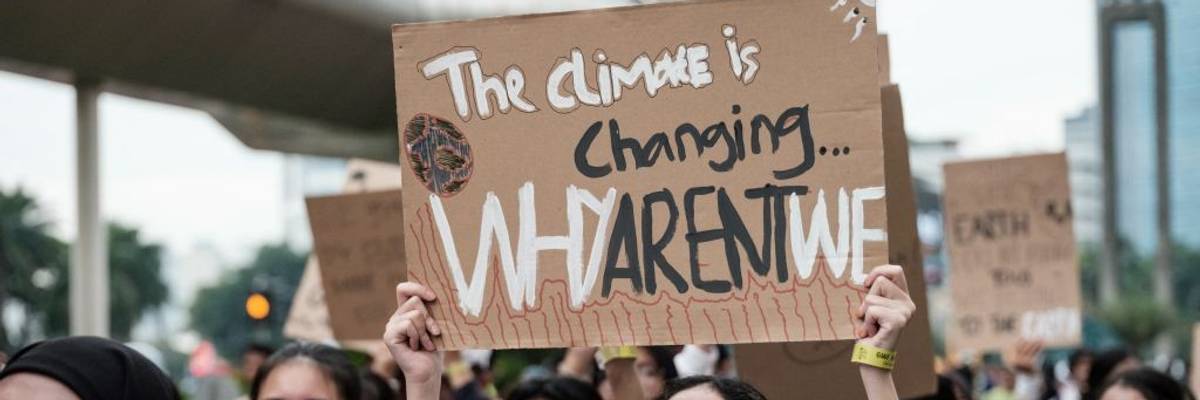
Participants hold placards as they march on a street ahead of Earth Day on April 22, the annual environmental awareness day, in Jakarta on April 21, 2024.
(Photo by Yasuyoshi Chiba / AFP via Getty Images)


Kathleen Rogers
Apr 22, 2026
Common Dreams

Fifty-seven years ago, Earth Day changed American politics. On April 22, 1970, 20 million American, about 10% of the entire US population, took to the streets, campuses, and town squares in a single day to demand action after 150 years of uncontrolled industrial pollution. The demonstrations were so large and bipartisan that Washington responded almost immediately, probably out of fear but also respect for the intensity and size of the demonstrations. Within just a few years, President Richard Nixon created the Environmental Protection Agency and Congress passed 20 landmark laws including the Clean Air Act, Clean Water Act, and Endangered Species Act. Americans and their environment enjoyed that nonpartisan honeymoon for over a decade.

Again in the early 1990s, cooperation between Democrats and Republicans produced significant environmental progress, including the Clean Air Act Amendments of 1990, which addressed acid rain, smog, and toxics, and the Pollution Prevention Act of 1990, which stopped pollutants at their source. Were they costly? Initially to the polluters yes, but the health and safety results, estimated to be close to $2 trillion in health-cost savings, have been stunning. And eventually industry investment in clean technologies led to efficiency, profits, and innovation. These laws and others demonstrated that bipartisan cooperation could deliver both environmental and economic results.


What is often forgotten today is how broad that political coalition once was. Environmental protection was not a partisan cause. Republicans and Democrats almost competed to be seen as environmental champions. Conservative lawmakers voted for pollution limits, and no wonder: 75% of Americans supported increased government spending to reduce air and water pollution, and large majorities said they were willing to pay higher costs for clean air and water.

For a time, that public pressure worked.

When citizens demonstrate that protecting the planet matters—to their communities, their votes, and their future—leaders respond.

But the momentum that first Earth Day created has slowed and increasingly reversed. Why? One major turning point came in 2010, when the Supreme Court’s Citizens United decision allowed corporations and outside groups to spend unlimited money in elections. In the years since, political spending by all groups has surged but particularly by polluting industries, which outspent health and environmental groups 20 to 1. According to Climate Power, the fossil fuel industry spent $450 million during the 2024 election cycle.

In the past year, 425 environmental and health and safety laws and regulations have been rolled back or crippled, many of which, including all climate change related policies and laws, were promised during the election. The quid pro quo for donations was pretty straightforward—denial that climate change exists or is harmful.

Citizens United opened the spigot for anti-environmental spending, and what is coming out of those spigots is hurting our children, our health, and American innovation and economic leadership.

The influence of that spending has helped transform environmental policy from a bipartisan priority into one of the most polarized issues in Washington. In the years before the ruling, bipartisan climate legislation was still possible. In the years after Citizens United, cooperation largely collapsed. The result has been legislative gridlock at precisely the moment scientists and many economists say immediate action will both reduce or even solve the climate crisis and keep America from losing its place in the impossible to stop green economy.

Ironically, this reversal of environmental policy has occurred even as public concern has remained high. Surveys consistently show that large majorities of Americans believe climate change is real and more than 70% of Americans support stronger measures to address climate change. This disconnect between public concern and political action is the defining challenge of this Earth Day and the environmental movement itself.

That is why the theme of this year’s Earth Day, Our Power, Our Planet, is more than a slogan. It is a reminder of a fundamental truth that shaped the first Earth Day: Political power ultimately flows from citizens—real people—to Congress and the White House.

The environmental breakthroughs of the 1970s and 1990s did not happen because leaders suddenly discovered science. They happened because millions of people made environmental protection politically unavoidable. Citizens marched, organized, voted, and demanded action. They made it clear that protecting the planet was not optional. Today, that same civic power and engagement is needed again.

If governments believe environmental protection is a low priority for voters, progress will stall. If they believe the public is divided or disengaged, short-term political pressure and massive corporate dollars will always win. But when citizens demonstrate that protecting the planet matters—to their communities, their votes, and their future—leaders respond.

That is the real meaning of Our Power, Our Planet. The environmental movement has already shown what collective action can achieve. The question now is whether we are prepared to use that power again. Because the progress of the past half-century was never guaranteed; without sustained public engagement, it could easily erode.

Earth Day was never meant to be a celebration. It was designed as a demonstration of public will. Fifty-seven years later, the challenge is the same: to show governments, once again, that the power to protect our planet ultimately belongs to the people.

This piece was distributed by American Forum.


APRIL 22 EARTH DAY/ GAIA DAY


Tuesday, April 21, 2026

‘You Dirty Orange Maniac!’: The President of Ultimate Destruction

Sadly, as crazed as Donald Trump may be — and he clearly is a deeply disturbed (and, of course, disturbing) human being — when it comes to war and the burning of fossil fuels, he’s been anything but alone as president of the United States.


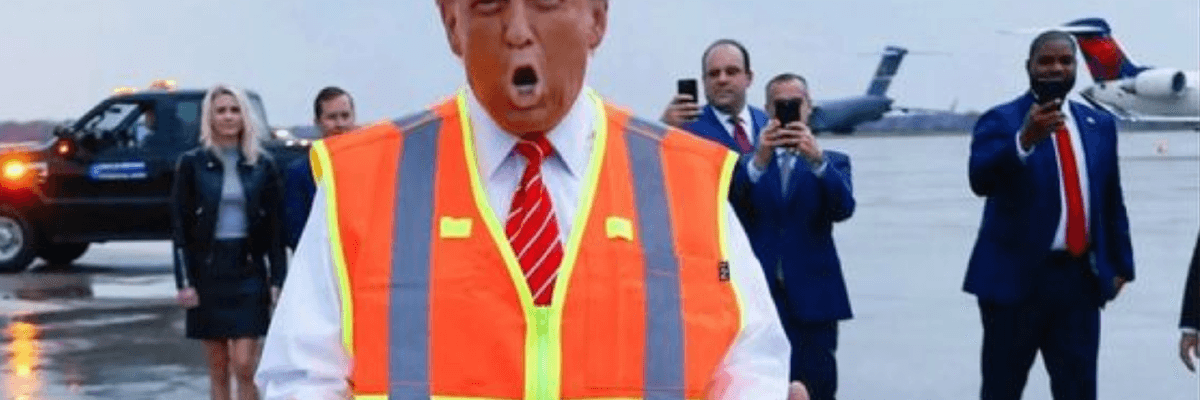
Orange blow-up garbagemen Donald Trump speaks at Green Bay airport
(Photo by Chip Somodevilla/Getty Images)

Tom Engelhardt
Apr 21, 2026
TomDispatch


When he’s on full blast, Donald Trump (not so long ago the “drill, baby, drill” candidate for president) is distinctly a furnace. And he seems intent on turning this planet, our only world, into a version of the same. But here’s the strange thing, when it comes to almost anything — from Iran to suddenly firing two key women, Pam Bondi and Kristi Noem, in his government (but certainly not the no-less-chaotic men) — there’s no minute, it seems, when he’s not flipping himself on his head and then spinning or stumbling or catapulting off in a new direction. There’s only one exception I’ve noticed and, all too sadly, that’s climate change, where everything he does — every single thing — is guaranteed to be a disaster for our children and grandchildren.

Recently, of course, he’s launched a nightmarish war, by definition a gigantic producer of greenhouse gases, that’s literally been all about oil and natural gas, thanks in part to the now chaotic, largely blocked Strait of Hormuz through which a quarter of humanity’s sea-borne oil and a fifth of its natural gas used to pass. And if you don’t believe me about it being a nightmare, just check out the most recent prices at your neighborhood gas station. Consider it an irony, then, that his disastrous Iranian war will undoubtedly lead in a direction — to the use of more green energy globally — that, if he ever thought about it, he would hate more than just about anything else. He has, of course, referred to environmentalists as “terrorists.” (“They are terrorists. I call them environmental terrorists.”) And in this country, over his two presidencies, he’s done his damnedest to attack and try to block wind and solar power projects in every imaginable way, even though, globally, green power is growing fast and getting ever cheaper.

And here’s the reality of our moment for which we do need to give Donald Trump credit: once upon a time, you couldn’t have made any of this up — or, of course, have made up Donald Trump as president of the United States (twice!). If you had, it would have seemed like the least believable science fiction novel ever written. Not that I drive a car in New York City (the subway and buses work fine for me), but as I was writing this piece, of course, the price of gas had also edged up in my city to almost four dollars a gallon and a (possibly global) recession is on the horizon. (Thank you, Donald Trump!)

Of course, in launching his recent war against Iran, however incoherently, “the PEACE PRESIDENT” (and yes, he’s into CAPS when it comes to himself) was, all too sadly, in good company, historically speaking. Since victory in World War II, from Korea to Vietnam to Afghanistan to Iraq and now to Iran (to mention only the big conflicts of that all-American era), our presidents have had quite a knack (if such a word can even be used) for starting wars, none (not a one!) of which has ended in anything faintly like victory. And it’s already obvious — you don’t need to have the slightest knack for seeing into the future to know this — that Donald Trump’s version of the same in Iran will prove to be a global disaster, made worse by the fact that, in the process, whether he faintly grasps it or not, he’s also launched another brutally losing war against Planet Earth.

And the worst thing is that I feel I’ve written all of this before. And before Trump — well, “leaves” is far too mild a word for it — abandons (??) the presidency, I could end up writing it again and again, and we would still be in the world — all too literally his world — from hell. Of course, for all we know, Donald J. Trump could decide to crown himself president and try to launch a third term in office that would, if successful, turn the constitution into an historical relic.

“The Only Orange Monarch I Want Is a Butterfly.”

The other week, feeling as I do about “our” president, I went to New York City’s “No Kings” rally. It was gigantic (though you wouldn’t have known that, had you read my hometown paper, the New York Times, in the days that followed). It started on 59th Street where Central Park ends, with masses of marchers on both Seventh and Eighth Avenue, heading for 34th Street. By getting there early, I made it to the front of the crowd on Seventh Avenue at the head of that vast mass of protesting humanity and, once it started, I wove my way in and out of the crowd, back and forth, downtown and uptown again, jotting in a little notebook some of the thousands of homemade signs people were carrying.

When I finally reached Broadway and 42nd Street, I stepped up on the sidewalk and looked back. To my amazement, I could see all the way to 57th Street where we had begun, and that significant-sized avenue was still totally — and I mean totally — packed right back to Central Park. And mind you, this old man was just one of an estimated more than eight million Americans who turned out at more than 3,000 rallies across the United States that day, in communities huge and microscopic, to protest the world Donald Trump has dumped on, spilled all over, and is continuing to roil and broil.

And, yes, it did seem like every third person (even the two demonstrators dressed as plastic tigers) was carrying a homemade sign. I doubt I had ever seen so many of them at any past demonstration. I was scrawling a number of them down in a little notebook, and they ranged from “Fight Truth Decay” and “Grandma says, ICE is not nice!” to “It’s a good thing Congress isn’t alive to see this” and “The only orange Monarch I want is a butterfly.”

And then there was the one carried by a bearded man that caught my attention: “You dirty ORANGE maniac! You blew it all up! Damn you to hell!” And I thought to myself, boy, is that painfully accurate. In his own fashion, among all the things he hasn’t succeeded in accomplishing, he has indeed been blowing it all up in a striking fashion and, unfortunately, potentially damning my children and grandchildren (and yours) to a literal planet from hell.

And sadly, as crazed as Donald Trump may be — and he clearly is a deeply disturbed (and, of course, disturbing) human being — when it comes to war and the burning of fossil fuels, he’s been anything but alone as president of the United States. After all, in these decades, war has been this country’s middle name and we’ve been burning fossil fuels to fight them as if… well, as if there would indeed be no tomorrow(s). And in his two terms in office, Trump and crew have gone with a passion after any form of clean, renewable energy that wouldn’t blister us all. Only recently, for instance, the Guardian (which is superb when it comes to climate-change coverage) was the only publication I saw that reported on new research in Nature magazine showing that this country has caused “an eye-watering $10tn [yes, that’s trillion!] in global damages to the world over the past three decades through its vast planet-heating emissions, with a quarter of this economic pain inflicted upon itself.”

Consider it something of an unintended irony, then, that the crew President Trump and his administration have put so much of themselves into goes by the acronym ICE. In fact, wouldn’t you have thought that “ICE” would be a curse word for President Trump and that, when it comes to creating an immigration hell on earth, his crew of manic enforcers would have been known as “HEAT”? Which reminds me that, at the No Kings rally, I noted an older woman carrying a homemade sign all too appropriately saying: “Deport Trump! Make ICE useful.”

And thanks to his brutal assault on Iran, this planet is only going to get hotter yet, as war releases staggering amounts of carbon dioxide into the atmosphere! Honestly, back in 2016, even if you had let your mind run in wild and unbelievably crazy directions, you simply couldn’t have made up Donald Trump’s planet as it is now, could you? Who could have imagined that the president of the United States, after launching a war with Iran in the Strait of Hormuz, would attack European countries for not joining him, saying, “You’ll have to start learning how to fight for yourself, the U.S.A. won’t be there to help you anymore, just like you weren’t there for us.”

And remind me, who has Donald Trump been there for, other than the major fossil fuel companies that backed him so radiantly in the 2024 election and are now getting a remarkable return on their investment?

Giving Decline New Meaning

Of course, to put all of this in some kind of perspective, sooner or later great imperial powers do go down and the United States has been the number one imperial power on this planet since the end of World War II, with its only true competitor (until China rose well into this century), the Soviet Union, which collapsed in a heap in 1991. So, it shouldn’t be surprising that this country, which, singularly in human history, once reigned more or less supreme on Planet Earth, should finally have begun its own decline, while turning over investment in present and future green energy to China.

But of course, there’s decline and then, in ICE terms, there’s DECLINE!!! And Donald Trump is threatening to turn imperial decline, something known throughout history, into a distinctly new phenomenon. Even declining imperial powers haven’t usually had such a mad ruler or leader. And he does seem remarkably intent, in his own increasingly confused way, on taking this country down with him. The difference, historically, is that until now no imperial ruler had the chance to take down not just his (almost never her) country, but (after a fashion) our planet (at least as a livable place for us), too. And he does seem remarkably intent on continuing to fossil-fuelize our world in a disastrous fashion.

Of course, at this very moment, we’re all watching his approval ratings generally (and particularly on the economy) begin to tank. (Oh wait, my mistake! A tank is a war vehicle, and right now that reference only applies to Israel, which recently lost a remarkable number of tanks in southern Lebanon.) But “our” president has also focused a significant part of his administration on ending anything that could benefit the climate, while burning fossil fuels in a fashion that should be considered beyond incendiary. That includes recently agreeing to offer almost a billion dollars to a French energy company to abandon a project to construct wind farms off the East Coast of this country (as long as it was willing to reinvest that sum in future oil and gas projects here instead).

Yes, someday he could well be seen not just as the president of decline but potentially of ultimate devastation and that flaming red tie of his could end up having a symbolic significance that, once upon a time, no one might have imagined. No wonder that sign I saw on the No King’s Day march — and let me repeat it here one more time: “You dirty ORANGE maniac! You blew it all up! Damn you to hell!” — sticks in my mind. It predicts the very future that, unbelievably enough, 49.8% of American voters tried to usher in again in 2024.

Once upon a time, who could ever have imagined either Donald Trump as president of these (increasingly dis-)United States or such a possible fate?


© 2023 TomDispatch.com


Tom Engelhardt, co-founder of the American Empire Project, runs the Type Media Center's TomDispatch.com. His books include: "A Nation Unmade by War" (2018, Dispatch Books), "Shadow Government: Surveillance, Secret Wars, and a Global Security State in a Single-Superpower World" (2014, with an introduction by Glenn Greenwald), "Terminator Planet: The First History of Drone Warfare, 2001-2050"(co-authored with Nick Turse), "The United States of Fear" (2011), "The American Way of War: How Bush's Wars Became Obama's" (2010), and "The End of Victory Culture: a History of the Cold War and Beyond" (2007).
Full Bio >