Brazil:
First International Anti-Fascist Conference organises against the far right
First published at Green Left.
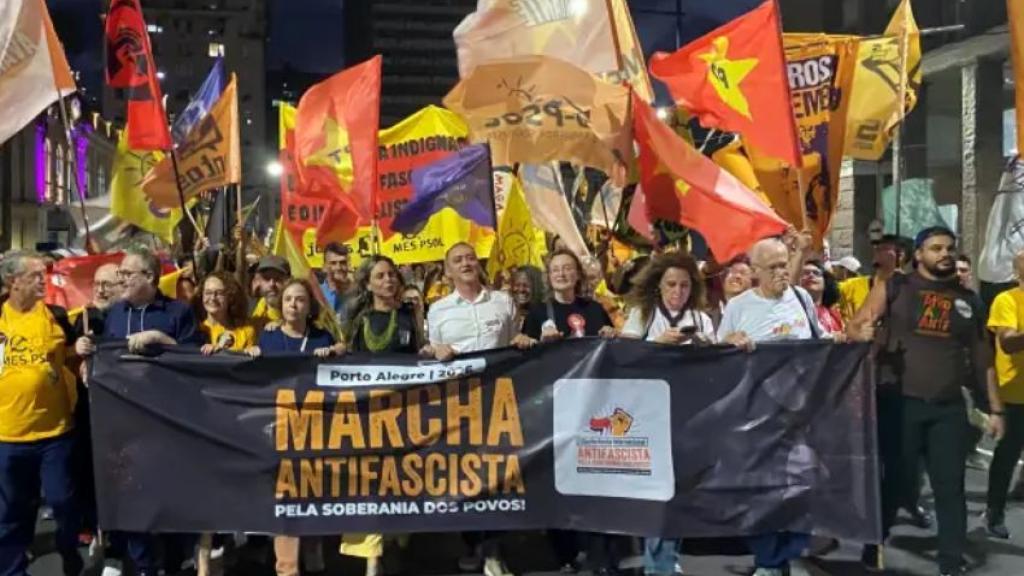
The first International Anti-Fascist Conference for the Sovereignty of Peoples, held in the Brazilian city of Porto Alegre on March 26–29, was an important step forward in organising the struggle against the far right across the Americas and internationally.
Four thousand activists from more than 40 countries across five continents took part. They sought to strengthen organisation against the various forms of fascism, the far right and the increasingly aggressive imperialist turn under capitalism.
The conference took place amid a week of significant international developments: the Nuestra América convoy to Cuba, which challenged United States President Donald Trump’s intensified blockade; street actions by more than 1 million people in Argentina against the far-right Javier Milei regime; and a large anti-fascist mobilisation in Britain. Perhaps most significant were the latest “No Kings” demonstrations in the US, involving up to 9 million people across hundreds of cities.
Valter Pomar, from Brazil’s Workers Party’ (PT), set the tone in the opening plenary. He said Trump is a product of a period of capitalist degeneration, in which the system increasingly turns to war. Capitalism and imperialism are intertwined, he said, and only socialism and a class-based agenda can provide an effective fightback.
Pomar emphasised that sovereignty spans from food to digital — from our oldest to newest needs — and must be realised as popular sovereignty through the defeat of the dominant classes.
Plenaries and key workshops actively opposed racism and women’s oppression and supported gender diversity.
Internationalism
Palestinian liberation was the most prominent international struggle raised. Several participants had been part of the recent Global Sumud Flotilla, including the chair of the Palestine plenary, who called the struggle “the cause of our times”.
The ambassadors for Palestine and the Arab League gave greetings. However, the spokesperson for Palestinian cultural groups — which danced before the plenary — characterised the fight best: “No one dances alone; no one fights alone.”
Opposition to the war on Iran was another recurring discussion.
A Cuban speaker received a standing ovation before they even started speaking, reflecting the conference’s universal solidarity with Cuba in the face of the US blockade.
Anti-fascism
The fight against the far right in Brazil and Argentina was the focus of two plenaries. In the opening session, Brazilian federal deputy Sâmia Bomfim — a Socialist Left Movement (MES) member elected through the Socialism and Liberty Party (PSOL) ticket — discussed how Brazil, led by PT President Luiz Inácio Lula da Silva, could present an alternative to Trump’s attempts to reassert US power through war and intervention.
She warned that the Bolsonaro clan — with jailed former president Jair being succeeded politically by his sons — continues to lead the far right and is meeting with Trump officials ahead of the next presidential election. Bomfim called for a street action plan to resist the Bolsonaro family.
There was also discussion about the “critical” upcoming election and the Brazilian left uniting to support Lula at the ballot box.
Anti-imperialism
International collaboration enriched the discussion. Ukrainian and Russian activists, for example, found common ground in workshops addressing repression under Russian President Vladimir Putin and opposition to the invasion of Ukraine.
Sushovan Dhar, from the Indian branch of the Committee for the Abolition of Illegitimate Debt (CADTM), argued that several BRICS countries — including Russia, India and China — combine authoritarianism with neoliberalism, meaning “multipolarity is only for the elites”.
Rafael Bernabe, a former Puerto Rican senator, followed by invoking Vladimir Lenin’s warning against reducing popular struggles to “imperialist manipulation” and urging support for the rights of all peoples.
United States
Young socialist activists from the US shared perspectives on fighting Trump within the imperialist core. In a panel of political representatives, Abdul Osmanu, a local councillor in Hamden, Connecticut, echoed Black Panther Bobby Seale’s call to “seize the time” in response to the right’s offensive.
Young Democratic Socialists of America (YDSA) ran a workshop highlighting Palestine solidarity encampments, unionisation drives, resistance to Immigration and Customs Enforcement in Minneapolis and socialist electoral victories, such as Zohran Mamdani’s win in New York City. These developments, they argued, are raising workers’ expectations and could help build a large-scale internationalist movement against Trump’s “neofascism”.
Jana Silverman, from the DSA, said that the US has a long history of interference in Brazil, dating back to the 1964 military coup. More recently, Silverman noted, the Barack Obama administration was found to have phone tapped and spied on the Brazilian president and top officials.
Silverman argued that Trump marks a shift from US “soft power” to “hard power”. While tariff threats against Brazil failed, Silverman said, Trump may look for a military response.
Parties in resistance
Porto Alegre, a state capital, has particular historical significance as the host of the early World Social Forums (WSF) beginning in 2001. That legacy was in the back of many people’s minds as they gathered for the anti-fascist conference, which also expressed support for the upcoming WSF in Benin in August.
CADTM, which has played an important role in the WSF, helped organise the conference and facilitated participation from Africa, South Asia and Europe.
Unlike the movement-oriented WSF, however, this conference was more party-oriented. Key organisers included MES, PSOL, Brazil’s Communist Party, the governing PT and Argentina’s Workers’ Socialist Movement.
International delegations included parties from across Latin America, YDSA members (particularly those aligned with the Bread and Roses caucus), La France Insoumise and sections of the reunified Fourth International. Three Socialist Alliance members from Australia attended.
A 7000-strong march opened the conference on March 26, with big party contingents from Brazil and Argentina.
Workshops were often used by parties — particularly MES — to present concrete action plans, while plenaries allowed for broader political perspectives on agreed topics.
Unions
Trade unions had a strong presence, with representatives from Latin America and Europe discussing how to confront neoliberalism and the far right. Hugo Godoy, from the Argentina’s Workers’ Central Union, highlighted Milei’s attacks on unions and the role of organised labour in any effective resistance.
Speakers from Brazil, Uruguay, Colombia, Mexico and Europe converged on a common conclusion: a strong, united workers’ movement is essential to resisting neofascism.
The message was clear — workers must fight on two fronts: the workplace and the political arena. Danilo Serafim, from the Rio de Janeiro teachers’ union, and Quintino Severo, from Brazil’s biggest union federation Unified Workers’ Central, emphasised that unions will play a decisive role in the struggles ahead.
Socialist Alliance member Clive Tillman ran a workshop on building worker power through global unions, where participants discussed how to harness international union networks and industrial connections to strengthen resistance to neoliberalism and the right.
Declaration
The conference adopted a declaration highlighting that imperialist capitalism is in deep crisis. It stated that imperialist powers’ response to this “has been the promotion of fascism everywhere, the imposition of neoliberal policies, military aggression against weaker nations, and their recolonisation”.
The declaration recognised the diversity of forces opposing the far right and the different approaches and conditions they face. However, it identified common features of the far-right threat: attacks on democratic freedoms and labour rights; the explosion of structural unemployment; privatisation and austerity; scientific and climate denialism; support for agribusiness and extractivism; ultra-restrictive migration policies; and a massive increase in military spending.
It highlighted how the far right seeks to redirect discontent with the disastrous consequences of neoliberalism towards oppressed groups: migrants, women, LGBTIQ people, racialised communities and national or religious minorities.
The declaration asserted that “imperialism is becoming increasingly unrestrained, aggressive, and militaristic”, pointing to the “explicit genocide in Gaza”.
While recognising political differences, it called for unified action across movements, centred on defending and deepening democratic rights, strengthening workers’ power, coordinating resistance to fascist violence and neoliberal precarisation, confronting ecological destruction and advancing agrarian reform for food sovereignty.
Finally, it emphasised the need for international coordination. Commitments were made to organise a future international conference involving new organisations and to create an international coordinating space, which would encourage regional and national anti-fascist and anti-imperialist conferences, beginning in Argentina and North America.
In Australia, we should consider how to contribute to this process, particularly as East and South-East Asia and Oceania were relatively underrepresented at the conference.
The Porto Alegre anti-fascist and anti-imperialist convergence — Between unprecedented success and major obstacles
First published at CADTM.
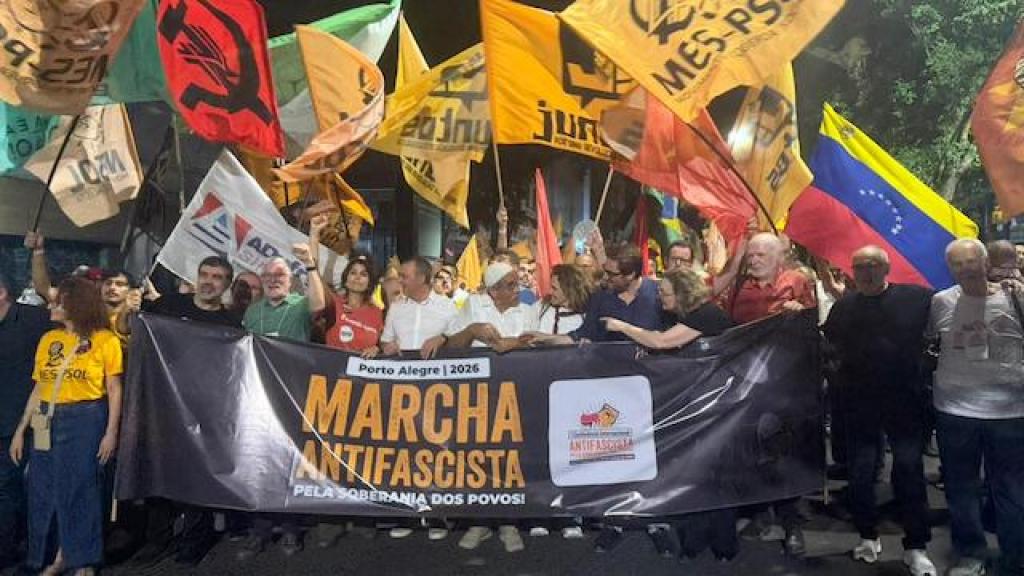
The anti-fascist and anti-imperialist conference held in Porto Alegre from March 26–29, 2026, marked a significant moment of internationalist renewal in a global context characterised by the rise of the far right and the proliferation of conflicts. Bringing together thousands of participants from over forty countries without institutional backing, it demonstrated a genuine desire for the convergence of left-wing forces despite deep divisions.
This article looks back at the conditions surrounding its emergence, the many political and organisational obstacles that had to be overcome, and the lessons to be learned for future struggles.
Idea for the conference
Following the attempted coup by supporters of Jair Bolsonaro on 8 January 2023 in Brasília, the proposal emerged to hold an international anti-fascist conference in Brazil.
It is important to note that after losing the presidential election in October 2022, supporters of the neo-fascist President Jair Bolsonaro stormed the Brazilian Congress and other key institutions in the capital, Brasília, on January 8, 2023. They modeled their actions after the January 6, 2021, storming of the U.S. Capitol by supporters of Donald Trump. Following these events, the Brazilian courts sentenced Jair Bolsonaro to 27 years in prison for leading an armed criminal organization, attempting to violently overthrow the democratic rule of law, and attempting a coup d’état.1
Also in 2023, the shock caused by the victory of neo-fascist Javier Milei in Argentina and the offensive he began to launch against the popular movement on December 10th of that year provided further impetus to take action. We said to ourselves: ‘Let’s not wait any longer; let’s launch a process leading to a large-scale initiative.’ The danger is global: from the Southern Cone of Latin America to India, the United States, Israel, Italy, France, Hungary, Belarus, Russia, Turkey, Egypt, the Philippines… to name but a few, for example.
Why Brazil?
The conference could have been convened from another country, but Brazil offered specific and, so to speak, unique conditions:
- The major left-wing political and social forces successfully called for a vote for Lula of the PT in 2022, leading to Jair Bolsonaro’s defeat at the polls. This victory was notable given Bolsonaro’s substantial electoral base, his support from Trump and the global far right, and backing from significant segments of big business. Had the left-wing parties not unified behind a common candidate in Lula, overcoming their differences on key issues,2 Bolsonaro might have won the election. This coalition included the PT, PCdoB, and PSOL, along with the Landless Workers’ Movement and various trade unions, including CUT.
- In early 2024, the PT and the PSOL in Porto Alegre agreed to set up a local joint committee to organise an international conference in the city that had been the birthplace of the World Social Forum in January 2001. The local branches of these two parties obtained the green light from their national leaderships (though the latter were not particularly enthusiastic about the project or made it a genuine priority) and sought to broaden the support base.
I should point out that when the process began in Porto Alegre, the possibility was not ruled out that, should the PT and the PSOL agree to convene the conference in São Paulo or another major Brazilian city, the venue could be moved to ensure greater Brazilian participation. In the end, Porto Alegre (POA) was chosen, which, given its proximity to Argentina and Uruguay, would allow large delegations from these two countries to travel by coach to the capital of the state of Rio Grande do Sul.3
The conference, scheduled for May 2024, had to be postponed because of the devastating floods that hit Porto Alegre and Rio Grande do Sul just days before the event was set to begin. These floods, the worst climate-related disaster in the history of this Brazilian state, resulted in the deaths of more than 180 people.
Attempt to launch an initiative in Europe
The political fragmentation of the left in Europe is very severe, and the focus on domestic politics clearly takes precedence over international affairs
It should also be noted that, in 2024, CADTM made contact with political leaders from various European countries to propose organising a unified conference in Europe, but the initiative did not come to fruition. The political fragmentation of the left in Europe is very severe, and the focus on domestic politics clearly takes precedence over international affairs.4 This is a clear step backwards compared to the 2000s and is deeply worrying given the extent to which the far right is growing in every country across Europe.
Convening the Antifa conference in Brazil
Returning to Brazil, it was in May 2025 that the local organising committee in Porto Alegre decided to revive the process leading up to the conference and set the dates for it to take place on March 26–29, 2026.
In the meantime, PCoB, a long-standing ally of the PT, joined the organising organisations. Numerous local social movements lent their support to the initiative, with the total number reaching 80 by September 2025.
It was only at the end of September 2025 — that is, about six months before the international conference — that the local organising committee began sending out invitations abroad.
Adding the theme of anti-imperialism
It was in October and November 2025 that the anti-imperialist dimension was introduced, prompted by the extreme aggression displayed by Trump
It was in October and November 2025 that the anti-imperialist dimension was introduced, prompted by the extreme aggression displayed by Trump, particularly towards Brazil, following the conviction of his ally, Bolsonaro. Trump’s threats spurred the Brazilian far right to mobilise en masse in early September, with more than 200,000 demonstrators taking to the streets in São Paulo. This mobilisation subsequently led to significant anti-imperialist demonstrations in Brazil’s major cities on September 22, 2025, when over 220,000 demonstrators gathered in São Paulo to defend Brazil’s national sovereignty and oppose amnesty for Bolsonaro and his accomplices, which was sought by Trump and the far right.
International support
CADTM International came up with the idea of drafting a broad appeal and launching it in our name, as an international network, to try to overcome as many obstacles as possible and broaden support
Initially, when we circulated the invitation letter signed mainly by the presidents of the PT, PSOL and PCdoB in Porto Alegre, the reception was not very warm. The invitation letter mentioned the support given to the initiative by numerous local social organisations, but the leadership roles of these three parties were evident and constituted an obstacle outside Latin America.
In Europe, organisations typically do not sign declarations with parties or respond to their calls. Such behaviour posed real difficulties. In Latin America and Asia, such behaviour poses less of a problem, or no problem at all.
It was in December 2025 that we at CADTM International came up with the idea of drafting a broad appeal and launching it in our name, as an international network, to try to overcome as many obstacles as possible and broaden support. Between 19 December 2025 and 20 January 2026, we collected signatures for the international appeal to strengthen the anti-fascist and anti-imperialist struggle. The appeal is radical, short, combative, and unifying and avoids singling out the United States and its allies as the sole imperialist bloc. The appeal criticises all forms of imperialist and colonialist aggression, no matter where they come from, and states that people must be supported in their resistance against such aggression, even if it means fighting back when needed. The genocide perpetrated by Netanyahu’s neo-fascist government in Gaza is denounced.
The appeal is radical, short, combative, and unifying and avoids singling out the United States and its allies as the sole imperialist bloc
We were rapidly able to secure signatures from leaders of left-wing parties across Europe. These included signatures from Jean-Luc Mélenchon (LFI) and Olivier Besancenot (NPA A) in France; Jeremy Corbyn and Zahra Sultana (Your Party) in the UK; Yanis Varoufakis (MERA 25) and Zoe Konstantopoulou (Path of Freedom) in Greece; Irene Montero (Podemos) and Ada Colau (Comuns) in Spain; and Italian MEPs Ilaria Salis and Domenico Lucano. Added to these were parliamentarians from Germany, Denmark, Luxembourg, Switzerland, Turkey… In France, a significant number of leaders and elected representatives from various strands of the left (LFI, Ecologists, PCF, NPA A, Après, Génération and even a few elected representatives from the PS) signed. On the Iberian Peninsula, leaders from almost the entire Spanish left (Podemos, Sumar, and Anticapitalistas); the Basque left (EH Bildu); the Catalan left (Comuns and CUP); the Galician left (BNG); the Andalusian left (Adelante Andalucia); and the Valencian Community (Compromís)…
It should be added that four MEPs who signed the appeal travelled to Porto Alegre at the end of March 2026 and addressed the gathering: Manon Aubry (LFI – The Left), Leïla Chaibi (LFI – The Left), Estrella Galan (SUMAR – The Left) and Ana Miranda (Bloco Nacional Gallego), which were very positive.
In the United States, we secured — which was very encouraging — the signatures of the entire leadership of the DSA (Democratic Socialists of the Americas), a political movement to which the new mayor of New York, Zohran Mamdani, belongs.
We have collected a large number of signatures from various groups in Latin America, including parliamentarians, party leaders, intellectuals, prominent activists, and numerous Communist Parties; member organisations of the Fourth International; the Patriotic Bloc in Colombia; Morena in Mexico; and several organisations from Argentina, such as such as Libres del Sur, the Socialist Workers’ Movement (a member of the FIT-U and the LIS), Vientos del Pueblo, the Popular Union, and others.
Among the intellectuals who have signed the appeal: the French writer Annie Ernaux (Nobel Prize in Literature 2022); the Swedish eco-socialist Andreas Malm; the Indian Vijay Prashad (member of the CPI-M and director of the Tricontinental Centre based in Chile and India); Titi Bhattacharya and Nancy Fraser, authors of the Feminist Manifesto of the 99%; Paco Ignacio Taibo II, director of the major publishing house Fondo de Cultura Económica (Mexico); Abel Prieto (Cuba); the Marxist economist Michael Roberts (UK); the political scientists Gilbert Achcar (UK), Joseph Daher (Syria), Franck Gaudichaud (France), Robert Brenner and Suzi Weissman (USA), Catherine Samary (France), Patrick Bond (South Africa), Walden Bello (Philippines), Frei Betto (writer, Brazil), Michaël Löwy (France-Brazil), Achin Vanaik (India), Françoise Vergès (Réunion/France), Jean Ziegler (Switzerland), Mireille Fanon (Martinique/France); and many others.
Internationally renowned activists have signed the appeal, including Thiago Avila, one of the main coordinators of the Soumoud flotilla for Gaza and, more recently, of the flotilla for Cuba; Adau Colau, former mayor of Barcelona; Rima Hassan (LFI), who is also active in the Soumoud flotilla; David Adler, deputy general coordinator of Progressive International; and Massa Kone (Mali), of the organising committee for the 2026 World Social Forum.
Signatories from alternative media include: Denis Robert, founding editor of Blast (France); Bhaskar Sunkara, founding editor of Jacobin (US); Vivek Chibber, editor of Catalyst (US); Jaime Pastor (Viento Sur, Spain); Daniel Raventos (Sin Permiso, Spain); Antoine Larrache (Inprecor, France); Penny Duggan (International Viewpoint); Ugo Palheta (Contretemps magazine); Angela Klein (SOZ magazine, Germany); Farooq Sulehria, editor-in-chief of the Daily Jeddojehad (Pakistan); Martín Mosquera (Jacobin, Latin America); Federico Fuentes, editor of LINKS (Australia); Rafael Hernandez (Temas magazine, Cuba); and Sushovan Dhar (Alternative Viewpoint magazine, India).
Under-represented regions:
- Asia, although figures and movements from the Philippines, Indonesia, Malaysia, India, Pakistan, Sri Lanka, Bangladesh and Nepal have lent their support.
- Sub-Saharan Africa, although activists from Mali, Togo, Cameroon, the DRC, Kenya, South Africa, Uganda and Eswatini have signed the appeal.
- The Arab region, although activists and representatives of organisations from the following countries have signed: Morocco, Tunisia, Lebanon, Syria and Iraq.
Support from ATTAC: In France, ATTAC hesitated for a long time but finally, and fortunately, signed the appeal. Almost all European ATTAC groups (ATTAC Austria, ATTAC Spain, ATTAC Wallonia/Belgium, ATTAC Hungary, ATTAC Italy, ATTAC France, etc.) signed, with one major exception: ATTAC Germany, which did not explain its refusal and did not send anyone to Porto Alegre. ATTAC groups in Argentina, Morocco and Togo, which are organically linked to CADTM, have also signed.
CADTM international network naturally actively supported the appeal and helped disseminate it. This encouraged its member organisations to contribute to the large delegation that travelled to Porto Alegre: more than 25 delegates from Morocco, Mali, the Ivory Coast, the DRC, India, Pakistan, the Philippines, Mexico, Colombia, Puerto Rico, Argentina, Belgium, Switzerland, and France — not to mention the delegates from Kenya and Haiti who were prevented from attending.
Support from trade union organisations and trade unionists: several trade unions and leaders lent their support to the international call: ELA and LAB from the Basque Country; the inter-union group from the Valencian Community; the Galician trade union confederation; the inter-union group from Spain; several trade unions from Brazil: CUT, ANDES, CTB,…; in Belgium, Jean-François Tamellini, General Secretary of the Walloon FGTB, and Felipe Van Keirsbilck, General Secretary of the National Employees’ Union (CNE/CSC); Angélique Grosmaire, General Secretary of the Sud PTT Federation (France), and Andrés Gómez, General Secretary of CGT Beaulieu (France); Eliana Como, member of the National Assembly of the CGIL trade union (Italy); Martín Esparza Flores and Humberto Montes de Oca, leaders of the Mexican Electricians’ Union (SME), and Luis Bueno Rodríguez, Coordinator of the New Workers’ Central Organisation Committee; Christian Dandrès, National President of the Swiss Public Services Union (SSP-VPOD) and Sk Mojibul Huq, Director, Bangladesh Garment Workers’ Union (BNSK).
The lists of the 1,800 signatories as of 15 March 2026 are compiled here. It is still possible to sign the International Appeal by clicking here.
Refusals to sign the appeal
Among the individuals contacted, only a few refused to sign. However, it is worth noting that Tariq Ali in the UK, Daniel Tanuro (a Marxist-eco-socialist author), and Raoul Hedebouw (president of the PTB) in Belgium refused to sign the appeal. These refusals, which we regret, are few in number and did not prevent the success of the signature collection.
What was particularly difficult to bear, given its consequences, was the refusal by the leadership of the major Italian trade union CGIL to sign the appeal; they had contacted other trade union leaders to urge them not to sign it either. Such was the case with the leadership of the FGTB in Belgium and probably also with the CGT in France, the Workers’ Commissions and the UGT in Spain,… The CGIL leadership refused to sign, stating that it disagreed with the phrase, referring to the resistance of people taking up arms when necessary. The CGIL leadership even contacted the leadership of Brazil’s CUT to urge them not to sign. We tried to convince the CGIL leadership by putting forward arguments (see letter attempting to persuade the CGIL and other organisations to sign at end of article). We also explained that signing the appeal was by no means a condition for participating in the conference. Although the CGIL initially announced its participation in the Porto Alegre conference by taking part in the first online meeting of the international organising committee at the end of November 2025, it ultimately decided not to send anyone there, which is a real shame. They could have attended the Porto Alegre conference without signing the appeal and would have had the opportunity to speak in at least one plenary session.
The CGIL has played an active role in establishing the International Network of Anti-Fascist Trade Unions; you can read the founding text by clicking here. The founding text is also available on the CADTM website. This is an excellent initiative, and the forum for convergence at the POA’s anti-fascist and anti-imperialist conference does not compete with this international network of anti-fascist trade unions. We had the opportunity to reiterate this position in person in Argentina on 22 and 24 March 2026 during major trade union meetings in which the CGIL, the Workers’ Commissions and the CGT, among others, were actively participating.
In Europe, the European Network of Solidarity with the Ukrainian Resistance (ENSU) refused to sign but fortunately sent a delegation to Porto Alegre. ENSU’s refusal was based on the fact that Russian imperialism was not condemned in the appeal; there was no mention of condemning the Russian invasion of Ukraine. ENSU supports sending weapons to Ukraine, whilst Italy’s CGIL opposes it. ENSU and the CGIL refused to sign the appeal for almost opposite reasons, which illustrates the difficulty of building broad unity.
Another trade union refused to sign the appeal and to travel to Porto Alegre for reasons other than those of the CGIL; this was Sud Solidaires in France. Sud Solidaires did not explain its refusal to sign in writing, but it appears to be linked to the fact that the PT, PCdoB and PSOL parties played a key role in organising the conference. Other reasons certainly played a part, such as solidarity with the Ukrainian resistance.
In Argentina, the PTS (a member of the FIT-U) also refused to sign. The PO (a member of the FIT-U) went further and actively campaigned against the conference, harshly criticising the Argentinian MST for signing the call and for sending a delegation to POA. In the case of the PTS and the PO, their refusal is based in particular on the fact that the conference included Lula’s PT, which forms alliances with sectors of big business.
Differences between the anti-fascist and anti-imperialist conference and the World Social Forum
In this instance, political parties, social movements, and citizens’ associations are present together, even though the World Social Forums and their continental counterparts do not typically admit political parties.
Moreover, it is not merely a matter of denouncing the far-right and imperialist aggression wherever it comes from; it is about trying to launch an initiative to attempt to change the situation. Admittedly, this move is a modest step as we are only at the beginning of the process, but given that the Porto Alegre stage is encouraging, we should be able to make progress step by step. This will involve overcoming the divisions that are dramatically weakening the left in order to confront the far right and the imperialist and neo-colonial policies of the various powers.
Porto Alegre conference a success
Managing to bring together more than 5,000 participants (actual figure) at the opening march is a success. Convincing participants to make the journey from over 40 countries without financial support from the authorities or major foundations is a success.
The only foreign foundation to provide financial support was the Rosa Luxemburg Foundation, which paid for the interpreting at the 11 main plenary sessions.
We must not forget that PT, PCdoB and PSOL are in opposition in Porto Alegre and in the state of Rio Grande do Sul. The extreme right currently holds power in the region. Lula’s government did not provide any funding.
At the first social forums, the situation was different: the PT and its allies were in government in Rio Grande do Sul and Porto Alegre. The support of the French monthly Le Monde Diplomatique and its numerous national editions had been crucial in ensuring widespread coverage from the very first initiative. Above all, the movement opposing neoliberal capitalist globalisation was in full swing: the 1990s had seen a proliferation of protests across the globe, while 1999 and 2000 were marked by massive international demonstrations in Seattle, Washington, Bangkok, Seoul, Europe, and elsewhere. Buoyed by these protests, several progressive governments came to power in Latin America: Chávez in Venezuela (1999), Lula in Brazil (2003), Evo Morales in Bolivia (2005), Manuel Zelaya in Honduras (2006), Rafael Correa in Ecuador (2007), and Lugo in Paraguay (2008).
This climate of growing protests and the movement known as the anti-globalisation movement, advocating for ‘another possible world’, lasted at least until 2006–2007 and saw a resurgence in 2009–2012 with the protests that followed the 2008 financial crisis, the Arab Spring (2011) and the Indignados and Occupy Wall Street movements (2011).
Nothing of the sort exists in 2026. We are currently experiencing the most challenging period in the past 40 years globally, and in Europe, it is the most challenging since the Second World War, marked by an unprecedented rise of the far right and a new large-scale war following Russia’s invasion of Ukraine.
Against this backdrop, bringing together over 3,000 participants — many of them highly militant young people—in just three days to attend 11 plenary sessions and 150 self-organised activities was a significant success. The main halls remained packed right up to and including the final plenary session on the afternoon of Sunday, March 29.
Significant differences in the perception of imperialism and imperialisms
The perception of imperialism varies greatly across the globe. In Latin America, for the past 120 years, only US imperialism has attacked the peoples, nations, and countries of the region, with the first US attacks dating back two centuries and being codified in the Monroe Doctrine of 1823.
In Central Europe, the main imperialist or other military aggressions were perpetrated from the 19th to the 20th century by the German Empire, then by Nazi Germany, then by the Russian Tsarist Empire, and subsequently by the USSR under Stalin (the German-Soviet Pact involving the occupation of half of Poland and the annexation of the Baltic States) or post-Stalin in the context of Warsaw Pact interventions (Hungary 1956, Czechoslovakia 1968).
In Africa, imperialist and colonialist aggressions were perpetrated from the 19th to the 21st centuries by the European imperialist powers.
In the Middle East, the imperialist aggressions of the last 70 years (i.e., after 1956 and the nationalisation of the Suez Canal by Nasser, followed by the French, British and Israeli imperialist intervention) were perpetrated by Israel, the United States and their allies.5
In East Asia, imperialist aggressions from the late 19th century to the 1950s were perpetrated by Japanese imperialism (as well as by Dutch imperialism in Indonesia and French imperialism in Indochina) and then systematically by the United States, whether in the Korean War in the early 1950s, in Indochina from the 1960s to 1975, or in the support Washington provided to numerous dictatorships in the region from the 1960s to the late 1990s.
If we do not take these differences into account, we cannot explain why the anti-imperialist left ‘today’ adopts positions that vary greatly from one major region of the world to another, except, fortunately, when it comes to denouncing the genocide of the Palestinian people by the Israeli government, which unites (almost) the entire anti-imperialist left.
European anti-imperialists should understand that the anti-imperialist left in the Americas does not perceive Putin’s Russia as a major, threatening imperialist power, whereas the left in Central Europe and much of Western Europe believes that denouncing Russian imperialism is fundamental and cannot be limited to criticising Washington, its European vassals, or NATO.
We must also understand why a significant section of the African anti-imperialist left, particularly in West Africa, regards the struggle against French imperialism as a priority and is not (yet) mobilising against the military agreements between certain governments in the region and Putin’s Russia, which are considered a lesser evil or a necessary evil in the fight against jihadist terrorism.
These debates are taking place across major left-wing networks, such as La Via Campesina; the views and positions regarding Putin’s Russia differ between European and Latin American peasant organisations. This divergence is understandable, and the debate is necessary. Differences in sensibilities and positioning also affect ATTAC and the international CADTM network.
Differences in stance against imperialist policies or aggression do not stem solely from where one lives and where one fights; they also reflect differences in the theoretical frameworks of various political currents: pro-Moscow “communism” from the period prior to the collapse of the USSR in the 20th century, or pro-Chinese Maoist, Trotskyist, Castroist, or Eurocommunist, etc. These differences have shaped older generations of activists and still influence younger generations.
We must move beyond or abandon the approach whereby one might support a major power or a regime simply because it is the enemy of the main enemy, a position often referred to as ‘campist’.
Moreover, in the case of Putin’s Russia, it is by no means certain that, at present, it is actually the enemy of the Trump administration and vice versa, as I demonstrate in this article.
We must also abandon the position that we defend not only a sovereign country against imperialist aggression (which is indisputable) but also its political regime, even when that regime represses the struggles of the working classes, as is the case with the Iranian regime, to give just one example.
We must also abandon the notion that Putin’s Russia is in some way the heir to, or a continuation of, the Russian Revolution of 1917. Russia under Putin’s leadership (who is a notorious anti-communist) is a second-rate imperialist capitalist power seeking to strengthen itself through war and territorial conquest.
Today’s China has different characteristics from Russia; that is obvious. It is an emerging imperialist capitalist power that has not resorted to military aggression to achieve its objectives. Contrary to what some would have us believe, it is not building socialism in its own way. It has integrated itself with great success in the globalised capitalist system and is on its way to becoming the world’s leading economic power. It is a pillar of the global capitalist system.
To act together from an anti-imperialist perspective, it is not necessary to agree on the characterisation of Russia or China, provided we agree on concrete tasks of solidarity. It is clear that such an agreement is very difficult to achieve on highly sensitive issues such as the invasion of Ukraine and the war currently being waged there.
It is critical to adopt a consistent internationalist policy and to fight against all imperialist or neo-colonial aggression, whatever its origin. We must build solidarity between peoples from the bottom up in order to strengthen resistance to the rise of neo-fascism and the increase in imperialist aggression, wherever it comes from.
Criticism that the appeal does not condemn Russia’s invasion of Ukraine
The appeal clearly calls for ‘combating imperialist and colonial aggression, whatever its origin, and supporting the struggle of the peoples who resist them, including by taking up arms when necessary.’
Trump, Putin, or other imperialist powers are not specifically mentioned. The only specific reference is to “the case of Palestine,” which “takes the form of a genocide orchestrated by the State of Israel, with the complicity of its imperialist allies.”
There are numerous instances of imperialist or sub-imperialist aggression. There are all those perpetrated by the United States and Israel; those by Russia, notably against Ukraine; those by the United Arab Emirates, notably in support of the RSF in Sudan, which is responsible for massive war crimes and crimes against humanity; those by various powers in the east of the Democratic Republic of the Congo; and those by Turkey against the Kurds in northern Syria, and this list is by no means exhaustive.
Had the Russian imperialist aggression against Ukraine been mentioned, it is clear that a large section of the left-wing forces in Latin America and North America, as well as certain left-wing forces in Europe and Asia, would have refused to sign. The PT, the PCdoB, a significant section of the PSOL, the Landless Workers’ Movement, the CUT in Brazil, the Latin American Communist Parties, and several trade unions that signed, as well as authors such as Vijay Prashad from India, would not have signed.
We preferred to put forward for signature an appeal that many forces could sign and which contains the sentence quoted above calling for the fight against “all imperialist and colonial aggression, whatever its origin” and which specifies “including by force of arms when necessary.”
Those in Europe and North America who argue that the text of the appeal absolutely had to condemn Russian imperialism and the invasion of Ukraine should make an effort to consider what motivated the decision we stand by: to gather a large number of signatures from left-wing individuals and movements and to encourage broad participation in the Porto Alegre conference so that debates can take place there and so that everyone can hear different points of view.
We can also expect those who are harshly critical of the appeal and the Porto Alegre conference to roll up their sleeves and invest their energy and resources in organizing a major united anti-fascist and anti-imperialist gathering in Europe, bringing together movements and activists from Eastern Europe, Central Europe, Western Europe and the Mediterranean.
International appeal subject of public attacks
The Italian far right has targeted the international appeal and, in particular, three Italian figures who signed it. The media outlet that launched the attack on 17 February 2026 is called Il Primato Nazionale.6 It is a key player in the ‘culture war’ waged by the radical right in Italy. Its importance lies less in its circulation figures than in its ideological function. It serves as a reference point both for the party of Prime Minister Giorgia Meloni (Fratelli d’Italia) and for the Lega led by Deputy Prime Minister Matteo Salvini. Il Primato Nazionale is the official press organ of CasaPound Italia, a neo-fascist political movement that defines itself as the “fascists of the third millennium.” Here is the first half of the article in question; we are publishing it without making any changes. This article condemns the appeal, its Italian signatories, and the creation of a new red international in Porto Alegre:
“From words to ‘concrete actions’: the anti-fascist manifesto signed by Ilaria Salis and Mimmo Lucano
Following the death of Quentin Deranque in Lyon, the ‘International Anti-Fascist and Anti-Imperialist Appeal’, signed notably by Ilaria Salis, Mimmo Lucano and Eliana Como, can no longer be read as a mere document. It must be analysed for what it is—a global political manifesto calling for organised convergence against an enemy defined in absolute terms and legitimising a mobilisation without borders.
The anti-fascist manifesto for ‘concrete actions’
The appeal, published on February 12, 2026, and circulated by the Committee for the Abolition of Illegitimate Debt (CADTM), describes a global advance of the “far right,” united by a series of factors: the dismantling of labour rights, restrictive migration policies, increased military spending, repression, surveillance, and austerity. The framework is that of a global conflict between capital and the people, between imperialism and resistance. So far, we are dealing with an ideological narrative consistent with the tradition of the international radical left.
However, the most politically significant point lies elsewhere. The text is not limited to analysis or denunciation. It explicitly invokes the need to ‘agree on concrete actions and to support the struggle of people who resist, even when they are forced to take up arms’. This is not a neutral statement. This is a passage that paves the way for the political legitimisation of violence as a tool of struggle, provided it falls within the framework of anti-fascism and anti-imperialism.
Among the initial signatories are prominent figures from the global left, such as Jean-Luc Mélenchon, Jeremy Corbyn, Yanis Varoufakis, and Annie Ernaux. But alongside these figures are also Italian representatives currently holding institutional positions: Ilaria Salis and Mimmo Lucano, MEPs for the Greens/European Free Alliance, and Eliana Como, a member of the CGIL National Assembly. These are not fringe activists, but representatives with public responsibilities.
In Porto Alegre, the new Red International
The document emphasises the necessity of international coordination against ‘imperialist aggression’, explicitly cites Palestine as an example of a colonial situation, and concludes with a quote from Che Guevara. The conference in Porto Alegre marks a significant step in a long process of united and ongoing mobilisation".
We stop the reproduction of this article here, as it demonstrates just how crucial the initiative behind the international appeal is. Indeed, the establishment of a neo-fascist international necessitated a timely response. By reacting to the fascist threat, one runs the risk of being subjected to verbal or physical violence from the neo-fascists, for they do not merely publish articles of the sort reproduced above; they also take action. This incident is what former Italian MEP Eleonora Forenza, a member of the Rifondazione Comunista party, has reported to the Italian courts. She served in the European Parliament from 2014 to 2019 as a member of the European United Left–Nordic Green Left (GUE/NGL) group. During an anti-racist demonstration in Bari, southern Italy, on September 21, 2018, Eleonora Forenza, her assistant, Antonio Perillo, and other activists were violently attacked by members of the far-right organization CasaPound, which publishes Il Primato Nazionale. Her assistant was seriously injured (head trauma). Eleonora Forenza brought a civil action in the ensuing trial. At first, several members of CasaPound were convicted not only of the assault but also of re-establishing the fascist party (a significant legal precedent in Italy). She regularly criticises the slowness of the Italian justice system, as the first-instance verdict was handed down several years after the events.
Courageously, Eleonora Forenza signed the international appeal (see her name in the third list of signatories published on 20 March 2026) following the publication of the article denouncing three other signatories of the appeal.
It is worth saying a few words about the two MEPs who signed the international appeal and are being denounced by the neo-fascists of Casa Pound: Domenico Lucano, mayor of Riace in Calabria, was persecuted by the Italian judicial system and the far-right Interior Minister Mr Salvini for his humanitarian policy of welcoming migrants and refugees. He was unjustly sentenced to 13 years in prison before winning his appeal after a long legal battle thanks to a solidarity movement in his favour. Subsequently, in June 2024, he was elected to the European Parliament (The Left group).
Ilaria Salis, an anti-fascist activist accused of violence against neo-Nazis demonstrating in Budapest, had been imprisoned in Hungary in degrading conditions (she had appeared in court with her hands and feet in chains) before being released in June 2024 following her election as an MEP for the Alliance of Greens and the Left (AVS), subsequently joining The Left group. In 2025, an official procedure launched by Viktor Orbán’s government to lift Ilaria Salis’s parliamentary immunity resulted in a very close vote in the European Parliament. The Hungarian authorities wished to resume proceedings against her for the alleged assault on neo-fascist activists in Budapest in 2023. The decisive vote on the lifting of Ilaria Salis’s parliamentary immunity took place on 7 October 2025, during the European Parliament’s plenary session in Strasbourg. The results and political positions in this vote, which a single vote decided, are as follows: Against the waiver of immunity (supporting Salis): 306 votes; in favour of the waiver of immunity (Hungary’s request): 305 votes.
Most members of the European People’s Party (traditional right) and three far-right groups in the European Parliament voted to lift immunity; these groups are the Patriots for Europe (Orbán’s and the RN’s groups), the ECR (Meloni’s Fratelli d’Italia), and the ESN (Europe of Sovereign Nations led by Germany’s neo-fascist AfD). The Italian MEPs supporting Giorgi’s government (Fratelli d’Italia and Lega) voted overwhelmingly in favour of waiving immunity, describing the result as a “disgrace for Giorgi’s Europe.” Ilaria Salis reacted immediately, stating that this was not just a personal victory but a victory for “European anti-fascism”. She used her platform in Parliament to become a spokesperson for political prisoners and anti-fascist activists across Europe. She has spoken out repeatedly on prison conditions in Europe, the rise of neo-fascist movements, and the right to housing (an issue on which she is also active in Italy). Her support for the international anti-fascist and anti-imperialist appeal launched by CADTM and for the Porto Alegre conference is part of her struggle, which has earned her threats from the far right.
Other signatories of the international appeal are also the target of numerous threats and legal actions against their activism, notably MEP Rima Hassan and National Assembly MP Raphael Arnault, both of La France Insoumise.
Rima Hassan is the target of judicial and media harassment, notably through being unjustly accused of ‘glorifying terrorism’ (which carries a sentence of up to seven years in prison), whereas in reality she is expressing her active support for the Palestinian people. The most recent instance of judicial harassment took place on Thursday 2 April 2026, when she was taken into police custody in Paris.
Following the death of Quentin Deranque, a fascist activist who succumbed to his injuries after a brawl with anti-fascists in Lyon on 14 February 2026, Raphaël Arnault received numerous death threats and was subjected to media harassment, even though he had nothing to do with this death.
Divergent views on imperialist aggression at the conference
In their speeches to the plenary, Rafael Bernabe of Démocracia Socialista (Puerto Rico), Sushovan Dhar of CADTM (India), Roberto Robaina, president of PSOL in Porto Alegre (Brazil), Penny Duggan of the Executive Committee of the Fourth International (France), and Patricia Pol of ATTAC France obviously condemned the Russian invasion of Ukraine. Several of them expressed their opposition to the aggression against Iran while affirming their opposition to the Iranian theocratic regime and their support for the protests. These speeches far outnumbered the ones that justified the Russian invasion. During the plenary session in which Rafael Bernabe (Puerto Rico), Sushovan Dhar of CADTM and Patricia Pol of ATTAC France condemned the Russian invasion, only one commentator (Batista from the Brazilian section of the Antifa International, founded in Caracas in September 2024) defended it.
Regarding Iran, during this plenary session, an Iranian imam based in Brazil spoke in defence of the Iranian political regime and Ayatollah Khomeini. I believe his invitation was unwelcome. However, it is important to note that Rafael Bernabe (Puerto Rico) and Sushovan Dhar (CADTM) clearly criticised the Iranian regime while condemning the aggression of Washington and Tel Aviv against Iran.
One of the workshops focused on expressing solidarity with Russian political prisoners, including Boris Kagarlitsky. Speakers included André Frappier, Mikhail Lobanov and Ksenia, Boris’s daughter. Members of the European Network of Solidarity with the Ukrainian Resistance (ENSU) organised another workshop that attracted a significant number of participants. Ukrainian trade union comrades spoke there. One of the members of ENSU, Alfons Bech, who was active at the Porto Alegre conference, wrote the following regarding the participation of the Ukrainian comrades: ‘From this point of view, the comrades’ participation was clearly a positive development. In addition to our workshop, which was well attended, Comrade Vasyl spoke at another workshop where Eric Toussaint asked him to take the floor.7 Although they were not given the floor during the plenary sessions, the presence of the Ukrainian comrades, just like that of the Russian socialist oppositionists, was highlighted by members of the MES, particularly during the conference’s closing session led by Roberto Robaina. They were also able to hold discussions with activists from Brazil and other countries. And they gave interviews and filmed videos which are currently being circulated amongst left-wing organisations.”8
A diversity of positions and their free expression are a prerequisite for the successful strengthening of anti-fascist and anti-imperialist action. Among left-wing movements, the ability to listen to viewpoints with which one disagrees is a necessary condition for building consensus to carry out joint actions.
What is the debate regarding anti-fascism?
As for the debate on anti-fascism, there is not enough space in this article to address the subject in detail, but there is one point that seems well worth highlighting. The rise of the far right cannot be explained solely by the effects of 40 years of neoliberal policies, which have led to the impoverishment and precariousness of large sections of the working class and certain sections of the so-called middle classes. The rise of the far right cannot be explained solely by the role of the mainstream media, which is favourable to it. It is clear that one of the causes of the rise of the far right and its influence on a section of the working classes is the result of the dissatisfaction and disillusionment caused by the policies pursued by so-called progressive governments in South America or social-democratic governments in Europe. This phenomenon is what I pointed out in my speech at the first plenary session of the Porto Alegre conference on 27 March, referring to the policies of the Lula and Dilma Rousseff governments between 2003 and 2013, or to the disillusionment caused by the policies pursued by President Alberto Fernández’s government in Argentina from 2019 to 2023. This phenomenon is equally true in Europe with the policies pursued by governments such as that of the ‘socialist’ François Hollande in France, the socialists in Portugal, the social democrats in Germany, or Syriza in Greece. We might also cite Biden in the United States.
So, in the face of the neo-fascist threat, should we propose, or should we not propose an alliance that includes them? This is one of the major questions that needs answering and which deeply divides the anti-fascist forces. Was La France Insoumise right or wrong to propose the New Popular Front in June 2024, including the PS? I believe so because, although the proposed program was not anti-capitalist, it marked a genuine break with the policies of Hollande and Macron and generated real enthusiasm. In short, the scope of alliances must be debated and resolved, considering the lessons of 1930s Europe. It is clear that the alliance forged between the PT, the PCdoB and the PSOL is a necessary response in the fight against the danger of the far right returning to the Brazilian presidency in October 2026, but this agreement does not end the debate on the concrete policies to be pursued to force genuine change against the interests of big business.
There are many such issues, and they are of the utmost importance: the need for a revolutionary eco-socialist program; the feminist and LGBTQIA+ dimensions of the anti-fascist and anti-imperialist struggles; the vital role of indigenous peoples; the struggles against illegitimate debt; and many other issues.
Assessing the final declaration
The final declaration is useful because it provides a clear and concise analysis of the current fascist threat and the rise of imperialist aggression. The text states: ‘We fight against all forms of imperialism and support the peoples’ struggle for self-determination by all necessary means.’ The declaration emphasises the need for unity despite differences: “The forces fighting the rise of the far right are diverse and have different analyses, strategies, tactics, programmes and alliance policies. Experience teaches us that, whilst recognising these differences, it is essential to organise a united struggle against our enemies.”
The text calls “for the fight against imperialist and colonial aggression, whatever its origin; for the struggle to end NATO; and for support for the struggle of the peoples and governments that are resisting.”
The declaration states that “it is urgent to share analyses, strengthen ties and take concrete action.” “The Anti-Fascist Conference for the Sovereignty of Peoples is committed to continuing the struggle relentlessly and to creating a space for building unity in the face of the rise of the far right and imperialist aggression. In the face of barbarism, we raise the banner of international solidarity, the struggle of the peoples, and a socialist, ecological, democratic, feminist and anti-racist future.”
The final declaration helped align agendas and emphasise the importance of mobilisation for upcoming international events, including:
- The International Eco-Socialist Meetings in Brussels (15–17 May 2026),
- The G7 counter-summit in Switzerland and France (mid-June 2026),
- The Summit against the NATO, in Turkey (July 2026),
- The World Social Forum in Cotonou, Benin (4–8 August 2026).
The intention to organise anti-fascist and anti-imperialist meetings at the level of major regions was confirmed with the scheduling of a meeting in Argentina and another for North America and the Caribbean, likely to be held in Mexico. There is also an agreement to reconvene an international conference in Porto Alegre.
The declaration lacks any reference to the resistance of the Ukrainian people in the face of the Russian imperialist invasion. The sentence on which the local organisers were unable to reach a consensus in the final hours before the reading of the final declaration was as follows: ‘Defence of a peace process in Ukraine that eliminates the root causes of the conflict, establishes security guarantees for all parties and respects the self-determination and sovereign will of the populations affected by the war.’ One might wonder whether, despite everything, it would have been better to adopt this wording rather than have nothing at all about Ukraine in the final declaration.
What is also clear is that a transparent and effective process will need to be found in future to adopt the final declaration at the next conference. It will not be easy, but it is very important. Ultimately, despite the limitations of the final declaration, it is useful.
The internationalist position
The key question for us, as revolutionaries and as internationalists, is this: on whose side do we stand? Our answer is clear. We stand with the people against the aims of big capital and the clashes between major powers and the various imperialisms.
In concrete terms, our position means that we support the activists in Russia and Ukraine who oppose the war waged by Russia in Ukraine. Affirming these positions necessitates a critique of the neoliberal and chauvinist nationalist policies of V. Zelensky’s right-wing government, as well as a denunciation of NATO and the imperialist aims of Trump and the Europeans regarding Ukraine.
We support the workers, students, and social movements in China that are fighting for their rights, better living conditions, and greater political freedoms.
We also support workers and the masses in the United States who are fighting against Trump’s policies.
We defend the sovereignty of countries in the Western Hemisphere and other parts of the world against the United States’ aggressive strategy of domination. We support people’s right to self-determination and sovereignty over their natural resources. We oppose all imperialist and colonialist aggression, whatever its origin.
In Europe, we oppose the imperialist and neo-colonial policies of our governments and denounce their complicity with Netanyahu’s neo-fascist government, which is committing genocide against the Palestinian people. We oppose the inhumane policies practiced by the majority of governments across the globe toward migrants and asylum seekers. We support all internationalist solidarity activities.
We defend a genuinely internationalist perspective. We stand with people against their oppressors. We are actively engaged with other political and social forces in continuing the efforts that led to the organisation and success of the anti-fascist and anti-imperialist conference in Porto Alegre, Brazil (26–29 March 2026). We are continuing to collect signatures for the International Call for the Strengthening of Anti-Fascist and Anti-Imperialist Action. And, as the CADTM international network, we are signing the final declaration of the Porto Alegre conference.
Conclusion
While differences over the nature of various forms of imperialism and the legacies of the 20th century continue to fragment the left, the urgency dictated by the coordinated rise of neo-fascism and imperial aggression has forced an unprecedented convergence. The success of this meeting will not be measured by the unanimity of its declarations but by its ability to transform this ‘unity of action’ into concrete and lasting resistance. Ultimately, the 2026 Porto Alegre conference is a watershed moment in the reconstruction of a militant internationalism, capable of uniting beyond the real differences that run through left-wing forces on a global scale. Its success lies as much in the scale of the mobilisation as in its ability to open up spaces for debate and convergence during a period of defensive struggle. But the obstacles encountered show that nothing can be taken for granted. The momentum set in motion in Porto Alegre can only be consolidated through deeper discussions, the clarification of positions, and, above all, the proliferation of concrete initiatives rooted in the struggles. More than an achievement, this conference thus constitutes a starting point: that of a long, uncertain but necessary process to rebuild an internationalist solidarity capable of meeting the challenges posed by the rise of neo-fascism and imperialist rivalries.
Constructive discussions with Salvatore Marra, of the leadership of the Italian trade union CGIL, on 30 January 2026
Letter sent to the CGIL and other reluctant movements opposed to the adoption of the international appeal:
A passage from the international appeal published on 20 January 2026 has raised questions: the one concerning support for the struggle of peoples resisting imperialist and/or colonial aggression ’even when they are forced to take up arms’. It is this last phrase — “even when they are forced to take up arms" — that has given rise to the questions raised.
As the author of this sentence, for which I take full responsibility, I wish to pose a series of questions based on the historical experience of anti-fascist and anti-imperialist struggles:
- Was it justified to support the armed resistance of the Italian partisans during the Second World War?
- Similarly, in the face of the Nazi occupiers, was it justified to support the armed resistance in France, Yugoslavia, Greece, Poland, Belgium,9 and elsewhere? I cite these countries, without claiming to be exhaustive, because the resistance movements there were significant.
- Was it appropriate to support the armed uprising in the Warsaw Jewish ghetto in April–May 1943 against the Nazis?
- Did the Spanish civilians who took up arms to resist Franco’s uprising deserve support? Should we have supported the tens of thousands of anti-fascist internationalists who came from abroad to join them in the International Brigades?10
- Were the Cuban people right to take up arms against the invasion of their territory in April 1961 by a group of around 1,500 mercenaries trained by the US government?11
- Were the Vietnamese people right to wage armed resistance against the French army, and later against the US army, in the 1950s, 1960s and 1970s?
Should we have supported the Chinese who resisted in an organised and collective manner, taking up arms, against the Japanese invasion in the late 1930s and during the Second World War? We could also mention the many popular movements of armed resistance that punctuated the entire 20th century and enabled numerous peoples and nations to win their independence from colonial rule. Should they have been supported?
Everyone can reflect on the popular resistance necessary in the face of the imperialist and colonial aggressions taking place today. The controversial sentence clearly states that it is a matter of supporting people’s resistance, including taking up arms when necessary. No contemporary examples are cited, and everyone is free to form their own opinion.
It is the people themselves who choose their forms of resistance, whether peaceful and/or armed.
Furthermore, international law recognises the legitimate armed resistance of organised populations facing occupation or foreign armed aggression.
Kind regards,
Éric Toussaint
Spokesperson for CADTM International,
responsible for drafting the international appeal
------------
On Fri 30 Jan 2026 at 09:13, SALVATORE MARRA wrote:
Dear Eric,
First of all, we would like to thank you for contacting us and for providing explanations about the issue raised regarding a passage in the international anti-fascist appeal.
It seems to us that this appeal marks the launch of the Porto Alegre conference at the end of March. Is this the case or not?
We would also like to mention that we have noticed that a national leader of the CGIL has already signed the appeal. We are in contact with her internally and will clarify the matter as soon as possible.
Furthermore, we wish to emphasise that this debate on the use of arms was one of the arguments most frequently used to launch a virulent attack on the position of the CGIL and the ANPI during the debate on sending arms to Ukraine, to which we were clearly opposed from the very start of the Russian aggression. Furthermore, we believe it is inappropriate to discuss the use of weapons in isolation, without considering the various contexts. The cases you mention are all different from one another and occur in profoundly distinct contexts.
International law obviously provides for the right to self-defence in the event of aggression, but we do not feel that the context to which the appeal refers corresponds to the circumstances provided for by international law.
I would add that we are the coordinators of the International Network of Anti-Fascist Trade Unions and that the manifesto makes no reference to the use of weapons or to violent and/or armed struggle; consequently, our signing of this appeal would also be at odds with the content of the manifesto.
Before we make a final decision regarding our participation, whether active or passive, in the initiative, we require clarification regarding this appeal and its nature. At the same time, we are well aware that, since it has already been signed by hundreds of people, amending it is probably impossible.
Yours sincerely,
Salvatore Marra
------------
From: Eric Toussaint
Sent: Friday 30 January 2026, 12:03
To: SALVATORE MARRA, NICOLETTA GRIECO Subject: RE: Clarification regarding a passage in the international anti-fascist appeal published on 20 January 2026
Dear Salvatore, dear Nicoletta,
The appeal (https://www.cadtm.org/International-Call-to-Strengthen-Antifascist-and-Anti-Imperialist-Action) was launched to call for a strengthening of the anti-fascist and anti-imperialist struggle at the international level and to express support for the Porto Alegre initiative.
Signing it is by no means a prerequisite for attending the Porto Alegre conference. It has never been stated in writing or verbally that one must sign the appeal in order to attend the Porto Alegre conference. This has been clearly stated on several occasions and reaffirmed in particular during the online meeting of the conference’s international preparatory committee on 28 January 2026 (see the attached minutes). Consequently, nowhere is it stated that one must sign the appeal to participate in the Porto Alegre conference at the end of March 2026.
In other words, CADTM, the initiator of this appeal, does not present it as the political basis for the Porto Alegre conference.
The call is not in competition with that of the International Network of Anti-Fascist Trade Unions, which can be viewed on your website:
https://binaries.cgil.it/pdf/2023/02/14/143530926-b2fabecc-d98c-47ff-9654-cab5a96333c9.pdf
The existence of the anti-fascist trade union network you have created is very positive, and we must strengthen it as much as possible. This must be affirmed at the Porto Alegre conference.
The Porto Alegre conference will democratically determine the final declaration to adopt. We will seek to ensure that it is as unified as possible. I believe we should exclude any issues that could hinder unity from the final declaration.
Kind regards,
Eric Toussaint
www.cadtm.org – CADTM International
8 Rue Jonfosse, 4000 LIÈGE – Belgium
------------
On Fri 30 Jan 2026 at 12:45, SALVATORE MARRA wrote:
Dear Eric,
Thank you for these clarifications and for your constructive approach. We are awaiting further information about the program and the various activities so that we can make a final decision regarding our participation.
It would be good to have a link on the website to the manifesto of the International Network of Anti-Fascist Trade Unions, which includes the CUT, CGIL, CGT, CCOO and others.12
Kind regards,
Salvatore
- 1
“The former president and several of his allies were convicted by a panel of Supreme Court justices for attempting to overthrow Brazil’s democracy following his 2022 election defeat. The plot included plans to kill the then president-elect Luiz Inácio Lula da Silva, Vice President Geraldo Alckmin and Justice de Moraes. The plan also involved encouraging an insurrection in early 2023. The former president was also found guilty of charges including leading an armed criminal organisation and attempting the violent abolition of the democratic rule of law.” published on 26 November 2025 https://www.euronews.com/2025/11/26/brazils-former-president-jair-bolsonaro-begins-27-year-prison-sentence-for-coup-plot
- 2
The PSOL disagreed with the alliance formed by Lula and the PT with sections of the bourgeoisie, whom they invited to participate in government in the event of an electoral victory. Following Lula’s victory, the PSOL declared that its members would not participate in government, lending their parliamentary votes to policies that would serve the interests of the people.
- 3
The distance between Porto Alegre and Montevideo is 800 km, and that between POA and Buenos Aires is 1,300 km.
- 4
Fortunately, despite this focus on the domestic agenda, a significant number of left-wing organisations have not abandoned their international solidarity work, for example, in support of the Palestinian people. This is particularly the case with LFI in France, the Italian radical left, the radical left in Britain and Ireland, Belgium, and so on. In Germany, the apprehension of being labelled anti-Semitic has left a segment of the left on the defensive, hindering its ability to engage in international solidarity with the Palestinian people.
- 5
Direct Russian military intervention concerned only Syria.
- 6
Il Primato Nazionale, ‘From words to “concrete actions”: the anti-fascist manifesto signed by Ilaria Salis and Mimmo Lucano’ https://www.ilprimatonazionale.it/approfondimenti/azione-antifascista-porto-alegre-manifesto-317737/
- 7
This was the workshop co-organised by CADTM International on ‘Imperialist grabbing of natural resources: 3 examples (Eastern Congo, Venezuela and Ukraine)’. CADTM International, CADTM (DRC), and the Union of Women for Human Dignity (UFDH – DRC) co-organised this workshop. See the list of the 9 workshops co-organised by CADTM: https://www.cadtm.org/Activities-from-CADTM
- 8
Alfons Bech of RESU adds: “The pro-Ukraine camp was on the back foot at this conference. For me, the most important thing is that a step forward has been taken in terms of unity and coordination among those trade unionists, parties and individuals in the Americas who were already supporting Ukraine. Additionally, it is possible that some new supporters may emerge as well. I believe this step forward opens a new phase of collaboration between parties, trade unionists and people from North, Central and South America. Between them and Europe. It is a qualitative step forward that actors who defend identical or similar positions in support of Ukraine and its working class are now acting together around this conference and adopting the same resolution, compared to the situation prior to the conference. The conference was organised with the understanding that we must now move forward with the three decisions made at its conclusion: a) to create a Google group for workshop participants, organisations and individuals to stay in touch with comrades, news and campaigns in Ukraine; b) to share the articles and reports we will write on the conference in relation to Ukraine; c) to take part in the monthly meetings organised by the ENSU at a time convenient for the Americas, on the first Saturday of every month. (Source: https://entreleslignesentrelesmots.wordpress.com/2026/04/05/notes-sur-la-premiere-conference-internationale-antifasciste-de-porto-alegre-autre-texte/ In English: https://www.europe-solidaire.org/spip.php?article78468)
- 9
As a trade unionist in Belgium, I have learned that it is largely thanks to the courage of trade union leaders, such as André Renard, who took up arms against the Nazi occupiers in my region (Liège and Wallonia in general), that we were able to rebuild a powerful and militant trade union movement after the Second World War. This helped secure some very significant social victories in the years that followed.
- 10
Between 32,000 and 40,000 foreign volunteers joined the International Brigades between 1936 and 1938 to support the Spanish Republic. Coming from 53 countries, these anti-fascists included around 10,000 French nationals, with significant contingents of Germans, Italians, Poles and Americans. Around 15,000 of them died in combat.
- 11
- 12
See the link on the CADTM website published on 5 February 2026: https://www.cadtm.org/Manifesto-of-the-International-Antifascist-Trade-Union-Network. Please find the list of signatories here.



.JPG)