Friday, April 24, 2026

Meta to cut workforce by 10% as artificial intelligence spending surges

Meta outlined plans to cut about 8,000 jobs on Thursday as it invests heavily in artificial intelligence. The move comes as part of a broader tech-sector shift towards cost control, with Microsoft also weighing voluntary buyouts ahead of next week’s earnings reports.


Issued on: 24/04/2026 - 
FRANCE 24

Meta announced plans to lay off 10 percent of its workforce in order to invest more in AI. © Sebastien Bozon, AFP

Meta plans to cut a tenth of its workforce, looking for productivity gains from its remaining workers as it invests heavily in artificial intelligence.

Meta will lay off about 8,000 employees and leave thousands of other positions unfilled next month, a source told AFP.

The move comes as co-founder and chief executive Mark Zuckerberg makes a priority of delivering “superintelligence” in a costly AI race against rivals including Amazon, Google, Microsoft and OpenAI.

Reports on Thursday also indicated that Microsoft is looking to trim its ranks with voluntary buyouts of some US employees in an unprecedented move by the tech stalwart founded in 1975.

About seven percent of US employees at Microsoft were reported to be eligible for an offer aimed at workers who are senior director level or lower, whose years of employment and age add up to 70 or more, according to a CNBC report.

Microsoft, which has also been pouring billions of dollars into AI, declined to comment.

Meta and Microsoft are both set to report quarterly earnings next week.

Meta in January reported quarterly earnings that topped market expectations, as revenue grew along with investments in AI.

Meanwhile, costs tallied $35.15 billion, an increase of 40 percent from the same period a year earlier, the earnings report noted.

Capital expenses, including infrastructure such as data centres to power AI, were $22.14 billion in the quarter, according to the company.

Meta anticipated capital expenditures in the $115 billion to $135 billion range this fiscal year, driven by increased investment in Meta Superintelligence Labs and its core business.

“I’m looking forward to advancing personal superintelligence for people around the world in 2026,” Zuckerberg said on an earnings call.

Meta is locked in a bitter rivalry with other tech behemoths racing to invest heavily in AI, aiming to ensure the technology generates profits in the not-so-distant future.

Most analysts believe Meta will make the investment pay off by improving advertising efficiency and creating new opportunities, such as with its smart glasses through a partnership with Ray-Ban maker EssilorLuxottica.

Meta is ramping up spending to record highs, announcing an array of multi-billion-dollar deals with AI partners and incentivising employees to be more productive by using AI agents for coding and other tasks, according to Wedbush analyst Dan Ives.

Ives reasoned that more layoffs could be in store at Meta this year as part of a strategy to use AI to gain efficiencies.

“We believe that this is part of Meta’s strategy to increasing leverage AI tools to automate tasks that once required large teams, allowing the company to streamline operations and reduce costs,” Ives said in a note to investors.

“We are encouraged by management’s cost-cutting efforts thus far.”

(FRANCE 24 with AFP)

Meta, Microsoft purge jobs amid AI build-up
DW with AP, AFP, dpa
24/04/2026 - 


Facebook's parent company said it would slash 10% of its workforce, while Microsoft is offering an early retirement scheme. The cuts come as both tech giants make massive investments in AI.

Social media giant Meta on Thursday announced plans to lay off about 8,000 employees, or about 10% of its workforce, as it seeks to scale up development of artificial intelligence (AI) applications.

The owner of social media platforms Facebookand Instagram, along with the messaging app Whatsapp, said in an internal memo that the first round of cuts is due on May 20. Along with the cuts, Meta said 6,000 further posts would be left unfilled.

Also on Thursday, US media reported that tech giant Microsoft was planning to offer voluntary early retirement buyouts for around 8.700 workers, or about 7% of its workforce
.

Massive AI investment


The job cuts come as both companies increase spending on developing AI applications.

Meta has announced plans to develop "personal superintelligence," which CEO Mark Zuckerberg has said will tailor AI agents to the needs and wishes of individual users.

"Personal superintelligence that knows us deeply, understands our goals, and can help us achieve them will be by far the most useful. Personal devices like glasses that understand our context because they can see what we see, hear what we hear, and interact with us throughout the day will become our primary computing devices," Zuckerberg wrote in July 2025.


Meta has warned investors that expenses on infrastructure costs and hiring AI experts will grow to as much as $169 billion in 2026.

Microsoft is spending billions of dollars on expanding a global network of data centers that power cloud computing and AI systems like Copilot. Investor concerns about the costs and eventual profitability of data centers have weighed heavily on Microsoft's share price over the past 6 months.

The early retirement buyout program is a first for the legacy tech giant founded in 1975.

Edited by: Karl Sexton
Wesley Rahn Editor and reporter focusing on geopolitics and current affairs


Amid AI shift, tech firms like Microsoft cut staff and alter pay

24.04.2026, DPA

AI - Tech companies are cutting jobs to focus on AI with Microsoft the latest to announce buyouts.

Photo: Amazon/dpa-tmn

Microsoft is rolling out voluntary buyouts for some of its US employees, a first for the 51-year-old tech giant as it adjusts to the rapid advancements in artificial intelligence (AI).

The one-time retirement programme is open to eligible workers at the senior director level and below who have a combined age and years of service totalling at least 70.

Some 7% of Microsoft's US workforce meets this criterion, as per a source familiar with the situation.

Employees are set to receive detailed information on May 7, but those on sales incentive plans won't qualify.

The initiative comes as Microsoft increases its spending on data centres to meet the rising demand for AI-driven cloud services, a trend that's also being seen in companies like Alphabet and Amazon.

At the same time, the software industry as a whole is facing challenges, especially with new AI coding tools from firms like Anthropic potentially upending traditional business models.

Microsoft has already taken measures to reduce expenses, including several rounds of layoffs last year. By June 2025, the company had around 228,000 employees worldwide, with roughly 125,000 in the US.

Alongside the buyouts, Microsoft is also adjusting its employee compensation structure. Managers won't have to tie stock awards directly to cash bonuses anymore, giving them more flexibility to recognize performance. Plus, the company is simplifying its performance review system, cutting the number of pay options for managers from nine to five.

These changes underscore Microsoft's ongoing efforts to streamline operations and shift resources as it prepares for long-term growth in the AI age.

The news comes as US tech giant Meta prepares to cut 10% of its workforce next month as it invests heavily in AI, according to local reports.

The company, which owns social media sites such as Facebook and Instagram, told employees in an internal email that the major round of redundancies is to be made on May 20, US media reports say.

Meta had just under 79,000 employees at the turn of the year, meaning the cuts are likely to affect nearly 8,000 people. In addition, some 6,000 vacant positions will not be filled.

The reason given for the redundancies was a desire to make the company more efficient and balance expenditure.

Meta is investing heavily in artificial intelligence infrastructure. For this year alone, capital investments of between $115 billion and $135 billion have been promised.


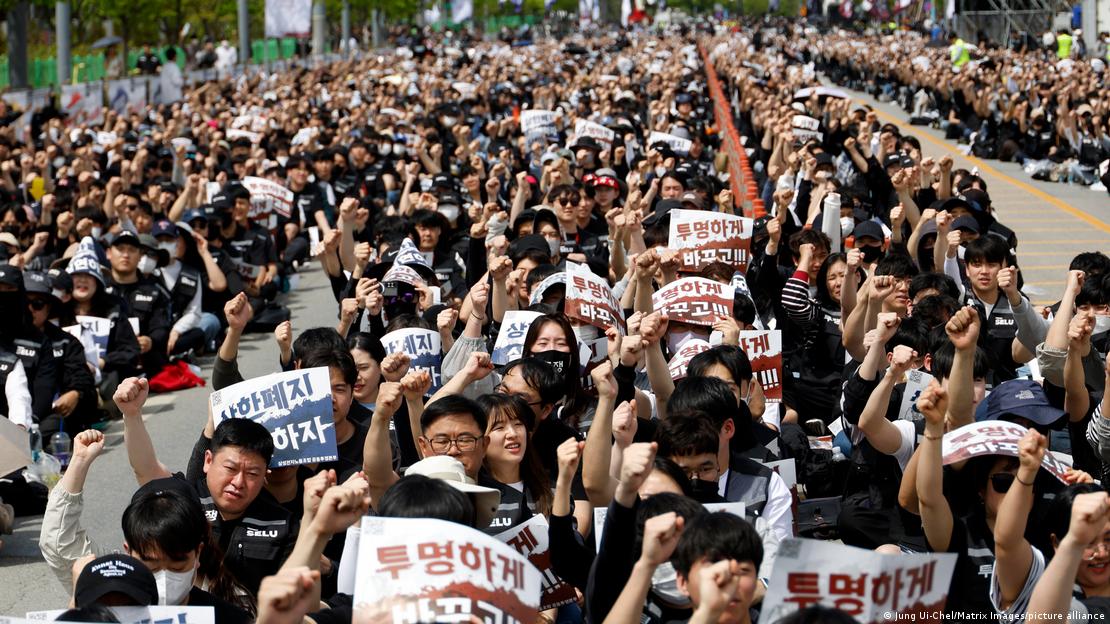
Samsung workers rally, call for larger share of AI profits

Muna Turki 
DW with AP, AFP, Reuters
 23/04/2026 

Unions at Samsung are threatening a weekslong strike if demands are not met. A production halt at one of the world's largest memory chipmakers could disrupt global chip supplies.


“Make compensation transparent and remove maximum limits on bonuses!”
 read signs at the protest
.Image: Jung Ui-Chel/Matrix Images/picture alliance


About 40,000 Samsung Electronics workers rallied on Thursday, demanding a larger share of the company's booming profits.

Unions warned they could launch an 18-day strike if their demands are not met, potentially disrupting the production of chips necessary to feed the growing AI industry.

The South Korean giant said it would continue efforts to reach a swift agreement in ongoing wage negotiations.

What are Samsung unions demands?

Samsung unions said the company failed to offer an adequate pay package despite its strong performance. Samsung's shares have surged nearly 300% over the past year, driven by demand for AI chips.

The unions want Samsung to remove the cap on bonus pay, among other demands. The cap is currently set at 50% of the annual base salary.

The unions say that a chip division employee earning 76 million won ($51,000, €44,000) would receive a 2025 bonus of 38 million won ($26,000, € 22,000). This is less than a third of what a worker in a similar role at rival company SK Hynix would receive. Last September, SK Hynix agreed to scrap its bonus cap.

SK Hynix is the direct rival of Samsung Electronics. The two South Korean companies produce together about two-thirds of the world's memory chips.

SK Hynix overtook Samsung to become Nvidia's main supplier of high-bandwidth memory (HBM) chips following the launch of ChatGPT in 2022.

This union-led protest took place at largest single semiconductor manufacturing site globally in Pyeongtaek, South Korea, on April 23, 2026.
Image: Jung Ui-Chel/Matrix Images/picture alliance


Strikes threaten AI chips supply


Samsung has rejected union demands to remove the bonus cap but says it will offer additional funding so memory division workers, who develop memory chips, earn more than competitors this year.

If talks fail, unions plan an 18-day strike starting May 21. They say a halt of production could cost the company more than 1 trillion won ($700 million, €600 million) per day.

Even a short disruption could damage customer trust and take years to recover from, Samsung officials say.

Chipmakers have benefited from the AI boom, but the Middle East conflict has raised concerns about supply chains. The crisis has restricted access to key materials such as helium and pushed up energy costs.

Samsung, long known for resisting unions, saw its first-ever worker strike in 2024..

Edited by: Alex Berry
UK: Health data listed for sale on Alibaba in China
DW with Reuters, AP, open source materia
 23/04/2026 


The British government is investigating how health data volunteered to a charity for research purposes wound up for sale via three vendors on the Alibaba e-commerce site in China. One listing had 500,000 people's data.

Biobanks, in this case in Paris, collect, collate, store and manage samples and health data en masse, making the anonymized data available to accredited researchers
Image: Thomas Samson/AFP

A UK government minister told Parliament on Thursday that data from a health charity, UK Biobank, was briefly listed for sale by at least three vendors on the Chinese Alibaba e-commerce platform.

Ian Murray, the Labour MP for Edinburgh South and a minister of state at the Department of Science, Innovation and Technology, told Parliament that the charity first alerted the government to the issue on Monday.

He said that the data was no longer listed for sale and that no buyers were thought to have paid for access, thanking the Chinese government for the "speed and seriousness with which they worked with us to help remove these listings."

What did the government say about the data being listed for sale on Alibaba?

Murray said that UK Biobank told the government of at least three listings appearing to sell data that volunteers had provided to the UK charity in a bid to improve research capabilities worldwide.

"At least one of these datasets appeared to contain data from all 500,000 UK Biobank volunteers," Murray told the House.

"I want to reassure the House up front, however, that Biobank have advised that this data did not contain people's names, addresses, contact details, or telephone numbers," he said.

"The government has spoken to the vendor today, and they do not belive there were any purchases from the three listings before they were taken down. Once the government was aware of the situation, we took immediate action to protect participants' data," he said.

The British government praised both China and e-commerce giant Alibaba for their rapid cooperation removing the listings
Image: Jaque Silva/NurPhoto/picture alliance


How did UK Biobank respond?


UK Biobank suspended all access to its research platform as a short-term precautionary response to the incident.

"We have temporarily suspended all access to the UK Biobank research platform, while we put in place a strict limit on the size of files that can be taken off the platform," chief executive Rory Collins said in a message to participants apologizing for the restrictions.

Murray also said that the charity had referred itself to the Information Commissioner's Office for a review of the incident.

"Secondly, we ensured that the Biobank charity revoked access for the three research institutions identified as the source of that information," Murray said.

Biobank's Collins described the actions of the individuals leaking information as "a clear breach of the contract they signed with UK Biobank," saying "they, along with their academic institutions, immediately had their access suspended."

The charity is one of the larger "biobanks" — often government-supported projects seeking to collect and collate various medical data and samples, typically on an anonymized basis — in the world. The systems are often hailed as being among the most important breakthroughs in modern biomedical research, facilitating rapid and easy access to vast datasets for researchers.

"We are still working with Biobank to ascertain from them the specific detail of what has happened. We have asked them to investigate how this data ended up for sale online as a priority," Murray told the House of Commons on Thursday.

Biobanks are hailed as one of the most important new methods of seeking to accelerate and facilitate biomedical research
Image: Erik Simander/Expressen/TT/IMAGO


What other information did the opposition ask for?


Conservative MP Lincoln Jopp, who made reference to his past experience in handling such data breaches as the chief operations officer for a tech company, called the case a "very grave incident."

"UK Biobank is an amazing project with thousands of trusting volunteers," Jopp said. He said he hoped the government would support UK Biobank's efforts to improve security, "including vetting the research institutes which it trusts."

He asked Murray whether the research institutes banned had been from China themselves and also asked how likely it was that the data was now in the hands of the Chinese government. He also asked whether research institutes from "Russia, Iran or North Korea" were among those with access to UK Biobank records, and what kind of data had been listed for sale if not personal information.

Murray said examples of the type of more medically-relevant data that might have been taken included "gender, age, month and year of birth," attendance dates, socioeconomic status, lifestyle habits, sleep, diet, mental health and health outcomes data, among several other things. The minister said that while the charity could not "assure 100%" that individuals could not be identified using such data, Biobank considered the likelihood to be low in most circumstances.

Murray said that as he understands from the charity UK Biobank, Russia, Iran and North Korea were not accredited for access to the database.

"UK Biobank are very strict about who can access, because there is an accreditation process," Murray said. "But secondly, although these three institutions are Chinese in this particular instance, again, the Chinese and Alibaba have been very proactive in helping us, with the British Embassy in Beijing, to take down and whack-a-mole anything else that comes up. And they're currently going through that process."

"Yale, for example, had their accreditation suspended for a breach of data," Murray said. "So this is not a country-specific issue, it just so happens in this particular issue, the three institutions were Chinese."

Edited by: Alex Berry

Security authorities warn Chinese cyberspies targeting smart devices

23.04.2026 

Chinese cyberspies targeting smart devices - Network cables plugged into a router. International security authorities are warning about the risk of Chinese state-backed hackers using a network of infiltrated devices for spying on targeted individuals and companies.

Photo: Sina Schuldt/dpa/dpa-tmn

International security authorities are warning about the risk of Chinese state-backed hackers using a network of infiltrated devices for spying on targeted individuals and companies.

A group of agencies, including the German domestic intelligence service, the UK's National Cyber Security Centre, the Australian Signals Directorate and numerous others, warned in a security advisory about "China-nexus cyber actors and their tactic of using large scale networks of compromised devices (covert networks) to route their cyber activity."

A custom-built infrastructure consisting mostly of compromised end devices and large-scale obfuscation networks has been used in various Chinese cyberattacks, said the report, released on Thursday.

Compromised end devices in Germany are also being used for such campaigns, it said.

This particularly affects IT infrastructure for homes or small offices, smart devices and devices connected to the so-called Internet of Things, including networked cars.

The network of compromised devices was apparently used to spy on targets in the political sphere. Sensitive company data is also said to be targeted.

The report warned that the state-sponsored actors could be using the data taken from the networked devices.

It recommended various protective measures, including multi-factor authentication for remote connections.


Climate change impacts India's harvest festivals


Zeeshan Tirmizi
DW
04/19/2026

As people across India celebrate traditional agrarian spring festivals, climate change has become an unwanted guest at the table. How are communities rising to the pressure on harvests, water, and rural life?

Festivals connected to agriculture are common in parts of India, but the challenges of rising temperatures are changing the face of farming

Image: Anupam Nath/AP Photo/picture alliance

Parts of rural northern India are currently exploding in color. Not just from the coming of spring, but seasonal festivals characterized by folk music, dancing, farmers in traditional dress, and dishes like sweet saffron rice.

Among them is Vaisakhi, which is an important festival date on the Sikh calendar. Held in the northern province of Punjab, it marks the successful growth of winter wheat, and crops like mustard, chickpeas, lentils, barley and sunflower seeds.

"When the crop is fully ready for harvest, all the farmers come together to celebrate," Ashwani Ghudda, a local social worker, told DW. "They offer prayers, visit fairs, and then prepare to begin the harvesting."

Punjab, which currently produces 10% of India's wheat and 15% of its rice, is a historically agrarian state, so farming has long been a way of life.

"A lot of folklore and festivities have emerged from that," said Harindar Grewal, environment adviser with the central India-based nonprofit Citizens for Change Foundation.

Cattle are washed and fed special dishes as part of spring festivities in Assam
Image: Upasha Hazarika

It's a similar picture in the eastern region of Assam, where the Bohag Bihu festival marks the transition from the dry season to the onset of the agricultural cycle with singing, dancing and rituals that focus on the care of cattle.

Chandana Sarma, associate professor in anthropology at the state's Cotton University, says the celebration is rooted in ancient fertility rites and serves "as a ritual calendar marker of ecological renewal where agriculture, sexuality and social reproduction are integrated."

She says this reflects the deep interdependence between humans, nature and subsistence systems in local communities.
Climate pressure behind the celebrations

This year, the festivals are taking place against a backdrop of climate-related challenges that have damaged crops in both regions of the country.

In Assam, about 20,000 acres of crops have been lost to floods and hailstorms over the past year, which the regional government has linked to hydrometeorological disasters. And this month, unseasonal rain and hailstorms have damaged wheat crops across more than 135,000 acres in seven districts of Punjab.

Grewel says farmers can no longer rely on precipitation to arrive in December and January when it would help wheat to grow. If it comes when the grain is forming or maturing, "it brings a lot of misery," he said.

Flooding in parts of India has been connected to rising global temperatures that lead to more intense bouts of rainfall
Image: Biju Boro/AFP

But the state's farming system is under pressure not only from climate stress. There are also long-standing structural problems.

The widespread practice of rotating between wheat and rice crops has led to groundwater depletion, which Grewel says has been exacerbated by the state providing free electricity that encourages farmers to pump excessively to feed thirsty plants.

"Punjab was never a natural area for raising paddy, unlike northeast India where you have plenty of rainfall."

Assam, which is one of the wettest states in India, is facing its own climate challenges. Average temperatures have risen in recent years and the state is vulnerable to increasing episodes of intense and erratic rainfall.

Since 2020, 1.32 million acres — nearly seven times the size of New York City — of crops have been damaged by floods, storms or hailstorms.

Some farmers are changing crop varieties and improving irrigation to meet the challenges of a warming world, but a recent study found many are struggling to adapt. Researchers say limited access to credit, as well as land shortages and inadequate government support, are holding back more widespread diversification.

What support do farmers need?

Authorities in Punjab have deployed a large team to assess recent crop damage, and Assam officials say they and the central government have released $439 million (€405 million) to support farmers affected by climate‑related disasters.


Still, Grewal says stronger institutional support could help farmers, and thereby food security. One way would be to provide shelter for farmers who take their crops to local agricultural markets in search of buyers, rather than them having to wait outside with a trailer full of produce.

"At the onset of rain, it destroys their crops," he said. "If they have sheds and other things, that can be mitigated."

For the longer term, Grewal suggest rethinking farming practices, including reducing dependence on rice grown in paddy fields.

"They can diversify into agro‑farm forestry and horticulture, including greenhouse farming used in many countries to raise productivity," he said, stressing that changes must protect the long‑term sustainability of agricultural land.

"Punjabi farmers are enterprising, and it was this human effort that drove the Green Revolution. What is needed now is strong intent," he said.

Even as conditions change, festivals continue to frame agricultural life.

"Today, Bohag Bihu functions less as a direct agricultural ritual and more as a cultural framework," said Chandana Sarma of Cotton University.

"The festival mediates between past agrarian lifeworlds and present mixed economies, sustaining cultural meaning even as material farming practices evolve."


Edited by: Tamsin Walker

Zeeshan Tirmizi Zeeshan Tirmizi is an Indian early-career journalist. He joined DW in 2026 as a trainee journalist.
Amnesty International paints a grim picture for human rights

Jens Thurau
DW
04/23/2026

In its 2025/2026 report, the human rights watchdog Amnesty International calls out the "predatory behavior of the powerful" and calls for action to defend the global order.


Leaders Benjamin Netanyahu and Donald Trump are harshly critcized in the Amnesty International report
Image: Jim Watson/AFP

The conclusion drawn by the human rights organization Amnesty International in its report on last year is bleak: Human rights violations are on the rise worldwide, at the hands of both states and non-state actors. And in the majority of cases, those responsible go unpunished.

The "Amnesty Report 2025," which was just released in various locations worldwide, states that the year 2025 was marked by many powerful people acting like "predators."

Amnesty specifically denounces political leaders whose actions dominated headlines worldwide last year: "Political leaders like Trump, Putin and Netanyahu, among many others, carried out their conquests for economic and political domination through destruction, suppression and violence on a massive scale."


'Violating international law will not free Iran'


According to Julia Duchrow, secretary general of Amnesty International in Germany, the war in Iran is currently the most pressing issue. But she emphasizes that Amnesty has documented human rights violations in some 140 countries.

"In Iran, people face a double threat: first, from the attacks by the US and Israel in violation of international law — including against the civilian population and infrastructure — and second, from repression by their own government, which has already led to many thousands of deaths," Duchrow told DW.

And yet, according to Duchrow, the regime in Tehran can only be replaced if international law is also respected: "The unlawful attacks have not led to an improvement in the situation. We now fear even more intense attacks by the Iranian leadership against its own people."

Israeli ambassador sees Iran as an existential threat


Israel's ambassador to Germany, Ron Prosor, sees things quite differently. "The mullahs and ayattollahs," he told DW this week, had a "policy to annihilate the state of Israel. The ideology is deadly. We saw that ideology with Hamas, we saw that ideology with Hezbollah, and Iran."

But it is not only the US, Russia and Israel that have abandoned the old world order, according to Amnesty. Many other states are also increasingly moving away from a system of politics based on firm international rules, according to Amnesty's annual report: "A world order that emerged from the ashes of the Holocaust and the unspeakable destruction wrought by two world wars, and which had been steadily built up over the past 80 years — with great effort, though unfortunately not sufficiently stable." The nations that remain committed to democracy, the rule of law and international stability often seem helpless and increasingly reliant on appeasement, Amnesty argued.


Is there really nothing left of old world values? Quite the contrary, according to Amnesty. The report praises the "masterful work" of diplomats and activists who have been striving for a more peaceful world since 1945: "The 1948 adoptions of the Universal Declaration of Human Rights and the Genocide Convention, and the many other normative instruments debated and adopted over the subsequent 80 years, are no illusion."

The report says that those who are now loudly lamenting the end of the rules-based world are, for the most part, only interested in its demise: "Make no mistake: reports of the death of the international rule-based order are greatly exaggerated."

Amnesty International singles out two governments in particular: those of the United States and Israel. With regard to the United States under President Donald Trump, the report states that in January 2026, Secretary of State Marco Rubio outlined a vision for a new order — a Western alliance of Christian civilizations — that ignored important historical facts. The report does not mince words: "The words cannot hide the facts: this is a history too of domination, colonialism, slavery and genocide."

The remarks on Israel's actions against its neighboring states in the Middle East conflict are also stark: "For millions of people, international safeguards have failed, as in the case of Palestinians who are subjected to genocide, apartheid and occupation by the Israeli government." And addressing Russian President Vladimir Putin, the report states: "Russia continues to commit crimes against humanity in Ukraine."


Hope for the engagement of civil society

All of this points to a trend that seems likely to continue unabated and spawn new conflicts. However, at least in the case of the war waged by the US and Israel against Iran, the annual report notes that some EU member states clearly distanced themselves from the conflict: "In early 2026, some European states appeared to take fuller measure of the risks, refusing to join the US and Israeli attacks on Iran and committing to protect strategic security."

And Julia Duchrow, too, still finds enough examples to give us hope in a world that seems to be falling apart: "In Iran, people took to the streets even though they knew their lives were in danger. In Hungary, Viktor Orban's inhumane policies have just been voted out of office. And people continue to be released from detention, such as Maria Kolesnikova in Belarus, for whom we have advocated." Maria Kolesnikova, a well-known Belarusian musician and civil rights activist, was finally released from detention in December 2025 after five years.

This article was originally published in German.

This article was updated on April 23, 2026 to include a comment by Ron Prosor, Israeli ambassador to Germany.


Jens Thurau 
is a senior political correspondent covering Germany's environment and climate policies.


Libya oscillates between cooperation and illusion
DW
24/04/2026 

For the first time, representatives from both sides of Libya's political divide are participating in Flintlock, a multinational military exercise under US leadership. Is this a tentative sign of hope for reunification?


The US-led military exercise Flintlock 2026 kicked off in Sirte, Libya with Libyan special forces training together for the first time
Image: Special Operations Command Africa

Soldiers from around 30 nations are training to fight terrorism, practicing international cooperation and seeking to strengthen the region's fragile stability in Flintlock, a joint military exercise under US leadership. The training takes place in Libya and Ivory Coast through the end of April.

For Libya, which has been split into east and west administrations following years of civil war, it is particularly significant that representatives from both parts of the country are participating in the exercise for the first time.

'Visible rapprochement'


"All things considered, this is a truly remarkable political signal," Hager Ali, a political scientist at the German think tank GIGA Institute in Hamburg, told DW. Flintlock is part of an established US-led military exercise format; however, the location and participants make a difference this time, she said.

"The fact that the exercise is taking place in Libya for the first time and that both rival camps are represented is certainly a special feature," she added, noting that it is evidently part of the longer-term efforts to reunite the armed forces that have been fragmented since the fall of Gaddafi in 2011.

Michael Bauer, head of the Konrad Adenauer Foundation (KAS) office in Tunis, agrees. "The publicly staged handshake between the two rival camps represents a rare, visible sign of rapprochement," he said. This demonstrates that cooperation is possible, at least at the operational level — albeit still under external mediation, particularly by the US, he told DW.


Russian President Vladimir Putin and Libya's commander of the east, General Khalifa Haftar, have a shared interest in Libya's resourcesImage: Gavriil Grigorov/SNA/IMAGO
Dysfunctional state

This cautious rapprochement under American pressure involves a country that still barely functions as a state. "The country lacks a unified, functional government structure with a clear delineation between the executive, legislative and judicial branches," the recently published Bertelsmann Transformation Index 2026 states.

In other words, political and economic power is divided between rival governments, armed groups and other regional actors, resulting in a fragmented political environment that hinders the establishment of effective democratic rule.

Libya has been divided since 2014 between two rival governments. In the west, the UN-recognized Government of National Unity in Tripoli. In the east, the Government of National Stability in Tobruk is backed by General Khalifa Haftar's Libyan National Army.

Against this backdrop, any form of cooperation is remarkable — and the military exercise is not the only example. Recently, for the first time in many years, a joint national budget was adopted. North Africa expert Bauer views this as a "tangible sign of institutional rapprochement," but warns against unrealistic expectations.

Hager Ali, too, considers this to be only one possible step in a longer process. "The joint budget could help rebalance economic power structures — particularly vis-à-vis influential actors such as General Khalifa Haftar, who rules the eastern part of the country and whose network is deeply embedded in Libya's economic structures," she said, adding that at least, it represents an attempt to centralize political and economic leverage more strongly.

Other factors at play

Both analysts emphasize that the motives behind theUS-led military exercise extend far beyond Libya. The focus is on counterterrorism across the entire Sahel region, the increasing spread of weapons there — for example as a result of the war in Sudan — and efforts to push back Russian influence. Hager Ali points in particular to Moscow's presence in eastern Libya, noting that "the US in particular is clearly seeking to counter this more strongly."

Libya is increasingly become a stage for international strategic competition due to its geographical location in North Africa and oil resources.

"Libya's oil production, stable for now under informal arrangements but structurally fragile, matters more than usual," the Washington-based think tank Middle East Institute (MEI) recently stated.

This could present an opportunity for Libya, however, domestic political dynamics remain unpredictable, and key questions regarding the distribution of power and resources continue to be disputed among rival centers of power. "Succession in Libya is unlikely to be resolved solely through formal legal mechanisms," the MEI analysis says. Isolated signs of cooperation are unlikely to make much of a difference in addressing this structural problem.

Libya's location along the Mediterranean Sea in North Africa, and its vast oil and gold ressources, are considered strategically attractive for foreign countries
Image: Hussein Malla/AP Photo/picture alliance

Economic tensions

"Libya's current fiscal path is unsustainable. Persistently large fiscal deficits are intensifying pressures on the exchange rate, international reserves and inflation," the International Monetary Fund assessed in a recent study. High public spending, inflation, and currency pressures are placing pressure on the population and exacerbating social tensions. Reforms have long been considered urgently necessary but remain politically difficult to implement.

Despite the recent signs of cooperation, North Africa analyst Michael Bauer sees likttle chance in the near future of substantial progress between the conflicting parties and their leaders. "The division gives them access to resources and ensures their influence," he told DW. "The tentative attempts at cooperation have so far been little more than collaboration deemed useful by both sides," the Libya expert added.

For Libyans, this means that cooperation on military exercises and the national budget could indeed be a first step. However, as long as the key political actors continue to profit from Libya's division and maintain their power structures, a strong and united Libya is likely to remain an illusion.

This article was first published in German.

Kersten Knipp Political editor 
Amid fuel crisis, a bold move to leave oil and gas behind

DW
 24/04/2026 


At an unprecedented meeting in Colombia, delegates from more than 50 countries want to chart a practical path to wean the world off fossil fuels. Can they succeed where the UN climate talks have failed?

Representatives from more than 50 countries are meeting in Colombia to make a plan on transitioning away from fossil fuels
Image: Roberto Pfeil/dpa/picture alliance

Cristian Retamal, Chile's former negotiator at the annual UN climate talks, hopes this week's conference in Colombia will lead to the start of a new global political movement.

Retamal is in Colombia's northern coastal city of Santa Marta, where representatives from more than 50 countries are meeting for the first-ever conference on transitioning away from the fossil fuels that are heating the planet.

They aim to come up with a practical, equitable plan to help the world reduce its dependence on coal, oil and natural gas, and identify which legal, economic and social measures are needed to do so.

The conference, taking place from April 24 to 29, was created amid frustration at last year’s UN climate conference. Despite support from a broad coalition of more than 80 countries, the talks failed to nail a binding mandate to phase out fossil fuels, due to a veto led by petrostates like Russia and Saudi Arabia.

COP30 deal sealed without fossil fuel plan 04:35

Retamal said broad international interest from all levels showed that the world recognized the need to end the fossil fuel era, despite the impasse at COP.

"In the '90s, climate became an issue at the UN level because a few countries decided to start working on that and pushing for the UN system to address the issue," Retamal told DW. He believes the Colombia talks could be a similar catalyst.

Major fossil fuel nations taking part


Colombian Environment Minister Irene Velez Torres, whose country is co-hosting with the Netherlands, has said participants at the unprecedented meeting are not just countries on the front lines of climate change, like Pacific Island developing states.

Major fossil fuel producing nations like Canada, Australia, the United Kingdom and Norway are also taking part. Germany, France and a few other EU member nations are also sending delegates, along with the European Commission.

The effects of climate change include more extreme weather around the world, including a major flood in Indonesia in December 2025
Image: Chaideer Mahyuddin/AFP

The world's biggest coal, oil and gas producers, such as the US, China, Saudi Arabia and Russia, won't be there. But that hasn't stopped major environmental organizations like Greenpeace and the WWF from calling it a "historic" meeting of a new "coalition of the willing."

An end to fossil fuel subsidies?


"It is implementation time, no more discussions on ambitions," a spokesperson for Stientje van Veldhoven-van der Meer, the Dutch minister of climate and green growth, told DW.

"We will start concrete work with a group of countries with shared views on what a transition away from fossil fuels looks like and what is required: decrease supply and demand," he added. Part of that shift would include a plan to "phase out fossil fuel subsidies."

Renewable energy has seen record growth in recent years. Led by solar power, especially in China and India, clean energy sources exceeded global demand for electricity in 2025, according to the latest analysis from energy think tank Ember.

The share of renewables, including solar, wind, hydropower and other clean energies, made up more than one-third of the world's electricity mix for the first time last year.

But a worldwide phaseout of fossil fuel power, and associated greenhouse gas emissions, is still some years off. Fossil fuels are being subsidized to the tune of around $920 billion (€782 billion) every year, making oil, gas and coal appear better value than they actually are.

Iran war exposes overreliance on fossil fuels


The burning of fossil fuels is a major contributor to global warming, which is causing longer heat waves and droughts, stronger storms and flooding worldwide. These consequences are becoming more extreme and costly, with lasting consequences for people and economies.

The surge in oil and gas prices and supply shortages triggered by the Iran war has highlighted the vulnerability of countries that are reliant on fossil fuels, or the revenue generated by their sale.

"Transitioning away from fossil fuels reduces exposure to both external dependencies and to toxic pollution, enables more stable development and strengthens self-determination and democracy," said Lili Fuhr, director of the Fossil Economy Program at the Center for International Environmental Law.

For years, energy experts have warned of relying too heavily on coal, oil and gas to power the global economy. Retamal said while the conference in Santa Marta wasn't organized in the context of the current energy crisis, it did give delegates a good reason to "seriously discuss […] how to transition away from fossil fuels."

No 'magic wand' to end fossil fuels reliance

Despite the optimism, the talks won't act as "a magic wand" to clear away all the problems and obstacles that have built up over the decades, said Madeleine Wörner, a climate and energy expert at the German aid organization Misereor.

Retamal agreed, saying it will likely take several years before countries can agree to a binding road map or treaty. Delegates won't just be discussing how to phase out fossil fuels, but also the many legal and trade issues that go along with such a monumental transition.

Wörner pointed out that major corporations, for example, could decide to claim compensation for lost profits under investor-state dispute settlement clauses, if their fossil fuel facilities are shut down earlier than planned. Such a far-reaching decision wouldn't just mean potential costs, she added, but could also lead to bilateral disputes.

Millions of people around the world also depend on the fossil fuel industry for their livelihoods. An eventual phaseout would also have to ensure that these people aren't left behind.

Germany not sending top-level politician

Co-hosts Colombia and the Netherlands are both sending their climate ministers to the talks, and Colombian President Gustavo Petro is also expected. Jochen Flasbarth, the secretary of state for the environment, will make the trip for Germany.

"It's a shame that the German government isn't represented at the highest level," said Wörner. Germany's coalition government hasn't presented a united front on climate policy, she said, meaning Germany likely won't play a major role in shaping the discussion in Santa Marta.

The conference is being framed as a dialogue, not a negotiation. Starting Friday, a wide spectrum of civil society groups, academics and representatives from the private sector will talk about potential solutions. Political representatives will join the talks for the final two days.

By then, it should be clearer what this new movement will actually be able to achieve.

This article was originally written in German.


Tim Schauenberg One of DW's climate reporters, Tim Schauenberg is based in Brussels and Münster.

Everest ice block obstructs large group of spring climbers
DW with AFP, AP
 24/04/2026 

A chunk of ice suspended above the Khumbu Icefall near Base Camp on Mount Everest means it's not safe either for climbers or the specialist "icefall doctors" who typically clear away smaller obstructions.

In all, 410 climbers had been approved to scale the world's highest peak, as the typical spring window opens
Image: Purnima Shrestha/REUTERS

A dangerous chunk of glacial ice, or serac, not far above Mount Everest's Base Camp is blocking the climbing route to the summit and shortening the already-brief window for climbers in the busiest spring season.

Nepal's government has issued 410 permits for tourist climbers his season, with mountaineering a major revenue stream for the small country that's home to eight of the world's 10 highest peaks.

What's causing the delay and why can't it be cleared?

A team of the so-called "icefall doctors," specialist climbers who clear the path of more minor ice obstructions for the less experienced mountaineers, began fixing ropes and ladders on Mount Everest last month to prepare for the spring climbing season.

But the large serac above the treacherous Khumbu Icefall, at an altitude of more than 5,300 meters (roughly 17,400 feet), could collapse without warning and unleash a deadly avalanche.

"This is not something you can fix or move," said Himal Gautam, spokesperson for the Department of Tourism. "It's natural. We can only wait and assess."

Even in normal conditions, the Khumbu Icefall is regarded as one of the most dangerous sections on the South Col route to Everest's summit
Image: Purnima Shrestha/REUTERS

Icefall doctor Dawa Jangbu Sherpa told the AFP news agency that the team "expect that it will clear in a few days."

The Khumbu Icefall, a constantly shifting maze of crevasses and ice blocks, is located just above Mount Everest Base Camp and is seen as one of the most dangerous parts of the South Col ascent even under normal circumstances.

Himal Gautam said that a team of experts would head to the site to monitor and "devise an alternative plan if needed."

"We are trying to ensure that there are no delays, even drop supplies by a helicopter, so that routes can be prepared on schedule," he said.

A remote tent village of around 1,000 people — foreign climbers and support staff — has built up at safer altitudes on the 8,849-meter mountain, waiting to make for the summit.

Crowded climbs amid mountaineering boom


The spring season, the busier of the two with warmer temperatures than the autumn window between September and November, typically concludes by the end of May.

Acclimatization and base camp preparations take place from March to late April, while sherpas clear the path, and the summit window tends to be in May.

Monsoon risks make the summer months unsafe for almost all climbing activity, despite the comparatively clement temperatures.

Climbing has become big business in the Himalayas, and particularly on Everest, since Tenzing Norgay and Edmund Hillary became the first confirmed duo to reach the summit of the world's highest peak in 1953.

Tibet: Rescued hiker recalls being stranded on Mount Everest 02:11

The 410 permits this spring season are close to the all-time record of 479 set in 2023.

Congested climbing routes, even mountain traffic jams as groups get in each other's way have become common on the mountain, as have other signs of overcrowding like litter and detritus.

The shorter the tim
e period teams have to try to scale the vast mountain, the more such risks are amplified.

Autumn summits in 2019 were also thwarted by a serac

The caution dealing with the vast glacial ice blocks can be traced in no small part back to 2014, when 16 Nepali guides were killed by an avalanche as a chunk of the same glacier sheared off.

It was one of the deadliest accidents in Everest's climbing history.


Edited by: Sean Sinico

Mark Hallam News and current affairs writer and editor with DW since 2006.


Warner Bros shareholders greenlight sale to Paramount

Muna Turki 
DW with Reuters and AP
 24/04/2026 

The deal would combine two major Hollywood studios and bring CBS and CNN under one roof, tightening an already concentrated media landscape, critics say.

The merger would bring together two of Hollywood’s remaining five legacy studios
.Image: Daniel Cole/REUTERS

Warner Bros. Discovery shareholders voted overwhelmingly on Thursday to approve the sale of the company to Paramount.

The deal could reshape Hollywood and the American media landscape, which critics say is already dominated by just a few powerful players.

The European Commission and several US states, including California, are reviewing the merger.

Executives at Paramount say the deal will benefit consumers.

What does Warner Bros shareholders' approval mean?


In a preliminary vote count, the Warner Bros. Discovery shareholders approved the previously announced accusition by Paramount. The deal values the company at nearly $111 billion, including debt.

The transaction is not final, as it still requires regulatory approval and could face legal challenges.

The merger has been under political scrutiny in the United States. Last week, Democratic senators held a "spotlight" hearing on the deal, raising antitrust concerns about the combined company’s market power.

In Europe, the deal is expected to face fewer regulatory hurdles. The combined company would hold less than 20% market share across European Union markets, reducing antitrust concerns for the European Commission.

The deal follows an unsolicited bid by Paramount for Warner Bros. Discovery, despite an existing agreement with Netflix. The competing offers triggered a bidding battle that ended with Netflix withdrawing.


Merger tightens media market, critics warn

The merger combines two major streaming platforms, Paramount+ and HBO Max, as well as the two major Hollywood studios. It brings two of the biggest names in US television news, CBS and CNN, under the same company.

Critics of US President Donald Trump fear that CNN, which has frequently reported critically on his administration, could lose its editorial independence under the umbrella of Paramount. Paramount owner David Ellison is described as a Trump ally.

Opposition to the merger has also come from within the movie industry. An open letter signed by hundreds of Hollywood figures earlier in April warned that the deal would "further consolidate an already concentrated media landscape, reducing competition at a time when our industries and audiences can least afford it."

Paramount executives have rejected those concerns, saying the merger would benefit consumers, particularly if Paramount+ and HBO Max are combined into a single streaming service.

The deal could also draw additional scrutiny because it includes financing from sovereign wealth funds in Saudi Arabia, Qatar and the United Arab Emirates, raising potential national security concerns.

Warner Bros expects the deal to close later in 2026.

Edited by: Karl Sexton


Thai opposition faces trial over royal defamation law
DW with AFP, Reuters
 23/04/2026 


Forty-four lawmakers could be banned from office for seeking to change Thailand's strict lese-majeste law, which criminalizes criticism of the monarchy. Critics say it has been used to silence opponents.


Thailand's strict century-old lese-majeste law criminalizes criticism of King Maha Vajiralongkorn and his family with prison terms of up to 15 years per offence
 FILE PHOTO: July 28, 2025
Image: Anusak Laowilas/NurPhoto/picture alliance

Thailand's Supreme Court said on Friday it had accepted a petition accusing 44 current and former opposition lawmakers of ethics violations over a 2021 attempt to amend the country's law protecting the monarchy from criticism.

Those facing trial, starting on June 30, include members of the progressive People's Party and its predecessor, the Move Forward Party.

If found guilty, the lawmakers could face lifetime bans from holding office.

The court said it would not suspend the 10 serving lawmakers named in the case, including People's Party leader Natthaphong Ruengpanyawut and deputy leader Sirikanya Tansakul.

Natthaphong Ruengpanyawut leads the People's Party and is among those to face charges
Image: Sakchai Lalit/AP Photo/picture alliance


What is Thailand's lese-majeste law?

Thailand's strict century-old lese-majeste law, known as Section 112, criminalizes criticism of King Maha Vajiralongkorn and his family.

It carries prison terms of up to 15 years per offence for criticism of the monarchy.

Thai monarchs are still held in extremely high regard by many across the country.

Critics say it has been used to silence political opponents.

Thailand's liberal opposition after Move Forward was blocked from forming a government despite winning the 2023 election, then dissolved in 2024 over its campaign to amend the law, which bans any criticism of the royal family

The party was accused of undermining Thailand's system of governance, in which the king is head of state.

In August 2025, a court in Thailand cleared former Prime Minister Thaksin Shinawatra of breaching the lese-majeste law charges that had left him facing possible prison time.

Conservatives pull off election comeback in Thailand  01:44


Shakeel Sobhan Covering politics, social, and environmental issues in India.