Showing posts sorted by relevance for query ALL CAPITALI$M IS $TATE CAPITALI$M. Sort by date Show all posts

Thursday, August 05, 2021

QUE.INC.
ALL CAPITALI$M IS $TATE CAPITALI$M


Quebec injects $10.7m into Monarch to help reopen Beaufor gold mine

Cecilia Jamasmie | August 4, 2021 | 

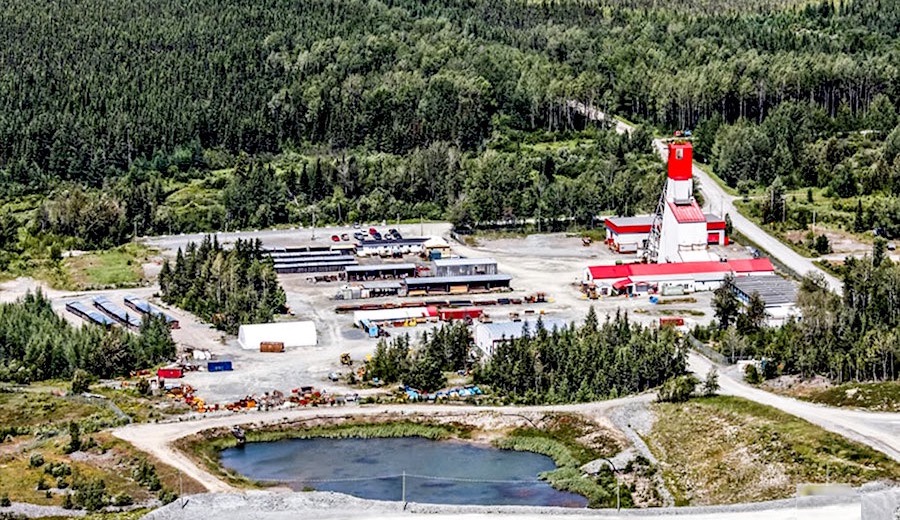
Beaufor includes two leases, a mining concession and 23 mining claims covering an area of 6.91 km². (Image courtesy of Monarch Mining.)

The Canadian province of Quebec has granted Monarch Mining (TSX-V: GBAR) a C$13.5 million (almost $11m) senior secured term loan agreement to help the company restart the Beaufor gold mine and Beacon mill, 20 km east of Val-d’Or.


The three-year term loan agreement with Investissement Quebec bears interest at a rate of 6% a year until the restart of the mine and mill, 5% during the first year of production and 4% for the subsequent years.


Currently on care and maintenance, Beaufor has produced over 1.1 million ounces of gold at an average grade of 7.5 grams gold per tonne since first production in the 1930s.

Before suspending operations in June 2019, it employed 150 people at the mine and 30 at the 750 tonne-per-day mill.

CURRENTLY ON CARE AND MAINTENANCE, BEAUFOR PRODUCED OVER 1.1 MILLION OUNCES OF GOLD SINCE FIRST PRODUCTION IN THE 1930S

Monarch, which acquired the operation in 2017, estimates that it will be creating more than 100 new jobs when its facilities become fully operational next year.

“The revival of the Beaufor mine and Beacon mill is an initiative that will support the economic recovery in Abitibi-Témiscamingue while continuing to develop our expertise in the gold sector,” Quebec Finance, Economy and Innovation Minister Eric Girard, said in the statement.


Beaufor has measured and indicated resources of 431,100 tonnes grading 6.68 grams gold per tonne for 92,700 ounces. An updated resource, based on an ongoing 42,500-metre drill program, is slated to be released in the third quarter.

Monarch Mining is a spinout of assets from Monarch Gold, which Yamana Gold (TSX: YRI) (NYSE, LON: AUY) acquired in a C$152-million cash and shares deal last November. The transaction gave Yamana the Wasamac property, which is about 100 km from its 50%-owned Canadian Malartic mine, as well as Camflo mill, also in Quebec.


Monarch Mining’s other assets include the McKenzie Break project and the Croinor past-producing mine, both in the Val-d’Or area.

Wednesday, August 06, 2025


Austal Launches Defense Shipbuilding Australia with Government Nod
ALL CAPITALI$M IS $TATE CAPITALI$M

Austal Henderson Australia
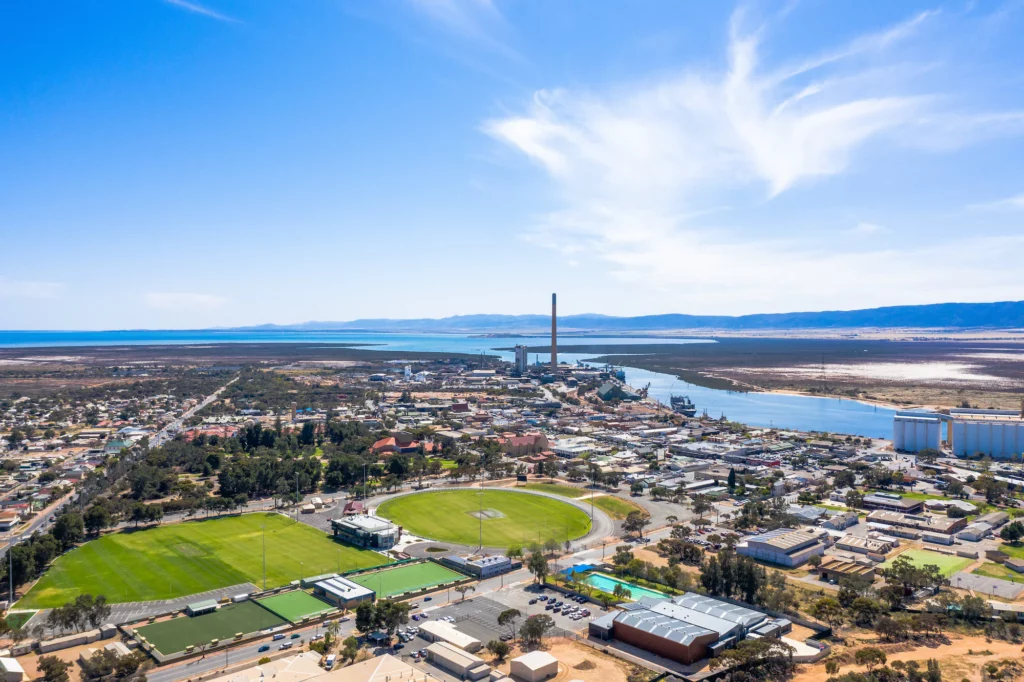
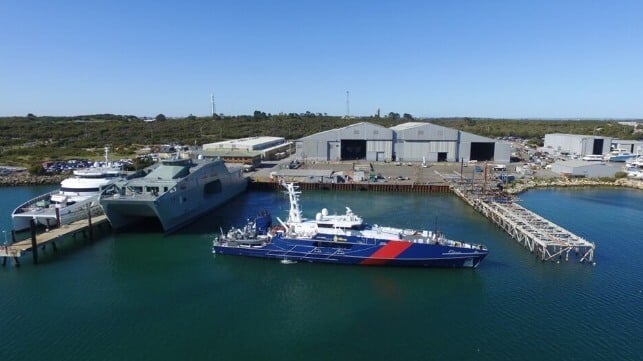
Austal gains a Strategic Shipbuilding Agreement with Australia for its Henderson yard (Austal)

Published Aug 5, 2025 6:28 PM by The Maritime Executive


In what management is calling a “defining moment” for the company, Austal and the Government of Australia have agreed on terms for a Strategic Shipbuilding Agreement. It took nearly two years to reach terms for the agreement, which sets the company up as a major supplier to the military, and in turn, Austal will launch a new subsidiary, Austal Defence Shipbuilding Australia.

Under the agreement, which has an initial maximum term of 15 years, Austal Defence Australia becomes a prime contractor, ultimately responsible for all aspects of the design and integration, construction, installation, integration, testing, delivery/acceptance of vessel programs for Australia. According to the company, the new agreement will establish a management framework and common terms through which it will deliver surface shipbuilding programs under shipbuilding contracts using a variety of key contractors and suppliers.

The government, in announcing the agreement, says it is securing a continuous pipeline of shipbuilding work in Western Australia. It highlights that Henderson in Western Australia, where Austal is headquartered, is one of two major shipbuilding hubs in Australia. Through the agreement, they look to establish a Defence Precinct in Henderson, which will support a wide range of subcontractors and service providers.

“For too long, the Australian shipbuilding industry has lacked the consistent work needed to develop a competitive and reliable shipbuilding capability,” says the Ministry for Defence. “This has had a flow-on effect of hindering the development of Australian-made Defence capabilities and resilience in our shipbuilding industry.”

The agreement will be supported by two pilot programs that were previously announced and which will provide Austal with many years of steady work. First is the Landing Craft Medium program, which is expected to be 18 vessels. It is intended to be the first pilot project, and Austal reports it expects the contract will be finalized in the first quarter of 2026. Work is projected to last for eight years, with the program costing A$1 to $1.3 billion (approximately US$650 to $775 million). The final delivery is expected in 2032.

 

The Landing Craft Medium will be the pilot project and Austal expects to build 18 by 2032 (Austal)


The second project is the Landing Craft Heavy, initially announced in November 2024. It calls for building eight Damen-designed LST100 Landing Craft for the Australian Army. The goal is to put this under contract before the end of 2025.

The government will receive a single “Sovereign Share” in the new company along with an associated call option. Under the terms of the call option, the government could move to acquire Austal Defence Australia at a “fair market value” should a new shareholder or third party acquire more than 20 percent of Austal. Existing shareholders of Austal have a higher threshold to trigger the call option. 

This is seen as a direct move in response to the repeated attempts by South Korea’s Hanwha Group to buy Austal. After the group’s initial proposal was rejected by Austal, which said due to its strategic nature, it did not believe the government would approve a takeover, Hanwha has made new approaches. The South Koreans purchased Austal shares on the open market and hold an option on shares while it has applied to Australia for permission to increase its holding in Austal to 19.9 percent.

Austal started operations in 1988 in Henderson and this new government agreement secures Austal’s role as a military supplier in Australia. It comes as the company has also established itself as a major builder for the U.S. government with programs for the Navy and the Coast Guard.

Tuesday, July 22, 2025


Aclara seeks state funding for US-Brazil plans


ALL CAPITALI$M IS $TATE CAPITALI$M


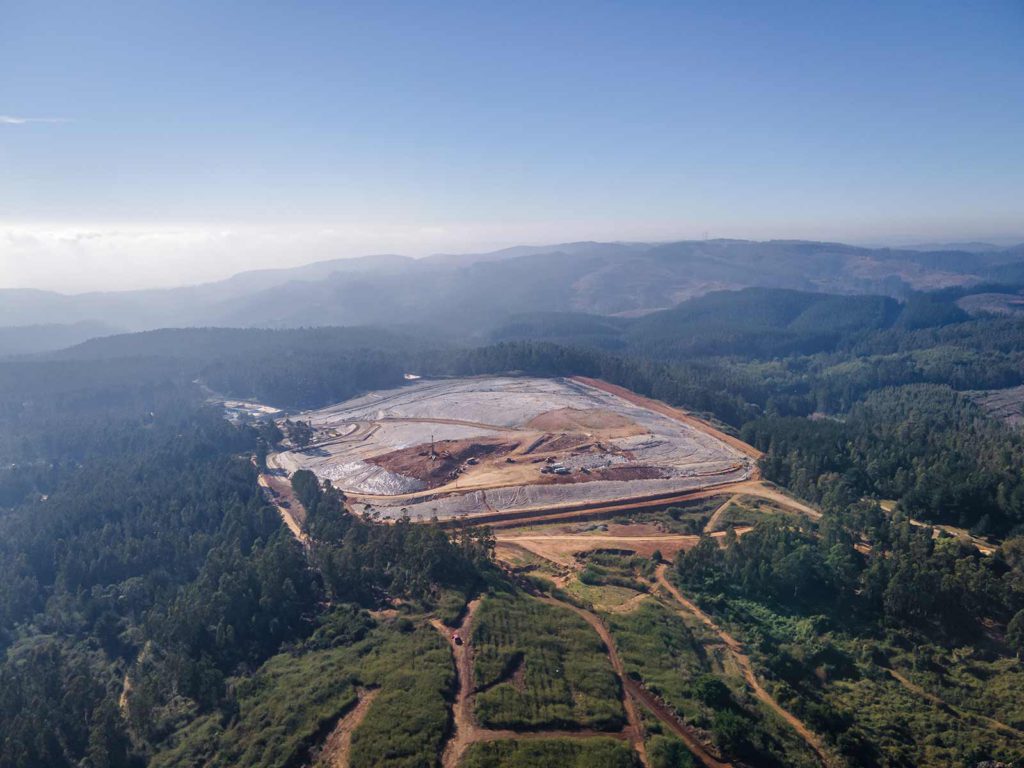
Landfill in Penco project. Credit: Aclara

Aclara Resources Inc. is in talks with US government agencies for possible financing toward its $1.5 billion plan to mine rare earths in Latin America and develop processing facilities in the US.

The company is looking to leverage efforts by Western governments to reduce reliance on China, which currently makes about 90% of the world’s rare earth permanent magnets.

Aclara has filed funding submissions with US agencies and is preparing to present its case in Washington, chief executive officer Ramon Barua said in an interview. The firm sees an opportunity after the Pentagon’s recent arrangement to take a stake in the only US producer, MP Materials Corp.

“Those conversations right now are private, but a project like ours definitely catches the attention of the administration,” he said. “So we’re trying to explore together with them if there’s an opportunity to join forces.”

Aclara is 57% owned by the Hochschild Group and trades in Toronto, where it as a market value of about $245 million. The firm, which doesn’t generate revenue, has two development-stage projects — one in Chile and one in Brazil.

Barua declined to say which agencies Aclara is dealing with or what form financing could take. He did make note of grants and loans offered by the Department of Defense as well as the Energy Department and the US International Development Finance Corporation, as well as the Pentagon’s $400 million equity investment in MP Materials earlier this month to fund a major new magnets plant.

That deal implies prices that are double those in China, and the new US facility would need the kind of elements that Aclara plans to mine in Brazil and Chile.

“We have something that is perfectly complementary to their MP Materials deal,” he said.

Aclara wants to begin tapping ionic clay deposits in Chile and Brazil by 2028, supplying elements used in applications such as electric vehicles and wind turbines. “If we want to meet that goal, we need to have significant funding between now and the end of the year.”

Besides the extraction projects in Chile and Brazil, Aclara is considering locations for a processing plant in the US, with Louisiana, Texas, South Carolina and Virginia all candidates. It also has an accord with German magnet maker Vacuumschmelze GmbH, which is set to build a facility in South Carolina.

To be sure, it’s not the first time rare earths have captured global attention. In the early 2010s, companies including Molycorp Inc. rode a wave of investor interest, until the market crashed as more supply came on and consumers switched to cheaper alternatives.

The industry still faces plenty of hurdles beyond pulling elements out of the ground such as competing with China in processing and creating a price benchmark outside China’s opaque market.

But a recent uptick in geopolitical tensions — after China imposed restrictions on exports and the US announced the MP Materials deal — is changing the tone of conversations with prospectives investors, Barua said. Previously talks focused on prices. Now, investors are more concerned about how soon projects can get started, he said.

“For projects like ours that require funding and offtake agreements, recognizing that the price of these elements is significantly higher than what the Chinese suggest, is very important,” he said.

(By James Attwood and Mariana Durao)

Wednesday, August 06, 2025

Australia pledges $87M to rescue Trafigura’s Nyrstar smelters in critical minerals push

ALL CAPITALI$M IS $TATE CAPITALI$M


The Port Pirie multi-metals processing facility has been in continuous operation for more than 130 years. Credit: Nyrstar

Australia said on Tuesday that it will provide A$135 million ($87.4 million) in financial support for two smelters owned by Trafigura unit Nyrstar, as part of its strategy to become a key supplier of critical minerals to Western allies.

The funding, announced by federal and state governments and supported by investment by Nyrstar, comes amid growing worries about supply chain vulnerabilities tied to China that have ramped up pressure on Western nations to secure access to critical minerals vital for the energy transition and defence.

Australia aims to position itself as a main player in this shift, but its metals processing sector is under strain from high energy and labour costs, while oversupply from top producer China continues to depress prices.

Earlier this year, Nyrstar put its troubled Port Pirie lead smelter in South Australia and Hobart zinc processing operations in Tasmania under strategic review, citing high energy prices and lower processing fees.

The support package will now allow Nyrstar to maintain operations while it explores modernization of both facilities and accelerates studies to produce critical minerals – germanium and indium in Hobart and antimony and bismuth in Port Pirie.

The initial focus will be on fast-tracking an antimony pilot plant in Port Pirie, Nyrstar said. It first told Reuters in May that it was considering production of the metal used in ammunition and lead-acid batteries at the site.

But modernizing Australia’s ageing smelters will require significantly more capital, potentially testing the government’s, and taxpayers’, resolve.

China, which dominates global processing of many critical minerals, has over the past year imposed restrictions on antimony and rare earths exports, disrupting supply chains for industries including automotive and defence and underscoring the geopolitical risks of over-reliance on Chinese refining.

Bolstering an alternative supply chain has become a top priority for Western governments and for the Trump Administration.

South Australia Premier Peter Malinauskas warned that without Western intervention, China could hold all the world’s smelting capacity. “That’s an unacceptable risk, particularly in the current geostrategic environment,” he told broadcaster ABC.

Australia’s minister for industry and innovation, Tim Ayres, told the ABC that he expected Port Pirie would be capable of producing 15,000 metric tons of antimony metal.

Antimony is an alloy hardener for other metals in ammunition and batteries and is critical for the manufacturing of semi-conductors found in electronics and defence applications. It is also used in flame retardant materials.

Meanwhile, the bailout of Nyrstar may trigger a flurry of aid-seeking calls to government officials from other struggling processing companies.

Last week IGO said it was assessing the future of its loss-making lithium hydroxide plant on the outskirts of Perth, run by joint venture partner Tianqi Lithium.

Glencore has asked for government assistance to support its Mount Isa copper smelter in Queensland state, while Rio Tinto has repeatedly flagged a tough outlook for its Tomago aluminum smelter in New South Wales, the state’s biggest energy user, given costly power.

BHP already pulled the trigger on its Western Australian nickel operations, putting them on ice a year ago.

($1 = 1.5451 Australian dollars)

(By Melanie Burton and Christine Chen; Editing by Tom Hogue, Stephen Coates and Himani Sarkar)

Tuesday, September 23, 2025

United States Antimony stock jumps after $245M Pentagon contract win

ALL CAPITALI$M IS $TATE CAPITALI$M

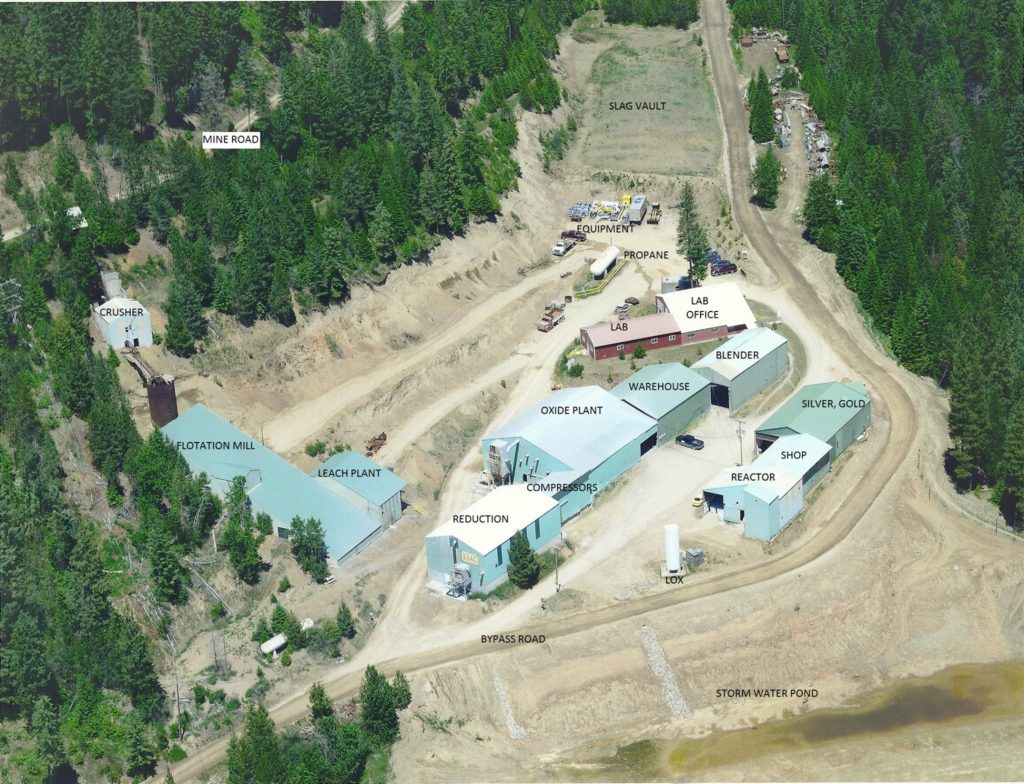
Layout of US Antimony’s operations. Credit: United States Antimony Corp.

United States Antimony Corporation (NYSE: UAMY) has secured a sole-source, five-year contract worth up to $245 million from the US Defense Logistics Agency (DLA) to supply antimony metal ingots for the national defense stockpile.

The news sent US Antimony’s shares soaring 17.8% in New York trading on Tuesday, pushing the company’s market capitalization to about $975 million.

Securing domestic supply

Antimony, a grey metal listed by the US as critical to national and economic security, is used in defense and high-tech applications including flame-retardant materials, certain semiconductors, ammunition primers, and superhard alloys. The US has not produced antimony commercially since 2016, making domestic supply a priority.

United States Antimony operates the only two smelters in North America with long-standing capacity to process the metal. According to the company, both facilities are already capable of producing ingots that meet stringent military specifications, with first deliveries under the contract expected this week.

US Antimony has been working to expand its feedstock base, sourcing ore globally while advancing domestic projects. Mining recently began on its Alaska acreage, with initial results showing high-grade deposits that the company says will enable efficient processing and contribute to the US supply chain. It is also advancing acreage in Montana.

The company emphasized that competing antimony sources, whether from the US or abroad, are at least three years away from commercial-scale production and may not meet defense standards.

Chairman and CEO Gary C. Evans called the Pentagon contract a “meaningful milestone” for the company and its employees.

“This sole-source award underscores our unique position as the only fully integrated antimony operation outside China,” Evans said, highlighting the significance of winning a government contract worth nearly 17 times the company’s 2024 revenue of $14.9 million.

Founded decades ago, US Antimony Corporation produces and markets antimony, zeolite, and precious metals across the US and Canada. Its Montana facility processes ore into antimony oxide, antimony metal, and antimony trisulfide while also recovering gold and silver. Its Bear River Zeolite operation in Idaho supplies materials for water filtration, nuclear waste treatment, agriculture, and other industrial uses.

US agency wants to buy scandium oxide from Rio Tinto for defence stockpile


Scandium. Image from Rio Tinto.

The US Defense Logistics Agency is seeking to buy scandium oxide worth up to $40 million over the next five years from a unit of mining giant Rio Tinto to secure supplies of the critical material for addition to the national stockpile.

Scandium is one of the rare earth elements, whose importance to the Western defence and technology sectors has been in the spotlight since China, the main producer, imposed export controls.

“Scandium, until recently, was primarily sourced from China. In late 2024, China placed export controls on scandium, which constrained the supply chain and prompted this acquisition for the National Defense Stockpile,” DLA said in a document published last week.

It intends to buy 6.4 metric tons of scandium oxide within five years.

In the first year it will be seeking almost 2 tons, equivalent to about 5% of last year’s global production of scandium oxide, which, according to US Geological Survey, totalled 40 tons with existing capacity of 80 tons.

To increase domestic supply of scandium, the US awarded up to $10 million to Elk Creek Resources, a unit of NioCorp Developments, in August.

However, for now the US government has to seek the product, used in many defence systems, from outside the country.


“Rio Tinto Services Inc. has been identified as the only vendor available capable of fulfilling the government’s required product needs at the capacity required for the contract,” the document said.

Rio Tinto said it would not comment on commercial matters, but added that it was “actively collaborating with the US government to identify opportunities and leverage available support to increase domestic production and strengthen supply chains for the American market.”

In 2020, Rio Tinto’s scientists became the first to develop a process which allows the extraction of high-purity scandium oxide from waste streams of titanium dioxide production, without the need for any additional mining.

“Rio Tinto is uniquely positioned to help secure materials critical to America’s future,” the group said in an emailed reply to a Reuters‘ request for comment.

Rio Tinto’s facility in Quebec, Canada produced the first batch of scandium oxide three years ago and currently has the annual production capacity of 3 metric tons.

(By Polina Devitt; Editing by Ros Russell)


Sunday, September 21, 2025

Ontario sweetens deal for Chapman’s Ice Cream expansion with $27M investment

ALL CAPITALI$M IS $TATE CAPITALI$M

The new facility will be 175,000 square feet and enable Chapman’s to continue making over 200 products using exclusively Canadian milk and cream.

September 19, 2025 

Ontario Premier Doug Ford enjoys a Chapman's ice cream treat at a press conference outside the facility on Fri., Sept 19, 2025. (CTV News/Steve Mansbridge)

The Ontario government is scooping out $27 million for Chapman’s, Canada’s largest independent ice cream manufacturer, to help expand its operations and build a new facility in Markdale.

Premier Doug Ford announced the investment during a press conference on Friday outside Chapman’s facility, calling it a “major vote of confidence” in Ontario’s economy and workers.

The province’s investment is on top of Chapman’s over $200 million it’s fronting for the project, which is expected to create 200 new jobs, bringing the family-run company’s workforce to over 1,000 employees.

“We’re going to continue doing whatever it takes to protect workers by cutting red tape and making Ontario the most competitive place in the G7 to invest and create jobs,” said Ford during a press conference on Friday outside Chapman’s facility, before stating his love for the Canadian-made products.

“I eat these things every night,” Ford added, holding a Chapman’s ice cream bar. “These are the best ice cream sandwiches anywhere,” he added before taking a bite.


The new facility will increase production capacity, allowing Chapman’s to develop new products, meet growing demand, and expand into international markets.

Chapman’s COO Ashley Chapman said the province’s support will help the company establish a stronger competitive ground in the face of increasing competition from multinationals.


Kim Phillips

Journalist, CTVNews.ca Barrie

Saturday, November 16, 2024

US finalizes up to $6.6 bn funding for chip giant TSMC

ALL CAPITALI$M IS $TATE-CAPITALI$M

By AFP
November 15, 2024

The first of TSMC's three new facilities in Arizona is set to fully open by early-2025, according to President Joe Biden - Copyright AFP Richard A. Brooks
Beiyi SEOW

The United States will award Taiwanese chip giant TSMC up to $6.6 billion in direct funding to help build several plants on US soil, officials said Friday, finalizing the deal before a new administration enters the White House.

“Today’s final agreement with TSMC –- the world’s leading manufacturer of advanced semiconductors –- will spur $65 billion dollars of private investment to build three state-of-the-art facilities in Arizona,” said President Joe Biden in a statement.

The Biden administration’s announcement comes shortly before President-elect Donald Trump takes office. Trump has recently criticized the CHIPS Act, a major law passed during Biden’s tenure aimed at strengthening the US semiconductor industry.

While the US government has unveiled over $36 billion in grants through this act, including the award to TSMC, much of the funds remain in the due diligence phase and have not been disbursed.

But once a deal is finalized, funds can start flowing to companies that have hit certain milestones.

TSMC is the second company after Polar Semiconductor to finalize its agreement.

“Currently, the United States does not make on our shores any leading-edge chips, and this is the first time ever that we’ll be able to say we will be making these leading-edge chips in the United States,” said Commerce Secretary Gina Raimondo told reporters Thursday.

“I want to remind everyone that these are the chips that run AI and quantum computing. These are the chips that are in sophisticated military equipment,” Raimondo added.

Making these chips in the United States, she noted, helps address a national security liability.

The first of TSMC’s three facilities is set to fully open by early-2025, Biden noted.

At full capacity, the three facilities in Arizona are expected to “manufacture tens of millions of leading-edge logic chips that will power products like 5G/6G smartphones, autonomous vehicles, and high-performance computing and AI applications,” the Commerce Department said.

It added that “early production yields at the first TSMC plant in Arizona are on par with similar factories in Taiwan.”

The investment is anticipated to create around 6,000 direct manufacturing jobs.

A senior US official told reporters on condition of anonymity that they expect at least $1 billion to go to TSMC this year.

Besides the $6.6 billion in direct funding, the United States is also providing up to $5 billion in proposed loans to TSMC Arizona.

While the United States used to make nearly 40 percent of the world’s chips, the proportion is now closer to 10 percent — and none are the most advanced chips.

TSMC shares were down by 0.6 percent in New York early Friday.

Wednesday, November 20, 2024

 ALL CAPITALI$M IS $TATE CAPITALI$M

India Rolls Out Subsidies and Preferential Financing for its Shipyards

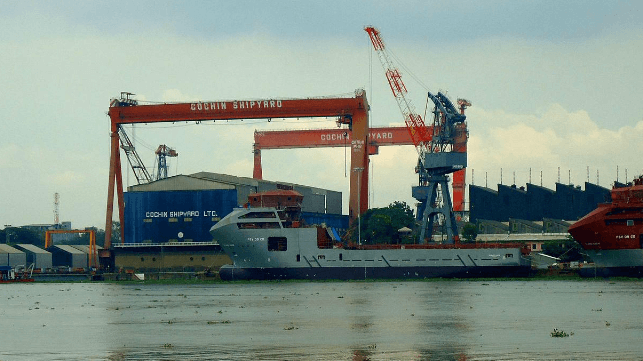
Cochin Shipyard
Ranjithsiji / CC BY SA 3.0

Published Nov 17, 2024 10:01 PM by The Maritime Executive


India is set to unveil a new policy aimed at incentivizing domestic shipbuilding. The ports, shipping and waterways ministry (MoPSW) is finalizing a cabinet note on incentives to promote domestic shipyards, reported the Indian business newspaper Mint. The proposed incentives are primarily focused on encouraging the development of fuel-efficient and technologically advanced vessels.

The new incentive program is the second phase of the existing Shipbuilding Financial Assistance Policy (SBFAP), which was adopted in 2016 and slated to expire in 2026. In the first phase of SBFAP, 313 vessel orders encompassing both domestic and export orders have been procured by 39 shipyards. So far, 135 vessels have been delivered.

During the second phase, the government reportedly wants to allocate $2.1 billion for the program. This will help provide a 25 percent subsidy for specialized vessels, rising to 30 percent for green and highly specialized vessels.

Another significant proposal is issuing credit notes worth 40 percent of a ship’s scrap value. After a demolition sale, the credit note could be reimbursed against the cost of constructing a new vessel at an Indian shipyard. Through this proposal, the government is hoping to encourage fleet renewal of Indian vessels. Around 44 percent of India’s merchant shipping fleet is above 20 years of age, data from MoPSW shows.

In addition, the government is also considering to introduce a purchase preference policy beginning in fiscal year 2031. This means vessels seeking new registration for coastal cargo transport in India would need to be built at a domestic shipyard.

India is targeting the shipbuilding industry as one of the critical pillars in achieving its Atmanirbhar Bharat vision (self-reliant India). The goal is to increase the percentage share of India-built ships in India’s fleet to seven percent by 2030 and 69 percent by 2047. The subsidy programs are key in making Indian yards as competitive as those of China and South Korea.

India is also in the process of giving the shipping industry infrastructure status for the first time. Currently, only shipbuilding and shipyards have infrastructure status, but the broader coverage will help reduce project costs for the shipping sector. Infrastructure status means a company can float infrastructure bonds, hence attracting investments from commercial banks and other kinds of concessions.

Top image: Ranjithsiji / CC BY SA 3.0


Estonian Maritime Industry: Unlocking new opportunities

Estonian Transport Administration

Published Nov 19, 2024 1:07 PM by Estonian Transport Administration


Estonia’s maritime sector offers a wealth of opportunities for shipowners and maritime entrepreneurs looking to establish a business in a digitally progressive, efficient, and entrepreneur-friendly environment. The Estonian Transport Administration initiative by the EST Flag, promoting an efficient and competitive environment for shipping companies with streamlined solutions tailored to the needs of today’s global maritime industry.

Estonia has garnered international attention and recognition for its e-solutions that empower citizens and businesses alike. As the world’s first fully digital country, Estonia offers 99 percent of government services online, 24/7. Key tools like the e-business register, e-notary, e-signature, and e-tax systems are just a few of the innovations that make conducting business here seamless. Estonia’s commitment to digital innovation extends to the maritime sector, where e-Residency unlocks powerful tools for shipowners. 

Digital systems for maritime business owners: Seafarers information system & ship information system 

Estonia’s e-Residency enables shipowners to access two specialized digital systems that transform how maritime business is managed: 

Seafarers Information System: Allows seafarers to apply for and extend various documents without leaving home or ship. It securely stores all maritime documents such as qualification certificates, practice records, medical certificates, and endorsements. Additionally, the system provides a convenient option to verify the validity check for a certificate of competency, endorsement, or medical certificate. 

Ship Information System: With 24/7 self-service and ship management capabilities one can operate a fleet remotely from anywhere in the world – order audits, apply for or update certificates, and access results and documents. The system also helps to keep track of payment obligations, so one never misses a fee. 

e-Residency: A gateway to maritime business 

Estonia’s pioneering e-Residency program, launched in 2014, offers entrepreneurs worldwide the opportunity to establish and manage an EU-based company remotely. Today’s statistics show that more than 118,500 e-residents have joined the program and over 32,500 Estonian companies have been established by e-residents. 

With e-Residency, shipowners benefit from: 

Easy EU Company Formation: Register an Estonian company online, unlocking access to the European market under the EU flag.

Digital Business Management: With a secure digital ID, e-residents can remotely manage key business functions, including signing contracts, filing taxes, and accessing government and bank services. 

Flexible Financial Solutions: Estonian banks and fintech companies provide accessible business accounts for e-residents, facilitating easy financial management. 

Applying for e-Residency is simple: submit an online application, pass a background check, and collect your digital ID card at an Estonian embassy or consulate. After your application has been approved, it can take 2-5 weeks for your e-Residency kit to arrive at your selected pickup location. This straightforward process provides maritime business owners with a stable and transparent EU business environment. Business consulting, accounting, and other trusted service providers can be found on the e-Residency website. 

The EST Flag advantages for maritime entrepreneurs 

Estonia offers respected value to shipowners through EST Flag, which supports a fast, solution-oriented approach to maritime operations. Recognizing that “every hour a vessel is in port costs”, the Estonian Transport Administration prioritizes rapid response times, ensuring that administrative processes are completed as quickly as possible with a focus on efficient and constructive solutions. 

EST Flag offers shipowners competitive advantages, including: 

Transparent Tax Benefits: Estonia’s tax system is transparent, efficient, and has simple tax rules and uniform tax rates, which keep compliance costs low. Tax filings take minimal time thanks to a fully digital tax environment. Estonia has the most competitive tax system in the OECD, and its deferred profit tax system encourages entrepreneurship and makes a company’s path to market much easier and less risky. 

EU-Integrated Environment: Estonia’s combination of stable political course and EU membership ensures a reliable and compliant framework for maritime businesses seeking to expand internationally. All Estonian digital business services through e-Residency are available in English. 

By choosing Estonia, maritime entrepreneurs gain access to a digitally advanced, EU-compliant, and supportive business ecosystem tailored to shipowners' needs. Whether registering a vessel under the Estonian flag, exploring marine technology, or expanding business in the EU, Estonia provides a streamlined, innovative path to success. 


This article is sponsored by the Estonian Transport Administration. For additional information visit the website and its LinkedIn page.

The opinions expressed herein are the author's and not necessarily those of The Maritime Executive.

Saturday, June 22, 2024

Australia to fund road clearing to Porgera mine after PNG landslide

ALL CAPITALI$M IS $TATE CAPITALI$M

Reuters | June 20, 2024 | 

The gold mine is located in the Enga Province of Papua New Guinea. (Image courtesy of Porgera Joint Venture.)

Australia said it would provide A$2 million ($1.33 million) to Papua New Guinea to restore road access to the Porgera gold mine, previously one of the world’s largest, and other support for survivors after a deadly landslide in Enga province in May.


Seven Australian ministers and the country’s police chief are in Papua New Guinea (PNG) to hold security and trade talks amid competition with China for policing ties in the Pacific Islands, and to underscore Australian humanitarian assistance after the disaster last month.

“It was moving to see so many people in such a dire situation,” Australia’s Minister for Pacific, Pat Conroy, said in an ABC Television interview, after visiting the site with PNG Defence Minister Billy Joseph and the delegation.

Australia will provide assistance for health clinics, and education packs for thousands of survivors who must move from villages where mountainsides collapsed.

PNG had requested A$2 million to “start the work to open up the national highway there to the Porgera gold mine, which is obviously an incredibly important source of jobs and revenue for the people of Enga province”, Conroy said.

The Porgera mine, about 30 kilometres (19 miles) from the landslide, is an underground mine jointly run by Canada’s Barrick Gold and China’s Zijin Mining Group, with the Papua New Guinea government holding a 51% share.

The mine was re-started this year after being in dispute for four years as PNG sought to boost returns to tribal landowners, and had been expected to reach full production this year.


Barrick did not immediately respond to a request for comment.

PNG Prime Minister James Marape said in April the reopened mine was expected to return to its status as one of the world’s largest gold mines, becoming a significant contributor to the national treasury and generating income for Enga province. The mine employs about 2,000 local workers.

It remains unclear how many people died in the landslide on May 24, with the national government and a UN estimate putting the death toll at about 670.

Australia’s Foreign Minister, Penny Wong, said in an ABC interview on Thursday that Australia was “in a permanent contest in the Pacific”, referring to its rivalry with China for security ties, and wanted to ensure stability in PNG.

($1 = 1.4984 Australian dollars)

(By Kirsty Needham and Melanie Burton; Editing by Gerry Doyle)

Oct 22, 2009 ... ... PDF etc.). See also the What is the directory structure for the texts? FAQ for information about file content and naming conventions ...


Saturday, August 16, 2025

ALL CAPITALI$M IS $TATE CAPITALI$M

Days after Intel CEO meets with Trump, the federal government is reportedly negotiating a stake in the chips champion

Nick Lichtenberg
Fri, August 15, 2025 


Lip-Bu Tan, CEO of Intel, following a meeting at the White House, Aug. 11, 2025.


In a potentially dramatic shift for corporate America and U.S. industrial policy, the Trump administration is actively considering a plan to buy a direct stake in Intel, one of the world’s largest and most strategically important chipmakers and the recent target of fierce criticism from the president himself. These revelations, first reported by Bloomberg, triggered an immediate surge in Intel’s stock—jumping by as much as 8.9% in late Thursday trading as investors responded to the possibility of government intervention and support for the beleaguered firm.

This kind of direct government investment in a tech giant marks a notable departure from the more hands-off approach favored by nearly all previous U.S. administrations. Traditionally, federal support for chipmaking came mainly in the form of grants or subsidies, such as those allocated under the CHIPS Act. Trump’s approach appears to favor direct equity stakes, echoing recent White House moves in other sectors, such as the federal government taking a “golden share” while allowing Nippon Steel to acquire U.S. Steel, and the Department of Defense buying $400 million in preferred shares in MP Materials, a miner of rare-earth minerals.
Motivations and political context

The rationale for this move centers on strengthening U.S. technological independence, with Intel being the only major semiconductor company producing advanced chips at scale inside the U.S. Its planned mega-plant in Ohio—originally announced in 2022 as a $20 billion investment—has faced repeated delays amid struggles to compete with global leaders such as TSMC and Samsung.


The semiconductor sector is increasingly seen as crucial for everything from smartphones to weaponry. Trump’s critics often cite “state capitalism,” but supporters argue direct support for Intel is essential for national security, technological leadership, and economic growth, especially as China, Taiwan, and South Korea pour resources into their own chip industries.

The current situation at Intel

Intel has been reeling from a series of setbacks. In 2024, its stock lost 60% of its value—the sharpest drop in its history. The company missed key opportunities in AI chips, and its foundry business, aimed at producing chips for other firms, is reportedly struggling to win major clients.

Intel’s new CEO, Lip-Bu Tan, was named after the board ousted Pat Gelsinger last year in an effort to accelerate a turnaround. Tan has already scaled back ambitions for the Ohio plant, deferring expansions and taking a cautious, demand-driven approach. His past investments in Chinese semiconductor firms drew pointed criticism after a bombshell Reuters investigation in April—so much so that President Trump publicly called for his resignation last week over allegations that Tan was “highly conflicted” with his ties to Chinese entities. Tan has since held a meeting with Trump at the White House, which Trump called “very interesting,” adding that Tan has “an amazing story.” People familiar with the matter told Bloomberg that the current investment plan stems from those crunch talks.

Previous to Trump’s statement, four former directors of Intel published a commentary exclusive to Fortune, saying the company was likely to retreat as America’s chips champion. After the president’s statement, they advocated for a separation of Intel’s essential foundry business that’s so core to national security.

Former Intel CEO Craig Barrett has since provided a commentary to Fortune about how to save the company, calling Intel “cash poor” and unable to afford “investments in the capacity needed in the future to replace [semiconductor rival] TSMC or even a reasonable fraction of TSMC capacity.” Barrett added that Intel probably needs a cash infusion of roughly $40 billion to be competitive. “Realistically that investment is 100% of the [CHIPS] Act capital grants so unlikely the [U.S. government] is the savior.” Bloomberg subsequently reported that the Trump administration was considering using funds from the CHIPS Act to at least partially fund the purchase of an equity stake in Intel, citing people familiar with the matter.

The White House and Intel did not respond to Fortune’s requests for comment.

For this story, Fortune used generative AI to help with an initial draft. An editor verified the accuracy of the information before publishing.

This story was originally featured on Fortune.com


The White House reportedly discussing taking a stake in Intel, sending shares climbing


Clare Duffy, Phil Mattingly, CNN
Thu, August 14, 2025 


The Intel logo on a sign in front of Intel headquarters on July 16 in Santa Clara, California. - Justin Sullivan/Getty Images

The Trump administration is reportedly considering having the US government take a stake in Intel, a company that was once one of America’s most important tech giants but which has since fallen on hard times.

Following a meeting between President Donald Trump and Intel CEO Lip-Bu Tan this week, Bloomberg reported on Thursday that the two sides are discussing an unusual deal in which the government would pay for a stake in the company. The specifics are reportedly still being worked out.

The agreement could bolster the struggling chipmaker, which has fallen behind rivals after missing key technology waves. The White House also wants to help Intel follow through on plans to open a new US manufacturing facility in Ohio, which has been repeatedly delayed, according to Bloomberg. Intel shares (INTC) rose more than 7% on Thursday, jumping in late-day trading following Bloomberg’s report about the talks.

It’s unclear when or if such a deal might be inked. But if it were to happen, it could also serve as a model for other investments by the Trump administration, which has been weighing opportunities to take similar stakes in various US companies in critical industries, two people familiar with the White House discussions on the matter told CNN. Trump has been pushing to increase domestic manufacturing, especially of key tech products and components such as semiconductors and artificial intelligence data centers.

“Discussion about hypothetical deals should be regarded as speculation unless officially announced by the Administration,” White House spokesman Kush Desai said in a statement to CNN.

An Intel spokesperson declined to comment on the Bloomberg report but said the company “is deeply committed to supporting President Trump’s efforts to strengthen U.S. technology and manufacturing leadership.”

“We look forward to continuing our work with the Trump Administration to advance these shared priorities, but we are not going to comment on rumors or speculation,” the spokesperson said in a statement.

Tan met with Trump on Monday after the president called for his immediate resignation following reports and allegations that he has ties to China. Trump later called the meeting “very interesting” and said Tan’s “success and rise is an amazing story.” The president added that he expected Intel and his cabinet members to bring him “suggestions” in the coming days.

Intel called the meeting “candid and constructive” and reiterated its commitment to “strengthening U.S. technology and manufacturing leadership.”

The people familiar with the discussions said Intel approached the meeting with the intent to discuss a wide range of potential investment or partnerships proposals. That presented an opportunity for Trump, emboldened after a series of unique investment partnerships between his administration and corporate America, the people said. The two sides agreed to continue conversations geared toward an agreement in the days following the meeting.

Tan took over Intel in March and has been attempting to turn around the beleaguered company. Intel said last month that it had mostly completed plans to lay off 15% of its staff as part of Tan’s efforts to right the ship.

A White House-Intel deal wouldn’t be the first unusual arrangement the Trump administration has come to with an American firm in recent weeks.

Last month, American rare-earth materials company MP Materials announced a multibillion-dollar package of investments and long-term purchase commitments from the US Department of Defense that it said would help it build a new US magnet manufacturing plant and expand existing facilities.

And US chipmakers AMD and Nvidia this week agreed to pay the US government 15% of their revenues from semiconductor sales to China in exchange for licenses to restart exports there, following meetings between Trump and Nvidia CEO Jensen Huang.

Thursday, July 10, 2025

ALL CAPITALI$M IS $TATE CAPITALI$M

AI surge sparks semiconductor facility expansion in South Korea

AI surge sparks semiconductor facility expansion in South Korea
/ Unsplash - Markus Spiske

By bno - Jakarta Office July 8, 2025

South Korea’s semiconductor industry is experiencing a significant investment surge, driven by the explosive demand for artificial intelligence (AI) chips and bolstered by strong government support. Chipmaking giants Samsung Electronics and SK hynix are at the forefront of this expansion, with large-scale construction projects and technology upgrades aimed at securing their positions in the rapidly growing global AI chip market.

Government steps up with billions in support

The Korean government in April announced a major boost to its semiconductor strategy, increasing planned investment from KRW26 trillion to KRW33 trillion (approximately $23.2bn), Korea Times reports. The initiative aims to build a private-sector-led innovation ecosystem and strengthen national competitiveness amid ongoing geopolitical and economic uncertainty.

Initial funding will support infrastructure development for chipmaking hubs in Yongin and Pyeongtaek, both located south of Seoul. These sites are already central to current and future facilities by Samsung and SK hynix.

In addition, low-interest loans for the industry will be increased by KRW3 trillion between 2025 and 2027, bringing the total to KRW20 trillion. The government will also invest in large-scale R&D projects, advanced fabrication plants, and talent development programmes, including initiatives to train local specialists and attract top-tier global experts.

Samsung reignites construction of mega fab

Samsung Electronics is reportedly resuming construction at its Pyeongtaek Campus Line 4 (P4), according to The Korea Herald. The site had previously paused some phases, but activity on phases two and four is now restarting. These new lines will focus on sixth-generation 1c DRAM chips using a 10-nanometre process, essential for next-gen HBM4 chips.

Samsung Vice Chair Jun Young-hyun recently travelled to the US for talks with Nvidia, a move widely seen as an effort to secure future HBM orders and reassert Samsung’s competitiveness in the high-bandwidth memory market.

Once operational, Phase 4 of the P4 facility is expected to contribute 80,000 wafers per month, accounting for 40% of the site's planned 200,000-wafer monthly capacity. Reports also suggest Samsung may revisit its halted P5 project, which would require an investment of over KRW30 trillion ($22bn) to produce DRAM, NAND flash, and foundry chips.

SK hynix doubles down on DRAM and packaging

The Korea Herald also reports that SK hynix is also intensifying its manufacturing push. Its M15X plant in Cheongju is set to open later this year, focusing on fifth-generation 10nm-class DRAM chips for HBM4 products. The facility will have a monthly capacity of around 90,000 wafers.

In parallel, SK hynix is developing a new back-end packaging plant, named “P&T 7,” also in Cheongju. This facility will enhance packaging capabilities and improve energy efficiency for high-performance AI semiconductors.

A market on the rise

The global AI semiconductor market is expected to grow rapidly, with the Export-Import Bank of Korea projecting an increase from $41.1bn in 2022 to $133bn by 2028. This sharp upward trajectory is spurring urgent investment from both government and industry players.

South Korea’s strategy goes beyond building more fabs. It is a calculated push to stay competitive in the global AI chip race. The government is backing the sector with serious funding while letting private players lead innovation, which is a practical and forward-looking approach.

Samsung is clearly shifting focus toward high-performance memory with its DRAM and HBM investments, while SK hynix is strengthening its packaging capabilities to meet AI processing needs. Both are positioning themselves for long-term dominance in a market that is evolving fast. The key question is whether Korea can scale its foundry capacity quickly enough to challenge the current leaders. If it succeeds, the global chip map could look very different within the decade. 

Rio unveils $65bn AI hub as Brazil courts global data centre investment

Rio unveils $65bn AI hub as Brazil courts global data centre investment
Brazil's renewable energy credentials are already well-established, having surpassed its target of reaching 84% renewable electricity by 2030 ahead of schedule. / pixabay
By bnl editorial staff July 9, 2025

Brazil is vying to capture a substantial share of the global data centre market, as Rio de Janeiro launches an ambitious $65bn artificial intelligence hub and the federal government mulls significant tax relief measures for the sector.

The Rio AI City project, announced last week through a memorandum of understanding (MoU) between the city and key federal institutions including the National Bank for Economic and Social Development (BNDES), aims to establish a 3-GW data centre capacity by 2032. The facility will be located in Barra da Tijuca, leveraging what Mayor Eduardo Paes described as favourable regulatory and fiscal conditions.

"We have the support of the BNDES, clean energy, a robust infrastructure of underground cables and fiber optics, and most valuable of all: human capital," Paes stated during the signing ceremony at the BNDES headquarters.

The announcement follows revelations that Brazil could attract demand for data centres worth 10 GW over the next decade, according to Igor Marchesini, special adviser to the Ministry of Finance. Speaking at the Energy Summit 2025 in late June, Marchesini pointed to Brazil's competitive advantages, particularly its clean energy matrix, which he argued sets the country apart from competitors facing infrastructure constraints, Estadao reported.

"Here we have something that only Brazil has: the matrix is clean, we won't even increase the electricity bill or increase pollution," Marchesini noted, contrasting Brazil's position with regions such as Ireland and Virginia where data centre expansion has faced public resistance over energy consumption concerns.

Brazil's renewable energy credentials are already well-established, having surpassed its target of reaching 84% renewable electricity by 2030 ahead of schedule. The country's ten-year Energy Expansion Plan projects solar capacity reaching 47 GW and wind capacity hitting 31 GW by 2030, according to the Energy Research Office's 2022 framework.

The government's optimism is underpinned by forthcoming tax incentives. A provisional measure offering 52% tax relief for data centres has been finalised and awaits transmission from the Civil House to Congress.

The tax relief forms part of a broader strategy to encourage data centre development in Brazil's Northeast region, where surplus energy capacity could help reduce regional inequalities whilst capitalising on growing global demand. Marchesini noted that many regions worldwide face seven-year waiting lists for data centre connections, presenting Brazil with a significant opportunity.

Supporting this infrastructure push, the BNDES announced plans for a dedicated fund targeting data centre and artificial intelligence projects, with initial investments ranging from $90mn to $180mn. Nelson Barbosa, Director of Planning and Institutional Relations at the BNDES, indicated the fund could eventually reach $450mn to $900mn when private investments are included.

"We are going to create a cooperation model for the BNDES that can be replicated in other cities and states," Barbosa stated, emphasising the bank's commitment to supporting small and medium-sized enterprises (SMEs) within the sector.

The development bank has already committed $306mn to the sector since 2023, including $180mn across nine hardware-related transactions and $126mn in equity funds expected to leverage an additional $414mn in private capital.

However, industry voices have warned against regulatory overreach. Alessandro Lombardi, president of Elea Data Centers, which plans to install 1.5 GW of capacity over six to seven years, cautioned that excessive regulation could deter investment, as reported by Estadao. His company has opened its first 10-MW facility in Rio de Janeiro and is constructing an 80-megawatt centre slated for 2026 delivery.

"But if [Brazil] overdoes it with regulation, it won't attract investors. There are three bills under consideration; there should be just one, to make things clearer. There needs to be user-friendly regulation," Lombardi stated, though he expressed optimism about recent progress.

Meanwhile, the broader regulatory landscape for artificial intelligence remains in development. Minister of Science, Technology and Innovation Luciana Santos highlighted the Brazilian Artificial Intelligence Plan, which calls for $4.14bn in investments through 2028 and has 31% of proposed actions completed or underway.

"We are committed to using artificial intelligence to serve a growth project with social justice and equity," Santos stated. "Mastering AI is a crucial matter of national sovereignty in the face of changing global geopolitics."

The convergence of Brazil's clean energy edge, government support, and skyrocketing global demand for data centre capacity presents a once-in-a-generation opportunity for the country to emerge as a regional technology hub. But success will depend on balancing regulatory clarity with investor-friendly policies, whilst maintaining the environmental advantages that set Brazil apart from competitors facing infrastructure constraints.