ALL WHITE KIRK KULTISTS
JONATHAN J. COOPER and SEJAL GOVINDARAO
Updated Sun, December 21, 2025
TOPSHOT - Turning Point USA CEO Erika Kirk, widow of right-wing political activist Charlie Kirk, speaks during Turning Point's annual AmericaFest conference in Phoenix, Arizona on December 18, 2025. (Photo by Olivier Touron / AFP via Getty Images)(OLIVIER TOURON via Getty Images)
PHOENIX (AP) — When Turning Point USA's annual AmericaFest convention reached its halfway point, Erika Kirk tried to put a smiling face on things.
“Say what you want about AmFest, but it’s definitely not boring,” said Kirk, who has led the influential conservative organization since her husband Charlie was assassinated in September. “Feels like a Thanksgiving dinner where your family’s hashing out the family business.”
That's one way to put it.
Some of the biggest names in conservative media took turns torching each other on the main stage, spending more time targeting right-wing rivals than their left-wing opponents.
The feuds could ultimately define the boundaries of the Republican Party and determine the future of President Donald Trump's fractious coalition, which appears primed for more schisms in the months and years ahead.
Here are some of the most notable moments from the four-day conference.
Shapiro criticizes podcasters
Ben Shapiro, co-founder of the conservative media outlet Daily Wire, set the tone with the first speech after Erika Kirk opened the convention. He attacked fellow commentators in deeply personal terms, saying some of the right's most popular figures are morally bankrupt.
Candace Owens “has been vomiting all sorts of hideous and conspiratorial nonsense into the public square for years,” he said.
Megyn Kelly is “guilty of cowardice" because she's refused to condemn Owens for spreading unsubstantiated theories about Kirk's death.
And Tucker Carlson's decision to host antisemite Nick Fuentes on his podcast was “an act of moral imbecility.”
Shapiro's targets hit back
Barely an hour later, Carlson took the same stage and mocked Shapiro’s attempt to “deplatform and denounce” people who disagree with him.
“I watched it,” he said. “I laughed.”
Others had their chance the next night.
“Ben Shapiro is like a cancer, and that cancer spreads,” said Steve Bannon, a former Trump adviser.
Kelly belittled Shapiro as a marginal figure in the conservative movement and said their friendship is over.
“I resent that he thinks he’s in a position to decide who must say what, to whom, and when,” Kelly said.
Owens, who has spread unsubstantiated conspiracy theories about Charlie Kirk's death, wasn't welcome at the convention. But she responded on her podcast, calling Shapiro a “miserable imp."
A schism over Israel and antisemitism
Israel came up repeatedly during the conference.
Some on the right have questioned whether the Republican Party's historically steadfast support for Israel conflicts with Trump's “America First” platform. Carlson criticized civilian deaths in Gaza in remarks that wouldn't have been out of place in progressive circles.
Some attendees dug deep into history, highlighting Israel's attack on the USS Liberty off the Sinai Peninsula in 1967. Israel said it mistook the ship for an Egyptian vessel during the Six Day War, while critics have argued that it was a deliberate strike.
Bannon accused Shapiro, who is Jewish, and others who staunchly support Israel of being part of “the Israel first crowd.” Kelly said criticism from Shapiro and Bari Weiss, the newly installed head of CBS News, “is about Israel."
Vance says loving America is enough to be part of MAGA
In the conference's closing speech, Vice President JD Vance declined to condemn extremism or define a boundary for the MAGA coalition. The movement should be open to anyone as long as they “love America," he said.
“I didn’t bring a list of conservatives to denounce or to deplatform,” Vance said Sunday.
Erika Kirk pledged Turning Point’s support for Vance to be the next Republican presidential nominee.
“We are going to get my husband’s friend JD Vance elected for 48 in the most resounding way possible,” she said on the first night of the convention. Vance would be the 48th president if he takes office after Trump.
Turning Point is a major force on the right, with a massive volunteer network around the country that can be especially helpful in early primary states.
Newsom is political enemy No. 1
California Gov. Gavin Newsom, a leading Democratic presidential contender, was a favorite punching bag.
“It looks like they’re going to nominate a California liberal who’s presided over rolling blackouts, open borders and unchecked violent gangs,” Vance said. “They’re just trying to settle on whether it’s going to be Gavin Newsom or Kamala Harris.”
Rapper Nicki Minaj, who made a surprise appearance, belittled the California governor, using Trump's favored nickname for him, Newscum.
“Please tread lightly," Minhaj said during an on-stage conversation with Erika Kirk. "That’s what I would say to Gabby-poo.”
A representative for Newsom did not respond to a request for comment.
MAHA teams up with MAGA
The Make America Healthy Again movement had a big presence at Turning Point, signaling its quick rise in the right-wing ecosystem.
MAHA is spearheaded by Robert F. Kennedy, who leads the Department of Health and Human Services. However, there has been friction with other parts of the Make America Great Again coalition, particularly when it comes to rolling back environmental regulations.
Wellness influencer Alex Clark, whose podcast is sponsored by Turning Point, asked the crowd whether the Environmental Protection Agency is “with us or against us?”
“Big chemical, big ag and big food are trying to split MAGA from MAHA so things can go back to business as usual, but we don’t want that, do we?” Clark said.
Clark and others have asked for Trump to fire EPA Administrator Lee Zeldin, who responded by reaching out to MAHA activists. The EPA also said it would release a MAHA agenda for the agency.
Erika Kirk greets Vice President JD Vance during Turning Point USA's AmericaFest 2025, Sunday, Dec. 21, 2025, in Phoenix. (AP Photo/Jon Cherry)(ASSOCIATED PRESS)
CEO and Chair of the Board of Turning Point USA Erika Kirk (L) speaks with US rapper Nicki Minaj during Turning Point's annual AmericaFest conference in Phoenix, Arizona on December 21, 2025. This year's conference commemorates the late right-wing activist Charlie Kirk, who was fatally shot on a Utah college campus in September, sparking an outpouring of grief among conservatives and prompting President Donald Trump to threaten a crackdown on the "radical left." (Photo by Olivier Touron / AFP via Getty Images)(OLIVIER TOURON via Getty Images)
Conservative political commentator and podcast host Tucker Carlson speaks at Turning Point's annual AmericaFest conference, in remembrance of late right-wing political activist Charlie Kirk, in Phoenix, Arizona on December 18, 2025. Kirk was shot dead on a Utah college campus in September, sparking a wave of grief among conservatives, and threats of a clampdown on the "radical left" from President Donald Trump. (Photo by Olivier Touron / AFP via Getty Images)(OLIVIER TOURON via Getty Images)
PHOENIX, ARIZONA - DECEMBER 21: Erika Kirk interviews surprise guest Nicki Minaj on the final day of Turning Point USA's annual AmericaFest conference at the Phoenix Convention Center on December 21, 2025 in Phoenix, Arizona. Minaj spoke about her frustrations with California Governor Gavin Newsom, and about why she has embraced the conservative movement. (Photo by Caylo Seals/Getty Images)(Caylo Seals via Getty Images)
A prerecorded message from President Donald Trump is displayed on a screen after his son Donald Trump Jr. called him from the stage to address the audience by phone during Turning Point's annual AmericaFest conference in Phoenix, Arizona on December 21, 2025. This year's conference commemorates the late right-wing activist Charlie Kirk, who was fatally shot on a Utah college campus in September, sparking an outpouring of grief among conservatives and prompting President Donald Trump to threaten a crackdown on the "radical left." (Photo by Olivier Touron / AFP via Getty Images)(OLIVIER TOURON via Getty Images)
First Turning Point USA conference without Charlie Kirk exposes rifts in Christian right
PHOENIX (RNS) — At AmericaFest — where ICE merch is sold beside ‘Jesus Won’ T-shirts — the idea that conservative values are God-ordained may be the biggest unifying factor.

Erika Kirk, widow of Charlie Kirk and now CEO of Turning Point USA, takes the stage during AmericaFest on Friday, Dec. 19, 2025, at the Phoenix Convention Center in Arizona. (RNS photo/Kathryn Post)
Kathryn Post
December 20, 2025

Attendees record photos and videos during a speech at Turning Point USA’s AmericaFest on Friday, Dec. 19, 2025, in Arizona. (RNS photo/Kathryn Post)
On the floor, however, the college and high school students who make up the rank and file of Turning Point USA remained optimistic. Roughly one-third of the 31,000 who came to Phoenix for AmFest were students. Many said their campus chapters, which go on door-knocking campaigns ahead of elections and man tables to promote conservative values, are gaining traction in the wake of Kirk’s death.
Two Generation Z attendees, one from California and another from Louisiana, said they joined TPUSA chapters in response to Kirk’s assassination. In her speech, Erika Kirk told the audience that more than 140,000 students have applied to get involved with TPUSA Sept. 10, when Kirk died, bringing its student membership to more than a million. The organization is getting help from states such as Florida and Texas, which are working to make it easier to establish TPUSA Club America high school chapters.
Sixteen-year-old Sage Tousey, president of the Hamilton Southeastern Club America in Fishers, Indiana, told Religion News Service that her chapter swelled from 20 students to nearly 50 since Kirk was shot and that it has become more religious in outlook as it focuses on service projects such as placing wreaths on soldiers’ graves.
Tousey, a nondenominational Christian, suggested that religion is a more cohesive force than politics. “We will always say Christ first, politics second,” she said.

Attendees arrive for AmericaFest on Friday, Dec. 19, 2025, at the Phoenix Convention Center in Arizona. (RNS photo/Kathryn Post)
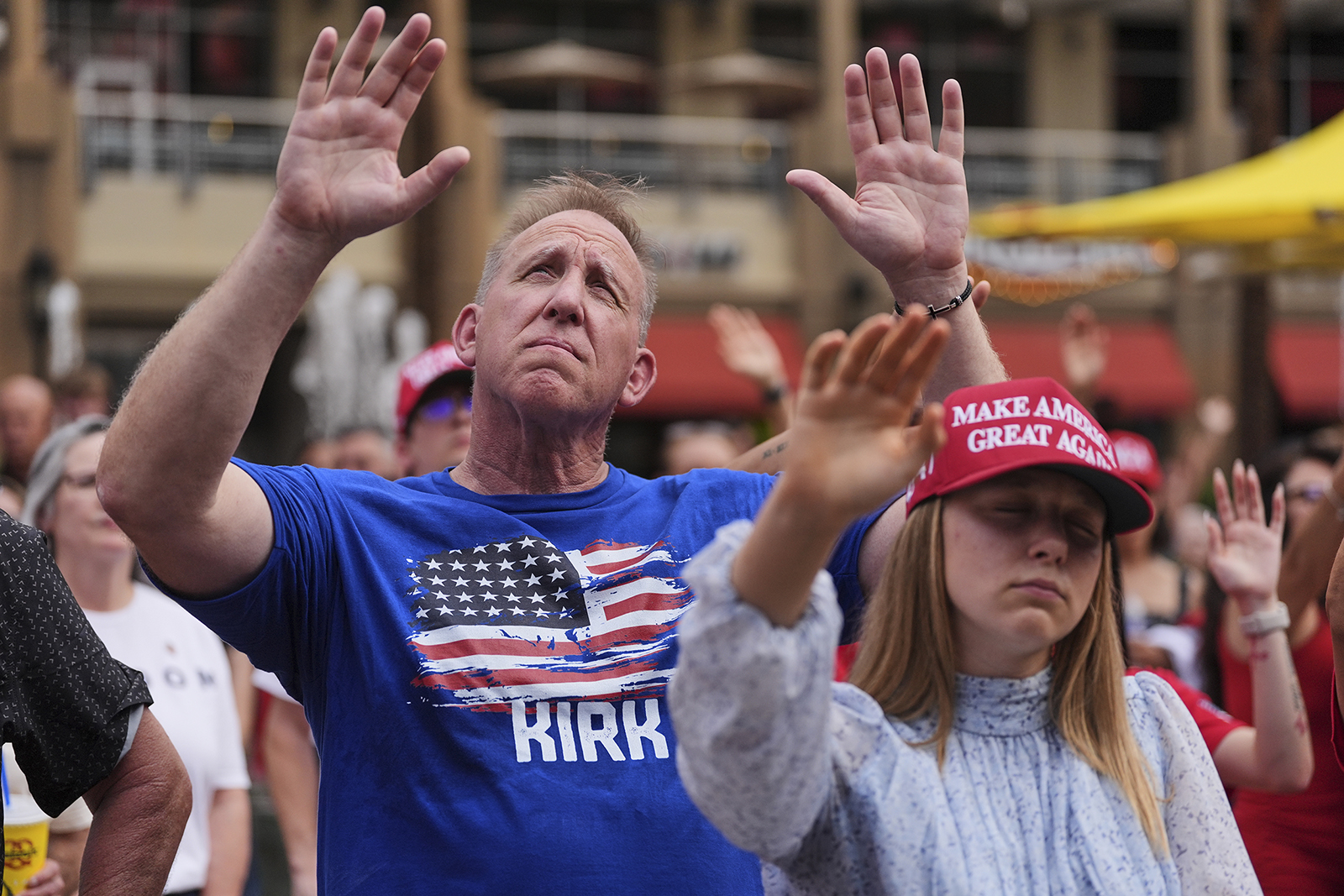
On Thursday’s warm, sunny morning in Phoenix, conservative politics and faith seemed to live side by side, with pro-Immigration and Customs Enforcement T-shirts being sold beside ones reading “Jesus Won.” And while Kirk’s death hung over the meeting, the young conservatives, their blue lanyards bright against the brown and gray streetscape of downtown Phoenix, were volubly excited for the sold-out event.
“It’s a bit of a homecoming,” said Jackson Heaberlin, 18, who serves as the outreach chair of the Clemson College Republicans at Clemson University in South Carolina. “You have all these months of very upsetting news, story after story of a left-wing radical violence, and then now you’re insulated in an environment of conservatives who are young and passionate.”
Even the disagreements among the headliners were taken as a sign of health. Attendees contrasted the sniping from the podium with cancel culture, which they see as standard procedure on the left. “In the conservative movement, we will not always agree on things, but we know that we can always come together under religion,” said Tousey.
Though TPUSA does have an arm that organizes pastors, TPUSA Faith, the core organization isn’t explicitly Christian — it describes its purpose as organizing students for limited government and free markets. Still, AmFest was saturated with religion. Attendees raptly listened to British comedian Russell Brand, who was baptized in 2024 and faces rape charges in Britain, urge the audience to build a Christian nation. Shapiro, who is Jewish, said the idea that God imbued humans with “creative capacity and the power to choose” is the “essence of conservatism.”
Kirk himself seemed to deepen his faith over his decade and more in the spotlight, and observers were watching the rhetoric at AmFest to see how much the organization will burnish its Christian brand moving forward.
“They want to promote this kind of above-politics thing with Charlie’s legacy,” said Matthew Boedy, a professor at the University of North Georgia who has studied TPUSA. Boedy pointed to a “clear divide” between the Christian ethic shown by Erika Kirk, who emotionally forgave the killer at Kirk’s Sept. 21 memorial service in nearby Glendale, Arizona, and Trump’s stating flatly on the same day: “I don’t forgive my enemies.”

Merchandise booths sold a variety of t-shirts, hats and other products during the AmericaFest event hosted by Turning Point USA on Friday, Dec. 19, 2025, in Arizona. (RNS photo/Kathryn Post)
In an interview last week, New York Times columnist Ross Douthat asked Andrew Kolvet, who has taken over as host of “The Charlie Kirk Show” podcast, whether conservative politics could use more “of the Erika Kirk spirit” than “Trumpian attitude.” Kolvet advocated for “a more conciliatory tone at times than our president,” while saying he appreciates Trump’s unapologetic approach.
At AmFest, the Rev. Lucas Miles, senior director of TPUSA Faith, described Erika Kirk as a “well-discipled” Christian, and Trump as a newer believer. “I think we’re just seeing a spectrum of … maturing in Christ and being conformed in the image of Christ,” he said.
The divide echoed a related debate among conservative Christians about guarding against empathy for immigrants — a theme that has puzzled even some prominent evangelical Christians as counter to Jesus’ teaching.
“The toxic empathy is getting so exhausting,” said Katie Turnbull, 25, who attended AmFest with her husband. “You hear huge pastors with huge churches preach to their congregations that love is love, and that we get to define love as opening the floodgates of our borders and bringing in the Third World.”

Attendees at Turning Point USA’s AmericaFest on Dec. 19, 2025, in Phoenix. (RNS photo/Kathryn Post)
Some of those who addressed the conference, on the other hand, argued for making room for difference in U.S. society. On Friday, Vivek Ramaswamy, a former Republican candidate for president now running for Ohio governor, pushed back on the anti-immigrant sentiment that was in the air at the conference. A Hindu and the child of immigrants from India, Ramaswamy told the audience that normalizing hatred toward any ethnic group has “no place in the future of the conservative movement.”
These kinds of sentiments were a minority view, however. While at times critical of Trump’s tone, most attendees viewed the president’s aggressive anti-immigrant policy as above reproach. Several younger attendees hoped for broader restrictions even on legal immigration and combined concerns about immigration with broader fears about the rise of Islam, which they view as vehemently anti-Christian.
Gwyn Andrews, 22, who founded a TPUSA chapter at the University of West Georgia, expressed concern about the “Islamic faith issue that has been infiltrating our cities, our colleges,” adding that “a big issue for me personally is to make sure that people truly understand the Islamic faith and how that directly ties to socialism, as we’ve seen in New York City with Mamdani,” referring to New York’s Muslim mayor-elect.
She said that for American society to thrive, Muslim immigrants need to assimilate, a word that cropped up consistently at AmFest. “The goal is for them to understand that when you assimilate here, you can’t go to Dearborn, Michigan, and turn the entire place into a Third World country and then try to implement Shariah law,” she said.
Anti-Muslim sentiment is nothing new to TPUSA. Kirk long argued that Islam is not compatible with the West and that to be American requires that you “worship God, not Allah.” In a recent episode of “The Charlie Kirk Show,” Jewish conservative political commentator Josh Hammer argued that to be considered an American, one ought to “publicly assimilate into the Protestant-majority inherited culture.”
RELATED: Nick Fuentes and the Groyper challenge to Catholicism
But in Phoenix, Miles framed assimilation as a faith question, saying God instructed his followers to welcome foreigners passing through, but stressed that those who stayed, like the biblical figure Ruth, chose to assimilate. Those wanting to “keep their own identity and maybe usurp and take advantage,” he said, “the Hebrews were warned … to keep them at bay.”

Alex Clark takes the stage at Turning Point USA’s AmericaFest on Friday, Dec. 19, 2025, in Arizona. (RNS photo/Kathryn Post)
AmFest’s insistence on Christian dominance over national policy, said Christina Littlefield, associate professor of communication and religion at Pepperdine University, veers into Christian nationalism, the idea that the government should privilege a particular vision of Christianity at the cost of democratic pluralism.
Portraying Kirk, who often argued that America should be a Christian nation, as a martyr is “radicalizing” for many conservatives, said Littlefield, co-author of “Christian America and the Kingdom of God” with Richard T. Hughes, a dynamic she called dangerous. “Someone killed him because they did not like his political beliefs, which I condemn, but he did not die as a martyr for the faith.”
While TPUSA is openly mourning Kirk’s death, it’s also leveraging his story to rally Christian pastors and recruit voters. Miles told RNS that TPUSA Faith’s network jumped from 4,200 member churches prior to Kirk’s death, to 9,500, and is now planning a “Make Heaven Crowded Tour,” hosting faith events at churches in more than 25 cities. A new, free curriculum, First Truths, examining the fundamentals of the Christian faith is already available, and next year, the group will release another curriculum critiquing Islam.
At AmFest, Miles and other speakers appealed to faith to end the infighting seen on the stage, imbuing the organization’s political power with spiritual stakes.
“If we don’t unify as the body of Christ, then we are in a position where we are vulcanized, we’re fractured,” Miles told attendees at a breakout session. Christian unity, he said, is needed to hold the line “when it comes to Marxism, when it comes to Islam, when it comes to progressivism, when it comes to abortion.”

PHOENIX (RNS) — At AmericaFest — where ICE merch is sold beside ‘Jesus Won’ T-shirts — the idea that conservative values are God-ordained may be the biggest unifying factor.
Erika Kirk, widow of Charlie Kirk and now CEO of Turning Point USA, takes the stage during AmericaFest on Friday, Dec. 19, 2025, at the Phoenix Convention Center in Arizona. (RNS photo/Kathryn Post)
Kathryn Post
December 20, 2025
RNS
PHOENIX (RNS) — On a stage framed by glinting red-white-and-blue lights, Michael Knowles, a podcaster for the political outlet The Daily Wire, recalled Jesus’ Sermon on the Mount, the New Testament’s signal call for mercy and hope.
“Blessed are the peacemakers, for they shall be called sons of God,” Knowles read on Thursday (Dec. 18) at opening night of AmericaFest, the annual conference of Turning Point USA, the conservative youth activist organization co-founded by Charlie Kirk.
There was no doubt that Kirk, who was assassinated in September, was the peacemaker Knowles had in mind. He was one of several speakers at the Phoenix Convention Center in the following days to paint Kirk as a spiritual unifier who connected disparate parts of the American right and reached out to progressives.
If Kirk had that power, this year’s AmFest, which closes on Sunday, has brought home how badly U.S. conservatism needs that kind of uniting presence. The movement’s cohesion has been tested in recent months by Tucker Carlson’s controversial interview with antisemitic internet influencer Nick Fuentes and by disputes over American support for Israel. It’s also been shaken by ongoing revelations tying Trump world figures to sexual predator Jeffrey Epstein and by roiling conspiracy theories, such as former Trump adviser Candace Owens’ suggestion that TPUSA is complicit in its own co-founder’s murder.
Kirk’s widow, Erika Kirk, acknowledged these rifts in her opening speech to the conference, saying: “We’ve seen fractures. We’ve seen bridges being burned that shouldn’t be burnt.”
Her warning went largely unheeded at AmFest, judging by speeches made from the stage, where Daily Wire co-founder Ben Shapiro, Carlson, former White House strategist Steve Bannon and journalist Megyn Kelly all used their speaking slots to swipe at each other.
PHOENIX (RNS) — On a stage framed by glinting red-white-and-blue lights, Michael Knowles, a podcaster for the political outlet The Daily Wire, recalled Jesus’ Sermon on the Mount, the New Testament’s signal call for mercy and hope.
“Blessed are the peacemakers, for they shall be called sons of God,” Knowles read on Thursday (Dec. 18) at opening night of AmericaFest, the annual conference of Turning Point USA, the conservative youth activist organization co-founded by Charlie Kirk.
There was no doubt that Kirk, who was assassinated in September, was the peacemaker Knowles had in mind. He was one of several speakers at the Phoenix Convention Center in the following days to paint Kirk as a spiritual unifier who connected disparate parts of the American right and reached out to progressives.
If Kirk had that power, this year’s AmFest, which closes on Sunday, has brought home how badly U.S. conservatism needs that kind of uniting presence. The movement’s cohesion has been tested in recent months by Tucker Carlson’s controversial interview with antisemitic internet influencer Nick Fuentes and by disputes over American support for Israel. It’s also been shaken by ongoing revelations tying Trump world figures to sexual predator Jeffrey Epstein and by roiling conspiracy theories, such as former Trump adviser Candace Owens’ suggestion that TPUSA is complicit in its own co-founder’s murder.
Kirk’s widow, Erika Kirk, acknowledged these rifts in her opening speech to the conference, saying: “We’ve seen fractures. We’ve seen bridges being burned that shouldn’t be burnt.”
Her warning went largely unheeded at AmFest, judging by speeches made from the stage, where Daily Wire co-founder Ben Shapiro, Carlson, former White House strategist Steve Bannon and journalist Megyn Kelly all used their speaking slots to swipe at each other.
Attendees record photos and videos during a speech at Turning Point USA’s AmericaFest on Friday, Dec. 19, 2025, in Arizona. (RNS photo/Kathryn Post)
On the floor, however, the college and high school students who make up the rank and file of Turning Point USA remained optimistic. Roughly one-third of the 31,000 who came to Phoenix for AmFest were students. Many said their campus chapters, which go on door-knocking campaigns ahead of elections and man tables to promote conservative values, are gaining traction in the wake of Kirk’s death.
Two Generation Z attendees, one from California and another from Louisiana, said they joined TPUSA chapters in response to Kirk’s assassination. In her speech, Erika Kirk told the audience that more than 140,000 students have applied to get involved with TPUSA Sept. 10, when Kirk died, bringing its student membership to more than a million. The organization is getting help from states such as Florida and Texas, which are working to make it easier to establish TPUSA Club America high school chapters.
Sixteen-year-old Sage Tousey, president of the Hamilton Southeastern Club America in Fishers, Indiana, told Religion News Service that her chapter swelled from 20 students to nearly 50 since Kirk was shot and that it has become more religious in outlook as it focuses on service projects such as placing wreaths on soldiers’ graves.
Tousey, a nondenominational Christian, suggested that religion is a more cohesive force than politics. “We will always say Christ first, politics second,” she said.
Attendees arrive for AmericaFest on Friday, Dec. 19, 2025, at the Phoenix Convention Center in Arizona. (RNS photo/Kathryn Post)
On Thursday’s warm, sunny morning in Phoenix, conservative politics and faith seemed to live side by side, with pro-Immigration and Customs Enforcement T-shirts being sold beside ones reading “Jesus Won.” And while Kirk’s death hung over the meeting, the young conservatives, their blue lanyards bright against the brown and gray streetscape of downtown Phoenix, were volubly excited for the sold-out event.
“It’s a bit of a homecoming,” said Jackson Heaberlin, 18, who serves as the outreach chair of the Clemson College Republicans at Clemson University in South Carolina. “You have all these months of very upsetting news, story after story of a left-wing radical violence, and then now you’re insulated in an environment of conservatives who are young and passionate.”
Even the disagreements among the headliners were taken as a sign of health. Attendees contrasted the sniping from the podium with cancel culture, which they see as standard procedure on the left. “In the conservative movement, we will not always agree on things, but we know that we can always come together under religion,” said Tousey.
Though TPUSA does have an arm that organizes pastors, TPUSA Faith, the core organization isn’t explicitly Christian — it describes its purpose as organizing students for limited government and free markets. Still, AmFest was saturated with religion. Attendees raptly listened to British comedian Russell Brand, who was baptized in 2024 and faces rape charges in Britain, urge the audience to build a Christian nation. Shapiro, who is Jewish, said the idea that God imbued humans with “creative capacity and the power to choose” is the “essence of conservatism.”
Kirk himself seemed to deepen his faith over his decade and more in the spotlight, and observers were watching the rhetoric at AmFest to see how much the organization will burnish its Christian brand moving forward.
“They want to promote this kind of above-politics thing with Charlie’s legacy,” said Matthew Boedy, a professor at the University of North Georgia who has studied TPUSA. Boedy pointed to a “clear divide” between the Christian ethic shown by Erika Kirk, who emotionally forgave the killer at Kirk’s Sept. 21 memorial service in nearby Glendale, Arizona, and Trump’s stating flatly on the same day: “I don’t forgive my enemies.”
Merchandise booths sold a variety of t-shirts, hats and other products during the AmericaFest event hosted by Turning Point USA on Friday, Dec. 19, 2025, in Arizona. (RNS photo/Kathryn Post)
In an interview last week, New York Times columnist Ross Douthat asked Andrew Kolvet, who has taken over as host of “The Charlie Kirk Show” podcast, whether conservative politics could use more “of the Erika Kirk spirit” than “Trumpian attitude.” Kolvet advocated for “a more conciliatory tone at times than our president,” while saying he appreciates Trump’s unapologetic approach.
At AmFest, the Rev. Lucas Miles, senior director of TPUSA Faith, described Erika Kirk as a “well-discipled” Christian, and Trump as a newer believer. “I think we’re just seeing a spectrum of … maturing in Christ and being conformed in the image of Christ,” he said.
The divide echoed a related debate among conservative Christians about guarding against empathy for immigrants — a theme that has puzzled even some prominent evangelical Christians as counter to Jesus’ teaching.
“The toxic empathy is getting so exhausting,” said Katie Turnbull, 25, who attended AmFest with her husband. “You hear huge pastors with huge churches preach to their congregations that love is love, and that we get to define love as opening the floodgates of our borders and bringing in the Third World.”
Attendees at Turning Point USA’s AmericaFest on Dec. 19, 2025, in Phoenix. (RNS photo/Kathryn Post)
Some of those who addressed the conference, on the other hand, argued for making room for difference in U.S. society. On Friday, Vivek Ramaswamy, a former Republican candidate for president now running for Ohio governor, pushed back on the anti-immigrant sentiment that was in the air at the conference. A Hindu and the child of immigrants from India, Ramaswamy told the audience that normalizing hatred toward any ethnic group has “no place in the future of the conservative movement.”
These kinds of sentiments were a minority view, however. While at times critical of Trump’s tone, most attendees viewed the president’s aggressive anti-immigrant policy as above reproach. Several younger attendees hoped for broader restrictions even on legal immigration and combined concerns about immigration with broader fears about the rise of Islam, which they view as vehemently anti-Christian.
Gwyn Andrews, 22, who founded a TPUSA chapter at the University of West Georgia, expressed concern about the “Islamic faith issue that has been infiltrating our cities, our colleges,” adding that “a big issue for me personally is to make sure that people truly understand the Islamic faith and how that directly ties to socialism, as we’ve seen in New York City with Mamdani,” referring to New York’s Muslim mayor-elect.
She said that for American society to thrive, Muslim immigrants need to assimilate, a word that cropped up consistently at AmFest. “The goal is for them to understand that when you assimilate here, you can’t go to Dearborn, Michigan, and turn the entire place into a Third World country and then try to implement Shariah law,” she said.
Anti-Muslim sentiment is nothing new to TPUSA. Kirk long argued that Islam is not compatible with the West and that to be American requires that you “worship God, not Allah.” In a recent episode of “The Charlie Kirk Show,” Jewish conservative political commentator Josh Hammer argued that to be considered an American, one ought to “publicly assimilate into the Protestant-majority inherited culture.”
RELATED: Nick Fuentes and the Groyper challenge to Catholicism
But in Phoenix, Miles framed assimilation as a faith question, saying God instructed his followers to welcome foreigners passing through, but stressed that those who stayed, like the biblical figure Ruth, chose to assimilate. Those wanting to “keep their own identity and maybe usurp and take advantage,” he said, “the Hebrews were warned … to keep them at bay.”
Alex Clark takes the stage at Turning Point USA’s AmericaFest on Friday, Dec. 19, 2025, in Arizona. (RNS photo/Kathryn Post)
AmFest’s insistence on Christian dominance over national policy, said Christina Littlefield, associate professor of communication and religion at Pepperdine University, veers into Christian nationalism, the idea that the government should privilege a particular vision of Christianity at the cost of democratic pluralism.
Portraying Kirk, who often argued that America should be a Christian nation, as a martyr is “radicalizing” for many conservatives, said Littlefield, co-author of “Christian America and the Kingdom of God” with Richard T. Hughes, a dynamic she called dangerous. “Someone killed him because they did not like his political beliefs, which I condemn, but he did not die as a martyr for the faith.”
While TPUSA is openly mourning Kirk’s death, it’s also leveraging his story to rally Christian pastors and recruit voters. Miles told RNS that TPUSA Faith’s network jumped from 4,200 member churches prior to Kirk’s death, to 9,500, and is now planning a “Make Heaven Crowded Tour,” hosting faith events at churches in more than 25 cities. A new, free curriculum, First Truths, examining the fundamentals of the Christian faith is already available, and next year, the group will release another curriculum critiquing Islam.
At AmFest, Miles and other speakers appealed to faith to end the infighting seen on the stage, imbuing the organization’s political power with spiritual stakes.
“If we don’t unify as the body of Christ, then we are in a position where we are vulcanized, we’re fractured,” Miles told attendees at a breakout session. Christian unity, he said, is needed to hold the line “when it comes to Marxism, when it comes to Islam, when it comes to progressivism, when it comes to abortion.”