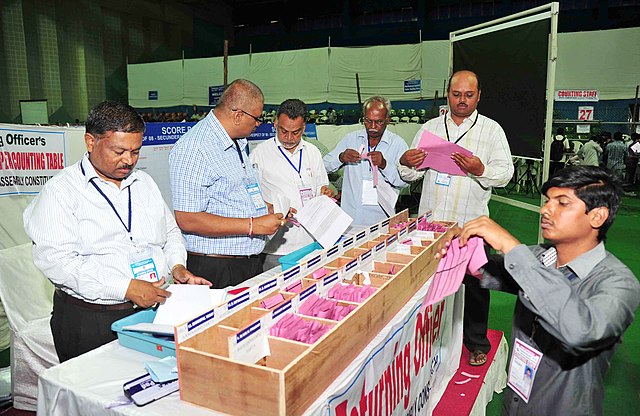
There is this to be said for the honourable Om Birla, speaker of the Lok Sabha: as a No-Confidence motion came to be tabled for his removal on charges of alleged partisan conduct in the running of the House, he lost not a minute in recusing himself from his perch, vowing not to return till he was exonerated.
This was done truly in the best interests of probity at the highest rung of constitutional governance.
But if you thought his laudable example may henceforth be emulated by other worthies in high constitutional office, think again.
Close on the heels of the now defeated No-Confidence motion against the honourable speaker, 193 members, no less, of parliament have tabled a motion to impeach the Chief Election Commissioner of India on grounds of, allegedly, failing to uphold with impartiality the “ basic” constitutional injunction to ensure “free and fair” elections in the republic by favouring, in multiple ways, the prospects of the ruling Bharatiya Janata Party (BJP).
This is the first time since the first ever election in independent India that an Election Commissioner has thus come to be proceeded against – surely not a record to write home about, and a circumstance that ought to trouble the Commission to ponder that it should be so, and why.
The citizen wedded to the true spirit and sanctity of democracy would have expected that, regardless of calculations about how much success this move to impeach him may or may not enjoy, the CEC, along with the other two Commissioners would think it fit to follow Birla’s moral example and likewise recuse himself from his position till the conclusion of the impeachment process – a move necessarily bearing on garnering the trust of “we the people” in the integrity of India’s electoral processes.
But no; Gyanesh Kumar clearly is made of sterner stuff.
That the entire opposition, as in Birla’s case, representing over 60% of the popular vote, is ranged against him does little to induce the least introspection in Gyanesh Kumar.
Even if it is his view that the measure undertaken by the combined opposition is merely a case of crying wolf at electoral losses, democratic propriety might have triggered some qualm, after all, for continuing to man an office that must in every circumstance remain, like Caesar’s wife, above suspicion.
It may also be noted that this is the first Election Commission whose operations have had to be so continuously overseen by the top court of the Republic – hardly a certificate of merit for the voter who is looking to exercise the only right that puts her on a level with the highest and the mightiest.
In a cavalier conjunction, the Commission, if anything, has gone on to declare dates for elections to five state assemblies while the motion of impeachment is waiting to be considered in due process.
All that while also the Commission’s insistent Special Intensive Revision (SIR) exercise, undertaken ostensibly to clean up voters lists, has now landed the realm in an unprecedented situation in two of the five states: in West Bengal, some 60 lakh individuals still await the acceptance of their claim to be genuine voters, a determination that must be made before April 6 and 9.
And think that such is the distrust in the operations of the Commission that unprecedentedly this task of voter verification has been assigned by the Supreme Court of India not to Commission workers alone but to the supervision of judges from here, there, and elsewhere, a measure unheard of in our republican history thus far.
There is no telling that this exercise in ensuring that every eligible citizen’s voter claim is recorded in due time will see completion.
Likewise, some 40 lakh residents of Kerala are now stranded in the Gulf countries owing to the war now underway, and we have no instruction as to how the Commission proposes to obtain their legitimacy and vote for the coming election to the Kerala assembly.
We Indians are often reminded of how ours is the “largest” democracy in the world; what we now need rather despairingly to know is that we are also the fairest.


No comments:
Post a Comment