Iran War: We Have Met the Enemy, and He Is U.S.
Let me bury the lede just a bit:
In December of 1862, Union troops under the command of Ambrose Burnside crossed the Rappahannock river by pontoon bridge and occupied the town of Fredericksburg, Virginia, in an attempt to come to grips with Confederate forces under Robert E. Lee.
That first skirmish of the battle named for the town went rather easily for the Union Forces … who couldn’t help but wonder why.
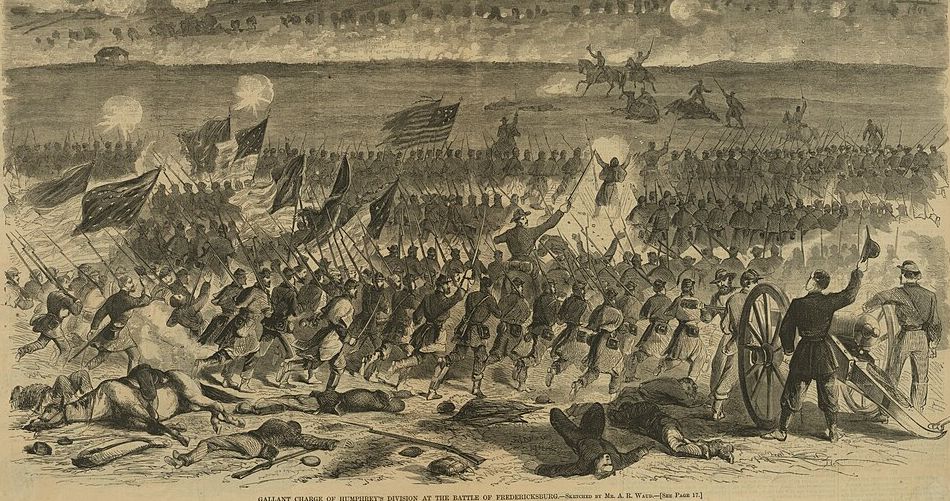
“Some guessed it was because they had no ammunition to spare,” Shelby Foote relates in his excellent three-volume history of the war, “others that they were afraid of retaliation by ‘our siege guns.’”
“Still another,” Foote continues, “a veteran private, had a different idea. ‘Sh*t,’ he said. ‘They WANT us to get in. Getting out won’t be quite so smart and easy. You’ll see.”
And see they did: Four days later, the Union troops finally skedaddled back to the other side of the river, minus nearly 1,300 killed in action, nearly 10,000 wounded, and nearly 2,000 captured or missing. Lee’s army suffered about half as many casualties and remained in control of the field.
OK, lede buried. Now let’s talk about the wholly optional, clearly idiotic, and unquestionably illegal (at least per US law on the subject) war on Iran, now well into its third week.
I doubt the Iranian regime WANTED the US and Israeli regimes to escalate the region’s long-standing tension, constant low-intensity fighting, and occasional flare-ups to full-on war for the second time in less than a year …
… but now that it’s happened, the Iranians seem intent on extracting a real price for the blunder instead of negotiating another lull or, as some keep putting it, giving Donald Trump an excuse to “declare victory” and take an “off-ramp” back to the status quo ante.
Can you blame them?
The US and Israel have effectively been at war with Iran since 1979, when the Iranian people gave US puppet dictator “Shah” Mohammad Reza Pahlavi the boot (after which hard-line Islamists, like the Bolsheviks in Russia before them, took advantage of the chaos to seize power).
Adding insult to injury, Trump and Company are promoting Pahlavi’s son as the face of their “regime change” aspirations.
Getting out won’t be quite so smart and easy. We’re seeing.
Oil prices are up by 25-35% (depending on type of the crude). Ditto gasoline prices.
And fertilizer prices.
And, soon, the price of everything that has to be delivered using gasoline, grown using fertilizer, etc.
Which is pretty much, well, everything.
Even when — if — tanker traffic through the Strait of Hormuz can get back to normal, we’ll be feeling the economic after-effects for a long time. The effects of the war stretch beyond that transport choke point. The Iranians are also striking production facilities, and just this morning hit a major natural gas field in the United Arab Emirates. The damaged and destroyed infrastructure across the region isn’t going to rebuild itself.
The longer this war continues, the worse off Americans will be, above and beyond having to foot the bill — in both blood and treasure — for a war the US regime has yet to present anything resembling a rational explanation for.
Even if the Iranian people rise up and overthrow the current regime, as American pro-war flacks keep predicting, the likelihood that its replacement will be any more friendly to the US and Israel falls somewhere between “infinitesimal” and “non-existent.”
Can the Iranian regime lose this war? Yes.
Can the American people win it? No. And we never could. It was always going to make us worse off.
Our enemies aren’t in Tehran, they’re in Washington, DC.

No Naval Escort for Trump: US Allies and the Strait of Hormuz
With each dragged-out day, President Donald Trump begins to resemble a mad emperor who has not only taken leave of his senses but also of everything else. Having hitched his wagon to the Israeli program of chaos and destabilisation in the Middle East, he is stuck in a war he is incapable of controlling or dictating. The periodic announcement of the next assassination of a notable Iranian leader is trumpeted like a holy ritual. The next round of ecstatic bombing is hailed in the court as the biggest yet. But behind these gestures lies an expansive emptiness.
Perhaps most telling of such emptiness is the sham of the alliance system he has sought to distance himself from even as he mocks its members. Whether it is members of NATO or allies such as Canada and Australia, Trump has been treated with scrupulous, sometimes grovelling care. Flaring tantrums and spontaneous interpretations of world politics mingle in ugly consummation. Views are contradicted in the same slurry of words. The allies can only nod.
Of late, he has shown greater concern about the increasing distance shown by the Pax Americana family. Initially, almost all of them made sure not to call his administration or that of Israeli Prime Minister Benjamin Netanyahu brigands for having violated the United Nations Charter in attacking Iran. Australia bolted out puffing with a condemnation of Iran for having, supposedly, a viable nuclear weapons program that needed to be eliminated. Canada and various countries in the European Union all adopted variations of the same theme, taking care to demonise Tehran for its ambitions and not, for a moment, considering what Israel and the US had done. The United Kingdom, after initial hesitation, offered the US use of its bases in bombing Iran. The grand retreat from international law seemed complete, the jungle dwellers very much in charge.
This initial enthusiasm for US-Israeli adventurism began to cool. It is becoming increasingly clear that those devilish Persians are holding out with white-knuckled determination, causing much global mayhem with their targeting of infrastructure in the Gulf states and a closure of the Strait of Hormuz. Planners in the Pentagon, State Department, and White House must have been aware of the dangers of Iran effectively closing the vital waterway responsible for the transit of a fifth of the world’s oil. To this, add a laundry list of essentials: gas, fertilisers, and critical minerals. Yet these wiseacres find themselves scrambling to find allies and willing contributors to escorting vessels through the Strait.
Trump, for his part, has a fantasist’s view of the war, one peppered by contradiction. In posts on Truth Social, he describes “a Nation that has been totally decapitated” that still, mysteriously, has the means to close the waterway and inflict damage. Yet he hopes for assistance from such countries as China, France, Japan, and South Korea, who might “send Ships to the sea that that the Hormuz Strait”. But not to worry, as the US “will be bombing the hell out of the shoreline, and continually shooting Iranian Boats and Ships of the water.” (How is that going, Mr. President?)
The wish for escorting commercial traffic, however, is not likely to be met – at least as things stand. Washington’s allies are baulking. Kaja Kallas, the European Union’s High Representative for Foreign Affairs and Security Policy, had seen the pre-emptive attack on Iran and the assassination of Iran’s Supreme Leader Ayatollah Ali Khamenei as a heaven-sent opportunity. Now, she was gruffly insisting that, “This is not Europe’s war. We didn’t start the war. We were not consulted.”
UK Prime Minister Sir Keir Starmer merely conceded that a “viable plan” to deal with the Strait was being sought, while Energy Secretary Ed Miliband stated that “any options that can help to get the strait reopened are being looked at in concern with our allies.” France’s President Emmanuel Macron was of the view that any mission to escort container ships and tankers through the Strait “must be entirely separate from the ongoing war operations and bombings”. But most stinging of all was German Defence Minister Boris Pistorius: “What does Trump expect from a handful of European frigates that the powerful US navy cannot do?” This was not NATO’s war. “We have not started it.”
On Truth Social, Trump vented with his usual spiky petulance. He noted that “most” of America’s NATO allies had informed Washington that they did not wish to get involved “against the Terrorist Regime of Iran, in the Middle East, despite the fact that almost every Country strongly agreed with what we were doing, and that Iran cannot, in any way, shape or form, be allowed to have a Nuclear Weapon.” He is, on that score, partially correct, insofar as a gaggle of liberal democratic states had few reservations cheering on extra-judicial murder and regime change in Tehran.
He is far from correct in assuming that countries such as Australia and the United Kingdom have refused to get involved: contributions to the war in what has been shiftily described as a “defensive” capacity have been made. And a country like Australia is always implicated in any bombing campaign the US ever embarks upon, given the indispensable role played by the highly secretive Pine Gap joint satellite and signals intelligence facility, located just outside Alice Springs.
As for those same allies, the President declared a lack of surprise at their reluctance “because I always considered NATO, where we spend Hundreds of Billions of Dollars per year protecting these same Countries, to be a one way street – We will protect them, but they will do nothing for us, in a time of need.” But did Trump require their assistance? No, as it turns out, as “we have had such Military Success, we no longer ‘need’, or desire, the NATO Countries’ assistance – WE NEVER DID! Likewise, Japan, Australia, or South Korea.” The question begs itself: Why ask in the first place?
With each dragged-out day, President Donald Trump begins to resemble a mad emperor who has not only taken leave of his senses but also of everything else. Having hitched his wagon to the Israeli program of chaos and destabilisation in the Middle East, he is stuck in a war he is incapable of controlling or dictating. The periodic announcement of the next assassination of a notable Iranian leader is trumpeted like a holy ritual. The next round of ecstatic bombing is hailed in the court as the biggest yet. But behind these gestures lies an expansive emptiness.
Perhaps most telling of such emptiness is the sham of the alliance system he has sought to distance himself from even as he mocks its members. Whether it is members of NATO or allies such as Canada and Australia, Trump has been treated with scrupulous, sometimes grovelling care. Flaring tantrums and spontaneous interpretations of world politics mingle in ugly consummation. Views are contradicted in the same slurry of words. The allies can only nod.
Of late, he has shown greater concern about the increasing distance shown by the Pax Americana family. Initially, almost all of them made sure not to call his administration or that of Israeli Prime Minister Benjamin Netanyahu brigands for having violated the United Nations Charter in attacking Iran. Australia bolted out puffing with a condemnation of Iran for having, supposedly, a viable nuclear weapons program that needed to be eliminated. Canada and various countries in the European Union all adopted variations of the same theme, taking care to demonise Tehran for its ambitions and not, for a moment, considering what Israel and the US had done. The United Kingdom, after initial hesitation, offered the US use of its bases in bombing Iran. The grand retreat from international law seemed complete, the jungle dwellers very much in charge.
This initial enthusiasm for US-Israeli adventurism began to cool. It is becoming increasingly clear that those devilish Persians are holding out with white-knuckled determination, causing much global mayhem with their targeting of infrastructure in the Gulf states and a closure of the Strait of Hormuz. Planners in the Pentagon, State Department, and White House must have been aware of the dangers of Iran effectively closing the vital waterway responsible for the transit of a fifth of the world’s oil. To this, add a laundry list of essentials: gas, fertilisers, and critical minerals. Yet these wiseacres find themselves scrambling to find allies and willing contributors to escorting vessels through the Strait.
Trump, for his part, has a fantasist’s view of the war, one peppered by contradiction. In posts on Truth Social, he describes “a Nation that has been totally decapitated” that still, mysteriously, has the means to close the waterway and inflict damage. Yet he hopes for assistance from such countries as China, France, Japan, and South Korea, who might “send Ships to the sea that that the Hormuz Strait”. But not to worry, as the US “will be bombing the hell out of the shoreline, and continually shooting Iranian Boats and Ships of the water.” (How is that going, Mr. President?)
The wish for escorting commercial traffic, however, is not likely to be met – at least as things stand. Washington’s allies are baulking. Kaja Kallas, the European Union’s High Representative for Foreign Affairs and Security Policy, had seen the pre-emptive attack on Iran and the assassination of Iran’s Supreme Leader Ayatollah Ali Khamenei as a heaven-sent opportunity. Now, she was gruffly insisting that, “This is not Europe’s war. We didn’t start the war. We were not consulted.”
UK Prime Minister Sir Keir Starmer merely conceded that a “viable plan” to deal with the Strait was being sought, while Energy Secretary Ed Miliband stated that “any options that can help to get the strait reopened are being looked at in concern with our allies.” France’s President Emmanuel Macron was of the view that any mission to escort container ships and tankers through the Strait “must be entirely separate from the ongoing war operations and bombings”. But most stinging of all was German Defence Minister Boris Pistorius: “What does Trump expect from a handful of European frigates that the powerful US navy cannot do?” This was not NATO’s war. “We have not started it.”
On Truth Social, Trump vented with his usual spiky petulance. He noted that “most” of America’s NATO allies had informed Washington that they did not wish to get involved “against the Terrorist Regime of Iran, in the Middle East, despite the fact that almost every Country strongly agreed with what we were doing, and that Iran cannot, in any way, shape or form, be allowed to have a Nuclear Weapon.” He is, on that score, partially correct, insofar as a gaggle of liberal democratic states had few reservations cheering on extra-judicial murder and regime change in Tehran.
He is far from correct in assuming that countries such as Australia and the United Kingdom have refused to get involved: contributions to the war in what has been shiftily described as a “defensive” capacity have been made. And a country like Australia is always implicated in any bombing campaign the US ever embarks upon, given the indispensable role played by the highly secretive Pine Gap joint satellite and signals intelligence facility, located just outside Alice Springs.
As for those same allies, the President declared a lack of surprise at their reluctance “because I always considered NATO, where we spend Hundreds of Billions of Dollars per year protecting these same Countries, to be a one way street – We will protect them, but they will do nothing for us, in a time of need.” But did Trump require their assistance? No, as it turns out, as “we have had such Military Success, we no longer ‘need’, or desire, the NATO Countries’ assistance – WE NEVER DID! Likewise, Japan, Australia, or South Korea.” The question begs itself: Why ask in the first place?
What makes the US war against Iran different?
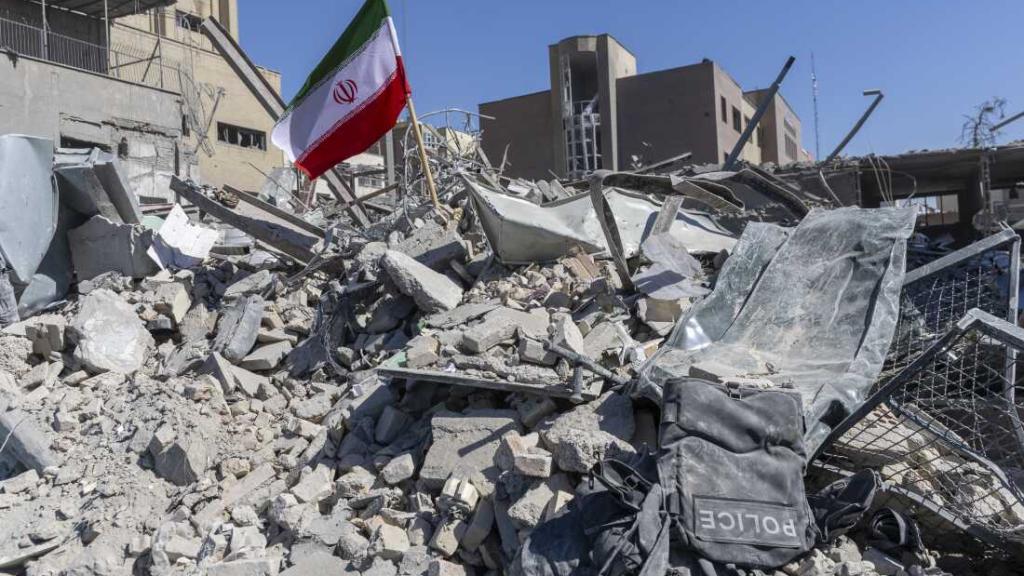
This war is different. You can see it from the incoherent and inconsistent explanations of the Trump administration as to why they have launched another war against Iran and its objectives. You can also see it from the fact that the war seems to have been badly prepared, as the Pentagon and its Gulf allies worry, after just a few days of bombing, about the danger of depleted stocks of munitions if the war continues much longer. The US Central Command is asking the Pentagon to send more military intelligence officers to its headquarters to support operations against Iran for at least 100 days (but likely through to September) as the war will probably last much longer than initially expected.
The result of this is that in contrast to past wars, the attack on Iran is highly unpopular among the US people — even before it has suffered any meaningful losses. Former senior US diplomat Gerald Feierstein, who dealt with the Middle East, comments on the chaotic nature of the US operation:
What we’ve seen is a completely ad hoc operation where it appeared that nobody actually understood or believed that military action was imminent. It seems like they woke up on Saturday morning and decided that they were going to start a war.1
However, the improvised character of the US-Zionist war against Iran is rather a reflection of a much deeper contradiction — one which makes this war different from all past US imperialist wars since 1945. Until now, Washington’s wars were always a result of its strategy. The Korea and Vietnam wars were a result of its Cold War against the Soviet Union. The first Iraq War in 1991 served to establish US global domination as Stalinism was collapsing. The Afghanistan War and second Iraq War in 2003 were supposed to defend its global hegemony and domination of the Middle East in particular.
Deprioritising the Middle East?
In contrast, the present war against Iran stands in glaring contradiction to the actual strategy of the White House — the so-called “Donroe Doctrine” (or “Trump Doctrine” to use the formulation of a servile Washington Post columnist).2 As we noted in our analysis of the National Security Strategy document, the Trump administration announced a major shift in US foreign policy. As a result of its long-term decline, US imperialism no longer attempts to be the global hegemon but rather wants to focus on fully dominating the Western hemisphere, which includes a reactionary offensive to recolonise Latin America, pressurise Canada, occupy Greenland and destroy the European Union. Another result of this shift is that Washington is looking for a temporary détente with Russian and Chinese imperialism.3
A consequence of this new foreign policy doctrine was the deprioritisation of the Middle East. While this was a key region for US imperialism, where it had fought most of its wars since 1991, the Trump administration has always emphasised its desire to reduce its military presence there. The NSS document explicitly states:
Conflict remains the Middle East’s most troublesome dynamic, but there is today less to this problem than headlines might lead one to believe… But the days in which the Middle East dominated American foreign policy in both long-term planning and day-to-day execution are thankfully over — not because the Middle East no longer matters, but because it is no longer the constant irritant, and potential source of imminent catastrophe, that it once was. It is rather emerging as a place of partnership, friendship, and investment.4
However, only a few months after the publication of this document, Washington ordered the greatest amount of air and naval power in the Middle East since the 2003 invasion of Iraq and started a major war by killing Khamenei, Iran’s Supreme Leader and the highest religious authority for up to 260 million Shia Muslims globally. With one stroke, Trump and Israel Prime Minister Benjamin Netanyahu provoked a conflict which might have much worse consequences for US imperialism than the wars in Afghanistan and Iraq. In any case, this is a war that will shape the future not only of Iran but the Middle East and the Trump presidency.
The Israel factor
So, why is Trump taking such a huge risk and starting a “war of choice” without any military necessity, a war that is in full contradiction to established US foreign policy doctrine? As I indicated in past articles, there exist several political factors, both of strategic as well as of conjunctural nature, which explain this war.5
The first is the role of Israel and Zionist forces in the US. To avoid any misunderstanding, I deliberately speak about Zionist and not Jewish forces. I do so not because of “political correctness” but because it is fundamentally wrong to identify Zionism and Jewry. Historically, before 1945 Zionism was only a minority current among Jews. While Zionism became a majority among Jews after the Shoa, today many Jews have turned away from Israel — in particular after the horrible genocide of the settler state against the Palestinian people in Gaza since October 7.
In the US, where about the same number of Jews live as in Israel, a growing minority of them no longer support the settler state. Recently, a study released by the Greater Boston Jewish Community found that among younger adults between 18–29 years, 38% identify as somewhat or strongly anti-Zionist and only 30% agree with the statement that it is important for Israel to be the nation-state of the Jewish people.6
At the same time there are highly influential reactionary forces, such as Christian fundamentalists, which are non-Jewish but fanatical supporters of Israel. In other words, Zionism is not an ethnic or religious category but a political one: those who support the existence of the Israeli settler state.
Netanyahu’s intensive lobbying for Trump joining a war against Iran is hardly surprising. A retreat from the Middle East would be a setback for US imperialism. However, it would hardly question its existence. Things are different when it comes to Israel. Its very existence would be at risk if Washington retreated from the region. How would a settler state of 7 million Israelis, which has terrorised the native population for more than three quarters of a century, with the help of Western imperialist powers, survive in a region of more than 450 million Arabs?
Israel has to do whatever it can to keep the US military involved in the Middle East. Dragging it into a major war against Iran, which inevitably would provoke long-term instability full of political explosions, was the surest way to achieve this. No doubt, Netanyahu has accomplished a diplomatic victory for now.
It is well documented, and hardly disputed, that Netanyahu has lobbied for many years to convince the White House to wage war against Iran. Even leading figures in the Trump administration admit that Israel — the only country that the Pentagon’s National Defence Strategy document calls a “model ally”7 — played a crucial role in the decision to start this war. Marco Rubio, Trump’s Secretary of State and, at the same time, National Security Advisor, told leading representatives of both parties in a confidential meeting on 24 February (four days before the war started) “that, no matter if Israel or the United States struck first, Iran would respond with a powerful barrage of weapons against U.S. bases and embassies. It was logical then, Mr. Rubio said, that the United States should act in concert with Israel, since America would be dragged in anyway. And Israel, Mr. Rubio said, was determined to act.”8
He repeated this argument in public on March 2, when he said to journalists:
If we stood and waited for that attack [from Iran, Ed.] to come first, before we hit them, we would suffer much higher casualties. And so, the president made a very wise decision: We knew that there was going to be an Israeli action. We knew that would precipitate an attack against American forces. And we knew that if we didn’t preemptively go after them before they launched those attacks, we would suffer higher casualties.9
Unsurprisingly, this has caused much outrage, even among Trump’s MAGA supporters and pro-Zionist mainstream politicians from the Democratic Party, as Rubio effectively admitted that the Trump administration was letting Netanyahu dictate US policy.
Another confirmation of Israel’s highly influential role in dragging the US into the Iran War was a report by the Jerusalem Post in early February, which quoted an Israeli defence official saying: “We told the Americans we will strike alone if Iran crosses the red line we set on ballistic missiles.”10 This is a remarkable statement given the fact that Israel is the much smaller partner in the US–Zionist alliance and the settler state would have no chance in any conflict with Iran without US weapons, ammunition and protection. Hence, the Netanyahu government is fully aware that it has strong influence over the Trump administration.
Israel’s influence in the decision process of this war is also reflected in the fact that, according to Axios — a US news website with close connections to the US and Israeli political and security apparatuses — Netanyahu succeed in pushing the Trump administration to start the war earlier than it had originally planned (late March or early April).11
Historical reasons for the disproportionate Zionist influence
How is it possible that such a small state such as Israel can play such a disproportionally large role in US foreign policy? There are several reasons.
First, Israel is a small country in terms of its population, but since the 1990s it has become a junior imperialist state with a sizeable monopoly capital, particularly in arms and IT industries — key sectors in the modern economy.
Second, the Zionist lobby is not a mysterious conspiracy by shady figures but a highly influential and dominant sector of the US ruling class, which historically emerged after the US replaced Britain and France as the chief backers of Israel in the 1960s. As the Middle East played an increasingly important role in US foreign policy, the US needed a heavy-armed guardian in the region. Israel perfectly fitted this role because, as a settler state whose very existence is based on the expulsion and genocide of the Palestinian people, it was a “natural-born enemy and oppressor” of the native (Arab) population in the region.12 Such a role has always been an integral part of Zionism. The founder of Zionism, Theodor Herzl, wrote already in 1896: “We should there [in Palestine, Ed.] form a portion of the rampart of Europe against Asia, an outpost of civilisation as opposed to barbarism.”13
Hence, Zionism was conceived by its founders as a settler project in close collaboration with imperialist Great Powers. Given that Zionism emerged among European Jewry, it was clear that its leaders were trying to become key allies of Western imperialism. As a result of this historically developed relationship, and Israel’s key role as a “model ally” in one of the most important regions of the world, the ruling class in Western imperialist countries has become closely entangled with their Israeli partner (in crime).
In other words, the Zionist fortress has been crucial for Western imperialism to keep an important region under control where the vast majority of the population deeply detests the settler state and its Western backers. Resulting from this relationship have been various security ties, including the training of US police force by Israeli officers.
Likewise, support for Israel could easily be ideologically justified by all sectors of the ruling elite. The liberals can claim that this is a “progressive” project aimed at “fighting antisemitism” and preventing “another Holocaust”. Conservative and right-wing sectors can refer to Israel’s “whiteness”, the (supposed) close religious ties between Judaism and Christianity and the shared hatred against Muslims.
In short, Israel’s indispensability for US and European imperialism combined with shared military and economic interests have provided this “model ally” with disproportional influence in Western countries.
However, the developments of the past few years have hugely undermined the position of Zionism. The US no longer wants to focus on the Middle East and wants to withdraw large parts of its military forces from the region. At the same time, a huge pro-Palestine movement has emerged since October 7, which has made Israel increasingly unpopular in Western countries, including the US. For the first time, more US citizens sympathise with Palestinians than with Israelis, according to the latest polls (41% vs. 36%).14 In the past, Republican and Democrat candidates were frightened by hostility of the Zionist lobby organization AIPAC; today candidates hasten to assure the public that they do not take any donations from this organization.
However, until now such a shift has not found its reflection within the ruling class, so the dominating representatives of the ruling class — from former president Joe Biden to Trump, from Democratic Senator John Fetterman to Republican senators Lindsay Graham and Ted Cruz — are still hardcore Zionists.
Trump’s desperate hope for a ‘little, successful war’
The second, no less important, factor for Trump’s decision to go to war against Iran is the fragile domestic political situation and his enormous unpopularity. His tariff policy is in deep crisis, as it has not solved the problem of trade unbalances, resulted in higher prices for US citizens and was finally overruled by the Supreme Court. The living conditions of the US population have not improved and his policy of sending ICE thugs to cities to terrorise the people has provoked huge popular resistance and public backlash. There have been mass demonstrations and strikes against ICE terror and, today, half of US citizens even support abolishing this racist agency.15
Unsurprisingly, the Republican Party has lost nearly all federal and state elections since Trump came to power and is projected to lose its majority in both chambers of Congress at the mid-term elections in November — something that could paralyse the presidency for the remaining two years.
Furthermore, Trump himself is deeply discredited since it has become public knowledge that he and his friends are deeply involved in the horrific Jeffrey Epstein scandal. This scandal is most likely related to the above-mentioned Israel factor, as Trump is said to be mentioned thousands of times in the unpublished three million Epstein files, which include very serious and discrediting incidents. Since Epstein had well-known close connections to Israeli politicians and security figures for many years (Epstein was considered as an Israeli intelligence asset), the Zionists are likely in a position of holding highly discrediting material on the US president. It would be surprising if this factor had not played a role in Trump’s decision to support Israel’s strategy of waging war against Iran, in contrast to his own foreign policy doctrine.
In any case, the collapse of Trump’s popularity and the danger of losing the incoming mid-term elections has pushed Trump to look for a prestigious “little, successful war”. The triumph of kidnapping Venezuela’s President Nicolas Maduro without losing any US soldier certainly emboldened him. The prospect of going down in history as the US president who brought down the regimes of Iran, Venezuela and Cuba — as Cruz outlined two weeks ago — must have had an enormous appeal to the unpopular clown.
While such a triumph can not be excluded, it is far more likely that the US will become stuck in a long war and a long-term and explosive mess.
Ynet, the online outlet for the Yedioth Ahronoth (Israel’s largest newspaper), has published a remarkable article which — despite its support for the war against Iran — points to the factors behind Trump’s decision.
A little over a year into his second term, Trump has completely forgotten those promises — if he ever truly believed them himself… Last summer, following the previous strike in Iran, Trump claimed that “the Iranian nuclear program was eliminated.” When American journalists reported that this was not in fact the case, they received direct threats from the White House. Now, eight months later, the American president has launched a war without obtaining the required congressional authorization, as mandated by the Constitution — and without explaining to the American public, or to the world, why he is doing so… Despite what he says publicly, Trump knows his political standing is not strong. The economy is faltering, the Epstein files scandal is not going away, and the midterm elections are approaching — and could become a Democratic tsunami. Trump has decided that a war with Iran — if it ends with regime change — could completely transform the picture.16
The past weeks have demonstrated, once more, the difference between Trump and Netanyahu as state leaders — differences which are not only caused by their respective personalities but also the different long-term interests of their respective states. Netanyahu has a strategy and knows what he wants. Objectively, his strength lies in the fact that his personal interests (staying in power and out of jail) overlap with the interests of the settler state — the “Ideal Total Imperialist” (to paraphrase Karl Marx), which desires expansion in the Middle East to build a “Greater Israel”.
In Trump’s case, there also exists a certain overlap of personal interests and objective interests of declining US capitalism — his determination to stay in power at any costs is complementary with the necessity to increasingly replace bourgeois democracy with a bonapartist system. However, at the same time, his personality of a clown is in unresolvable contradiction to the collective interests of the most powerful imperialist state.
For all these reasons, I think Trump’s war against Iran is one that has been badly planned, is very risky and is in contrast to the foreign policy doctrine of his own administration. Nevertheless, political and conjunctural factors have pushed him to start this war. In contrast, Israel has managed to drag the US into a war that is necessary from the point of view of their own strategic interests. However, if the US-Zionist monster loses this war, the US can retreat. Israel can not but will rather face the beginning of its end.
To conclude this article, I reiterate that in this war socialists have the duty to take an unequivocal anti-imperialist position: Defend Iran – defeat the American-Zionist aggression!
Michael Pröbsting is a socialist activist and writer. He is the editor of the website thecommunists.net, where a version of this article first appeared.
- 1
Politico: Inside the Trump administration’s scramble to support its own war, 3 March 2026, https://www.politico.com/news/2026/03/04/evacuation-middle-east-iran-war-00812898
- 2
Marc Thiessen, We’re witnessing the birth of the Trump Doctrine, Washington Post, 3 March 2026, https://www.washingtonpost.com/opinions/2026/03/03/iran-strike-venezuela-military-trump-doctrine/
- 3
Michael Pröbsting: Trump and the Political Crisis of European Imperialism. On the inner contradictions and challenges of Europe's ruling class in face of Trump’s new foreign policy doctrine, the opportunist position of left reformism and the tasks of socialists, 28 January 2026, https://www.thecommunists.net/theory/trump-and-the-political-crisis-of-european-imperialism/; Trump’s Donroe Doctrine and its Consequences for Venezuela, Latin America and the World (Part 1: https://www.thecommunists.net/worldwide/latin-america/trump-s-assault-on-venezuela-and-his-plan-to-recolonise-latin-america/ and Part 2 https://www.thecommunists.net/worldwide/latin-america/trump-s-assault-on-venezuela-and-his-plan-to-recolonise-latin-america/#anker_3); An Official Confirmation that the U.S. Is No Longer the Global Hegemon. Trump’s new National Security Strategy outlines a strategy for U.S. imperialism for a multi-polar world, 20 December 2025, https://links.org.au/trumps-new-national-security-strategy-outlines-us-imperialisms-policy-multi-polar-world; A Major Shift in Washington’s Foreign Policy Doctrine. The draft of the Pentagon’s newest National Defense Strategy reflects the dramatic decline of U.S. imperialism, 10 September 2025, https://www.thecommunists.net/worldwide/global/a-major-shift-in-washington-s-foreign-policy-doctrine/.
- 4
The White House: National Security Strategy of the United States of America, November 2025, p. 28
- 5
Michael Pröbsting: Towards the next Zionist-American War against Iran. On the reasons for Trump’s desire to attack Iran in the age of the “Donroe Doctrine”, 19 February 2026, https://www.thecommunists.net/worldwide/africa-and-middle-east/towards-the-next-zionist-american-war-against-iran/; Heading towards more Wars in the Middle East, 30 December 2025, https://www.thecommunists.net/worldwide/africa-and-middle-east/heading-towards-more-wars-in-the-middle-east/
- 6
2025 Greater Boston Jewish Community Study, 12 February 2026, https://www.cjp.org/cjp-news/2025-greater-boston-jewish-community-study
- 7
Department of War: 2026 National Defense Strategy, p. 2 and 12
- 8
New York Times: How Trump Decided to Go to War. President Trump’s embrace of military action in Iran was spurred by an Israeli leader determined to end diplomatic negotiations. Few of the president’s advisers voiced opposition, 2 March 2026, https://www.nytimes.com/2026/03/02/us/politics/trump-war-iran-israel.html
- 9
Al Jazeera: Iran live news: US jets crash; Iran says no Trump talks, hits energy sites, 2 March 2026, https://www.aljazeera.com/news/liveblog/2026/3/2/us-israel-attack-iran-live
- 10
Jerusalem Post: Israel warns Trump: We may act alone if Iran crosses ballistic missile red line, 8 February 2026, https://www.jpost.com/israel-news/defense-news/article-885948
- 11
Axios: The Trump-Netanyahu call that changed the Middle East, 3 march 2026, https://www.axios.com/2026/03/03/trump-netanyahu-call-iran-war-israel-coordination
- 12
See two books by Yossi Schwartz, a Jewish Anti-Zionist since nearly six decades living in Occupied Palestine, who has dealt extensively with the Zionist state and the Marxist program: The Zionist Wars. History of the Zionist Movement and Imperialist Wars, 1 February 2021, https://www.thecommunists.net/theory/the-zionist-wars/; Palestine and Zionism. The History of Oppression of the Palestinian People. A Critical Account of the Myths of Zionism, RCIT Books, Vienna 2019, https://www.thecommunists.net/theory/palestine-and-zionism/; see also a pamphlet by Michael Pröbsting: On some Questions of the Zionist Oppression and the Permanent Revolution in Palestine, May 2013, https://www.thecommunists.net/theory/permanent-revolution-in-palestine/
- 13
Theodor Herzl: A Jewish State (1896), Federation Of American Zionists, New York 1917 p.12
- 14
Axios: America's slipping sympathy for Israel, 27 February 2026, https://www.axios.com/2026/02/27/palestinians-israelis-us-polling-gallup
- 15
Axios: Half of Americans support abolishing ICE in record poll, 4 March 2026, https://www.axios.com/2026/03/04/trump-ice-support-abolish-half-americans-record-poll
- 16
Ynet: Trump's big gamble: overthrowing Iranian regime to save his presidency, 1 March 2026, https://www.ynetnews.com/article/rysgrpwfbe#autoplay
More on the Great Big Stinking Lies About Iran
We are now on Part 4 and it might seem we are gilding the Lilly.
But here’s the thing: What is going on in the Persian Gulf is rotten beyond words. The rogue madman in the Oval Office has detonated a conflagration there that could send the entire global economy and financial system spiraling into a catastrophe – and not just because or even mainly due to the 23 million barrels of oil per day at risk out of 105 million needed worldwide.
What’s really at risk is the underlying global financial system. The latter is a veritable house of cards sitting upon a mountain of debt, leverage and speculative excess. So it may not have the capacity or resilience to withstand a sudden $200 per barrel oil shock.
Yet and yet. The whole insanely reckless act of launching a sweeping military attack on a nation of 90 million people that had zero capacity to impose military harm on the home territory of the United States is predicated on one of the Great Big Stinking Lies of History. Namely, that the Iranian regime is a uniquely evil stain on the face of the earth and has spent 47 years bringing injury, mayhem and death to America and much of the region around it.
The truth, however, is there’s nothing especially unique about Iran’s manifold sins at all. It’s just another run-0f-the-mill authoritarian state run by a medieval theocracy that has imposed one of the most benighted tyrannies of modern times. Accordingly, it has brought untold hardships and miseries to its people—especially via the brutal ruffians of the IRGC.
But that’s mainly the unfortunate work of the clerics and their IRGC allies ruling inside its borders. When it comes to the outside world, Iran has invaded not a single neighboring country since 1979 (and indeed, not in the last 300 years before the mullahs). At the time time, it was savagely attacked by Saddam Hussein with US and European arms during the 1980s; has been brutally sanctioned by Washington trade embargoes and economic warfare for the past 30 years; and for decades has also been relentlessly assaulted via Israeli assassination squads, saboteurs and periodic missiles and bombs.
In fact, the whole “leading state sponsor of terror” slogan has more validity as a Bibi Netanyahu campaign theme than it does as an accurate description of the real world.
And, no, the “whadabout the proxies” canard doesn’t cut it, either. Not a single one of Iran’s so-called “proxies” in the region were confected out of whole cloth by the mullahs as some kind of mercenary force recruited, trained and financed by Tehran and artificially implanted in the soil of Lebanon, Syria, Yemen and Gaza.
To the contrary, the first three of these represented Shiite populations, which aligned with their Shiite brethren in Iran out of confessional ties and due to the fact that they were imperiled in their home countries. After all, there was no Hezbollah until Israel invaded southern Lebanon in the early 1980s and imposed a harsh occupation that left tens of thousands dead, culminating in the genocidal atrocities at Sabra and Shatila.
Likewise, the late Assad government in Syria was Alawite, which is a Shiite branch, and had been at war with Israel off and on since 1967 under Bashar Assad and his father before him. Whatever the merits of its half-century long struggle with the Israelis, the Assad regime didn’t need any new marching orders from Tehran to become a “proxy”.
Even in the case of Yemen, the country has been divided and wracked by civil war conditions since the 1960s as regionally based Shiite and Sunni factions battled for power. The Houthi faction domiciled in the north and west of Yemen, of course, is Shiite and made an alliance with Tehran. Not surprisingly, the southern and eastern Sunni areas of the country were aligned with the Sunni monarchy of Saudi Arabia, which has waged war against the Houthi much of the time since 2015.
Finally, however evil the Hamas forces surely are, they were not born, bred and raised by the mullahs. If anything, the Israeli sponsored open air prison in Gaza and five brutal episodes of “mowing the lawn” via vicious bombing campaigns since 2007 were more than enough to explain the rise of Hamas.
In fact, Hamas was mainly Sunni, not Shiite, and was aligned with Iran only out of having a common enemy. Even then, most the the suitcases full of cash that Netanyahu permitted to come into Gaza year after year before October 7th was Sunni money from the Gulf states, not Iranian proxy finance.
So, yes, there has been a goodly amount of conflict and violence in the region, but it was not robotically commanded by the Ayatollahs. It was deeply rooted in the indigenous conflicts of the region that long pre-dated the 1979 Islamic Revolution.
The common thread, course, is that all four of these forces were indigenous to the region and had a beef with Israel separate and apart from anything happening in Tehran. That’s mainly because each of these groups were directly attacked or demonized by Bibi Netanyahu for deep reasons of Israeli politics.
For instance, the only reason Hamas thrived as long as it did is that Bibi Netanyahu financed it via Qatar in order weaken the Palestinian Authority. In turn, that cynical ploy was aimed to sidecar any eventual implementation of the Oslo Accords and a two-state solution on the grounds the Palestinians were so divided and violent that there was “no one to negotiate with”.
In any event, the gist for the 47-Years War on America Lie stems almost entirely from Israel’s on-going battle with the four mis-labeled “proxies” and Washington’s repeated interventions, funding and international political and diplomatic support for Israel. And even then, taking sides in this manner had no benefit whatsoever for the homeland security of America.
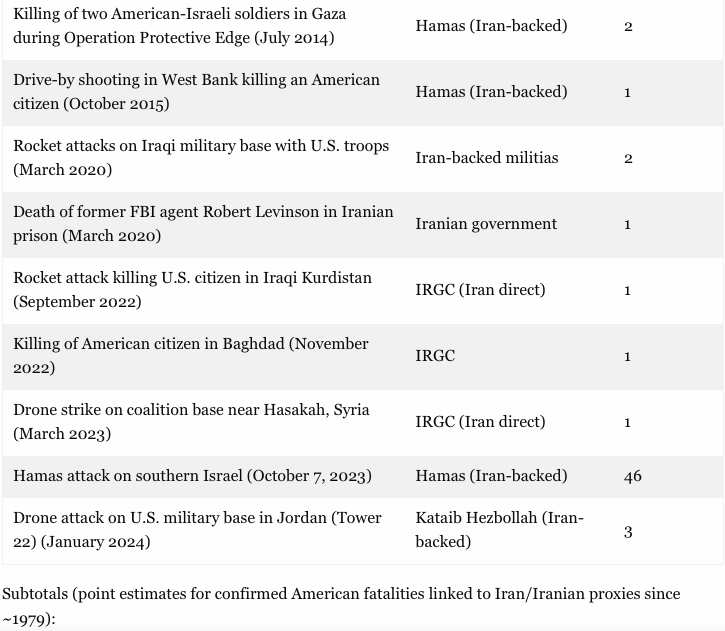
Yet it was the unnecessary and avoidable fallout from consistently taking sides with Israel against these regional foes that gives rise to the hoary myth that Iran has murdered more than 1,000 Americans over the 47 years since the Revolution. Yet a simply fact check conducted by Grok 4 at our request debunks this endlessly chanted claim lock, stock and barrel.
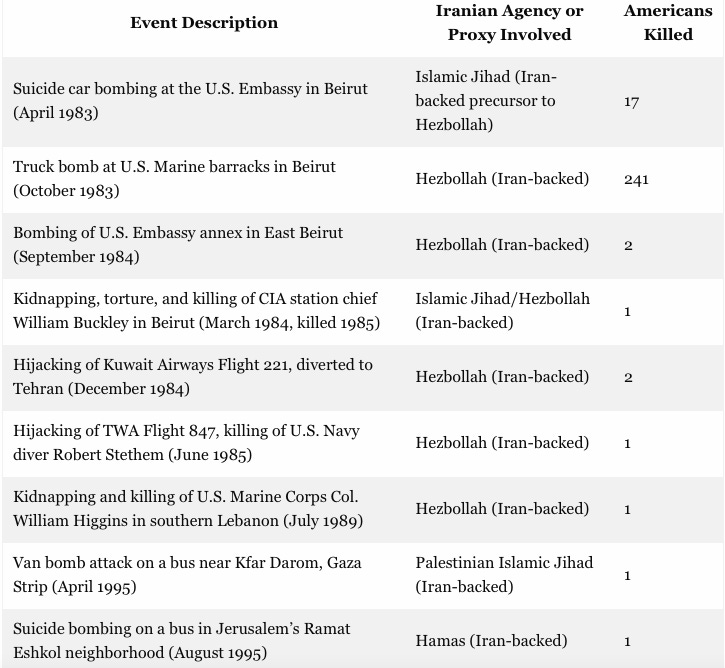
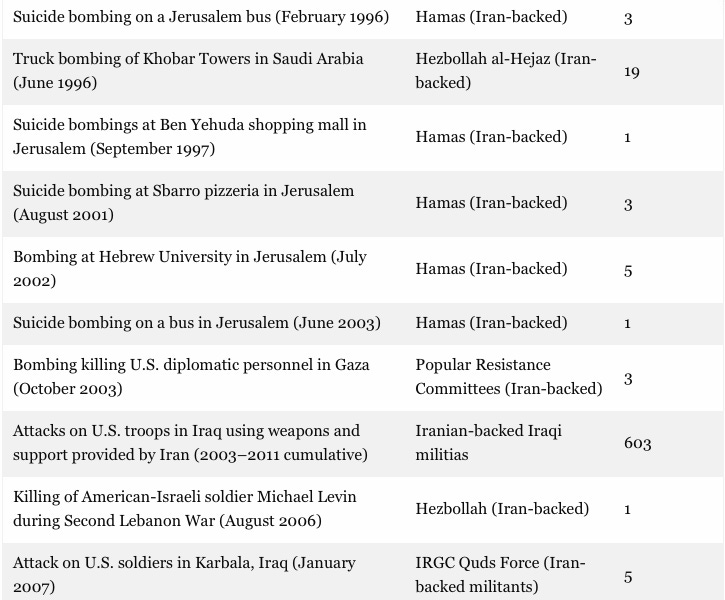
The table below lists every event between 1979 and the present that allegedly gave rise to Iranian murders of Americans—along with the numbers of purported victims and the circumstances of the attack. Some of these are far fetched, indeed, but to give benefit of the doubt we included each and everyone of them.
But here are the key realities:
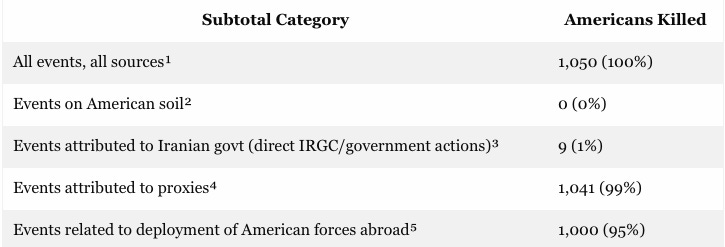
- Not one of the 1,050 American deaths during this period occurred on American soil.
- Exactly 1,041 of these deaths occurred at the hands of alleged Iranian proxies versus only 9 attributable to Iranian military or other government agencies.
- Fully 1,000 or 96% of the America deaths happened in the context of US military deployments to the region and the resulting active wars and peacekeeping activities in Lebanon, Iraq, Syria, Yemen and adjacent territories and coastal waters
That’s right. Not one of these US military deployments from the Beirut Marine barracks forward was necessary for America’s homeland security. To the contrary, all were elective wars undertaken pursuit to the imperatives of Empire. Accordingly, the resulting deaths are due to putting American military and civilian personal wrongfully in harms’s way – and most especially from taken sides in local and regional military conflicts that were none of Washington’s business.
Footnotes
¹ Central estimate from itemized events (~971) plus modest additions for broader proxy support (e.g., Afghanistan, scattered post-2011 attacks), consistent with U.S. government compilations citing over 1,000 linked deaths.
² No confirmed fatal attacks by Iranian agencies/proxies on U.S. mainland soil.
³ Direct actions only (e.g., Karbala planning/execution, Levinson death in custody, select direct strikes); vast majority of fatalities are via proxies.
⁴ Proxy groups (e.g., Hezbollah, Hamas, Kataib Hezbollah, other militias); calculated as total minus direct govt figure.
⁵ Overseas military-focused incidents (e.g., Beirut bombings, Khobar Towers, Iraq 603, recent bases); this dominates the total. These figures draw from reliable sources like the Pentagon (e.g., 603 in Iraq), White House/State Department (e.g., 46 on October 7), and think tanks (FDD, AJC); exact attribution varies slightly due to classification or indirect responsibility debates.
In short, the 1,000 American deaths chant is completely and hideously wrong because these figures resulted from Washington-initiated military actions in the Mideast that were wholly unjustified; and, consequently, put American lives in harms’ way against local people who had reason to defend themselves from actual or potential US military assault.
Thus, while all of these deaths were tragic and unnecessary, the neocon exploitation and lies about them needs be subject to withering ridicule. That is to say, things that didn’t need to happen owing to Washington’s fault over nearly a half-century do not remotely amount to a causus belli in any rational world.
Indeed, even if you consider these unfortunate deaths as abstract statistics without context or blame, there is absolutely no cause to start a quasi-world war in the Persian Gulf, which supplies a crucial share of the world’s crude oil, refined petroleum, LPGs, liquefied natural gas, industrial sulfur and helium crucial to semi-conductor chip production, among others.
To the contrary, the unhinged madman domiciled in the all powerful Oval Office has the region and the US and global economy on the edge of catastrophic upheaval based on an utterly untruthful narrative about 1,050 American deaths during the last 47 years that were far exceeded by the ordinary course accidents and hazards of daily life in America during that same period, such as fatalities from:
- Powered Lawnmower Accidents: 3,200 deaths.
- Bee Stings: 3,900 deaths.
- Falling out of Bed:10,300 deaths.
- Visiting Mexico: 4,000 American murdered there.
- Lighting strikes: 2,000 deaths.
- Cardiac arrest during sex: 8,000 deaths.
- The Sackler Family: 500,000 deaths.
For want of doubt that the American deaths that Trump claims to be avenging occurred after Washington had essentially declared war on Iran during the 1980s, consider the so-called Tanker War and the shoot-down of Iran Air Flight 655 by the US Navy in July 1988.
As it happened, President Reagan had wisely redeployed the US Marine contingent from Beirut to an aircraft carrier positioned deep in the Mediterranean in February 1984. Yet that prudent action was by no means the end of Washington’s pointless meddling in the Persian Gulf region. In fact, Washington’s foolish “tilt to Iraq” actually escalated soon thereafter when the so-called “Tanker War” between Iraq and Iran incepted a few months later.
With the land war stalemated, the conflict had spilled into the Gulf, with both sides targeting tankers to starve the other’s economy. It was Iraq, however, which initiated the attacks in the spring of 1984 on Iranian shipping to disrupt Tehran’s oil revenues, using French-supplied Exocet missiles from Mirage jets and Super Frelon helicopters. Iran retaliated shortly thereafter against Iraqi and neutral tankers, especially those from Saddam’s close ally in Kuwait, employing mines, speedboats and Silkworm missiles.
Nevertheless, no oil tankers were actually sunk and while war risk premiums rose considerably from 0.3% of hull value before the Tanker War to 2% to 3% at times during the next three years, the so called tanker war did materially impair the average volume of about 10 million barrels per day flowing through the Strait of Hormuz or impact the world oil price adversely.
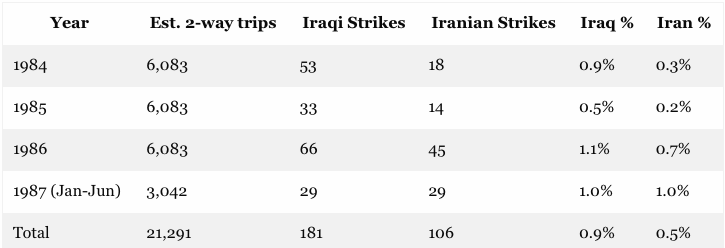
Accordingly, the ballyhooed Tanker War didn’t really amount to a hill of beans in the scheme of things. During the period before explicit US entry into the naval battles in June 1987, the annual number of tanker trips through the Straight of Hormuz empty and then returning loaded averaged just over 6,000 per year.
And while light damage occurred to this tanker traffic occasionally owing to missile strikes after the Tanker War incepted, the total number of strikes during the next 42 month period by the Iraqi aggressor was 181 or just under 1% of the cumulative tanker traffic during the period. At the same time, the comparable numbers for Iran was 106 strikes and 0.5% of two-way traffic thru Hormuz.
Either way, it wasn’t a biggie from the point of view of upwards of 500 tankers passing in and out of the Strait of Hormuz on an average monthly basis during the period.
Impact Of Tanker War Strikes on Two-Way Traffic Thru The Strait of Hormuz, 1984 to June 1987
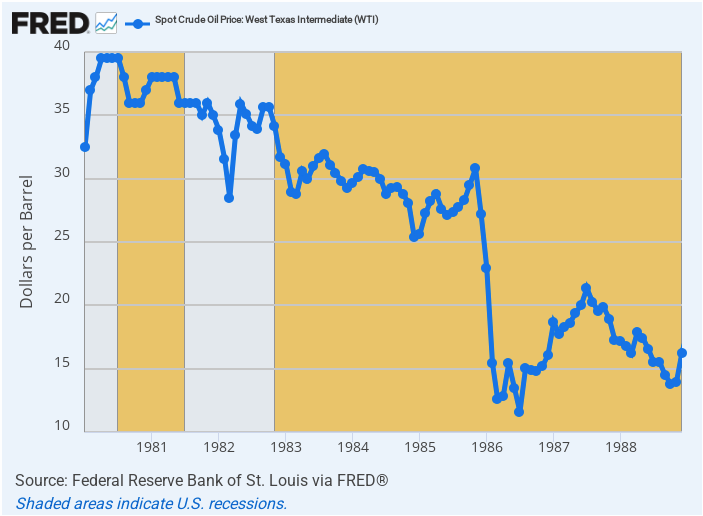
Needless to say, the impact on the world oil price, which on the margin is set by flows from the Persian Gulf, was essentially undecipherable. Indeed, owing to offsetting factors in the world market, such as the rise of production in the North Sea, Alaska, Saudi Arabia and elsewhere, as well as steadily improving global energy efficiency, the world oil price actually dropped from $40 per barrel at the 1980 peak to as low as $15 per barrel by 1986.
In fact, at the cycle bottom in 1986 high cost producers like those in the Lower 48 of the USA plunged into a veritable oil patch depression.
Thus, even when the tanker war intensified in early 1987, the world oil price rebounded temporarily to just $20 per barrel, but in inflation-adjusted terms that was barely one-third of peak prices just seven years earlier. In a word, therefore, Mr. Market was doing his job encouraging both increased production and improved energy use per dollar of GDP virtually the world over. He didn’t need any help from the US Navy.
World Oil Price (WTI), 1980 to 1989
At no time during the Tanker War, therefore, was there any reason for US naval involvement in the Persian Gulf on the grounds of stabilizing the world oil commerce and price.
Of course, that’s not a valid basis for US military action abroad, anyway. The only valid reason for military engagement with foreign powers is to counter threats to the American Homeland, but the latter was obviously not threatened in any way, shape or form by the Iran/Iraq tanker war.
Nevertheless, the keepers of Empire on the banks of the Potomac couldn’t keep their nose out of other people’s business in the context of Washington’s unaccountable tilt to Iraq. So President Reagan was persuaded to authorize Operation Earnest Will on July 24, 1987, which then became the largest U.S. naval convoy operation since World War II.
It involved re flagging Kuwaiti tankers and escorting them with warships like the USS Vincennes. The latter which was deployed to the Gulf in order to counter Iranian “swarm” tactics such as those employed by IRGC speedboats to harass shipping.
Ironically, however, Washington’s plunge into the tanker war in mid-1987 had come on the heels of what should have been a clear wake-up call about the folly of messing around (FAFO) in the midst of a hot war in the Persian Gulf. To wit, in May 1987, Iraqi Mirage war planes had launched a mistaken “fog of war” friendly fire attack via an Exocet attack on the USS Stark, killing 37 US sailors aboard and damaging the vessel so badly that its eventual rehabilitation cost more than $180 million.
So a sobering warning about putting American military personnel in harms’ way for no good reason of homeland security was given in a loud and clear manner. But shortly thereafter as the US escalation peaked in April 1988 under Operation Praying Mantis, another US warship called the USS Samuel B. Roberts hit an Iranian mine causing more deaths and damage.
Accordingly, by July 1988 the Vincennes was on high alert and had repeatedly engaged IRGC patrol boats. But then disaster struck.
On the morning of July 3, 1988, Iran Air Flight 655, an Airbus A300B2-203 operated by Iran’s national airline, departed from Bandar Abbas International Airport in southern Iran. The flight was a routine commercial route from Tehran to Dubai via a stopover in Bandar Abbas, carrying 290 people—including 208 adult passengers, 66 children and 16 crew members. Most were Iranian nationals, but the manifest included 10 Indians, 6 Emiratis, 1 Italian, and others from various nationalities. The plane was fully loaded, ascending normally on a well-established commercial airway known as Amber 59, over Iran’s territorial waters in the Strait of Hormuz.
As it happened, Bandar Abbas was a dual-use airport, serving both civilian and military purposes. This undoubtedly added to the subsequent confusion because Iranian F-14 Tomcat fighters – U.S.-made jets sold to Iran before the 1979 Revolution – were based there, making the area a hotbed of military activity in the midst of the ongoing Iran-Iraq War. Just minutes before takeoff, the USS Vincennes(CG-49), which was a Ticonderoga-class guided-missile cruiser equipped with the advanced Aegis combat system, was engaged in a surface skirmish with Iranian gunboats about 40 nautical miles southwest of Bandar Abbas.
The Vincennes, under Captain William C. Rogers III, had entered Iranian territorial waters earlier that morning while pursuing Iranian Revolutionary Guard Corps (IRGC) speedboats that had reportedly fired on a U.S. helicopter from the frigate USS Sides – again a consequence of Washington’s foolish tilt to Saddam.
The resulting engagement escalated into a firefight, with the Vincennes and another US warship, the frigate USS Elmer Montgomery. These two US Navy vessels then exchanged fire with up to 13 Iranian small boats armed with machine guns and rocket launchers. Amid this chaos, the Vincennes’ radar detected Flight 655 climbing from Bandar Abbas at about 350 knots (approximately 400 mph), heading southwest toward Dubai – directly toward the Vincennes‘ position.
At that point, the Vincennes’ Combat Information Center operators misidentified the ascending airliner as a descending Iranian F-14, possibly on an attack run. The Aegis system, designed for high-threat environments, displayed the plane’s transponder signal as Mode III (civilian), but crew members reportedly saw conflicting data, interpreting it as Mode II (military).
The plane was broadcasting on the international air distress frequency and squawking a civilian IFF code, but the Vincennes crew believed it was mimicking an F-14’s tactics. Stress from the ongoing gunboat battles, combined with “scenario fulfillment” (where operators fit data to expected threats), led to the ensuing catastrophic error.
Captain Rogers issued seven radio warnings over military and civilian channels, urging the aircraft to change course or identify itself, but Flight 655’s pilots, focused on their commercial flight path and communicating with air traffic control, did not respond. That’s likely because they were not monitoring the military frequency by which the Vincennes was pinging.
So at about 10:30 AM, with the airliner at 13,500 feet and 11 nautical miles away, Rogers authorized the launch of two SM-2MR surface-to-air missiles. The first struck the plane’s right wing, causing it to disintegrate mid-air. Debris and body parts rained into the Strait of Hormuz.
All 290 aboard perished instantly or on the impact with the water. Iranian rescue teams recovered 246 bodies, many mutilated by the explosion or mangled by shark attacks. The black boxes were never found, as they sank in deep waters.
Initial U.S. reports claimed the plane was descending aggressively outside its corridor, mistaken for an F-14. However, a later Pentagon investigation (the Fogarty Report) clarified that the plane was ascending on its standard route at normal speed. The error was attributed to human factors – combat stress, poor data interpretation, and the Aegis system’s limitations in distinguishing civilian from military targets in crowded airspace. Naturally, Iran condemned it as a deliberate act of terrorism, citing U.S. support for Iraq and prior Gulf incidents.
Needless to say, this disaster did more to reinforce the regime’s “Great Satan” propaganda against America than any other event in the last 47 years. So surely a profuse apology and generous compensation by Washington were in order.
And yet and yet – it was not forthcoming. In fact, George HW Bush, the hard-nosed ex-CIA director, and current US Vice President campaigning for President, infamously made it clear at a UN speech that no American apology would be forthcoming, saying—-
I will never apologize for the United States – I don’t care what the facts are… I’m not an apologize-for-America kind of guy.
Of course, less than two years later that same George HW Bush had switched sides abruptly. That is to say, after America’s Iraqi ally in the Iranian airliner incident attacked Kuwait in a petty argument over directional drilling in the giant Rumalia oilfield that straddled the border of the two erstwhile partners, Bush declared that Saddam’s purported “aggression” against Kuwait “will not stand”, thereby launching the First Gulf War in early 1990.
Well, for crying out loud. To the question what was ever at stake with respect to the only valid reason for attacking any foreign nation, which is an actual or imminent attack on the homeland territory of the USA, the answer was absolutely nothing from the time of the hostage crisis at the US embassy in Tehran, to the tilt to Iraq when the 1980s war broke out with its neighbor, to the US Marines deployment to Beirut, to the Persian Gulf Tanker War, to the hideous act of shooting-down a civilian airliner that was foolishly mistaken for a war plane that does not remotely resemble the Airbus A300 of Flight 655.
Still, that’s where “Iran’s 47-Years War on America” stood at the end of the 1980s. And then, to add insult to injury, the Israeli and Washington neocons went into full-bore war on the Iranian Regime in the 1990s and beyond, as we will amplify in Part 5.
David Stockman was a two-term Congressman from Michigan. He was also the Director of the Office of Management and Budget under President Ronald Reagan. After leaving the White House, Stockman had a 20-year career on Wall Street. He’s the author of three books, The Triumph of Politics: Why the Reagan Revolution Failed, The Great Deformation: The Corruption of Capitalism in America, TRUMPED! A Nation on the Brink of Ruin… And How to Bring It Back, and the recently released Great Money Bubble: Protect Yourself From The Coming Inflation Storm. He also is founder of David Stockman’s Contra Corner and David Stockman’s Bubble Finance Trader.

No comments:
Post a Comment