Friday, October 16, 2020

'Mercenary' hacker group runs rampant in Middle East, cybersecurity research shows


By Raphael Satter and Christopher Bing

WASHINGTON (Reuters) - Saudi diplomats, Sikh separatists and Indian business executives have been among those targeted by a group of hired hackers, according to research published on Wednesday by software firm BlackBerry Corp.

The report https://www.blackberry.com/us/en/company/newsroom/press-releases/2020/blackberry-uncovers-massive-hack-for-hire-group-targeting-governments-businesses-human-rights-groups-and-influential-individuals on the group, known publicly as Bahamut, the name assigned to the mythical sea monster of Arab lore,*** highlights how cybersecurity researchers are increasingly finding evidence of mercenaries online.


BlackBerry's vice president of research, Eric Milam, said the diversity of Bahamut's activities was such that he assumed it was working for a range of different clients.

"There's too many different things going on across too many different ranges and too many different verticals that it would be a single state," Milam said ahead of the report's release.

In June, Reuters reported on how an obscure Indian IT firm called BellTroX https://www.reuters.com/article/idUSKBN23G1GQ offered its hacking services to help clients spy on more than 10,000 email accounts over seven years, including targeting prominent American investors.

BlackBerry - which absorbed antivirus firm Cylance in 2019 - stitched together digital clues left by other researchers over the years to create a picture of a sophisticated group of hackers. BlackBerry also linked the group to mobile phone applications in the Apple and Google app stores. Those apps, which included a fitness tracker and password manager, may have helped the hackers track their targets, the report said.

A Google spokesman said all the apps in the Google Play Store mentioned in the report had been removed. Apple said two of the seven apps were no longer in its App Store and that it was not provided with enough information about the remaining programs to judge whether they were malicious.

Milam declined to comment on who he thought might be behind Bahamut, but he said he hoped the report would help to sharpen the focus on hackers-for-hire.

Taha Karim, the chief executive of Emirati cybersecurity company tephracore - who was not involved in BlackBerry's research but reviewed the report ahead of publication - said the findings were credible and "they found links that aren't obvious."

THE TARGETS

BlackBerry did not name any of Bahamut's targets directly, but researchers have previously publicly identified Middle Eastern human rights activists, Pakistani military officials, and Gulf Arab businessmen as being in the group's crosshairs. Reuters was also able to identify new targets by cross-referencing data published in BlackBerry's report with boobytrapped webpages preserved by urlscan.io, a cybersecurity tool.

One heavily targeted organization included the New York-based Sikhs for Justice, a separatist group that's campaigning for an independent homeland for Sikhs in India. Its founder, Gurpatwant Singh Pannun, said his campaign websites have been repeatedly hacked and his emails broken into. Others pursued by the hackers included: The United Arab Emirates' Ministry of Defense, its Supreme Council for National Security, and Shaima Gargash, the Emirates' No. 2 diplomat in Washington.

In an email, Gargash said the embassy had no comment.

Saudi officials were also targeted by the hackers. Cached phishing pages preserved by services such as urlscan and reviewed by Reuters showed that the cyber spies targeted Mawthouq, the Saudi government's email service, half a dozen Saudi government ministries, and the Saudi Center for International Strategic Partnerships, a Riyadh-based body aimed at helping coordinate the petrostate's foreign policy.

The Saudi Embassy in Washington declined comment.

The hackers pursued royals and business executives in Bahrain, Kuwait, and Qatar. In August 2019 they attempted to compromise an employee of major Indian energy conglomerate Reliance Industries around the time that the company was negotiating the sale of a stake in its oil-to-chemicals business to Saudi Aramco.

Reliance did not return repeated messages. Attempts to reach the hackers were unsuccessful.

(Reporting by Raphael Satter and Christopher Bing in Washington; editing by Grant McCool and Marguerita Choy)

*** Bahamut - Mythical Creature in Arabian Mythology | Mythology ...
mythology.net › mythical-creatures › bahamut
Oct 12, 2016 — In Arabic mythology, Bahamut is usually described as an ... Occasionally, he is given a more monstrous form, appearing as a sea-serpent with limbs and ... A variation of Bahamut appears in Hebrew legend, under the name Behemoth. ... and the Haggadah, expand upon Behemoth's lore by describing the ...

Credit Suisse Apologizes for Black Janitor Act at Chairman Party
Black performer dressed as janitor at chairman event last year
Former CEO Tidjane Thiam left the room, according to NYT

Photographer: Stefan Wermuth/Bloomberg

Credit Suisse Group AG apologized for “any offense” caused by a performer who dressed as a janitor at a party for the bank’s chairman last year, causing former Chief Executive Officer Tidjane Thiam to leave the room.

The New York Times on Saturday reported that chairman Urs Rohner held a party at a Zurich restaurant to celebrate his 60th birthday last November. Thiam left after a Black performer came onstage dressed as a janitor, and began to dance to music while sweeping the floor, the newspaper reported, adding that the festivities had a Studio 54 theme, with 1970s costumes.


Tidjane Thiam
Photographer: Stefan Wermuth/Bloomberg

“There was never any intention to cause offense, and we are sorry for any offense caused,” a bank spokesperson said on Wednesday. “This is a total mis-characterization of the evening.” Rohner, via the spokesperson, referred to the lender’s statement.

The incident has sparked a debate about racism within banking and in Switzerland as Credit Suisse seeks to move beyond one of the most damaging episodes in its recent history after it spied on former wealth management head Iqbal Khan, who was leaving for rival UBS Group AG. Last year’s scandal tainted the bank’s reputation, led to the ouster of Thiam after a power struggle, and rattled the usually reserved world of Swiss banking.

“Credit Suisse is strongly committed to equality, diversity and supporting all our employees,” the bank said in a statement. “Over the past year Credit Suisse has taken additional strides to show our commitment to under-represented groups within the firm, and is putting in place broader initiatives to further this. As a company, we are proud to be a geographically and culturally diverse group, and we strive to further strengthen this culture, which supports all our colleagues.”
A woman's inspiring journey from janitor to health care worker

By Mallika Kallingal, CNN Sat October 10, 2020


(CNN)Jaines Andrades started working at Baystate Medical in Springfield, Massachusetts, as a janitor. But she worked her way through nursing school, and now ten years later she has returned as a nurse practitioner.

"It's tough to be the person that cleans. If I had to go back and do it again, I would. It's so worth it," Andrades told CNN affiliate WBZ-TV.

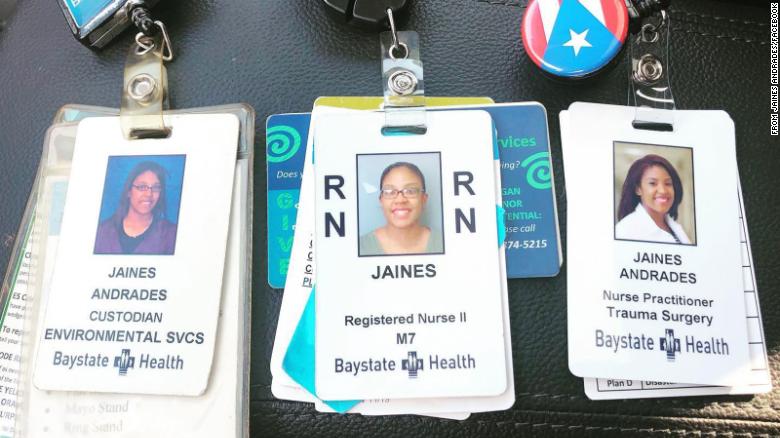
In a Facebook post, Andrades wrote about her journey from hospital custodian to nurse practitioner and posted a picture of all three of her IDs.

She said her journey at the Springfield hospital started when she got a call for an interview. At the time she had been working at a fast food restaurant, according to WBZ-TV.

She said she always wanted to help people. "Even if it was cleaning, as long as I was near patient care I'd be able to observe things. I thought it was a good idea," she said.

Her favorite part of nursing is bringing relief and comfort to her patients. "I just really love the intimacy with people," Andrades told the CNN affiliate.

And now she has realized her dream. She became a Baystate nurse, and then a nurse practitioner in the very same place she used to clean.

"Nurses and providers, we get the credit more often but people in environmental and phlebotomy and dietary all of them have such a huge role. I couldn't do my job without them," Andrades said.

And she says she feels happy her story is inspiring others.

"I'm so appreciative and like in awe that my story can inspire people," Andrades told WBZ-TV. "I'm so glad. If I can inspire anyone, that in itself made the journey worth it."

Woman Becomes Nurse Practitioner at Same Hospital Where She Was Once a Custodian: 'Worth It!'


Over a 10-year period, Jaines Andrades worked her way up from janitor to registered nurse and now, nurse practitioner

By Joelle Goldstein  October 12, 2020


Share: The Inspiring Story of How One Woman Went From Custodian to Trauma Surgery Nurse Practitioner

A Massachusetts woman is showing the world the true meaning of perseverance after she worked her way up from being a custodian at a local hospital to now treating its patients as a nurse practitioner.

Ten years ago, Jaines Andrades started her career at Baystate Medical Center working in environmental services, where she cleaned up operating rooms as a janitor, Meredith Corporation station WGGB reported.

Today, instead of cleaning the operating rooms, she is one of the leaders inside them as a certified nurse practitioner in trauma surgery, according to the outlet.

"At one point, I dreamed of the position I have today," Andrades told WGGB of her incredible journey, which started when she was just 19 years old.

Jaines Andrades
BAYSTATE HEALTH

In 2014 — four years after Andrades began her career at Baystate as a custodian — the Springfield resident earned her nursing degree, WGGB reported.

RELATED: Former Security Guard Becomes Medical Student at Louisiana Hospital Where He Worked

She continued working in environmental services until an opportunity to work as a registered nurse arose.

"I stayed, actually, in environmental, despite being a nurse because I didn’t immediately get a nursing job at Baystate, so I wanted to keep my foot in the door," she explained to the outlet.


Jaines Andrades (L)
BAYSTATE HEALTH

Eventually, Andrades decided to go back to school to become a nurse practitioner (NP) and once she completed her degree, was offered a job at Baystate yet again.

"Once I start something, I have to see it through, so if I’m going to be a custodian and then be a nurse, it only makes sense to be a nurse practitioner there," she told WGGB of working at Baystate all these years.

RELATED: Man Graduates with Nursing Degree from University Where He Was Once a Janitor: 'I Never Gave Up'

On Sept. 28, Andrades reflected on the accomplishment by posting a photo of her three work badges on Facebook. Though they all have her name and photo on them, each one has her different job title and shows Andrades' career progression over the years.

"10 years of work but it was worth it! I’m a provider at the same place I use to clean," she captioned the post, which has been shared over 10,000 times and liked over 12,000 times.

Reflecting on her career, Andrades told WGGB that having such diverse experiences at the Springfield medical center has kept her humble while interacting with others.

"I remember those times where I saw interactions as a custodian to remind myself that everyone’s human," she explained. "Your academic success or your professional success, obviously, it deserves praise and you should be proud of that, but it doesn’t make you a better person."

"As a human being," she added to the outlet, "I’m still that girl who used to clean."


For more on Andrades' journey, tune into PEOPLE (the TV Show!) on Monday night.
https://people.com/human-interest/woman-becomes-nurse-practitioner-at-hospital-she-was-custodian/
PEOPLE (the TV Show!) is a half-hour daily TV show inspired by the brand's unique combination of the most popular celebrity and inspirational human-interest stories, including entertainment news, exclusive interviews, feature stories, beauty and style, true crime and more.  The show is hosted by Kay Adams and Lawrence K. Jackson with correspondents Jeremy Parsons and Sandra Vergara. You can also stream the show daily at 7 p.m. ET/4 p.m. PT on People.com, PeopleTV app (OTT) and PEOPLE’s Facebook, Twitter and YouTube accounts.

BOOK REVIEW:

War Communism? Corona, Climate, Chronic Emergency


Tuesday 13 October 2020, by Simon Butler  

Andreas Malm 
CORONA, CLIMATE, CHRONIC EMERGENCY: War Communism in the Twenty-First Century, Verso, London, 2020.

There appears to be a big difference between capitalist governments’ collective response to the Covid-19 pandemic and their response to the climate emergency. Covid has prompted rapid, draconian inroads on the functioning of many businesses and even entire industries. In country after country, large parts of the economy have been shuttered and production has been redirected to social needs, such as personal protective equipment, hand sanitizers and ventilators.

There are obvious differences between countries, but many governments appear to have made uncharacteristic decisions that put human life and welfare ahead of profit making.

In Corona, Climate, Chronic Emergency, Andreas Malm begins by asking why capitalist governments have seemingly been willing to pitch the world into recession to fight Covid, while they have been so resistant to calls to cut carbon pollution sharply. After all, Malm muses, “no champion of radical emissions cuts has ever asked people to submit to something as unpleasant as a lockdown.”

He offers several explanations for the seeming disparity. Unlike climate disruption, which is already hitting the global south first and hardest, Covid hit Western countries early on. Were Covid mainly confined to poorer countries it’s unlikely Western governments would have treated it as a global crisis. Covid also spread quickly, preventing capitalists from mounting a public relations campaign to defend their profits in the same way that the fossil fuel industry has financed climate change denial.

Another explanation for the difference is that capitalist states’ tough border restrictions and ‘war against the virus’ rhetoric fit neatly within conservative nationalist ideologies. The same cannot be said of radical action on climate change, which is internationalist by definition and requires the historically biggest polluters of the rich world to cut emissions the most.

Furthermore, while every oil or coal company, agribusiness giant and car-maker seeks to expand higher emissions is the business plan, Covid is not a direct product of the day-to-day functioning of the capitalist economy.

The state-led response to Covid is a sharp disruption to capital accumulation, but it is still a temporary measure. By contrast, climate action is forever, a serious response to climate change is a direct challenge to private property and the commodification of nature.
Global sickening

Malm argues that comparing the current Covid response with climate inaction is not comparing like with like. “The contrast between coronavirus vigilance and climate complacency is illusionary,” he says. Rather, “Covid-19 is one manifestation of a secular trend running parallel to the climate crises, a global sickening to match the global heating.”

For many years, scientists have warned about the threat posed by rising “zoonotic spillover” — the process by which a virus can leap to humans from another species. Their warnings of potential pandemics have been ignored.

Outbreaks of new infectious diseases have been on the rise since the 1940s, accelerating to unprecedented heights after the 1980s. Most result from zoonotic spillover. Along with Covid, which originated with bats, other modern diseases such as AIDS, Ebola, SARS, MERS and Zika also originated in animals.

Spillover is a higher risk today for several reasons. A major cause is the huge disruptions and encroachments made on natural environments, such as deforestation and urbanization. This brings wild animals in closer contact with human populations than before.

“That strange new diseases should emerge from the wild is, in a manner of speaking, logical: beyond human dominion is where unknown pathogens reside. But that realm could be left in some peace. If it weren’t for the economy operated by humans constantly assailing the wild, encroaching upon it, tearing into it, chopping it up, destroying it with a zeal bordering on lust for extermination, these things wouldn’t happen. The pathogens would not come leaping towards us. They would be secure among their natural hosts. But when those hosts are cornered, stressed, expelled and killed, they have two options: go extinct or jump.”

The relentless commodification and caging of wild animals adds to the risk of zoonotic spillover. Modern livestock and aquaculture industries, which cram thousands of animals into confined spaces, are perfect breeding grounds for pathogens that can jump to humans.

Climate change itself is also disrupting animal populations. Warmer temperatures encourage them to migrate away from the equator, further increasing the chance of new interactions between animals and humans, and hence more zoonotic spillover.

Given this, Malm concludes that the response to Covid-19 has a lot in common with how capitalist states respond to other ecological problems — treating the symptoms while ignoring the causes.

“Ears have been as deaf to the science of spillover as to that of climate, if not more so. One might regard Covid-19 as the first boomerang from the sixth mass extinction to hit humanity in the forehead.”

The likelihood of similar, or even worse, pandemics coinciding with extreme climate change amount to a single “chronic emergency.”

Emergency and ‘war communism’

The final part of Malm’s book discusses the political responses and actions needed to truly address the root causes of this chronic emergency. Without decisive action we face a dangerous world of future pandemics colliding with immense ecological disasters. This means that the hope that gradual reforms will tame capitalism is less relevant than ever.

“Social democracy works on the assumption that time is on our side. But if catastrophe strikes, and if it is the status quo that produces it, then the reformist calendar is shredded.”

Malm also writes a chronic emergency obituary for anarchism, with its deep antagonism to the state. To get through the dire situation ahead and bring about the rapid changes needed, we will need state power on our side.

Nor is there any point holding on to dreams about “luxury communism” or vast material abundance under socialism. Even if we succeed in dismantling capitalism there’s no reason to think a society of lavishness and plenty will be possible on a planet impoverished by extreme climate heating and mass extinction.

Instead, the overriding priority is a project for dignified survival in a time of ominous emergency. Malm calls this project “ecological Leninism”, which he summarizes under three principles.

First, it “means turning the crises of symptoms into crises of the causes”, much like how Lenin urged the Bolsheviks to transform the outbreak of World War I into an opportunity to undermine the system that produced such horrible wars.

Second, “speed [is] a paramount virtue.” Given the state of the crisis, delay and half-measures are equal to welcoming disaster.

Third, ecological Leninism “leaps at any opportunity to wrest the state in this direction, break with business-as-usual as sharply as required and subject the regions of the economy working towards catastrophe to direct public control”.

The transition to a sustainable, ecologically sane society won’t look much like luxury communism. It will be more like “war communism” — a reference to the policies adopted by the Bolsheviks in early years of the Russian Revolution. In a time of civil war, facing near total economic collapse, a foreign blockade, and widespread famine, encircled by better armed and resourced enemies, the young worker’s state rapidly undertook widespread nationalisations of the economy. Against the odds, it survived the emergency and won the civil war.

Malm warns that his analogy is not to be taken literally. For instance, he says he no more endorses the most unsavoury aspects of War Communism than climate activists who use World War II analogies want to drop atomic weapons on Japan.

Instead, he is arguing for a planned emergency program of action, in which democratically-constituted state organizes and carries out the necessary steps to ensure human survival in a severely damaged planetary biosphere.

“Ecological war communism … means learning to live without fossil fuels in no time, breaking the resistance of dominant classes, transforming the economy for the duration, refusing to give up even if all the worst-case scenarios come true, rising out of the ruins with the force and the compromises required, organizing the transitional period of restoration, staying with the dilemma.”

Readers of Malm’s eloquent and important book need not agree that “war communism” is the best way to sum up the transitional measures needed to bring about an ecological society. I prefer plain ecosocialism myself — it carries a lot less baggage. But the great strength of Corona, Climate, Chronic Emergency is that it gets the origins and the scale of the cascading ecological crises we face exactly right. Compared with most other books that discuss the crisis, its solutions are more realistic because they are more radical.

As Malm concludes, the measures he proposes “are exactly as utopian as survival.”

Source Climate & Capitalism.

Attached documents
war-communism-corona-climate-chronic-emergency_a6842.pdf (PDF - 363.2 kb)
Extraction PDF [->article6842]

Ecology and the Environment
Intersecting crises and the impact in Britain
Global Fever
Fires ravage Brazil’s wetlands
The Fires Currently Raging in California, and Climate Change
South African movement adopts Climate Justice Charter
Covid-19 Pandemic
Capitalism Made Women of Color More Vulnerable to the COVID Recession
Situation of Garment Factory Workers in Katunayaka – COVID-19 Update
Pandemic, Polarization, and Resistance in the US
Opening Up the Schools?
The crisis triggered by the pandemic and the economic policy of the European Union


Right wing fuses anti-Semitism with 
anti-communism in its conspiracy theories

October 9, 2020 BY AMIAD HOROWITZ

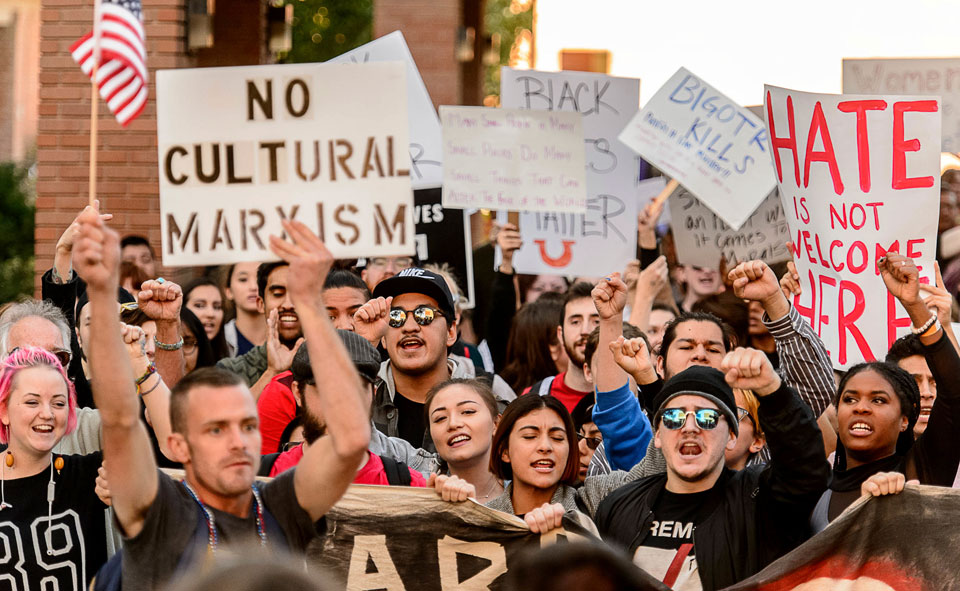
A man with a sign reading "No cultural marxism" taunts a group of protesters rallying at the University of Utah in Salt Lake City with Black Lives Matter messages, Sept. 27, 2017. 'Cultural Marxism' has become the new code among anti-Semitic propagandists. | Trent Nelson / The Salt Lake Tribune via AP


It’s hard for anyone reading any reactionary publication to avoid the name George Soros. Many right-wingers claim that Soros, a billionaire Jewish businessman, is funding radical leftists. They claim that Soros pays Black Lives Matter protesters, and some say he helps coordinate leftist activities around the world. Of course, anyone who does the slightest bit of research can easily discover that these accusations are not true. Despite this, millions of Americans believe these lies and repeat them regularly. Why is this, and why is it so easy to convince so many people of something that is obviously not true? The answer is that this lie plays into the long history of the fusing of anti-communism with anti-Semitism that is ingrained in much of American right-wing thought.

From the moment Karl Marx and Friedrich Engels published The Communist Manifesto in 1848, anti-communism has gone hand-in-hand with anti-Semitism. Many of Marx’s enemies (both on the right and the left) used his Jewish heritage to disparage his ideas and followers. However, the joining of anti-Semitism and anti-communism reached its zenith after the Russian Revolution and the rise of the Bolsheviks in 1917.
Fox News TV host Glenn Beck ran a series on his program in 2010 depicting billionaire Jewish businessman George Soros as a ‘puppet master’ who pulled the strings of the radical left and Democrats. The connection of anti-Semitism and anti-communism remains a staple of right-wing conspiracy theories. | via YouTube


By the start of the 20th century, the Russian Empire was the third largest empire in history. Its expansion had not only increased the landmass of the country, but also diversified the population of the empire. One of the largest minority groups now under the rule of the Tsar were the Jews, who were seen as second class at best, or as foreign and unwanted at worse. Russian Jews were subject to all kinds of abuse, both official and unofficial. There were laws restricting where Jews could live, and most infamously, they were subject to pogroms. Pogroms were repeated, large scale, violent attacks conducted by Russians against Jewish communities. These attacks were often incited by the anti-Semitic rhetoric of the authorities and the local churches. In the years leading up to 1917, thousands of Jews were murdered, even larger numbers injured and assaulted, and more still had their homes and possession destroyed.


After the October Revolution, Russia descended into Civil War. On the one side, there were the Bolshevik-led forces known as the Red Army. On the other side, there were various anti-Bolshevik groups, the largest being known as the White Army. The White Army was made up of monarchists, conservatives, and other reactionary, anti-revolutionary forces. Some of the elite in the White Army knew that they could use the existing, high levels of anti-Semitism to their advantage. To that end, they sought to merge anti-Semitism with anti-Bolshevism in order to increase their base.

In 1917, they published a pamphlet titled Jewish Bolshevism, which used traditional racist propaganda to vilify Jews and, by proxy, Communists. This was followed by the mass publication of the 1903 Protocols of the Elders of Zion, one of the most infamous publications of the 20th century. The Protocols were produced by the Tsarist secret police, claiming to prove a massive conspiracy by the Jewish people for world domination. The document was arguably the single most influential anti-Semitic publication in modern history, and it threw fuel onto the already raging fire that was the early 20th-century hatred of Jews.
Kornilov’s Shock Detachment, the White Army’s elite Shock Regiment during the Russian Civil War. | Wikimedia Commons

With the success of the Bolshevik-led working class revolution in Russia, reactionary powers and capitalists around the world began to fear communist uprisings in their own countries. In no country was this truer than the United States. The U.S. government began a campaign of persecution and slander against communists, initiating a period now known as “The First Red Scare.” As part of this effort, a White Army officer brought a copy of The Protocols from Russia to the U.S. for distribution. There were many versions, with some freely switching between the words “Jew” and “Bolshevik” in their translation.

Rabid Jew-hater and reactionary Henry Ford—of Ford Motor Co. fame—made it his personal mission to spread the joint anti-communist/anti-Semitic plot. The automobile mogul published excerpts from The Protocols, along with other anti-communist and anti-Jewish pieces, in his newspaper, The Dearborn Independent, as part of a series called, “The International Jew: The World’s Foremost Problem.” He also paid for the book’s translation into various languages and its printing for distribution around the world. Ford knew that he could appeal to people’s existing anti-Semitism to help stoke the fear of communism, and thereby protect his wealth and the wealth of the rest of the capitalist class.


Related Stories:

Democratic outreach to Jewish voters cites rising anti-Semitism under Trump

Republicans’ rabid anti-communism is a sign of their political weakness

Trump turns to neo-Nazi symbols to attract racist votes

Don’t ignore Trump fanning the flames of QAnon conspiracy theories

Without a doubt, the most infamous purveyors of the idea of “Jewish Bolshevism” was the German National Socialist (Nazi) Party. The idea that they would protect the “Aryan race” from “the Communist plot led by world Jewry” was at the center of their ideology and propaganda. In fact, exterminating the large Jewish population in Eastern Europe was a significant impetus for the invasion of the Soviet Union, as was the prospect of destroying the world’s only Communist-led state.  
Automobile titan Henry Ford funded the publication and distribution of massive amounts of anti-Semitic propaganda, including ‘The Protocols.’ Here is the front page of a 1920 edition of his ‘Dearborn Independent’ newspaper. | Wikimedia CommonsMany people imagine that the story of this fused hatred ends with the defeat of the Third Reich. Although the Nazis might have been the loudest propagandizers against “Jewish Bolshevism,” they were not the last. The right continued to push this conspiracy theory throughout the Cold War and into modern times. Right-wing authors such as Elizabeth Dilling and Frank L. Britton published works throughout the Cold War warning against a Jewish-Communist plan to take over America.

In the immediate post-war years, the most deplorable instance of this carefully composed fusion of right-wing fantasies came in the high-stakes atom bomb spy trial of Julius and Ethel Rosenberg who, despite worldwide appeals for clemency, were executed by the U.S. government on June 19, 1953, under a cloud of manufactured evidence and perjured testimony. Historians have pointed out that although most of the principals in the case were Jewish—the defendants, lawyers, judge—there was not a single Jew allowed to serve on the jury in the densely Jewish city of New York. A prominent advisor for the prosecution was lawyer Roy Cohn, who would later become a mentor to the young Donald Trump.

At the beginning of the 1990s, with the collapse of the USSR, the propagators of “Judeo- Bolshevism” needed to rebrand, and “cultural Marxism” became its stand-in. The meaning, however, remained the same. The so called “moderate right” in the USA would like people to believe that this problem only exists on its fringes, but many mainstream conservative and reactionary personalities openly and loudly promote this conspiracy theory.

Pat Buchanan, a prominent Republican and frequent presidential candidate throughout the 1970s, ’80s, and ’90s, has warned his followers against the “threat of cultural Marxism” and its “de-Christianizing of America.” Jordan Peterson, a pseudo-intellectual with a large right-wing following whose books have become best sellers in the U.S. and around the world, often rants about how “cultural Marxism” is destroying “Western Civilization.”

In 2017, at the so called “Unite the Right” rally in Charlottesville, Va., the marchers were recorded chanting “Jews will not replace us.” This is a direct reference to the idea of “Judeo-Bolshevism” in The Protocols of the Elders of Zion. The next day, President Trump referred to the marchers as “very fine people.” An idea does not get any more mainstream than when it is condoned by the president of the United States and head of the Republican Party.
In this photo taken Friday, Aug. 11, 2017, multiple white nationalist groups march with torches through the UVA campus in Charlottesville, Va., for the so-called ‘Unite the Right’ rally. Pitched as a protest against the radical left, the event prominently featured anti-Semitic and anti-communist themes, as well as the chanct ‘Jews will not replace us.’ One anti-fascist demonstrator, Heather Heyer, was murdered by a right-wing extremist the following day. | Mykal McEldowney / The Indianapolis Star via AP

This tactic of using pre-existing prejudices to build support for reactionary ideas has been very successful for the right. It has been so successful that they are expanding its use in the contemporary USA. While dog whistles like George Soros conspiracy theories are still used, the rhetoric about dangerous conspiracies between Marxists and racial minorities has been expanded to include and focus on the Black Lives Matter movement. BLM is constantly accused of being a radical left organization and Marxist, despite no evidence supporting this claim.

However, when Trump and his minions declare that BLM is a “Marxist group,” what he is doing is telling the many racists in the USA that they should be afraid of communism. At the same time, he is telling those who have already fallen for the red-scare tactics used over the past century to be afraid of BLM.

We now stand at the threshold of a new Cold War. The Trump administration is telling Americans to be afraid of communism, to be afraid of BLM, and to be afraid of China. This coincides with an emboldening of white supremacists across the USA, as well as the growing anti-racist movement to counter the right. We must be aware of the long-used tactic of the reactionary right that links minority groups with Communist thought and uses already-existing racism and bigotry to swell the ranks of anti-communists so that we are better prepared to both recognize it when we see it and combat it successfully.

As with all op-eds published by People’s World, this article reflects the opinions of its author.


ONTARIO
Workers, families hold protest for long-term care changes


Protests happened in 20 municipalities across Ontario

Julie Ireton · CBC News · Posted: Oct 08, 2020

Amy Ayers, a personal support worker at Almonte Country Haven, has worked throughout the pandemic, except for 14 days when she was sick with COVID-19 herself. (Francis Ferland/CBC)


Workers, unions and families gathered in Almonte, Ont., Thursday to call for immediate action by the Ford government to recruit staff and to improve working conditions in Ontario's long-term care homes.

Amy Ayers, a personal support worker at Almonte Country Haven who helped organize the day of action, has been at the long-term care facility throughout the COVID-19 pandemic, and she even contracted the virus herself last spring.

"What we're doing here is coming out to make people who are unaware, aware of the crisis in long-term care centres," said Ayers.

Similar protests happened in more than 20 municipalities across Ontario.

Last spring, 72 of 82 residents, along with several staff members at Almonte Country Haven, tested positive for COVID-19. There are currently no cases in the long-term care home right now.

"I'm kind of coming out of my shell to speak up about the very damaged system and I hear a lot from coworkers, other PSWs ... they're afraid to come out, talk and stand up for what they believe is right. So I'm here to say, it's OK," said Ayers.
More needs to be done

The Ontario Health Coalition said the problems include understaffing, testing backlogs, sharing of four-person rooms, and insufficient infection control provisions. It's calling for a minimum daily standard of four hours of hands-on care for every resident.

Ayers says a lot of lessons have been learned, but more is needed across the care system.

"Number one would be more staffing per ratio of residents. With that we can give more quality of care," said Ayers. "Our elderly in long term care deserve better. They deserve to have top notch care. I can't stress that part enough."

Mae Wilson died of COVID-19 at Almonte Country Haven in the spring. (Submitted by Grant Wilson/Karen Thompson)

Mae Wilson lived at Almonte Country Haven for four years until she died of COVID-19 in May.

Her daughter, Karen Thompson, attended the day of action with her own signs and ideas about how the system can be improved now.

"We have to make the system better. We're going into the second wave, and we haven't really done a thing to make it better," said Thompson.
Patient ombudsman report

The day of action for long term care in Ontario happened on the same day as the province's patient ombudsman released a report.

The report details complaints about the safety of residents and staff and points to a crisis in the province's long-term care homes.

At Queen's Park on Thursday, Ontario's minister of long-term care, Merilee Fullerton was asked when changes in nursing homes can be expected.

"Staffing is a priority and our government is putting dollars behind that as we speak," said Fullerton in the legislature.

Karen Thompson's mom died of COVID-19 at Almonte Country Haven in the spring. She wants the system to change to better care for residents and staff. (Francis Ferland/CBC)

Karen Thompson hopes the system improves but she is worried that the government doesn't have an accurate account of what's going on inside many care homes because workers like Amy Ayers who speak out, are rare.

"Everyone clams up. I know a lot of the PSWs. They say everything is fine. They just can't talk. They're afraid to say stuff and then get in trouble later and get fired," said Thompson.
Legal Evictions Are Banned During The Pandemic, But ‘Invisible’ Evictions Are On The Rise

PART OF THE AFFORDABILITY DESK
Ally Schweitzer

DCIST | OCT 15

In D.C., evictions can’t be legally carried out during the pandemic. That didn’t help Denis Gallegos, whose landlord locked him out after he lost his job.
Tyrone Turner / WAMU

Denis Gallegos was two months behind on rent when he came home to find his locks had been changed.

The 34-year-old immigrant from Honduras was sharing a townhouse on Trenton Place SE with a young family, paying them $500 in cash each month for a small room. But when the pandemic hit in March, Gallegos lost his job at an upscale restaurant in Georgetown. He couldn’t afford to pay his rent. Neither could his roommates. The landlord started turning up at the house, insisting they pay or move out.

“I told him I couldn’t go because we were in the middle of a pandemic,” Gallegos says.

So the landlord called the authorities.

A police report shows that the landlord, Abiyot Hirui, called to report a burglary at the townhouse on June 17. Police entered the home late and found Gallegos inside. He told them he was a tenant, not a burglar, and that Hirui had been harassing him and his housemates for weeks. The police informed Hirui that evictions were a civil matter and there was nothing they could do, and left.

The following day, Gallegos says, he found the locks changed at the house. All of his belongings, including his HIV medication, were inside.

Gallegos says he slept at Casa Ruby, a safe space for at-risk LGBTQ youth, that night. On June 19, he filed a complaint for wrongful eviction in D.C. Superior Court. The judge ordered Hirui to give Gallegos keys to the house that same day. But Gallegos didn’t want to stay there, he says, and he soon moved out. He’s now crashing at a friend’s home in Northwest D.C., occupying a small room off the back of the house, not sure where he’ll go next. And he’s still shaken from his experience.

“It was a very ugly thing for me,” Gallegos tells WAMU/DCist through an interpreter. “I had nightmares. I couldn’t sleep. I couldn’t eat.”

Hirui did not respond to a request for comment, and his attorney referred WAMU/DCist to transcripts of his court hearings.


Denis Gallegos, who was locked out of his home in June, now lives in the back of a friend’s house in Northwest D.C.Tyrone Turner / WAMU

Lawyers who represent low-income renters in the D.C. area say they’re encountering more stories like this as the pandemic lurches into its seventh month.

The reason, they say, is the extreme economic uncertainty wrought by the crisis, combined with waning government assistance. The region’s jobless rate was close to 7% in August, unemployment benefits are running out, and as many as 715,000 renters in D.C., Maryland and Virginia are now at risk of eviction, according to the Aspen Institute. Some landlords have become desperate to replace out-of-work residents with new ones who can pay the rent. Consequently, more are evicting tenants without court orders, which is illegal.

There are restrictions on evictions during the pandemic. A sweeping national mandate from the Centers for Disease Control halts evictions for renters who earn less than $99,000 annually until the end of the year. In D.C., landlords are barred from evicting tenants for any reason while the city remains under a state of emergency. But these measures only prevent legal evictions. Landlords who choose to evict tenants illegally may not have gone through the courts anyway, advocates say.

Tracking, and stopping, illegal evictions can be challenging. Eviction filings in Northern Virginia were down 85% earlier this year compared to 2018, according to the RVA Eviction Lab, likely because the state’s high court issued a series of temporary eviction bans through September. But the data don’t capture evictions that take place outside the courts. A recent national survey of legal aid and civil rights attorneys showed widespread reports of illegal lockouts. Some advocates call these “invisible evictions” because they don’t leave a paper trail.

“We’re hearing stuff like this pretty steadily now,” says Elaine Poon, managing attorney at Legal Aid in Charlottesville. She says her office received three calls about illegal evictions just last week. “It’s kind of at an all-time high.”

In one case brought to Poon’s office, a renter reported that after their landlord lost his eviction case in court, he threatened to come to their house every day until they vacated the property. Poon suspects that many renters facing intimidation from their landlords simply move out to avoid a fight.

“What ends up happening is a lot of landlords get away with it,” she says.

Invisible evictions, Poon says, often affect immigrant households.

Renters facing intimidation from their landlords will often move to avoid a fight. “A lot of landlords get away with it,” says attorney Elaine Poon.

“They don’t always know what the law is here, and it might be that in [their] home country, there isn’t a lot of protection,” the attorney says. “They just assume, ‘I’d better get out of here.’”

Immigrants and other vulnerable renters are also affected by what’s known as self-eviction. That’s when a tenant moves out after receiving their first eviction notice, even though they’re not legally required to. Anecdotal evidence suggests self-eviction is on the rise during the pandemic, too. When Legal Aid staff recently visited the homes of Charlottesville residents slated for legal evictions, Poon says, they often found they had arrived too late.

“Almost every single time, a huge percentage of the people had moved out already,” she says.

The D.C. Council passed a temporary ban on issuing tenants eviction notices in September after hearing stories of self-eviction from advocates in the District. There’s no such ban in Virginia or Maryland. And the protections that do exist in those states aren’t perfect, advocates say. In order to seek protection under the CDC mandate, renters must sign a declaration affirming their lack of income and other details, and present it to their landlord. That requires a certain level of know-how, says Matt Hill, an attorney with the Public Justice Center in Baltimore.

“The biggest problem [with the CDC order] is that folks really don’t know about it,” Hill says. “We see a real lack of outreach and education.”

There’s also a significant loophole in landlord-tenant law that isn’t addressed by the mandate, Hill says. In Maryland and Virginia, landlords can simply terminate the leases of renters who fall behind on payments, then seek to evict them for overstaying their lease. (D.C.’s “just cause” eviction law bans this practice in the city.) Hill says these “holdover” tenants aren’t necessarily covered under the federal eviction order.

“There’s an open question, at least to some judges, about whether the CDC order applies in those cases,” Hill says. “The order isn’t drafted as clearly as we would like.”

Regardless of how renters get evicted, they often wind up in one of three different situations: They move in with friends or family, often in crowded living conditions; bounce between temporary accommodations or shelters; or wind up on the streets. None of these outcomes are ideal under normal circumstances, let alone during a pandemic, Hill says.

“We know that evictions lead to homelessness,” he says, “so we need to do everything we can to stop evictions.”

“Landlords don’t want to evict anyone, ever, let alone evict in the winter,” says Patrick Algyer with the Northern Virginia Apartment Association.

Landlords and their surrogates don’t necessarily disagree, says Patrick Algyer, executive director of the Northern Virginia Apartment Association. He says most property owners view eviction as a last resort.

“Landlords don’t want to evict anyone, ever, let alone evict in the winter,” Algyer says. “That’s just a horrible time.”

Still, Algyer says, landlords who have gone months without some or all of their rental revenue have to pay their mortgages, bills, maintenance expenses and taxes and without relief from local or national governments, they’re reliant on tenants, who are often struggling. Rent collection at professionally managed buildings across the country has fallen slightly during the health emergency, according to the National Multifamily Housing Council. Small, independent landlords have anecdotally reported losing rental income, too, though there’s no comprehensive data on rent collection at properties owned by “mom-and-pop” landlords.

Without income, some landlords — especially small ones — risk defaulting on their mortgages. To avoid foreclosure, some may decide to sell their properties to condo developers, taking housing out of the already strained rental market.

Like D.C. and Maryland, Virginia has committed millions of dollars to help struggling tenants pay their rent. But Algyer says Virginia’s $50 million rental assistance program — paid for by the CARES Act — hasn’t gone nearly far enough. At first, funds were only available to tenants, not landlords, so property owners had to wait for tenants to navigate the process of applying for, and receiving, payments. And because Virginians owed an estimated $169 million to $211 million in missed rent as of September, according to the RVA Eviction Lab, the assistance won’t reach everyone who needs it.

“As this continues to snowball, we really have to start providing the landlords with more relief to help them get through this,” Algyer says. “All we’re doing with this program is just kicking the can down the road.”

Landlords have lobbied Congress for economic relief, but they’ve hit a wall with Senate Republicans, many of whom oppose another coronavirus relief package. Real-estate interests have also mounted legal challenges to eviction bans on the state and federal level. In one high-profile federal suit, landlords argue that federal agencies lack the authority to waive state laws, and that the CDC eviction ban encroaches on private property rights. Advocacy organizations including the National Housing Law Project and Legal Services of Northern Virginia have urged the court to deny the motion.

But landlords and tenant advocates agree on at least one thing: the importance of large-scale rental assistance. Without it, they say, both landlords and renters will continue to struggle. Elaine Poon with Legal Aid in Charlottesville says renters temporarily saved by the CDC order could still become homeless once the mandate expires Dec. 31.

“They will be evicted New Year’s Day in the dead of winter, and I doubt the pandemic will be gone by then,” she says.

Denis Gallegos says his lockout experience was traumatic, but he thanks God that he had somewhere else to go.

“It’s not comfortable,” he says. “But I’m inside.”

Martin Austermuhle contributed Spanish language interpretation to this report.

This article is part of our 2020 contribution to the DC Homeless Crisis Reporting Project, in collaboration with other local newsrooms. The collective works will be published throughout the day at DCHomelessCrisis.press. You can also join the public Facebook group or follow #DCHomelessCrisis on Twitter to discuss further.

This story originally appeared on DCist.


No Really, What is Anarchism?

Eric Fleischmann
October 7, 2020

The terms ‘anarchist’ and ‘anarchism’ are returning to the center stage of political lingo in the twenty-first century. To quote my own article on Center for a Stateless Society:

“President Donald Trump has repeatedly attempted to associate Black Lives Matter with anarchists and anarchism. He has tweeted such threatening posts as just the phrase ‘Anarchists, we see you!’ with a video of a man dressed in black at one protest, and he has referred to protesters in Portland, Oregon as ‘anarchists who hate our Country’ and called for Governor Kate Brown to ‘clear out, and in some cases arrest, the Anarchists & Agitators in Portland.’

It is certainly true that many anarchists—such as myself—have been involved in Black Lives Matter protests, but it is obvious that President Trump is not making an objective ideological observation but rather is attempting to use anarchist as a ‘dirty word’ intended to make protestors out to be terroristic criminals.”

“Joe Biden employed a similar tactic in the following statement: “‘I’ve said from the outset of the recent protests that there’s no place for violence or destruction of property. Peaceful protesters should be protected, and arsonists and anarchists should be prosecuted, and local law enforcement can do that.’”

The mainstream media’s understandings of anarchism since (at least) the nineteenth century have involved a desire for chaos, disorder, and destruction. In early twentieth century North America, anarchists were depicted as bearded, often-foreign men with bombs, knives, or other weapon threatening symbols of the United States, liberty, or civilization. Modern day examples might include psychopathic terrorists like Solomon Lane from “Mission Impossible: Rogue Nation and Fallout” who, as Villains Wiki explains, seeks to create “a new world order based on unstoppable accidents and terrorist attacks that will actually turn the entire world into a massive terrorist superpower.”

Or, more generously, there is the character Zaheer in “Legend of Korra” (voiced by punk rock legend Henry Rollins) who seeks to bring down all governments, prompting the protagonist Korra at one point: “The idea of having nations and governments is as foolish as keeping the human and spirit realms separate [a reference to a previous season’s plot]. You’ve had to deal with a moronic president and a tyrannical queen. Don’t you think the world would be better off if leaders like them were eliminated?”

The latter example is a tad kinder to the ideology, but media depictions of anarchism rarely give a full view or even the benefit of the doubt. There are numerous schools of thought — generally differentiated by their economic models — that fall under the descriptor of anarchism ranging from anarcho-communism to individualist anarchism (and even ideologies that claim the title to the dismay of almost all other anarchists such as anarcho-capitalism and the racist, crypto-fascist national anarchism), but I would like to semi-informally compile some quick (unfortunately largely Western) information to hopefully help anybody begin to genuinely answer the question “what is anarchism?”

I am no expert in etymology, but according to (may a higher power forgive me) the Internet, it seems that ‘anarchy’ is derived from the ancient Greek anarkhia (‘without a ruler’) — composed of an- (‘without’) and arkhos (‘ruler’) — which was used first recorded as having been used in 404 B.C.E. in reference to the Year of Thirty Tyrants in Athens during which there was no one ruler or archon. This transformed into the Medieval Latin anarchia and French anarchie (both meaning roughly the same thing as the Greek). Thus, for numerous centuries ‘anarchy’ was used to refer to confusion in the absence of authority.

According to the Merriam-Webster Dictionary, the first usage of the term ‘anarchism’ as opposed to ‘anarchy’ was in 1642. However, it is popularly accepted that the first usage of it as a political ideology in itself is by Pierre-Joseph Proudhon, who wrote in 1840, “Anarchy, — the absence of a master, of a sovereign, — such is the form of government to which we are every day approximating.” Thus, Proudhon adds the -ism—stating in a hypothetical back-and-forth “‘What are you, then?’ — ‘I am an anarchist.’”— to denote a deliberate political ideology.

Proudhon acknowledges that “[t]he meaning ordinarily attached to the word ‘anarchy’ is absence of principle, absence of rule; consequently, it has been regarded as synonymous with ‘disorder.’” Then he rejects these previous understandings, stating that “[a]lthough a firm friend of order, I am (in the full force of the term) an anarchist.”

A formal and ‘mainstream’ definition of anarchism can be found in the 1910 edition of The Encyclopedia Britannica, in which Pyotr Kropotkin writes that anarchism is “the name given to a principle or theory of life and conduct under which society is conceived without government – harmony in such a society being obtained, not by submission to law, or by obedience to any authority, but by free agreements concluded between the various groups, territorial and professional, freely constituted for the sake of production and consumption, as also for the satisfaction of the infinite variety of needs and aspirations of a civilized being.”

Furthermore, it must be added that many thinkers have identified anarchism as the libertarian branch of the much larger socialist movement. Mikhail Bakunin—the famous anarchist rival of Karl Marx—identified anarchism as “Stateless Socialism” and writes that “freedom without Socialism is privilege and injustice” and that “Socialism without freedom is slavery and brutality.”

Continuing, in Anarchism and Other Essays, Emma Goldman writes that anarchism is “[t]he philosophy of a new social order based on liberty unrestricted by man-made law; the theory that all forms of government rest on violence, and are therefore wrong and harmful, as well as unnecessary” — which might be a commonly accepted definition by students of politics, who may not be deeply knowledgeable on the subject.

But two more contemporary thinkers, David Graeber and Noam Chomsky give definitions that, when coupled together — deepen an understanding of anarchism: Graeber, in The Democracy Project, writes that “[t]he easiest way to explain anarchism…is to say that it is a political movement that aims to bring about a genuinely free society — and that defines a ‘free society’ as one where humans only enter those kinds of relations with one another that would not have to be enforced by the constant threat of violence.” Noam Chomsky says, in an interview with Harry Kreisler, that…

“The core of the anarchist tradition, as I understand it, is that power is always illegitimate, unless it proves itself to be legitimate. So the burden of proof is always on those who claim that some authoritarian hierarchic relation is legitimate. If they can’t prove it, then it should be dismantled.”

There are many questions left to be asked of anarchism: how will individual violence be handled? How will a stateless society protect itself from neighboring states? What economic formations will take shape in the absence of a state? However, these are not questions to be answered here.

The most salient concept demonstrated is that anarchism is not an ideology of violence (or at least it is significantly less so than those ideologies that call for concentrations of violence in the state and its cronies) but one which opposes violence at a systemic level and seeks liberation and voluntary interaction in all spheres of life.

About the Writer
Eric Fleischmann,
1A 

What Is Anarchism?
NPR October 12, 2020

An anarchy symbol is viewed after it was spray painted on a window during a demonstration by Occupy Wall Street and other groups in downtown Chicago on the eve of the NATO summit in Chicago, Illinois.Spencer Platt/Spencer Platt/Getty Images

We've been hearing a lot about anarchists lately, especially from the president.

President Trump tends to bring them up in his descriptions of the recent protests for racial justice that have happened across America.

And in September 2020, a White House memo deemed Seattle, New York and Portland "anarchist jurisdictions" and ordered a review of the federal funding for these cities.

But what exactly does it mean to be an anarchist? And what would an "anarchist jurisdiction" even look like?

To find out, we talked with anarchists Kim Kelly, William C. Anderson, and Ruth Kinna.

Analysis |
Egypt's 'Anarchists' Are Once Again Calling on Sissi to Resign, but This Time It's Different


The president must contend with a protest that has spread for the first time to the countryside, just before elections where his parliament's legitimacy is at stake


Egyptian President Abdel-Fattah al-Sissi on a visit to London in January 2020.
Credit: Henry Nicholls / AP

Zvi Bar'el Published on 10.10.2020

Five bullets from a policeman’s gun ended the life of Owais al-Rawi of the village of al-Awamiya in Luxor province in southern Egypt. His father and neighbors rushed to his aid and loaded him into a car to take him to the hospital, but he died on the way. All he wanted was to free his younger brother, who had been detained by police, but other officers chased him down.

For many hours, the police held Rawi’s body to use as a bargaining chip with the villagers for the release of three security personnel who had been abducted during demonstrations in the village on September 20. Rawi isn’t believed to have been among the abductors, but the police suspected that he knew about the abduction plan because on social media he encouraged his followers to protest against the regime.

Neighbors told journalists that Rawi was an ordinary man who would simply go to work and come home, and was awaiting the birth of his third child. He worked at the international hospital in Luxor and was barely able to scrape by.

Millions of Egyptians are in a similar situation. According to the World Bank, more than 60 percent of the country’s 100 million people live below the poverty line. The government says this figure is too high by half, though the government determines the height of the poverty line at will.

The precise statistics are of no interest to the people who are well aware of their situation; after all, they’re the ones bearing the costs of the reforms of President Abdel Fattah al-Sissi – the gas prices that rose sharply after the fuel subsidy was canceled, the soaring cost of getting to work by subway, the cost of medication that skyrocketed even before the coronavirus hit, and the cost of vital private medical services, given the inferior public health services.

On September 20, Egypt was shaken by riots that erupted in rural areas, too, for the first time. This is a historic date for Egypt. Last year on September 20, massive protests erupted in the wake of videos published by businessman and actor Mohammed Ali about corruption in the military and by the president and his family. Huge throngs took to the streets calling for Sissi’s resignation and a purge in the army.

Open gallery view

A man walking in front of demolished buildings along the agricultural road leading to Cairo, October 4, 2020. Credit: Amr Abdallah Dalsh / Reuters

According to Ali, Sissi built himself lavish palaces and mansions in Egypt’s New Administrative Capital being built next to Cairo. Also, military leaders are receiving hefty kickbacks from multimillion-dollar projects, and money that’s supposed to go for public services is being pocketed by the president’s associates. None of this is new for Egyptians, but it’s hard to think of another time under Sissi when this phenomenon had gained such publicity.

Hundreds Detained as Egyptian Police Quash Protests, Says Human Rights Group

More than 4,000 people, including journalists, lawyers and political activists, were arrested on charges of violating the law on demonstrations, harming national security and membership in a terror group; that is, the Muslim Brotherhood. The regime was shocked by the scope of the protests, which were the biggest since Sissi was elected president in 2014, and top intelligence officials were held to account for mishandling of the demonstrations.


This time, too, the regime says the Muslim Brotherhood is behind the protests, and thus the government has contradicted itself. On the one hand, it claims that it put down the Muslim Brotherhood, and on the other it acknowledges that the movement can still bring crowds onto the streets.

A small fortune for the people

Although the demonstrations this time were much smaller, with some as paltry as dozens of protesters, the participation of rural Egyptians underscored the nature of the new threat.

The reason for the protests this time was a new law enabling people convicted of construction-related offenses to pay fines and avoid having their homes or home additions demolished. Originally, a more draconian law was passed in 2017 stipulating that all illegal construction would be demolished in keeping with the regime’s zero-tolerance policy for illegal building and its plan to move people out of slums and makeshift homes.


But amid public pressure this law was amended to say that a “ransom” ranging from 125 to 5,000 Egyptian pounds ($318) per square meter could be paid instead – often an unattainable sum.

Open gallery view

A boy walking past a demolished building in Egypt's Qalyubia province, October 2020.
Credit: Mohamed Abd El Ghany / Reuters

These regulations aren’t just aimed at tycoons and real estate sharks. They largely hurt low wage earners with large families and migrants from the countryside who moved to cities decades ago and later expanded their homes without a permit.

This law is a continuation of the government’s decision to freeze construction of new private homes for six months, during which the owners must present business plans that conform to the new construction law and obtain approval.

This is ostensibly a revolutionary decision aimed at regulating the construction industry and reclaiming some of the land the state has lost to illegal building. But Egyptians view the plan as just another means of sucking funds from the people and exerting direct control over their property.

This feeling is heightened by parliament’s assessment that the government could collect 300 billion to 500 billion Egyptian pounds ($32 billion) from the fines and building fees alone, and that the government will increase tax revenues because it will have updated information on homeowners and the size of their properties.

Forceful seizure of property is nothing new to Egyptians. It occurred under Gamal Abdel Nasser, who also removed thousands of Egyptians from the Aswan Dam area, falsely promising that they could return when construction of the dam was complete.

And under Sissi, “for security reasons,” thousands of people near the Gaza border were forced out of their homes – which were then razed – and were required to relocate to El-Arish and other Sinai cities. They received very meager compensation. Such moves have harmed the public’s trust in the government – and the public doesn’t believe the president’s promises now.

Sissi makes threats

Open gallery view

Supporters of Egyptian President Abdel Fattah Al-Sisi holding banners celebrating the 47rd anniversary of the 1973 Arab-Israeli war, Cairo, October 2, 2020. 
Credit: Mohamed Abd El Ghany / Reuters

In an article on the Mada Masr website, Egyptian scholar and journalist Ali al-Rajal outlines the differences between the Mubarak and Sissi eras in this regard. He says the construction violations and the way they were ignored in President Hosni Mubarak’s time were part of the social contract that arose between a government incapable of solving the housing shortage and the public that had no choice but makeshift construction.

It’s true that in Mubarak’s time as well, corruption flourished and major contractors profited handsomely from the lack of regulation, but Sissi’s program that’s being violently implemented isn’t offering solutions. No one knows where the millions of people whose homes have been razed will go and how they’ll make a living. After all, a majority of these structures are in the big cities, and if these people are forced to leave for the countryside, they’ll have no way to support themselves.

Government figures show that only 100,000 homeowners have applied for approval so far, a tiny number far below the government’s expectations. Infuriated by this, on September 27 Sissi gave an angry speech warning that the government would use all means to implement the program. He also threatened the mayors and other officials who must implement the law that “anyone who fails to uphold the guidelines will be gone.”

Stormy responses ensued, so the following day the government released 68 children who had been arrested on suspicion of taking part in the demonstrations. But many others remained in custody.

Later Sissi denounced the protests and harnessed the famed institution for Sunni Islamic scholarship, Al-Azhar, to support the plan. The president’s relations with Al-Azhar are tense due to Sissi’s decision to curb the religious center’s monopoly on issuing religious edicts and undermine the fragile balance between religion and state.

Still, Al-Azhar said in a statement it was “following the destructive movements intending to undermine the public order, undermine our beloved Egypt’s security, spread chaos and disrupt the atmosphere of development and investment.” Similar statements were made by the Arab Spring protesters in 2011.

“Anarchists” and “chaos spreaders” aren’t an Israeli invention, and the size of the demonstrations doesn’t necessarily reflect the scope of the people’s distress, frustration and anger.

The president’s son, Gen. Mahmoud al-Sissi, has been tapped to quash the protests, but he must do it in a way that won’t mar the parliamentary election that’s due to begin this month and last a week into November.

Sissi has been praised by foreign banks, Egypt’s foreign currency reserves have increased in the past year and the pound is more or less stable. But Egypt still needs loans from the International Monetary Fund, foreign direct investment has plummeted to $5 billion, tourism is still frozen and natural gas production from the huge Zohr site isn’t yet funneling cash to the state coffers.

Demonstrations where Sissi’s portrait is burned and he’s called on to resign aren’t a threat to his regime, but they unnerve domestic and foreign investors. In the political sphere, Sissi can rely on the election to give him an obedient parliament that’s no different from the current one, but the legislature’s legitimacy depends on voter turnout.

If in the 2015 election voter turnout was meager to disgraceful, reaching only 10 percent in certain districts, this time the protests could erode parliament’s legitimacy even further.

Sissi, who has been criticized abroad for bullying his rivals, is trying to calm things down. He’s offering compensation to evicted families, and he has ordered clay bricks for state projects despite their inferiority to cement blocks.

He’s doing this because most of the production is in the Giza industrial zone, where stormy demonstrations took place, and according to some Egyptian commentators, Sissi might even put off implementing the construction law that’s inflaming the streets. But this would only be a respite in the government’s campaign to reconquer Egypt