.jpg)
Italy's Prime Minister Giorgia Meloni with US President Donald Trump.
By Prof. Umberto Sulpasso
The electoral precipice for Giorgia Meloni was one step away. And the matrix was evidently all in the symbiotic alliance with Trump and Netanyahu, the two leaders who are shaking up the international political order with wars and disruptions. The resounding defeat in a constitutional referendum. The disjointed collapse in Hungary of the anti-Europe ally practically kicked out by the voters, had already shaken the electoral base of the PM. But Trump had the knockout blow in store: a frontal attack on the Pope and this would have been lethal for the PM if she had not decided to distance herself from the Trump-Netanyahu duo. But it is not certain that having changed course is enough
The Three Preparatory Blows To Meloni’s KO
1. The Jab-cross that opened the guard : The Constitutional Referendum lost
2. Jab-left hook. The resounding defeat in Hungary of Victor Orban, a symbol of anti-Europeanism disguised in the form of nationalism
3. Uppercut. The attack on the Pope by the American President
Three blows capable of transforming the next electoral experience into a historic KO capable of reserving the same fate for Meloni as the Hungarian leader. Cancellation.
The Italian political context is dominated by two women, PM Giorgia Meloni, and opposition leader Elly Shlein. And here Louisa May Alcott could be the inspiration for the post-Netanyahu-Trump in Italy. Her first successful book, “Little Women” was followed by a further success “Little Women Grow Up,” and Alcott’s second title fits singularly well with the politics of PM Giorgia Meloni, who on the brink of the precipice has decided that she politically wants to survive three blows received in less than a month, before they turn into a real KO.
From Manufacturing Consent To Manufacturing Dissent
If the defeat in the referendum can be read as a national event, the election in Hungary is the sign of an epochal eclipse of a political approach that had two leading theorists in Noam Chomsky and Edward Barnays: the election of Peter Magyar at the expense of Orban certifies the crisis of consensus as a means to conquer power, replaced by dissent.
I continue to consider Noam Chomsky a master of political philosophy despite the recent Epstein injuries. Personally, I am not hunting for unblemished heroes, there are none, and if there were they would not belong to the human species, and in any case they would not interest me: perfect beings are boring. I look for and appreciate personalities who do important positive operations of political theory, and Chomsky has done many. Opposition to the Vietnam War, struggle for freedom of information, support for qualified liberal personalities. Criticism of the fascist right wing in Israel. The Israeli government even denied him a visa for a conference in Tel Aviv. All this cannot and must not be forgotten and it is worth remembering Chomsky with regard to the Hungarian political election, because there is one thing that the great linguist taught like few others, and can be found in Manufacturing Consent, along with the book Propaganda by Edward Barneys, another pillar of twentieth-century political communication. And let’s see why.
Freud’s Nephew
Edward Barnays, Freud’s nephew, theorized the principle that government must be conquered with subliminal messages. He gave a practical demonstration of the potential of these messages in at least three sensational situations. One: launching the idea of the abundant “American breakfast”, (Eggs and Ham). Two: by favoring the coup d’état in Guatemala, by inventing, on behalf of United Fruit – from which Woody Allen would one day draw inspiration for his banana republics – the message that the president-elect was a communist, which was not true, but the subliminal message passed and there was a coup d’état favored by the CIA. Three: perhaps the most resounding success because it also concerns us, doubling the cigarette market with the brilliant idea of loading the image of the woman who smokes with positive messages. “Torches of Freedom” was the operation by which simultaneously a considerable number of women of American high society lit a cigarette in public, making it a symbol of female freedom. The cigarette, which was seen as a phallic symbol, became a manifestation of female sexual freedom. There were a few more cancers… but Barnays got a very high reward from the American Tobacco Association that had hired him, perhaps greater than that obtained by United Fruit.
Epochal Political Change: Power Conquered Not By Building Consensus But By Building Dissent – A Dangerous Political Change
But why were “Manufacturing Consent” and “Propaganda” put in the attic with the Hungarian election?
They go to the attic because it is now evident that electoral power is no longer won by “building consensus”, that is, by making positive proposals, while the vice versa of “building dissent” focuses on what is not good. On what goes wrong.
Péter Magyar, beat Victor Orbán not because he proposed an alternative program, but because he “disagreed”. Magyar does not come from the opposition, but from Orban’s own party from which he “disagrees”. His ex-wife, Judit Varga, was at one time Orbán’s Minister of Justice, is publicly accused of covering up regime scandals. And this is the winning lever. In Hungary, therefore, it was not the opposition that won, but dissent.
“Manufacturing Dissent” has a phenomenal lever in the spread of the Internet, and of the socials, which facilitate dissent in an endemic way, hyperbolically multiplying individual manifestations, favoring that state of social malaise that favors the seizure of power by the political producers of dissent, which is the media mechanism that has temporarily put Chomsky and Barneys in the attic.
But it is a very dangerous mechanism. Podemos has dissolved into thin air. The 5 Stars have had to give up all the most relevant reforms. Polls on Trump show his vertical fall. .
The Uppercut That Prepares For The KO Of PM Meloni: Trump’s Brutal Attack On The Pope
Italy has essentially become a secular country, but there is no doubt that the Pope continues to have a role of great importance. A role that has increased considerably in recent years. Francis’ pontificate has produced enormous sympathy even on the left and has created cultural and political availability that was unthinkable 30 years ago, when the left recognized itself in a strong anticlericalism. But this is an international phenomenon. Pope Francis greatly increased the approval rating for the Vatican on the basis of principles and values that the left – including the American left – has always made its own. Respect for the different. Protection of humanistic values. And above all, peace as an indivisible unifying good. Leo XIV seems to be following in those footsteps. Brutally attacking the Pope without taking into account the scope of the spiritual values in which progressives from all over the world, including those in Italy, recognize themselves, not only means creating a new fracture in America, but also means disintegrating the electoral base of the PM in Italy.
The Pope very intelligently chose not to start a war, but in Italy Meloni basically had to choose between two Americas: to stay by the side of the American President or to defend the Pope’s America.
And the PM, in order not to fall into the black hole of anti-pope Trumpism, has chosen to govern, distancing herself from Trump and Netanyahu for the first time. And it was resoundingly appreciated by the leader of the opposition, also a woman.
Little women grow up, Louise Alcott would say. It is not necessarily enough for the PM to remain in power. It is clear in Italy as everywhere that dissent is used to conquer power, but not to govern. Maybe Trump will also soon also find out.
Prof. Umberto Sulpasso
Prof. Umberto Sulpasso has taught in many European and American universities. He is the author of the GDKP the Gross Domestic Knowledge Product, the first quantitative model in the world of Wealth of Nations in terms of knowledge produced, purchased and circulated. The Indian Government had officially appointed in 2019 Prof. Sulpasso as Director of GDKP INDIA. Among his recent publications there is, " Know Global, The Most Important Globalization"; "Darwinomics, The Economics Of Human Race Survival"; "New Enlightenment In Economics In The 21st Century"; and "Knowledge the new measure of Wealth of Nations." Prof. Sulpasso has launched “Knowledge the infrastructural information which will create the New Silk Road with Africa and Asia countries” in a recent international conference.
Tom Boggioni
April 14, 2026
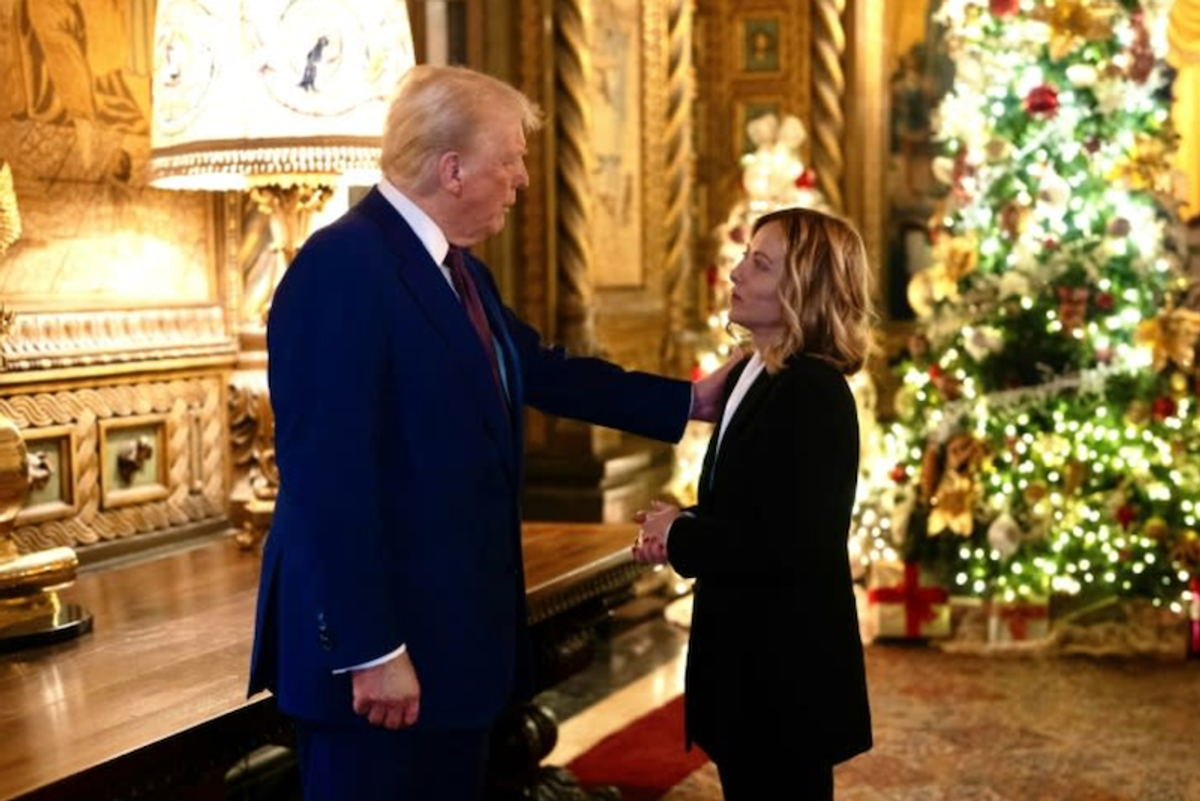
U.S. President-elect Donald Trump has played host to a slew of foreign leaders, most recently Italy's Prime Minister Giorgia Meloni, as he prepares to take office (Filippo ATTILI/AFP)
Donald Trump has turned on Italian Prime Minister Giorgia Meloni, publicly denouncing her as "unacceptable" for defending Pope Leo XIV against the president's criticism of his unprovoked Iran war.
According to Politico, Trump spoke directly with Italian daily Corriere della Sera to express his fury with Meloni's refusal to join his attack on the first American-born Pope who resides in Vatican City.
"I was shocked by her. I thought she was brave, but I was wrong," Trump said in the phone interview, delivering a stinging personal rebuke to an ally he had publicly praised just a year earlier.
When confronted with Meloni's Monday statement calling Trump's criticism of Pope Leo "unacceptable," the president responded with characteristic vindictiveness:
"It's her who's unacceptable, because she doesn't care if Iran has a nuclear weapon and would blow up Italy in two minutes if it had the chance."
Trump's grievance extends beyond the Pope dispute. He complained that Meloni expected the United States to "do the work for her" by protecting Italy from nuclear threats and ensuring stable oil supplies — suggesting she should be grateful for American military protection rather than criticizing his policies.
The deterioration of their relationship is striking. Trump noted the two hadn't spoken "in a long time," a stark contrast to just last year when Meloni visited Mar-a-Lago as Trump's guest. At that dinner, he called her "a fantastic woman" who had "really taken Europe by storm."
The rupture exemplifies Trump's pattern of discarding allies the moment they show independence from his agenda — a warning sign for other world leaders considering whether solidarity with the American president is worth the political cost.
Trump and Meloni: From close relations to a transatlantic crisis
The relationship between Trump and Meloni was typified by warm handshakes and even warmer words until the US leader did something considered by most Italians to be unthinkable: he criticised the pope.
US President Donald Trump has turned on Italian Prime Minister Giorgia Meloni, calling her "unacceptable" and claiming she lacks "courage" to back the US intervention in Iran after she condemned his attacks on Pope Leo XIV.
The unexpected public rift between the two leaders, who cultivated one of the closest transatlantic relationships over the past year, erupted after Trump criticised the pontiff for his anti-war stance on Iran.
"I thought she had courage, but I was wrong," Trump told Italian newspaper Corriere della Sera on Tuesday.
Trump previously called Meloni "one of the real leaders of the world" and "full of energy, fantastic", while Meloni said she was able to speak to him "frankly even when we disagree".
It all seemed to be going so well until Trump did something that, for many Italians, is regarded as sacrilege: he lambasted none other than the Holy Father.
Trump said he did not think Pope Leo XIV was "doing a very good job" because he was "weak on crime" and suggested the pontiff should "stop catering to the radical left," also stating, "We don't like a pope who says it's OK to have a nuclear weapon."

Trump's comments came after Pope Leo XIV openly criticised the US intervention in Iran from day one, stating just this weekend that a "delusion of omnipotence" is fuelling it.
Wherever you sit on the political spectrum in Italy, the idea of questioning, much less criticising, the pontiff is a red line.
Meloni on Monday called Trump's criticism of the pope "unacceptable".
"The pope is the head of the Catholic Church, and it is right and normal for him to call for peace and to condemn all forms of war," Meloni said.
She added she would not feel comfortable living in a society where "religious leaders do as they are told by politicians".
Trump pushed back, telling the Italian daily, "She's unacceptable because she doesn't mind that Iran has a nuclear weapon and would blow up Italy in two minutes if they had the chance."
Parallel to this, it emerged that at the end of March, Italy had refused a request from the US military for aircraft to land at the Naval Air Station Sigonella on the island of Sicily, falling in line with countries like Spain and France that refused Washington's requests to overfly their territory before continuing towards the Middle East and fighting the war in Iran.
And in another move likely to annoy the White House, Meloni announced on Tuesday that Italy had suspended the automatic renewal of its defence agreement with Israel, which involves the exchange of military equipment and technology research.
But after Trump's jibes at the pope, can the relationship ever be repaired or will it be for conservative Meloni, dead and buried for good? Whatever happens from here, let's take a look at how one of the closest transatlantic relationships developed.
December 2024: First face-to-face in Paris
The first meaningful encounter between Trump and Meloni dates back to late 2024 and the reopening ceremony of Paris' Notre Dame Cathedral.
It was a brief meeting, in a very crowded multilateral context, but it was enough to leave an impression on the US president, who described the Italian premier as a "real live-wire".
Trump gushed that Meloni was "full of energy (and) fantastic" according to people who were present at the meeting and who saw the encounter as a sign of warmer ties to come as Trump was still at that point president-elect and had yet to start his second term.

January 2025: Mar-a-Lago and the Sala crisis
In the middle of the drama surrounding the kidnapping of journalist Cecilia Sala in Iran, Meloni flew to Florida for a meeting with Trump at his Florida Mar-a-Lago residence.
The visit was brief, not preceded by any official announcement, and was interpreted as a strong political gesture at a time of heightened international tension.
According to sources close to the president, Trump was impressed and described Meloni as a leader who has "really taken Europe by storm".
“This is very exciting,” Trump told a group at Mar-a-Lago. “I’m here with a fantastic woman, the prime minister of Italy.”
In the days that followed, Trump publicly praised Meloni for flying all the way to the US just to spend a few hours with him.

January 2025: One of the few Europeans at the inauguration
Meloni was one of the few European leaders invited to Trump's inauguration in Washington. Her presence there was interpreted as having significant political weight, particularly given that so many other European leaders had been sidelined.
Just days later in Davos, Trump hinted at the possibility of a personal and political relationship with the Italian premier. "I like her a lot, let's see what happens," he said.
His praise for Meloni stood in stark contrast to his general belligerence towards the EU as a whole, slamming the 27-member bloc as treating "the United States very badly" against a backdrop of ongoing trade tensions.

April 2025: The political peak of the relationship?
An official visit to the White House represented, for some, the high point of the relationship between the two leaders, a meeting accompanied by a strong media presence and notably more personal tones.
Trump saved his warmest words for a social media post after the meeting: "She loves her country, and the impression she left on everyone was fantastic!"
During the White House talks, Meloni invited Trump to visit Italy and proposed an expanded format with European leaders to consolidate a direct political channel between Washington and Brussels.
Diplomatic sources described the meeting as "solid on the political level and surprisingly relaxed on the personal level" and generally harmonious.

April 2025: First informal talks at the Vatican
At the funeral of Pope Francis, the two meet briefly in the Vatican. The context was considered highly symbolic and significant, with numerous world leaders present.
Sources present reported a quick but significant exchange, in which international affairs were briefly touched upon, a fleeting meeting that appeared to confirm the continuity of the direct channel between the two.
June 2025: The isolated bench talks at the G7
The G7 in Canada was one of the most significant meetings between the pair, with Trump and Meloni choosing to isolate themselves on a wooden bench on the sidelines of the summit in Kananaskis.
That conversation, according to diplomatic sources, was long and direct and helped to reconcile some tensions in the final drafting of the declaration on the then 12-day conflict between Israel and Iran, which also saw US military involvement.
Just days later at a NATO summit, the two again sat side by side and had an informal discussion on the main security issues.

August 2025: The Zelenskyy meeting
Meloni attended an international meeting convened by Trump at the White House with Ukraine's President Volodymyr Zelenskyy in attendance, designed to discuss the future of Western support for Kyiv.
Trump hailed the meeting as a "big day" as Zelenskyy and his European allies all came to the US capital for a major discussion on how to end Russia's all-out war in Ukraine.
The US president then called Meloni "a great leader, an inspiration to all."
Trump also praised the Italian premier for leading her country at a young age and predicted she would be in office for a long time.

October 2025: The Gaza summit in Egypt
In Egypt, the two leaders meet at the peace summit for Gaza, amid the new plan promoted by Trump to end the Israel-Hamas war.
The US president, on stage, joked: "Who is this woman?" He then introduced Meloni to the international audience as "a very strong leader, she's doing a great job," and a "beautiful young woman".
The next day, on social media, Trump endorsed Meloni's autobiography and urged his followers to read it.
Early 2026: From the Nobel Prize to first tensions
On the US president's role in attempting to stop Russia's war in Ukraine, Meloni said on 23 January after a summit with Germany: "I hope we can give the Nobel Peace Prize to Trump and I trust that he can also make a difference on a just and lasting peace for Ukraine ... and then finally we too can nominate Donald Trump for the Nobel Peace Prize."
The prize instead went to Venezuelan opposition politician María Corina Machado “for her tireless work promoting democratic rights for the people of Venezuela and for her struggle to achieve a just and peaceful transition from dictatorship to democracy."
That decision did not go down well with Trump, who has long coveted the award, and he told Norway's Prime Minister Jonas Gahr Støre he no longer needed to think "purely of peace" after failing to win the prize.
"Considering your Country decided not to give me the Nobel Peace Prize for having stopped 8 Wars PLUS, I no longer feel an obligation to think purely of Peace," Trump said in a message.
By early 2026, Meloni reiterated her willingness to confront Trump even when she disagreed with his positions. At the same time, the first structural differences on NATO and the Middle East were beginning to emerge.

March 2026: Hormuz Strait, the first real operational rift
The crisis sparked by Iran's closure of the crucial Strait of Hormuz marked the first substantial point of friction between Washington and Rome.
Trump was getting increasingly vocal about his call for allies to assemble a naval force to open the strait going largely unanswered, with Italy among the most important countries which refused to become involved.
The European position was slammed by Trump, who called NATO a "paper tiger" and said he was considering withdrawing the US from the military alliance.
April 2026: The public rift
At the height of the crisis, some statements from Washington were interpreted in Rome as direct criticism of the Italian government's position.
Sources spoke of "uncoordinated tones through diplomatic channels," signalling a more formal communicative shift than had been previously used.
The government's response was firm: "Italy remains committed to international security, but every decision takes place within the NATO and multilateral framework."

No comments:
Post a Comment