Thursday, July 29, 2021

Zambia: Tackle Lead Poisoning at Former Mine


Diane McCarthy/HRW
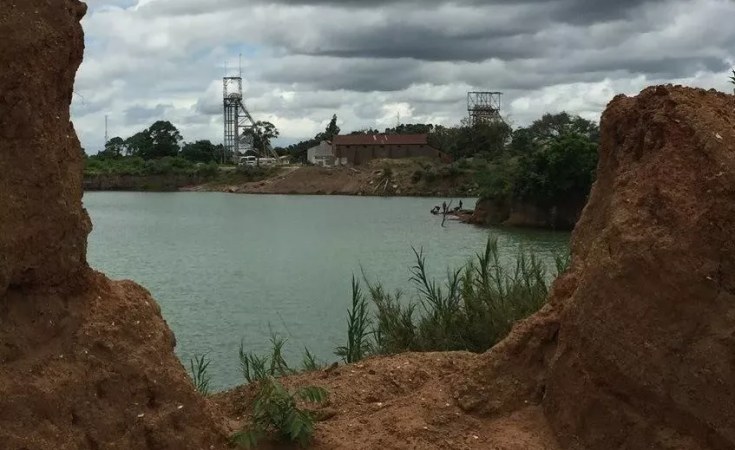
View of a former mine pit, now flooded, at the old mine site in Kabwe. In the foreground is an area where small-scale miners still work today (file photo).

27 JULY 2021
Human Rights Watch (Washington, DC)
PRESS RELEASE

Lusaka — Zambia’s next government should urgently clean up lead pollution that has affected the health of tens of thousands of children and adults in the city of Kabwe, six organizations said today, following the publication of a United Nations experts’ letter on the issue.

The Zambian general elections are scheduled for August 12, 2021. The organizations are Human Rights Watch, Advocacy for Child Justice, Caritas Zambia, Children's Environmental Health Foundation, Environment Africa Zambia, and Terre des Hommes.

On July 26 the UN published a letter from two UN special rapporteurs, the expert on toxics and human rights, Marcos Orellana, and the expert on persons with disabilities, Gerard Quinn, to the government of Zambia, about the severe lead pollution and serious human rights concerns in and around the former mine in Kabwe, Central Province.

They asked the Zambian government about its steps to address the toxic threat and urged robust steps to end the longstanding health rights violations and ensure the health, safety, and well-being of Kabwe’s residents.

The experts also sent a letter to Jubilee Metals, a South African company planning to reprocess metals at the former mine, and a letter to the South African government, seeking information about the human rights impacts of their business. “UN experts on toxic pollution and on people with disabilities have sounded the alarm bell over Kabwe,” said Juliane Kippenberg, associate children’s rights director at Human Rights Watch.

“Zambian political leaders and candidates should recognize the urgency of the Kabwe situation and commit in their election campaigns to cleaning up this toxic legacy.” Kabwe was the site of a mine and smelter that polluted the environment with extremely high levels of toxic lead from 1904 to 1994. Kabwe residents still have lead-polluted homes, backyards, schools, play areas, and roads, as documented in a 2019 report by Human Rights Watch.

Tens of thousands of children living near the mine are at acute risk of severe health risks from lead poisoning. It is estimated that up to 200,000 people in the vicinity have elevated blood lead levels. The former mine area contains over five million tons of waste from the mine and smelter. Lead dust from these uncovered waste dumps continues to blow over to nearby residential areas and threaten community health.

Rather than directly tackling the waste piles, the government has licensed further mining and reprocessing activities that pose additional health risks. In their letter, the UN experts expressed concern about reports of ongoing artisanal and small-scale mining. Lead is a heavy metal so toxic that there is no known safe level of exposure, according to the World Health Organization. It can cause hearing loss, vision loss, high blood pressure, IQ deficits, behavioral problems, and even coma, convulsions, and death.

Children are especially at risk because their bodies are still developing and absorb proportionally more lead than adults. A 2018 medical study estimated that over 95 percent of children in townships exposed to lead from the Kabwe mine have elevated blood lead levels, and about half of children in the townships have such high blood lead levels that they urgently require medical intervention. Adults are also affected, with particular risks during pregnancy. A video made by local youth activists working with Environment Africa in 2019 highlights the impact on children and the need for action.

The mine was originally owned by British colonial companies, including Anglo American, and later nationalized. There was never a comprehensive clean-up even though the mine was closed in 1994. Anglo American is currently facing a class-action lawsuit on behalf of affected children and women of childbearing age in Kabwe, filed by lawyers from South Africa and the United Kingdom in October 2020. “People in Kabwe whose rights to health have been violated have a right to effective remedies,” said Namo Chuma, country director of Environment Africa Zambia. “This includes access to health care, reparations, and immediate measures to end further toxic exposure.”

The UN expert on toxics and human rights, officially the special rapporteur on the implications for human rights of the environmentally sound management and disposal of hazardous substances and wastes, is mandated by the UN Human Rights Council to examine the human rights implications of toxic and otherwise hazardous substances, as well as initiatives to promote and protect human rights in this context.

The special rapporteur on the rights of persons with disabilities is mandated to strengthen efforts to recognize, promote, implement, and monitor the rights of people with disabilities. The Zambian government has taken some important steps to tackle the problem, the groups said. It is currently testing and treating children affected by lead in Kabwe with a loan from the World Bank, and has started to remediate homes and a school. However, its efforts do not address the source of the contamination itself, the mine waste. If the waste is not cleaned up, progress made could be quickly reversed, as it will continue to spread toxic dust across the area.

The government should conduct a comprehensive remediation process with the technical and financial support of donors and companies, the groups said. Regulations governing the human rights and environmental obligations of corporations in their global operations are urgently needed to avoid such disasters in the future. “The lead pollution in Kabwe is a scandal,” said Bishop Clement Mulenga, the bishop of Kabwe. “Proper remediation and reclamation are needed right now to protect the health and future of Kabwe’s children.”

Zambia’s next government should urgently clean up lead pollution that has affected the health of tens of thousands of children and adults in the city of Kabwe, six organizations said today, following the publication of a United Nations experts’ letteron the issue. The Zambian general elections are scheduled for August 12, 2021. The organizations are Human Rights Watch, Advocacy for Child Justice, Caritas Zambia, Children's Environmental Health Foundation, Environment Africa Zambia, and Terre des Hommes.

On July 26 the UN published a letter from two UN special rapporteurs, the expert on toxics and human rights, Marcos Orellana, and the expert on persons with disabilities, Gerard Quinn, to the government of Zambia, about the severe lead pollution and serious human rights concerns in and around the former mine in Kabwe, Central Province. They asked the Zambian government about its steps to address the toxic threat and urged robust steps to end the longstanding health rights violations and ensure the health, safety, and well-being of Kabwe’s residents. The experts also sent a letter to Jubilee Metals, a South African company planning to reprocess metals at the former mine, and a letter to the South African government, seeking information about the human rights impacts of their business.

“UN experts on toxic pollution and on people with disabilities have sounded the alarm bell over Kabwe,” said Juliane Kippenberg, associate children’s rights director at Human Rights Watch. “Zambian political leaders and candidates should recognize the urgency of the Kabwe situation and commit in their election campaigns to cleaning up this toxic legacy.”

Kabwe was the site of a mine and smelter that polluted the environment with extremely high levels of toxic lead from 1904 to 1994. Kabwe residents still have lead-polluted homes, backyards, schools, play areas, and roads, as documented in a 2019 report by Human Rights Watch. Tens of thousands of children living near the mine are at acute risk of severe health risks from lead poisoning. It is estimated that up to 200,000 people in the vicinity have elevated blood lead levels.

The former mine area contains over five million tons of waste from the mine and smelter. Lead dust from these uncovered waste dumps continues to blow over to nearby residential areas and threaten community health. Rather than directly tackling the waste piles, the government has licensed further mining and reprocessing activities that pose additional health risks. In their letter, the UN experts expressed concern about reports of ongoing artisanal and small-scale mining.

Lead is a heavy metal so toxic that there is no known safe level of exposure, according to the World Health Organization. It can cause hearing loss, vision loss, high blood pressure, IQ deficits, behavioral problems, and even coma, convulsions, and death. Children are especially at risk because their bodies are still developing and absorb proportionally more lead than adults.

A 2018 medical study estimated that over 95 percent of children in townships exposed to lead from the Kabwe mine have elevated blood lead levels, and about half of children in the townships have such high blood lead levels that they urgently require medical intervention. Adults are also affected, with particular risks during pregnancy. A video made by local youth activists working with Environment Africa in 2019 highlights the impact on children and the need for action.

The mine was originally owned by British colonial companies, including Anglo American, and later nationalized. There was never a comprehensive clean-up even though the mine was closed in 1994. Anglo American is currently facing a class-action lawsuit on behalf of affected children and women of childbearing age in Kabwe, filed by lawyers from South Africa and the United Kingdom in October 2020.

“People in Kabwe whose rights to health have been violated have a right to effective remedies,” said Namo Chuma, country director of Environment Africa Zambia. “This includes access to health care, reparations, and immediate measures to end further toxic exposure.”

The UN expert on toxics and human rights, officially the special rapporteur onthe implications for human rights of the environmentally sound management and disposal of hazardous substances and wastes, is mandated by the UN Human Rights Council to examine the human rights implications of toxic and otherwise hazardous substances, as well as initiatives to promote and protect human rights in this context. The special rapporteur on the rights of persons with disabilities is mandated to strengthen efforts to recognize, promote, implement, and monitor the rights of people with disabilities.

The Zambian government has taken some important steps to tackle the problem, the groups said. It is currently testing and treating children affected by lead in Kabwe with a loan from the World Bank, and has started to remediate homes and a school. However, its efforts do not address the source of the contamination itself, the mine waste. If the waste is not cleaned up, progress made could be quickly reversed, as it will continue to spread toxic dust across the area.

The government should conduct a comprehensive remediation process with the technical and financial support of donors and companies, the groups said. Regulations governing the human rights and environmental obligations of corporations in their global operations are urgently needed to avoid such disasters in the future.

“The lead pollution in Kabwe is a scandal,” said Bishop Clement Mulenga, the bishop of Kabwe. “Proper remediation and reclamation are needed right now to protect the health and future of Kabwe’s children.”

Read the original article on HRW.
Kenya: Cryptocurrency Booming Among Kenyan Farmers


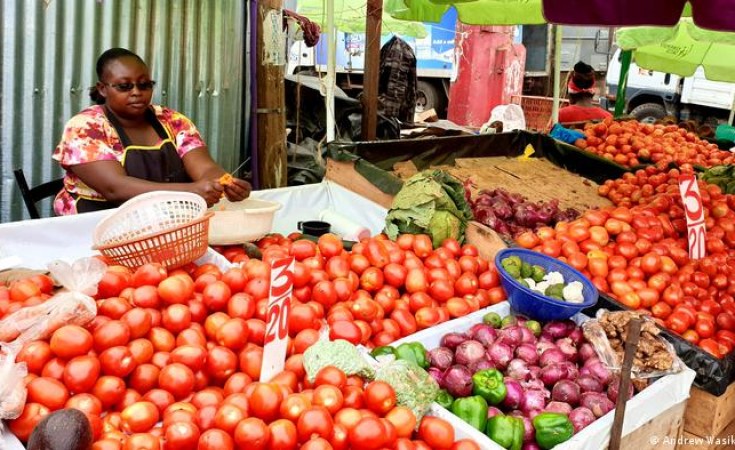
Andrew Wasike/Deutsche Welle
(file image)

26 JULY 2021
Voice of America (Washington, DC)By Ruud Elmendorp

Kilifi, Kenya — Cryptocurrencies make headlines for shaking up the financial world, but they are also gaining ground in less developed countries. In Kenya, an American economist, who introduced blockchain technology for low-income urban customers, has extended the cashless system to the countryside.

On a lush green farm in Kilifi on Kenya's tropical Indian Ocean coast, 26-year-old farmer Emmanuel Kahindi is harvesting tomatoes and other vegetables. He is using Kenya's cryptocurrency, Sarafu, to sell his vegetables, and to buy supplies without having to use any cash.

Sarafu helped me a lot, he said, especially because it makes me save my money, my Kenyan currency. He said he uses Sarafu to purchase things for the garden like seeds and fertilizer.

Sarafu coins work like vouchers that can be exchanged for goods or services of other users of the currency. Anyone with a Kenyan mobile phone line can enroll. Users are given 50 Sarafu for free. After that, they earn coins by selling a product or service to another user.


Sarafu is what's known as a community inclusion currency, or CIC, allowing people to give or take credit without having to deposit Kenyan shillings or other currency in a bank.

It was created by Will Ruddick, an American economist through his Kenyan nonprofit, Grassroots Economics. He recently introduced it to rural areas like Kilifi.

"I think that's where there is the most chronic lack of national currency. So, I think what's happening, we're filling a gap. People say look, the national ledger system, the national currency it is not available for us. We can't measure our trade in this thing," said Ruddick.


Kahindi moved with his harvest to a nearby restaurant in Kilifi. There he offers his vegetables for selling and gets Sarafu in a return. The owner is Giataari Mwang and he said he is happy with it.

"Sarafu is good because it allows us to get our farm produce straight from local neighborhood farms and put it on our plate and serve it to our customers and they are able to pay us with Sarafu," he said.

Close


SIGN UP FOR FREE ALLAFRICA NEWSLETTERS

Get the latest in African news delivered straight to your inbox

Top HeadlinesKenyaCurrenciesFood and Agriculture
SUBMIT

By submitting above, you agree to our privacy policy.


Bitange Ndemo is a senior lecturer at the University of Nairobi. He said such community-focused cryptocurrencies have a potential to expand beyond Kenya and in other parts of Africa.

He said that cryptocurrencies give communities an option to monetize resources in a way that they cannot do with cash, pointing at the cobalt mines in the Democratic Republic of Congo as a potential example.

"Nothing stops them from a cobalt coin based on the reserves they have in terms of cobalt. The country then can then raise sufficient resources to develop the country," said Ndemo.

In Kenya, the coins will be based on the agriculture production across the nation and here in Kilifi.

For Emmanuel, it is time to relax after work. He is now seated in the restaurant and is using Sarafu to enjoy a well-deserved meal.


Read the original article on VOA.
Ghana - Anti-Gay Bill Seeks Long Jail Terms for LGBTQ People

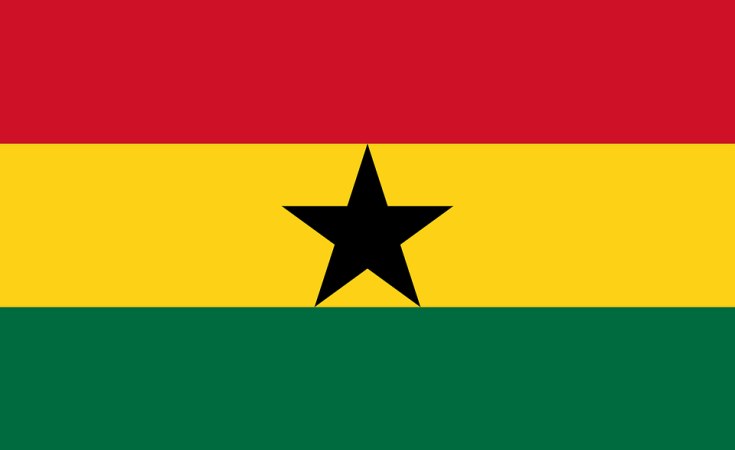
Pixabay
Ghana national flag

28 JULY 2021
Deutsche Welle (Bonn)By Isaac Kaledzi

The proposed bill could see LGBTQ community members imprisoned between five to 10 years for identifying or advocating for their rights.

Ghana's laws already criminalize gay sex by forbidding "unnatural carnal knowledge".

Now West African country wants to go a step further in its efforts to outlaw the LGBTQ community.

If the bill is passed, people of the same sex who engage in sexual activity could be fined or jailed for between three to five years.

The law would also make it a crime to be LGBTQ -- it would be punishable by five years in prison for any person to identify as lesbian, gay, transgender, transsexual, queer, pansexual or non-binary (someone who doesn't identify as male or female).

The bill, entitled "The Promotion of Proper Human Sexual Rights and Ghanaian Family Values Bill 2021" was submitted to Ghana's parliament in June.

General support for anti-gay bill


It enjoys cross-party support, with Ghana's parliamentary speaker, Alban Bagbin openly backing the proposed law.

It is widely expected that the bill will win enough votes to become law in Ghana, a deeply religious society where homophobic persecution is widespread.

The bill also has strong support among Ghanaians.

Even if the bill does end up being thrown out, it has already endangered the lives of LGBTQ people "with the discussions that it fuels and the homophobia that it will empower," said Nana Yaa Agyepong, a member of Silent Majority Ghana, a transnational queer feminist group.

"This is something that we cannot have because we have Ghanaians that deserve to live safely and at peace at home and not forced into exile," she told DW in Accra.

No room for gay rights activism


Advocating for LGBQ rights would also be illegal under the bill, with activists facing jail sentences of between five and ten years.

Rights activist Agyepong sees this as worrying as it "squashes conversations and dissents around the bill so people would not be able to do public education or media appearances or even on social media," she told DW.

One of the eight members of parliament who proposed the bill, Sam George, said he was influenced by what he saw as the "growing advocacy" and "propaganda" of Ghana's LGBTQ community.


"We are just bringing our laws up to speed to ensure that so long as our national position has not changed and still homosexuality is an illegality, let's make the laws reflective of that," George told DW during an interview at his office in the capital, Accra.

He says there is no room for negotiation in the fight to curbing all forms of LGBTQ activism.

"Our constitution says rights can be curtailed so long as they pose existential threat to the public safety, public health and public moral," he told DW.

"This act of homosexuality poses a public health challenge and a public moral challenge."


Bill includes discredited conversion therapy

The bill would also allow for conversion therapy, also sometimes called 'gay cure therapy', which tries to change people's sexual orientation or gender identity.

A number of public health bodies, including Britain's National Health Service, have warned that conversion therapy is "unethical and potentially harmful." Germany has banned the practice for minors.

Despite the bill's general support, some Ghanaians are calling for review of the document before it gets put to a parliamentary vote.

Human rights lawyer and member of parliament Francis-Xavier Sosu, for one, has concerns.

"You can see for a fact that it has some challenges. Challenges in terms of how to criminalize values and culture of people. Challenges with the kind of sentence regime it seeks to impose particularly at a time that we have all complained about our prisons being choked," Sosu told reporters in parliament house in Accra.

The draft bill comes on the back of several recent crackdowns on Ghana's LGBTQ community.

Rights activists attending a workshop in the city of Ho, south of Ghana, were arrested in May in a high-profile police bust. Those arrested were attending a training for activists and paralegals when supporting LGBTQ people. They were released after more than three weeks in detention, but still face prosecution for holding an "unlawful gathering" and "advocating LGBTQ activities".

The office of the organization LGBT+ Rights Ghana was also raided and closed earlier this year.

Ghana's move to further criminalize LGBTQ people is in contrast to several other African countries, which have decriminalized homosexuality, such as Rwanda, Angola, Botswana and South Africa.

  1. We’ll help to fine-tune anti-LGBTQI Bill – Pentecostal and ...

    1. https://freedomradiogh.com/well-help-to-fine-tune-anti-lgbtqi-bill...

      2021-07-28 · The Ghana Pentecostal and Charismatic Council (GPCC) says it is in full support of the new private members’ bill that seeks to explicitly criminalize LGBTQI activities in the country. Related Articles. Kumasi: Police identify 24-yr-old lady shot dead by men on motorbike. 2 weeks ago. Delta strain detected in Ghana

    (PDF) Homosexuality, Politics and Pentecostal Nationalism ...

  2. https://www.academia.edu/9501979

    ADRIAAN VAN KLINKEN Homosexuality, Politics and Pentecostal Nationalism in Zambia ABSTRACT Building upon debates about the politics of nationalism and sexuality in post-colonial Africa, this article highlights the role of religion in shaping nationalist ideologies that seek to regulate homosexuality. It specifically focuses on Pentecostal Christianity in Zambia, where the constitutional ...

  3. Pentecostals and the spiritual war against coronavirus in ...

  4. https://theconversation.com/pentecostals-and-the-spiritual-war-against...

    2020-04-30 · Pentecostals and the spiritual 

  5. (PDF) A missional study of Ghanaian Pentecostal churches ...

    https://www.researchgate.net/publication/278548236_A_missional_study_of...

    2015-06-11 · According to the tenet of the Apostolic ChurchGhana 

  1. GPCC – Ghana

    https://gpccghana.org

    2020-07-31 · The Ghana Pentecostal and Charismatic Council (GPCC) has undergone a dynamic transformation over the years, as the leading mouth-piece for Penteco-Charismatics in Ghana. From a humble beginning of four (4) members at its inception in 1969, the Council now boasts of over two hundred (200) member churches with each individual church 

  • Sacred Spaces and the Pentecostal Charismatic Churches in ...

    ugspace.ug.edu.gh/bitstream/handle/123456789/32925/Sacred Spac… · PDF file

    For the Charismatic Churches in Ghana, Gifford posits that “there has also been a remarkable explosion of these new autonomous Pentecostal Churches. The word ‘Charismatic’ is used to distinguish them from the churches of recognized Pentecostal denominations like the Assemblies of God church”. These churches according to

  • PENTECOSTALISM IN GHANA: AN AFRICAN REFORMATION

    pctii.org/cyberj/cyberj13/amanor.pdf · PDF file

    The Pentecostal and Charismatic movements, of which they served as the precursors, and which were initially on the fringes of society, has now moved into the center, crossing into every branch of the Church in Ghana. They have given a new face of Christianity to the country, which is outwardly expressive, inwardly liberating, and which provides adequate identity of a faith that can be truly ...


    1. AFRICA S NEW BIG MAN RULE? PENTECOSTALISM AND …

      https://gvpt.umd.edu/sites/gvpt.umd.edu/files/pubs/McCauley_Africa… · PDF file

      pre-colonial norms, post-colonial institutions, and weak states created *John F. McCauley (mccauley@umd.edu) is Assistant Professor of Government and Politics at the University of Maryland, USA. An earlier version of the article was presented at the Nigeria Centre for Pentecostal 

      1. Decolonising Western missionaries’ mission theology and ...

        www.scielo.org.za/pdf/ids/v51n1/15.pdf · PDF file

        forces of colonialism that perpetuates the subjugation and the exploitation of our minds, bodies, and land. Its ultimate purpose is to overturn the colonial structure and realise indigenous liberation (Waziyatawin & Yellow Bird 2012). It engages with imperialism and colonialism at every level. This entails the corporate and national takeover of things and institutions under colonial control ...


    Pakistan PM: 'US Really Messed It Up in Afghanistan'

    By Ayaz Gul
    July 28, 2021 


    ISLAMABAD - Pakistan’s prime minister says that America’s accelerated troop exit from Afghanistan has left Washington with no “bargaining power” for arranging a peace deal between warring Afghans.

    “I think the U.S. has really messed it up in Afghanistan,” Imran Khan said in an interview with PBS NewsHour aired on Tuesday night.

    Khan stressed that the United States and NATO allies had about 150,000 troops in Afghanistan and that was the time when they ought to go for a political solution rather than trying to militarily end the war with the Taliban insurgency there.

    “But once they had reduced the troops to barely 10,000, and then, when they gave an exit date, the Taliban thought they had won. And so, therefore, it was very difficult for now to get them (the Taliban) to compromise,” he told the American broadcaster.

    President Joe Biden said earlier this month that “We did not go to Afghanistan to nation-build. And it’s the right and the responsibility of the Afghan people alone to decide their future and how they want to run their country.”

    The Taliban has captured vast areas across Afghanistan, including key trade routes with neighboring countries, since U.S.-led foreign troops officially began leaving the country in early May.
    Humvees that belong to Afghan Special Forces are seen destroyed during heavy clashes with Taliban, in Kandahar province, Afghanistan, July 13, 2021.

    The international military drawdown has largely been completed and all American as well as allied troops will have left Afghanistan by the end of August under orders from Biden amid fears the Taliban could regain control of the war-ravaged country.

    “Here were the U.S. for two decades in Afghanistan trying to force a military solution. The reason why we are in this position now is because the military solution failed,” Khan said.

    U.S. and Afghan officials have long accused Pakistan of allowing the Taliban to use sanctuaries in the neighboring country to direct attacks inside Afghanistan, charges Islamabad denies.

    Khan’s government maintains it has used whatever leverage Islamabad had over the Taliban to bring them to the table for peace talks with Washington. The negotiations culminated in the February 2020 deal, setting the stage for all American troops to withdraw from the Afghan war after 20 years.

    But the ensuing peace talks between the Taliban and the U.S.-backed Afghan government have met with little success and largely stalled.

    “Absolutely, there's nothing more we can do, except push them as much as we can for a political settlement. That's all,” Khan told the PBS show when asked if Pakistan needs to do more to press the Taliban to end their violent campaign.

    Afghan President Ashraf Ghani earlier in the month alleged 10,000 jihadi fighters have recently entered his country from sanctuaries in Pakistan and other areas to join Taliban ranks.

    “This is absolute nonsense,” Khan responded. “Why don't they give us evidence of this? When they say that Pakistan gave safe havens, sanctuaries to (the) Taliban, where are these safe havens?,” he asked.
    Supporters of the Taliban carry Islamic flags after the Taliban said they seized the Afghan border town of Spin Boldaka across from the town of Chaman, Pakistan, July 14, 2021.

    The prime minister went on to explain insurgents could hide among the refugee camps in Pakistan that still host three million Afghans, saying the Taliban constitute the majority in the refugee population.

    “(The) Taliban are not some military outfit. They are normal civilians. And if there are some civilians in these camps, how is Pakistan supposed to hunt these people down? How can you call them sanctuaries?” he asked.

    Khan feared a “protracted civil war” would pose security challenges to Pakistan and could trigger a fresh refugee influx that his country could ill-afford due to its economic challenges.
    FILE - Children of Afghan refugees play outside tents in Afghan Basti area on the outskirts of Lahore, Pakistan, June 19, 2021.

    He defended his decision to not allow the U.S. to establish military bases on Pakistani soil for anti-terrorism operations in Afghanistan after all American troops leave the neighboring country.

    Khan explained that Pakistan’s decision to join the U.S.-led war on terrorism after the September 11, 2001 strikes against America triggered a domestic militant backlash, killing 70,000 Pakistanis and inflicting an estimated $150 billion in losses to the national economy.

    “Now, if there's a conflict going on in Afghanistan and there are (U.S.) bases in Pakistan, we then become targets,” he said.

    “We want to be partners in peace, but not in conflict,” Khan emphasized when asked what kind of relationship Islamabad wants with Washington.

    Khan’s interview came while his national security advisor, Moeed Yusuf, is in Washington for official talks with his U.S. counterpart, Jake Sullivan, on how to move a traditionally rollercoaster bilateral relationship. The head of the Pakistani spy agency is also said to be accompanying Yusuf.

    Afghanistan: The Costs


    'How Can Pakistan Hunt Them Down?' 
    PM Imran Khan Calls Taliban 'Normal Civilians' as Afghanistan Sees Red


    Imran Khan stressed that Pakistan hosts three million Afghan refugees of which the majority are Pashtuns, the same ethnic group as the Taliban fighters.

    Pakistan has been long accused of helping the Taliban militarily, financially and with intelligence inputs in their fight against the Afghanistan 
    government.

    THE TALIBAN WERE CREATED BY THE PAKISTAN SECRET SERVICE UNDER BENAZIR BHUTTO

     NEWS18.COM

    LAST UPDATED:JULY 29, 2021,

    Pakistan Prime Minister Imran Khan has called Taliban “normal civilians”, not military outfits, and asked how the country is supposed to hunt them down when it has three million Afghan refugees at the border.

    In an interview with PBS NewsHour aired Tuesday night, Khan stressed that Pakistan hosts three million Aghan refugees of which the majority are Pashtuns, the same ethnic group as the Taliban fighters.

    “Now, there are camps of 500,000 people; there are camps of 100,000 people. And Taliban are not some military outfits, they are normal civilians. And if there are some civilians in these camps, how is Pakistan supposed to hunt these people down? How can you call them sanctuaries?" he argued.

    When asked about alleged Taliban safe havens in Pakistan, the Prime Minister responded: “Where are these safe-havens? There are three million refugees in Pakistan who are the same ethnic group as the Taliban…"

    Pakistan has been long accused of helping the Taliban militarily, financially and with intelligence inputs in their fight against the Afghanistan government, but Imran Khan dismissed these accusations as “extremely unfair".

    Islamabad has issued “official warning" to Kabul that any “move to dislodge Taliban" from its borders will be “faced and repelled by the Pakistan Air Force", claimed Afghanistan’s Vice President Amrullah Saleh, accusing the neighbours of providing “close air support" to the Islamic fundamentalist outfit.

    “Pakistan air force has issued official warning to the Afghan Army and Air Force that any move to dislodge the Taliban from Spin Boldak area will be faced and repelled by the Pakistan Air Force. Pak air force is now providing close air support to Taliban in certain areas," Saleh tweeted.


    Thousands Of Rohingya Homeless As Monsoon Wreaks Havoc In Bangladesh

    Thousands of shelters in various Rohingya refugee camps in Southern Bangladesh have been flooded in recent days, displacing thousands of people.


    Associated Press (AP)29 July 2021

    Rohingya refugee children play in flood waters at the Rohingya refugee camp in Kutupalong, Bangladesh, Wednesday, July 28, 2021.
    (AP Photo/ Shafiqur Rahman)


    Days of heavy rainfall have pelted Rohingya refugee camps in southern Bangladesh, destroying dwellings and sending thousands of people to live with extended families or in communal shelters.

    Just in the 24 hours to Wednesday alone, more than 30 centimeters (11.8 inches) of rain fell on the camps in Cox's Bazar district hosting more than 800,000 Rohingya, the U.N. refugee agency said. That's nearly half the average July rainfall in one day while more heavy downpours are expected in the next few days and the monsoon season stretches over the next three months.

    “The situation is further compounded by the COVID-19 pandemic. There is currently a strict national lockdown in response to rising cases across the country,” the agency said.

    The agency said it was saddened by the deaths of six people at the camps earlier this week, five in a landslide caused by the rains and a child swept away by floodwaters.

    Citing initial reports, the UN High Commissioner for Refugees said more than 12,000 refugees were affected by the heavy rainfall while an estimated 2,500 shelters have been damaged or destroyed. More than 5,000 refugees have temporarily been relocated to other family member's shelters or communal facilities, the agency said in a statement.

    Refugees said they were struggling to eat or drink properly.

    “Due to the continuous rainfall for the last four days, today my house is full of water,” says Khatija Begum, who has five children. “We are not even able to eat,” Begum says she fears her children will drown and die in their sleep.

    Cyclones, heavy monsoon rains, floods, landslides, and other natural hazards are an annual difficulty in the camps. More than 700,000 Rohingya have lived in refugee camps in Bangladesh since August 2017, when the military in Buddhist-majority Myanmar began a harsh crackdown on the Muslim ethnic group following an attack by insurgents.

    The crackdown included rapes, killings, and the torching of thousands of homes, and was termed ethnic cleansing by global rights groups and the United Nations. While Bangladesh and Myanmar have sought to arrange repatriations, the Rohingya are too fearful to return home.

    The International Organization for Migration says Cox's Bazar district, where more than 1 million Rohingya refugees live, is one of the most disaster-prone parts of Bangladesh.

    It is a delta nation crisscrossed by many rivers that gets intense rainfall regularly due to its monsoon climate and location on the Bay of Bengal, where the warm waters can generate destructive tropical cyclones.

    ISRAEL P3 

    Ministry of Defense taps VCs to fund weapon development

    MoD representatives have held talks with venture capital funds regarding making joint investments in startups that are developing technology that can be used both in the defense and civilian sectors

    Udi Etsion11:4806.07.21
    The Ministry of Defense (MoD) is recruiting the capital market in order to assist it in the development of the IDF's future weapon systems. 
    Ministry representatives have already held several talks with investment bodies regarding making joint investments in companies developing dual technologies that are suited both for the defense sector and the civilian market.


    The initiative is being led by Daniel Gold, the Head of the Defense Research and Development Directorate (DDR&D) under the Ministry of Defense. "We are significantly accelerating the pace of our decision making, our processes, and their realization in order to take advantage of the swift changes taking place in technology and the pace of development," said Gold.
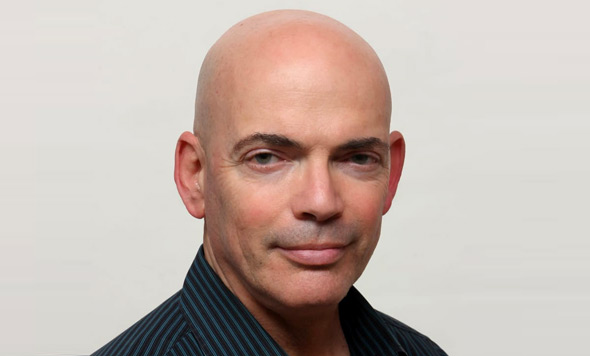
    Head of Defense Research and Development Directorate under the Ministry of Defense, Daniel Gold. Photo: Ministry of DefenseHead of Defense Research and Development Directorate under the Ministry of Defense, Daniel Gold. Photo: Ministry of Defense


    "Concurrently, we are increasing our exposure to creativity and innovation in the civilian world, and are also enriching it with our knowledge. Our needs are always greater than the budget we have at our disposal, and recruiting the capital market will benefit both sides. The defense establishment will benefit from innovation, creativity, and additional income sources, while the investment bodies will receive companies we have examined, which have products we are interested in, will be supported and receive apprenticeship from DDR&D and IDF experts as well as help in quickly maturing a quality product. This will also act as a channel through which we will be able to jointly conduct R&D with other countries."


    The DDR&D will not demand proprietary rights on any developments, but rather phantom options that it could use for future R&D development should the company's valuation increase. Phantom options are designed to mirror traditional share options but with the gain being paid in cash.


    The MoD's annual R&D budget, managed by DDR&D, currently stands at NIS 800 million (approximately $245 million). Additional funds are allocated for projects that are at a prototype stage. The MoD plans to match any investment made by the VCs, with the MoD's total budget for these investments expected to reach tens of millions of shekels, hence it will likely mainly be investing relatively small sums in early-stage startups.


    The investments are set to be made in companies active in a variety of sectors, including artificial intelligence, computerized vision, cybersecurity, quantum computing, biological engineering, robotics, and drones.

    THE STRONGEST QUAKE IN NORTH AMERICA

    8.2 magnitude earthquake rocks Alaska — the strongest quake to hit the US in 50 years


    A tsunami watch was issued for parts of the state and Hawaii, but it has since been lifted.

    By 
    Alexandra Kelley | July 29, 2021


    U.S. Geological Survey


    Story at a glance

    An 8.2 magnitude quake shook Alaska this morning near Perryville and Chignik.

    Tsunami warnings were issued for both Alaska and Hawaii.

    The quake was the strongest recorded in the U.S. in 50 years.


    An 8.2 magnitude earthquake hit Alaska early Thursday morning, prompting the brief issuance of a tsunami warning that has since been recalled.

    The U.S. Geological Survey confirmed that the quake, which occurred on July 28 in local time, was centered in Perryville, south of the Alaskan Peninsula. Experts note that the earthquake occurred due to thrust faulting near the subduction zone interface between the Pacific and North American tectonic plates.

    This was the strongest earthquake to take place in the U.S. in 50 years.

    Since the larger 8.2 earthquake, aftershocks have hit the surrounding Perryville region, mainly near Chignik, Alaska. The largest aftershock was a 6.1 magnitude earthquake in Chignik.

    At least 268 residents have reported feeling some level of seismic activity. Other reports note that communities further from the epicenter, including those in the Mat-Su Valley in Southcentral Alaska, felt shaking.

    Since the quake struck a coastal area, a tsunami advisory was issued for the Alaska Peninsula and 75 miles southeast of Chignik, but the advisory was lifted. A corresponding tsunami warning was issued for Hawaii, which was ultimately canceled, per state Governor David Ige (D).

    Larger-magnitude earthquakes are common along the Alaska-Aleutian subduction zone. The U.S. Geological Survey notes that since 1900, there have been eight other earthquakes that recorded more than a 7-level magnitude.

    8.2-magnitude earthquake off Alaska Peninsula sparks tsunami watch for 
    Hawaii

    By Staff Reuters
    Posted July 29, 2021 1:51 am
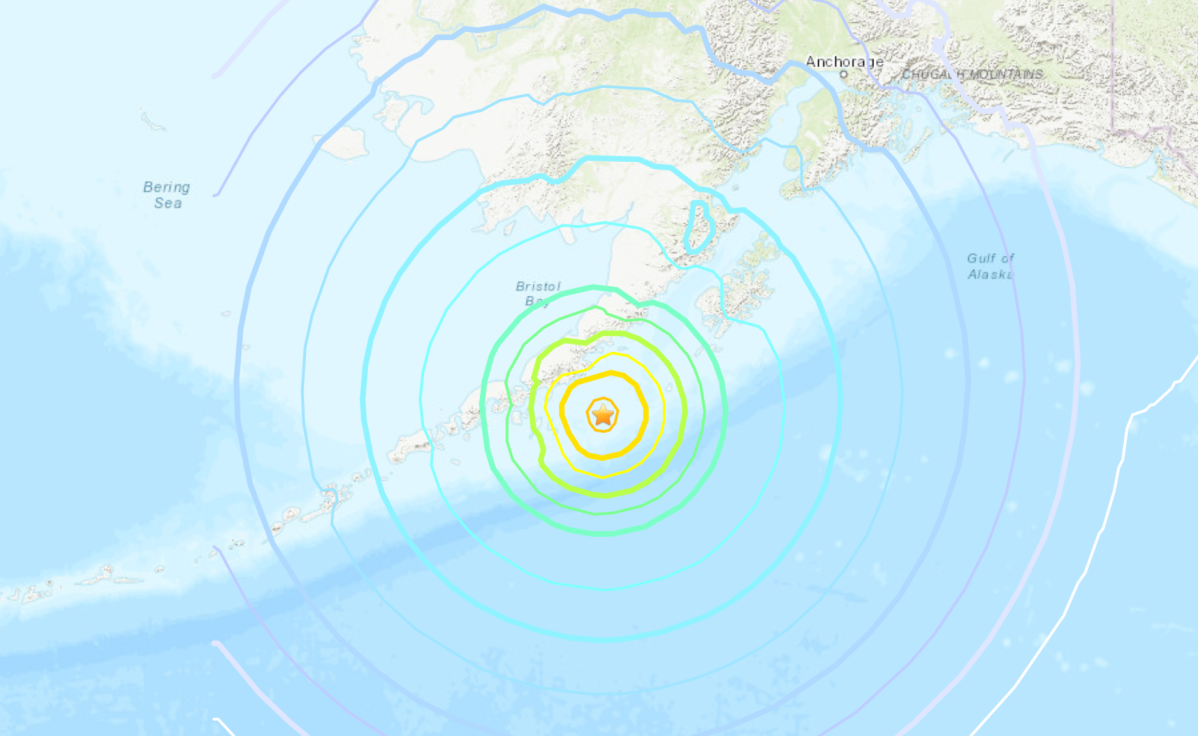
    The approximate location of a 8.2-magnitude earthquake off the coast of Alaska 
    on July 28, 2021. U.S. Geological Survey


    A shallow earthquake of magnitude 8.2 struck the Alaska Peninsula late on Wednesday, prompting tsunami warnings in the region and an alert in Hawaii, authorities said.


    There were no immediate reports on loss of property or life.

    READ MORE: 3 killed, dozens hurt after strong earthquake shakes China near Myanmar border

    The U.S. Geological Survey (USGS) said the quake, which struck at 10:15 p.m. local time (0615 GMT Thursday), was at a depth of 35 km.


    In Alaska, the National Tsunami Warning Center (NTWC) issued warnings for southern parts, the Peninsula, and Pacific coastal areas from Hinchinbrook Entrance to Unimak Pass. It also issued a “tsunami watch” for the U.S. state of Hawaii.

    The Pacific Tsunami Warning Center (PTWC) said the possibility of a tsunami threat to the U.S. state of Hawaii and the U.S. Pacific territory of Guam was being investigated.

    Japan’s Meteorological Agency was investigating whether there was a possibility of a tsunami hitting Japan, the public broadcaster NHK said.

    Authorities in New Zealand also said they were assessing if there was any danger to coastal regions.


    The U.S. NTWC and local authorities said they were evaluating the level of tsunami danger for other U.S. and Canadian Pacific coastal areas.

    The tremor struck about 91 km east-southeast of Perryville in Alaska. It was about 800 km (500 miles) from Anchorage, Alaska’s biggest city. It was followed by seven aftershocks, two of them above magnitude 6.0, according to USGS.ENT

    (Reporting by Shubham Kalia; Editing by Kevin Liffey)


     SOCIALISM FOR THE RICH

    US subsidies boost the expected profits and development of new oil and gas fields


    Peer-Reviewed Publication

    IOP PUBLISHING

    Researchers at the Stockholm Environment Institute (Somerville and Seattle, USA) and Earth Track, Inc. (Cambridge, MA, USA) examined 16 subsidies and environmental regulatory exemptions, providing one of the first estimates of how government subsidies will affect investment decisions for new gas fields in the coming decade. Their results are published on 29 July 2021 in the IOP Publishing journal, Environmental Research Letters. 
     
    Despite repeated pledges to phase out “inefficient” fossil fuel subsidies, the United States — the world’s largest current oil and gas producer — continues to provide billions of dollars each year to the oil and gas industry through various support measures. The study not only looks at tax incentives, but it is one of the first of its kind to also account for the effects of regulatory exemptions that reduce the costs for hazardous waste and wastewater management for oil and gas producers. 
     

    “Besides two federal tax incentives that have existed since 1916, we were surprised to find that less widely recognized forms of government support can also be highly beneficial,” said SEI Scientist Ploy Achakulwisut, a lead author of the paper. “The public ends up footing the bill for services like well closure and hazardous waste disposal – directly with their tax money and indirectly with their health.”
     
    For their analysis, the study’s authors developed a cash-flow model, using Rystad Energy’s UCube database and their own assumptions regarding commodity prices. They then evaluated the effects of 16 subsidies and regulatory exemptions on the expected investment returns of thousands of oil- and gas-producing fields that are projected to be developed between 2020 and 2030.  
     
    The results show that, depending on future oil and gas prices and the minimum required rates of return, subsidies (including exemptions) either encourage more extraction than would otherwise be economically viable, or flow to excess profits. In the former instance, subsidies would help lock in higher greenhouse gas emissions, as well as increase air and water pollution and health risks. In the latter case, they would not be fulfilling their stated economic purpose.
     
    For example: at 2019 oil and gas prices – or $64 per barrel of oil and $2.6 per mmbtu (million British Thermal Units) of gas – only 4% and 22% of new oil and gas resources would be subsidy-dependent. In this case, over 96% of subsidy value would flow directly to excess profits. This scenario assumes that investors require a 10% minimum rate of return, or “hurdle rate”.

     
    However, if oil and gas prices are as low as they were in 2020 – or $40 per barrel of oil and 2 per mmbtu of gas – then more than 60% of new oil and gas resources would depend on subsidies to be economically viable. This scenario assumes that investors would require a higher 20% hurdle rate, which may already be the case as risks increase for oil and gas investments. 

     
    The authors also examine the extent to which subsidies to fossil-fuel producers affect CO2 emissions by depressing oil and gas market prices and incentivizing higher consumption. They estimate that, under a 10% hurdle rate, the subsidy-induced decrease in oil price could result in an additional 374 million barrels of oil being burned in 2030, adding 150 million tonnes of CO2 emissions.

     
    “In the wake of the COVID-19 pandemic, our results illustrate how different choices about economic recovery and tax reform can shape the US oil and gas industry and energy infrastructure in the years to come,” said co-lead author and SEI Senior Scientist Peter Erickson. “In addition, fossil fuel subsidies can have symbolic effects, since their continued existence may be read by other nations as a sign that the US is not taking its commitments to subsidy reform, or to climate action, as seriously as it should be.”
     
    “Good governance requires transparency on who is receiving subsidies,” added co-author Doug Koplow from Earth Track. “Our study helps to shine a light on the effects of subsidies on the expected returns of US oil and gas producers and their investment decision-making. The same methods could be applied to inform ongoing subsidy reform efforts in other countries.” G7 governments continue to provide billions of dollars in subsidies each year.

    ###

     Does testosterone influence success? Not much, research suggests

    Peer-Reviewed Publication

    UNIVERSITY OF BRISTOL

    With the Olympics underway, higher testosterone has often been linked to sporting success, and other kinds of success too.  But beyond sport, new research has found little evidence that testosterone meaningfully influences life chances for men or women.  In fact, the study suggests that despite the social myths surrounding testosterone, it could be much less important than previously thought.

    It is already known that in men testosterone is linked with socioeconomic position, such as income or educational qualifications.  Researchers from the University of Bristol’s Population Health Sciences (PHS) and MRC Integrated Epidemiology Unit (IEU) wanted to find out whether this is because testosterone actually affects socioeconomic position, as opposed to socioeconomic circumstances affecting testosterone, or health affecting both.  The findings are published today [28 July] in Science Advances.

    To isolate effects of testosterone itself, the research team applied an approach called Mendelian randomization in a sample of 306,248 UK adults from UK Biobank. They explored testosterone's influence on socioeconomic position, including income, employment status, neighbourhood-level deprivation, and educational qualifications; on health, including self-rated health and BMI, and on risk-taking behaviour.  

    Dr Amanda Hughes, Senior Research Associate in Epidemiology in Bristol Medical School: Population Health Sciences (PHS), said: “There's a widespread belief that a person's testosterone can affect where they end up in life. Our results suggest that, despite a lot of mythology surrounding testosterone, its social implications may have been over-stated.”

    First, the team identified genetic variants linked to higher testosterone levels and then investigated how these variants were related to the outcomes. A person’s genetic code is determined before birth, and generally does not change during their lifetime (there are rare exceptions, such as changes that occur with cancer).  This makes it very unlikely that these variants are affected by socioeconomic circumstances, health, or other environmental factors during a person’s lifetime. Consequently, any association of an outcome with variants linked to testosterone would strongly suggest an influence of testosterone on the outcome.

    Similar to previous studies the research found that men with higher testosterone had higher household income, lived in less deprived areas, and were more likely to have a university degree and a skilled job. In women, higher testosterone was linked to lower socioeconomic position, including lower household income, living in a more deprived area, and lower chance of having a university degree. Consistent with previous evidence, higher testosterone was associated with better health for men and poorer health for women, and greater risk-taking behaviour for men.

    In contrast, there was little evidence that the testosterone-linked genetic variants were associated with any outcome for men or women. The research team concluded that there is little evidence that testosterone meaningfully affected socioeconomic position, health, or risk-taking in men or women. The study suggests that - despite the mythology surrounding testosterone - it might be much less important than previously claimed. 

    Results for women were less precise than results for men, so the influence of testosterone in women could be studied in more detail in the future using larger samples.  

    Dr Hughes added: “Higher testosterone in men has previously been linked to various kinds of social success. A study of male executives found that testosterone was higher for those who had more subordinates. A study of male financial traders found that higher testosterone correlated with greater daily profits. Other studies have reported that testosterone is higher for more highly educated men, and among self-employed men, suggesting a link with entrepreneurship.

    “Such research has supported the widespread idea that testosterone can influence success by affecting behaviour. There is evidence from experiments that testosterone can make a person more assertive or more likely to take risks - traits which can be rewarded in the labour market, for instance during wage negotiations. But there are other explanations. For example, a link between higher testosterone and success might simply reflect an influence of good health on both. Alternatively, socioeconomic circumstances could affect testosterone levels. A person’s perception of their own success could influence testosterone: in studies of sports matches, testosterone has been found to rise in the winner compared to the loser.”

    The research is supported by the Health Foundation as part of a project entitled ‘Social and economic consequences of health: causal inference methods and longitudinal, intergenerational data’, which is part of the Health Foundation’s Social and Economic Value of Health.

    ###

    About the Health Foundation
    The Health Foundation is an independent charity committed to bringing about better health and health care for people in the UK.

    About Mendelian Randomization
    Information on Mendelian Randomization: a method of using variation in genes of known function between people to examine the causal effect of a modifiable exposure (i.e. diet) on disease (i.e. cancer) in observational studies. The use of genetics takes away any potential measurement, or human, error associated with questionnaires and participant recall which are often used to record lifestyle factors such as level of physical activity.

    About the MRC IEU
    The MRC Integrative Epidemiology Unit (IEU) at the University of Bristol conducts some of the UK's most advanced population health science research. It uses genetics, population data and experimental interventions to look for the underlying causes of chronic disease. The unit exploits the latest advances in genetic and epigenetic technologies. We develop new analysis methods to improve understanding of how our family background, behaviours and genes work together. Using these to investigate how people develop and remain healthy or become ill.

    About UK Biobank
    UK Biobank is a major national and international health resource, and a registered charity in its own right with the aim of improving the prevention, diagnosis and treatment of a wide range of serious and life-threatening illnesses – including cancer, heart diseases, stroke, diabetes, arthritis, osteoporosis, eye disorders, depression and forms of dementia. UK Biobank recruited 500,000 people aged between 40-69 years in 2006-2010 from across the country to take part in this project. They have undergone measures, provided blood, urine and saliva samples for future analysis, detailed information about themselves and agreed to have their health followed. Over many years this will build into a powerful resource to help scientists discover why some people develop particular diseases and others do not.