It’s possible that I shall make an ass of myself. But in that case one can always get out of it with a little dialectic. I have, of course, so worded my proposition as to be right either way (K.Marx, Letter to F.Engels on the Indian Mutiny)
Monday, April 20, 2026
Disabled parrot is undefeated alpha male of his group thanks to novel “beak jousting”
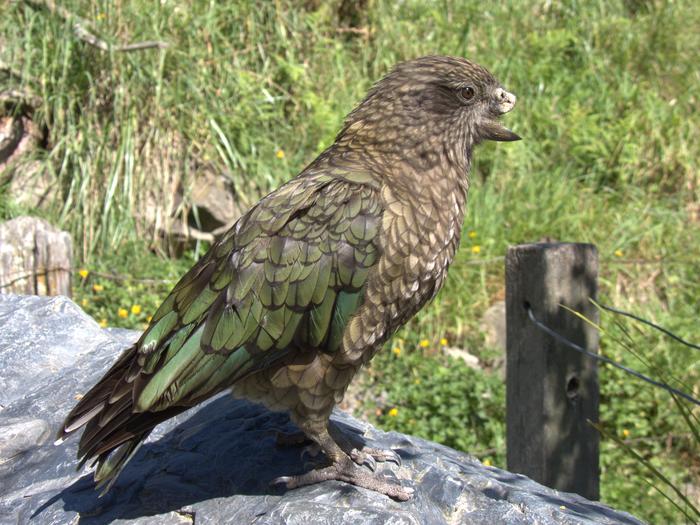
A study reported in the Cell Press journal Current Biology on April 20 shows how physical disabilities in the animal world can be overcome through behavioral innovation. The report features an endangered kea parrot in captivity at New Zealand’s Willowbank Wildlife Reserve named Bruce who is missing his entire upper beak. While earlier reports had described his unique use of pebbles as self-care tools, the new findings show how he uses a novel beak jousting technique to turn his disability into social dominance.
“Bruce is the alpha male of his group,” says study first author Alexander Grabham of Te Whare Wānanga o Waitaha | University of Canterbury (UC) in New Zealand. “He achieved this status by himself with the aid of a completely novel fighting technique—a jousting thrust with his exposed lower beak—that beak-intact kea cannot replicate.”
Compared to other kea using their beaks during fights, the researchers found that Bruce not only used jousting more frequently but also targeted different body areas in different ways. His jousting was also more effective than when he kicked. His innovative fighting technique led him to win every single male dominance interaction that the researchers recorded.
His winning record apparently led to other health benefits. Bruce had the lowest levels of corticosterone hormone metabolites levels, which is a sign of reduced stress compared to his peers. He enjoyed priority access to feeders and was the only male to be allopreened by other males, including beak cleaning.
Bruce had already earned some fame before, offering the first recorded case of self-care tool use in a kea. Grabham and colleagues noticed that Bruce fought other kea in a way they had never seen before. They wanted to learn more about what he was doing exactly and what it meant for his social position and the rest of his group.
Overall, the researchers have recorded 227 agonistic interactions from the Willowbank kea, including 9 males and 3 females. Out of 162 interactions between males, Bruce came out on top, winning all 36 interactions he was part of. The findings confirmed Bruce as the clear winner and dominant alpha male of the group.
The researchers describe how he uses his exposed lower beak in jousting thrusts, both at close range and from afar. Bruce uses his beak up close by extending his neck. He also would run or jump to propel his beak at opponents. They found that 73% of the time, his jousting behaviors, which other parrots don’t replicate, displaced opponents immediately. Their observations show he dominates not only in agonistic interactions but also socially during feeding and allopreening.
The findings highlight the remarkable behavioral flexibility and intelligence of endangered kea. But they also have broader implications about physical disabilities and what’s possible, according to the researchers.
“Bruce shows us that behavioral innovation can help bypass physical disability, at least in species with the cognitive flexibility to develop new solutions,” Grabham says. “Previous research has shown links between large brains, behavioral flexibility, and survival at the species level. Bruce demonstrates how those links play out in a single individual, on traits that matter day-to-day, like social dominance. Our findings also raise an important welfare question: if a disabled animal can innovate its way to success, well-intentioned interventions like prosthetics might not always improve their quality of life. Sometimes the animal can do better without help.”
###
This work was supported by the Templeton World Charity Foundation, an ERC Consolidator Grant UNIPROB, a Robert C. Bates Postgraduate Fellowship, and a Gordon Grant Postgraduate Fellowship.
Current Biology (@CurrentBiology), published by Cell Press, is a bimonthly journal that features papers across all areas of biology. Current Biology strives to foster communication across fields of biology, both by publishing important findings of general interest and through highly accessible front matter for non-specialists. Visit: http://www.cell.com/current-biology. To receive Cell Press media alerts, contact press@cell.com.
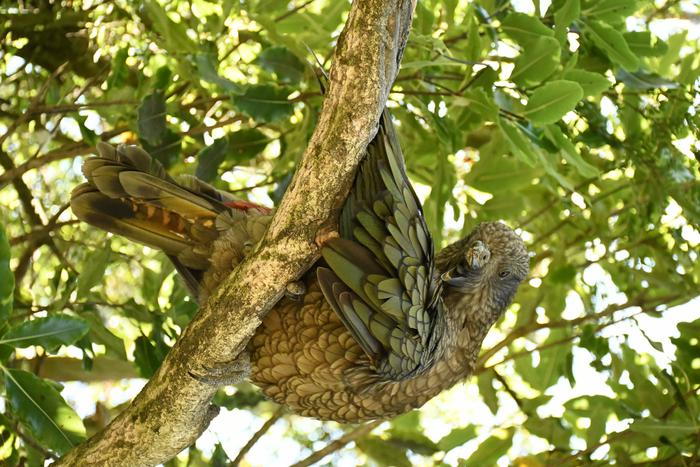
Bruce perched in a tree on one leg preening himself
A migratory bird brain, the Eurasian blackcap (Sylvia atricapilla), has been mapped for the first time using high-resolution light microscopy. The open-source software tools developed, and the detailed processes published, form a foundation for new brain atlases to be built for any species, providing a valuable resource for neuroscience worldwide. Created by a team from the Sainsbury Wellcome Centre at UCL and the University of Oldenburg, Germany, a paper describing the atlas has been published today (20 April 2026) in Current Biology.
Brain atlases - digital, high-resolution, 3D maps of brain structures - are transforming neuroscience. They improve the ability of researchers to interpret their own data, they enable cross-validation between and within experiments, and they foster collaboration - driving forward studies into learning, memory and cognition.
“A digital open-source brain atlas allows researchers to directly align their own experimental multimodal data to the common coordinate space of the atlas. It enables consistency, meaning researchers around the world can speak the same language when it comes to the brain. We are delighted to bring this resource to the community, and even more excited about building many more atlases for other research communities in the future,” said Dr Simon Weiler, Senior Research Fellow at the Sainsbury Wellcome Centre at UCL, and lead author of the study.
The team is already working on creating a similar digital 3D brain atlas of the zebra finch (Taeniopygia guttata), a bird used to study vocal learning.
The new Eurasian blackcap atlas is freely accessible via BrainGlobe for the neuroscience research community and will advance studies of magnetoreception, migration and navigation. The technology means that any brain sample, even historic histology samples that have been stored for years on glass slides, for example, can be mapped onto the atlas.
Birds are among nature’s foremost navigators, using the Earth’s magnetic field to orient themselves and travel between breeding and wintering grounds. Many species travel thousands of miles with centimetres of precision. In the same publication, the team has revealed a previously unknown direct link between magnetosensitive areas in the brain and the decision-making centre, the nidopallium caudolaterale (equivalent to the prefrontal cortex in mammals), demonstrating how the atlas can assist in characterising novel brain pathways.
"To me, this is a key tool that the migration, navigation, and magnetoreception community has been lacking for decades. It will greatly improve consistency and comparability between studies and related species and will significantly accelerate our understanding of underlying neuronal mechanisms,” said Professor Henrik Mouritsen, University of Oldenburg, an author of the study.
To create the atlas, the team at SWC used serial two-photon (STP) tomography to image eight male Eurasian blackcap brains. This advanced imaging technique results in well-aligned 2 x 2 x 5 μm voxel size images of entire brains. The individual 3D images from different brains were then iteratively aligned and averaged to create a representative brain template. Following this, experts at the University of Oldenburg manually annotated the template. This resulted in 44 segmented brain areas, including principal brain compartments, prominent anatomical subdivisions shared across all bird species, regions of the song system, and sensory regions implicated in magnetic field processing.Finally, the atlas was incorporated into the BrainGlobe ecosystem and automatic registration, cell detection and object mapping were demonstrated on experimental data.
“The core aim of BrainGlobe is to democratise computational neuroanatomy. Creating novel atlases is a step in achieving this. All parts of the pipeline are open-source, and over the coming months we will be improving it so that we, and anyone else, can rapidly create new atlases,” said Dr Adam Tyson, Head of the Neuroinformatics Unit at the Sainsbury Wellcome Centre at UCL and lead of the BrainGlobe Initiative.
While the team used state-of-the-art STP tomography, other microscopies, including light-sheet images are also suitable for creating atlases. Future advances in whole-brain labelling procedures, paired with STP tomography, will further guide brain area subdivision based on region-specific identification of marker genes or proteins, and the atlas will be regularly updated to incorporate new data.
ENDS
This research was funded by the Gatsby Charitable Foundation, Wellcome, the Alexander von Humboldt Foundation, the Chan Zuckerberg Initiative DAF, the European Research Council and the Deutsche Forschungsgemeinschaft.
Source:
Read the full paper in Current Biology: ‘An open-source three-dimensional digital brain atlas of a migratory bird, the Eurasian blackcap’
The Sainsbury Wellcome Centre (SWC) brings together world-leading neuroscientists to generate theories about how neural circuits in the brain give rise to the fundamental processes underpinning behaviour, including perception, memory, expectation, decisions, cognition, volition and action. Funded by the Gatsby Charitable Foundation and Wellcome, SWC is located within UCL and is closely associated with the Faculties of Life Sciences and Brain Sciences. For further information, please visit: www.sainsburywellcome.org
About the University of Oldenburg
Carl von Ossietzky University was founded in 1973, making it one of Germany's younger universities. Its goal is to find answers to the big questions facing society in the 21st century through cutting-edge interdisciplinary research and teaching.
Researchers and administrative staff work hand in hand and across disciplines. Many are involved in research – for example, in collaborative research centers, research groups, European projects, or the three clusters of excellence NaviSense, Hearing4all.connects, and Ocean Floor.
The university works closely with more than 300 international cooperation partners and universities. It also has links with non-university institutions in research, education, culture, and business. The research location is further strengthened by the establishment of the Helmholtz Institute for Functional Marine Biodiversity, Max Planck Research Groups, and Fraunhofer working groups.
The university prepares around 15,000 students for professional life. The spectrum ranges from the humanities and cultural sciences to economics, law, and social sciences to mathematics, computer science, the natural sciences, and medicine.
A new study published in Landscape Ecology shows how fast-growing poplar plantations can improve functional connectivity for forest birds in fragmented agricultural landscapes, provided they are strategically located and species have moderate to high dispersal capacity. The findings suggest that managed forests may contribute not only to biomass supply, but also to biodiversity conservation in highly human-modified regions.
Using spatial connectivity models in two European river sub-catchments in Spain and France, researchers examined how existing forest patches, both within and outside Natura 2000 areas, and poplar plantations interact to support movement across the landscape for three forest bird species with contrasting dispersal abilities.
“Plantations can act as stepping stones between forest patches, although their effectiveness depended strongly on their location within the landscape,” says Sara Pineda-Zapata, a Doctoral Researcher at the University of Eastern Finland and the lead author of the study. “We wanted to understand whether plantations, often viewed only through the lens of wood and biomass production, could also support ecological processes in fragmented landscapes,” she continues.
In Spain, plantations generated connectivity gains that were greater than their area would suggest, with some patches playing an important role in maintaining ecological connectivity for forest networks, including Natura 2000 areas. In France, plantation patches were more isolated and contributed less effectively. The strongest benefits were observed for species capable of moving over longer distances; for short-distance dispersers like the common chaffinch, plantations had a more limited effect unless they were located very close to an existing forest habitat, suggesting that even narrow gaps can remain major barriers for less mobile species.
“Plantations are often assessed only in terms of production, but when strategically located, they can provide much more than wood. They can contribute to landscape structure, help maintain ecological flows and complement conservation efforts in intensively used agricultural regions. The key message is that location matters, and that planning matters,” says Professor Blas Mola at the University of Eastern Finland.
Professor Alejandra Morán of the University of Basel in Switzerland highlighted that the results are relevant beyond bird movement: “Connectivity influences how species move, persist and respond to environmental change. When we think about ecosystem services, we should consider not only what land use produces in one place, but how it shapes ecological processes across the wider landscape.”
Rémi Duflot, from the University of Jyväskylä, emphasised the broader implications: "Birds are particularly informative because they respond quickly to landscape fragmentation. However, we caution that plantations cannot replace natural forests in ecological quality, and that increasing tree cover may reduce habitat for open-habitat species, while forest specialists often require more complex structures than plantations provide.”
“What our results show is that in fragmented landscapes, well-placed plantations can become part of the solution, opening up interesting possibilities for designing productive landscapes that are also more supportive of biodiversity,” concludes Pineda-Zapata.

No comments:
Post a Comment