Thursday, July 29, 2021


Study explains lax oversight in Facebook ads during 2016 election


Facebook advertising during the 2016 political campaign demonstrated a systematic bias toward ad buyers, researchers found.

Peer-Reviewed Publication

UNIVERSITY OF ARKANSAS

Adam Pope.jpg 

IMAGE: ADAM POPE, UNIVERSITY OF ARKANSAS view more 

CREDIT: UNIVERSITY OF ARKANSAS

University of Arkansas English professor Adam Pope and his colleague at San Jose State University examined lax oversight of advertising on Facebook during the 2016 political campaign and found a systematic bias toward ad buyers, specifically a Russian internet troll farm that sought to sow discord within the U.S. political system.

In “Rubles and Rhetoric: Corporate Kairos and Social Media’s Crisis of Common Sense,” published in Present Tense: A Journal of Rhetoric in Society, Pope and Sara West, assistant professor at San Jose State University, argue that social media ethics must be a central component of technical and professional writers' training.

Facebook and other social media platforms create advertising algorithms that are capable of targeting specific audiences in minute detail, but, as Pope and West found, the popular platform simply chose not to use that power to screen ads that violated federal and state laws. Instead, due to a systematic bias toward companies purchasing advertisements, Facebook failed to identify and prevent abuse of political advertising on the platform. The authors said the behavior demonstrated a corporate culture designed to leverage user data to serve paying customers in message placement rather than users.

“The Facebook platform can be understood as operating primarily to provide timely and targeted placement of advertisements for commercial clients,” Pope said. “We framed this phenomenon as corporate ‘Kairos,’ a term that simply means the ability of paying customers to precisely time and target their posts and content to audiences who will be favorably inclined to their message.”

The researchers found that rights of users connecting and communicating on Facebook were deemed less valuable than the so-called corporate-Kairos’ paid targeting. In other words, the marketing-first culture at Facebook — created primarily by an automated system — enabled bad actors with virtually no checks on their posting powers, even in extreme circumstances.

The extreme circumstance in this case was the 2016 presidential campaign, during which Facebook accepted rubles from a Russian troll farm, known as the Internet Research Agency, to place political advertisements on the platform. A troll farm is a group of individuals who try to influence political opinions and decisions on the internet. The use of foreign currency by a foreign nation to influence a U.S. election is prohibited by the Federal Election Commission.

The advertisements were focused on divisive political topics: LGBTQ+ rights, guns, the legal status of undocumented immigrants and others. The goal of these ads was to sow seeds of discord within the American political system, stoke racial and cultural tensions and even infiltrate political movements, such as Black Lives Matter.

“Understanding how these systems work and the ethical landscape of these platforms is essential as we train the next generation of technical and professional writers to operate in these spaces for their employers,” Pope said. “When these systems exist in a regulatory vacuum with questionably ethical automation, it behooves us as educators to critically engage our students and future working professionals on the risks and strategies of working with social media.”

###

Disclaimer: AAAS and E

What links organised crime with the radical right?

There are serious gaps in our knowledge about how violent extremists get their hands on weapons and money


Michael Colborne
16 July 2021, 8.10am

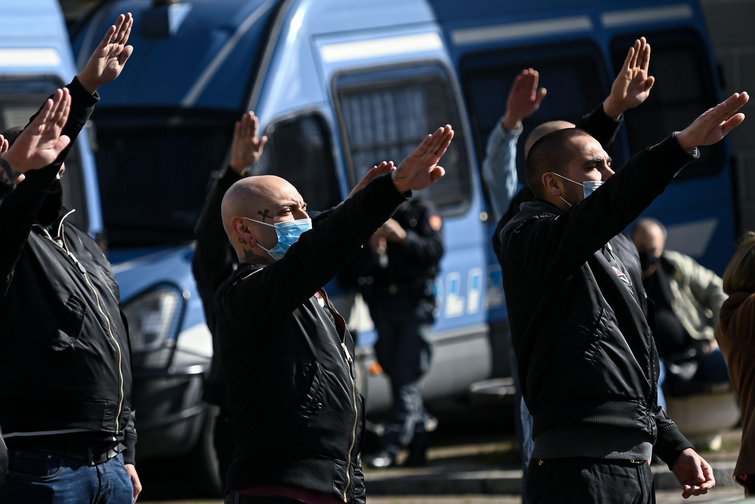
Far right supporters commemorate the death of Benito Mussolini on 2 May 2021 |
Piero Cruciatti/Alamy Stock Photo. All rights reserved


In the 1970s and early 1980s, Italy was plagued by a spate of violence and deadly terrorist attacks – the so-called “Years of Lead” (anni di piombo).

While the violence came from both the radical left and radical right, neo-fascist militant groups like New Order (Ordine Nuovo), National Vanguard (Avanguardia nazionale) and the Armed Revolutionary Nuclei (Nuclei Armati Rivoluzionari; NAR) made particularly brutal use of violence and terror against their enemies. Right-wing violence culminated in the 1980 Bologna massacre, a terrorist bombing by NAR members at the city’s train station that took the lives of 85 people.

Groups like NAR had help from Italy’s criminal underworld. NAR had links with the Banda della Magliana, a Rome-based criminal outfit, and the two would be involved in protection rackets, arms trafficking and murder together. In the 1970s, the ‘Ndrangheta, a huge organised crime syndicate with its roots in southern Italy, allegedly had links with both New Order and National Vanguard.

These are just a few examples of how the relationship between organised crime and the international radical right – particularly the most extreme and violent fringes of the radical right – is nothing new.

In fact, the trend continues to this day.

Earlier this year, German police arrested members of a neo-Nazi criminal network allegedly involved in money laundering as well as drugs and arms trafficking. Greece’s Golden Dawn was ruled a “criminal organisation” by a Greek court in October 2020, with its members involved in everything from money laundering to murder. In December 2020, Spanish police arrested radical right extremists allegedly involved in arms and drug smuggling, while in 2019 Italian police arrested a number of individuals who planned on forming a neo-Nazi party, including a leading ‘Ndrangheta member.

In countries with weak rule of law, the tentacles of organised crime can weave their way into the fabric of the state

Why would the radical right, particularly its most extreme elements, get involved with organised crime? There are, of course, a number of reasons, one of which involves something I’ve mentioned several times already: arms trafficking.

Market forces


Radical right extremists who want to arm themselves can’t easily do so through any legitimate means. Even in countries with lax gun laws like the US, radical right extremists generally can’t just buy up military-grade weapons and hardware without garnering unwanted attention from the authorities.

With a huge market for smuggled weapons around the world – sources for these weapons include places like the former Yugoslavia and Ukraine – and the involvement of a number of organised crime groups in this smuggling, it’s no surprise that radical right extremists would find themselves part of the game. It’s also no surprise, then, that in the wake of radical right terror attacks in recent years, authorities appear to be paying increasing attention.

Another reason for radical right involvement with organised crime is financing. How radical right groups get their money and their funding is, as has been noted by journalists covering the radical right (myself included), an issue that itself requires much more attention.

Not all radical right extremists require some significant form of financing, nefarious or otherwise; it doesn’t necessarily cost much money to write, draw and post hateful propaganda on Telegram for instance. But for radical right extremists with ambition, the costs can add up. For example, well-designed websites with professional-grade video, replete with flashy logos and almost-corporate branding, aren’t things one can buy up with a few pennies lying around.

In countries with weak rule of law, the tentacles of organised crime can weave their way into the fabric of the state. The phenomenon of state capture – a form of corruption where private actors, from politicians and businesspeople to criminals, influence a state’s decision-making processes to their own advantage – has been documented in places like Serbia, Turkey and other countries.

When radical right extremists join the game and themselves become part of the phenomenon of state capture – something seen in Ukraine, for example, where much of the radical right is alleged to have the patronage of the country’s powerful interior ministry – they give themselves a means of being protected from prosecution, an opportunity to act with greater impunity and, above all, a pathway to increase their status and influence.

We don’t know nearly as much about the relationships between organised crime and the radical right as we should

In short: if having friends in high places can protect you and help you profit as a radical right extremist, even when those friends aren’t on the right side of the law, why wouldn’t you take advantage?

The gaps in our knowledge


We still don’t know nearly enough about the connection between organised crime and the radical right. We know reasons, actual and potential, for why this connection has existed in the past right up to the present day. We know in detail about circumstances in specific countries and contexts (for example in Greece with Golden Dawn), but we don’t know enough about how the phenomenon works across borders and different social and political contexts.

Part of this, I’d argue, is our fault as journalists, researchers and academics who study the radical right. With our respective beats too often compartmentalised and specialised, matters related to organised crime remain too much on the other side of a fence for us. As a journalist who focuses on the radical right, my colleagues who investigate organised crime do seem sometimes to be investigating another world. But that needs to change.

Despite prominent headlines, we don’t know nearly as much about the relationships between organised crime and the radical right as we should. It’s critical that academics, researchers and journalists who focus on the radical right pay much more attention to the phenomenon.

None of this means we all need to try and become instant experts on the subject – I know I’m not about to become a wizard at tracking international cash flows, for example. It does mean, however, that we need to become better at collaborating and crossing our own borders, so to speak, when it comes to better understanding the radical right.

Winnipeg Catholic priest accuses residential school survivors of lying about abuse for money

ASSHOLES LIKE THIS SAY THE SAME THING ABOUT THE VICTIMS OF ABUSE BY PRIESTS

Jenn Allen

© St. Emile Parish/Facebook Father Rheal Forest delivers a sermon at St. Emile Roman Catholic Church in Winnipeg on July 10, one of several in which he made unfounded accusations about residential school survivors.

A Catholic priest has been banned by a Winnipeg archdiocese from speaking publicly after accusing residential school survivors of lying about sexual abuse to get more money from court settlements, of spreading falsehoods about residential schools, and joking about shooting those writing graffiti on churches, among other comments.

The statements were made over weeks of services at St. Emile Roman Catholic Church, and were included in videos on its Facebook page.

During a July 10 mass Father Rhéal Forest — who was temporarily placed at St. Emile while the parish's regular pastor, Father Gerry Sembrano, was on vacation — said residential school survivors lied about being sexually abused so they would receive more money during the settlement process with the federal government.

"If they wanted extra money, from the money that was given to them, they had to lie sometimes — lie that they were abused sexually and, oop, another $50,000," Forest said.

"It's kind of hard if you're poor not to lie," he continued, adding that all of the Indigenous people who he knew during his 22 years working up north liked residential schools.

Forest acknowledged that a few had bad treatment, but said some of that was due not to nuns and priests but rather night watchmen.

In its 2015 report, the Truth and Reconciliation Commission said there have been "over 40 successful convictions of former residential school staff members who sexually or physically abused students." As of Jan. 31 of that year, it said 37,951 claims for injuries resulting from physical and sexual abuse at residential schools had been received.

In another mass, Forest described passing by another local church that had been vandalized with the words "Save the children," a phrase used by Indigenous people and allies in reference to residential schools.

Forest said he'd like to scare off vandals with a shotgun blast and shoot them if they didn't run away.

"As I'm passing by, thoughts of anger. If I had a shotgun at night and I'd see them, I'd go, 'Boom!' just to scare them and if they don't run away, I'll shoot them," Forest said in the July 18 sermon, laughing.

He then quickly backtracked, saying: "But this would not help, it's bad to do that, I'd go have a chat with them." He went on to blame the media for making the vandals believe the Catholic Church killed residential school children.

CBC News has requested an interview with Forest. The Archdiocese of St. Boniface says it is considering the request.
 
© Tyson Koschik/CBC The Archdiocese of St. Boniface has apologized for Forest's comments, videos of which were removed from St. Emile's Facebook page.

The archdiocese was made aware of the comments on Monday, after CBC Manitoba flagged the videos. St. Emile regularly livestreams its services.

Daniel Bahuaud, a spokesperson for the archdiocese and Archbishop Albert LeGatt, said the videos involving Forest have since been removed and apologized for the comments. The archdiocese has also barred Forest from preaching and teaching publicly.

LeGatt and the archdiocese "completely disavow" Forest's comments, Bahuaud said in an email.

"We very much regret the pain they may have caused to many people, not least of course Indigenous people and, more specifically, survivors of the Residential School system."

In an interview Bahuaud said any further punishment for Forest would be decided by LeGatt.
'Disgusting views'

Kyle Mason — an Indigenous leader, activist and former Christian minister — said he was surprised "anybody within [the Catholic Church] can be so out of touch and so outdated, and have these really disgusting views going on within themselves."

Mason went on to say if the church "is really concerned about reconciliation here in Canada, they would be enthusiastically trying to make sure that all their priests and all their staff are well aware and that there would be no room for these kinds of comments."

Mason said he is glad to hear Forest is not allowed to preach publicly anymore, or take part in church educational activities. He said he would like to see Forest learn more about what really happened at residential schools before he is allowed to resume his public duties.

"I would strongly encourage [the church] to use this as a teaching moment for them to make sure that anybody — priests, nuns, staff, whatever it is, whatever their leaders are within their ranks — are well-informed on residential schools, Sixties Scoop and all the other ways that we are seeing the impact of these atrocities within our society," he said.

When asked what impact Forest's words would have on reconciliation, Mason was hopeful.

"In my opinion, reconciliation can't be stopped. It can be slow sometimes, but it cannot be stopped."

Do you have information about unmarked graves, children who never came home or residential school staff and operations? Email your tips to CBC's new Indigenous-led team investigating residential schools: WhereAreThey@cbc.ca.

 IT'S ABOUT HER 'HEALTH'

Aaron Rodgers defends Simone Biles, mental health in Packers presser


During his intro presser at Packers training camp, quarterback Aaron Rodgers defended Simone Biles for making her mental health a priority. 

Much has been said this week after United States gymnast Simone Biles withdrew herself from the team final at the 2020 Tokyo Summer Olympics. Biles, citing her mental health, made the difficult decision to step down from her role. She’s without question one of the best in the sport, maybe the best ever.

While countless folks have come out to support her, others have tried throwing her under the bus. Green Bay Packers quarterback Aaron Rodgers made it more than clear he’s in Biles’ corner, saying athletes should feel more open to discuss their internal battles.

Aaron Rodgers came out in full support of USA gymnast Simone Biles

Rodgers of course isn’t the only star athlete to show Biles love. As much as she wanted to help the U.S. win gold – they ended up taking silver – Biles knew that she had to make her mental health a priority. Imagine if she would have forced herself to compete knowing something was off?

“We also have to focus on ourselves, because at the end of the day we’re human too,” Biles said in Tokyo. “So, we have to protect our mind and our body, rather than just go out there and do what the world wants us to do.”

With her amazing acrobatics, there’s a good chance she very well could have ended up seriously injuring herself. That would have made things a million times worse for everyone involved.

Moving forward, Biles will work on getting herself back to 100 percent both mentally and physically before she competes. Until then, she’ll know that fellow athletes like Rodgers will fully support the decisions she ends up making.

Paul Krugman: GOP 'family values' rhetoric is as 'intellectually bankrupt' now as it was in 1992


Alex Henderson, AlterNet
July 28, 2021


Paul Krugman (Screenshot)

"Hillbilly Elegy" author J.D. Vance, who is seeking the GOP nomination in Ohio's 2022 U.S. Senate race, was cynically playing the family values card when he railed against the "childless left" during a speech on Friday night, July 23 — and he even mentioned some Democrats by name. Liberal economist Paul Krugman has responded to Vance's speech in his July 26 column for the New York Times, stressing that Republican "family values" rhetoric is as empty and vacuous in 2021 as it was when the GOP made "family values" the theme of the 1992 Republican National Convention.

Vance was speaking at an event hosted by the Intercollegiate Studies Institute, and the Democrats he singled out as examples of the "childless" trend in the U.S. included Vice President Kamala Harris, Transportation Secretary Pete Buttigieg, Sen. Cory Booker of New Jersey and Rep. Alexandria Ocasio-Cortez of New York City. And Vance praised Hungarian Prime Minister Viktor Orbán — a far-right authoritarian — for encouraging more procreation in his country. Booker and AOC, reporter Martin Pengelly noted in The Guardian, don't have any children. Harris has two stepchildren with her husband, Doug Emhoff.

Vance's speech, Krugman writes, brought back memories of the GOP's "family values" rhetoric of 1992.

"For a few weeks in 1992," Krugman writes, "U.S. politics were all about 'family values.' President George H.W. Bush was in electoral trouble because of a weak economy and rising inequality. So, his vice president, Dan Quayle, tried to change the subject by attacking Murphy Brown, a character in a TV sitcom (and) an unmarried woman who chose to have a child."

Krugman continues, "I was reminded of that incident when I read about recent remarks by J.D. Vance, the author of 'Hillbilly Elegy,' who is now a Republican Senate candidate in Ohio. Vance noted that some prominent Democrats don't have children, and he lashed out at the 'childless left.' He also praised the policies of Viktor Orbán, the leader of Hungary, whose government is subsidizing couples who have children, and asked, 'Why can't we do that here?'"

The Washington Post's Dave Weigel, covering Vance's speech, noted that he failed to mention President Joe Biden's child tax credit — which, Krugman points out, "will make an enormous difference to many poorer families with children."

"It was also interesting that (Vance) praised Hungary rather than other European nations with strong pronatalist policies," Krugman observes. "France, in particular, offers large financial incentives to families with children and has one of the highest fertility rates in the advanced world. So why did Vance single out for praise a repressive, autocratic government with a strong white nationalist bent? That was a rhetorical question."

Krugman goes on to say that "family values" rhetoric coming from Vance and other Republicans is meaningless without economic policies that actually help parents.

"The whole focus on 'family values' — as opposed to concrete policies that help families — turns out to have been an epic intellectual misfire," Krugman stresses. "Dan Quayle, of course, was no intellectual. But his sitcom offensive took place amid a sustained argument by conservative thinkers like Gertrude Himmelfarb that the decline of traditional values, especially traditional family structure, presaged widespread social collapse. The demise of Victorian virtues, it was widely argued, would lead to a future of spiraling crime and chaos. Society, however, declined to collapse."

Krugman cites some specific economic policies that are helpful to families, and they aren't Republican policies.

The economist writes, "When politicians rant about values, or attack other people's personal choices, it's usually a sign that they're unable or unwilling to propose policies that would actually improve American lives…. Doing more to help families with children — with financial aid, better health care and access to day care — is at or near the top of the list. The point, by the way, isn't to encourage people to have more kids — that's up to them — but to improve the lives of the children themselves, so that they grow up to become healthier, more productive adults."

Krugman adds, "On the other hand, yelling at members of the elite over their personal life decisions isn't on the list at all. And when that's all a politician does, it's a sign of intellectual and perhaps moral bankruptcy."
Report says laws against hate crimes in U.S. inconsistent, incomplete


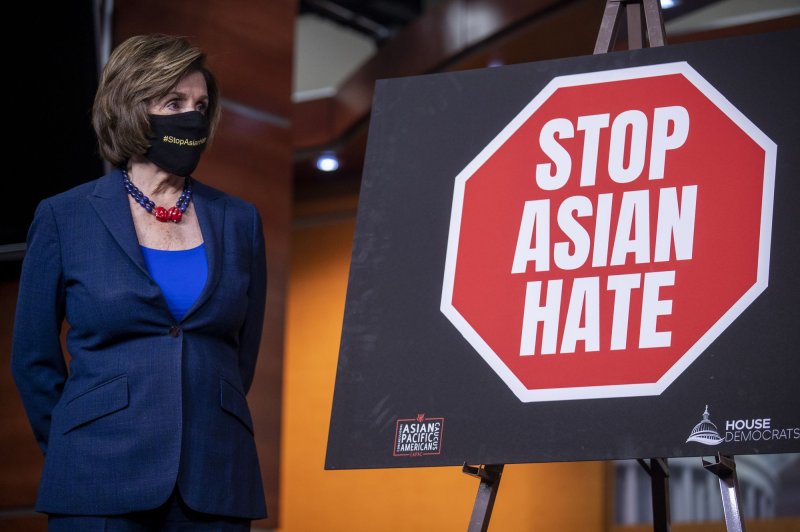
House Speaker Nancy Pelosi listens to remarks during a press conference about the COVID-19 Hate Crimes Act at the U.S. Capitol in Washington, D.C., on May 18. File Photo by Kevin Dietsch/UPI
| License Photo

July 28 (UPI) -- Federal and state laws against hate crimes nationwide generally lack uniformity and they often fail to address the root causes of the problem, according to a report Wednesday by equality advocates.

The 54-page report by the Movement Advancement Project gives a side-by-side view of state hate crimes laws, their limitations and an analysis of how well they address the problem.

The report examined laws across 10 categories -- criminal punishment, statute type, protected categories, institutional vandalism, collateral consequences, non-carceral sentencing, civil action, victim protections, data collection and law enforcement training.

The assessment says some of the challenges of hate crime laws include failing to address the root cause of the violence, widespread bias in the criminal justice system, flaws in hate crime data collection and reporting and changing the original intent of the law.

"At a time of rising hate violence, we need to re-examine and expand our responses," Ineke Mushovic, executive director of Movement Advancement Project, said in a statement. "Hate crime laws serve a necessary purpose, but they are inconsistent, sometimes flawed, and can even harm the very communities they are meant to serve."

For example, the report said while evidence shows that the majority of hate crimes are committed by White people, many states' law-enforcement-recorded hate crimes disproportionately list Black people as offenders.

Some entities have also attempted to add police officers as a protected class in hate crime laws, skewering its original intent, the assessment says.

The report also notes that hate crime laws vary greatly from state to state, meaning someone who experiences a hate crime may have a completely different set of protections, options or access to resources depending on where the crime occurred.  

"We need to improve our hate crime laws and engage in broader solutions to reducing hate in our country," Mushovic said. "Like any law, hate crime laws alone won't fix a problem as large as rising hate violence."
Little bear cub burned by wildfire recovering, but needs skin grafts


Tamarack the bear cub was found in the yard of a Markleeville after suffering burns from a wildfire near Lake Tahoe in California. Photo courtesy of Lake Tahoe Wildlife Care


July 28 (UPI) -- A bear cub that was burned by a wildfire near Lake Tahoe is now recovering at a wildlife center in California, and caretakers say it's expected to make a full recovery.

The cub was named Tamarack after the Tamarack Fire, which has burned nearly 70,000 acres in California and Nevada. The fire was almost 60% contained by Wednesday morning.


A homeowner in Markleeville, Calif., came across the cub in their yard last weekend.

"We found the cub -- sedated it -- (tried to run down the hill in the pitch black dark but we found him)," the Lake Tahoe Wildlife Care center said in a Facebook post Monday.

The center said Tamarack had burns on all four of his paws. They treated him with pain medication and fluids, and bandaged his feet.

The cub's being cared for at the wildlife center, where he's awaiting a tilapia skin grafting procedure.

"The wounds are progressing as expected & we are optimistic about his recovery!" the center posted Tuesday.

The center said Tamarack's recovery will be "long and expensive," and officials launched a donation page to assist with expenses.
Ship that blocked Suez, Ever Given, finally arrives in Rotterdam

BY FRENCH PRESS AGENCY - AFP 
HOEK VAN HOLLAND EUROPE
JUL 29, 2021 

The container ship Ever Given arrives at the ECT (Europe Container Terminals) Delta terminal in the port of Rotterdam, early on 29 July 2021. (AFP Photo)


Better late than never: After more than four months after blocking Egypt's Suez Canal and thus one of the world's busiest waterways, the gigantic container ship MV Ever Given docked into Rotterdam port Thursday.

Almost as long as New York's Empire State Building is tall, the ship entered Europe's port at around 3 a.m. GMT, an Agence France-Presse (AFP) correspondent saw.

"It was a great relief to see her and a special moment," said Hans Nagtegaal, the Rotterdam port's director of containers.

"Finally, we can get the job done offloading and hopefully get her back to a normal sailing routine," he told AFP.

Nagtegaal said the Ever Given will remain in Rotterdam until Monday, when she's expected to sail for Felixstowe in Britain, before going to into a dry dock in Dunkirk in France for a further inspection.

The MV Ever Given, which blocked the Suez Canal for six days in late March, finally steamed out of the waterway three weeks ago after Egypt and the vessel's Japanese owners signed a compensation deal.

The nearly 200,000-ton container vessel became wedged in the canal during a sandstorm on March 23, blocking a vital artery from Asia to Europe that carries 10% of global maritime trade and provides Egypt with vital revenues.

After an around-the-clock salvage operation to dislodge it, Egypt seized the ship and demanded compensation from owners Shoei Kisen Kaisha for lost canal revenues, salvage costs and damage to the canal.

Last month, the Suez Canal Authority announced it had signed a non-disclosure agreement with the Japanese firm ahead of reaching a final deal.

Cairo initially demanded $916 million in compensation before slashing that to around $550 million, but the final figure was the subject of tough negotiations.

Egypt, which earns more than $5 billion a year from the canal, lost between $12 million and $15 million in revenues each day it was closed, the SCA said.

In April, maritime data company Lloyd's List said the blockage by the vessel, which is longer than four football fields, held up some $9.6 billion worth of cargo each day it was stuck.
NAVWAR opens 'secret-level' security information pipeline


NAVWAR project manager Matt O’Neil, L, studies a data pipeline project with NIWC Pacific Deputy Project Manager Johanna Flores. Photo by Rick Naystatt/U.S. Navy


July 28 (UPI) -- The Overmatch Software Armory, connecting platforms to the Pentagon's All-Domain Command and Control, is operational at a higher level, the U.S. Navy said on Wednesday.

The Naval Information Warfare Systems Command, or NAVWAR, said the commercially-based, cloud-enabled element of its development, security and operations, or DevSecOps, pipeline will transform the Navy's methods of protecting access to data and applications.

The Armory has operated at IL4 and IL5 levels of secrecy in dealing with Defense Department Controlled Unclassified Material since 2018.

This, however, is the first time the Overmatch Software Armory is operating at IL6, accommodating DoD Classified Information up to the Secret-level, NAVWAR said.

The software streamlines processes, increases the speed of data delivery to the Navy, and allows continuous updating and direct delivery of newer versions of applications. The announcement came from the Naval Information Warfare Center command in San Diego.

"Previously, if we wanted to have our own classified secret software pipeline, we would have had to build an on premise solution and host it in a secure location onsite," David Jenkins, deputy for project development at the Naval Information Warfare Center's Pacific Command and Control Division, said in a press release.

It connects platforms, weapons, and sensors in a Naval Operational Architecture which integrates with Joint All-Domain Command and Control, but at a higher level of secrecy, and develops networks, infrastructure, data architectures, and analytic tools connecting every Navy domain.

RELATED Navy's information warfare research effort gets $400M ceiling increase

"By implementing DevSecOps we get the benefit of commercial best practices that improve the quality and security of software," said Delores Washburn, NIWC Pacific chief engineer and Overmatch infrastructure lead, said in a press release in April.

"Furthermore, it's an important catalyst for modernizing our legacy processes that tend to slow us down and we are already seeing big dividends in new modern ways to deliver capability to the fleet," Washburn said.
Poll says more Americans today know someone who is transgender


The study found that those who said they know a transgender person was higher among Americans under 30 and Democrats. The share was lower among Republicans. File Photo by Kevin Dietsch/UPI | License Photo

July 29 (UPI) -- The number of Americans today who say they know someone who is transgender -- more than 40% -- has risen significantly over the past four years, according to a new survey.

The poll, taken by Pew Research Center, says 42% of U.S. respondents said they know a transgender acquaintance -- an increase of 5 points since 2017.
ADVERTISEMENT

Also, the survey found that a quarter of respondents said they know someone who goes by a gender-neutral pronoun, an increase of 8 points since 2018.

"Growing shares of U.S. adults say they know someone who is transgender or who goes by a gender-neutral pronoun. Yet Americans' comfort levels with using gender-neutral pronouns to refer to someone -- as well as their opinions on whether someone's gender can differ from the sex they were assigned at birth -- have remained static," Pew Research Center said in a statement.

About half of respondents said they feel comfortable using gender-neutral pronouns like "they" and "them," and 56% said a person's birth sex determines whether they are a man or woman. Both figures are mostly unchanged since 2017.

The study found that those who said they know a transgender person was higher among Americans under 30 (53%) and Democrats (48%). The share was lower among Republicans (35%) and persons with a college degree (46%).

Pop stars Demi Lovato and Sam Smith both have declared themselves to be non-binary, meaning they do not fit into a biological gender.

The State Department recently announced it would allow Americans to choose their gender on passports, without any medical denotation. New York state passed legislation last month to allow residents to identify as "X" gender on official documents.

The Pew survey was conducted last month and questioned about 10,606 adults nationwide.