Wednesday, December 07, 2022

MSF warns of impact of closed detention centers on the health of migrants and refugees in Greece

The NGO Doctors Without Borders (MSF) warned Monday of the impact of the closed detention center model on the health of migrants, refugees and asylum seekers on the Greek Aegean islands a year after the first such center was opened on Samos.


Archive - New migrant detention center in Samos, Greece - NIK OIKO / ZUMA PRESS / CONTACTOPHOTO© Provided by News 360

In a statement, the organization has pointed out that people arriving on the island are "confined in the access-controlled center of Zervou, in an isolated place subject to a high level of security, where they find it very difficult to seek medical care, obtain treatment or receive legal advice."

The Zervou center, as well as those on Leros and Kos and those planned for 2023 on Lesvos and Chios, are "the result of an aggressive containment policy, funded by the European Union (EU), to open controlled access centers" in remote locations on five Aegean islands", as stated in the text, which warns that there "people seeking safety are confined while their asylum application is being processed".

These people, MSF has warned, "arrive in Greece distressed since most of them have fled conflict or persecution in their countries of origin, and many of them have suffered atrocious violence during their journey".

"People at the Zervou center tell us that they have survived human trafficking, sexual assault, forced labor and beatings," lamented Nicholas Papachrysostomou, MSF's general coordinator. "Some people have witnessed the death of their relatives in previous forced returns or shipwrecks. The internment centers do not meet their basic needs and unnecessarily harm their mental and physical health," he explained.

He also stressed that MSF's experiences show "the dangers of closed centers" and highlight that "asylum seekers need access to quality and timely medical care".

"Authorities should invest in decent reception conditions and safe accommodations, such as housing within communities, and create integration programs. Everyone needs a safe, supportive and humane environment to be able to register and process their asylum claim without the risk of re-traumatization, as set out in international law, EU law and national legislation," he said.

MEDICAL ASSISTANCE MSF has denounced that the main shortcoming is the "lack of access to health care". Sonia Balleron, coordinator of the MSF project in Samos, stated that these are "people who have been traveling for a long time without receiving medical attention".

However, since February 2022, the center has only been visited by medical staff on occasional days and for only a few hours. Healthcare inside the centers remains problematic due to the continuing lack of medical personnel and medical equipment.

Thus, MSF has warned that those who have lived traumatic experiences "suffer a deterioration of mental health due to the prison conditions of the centers and the segregation and security infrastructures."

Between September 2021 and September 2022, 40 percent of people with mental health problems treated by MSF on Samos presented symptoms related to psychological trauma.

"Now everyone presents with a basic level of psychological distress," said Elise Loyens, MSF medical coordinator in Greece, who noted that "it always presents with the same symptoms: body aches, dissociation, depression, sleep disorders." "People feel humiliated in these conditions," she added.
QAnon, white nationalists and hate speech: Experts reveal how the floodgates opened on Elon Musk’s Twitter

Story by Alex Woodward • Yesterday 

One day after officially acquiring Twitter, the world’s wealthiest person pledged that a “content moderation council” would review the restoration of previously banned accounts. Elon Musk said that civil rights groups – as well as those who had experience “hate-fuelled violence” – would be a part of the process.


Musk’s Twitter takeover copy.jpg© Getty

Then, on 23 November, Musk introduced a Twitter poll asking users whether he should grant “general amnesty to suspended accounts, provided that they have not broken the law or engaged in egregious spam”.

Extremism researchers and experts who have closely studied the spread of online hate and mis- and disinformation have warned that Mr Musk’s acquisition and the mass return of previously banned users could rapidly deteriorate the platform. Under the disingenuous banner of “free speech”, Twitter could become one of the most toxic spaces on the internet for marginalised groups, according to experts.

Without critical guardrails, the platform risks turning into a “hostile environment for people that might be subjected to abuse and the people who don’t want to see it, and that’s the vast majority of people,” according to Imran Ahmed, founder and CEO of the Center for Countering Digital Hate.

On 18 November, Mr Musk created another poll asking whether to allow Donald Trump back to the platform. The former president had been permanently suspended from Twitter “due to the risk of further incitement of violence” in the aftermath of the attack on the US Capitol fuelled by his election lies.

Mr Musk also reinstated at least 11 accounts belonging to prominent far-right and anti-trans influencers, including Jordan Peterson and right-wing satirical media company the Babylon Bee, which were both suspended for misgendering transgender people.

Twitter also restored an account for activist group Project Veritas, despite its ban “for repeated violations of Twitter’s private information policy,” as well as the personal account belonging to far-right Georgia congresswoman Marjorie Taylor Greene. Greene had been suspended for flagrant violations of the platform’s policies against spreading Covid-19 misinformation.

Effective 23 November, Twitter announced that the platform “is no longer enforcing the Covid-19 misleading information policy”.

‘Trust and safety and content moderation are dead’


The platform has reinstated tens of thousands of previously suspended accounts. Of these, roughly 62,000 accounts have more than 10,000 followers each, including one account with more than 5 million followers, and 75 accounts with more than 1 million followers, according to Platformer. Employees have reportedly called the mass reinstatement “the Big Bang.”

Dozens of clips of a video filmed by a white supremacist who murdered 51 Muslim worshippers at two mosques in Christchurch in 2019 – footage that is illegal to share in New Zealand – were not caught by the platform’s moderation tools at the end of November. The clips were only removed after the country’s government told Twitter about it.

“Effectively, trust and safety and content moderation on Twitter are dead under Elon Musk,” according to Sam Woolley, head of the Propaganda Research Lab in the Center for Media Engagement at the University of Texas at Austin and the author of The Reality Game: How the Next Wave of Technology Will Break the Truth. “Twitter has taken … a lot of time and put in a lot of effort over the last several years to respond to the problems of disinformation and propaganda on its platforms. What we have now is a completely confusing environment that Musk contends is free speech for everyone but which is really an informational dictatorship that prioritizes Musk’s whims over any kind of systematic governance of the platform.”

Within the first week of his acquisition, Twitter’s most popular untrustworthy accounts saw their engagements increase by more than 57 per cent, according to an analysis from NewsGuard with data from NewsWhip. Posts from the 25 most-followed Twitter accounts tracked by NewsWhip and associated with publishers that NewsGuard has identified as “repeatedly spreading false information” received more than 3 million likes and shares, the report found.

Two weeks earlier, those same accounts had received roughly 1.98 million likes and shares.

“The findings highlight how Musk’s public statements about potential future changes to Twitter policies appear to have encouraged greater activity by malign actors, boosting the popularity of misinformation on the platform,” according to NewsGuard.

Even without any apparent policy changes, and Mr Musk’s insistence that its policies remain the same, “the simple and highly publicized fact of new ownership and Musk’s public speculation about changes to the platform coincided with a significant increase in the popularity of false narratives,” NewsGuard stated.

The Center for Countering Digital Hate’s analysis of Brandwatch analytics also found a significant “uptick” in hateful and sexist language on the platform within the same time frame that Mr Musk claimed the company’s “strong commitment to content moderation remains absolutely unchanged” and that hateful speech declined to “below our prior norms”.

In the first full week under his ownership, there were more than 26,000 posts mentioning the n-word – triple the average in 2022, according to the report. There were also more 50,000 posts mentioning transphobic and homophobic slurs, up by 53 per cent and 39 per cent, respectively, than 2022 averages.

Within his first two weeks at the helm, from 31 October to 13 November, there were more than 204,000 tweets and retweets using the gender-based slur “c**t” – up 30 per cent from the 2022 average – and more than 831,000 posts mentioning “sl*t,” up 75 per cent from the 2022 average. Posts mentioning “wh*re” were also up by 60 per cent. The platform also saw significant spikes in antisemitic slurs and racist abuse towards Hispanic and Latino people, the report found.

Despite claims from Twitter’s now-former head of Trust and Safety, Yoel Roth, that the platform had reduced the number of times hate speech appeared on Twitter’s search and trending pages, “the actual volume of hateful tweets has spiked,” according to the center’s report. Asked during an interview at the Knight Foundation on 30 November whether he still believed Twitter’s safety had improved under new ownership, Mr Roth said “no

The European Union has signalled that the platform could be regulated or banned in EU countries unless it adheres to stringent rules for content moderation.

“In an offline context, it would be blisteringly obvious that if every time I opened my door and went onto the street, someone shouted a racial slur or religious slur, I would think, ‘Crumbs, I don’t want to leave the house,’” Mr Ahmed told The Independent. “The problem is that Musk recognizes the virtues of Twitter, clearly, because he recognizes the way that it brings people together and has allowed him to communicate to millions of people. He seeks to deny that ability to people from marginalized groups who know that the price of taking part in Elon Musk’s Twitter is an intensified wave of abuse, the likes of which they haven’t seen before.”

On 30 November, the company said in a statement that “none of our policies have changed,” but that its policy enforcement will instead rely on the “de-amplification of violative content: freedom of speech, but not freedom of reach”.

“We have to move beyond a surface-level understanding of what free speech means and actually begin to understand that free speech doesn’t mean the right to practice open hate and violence,” Mr Woolley told The Independent. “You’re not legally meant to be able to threaten people with violence or harm. You’re not meant to be able to sow purposefully false content about electoral processes, but all of these things are happening on Twitter. And so that’s not free speech. It’s informational anarchy and chaos that prioritizes powerful voices who know how to manipulate the system in order to get their content amplified.”

‘I will salute my leader, Elon Musk’

Shortly after his account was restored on the platform, alt-right figure Patrick Casey of the white nationalist group Identity Evropa said on his livestream broadcast that “other than Trump, Elon Musk has done the most for us, absolutely.”

“You have people like [Fox News personality] Tucker [Carlson] who have in some cases broadcast our ideas to tens of millions, hundreds of millions,” he said. “But Elon Musk, he’s up there … and we thank him for his service. … I will salute my leader, Elon Musk. Thank you, buddy.”

Conservatives, Republican officials, right-wing personalities and far-right figures have embraced Mr Musk and his ownership of Twitter, projecting the billionaire as a key figure in their crusade against perceived censorship under a leftist online regime. QAnon influencers who have amassed followings on platforms like Telegram and Truth Social after their bans elsewhere are also returning to the platform, while hashtags and phrases connected to the conspiracy theory movement – like WWG1WGA, an acronym for QAnon slogan “where we go one we go all” – are readily searchable.

Conspiracy theorist influencer John Sabal, known as “QAnon John”, is currently running a Twitter account affiliated with The Patriot Voice, which organises QAnon-affiliated conferences that attract well-known Republican figures and far-right personalities. He also believes Mr Musk is a so-called “white hat” working within the government to dismantle the alleged “deep state” against them.

Mr Musk – who said he intends to “vote Republican” and would support Florida’s Republican Governor Ron DeSantis for president in 2024 – frequently interacts with far-right influencers on the platform, building his own so-called “filter bubble” of right-wing admirers and opinions.

He has accused the platform, in its previous incarnation, of advancing “far left San Francisco/Berkeley views” and asserted that Twitter “obv[iously] has a strong left wing bias”. But the company’s own research shows that the platform amplifies right-wing content more than left-leaning posts. Right-wing accounts drove most conversation and topics in the leadup to the 2020 presidential election, according to an analysis from Politico and the Institute for Strategic Dialogue.

Much in the same way that the world paid attention to the former president’s every tweet, media outlets are closely watching Mr Musk’s bully pulpit, from which he broadcasts to nearly 120 million followers.

On 29 October, Hillary Clinton shared a link to a Los Angeles Times story detailing Paul DePape’s digital trail of far-right conspiracy theories before he brutally attacked House Speaker Nancy Pelosi’s husband Paul. The following day, Mr Musk replied with a screenshot of a bogus report accusing Mr Pelosi of getting into a drunken fight with a male prostitute. He deleted the tweet, but thousands of people had already shared it, along with the original widely debunked article which inspired thousands of similar posts.

On November 28, Mr Musk shared – then quickly deleted – a photograph of neo-Nazi influencer Tim Gionet, a.k.a “Baked Alaska”, saluting a McDonald’s.

Two days later, he asserted without evidence that Twitter had interfered with elections in the past. The claim was widely circulated as a breaking news item among right-wing accounts that have baselessly claimed Twitter helped “steal” the 2020 presidential election from Donald Trump.

On 1 December, hours after Ye — formerly known as Kanye West — praised Adolf Hitler and said he “loves Nazis” during a virulently antisemitic rant on InfoWars with conspiracy theorist Alex Jones, Mr Musk approvingly replied to a post made by Ye that mentioned Mr Musk and the First Amendment.

Later, after Ye posted a swastika embedded within a Star of David, he was suspended from the platform.

“I tried my best,” Mr Musk said. “Despite that, he again violated our rule against incitement to violence. Account will be suspended.”

That same day, neo-Nazi Andrew Anglin, founder of antisemitic white supremacist website The Daily Stormer, was reinstated.

While he pledges to combat the presence of “bots” or fake accounts used to manipulate engagement on the platform, Mr Musk has relied on easily manipulated Twitter polls in an apparent attempt to justify his decision-making.

“These surveys are just a means to an end,” Mr Woolley told The Independent. “They’re so easily gameable that Musk is able to get exactly what he wants out of them. … Musk is doing what I call manufacturing consensus. He’s creating the illusion of popularity for his ideas and other people’s ideas.”

‘A Faustian bargain’ and a race to the bottom


If users begin to leave Twitter, experts say that the platform risks becoming another closed-loop app indistinguishable from competitors like Truth Social and Parler. Such platforms also tout their alleged “free speech” bonafides and are dominated by right-leaning users and false information.

“His current direction of … turning it into a free-for-all of abuse and hatred is commercially unviable in one sense, because advertisers are already flooding out,” according to Mr Ahmed. “The alternative path, which is to make it a subscription-based model, is increasingly going to turn it into a right-wing paid version of Truth Social, and who wants to pay to be on Truth Social?”

Its viability also relies on its utility for media organisations, publishers and journalists. Specifically, it depends on whether they are willing to accept a kind of “Faustian bargain,” in which they can continue to draw highly engaging and valuable content from the platform while enabling Mr Musk’s worst impulses, according to Mr Ahmed.

“The problem with social media at the moment is that the industry for a decade now has been in a race to the bottom of, ‘How can we acquire as much market share as possible with the attention of eyeballs?’ By gaming the algorithm to engage with [them] for as long as possible,” he told The Independent. “Everything they’re doing is perfectly legal, and in fact, reflects their fiduciary responsibilities to their shareholders. The truth is that this is a classic example of where a race to the bottom needs to be arrested through regulation that sets minimal standards. It’s a classic example of it.”

Mr Musk provides “the best possible argument that we need to... say that they are part of the democratic space and so therefore they should be subject to democratic norms and democratic accountability,” according to Mr Ahmed.

“At some point we’ve got to wean ourselves off the teat of hoping that billionaires are going to save us,” he added. “Because they’re not.”


ZIONIST ON ZIONIST VIOLENCE
Itamar Ben-Gvir’s Militia
An IDF assault on left-wing activists in Hebron reveals an emboldened security force—and signals a step toward annexation.

Elisheva Goldberg
December 6, 2022

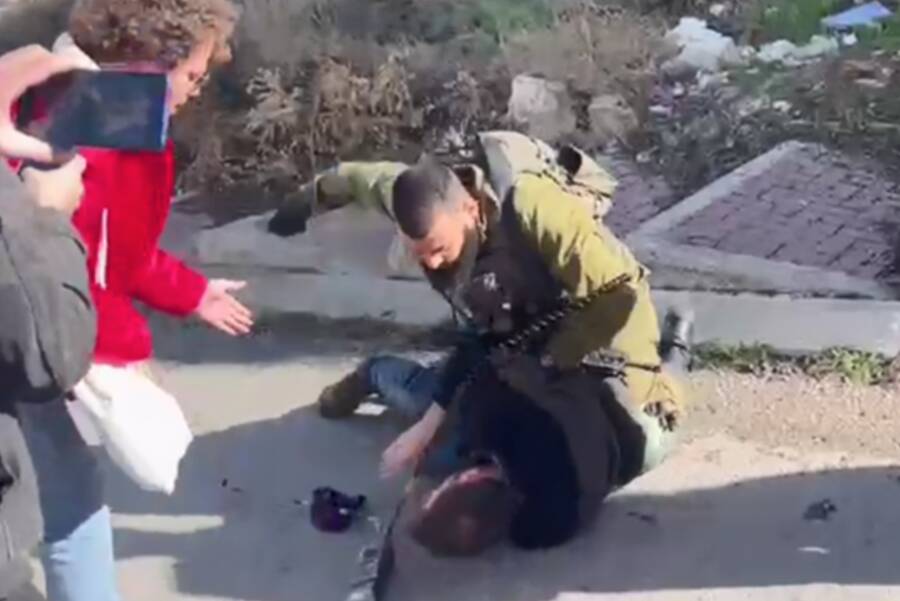
An Israeli soldier assaults a left-wing Israeli Jewish activist in Hebron in the occupied West Bank, November 25th, 2022.

Courtesy of Breaking the Silence

ON FRIDAY, November 25th, Israeli soldiers verbally and physically attacked left-wing religious Jewish activists—Israeli citizens—in the city of Hebron in the occupied West Bank. One of the soldiers taunted the activists, vowing that Itamar Ben-Gvir—the Kahanist lawmaker who is expected to become Minister of National Security in Israel’s new right-wing government—would “make order here.” “You’re through,” the soldier promised. Another soldier put one of the activists in a chokehold, punched him in the face, and stuck a loaded gun in his back. “They were like thugs with guns,” Mikhael Manekin, a longtime activist who was present on the scene, told +972 Magazine.

The assault stoked a national debate over the position of the Israeli armed forces in society and politics—raising basic questions about what they should be allowed to say and do. Aviv Kochavi, IDF chief of staff, wrote a public letter denouncing the soldiers’ behavior. Two soldiers were suspended. The one who taunted the activist was sentenced to 10 days in military prison by his commander, a punishment Avner Gvaryahu of the veterans’ organization Breaking the Silence called “a slap on the wrist” in an interview with Jewish Currents. Ben-Gvir, on the other hand, decried the punishment as “not reasonable,” “disproportionate,” and “inappropriate.” The soldier who punched the activist is currently awaiting military trial.

The public split between Kochavi and Ben-Gvir showcased an increasingly dramatic ideological and socioeconomic cleavage in Israeli society. “Kochavi is perceived as a symbol of the army of high-tech,” Manekin said—that is, the army of the elite, who tend to fill the IDF’s intelligence and cyberwarfare units. Meanwhile, “Ben-Gvir—who didn’t even serve in the army—is the symbol of the ground troops.” (Ben-Gvir was exempted from service due to his extremist views and association with the Jewish supremacist activist Meir Kahane.) In other words, from the standpoint of many enlisted soldiers, Ben-Gvir stands for the little guy—and for empowering the little guy to act with impunity. He campaigned on making the army’s already lax open-fire rules even more permissive, and on granting soldiers immunity from prosecution should they commit violent crimes against Palestinains. Last month he put his position bluntly: “If they throw stones, shoot them.”

Ziv Stahl, executive director of Yesh Din, an organization that tracks human rights violations in the West Bank, agrees that Ben-Gvir’s rise encourages violence. “A soldier that knows he can do whatever he wants and no one will prosecute him, no one will hold him accountable, will likely use violence more easily than before,” she said in an interview with Jewish Currents. Stahl believes that this atmospheric shift has already led to the use of more lethal force on the ground. She noted that in the last month, there has been “a definite rise in Palestinian death from lethal injuries.” Back in October, the UN Mideast envoy said that 2022 is on course to be the deadliest year for Palestinians in the West Bank since the institution started tracking fatalities in 2005. The UN’s latest figures, which run through the third week of November, count 168 Palestinians killed by Israelis so far this year, including more than 130 in the West Bank; media and human rights organizations report at least ten more killed in the West Bank in the past week alone.

The attack on the activists occurred on the heels of a coalition deal, signed by presumptive Prime Minister Benjamin Netanyahu, that also pitted Ben-Gvir against Israel’s top military brass. The agreement grants Ben-Gvir authority over parts of the Border Police which had previously operated in the West Bank under the authority of IDF leadership. In other words, Ben-Gvir’s authority over the Border Police fractures the military’s monopoly on power in the West Bank. Benny Gantz, Israel’s outgoing Minister of Defense and former IDF chief of staff, warned that Ben-Gvir’s newfound authority over the Border Police risked politicizing the entire security system and causing “serious harm,” likening the move to Ben-Gvir “establishing a personal militia.”

Meanwhile, many combat soldiers have celebrated Ben-Gvir’s ascent. Yagil Levy, professor of political sociology and public policy at the Open University of Israel, argues that Ben-Gvir’s message resonates in part because of a long-standing class divide within the IDF. The cyber and intelligence units that tend to be filled by the Israeli elite—who are often associated with the political center and left—provide an alternative to draft-dodging and a pathway to a career in Israel’s lucrative high-tech sector, Levy says. By contrast, the combat units that draw mainly from Israel’s socioeconomic and geographic periphery offer little prestige or professional benefit in exchange for doing the army’s dirty work. In a recent opinion piece for Haaretz, Levy wrote about the profound frustration of combat soldiers, who feel that they receive the blame when the army fails to prevent the deaths of soldiers, and complain that their “hands are tied” by the army’s rules of engagement. Levy says that these same combat soldiers see Ben-Gvir as their champion. “He treats them as castrated heroes, prevented from triumph by the politicians,” he said, and endows “blue-collar policing with the significance of a national mission . . . Suddenly these soldiers feel that their work matters, and they stand up straighter.”

Not only are Ben-Gvir’s new executive powers likely to influence the behavior of soldiers on the ground—they also serve to formalize a de facto one-state reality. This past Monday, Ben-Gvir’s running mate, Bezalel Smotrich, head of the Religious Zionism party, signed a separate coalition agreement with Netanyahu, which gives his party unprecedented power to appoint the heads of various bodies responsible for the government’s civil policy in the West Bank—bodies previously under the full authority of the army. Like Ben-Gvir’s coalition agreement, Smotrich’s agreement takes power away from the military and puts it into the hands of elected politicians. But the people governed by Israel in the West Bank did not elect Smotrich or Ben-Gvir. Nor, of course, did they elect Israel’s military commander, who has long acted as sovereign in the occupied territory. But the partial shift from military to political authority in the West Bank signals Ben-Gvir and Smotrich’s intentions to make Israeli domination there an official as well as de facto reality. As Stahl told me, when the keys to Palestinian lives are handed to Israeli politicians, it is “a big step towards annexation.”

Elisheva Goldberg is the media and policy director for the New Israel Fund and a contributing writer for Jewish Currents. She was an aide to former Israeli Foreign Minister Tzipi Livni and has written for The Daily Beast, The Forward, The New Republic, and The Atlantic.

2 earthquakes detected west of Port Hardy on Vancouver Island

Earthquakes Canada said there are no reports of any damage and none would be expected.

There was also no tsunami warning.

Click to play video: 'B.C. expands Alert Ready system'
B.C. expands Alert Ready system

In July, a study published by the Washington state Department of Natural Resources found that if a major earthquake were to happen along the Seattle Fault, tsunami waves could arrive in minutes in the Greater Seattle area.

University of Victoria assistant professor of earth and ocean sciences Lucinda Leonard gave her opinion on what B.C. would experience if a major earthquake occurred at the Seattle Fault.

“Thankfully, we are quite a bit further away from the Seattle Fault. We expect the tsunami would be a lot smaller by the time it reaches the shores in B.C., certainly less than one metre in height,” Leonard said.

The assistant professor said that although we most likely wouldn’t see large tsunami waves, there still would be impacts on the B.C. coast.

U.S. opposes Al Jazeera’s complaint to Israel at ICC over Shirin abu Akle’s death

The United States has expressed its opposition to the lawsuit filed Tuesday by the Qatari television network Al Jazeera against Israel before the International Criminal Court (ICC) for the death of Palestinian-American journalist Shirin abu Akle after being shot in the head during an operation by Israeli security forces in the West Bank city of Jenin.


File - A woman holding a photograph of Palestinian-American journalist Shirin abu Akle during a protest in Lebanon following her death during an Israeli operation in the West Bank. - Marwan Naamani/dpa© Provided by News 360

The U.S. State Department has announced that it is rejecting the move, hours after the request for an investigation was made public to the Hague-based court.

"We oppose it, in this case," Department spokesman Ned Price said in response to questions from reporters at a briefing Tuesday.

"We maintain our longstanding objections to the ICC's investigation of the Palestinian situation and the position that the ICC should focus on its core mission, which is to serve as a court of last resort to punish and deter atrocity crimes," the spokesman said.

Al-Jazeera confirmed in a statement that it "will send the case of Shirin abu Akle's death at the hands of Israeli occupation forces to the ICC in The Hague," before indicating that the decision "comes six months after the brutal murder of Shirin abu Akle."

Related video: Israel: Will not cooperate with U.S. probe into Abu Akleh's death
Duration 1:47   View on Watch


He stressed that during this period "Al-Jazeera's legal team has conducted a full and detailed investigation into the case and has found new evidence based on multiple witness statements, the examination of multiple video cuts and forensic evidence relating to the case".

The Hague Court later confirmed to CNN that it had received Al Jazeera's application under Article 15 of the Rome Statute.

In response to the Qatari television network's announcement, Israel's outgoing Prime Minister Yair Lapid stressed via his Twitter account that "no one will interrogate IDF soldiers and no one will give lessons on combat ethics, definitely not Al-Jazeera."

Along these lines, Israeli Defense Minister Benjamin Gantz noted that he "regrets the death of Shirin abu Akle, but it must be remembered that it was clearly a combat incident that was investigated in the most rigorous and thorough way (by Israel)".

For his part, the Palestinian Authority spokesman, Nabil abu Rudeina, recalled that Palestine is a party to the ICC and that "every Palestinian has the right to go to the court to judge the Israeli occupation for crimes that violate international law".

The journalist was shot dead on May 11 during an Israeli military operation in Jenin, while working for the Qatari television channel Al-Jazeera. The reporter was wearing a helmet and a vest identifying her as a journalist.

The findings of the independent investigation carried out by the United Nations Office for Human Rights into the journalist's death coincide with the assessment made by the Palestinian authorities and point to Israeli forces as responsible for the reporter's death.
Emperor king's top secret assassination letter finally decrypted after 500 years

Story by Harry Baker • Yesterday 

Researchers have finally cracked a complex code used in a top secret letter from 1547 that the Holy Roman Emperor and King of Spain, Charles V, wrote when he was fearing for his life. In the encrypted letter, which was sent to one of his ambassadors in France, Charles V writes about tensions with the French king Francis I, who he thought might be plotting to assassinate him.


null© Stanislas Library

Charles V, the King of Spain between 1516 and 1556, also ruled the Holy Roman Empire from 1519 to 1556. During his rule, Charles V presided over one of the largest empires in European history, which covered modern day Spain, Germany, Austria, Belgium, Netherlands and parts of Italy, and he also oversaw the Spanish colonization of the Americas.

In 1547, Charles V wrote a letter to his French ambassador Jean de Saint-Mauris. The document, which is dated Feb. 22, contains several paragraphs in normal handwriting interspersed by large sections of unrecognizable symbols — a secret code intended to hide sensitive information. The letter is now part of the archives at the Stanislas Library in Nancy, a city in eastern France, where it has remained untouched for centuries.

The letter, rediscovered by library staff in 2019, later came to the attention of a team of cryptographers and computer scientists who took it upon themselves to uncover the coded section of the document. Now, after more than six months of "painstaking" research, the code has been cracked, the team announced Nov. 23 at a press conference at the Stanislas Library.

"It's rare as a historian to manage to read a letter that no one had managed to read for five centuries," project researcher Camille Desenclos, a historian at the University of Picardy Jules Verne in France, said at the press conference.


Cracking the Real Da Vinci Code
Duration 5:36


The code used by Charles V was hard to decipher for two main reasons, according to a statement translated from French.

First, each symbol represented a whole word, rather than being a simple letter-for-letter encryption, which would have been much easier to work out. Second, some of the symbols were decoys that meant absolutely nothing, which were likely added to throw off anyone who had knowledge of the code and tried to read the letter.

The researchers began the investigation with a simple computer program designed to help them differentiate the symbols and understand the structure of the writing. However, this proved fruitless and the team was forced to create a more advanced algorithm that could use patterns in the symbols to determine probable meanings and highlight probable decoy symbols. The new algorithm helped uncover some of the hidden passage but could not decipher the entire section, the researchers wrote in the statement. But luckily, the team was able to find part of a decryption code in a separate letter written by Jean de Saint-Mauris to another ambassador serving Charles V, which helped to fill in the gaps.


The fully-transcribed letter highlights a "fragile peace" between Charles V and France, the researchers wrote. The contemporary tensions between France and Spain originated back to the Italian War of 1494 to 1495, before either Charles V or Francis I had come to power. During the war, Spain had occupied a northeastern region of Italy known as Piedmont, which bordered France to the east. This unsettled the French because Spain could easily attack from Piedmont if it decided to invade France.

Charles V's letter was written shortly after the death of England's King Henry VIII, who was an important ally of Francis I. Fearing that Henry VIII's death might destabilize France and cause its leaders to act irrationally, Charles V encouraged Saint-Mauris to do everything possible to maintain the peace between the two nations.

However, Charles V also wrote that he had heard of a rumor that someone high up in French politics had been petitioning Francis I to assassinate him, and so asked Saint-Mauris to investigate further. This is the first and only mention of this assassination plot historians have ever unearthed, and although the rumor Charles V heard was likely false, it is still an important new piece of cryptography, the researchers wrote.

Related: Charles Darwin's stolen 'tree of life' notebooks returned after 20 years

The letter also mentions a group of Charles V's advisories known as the "Schmalkaldic league," which was led by a group of German Lutheran princes who opposed the religious rulings imposed on them by the Catholic Holy Roman Empire. At the time the letter was written, Charles V had already started a military operation to bring the league to heel, the researchers wrote.

But despite Charles V's suspicions about his various enemies, 1547 ended up being a good year for the Spanish ruler. By the end of the year, Francis I had died and the Schmalkaldic league had been disbanded, which left him in a much stronger position, the researcher wrote.

With the decoded 1547 letter in hand, the researchers now hope to crack more codes within other encrypted letters written by Charles V. These types of correspondences give a rare "snapshot of Charles V's strategy in Europe," Desenclos said. "It is likely that we will make many more discoveries in the coming years."
Ancient mummy portraits and rare Isis-Aphrodite idol discovered in Egypt

Story by Owen Jarus • Yesterday 

Archaeologists have discovered ancient mummies buried with stunning, lifelike portraits of the deceased. The mummies were interred in a cemetery at the ancient city of Philadelphia in Egypt, the Egyptian Ministry of Tourism and Antiquities announced on Dec 1.


One of the newfound mummy portraits, seen here, is painted on a linen shroud.
 Courtesy Egyptian Ministry of Tourism and Antiquities

The city of Philadelphia, located about 75 miles (120 kilometers) southwest of Cairo in the Fayoum area of Egypt, was founded during the Ptolemaic period (304 B.C. to 30 B.C.), when Egypt was ruled by a dynasty of pharaohs descended from one of Alexander the Great's generals. Philadelphia — Greek for the city of brotherly love — continued to flourish even after the dynasty fell and the Romans took control of Egypt.

During excavations at the ancient site's necropolis, archaeologists unearthed two complete mummy portraits, along with semi-complete and incomplete portraits, Basem Gehad, director of the ancient Philadelphia necropolis excavation mission, told Live Science in an email.

The "people who were buried in such a context in Philadelphia are for sure upper-middle class or elite so that they could offer to their relatives [such] expensive portraits that are identical to the person," Gehad said. The portraits were painted by artists who were likely from Alexandria, an Egyptian city on the Mediterranean coast, Gehad said.

Mummy portraits

Archaeologists rarely find mummy portraits. Prior to the new discoveries, the last mummy portraits found in archaeological excavations were unearthed in the 1880s. Grave robbers looted ancient cemeteries, including Philadelphia's, for their mummy portraits during the 19th century. However, archaeologists did manage to analyze some of the Philadelphia graves.

"The cemetery was looted in the 1880s for Roman mummy portraits, most of which were sold to the Viennese dealer and collector Theodor Graf," Susan Walker, an honorary curator of the Ashmolean Museum at the University of Oxford, told Live Science in an email. "He catalogued and organised exhibitions of them world-wide, with the result that the portraits are now dispersed in museum and private collections, principally throughout America and Europe."

Walker, who was not involved in the excavations, told Live Science that the new discoveries may shed more light on Egyptian mummy portraits, as the new finds were examined with modern scientific methods. "As a result of the new excavations, we shall certainly have a better understanding of the cemetery that the looted portraits came from," Walker said.

In addition to the mummy portraits, archaeologists found the remains of a building where mummies were buried and a statue that depicts Isis-Aphrodite, an Egyptian-Greek goddess associated with love. They also unearthed the remains of papyri containing demotic (an Egyptian cursive script) and Greek writings. The papyri contain information on the social, economic and religious conditions of the people who lived in the area, the ministry said in a statement.

Excavations at the cemetery and analysis of the finds are ongoing.

Stunning necklace found at burial site of powerful Anglo-Saxon woman

Story by Katie Hunt • Yesterday 

Archaeologists have discovered a stunning 1,300-year-old necklace, made of gold, garnets and other semiprecious stones, at an excavation site in central England earmarked for a housing development.

The necklace and other precious objects, called the Harpole Treasure after the local parish in Northamptonshire county where they were unearthed in April, also revealed a powerful role played by some women in Anglo-Saxon England.

The jewelry piece was buried with a woman of high status, who died between 630 AD and 670 AD, according to researchers at the Museum of London Archaeology who unearthed the treasure. The trove also included a relatively large silver cross, two decorated pots and a shallow copper dish.

The Anglo-Saxon bling suggested the woman was powerful in her own right and extremely devout, perhaps an early Christian leader, a princess or an abbess.

The grave site is thought to be the most significant burial from a unique sliver of English history when pagan and Christian beliefs intermingled and women held powerful positions in the early church.

The discovery’s importance, the archaeologists said, was of a similar magnitude to that of other monumental Anglo-Saxon treasures unearthed in England, such as Basil Brown’s famed find in 1939 at Sutton Hoo, where a warrior king was buried in a ship, and the Staffordshire Hoard of gold and silver artifacts, discovered in 2009 by an amateur metal detectorist in a field in Staffordshire, England.

About a dozen other high-status female burials, known as bed burials, have been discovered elsewhere in England. In some cases, the grave sites included similar necklaces.

Few of these burial sites date back earlier than the 7th century AD, when burials of high-status men were more common, and as Christianity took root, later graves rarely featured valuable objects because being buried with ornate jewelry, such as the necklace, was frowned upon by the early Christian Church, said Lyn Blackmore, a senior finds specialist at MOLA.

“The Harpole Treasure, it’s not the richest (bed burial) in terms of the number of artifacts but it is the richest in terms of investment of wealth … and it has the highest amount of gold and religious symbolism,” she said at a news briefing.

X-rays taken of blocks of soil removed from the grave site revealed an ornately decorated but delicate cross cast in silver and mounted on wood. The artifact also had unusual depictions of human faces cast in silver.

Organic matter found in the grave is thought to contain fragments of feathers and textiles like leather, and further study should uncover the nature of the bed burial and whether it had a cover or canopy. The two pots were Frankish in style, Blackmore said, suggesting they came from what is now France or Belgium. The archaeologists hope molecular analysis will allow them to identify the residue in the pots; to date, their analysis has ruled out myrrh.

The skeleton itself was fully decomposed, with the exception of tiny fragments of tooth enamel, but the necklace and other features of the burial convinced the archaeologists that its occupant was female, Blackmore said.

Opulent gold riches


The discovery was made on April 11 but was made public for the first time on Tuesday.

The necklace is the most ostentatious of its type ever to be found in Great Britain, with 30 pendants and beads made of gold, garnets, glass and semiprecious stones strung together along with Roman coins. The striking artifact was found on the penultimate day of an eight-week excavation, said Levente-Bence Balázs, the MOLA site supervisor who first spotted the treasure glinting in the soil.

He was excavating what was thought to be a rubbish pit when he came across the crowns of two teeth, which signaled a burial of some sort. He then saw the rectangular pendant that formed the center of the necklace.

“In 17 years of excavating sites, this was the first time I’ve found gold. It’s not just the artifacts, it’s the sheer magnitude of the find,” he said.

The excavation work was funded by the house-building company Vistry Group, which said it had waived any rights to the the artifacts that now belong to the state.

The first occupants of the housing development are due to move into their homes in two weeks’ time and don’t yet know about the treasure that lies beneath their community, said Daniel Oliver, regional technical director at Vistry West Midlands. Nothing has been built on the precise location of the burial, which isn’t being made public, he added.

The area where the burial site was found was otherwise unremarkable, with no mounds or other features marking the grave. Archaeologists who worked at the site said they have surveyed the area thoroughly and are confident there is nothing else to find.

Officials at the Museum of London Archaeology said it would take at least two years to study the finds, but hoped the Harpole Treasure would eventually go on public display.

For more CNN news and newsletters create an account at CNN.com
100 million-year-old plesiosaur skeleton discovery 'could hold the key' to prehistoric research

Story by Kathleen Magramo • 2h ago

The discovery of a giant 100 million-year-old marine reptile’s skeleton in Australia has been hailed by researchers as a breakthrough that may provide vital clues about prehistoric life.

The remains of the 6-meter (19 feet) tall juvenile long-necked plesiosaur, also known as an elasmosaur, were found by a trio of amateur fossil hunters on a cattle station in the western Queensland outback in August.

Espen Knutsen, senior curator of palaeontology at the Queensland Museum, likened the discovery to that of the Rosetta Stone – the Ancient Egyptian block of granite rediscovered in 1799 that helped experts to decode hieroglyphics.

“We have never found a body and a head together and this could hold the key to future research in this field,” Knutsen said in a statement Wednesday that confirmed the discovery, adding it could give paleontologists greater insight into the origins, evolution and ecology of the cretaceous period in the region.

“Because these plesiosaurs were two-thirds neck, often the head would be separated from the body after death, which makes it very hard to find a fossil preserving both together,” he said.

The discovery was made by amateur paleontologists known as the “Rock Chicks” – Cassandra Prince, her sister Cynthia, and fellow fossil sleuth Sally, who goes only by her first name.


The skull of the 100 million-year-old plesiosaur found in Queensland, Australia
. - Queensland Museum

Related video: Palaeontologists find plesiosaur fossil in outback Queensland
Duration 1:34

Elasmosaurs, which grew to between 8 and 10 meters long, lived in the Eromanga Sea, which covered large parts of inland Australia with waters 50 meters deep about 150 million years ago.

Knutsen told CNN that when an elasmosaur died, its decomposing body would swell with gas that made it rise to the water’s surface, and often the head would break off when predators scavenged the carcass – making full-body discoveries rare.

He added that because the latest find was a young specimen it would shed light on how the body shape of elasmosaurs changed from youth to adulthood.

“We’re going to look at the chemistry of its teeth and that can tell us something about its ecology in terms of habitat as well, whether it was migrating throughout his life, or whether it was sort of staying in the same habitat, and also into its diet,” he said.

Ancient marine reptiles like plesiosaurs and ichthyosaurs are not classified as dinosaurs even though they lived around the same time. Plesiosaurs evolved from ancestors who lived on land and therefore didn’t have gills and had to surface occasionally for air. It remains unknown how long they could stay underwater.


Amateur fossil hunter Cassandra Prince with Espen Knutsen from the Queensland Museum. - Queensland Museum

It’s the latest big discovery about prehistory to have been made in Australia in recent years.

In June last year, scientists confirmed that the 2007 discovery of a fossilized skeleton in Queensland was the country’s largest dinosaur. The dinosaur, nicknamed “Cooper,” stood about two stories tall, and was as long as a basketball court.

Two months later, scientists discovered that there once was a species of flying “dragon” that soared over Australia 105 million years ago. The pterosaur was described by researchers as a “fearsome beast” that snacked on juvenile dinosaurs.

For more CNN news and newsletters create an account at CNN.com
Rare ice age fossils discovered on the drought-stricken Mississippi River

Story by Taylor Nicioli • Yesterday 

Recently exposed sandbars along the drought-stricken Mississippi River have caught the attention of fossil hunters, leading to two exceptional finds from a rare ice age species.

Wiley Prewitt was exploring a newly exposed area on October 26 when he came across a rather large tooth poking out of the sand. The Oxford, Mississippi, resident would soon learn it was a fossilized jawbone from a giant American lion, a species that has been extinct for roughly 11,000 years.

“I knew immediately just by the shape of the teeth that it was a carnivore fossil, but of course, I did not know that it was (an American) lion. We all know about those, but you never dream that you’re going to find one,” Prewitt said. “I just couldn’t believe it. It was hitting the fossil lottery. ”


Rare ice age fossils discovered on the drought-stricken Mississippi River© Provided by CNNA rare American lion fossil has been discovered near the Mississippi River. The tooth, pictured, has a fragment of the jawbone still attached. - George Phillips/Mississippi Museum of Natural Science

The American lion was the largest extinct cat to live in North America during the last ice age, according to the National Park Service. Known by its scientific name, Panthera atrox, meaning “fearsome panther” in Latin, the species was 25% larger than a present-day African lion, standing at 4 feet tall at the shoulders and measuring 5 to 8 feet in length. American lions weighed between 500 to 800 pounds on average, although some of the biggest may have topped 1,000 pounds, the park service notes.

Three days after Prewitt’s find, the Mississippi Fossil and Artifact Symposium & Exhibition hosted an event featuring previously discovered American lion fossils. Prewitt took the fossil in the hope of having experts identify it, but he didn’t know how significant his find would be to understanding a little more about Mississippi’s past.

“When (Prewitt) whipped out that anterior portion of a lion jaw, I knew right away what it was,” said George Phillips, curator of paleontology at the Mississippi Museum of Natural Science, who was at the event. “Who would have thought in a million years that another lion fossil would show up, considering that they’re rare, at an event (in) which the theme was the American lion?”

While the fossil was not a complete jawbone, plenty was left to identify the specimen easily, Phillips said: It had a significant gap between the canine and the premolars that could only belong to the American lion. After observing other fossils from the same species at the event, Phillips said it was easy to narrow down the other carnivore possibilities and confirm that he was looking at another fossil from the lion.

Related video: This 'living fossil' went undetected for nearly 30,000 years
Duration 1:23


Rare ice age fossils discovered on the drought-stricken Mississippi River© Provided by CNNThe American lion stood 4 feet tall at the shoulders and measured 5 to 8 feet in length. A femur from the species is the newest addition to the MMNS collection. It is pictured next to other femurs of predators commonly found today. - George Phillips/Mississippi Museum of Natural Science

One week after that surprising discovery, a local wildlife officer pulled a large American lion femur from the river’s sediment, resulting in another fossil from the same scarce species being added to the museum’s collection, Phillips told CNN.

Carnivore fossils are much harder to find in comparison with their prey counterparts, according to Phillips. Two American lion bone discoveries within a week or so is unbelievable, he said, calling it “just an incredibly rare fossil.”

A growing American lion collection

Prewitt plans to donate the fossil he found to the museum in Jackson, which would make it the fourth addition to the institution’s collection of American lion bones, counting the addition of the newly found femur.

“The interesting thing about the river is that every year is different. When the river comes up, the high water exposes different things and covers up other things. So here, you are always looking at new sites,” Prewitt said. “The fossils really make you contemplate deep time, and I think that, for me, that is really part of the magic of it.”


Rare ice age fossils discovered on the drought-stricken Mississippi River© Provided by CNNThe first fossil of the American lion was a lower jawbone, found in Natchez, Mississippi, in 1836. It was identified nearly 20 years later by paleontologist Joseph Leidy. - George Phillips/Mississippi Museum of Natural Science

The first fossil of the American lion was found in Natchez, Mississippi, in 1836, but paleontologist Joseph Leidy didn’t identify it until nearly 20 years later. Leidy found that the fossil, a lower jawbone, belonged to a never-before-discovered species. It was larger than the extinct European cave lion, the largest known member of the cat family at the time. Before then, it was unknown that giant lions had roamed North America.

“I think people take greater pride in an area when they realize that something like this exists — some aspect of the antiquity of the area where they live,” Phillips said. “Archaeologists try to do the same thing, to show that there were people that were here before you. Well, there are also extinct, weird-looking creatures that were here before you.”

For more CNN news and newsletters create an account at CNN.com
Quarter of a million unemployed young Britons are planning to NEVER get a job, survey shows

Story by Connor Stringer • Yesterday 

Almost a quarter of a million young people who are currently not working say they never plan to get a job, a survey has revealed.

The poll of 18 to 24-year-olds found that a staggering 227,000 youngsters currently out of a job or not studying claim they never intend to enter the labour market.


The research also found that almost a third (30 per cent) don’t think they will ever be able to achieve their career ambitions.

The apprehension is highest among those who are currently not working (35 per cent) and those who have faced difficulties in their early lives.

It was not made clear why so many young people say that they do not intend to find work.

The research, in which 5,000 young people were questioned, was carried out by educational organisation City and Guilds.


Almost a quarter of a million young people who are currently not working say they never plan to get a job, a survey has revealed. Tory MP Craig MacKinlay, pictured, said it ‘cannot be right’ that taxpayers could pay for a lifetime of support ‘for those not wishing to take the natural step into work and self-sufficiency’© Provided by Daily Mail

Tory MP Craig MacKinlay said: ‘At a time of bouyant job opportunities it is truly worrying that many young people have switched themselves out of the jobs market, with many waiting for the “dream job” that may not arise. Entry into any job is the pathway to a better one.’

Mr MacKinlay added that it ‘cannot be right’ that taxpayers could pay for a lifetime of support ‘for those not wishing to take the natural step into work and self-sufficiency’.


The MP added: ‘Perhaps it is time that benefit sanctions were introduced with real bite.’ City and Guilds CEO Kirstie Donnelly said those young people who face ‘additional challenges’ are falling behind their peers.

She said: ‘High youth unemployment has been an issue for more than a decade and the pandemic was just another challenge heaped on to an already creaking system that makes it incredibly difficult for young people to convert their aspirations into good jobs.’


Two thirds (64 per cent) of young people said that it is not easy to get a good job, and nearly a third (29 per cent) said they have struggled to get interviews. [File image] © Provided by Daily Mail

Two thirds (64 per cent) of young people say that it is not easy to get a good job, and nearly a third (29 per cent) say they have struggled to get interviews.

Miss Donnelly added: ‘If we don’t open doors for young people from all backgrounds to enter the labour market, and invest in their skills, we are losing out on all of that talent and creativity.

‘If we don’t fix this now, we risk storing up more problems for generations to come, exacerbating productivity shortfalls and social inequalities.’