Monday, March 18, 2024

Nippon Steel Defends US STEEL Deal After Biden Comes Out Against Bid

Joe Deaux and Shoko Oda
Fri, March 15, 2024 


(Bloomberg) -- Nippon Steel Corp. said it’s determined to complete its $14.1 billion acquisition of United States Steel Corp., even after President Joe Biden stated the company should stay in US hands.

In the wake of Biden’s comments, Japan’s largest steelmaker repeated its previous offer of an additional $1.4 billion in investment and a promise of no layoffs or plant closures, according to a statement on Friday.

While Biden stopped short of saying he would block the takeover, his statement on Thursday marked a rare presidential intervention in a transaction that outside an election year would have drawn less political scrutiny. Nippon Steel is doubling down on its bid for its iconic US rival just as opposition from the White House threatens to become insurmountable to getting the deal done.

The US also risks upsetting relations with a key ally. Japanese Prime Minister Fumio Kishida is due to hold a summit with Biden in Washington on April 10, where security cooperation will be on the agenda, but the US Steel issue is set to cloud the meeting.

“US domestic politics is defining what should be up to two private companies to decide,” said Shihoko Goto, director of the Asia Program at the Wilson Center in Washington DC. “The US Steel/Nippon Steel debate is also driving a harmful wedge between otherwise solid partner nations,” she wrote in a post on X, the social media site formerly known as Twitter.

Another Bidder


In the wings is the possibility of another bid for US Steel from Cleveland-Cliffs Inc. Earlier on Thursday, Chief Executive Officer Lourenco Goncalves said he’d consider making an offer — with union support — albeit at a significantly lower price than Nippon Steel’s proposal. US Steel rejected an earlier bid from Cleveland-Cliffs.

Nippon Steel’s shares fell slightly in Tokyo after an initial advance following its statement.

But a plunge in US Steel’s shares shows that investors are increasingly concerned about the future of the Japanese deal. The stock slumped as much as 11% on Thursday to $36.38, but pared losses after Goncalves’ comments, closing at $38.26. Its shares have dropped 18% in two days and are trading sharply below Nippon Steel’s offer of $55 per share.

Despite its storied history, US Steel’s role in the economy has diminished over several decades, a period during which producers in Asia have risen to dominate the global steel market. And while Nippon Steel’s proposed acquisition targets a historic business name, a takeover in the US commodities industry by a company based in a friendly country is hardly unusual.

Biden’s comments have also shone a fresh light on the influential position held by the United Steelworkers union and its leader, David McCall. Biden called McCall Thursday morning, reiterating that “he has the steelworkers’ back,” the White House said in a statement. For its part, the union welcomed Biden’s call for US Steel to remain domestically owned and operated, saying that the president’s comments should “end the debate,” according to a statement on Thursday.

Nippon Steel initially said in its statement on Friday that there would be no layoffs or plant closures until at least September 2026. That date was deleted in an updated statement later in the day so that the wording is “more appropriate,” according to a spokesperson.

Standalone Company


The political opposition to the deal means it’s increasingly likely that US Steel will end up as a standalone company, according to a note from Wolfe Research. Another possibility is that “a deal still goes through but after the election and likely with concessions to the union,” it said.

Finding a compromise with the union could give Nippon Steel a chance of success, said Takeshi Irisawa, analyst at Tachibana Securities Co. That would help give Biden the cover he would need to walk back his comments on American ownership.

Japan’s top government spokesman, Yoshimasa Hayashi, said at a briefing on Friday that the government is aware of the president’s statement on US Steel but wouldn’t comment on individual companies.

“In any case, the US-Japan alliance is stronger than ever,” said Hayashi. “Japan and the US will continue to work together on the realization of sustainable and inclusive growth and the maintenance and strengthening of a rules-based free and open economic order in the Indo-Pacific.”

Others were less sanguine.

“This throws sand in the wheels of U.S.-Japan economic cooperation,” Mireya Solis, director of the Center for Asia Policy Studies at Brookings Institution, posted on X. “Who will believe us when we appeal to the spirit of ‘friend-shoring’?”

--With assistance from Ryotaro Nakamaru, Jon Herskovitz, Yoshiaki Nohara and Isabel Reynolds.

(Includes an update of Nippon Steel’s comment in second paragraph)
Uber, Lyft to stop operations in Minneapolis over minimum wage law

Reuters
Fri, March 15, 2024 


(Reuters) - Uber Technologies and Lyft said on Friday they will stop operations in Minneapolis starting May 1 after the city's council paved the path for rideshare drivers to be paid a minimum wage.

The council voted 10-3 to override Mayor Jacob Frey's veto, ensuring rideshare drivers in the city are paid $15.57 an hour.

"We are disappointed the Council chose to ignore the data and kick Uber out of the Twin Cities, putting 10,000 people out of work and leaving many stranded," Uber said.

Meanwhile, smaller rival Lyft, calling the bill "deeply-flawed", said it hopes to return to Minneapolis as it advocates for a statewide solution in Minnesota.

This comes after rideshare and delivery drivers staged a protest on Valentine's Day this year demanding fair pay and working conditions.

The New York Attorney General's office said in November that Uber will pay $290 million and Lyft will pay $38 million to resolve a multi-year investigation into the companies, calling it the largest wage theft settlement in her office's history.

A study by the Minnesota state's Department of Labor and Industry published last week said the companies are unlikely to hike prices to levels that would significantly reduce consumer demand and commissions, adding that such an outcome was unlikely.

(Reporting by Akash Sriram in Bengaluru; Editing by Maju Samuel)
Kentucky GOP moves to criminalize interference with legislature after transgender protests

BRUCE SCHREINER
Fri, March 15, 2024 


Supporters of Senate bill 150, known as the Transgender Health Bill gather in the Rotunda of the Kentucky State Capitol as protesters look on from the balcony on March 29, 2023, in Frankfort, Ky. Protests at Kentucky's Capitol can seem as commonplace — and noisy — as basketball pep rallies when the Republican-led legislature is considering bills that stir the emotions of activists opposing them. (AP Photo/Timothy D. Easley, File)


FRANKFORT, Ky. (AP) — Kentucky’s Republican-supermajority legislature is taking steps to criminalize disruptive protests inside the Capitol, raising concerns among advocates that their right to challenge authority will be chilled.

Before big votes on polarizing issues, throngs of protesters have waved signs and shouted out synchronized chants at the foot of the steps that lawmakers climb to reach the House or Senate chambers, creating a din that echoes throughout the ornate statehouse. Activists sometimes pack committee rooms in the Capitol Annex or crowd the galleries to monitor floor debates.

Teachers, union members and abortion-rights supporters have staged massive demonstrations, but it was a protest against anti-transgender legislation — which resulted in the arrests of some demonstrators on criminal trespassing charges last year — that prompted the Kentucky House this week to approve new criminal offenses for interfering with legislative proceedings. The bill is now pending in the Senate.

Republican state Rep. John Blanton considers protesting to be “as American as apple pie,” and “part of the foundation of who we are and I’m fully supportive of that.” But he said there should be consequences when demonstrators “cross the line” and become disruptive.

“The purpose of House Bill 626 is to ensure that the General Assembly has an opportunity to legislate without interference from people who wish to prevent us from doing our work on behalf of our constituents,” Blanton said.

Other state legislatures also have criminalized disruptions. Georgia has a law, challenged in court, making a third such offense a felony. Until 2020 in Kansas, people who wanted to stage an event at the statehouse, including a protest, had to have a legislative sponsor and permit, and handheld signs were banned. The rules were relaxed after a lawsuit, allowing handheld signs as long as people don't attach them to a wall or railing. A permit or sponsor isn't needed unless someone wants to reserve a specific space like a committee room.

Under the Kentucky bill, “disorderly or disruptive conduct” intended to disrupt or prevent lawmakers from doing business would be a misdemeanor for a first offense and a felony for repeat offenses. The offenses also include impeding a lawmaker or aide from entering a legislative room or refusing to leave a legislative facility with the intent to prevent lawmakers from doing business.

Activists worry it could chill their rights to challenge authority.

“When lawmakers are willfully stripping away civil rights, what other avenues do Kentuckians have but to protest their actions?” said Chris Hartman, executive director of the Fairness Campaign, a Kentucky-based LGBTQ+ advocacy group that led opposition to the anti-transgender bill.

ACLU of Kentucky legal director Corey Shapiro said he's concerned that "people could be arrested for simply expressing their opinions to legislators.”

Lawmakers can generally criminalize actions impeding their orderly business, provided that “reasonable alternative avenues of speech” are available, said University of Kentucky constitutional law professor Joshua Douglas.

“My concern with the bill is that it does not define ‘disorderly or disruptive conduct,’ so it could be seen as too vague under the First Amendment,” Douglas said. “Laws that limit speech must be written very precisely so it is clear what speech conduct is prohibited for a good enough governmental purpose.”

Twenty years ago, when Democrats still controlled the House, hundreds of hymn-singing protesters exhorted lawmakers to support a constitutional amendment barring same-sex marriages, which voters then approved overwhelmingly.

Now the backlash is against Republican bills. Teachers thronged the Capitol a few years ago to protest pension legislation and other measures they considered to be anti-public education. Abortion-rights supporters spoke out, to no avail, as GOP lawmakers passed anti-abortion laws, culminating in the state's near-total ban.

Tensions boiled over last year when the House overrode Democratic Gov. Andy Beshear's veto of the bill banning access to gender-affirming health care for young transgender people. As prolonged chants rang out from the gallery, nearly 20 protesters were removed and charged with third-degree criminal trespassing.

“There were many of you that had your buttons to push last year that wanted to speak, that had your voices for your constituents silenced,” Blanton said to his House colleagues on Monday. “Because we just had to move on and take the vote, it got so out of control. So they were trying to impede our process.”

Blanton, a retired state police major, said the proposed new criminal offenses would be a better fit than trespassing statutes, since the Capitol is a public place. Of the 19 people arrested last year, only one has gone to trial, and was ordered to pay a $1 fine along with court costs. Four others pleaded guilty and the other cases are pending, according to the Lexington Herald-Leader.

As for how law enforcement officers would interpret a demonstrator's intent when enforcing the measure, their first response would be to observe and, if they can identify people being disruptive, ask them to leave, Blanton said.

“They’re not just going to go up there and randomly start arresting people,” Blanton said. “We’ve never seen that happen here.”

Such reassurances haven't eased the activists' concerns. “From my personal experience, state troopers are nothing but antsy when it comes to protesters,” Hartman said.

___

Associated Press Writers Jeff Amy in Atlanta and John Hanna in Topeka, Kansas, contributed to this report.

Officials surprised after ancient lake in Death Valley re-emerges: 'This is an extremely rare event'

Doric Sam
Mon, March 18, 2024 


Heavy precipitation from Hurricane Hilary led to the reemergence of a famed ancient lake in Southern California last year, and officials are blown away by how long the lake has persisted.

Park ranger Abby Wines explained to ABC News last month that the legendary Badwater Basin at Death Valley National Park began filling up with water when the tropical storm brought several rounds of extreme rain to the area. The area has seen more precipitation after Hilary and the lake has yet to evaporate, remaining in place much longer than initially expected with no timetable for when it will be gone.

Death Valley is the driest place in North America, typically seeing just two inches of rain per year, and that amount was exceeded in a single day on Aug. 20. ABC News noted that records show nearly five inches of rain came to the region within the past six months.

At a full 282 feet below sea level, Badwater Basin is at the lowest elevation in North America. The basin is devoid of obvious life and endorheic, meaning that water only flows into it and not out of it.

The last time the lake filled up was 2005, but Wines said it only took a week after it formed to dry up and hadn't formed again for nearly 18 years because of the evaporation rate in the desert. Satellite images showed the lake went from having no water on July 5 to being flooded with water from August through February.

"You might think with no drain to the sea, that Death Valley would always have a lake," Wines said. "But this is an extremely rare event. Normally the amount of water flowing in is much less than the evaporation rate."

At 6 miles long, 3 miles wide and 1 foot deep, the lake is deep enough to kayak in, which Wines called a "rare opportunity." Visitors to the park enjoyed the beautiful reflections of the surrounding mountain peaks in the water in the basin.

Similarly, Hurricane Hilary raised the level of Lake Mead to its highest point in 2023. Lake conservation is crucial for maintaining biodiversity, preserving food and water supplies, and combating the effects of our planet's overheating. For example, Mono Lake in California was restored from the brink of destruction because of water being diverted to Los Angeles and now has a thriving, unique ecosystem and serves as a beacon of hope for other conservation efforts.

The Panama Canal Averts a Crisis for Now— But at a Cost to Drinking Water

Peter Millard, Michael McDonald and Eric Roston
Fri, March 15, 2024 


(Bloomberg) -- The Panama Canal has avoided the worst of a shipping crunch that threatened to upend the global economy — but at a cost to marine life and the Latin American country’s supplies of drinking water.

After imposing strict limits on vessel traffic last year as drought left water levels languishing, the Panama Canal Authority is increasing the number of ships that can cross. Thanks to conservation measures, water levels fell just over a foot for the year through March 12, compared with three feet during the same period of 2023.

Those measures, though, come with side effects. The canal recycles water from locks that vessels pass through, instead of simply flushing it into the ocean. This reused water gets saltier, and some of it infiltrates Lake Gatún, an artificial lake that forms part of the channel and is also Panama’s largest source of potable supply.

The Panama Canal’s challenges highlight how combating climate change carries inevitable tradeoffs. As policymakers take action to limit the effects of global warming, there can be unintended consequences for the environment and the economy. And time is of the essence: Drought is already altering the world’s trade flows, creating chokepoints last year on the Mississippi River in the US and the Rhine in Europe.

This year, Panama has had roughly two-thirds of its normal rainfall, said Fred Ogden, a former University of Wyoming civil engineering professor who has done extensive work in the country. Upgrades to the canal have made the situation worse, because new locks opened in 2016 to accommodate bigger ships require more water.

Climate change means “things are changing at a pace that is basically surprising everyone,” Ogden said. The canal expansion has “increased the likelihood of drought restrictions. When you throw a drought on top of that — oh my gosh. What a mess.”

Read More: Fixing the Panama Canal Hinges on Expensive and Divisive Gamble


The Panama Canal’s low water levels and efforts to conserve what’s left have made Lake Gatún more salty. Salinity is at the highest since 2020, when the Smithsonian Tropical Research Institute began collecting data, and still growing, said Steve Paton, the director of the institute’s physical monitoring program.

The lake’s salinity shot up after the new set of locks was inaugurated in 2016. Up until that point it was 0.05 parts per thousand, and with the increased trade flows it quickly rose and reached 0.35 parts per thousand four years ago. It’s now nearing that level again and will probably hit or surpass it before the rainy season starts, Paton said.

The canal authority’s chief hydrologist, Erick Córdoba, said during an interview in November that finding new sources of freshwater will be critical to ensuring Panama can meet growing demand from the population, shippers and local industry. One plan is to create a new reservoir at a river valley near Lake Gatún to supply additional water. The canal is also looking to invest in more rainwater collection to help reduce salinity in the lake, he said.

Under normal circumstances, the Panama Canal handles about 3% of the world’s maritime trade volumes and 46% of containers moving from Northeast Asia to the US East Coast. Bottlenecks at the canal can ripple throughout the global economy, particularly as attacks by Houthis in the Red Sea add to shipping disruptions.

Last year, the El Niño weather pattern led to one of the driest years on record for the Panama Canal and forced it to slash transit. But El Niño is now fading, which means the rainy season should hit in late April or May, allowing the canal to ease shipping limits. The authority will allow 27 vessels a day to transit by late March, up from the current 24 but still well below the pre-drought capacity of 38.

“The forced reduction” in vessels “is having the desired effect of lowering total water consumption,” said Jorge Luis Quijano, a consultant and former chief executive officer of the canal authority. “However, it is difficult to predict if these favorable changes in weather will be enough to guarantee returning to 38 transits per day sometime later this year or next.”

Quijano said the canal could possibly increase to 30 or 32 vessels a day after the dry season ends, and then progressively raise the limit further if rainfall is favorable. In a statement on March 11, the canal authority said it’s monitoring water levels and will announce any further changes in a timely manner. It didn’t respond to additional requests for comment.

Other observers are more optimistic. Volumes could return to normal in three to five months, said Julia Junnan Zhao, principal data scientist at Dun and Bradstreet, a global data and analytics provider.

Any increase in vessels through the canal will come as a relief to shippers, some of whom paid millions of dollars to jump the queue while others took longer, costlier routes around Africa or South America.

In the meantime, the threats to drinking water and marine life remain. The canal authority’s strategy of recycling water could prompt marine species to start traveling between the Pacific and the Atlantic, disrupt coastal environments and even decimate fish stocks that communities along the Pacific and Caribbean rely on for food and tourism, Paton said.

Lionfish are an example of what can go wrong with invasive species. They are suspected to have escaped from aquariums along the US East Coast during floods and storms, and now threaten native fish populations in the Gulf of Mexico and the Caribbean. A new saltwater corridor could wreak similar havoc on both sides of Panama.

Signs of that shift are already emerging. As rising salinity reduces the barrier between the oceans, researchers are seeing an increasing number of marine species in Lake Gatún, Paton said.

It’s an example of the risks policymakers are grappling with as they confront the impact of climate change on freshwater supplies. Drought plagued regions all over the world last year, including the Americas, Africa and the Mediterranean.

The parched conditions have “given a big wake-up call to a lot of people,” Ogden said. “The future does not look bright for the consistency of water resources that we’ve been able to rely on up until now.”
India’s ‘Silicon Valley’ is running dry as residents urged to take fewer showers and use disposable cutlery

Rhea Mogul, Meenketan Jha and Sania Farooqui, CNN
Fri, March 15, 2024 

The water tanker arrives once every two weeks, its 1,000 liters expected to serve hundreds of people in this suburb of India’s most high-tech metropolis, where women carrying empty buckets come clamoring to quench their thirst.

The sight is not unusual says Susheela, a resident of the suburb of Bandepalya, who goes by one name and needs the water for her family of four. “Sometimes fights break out, there is a lot of arguing,” she said. “But what do we do? We need water. We are desperate.”

Susheela’s taps – like millions of others – in the southern city of Bengaluru have run dry and the borewells that supply water to her household are empty.

The tech hub, known as India’s “Silicon Valley” and home to giant multinationals like Infosys and Wipro, requires about 2 billion liters (528 million gallons) of water for its nearly 14 million residents every day. But those numbers dwindled to alarming levels, falling about 50% over the past week, according to the chairman of the city’s water supply and sewage board, V. Ram Prasat Manohar.

Residents have been advised to use water sparingly – encouraged to bathe on alternate days, use disposable cutlery, and limit washing clothes and utensils.

It’s a crisis that has been described as dire by those who live in Bengaluru – and experts warn it is only going to get worse as mercury levels climb in the lead up to summer.

“I have been warning about this for over a decade,” said climate scientist T.V. Ramachandra, from the Centre for Ecological Sciences. “It’s a culmination of unplanned urban growth, rapid deforestation and the ongoing climate crisis – and everyone is paying the price.”
From India’s garden city to dried up lakes

For decades, Bengaluru – also known as Bangalore – had a reputation for its wide network of man-made lakes that provided water to the city’s residents. The abundance of greenery and surrounding forests, boosted by its 900-meter (nearly 3,000 feet) elevation and pleasant climate, earned it the moniker “India’s garden city.”

But since the early 1990s, Bengaluru has undergone rapid urbanization, as its transformation into a major tech center resulted in exponential growth. Developers cut down the forests and built around its lakes as the city of about 4 million exploded to house more than three times that.

As layers of tarmac swept through the city, Bengaluru lost its ability to absorb water, Ramachandra said.

“Today 83% of Bangalore is covered in concrete,” he added. “There is no vegetation. There is no way that groundwater recharging can happen further to go to the underlying layers. This is a big problem.”

Rapid urbanization and the decline of waterbodies could also worsen the impact of the climate crisis, contributing to a rise in the city’s temperatures, Ramachandra warned.


The gardens of Karnataka Raj Bhavan, the residence of the state governor, in 2018. Bengaluru was once known as "India's Garden City." - Arijit Sen/Hindustan Times/Getty Images

More than 70% of the city’s water comes from the Cauvery River, a major waterway that flows through southern Karnataka state, of which Bengaluru is the capital.

But as the city expanded, authorities didn’t have enough time to extend its network of water pipes into the new neighborhoods, with these areas relying on groundwater extracted by borewells.

A weak monsoon last year depleted groundwater levels, causing a water shortage for the city’s huge population.

But for about 4 million of them who rely on the borewells and live mostly on the outskirts of the city, the situation is much worse. Some 7,000 of the city’s 16,000-odd borewells have run dry, according to Bengaluru’s Deputy Chief Minister D.K. Shivakumar – and experts say the focus should be on helping them.

“For the 11 million people (dependent on the Cauvery River), there’s a bit of scarcity but not too much of a crisis,” said civil engineer and Bengaluru-based water researcher Vishwanathan, who goes by one name.

“For the other three and a half million people who are completely dependent on groundwater, there is a crisis because groundwater is going dry.”

A cow walks across the arid Nallurahalli lake at Whitefield in Bengaluru on March 10, 2024. - Idrees Mohammed/AFP/Getty Images
‘Pushing families to the limit’

Residents from Bandepalya, a low-income community suburb in the city’s south, line up with buckets from 9 a.m., waiting for the water tanker to arrive.

Private tankers commissioned by the government distribute water to neighborhoods when river and groundwater levels run low, charging residents for the service and hiking prices when demand rises.

About four hours later, as the afternoon arrives in Bandepalya, so too does the tanker.

Scenes of chaos and anxiety follow as they hustle to fill their buckets and bring them home. Women try to fill two large buckets each to carry to their homes nearby. One woman begins to hit the vessel to check its water levels.

The tanker is emptied within minutes.

“We get water once in 15 days and have to buy water on a daily basis,” said resident Kumkum, who also goes by one name, from her home, adding that she is using bottled water to wash her children’s faces in the mornings.

Kumkum’s youngest child has fallen sick with a high fever because of the crisis.

“All these drums are empty and haven’t had water in them in days,” she said as she pointed to the empty buckets in her home. “We can’t wash our clothes or our utensils. We will catch rainwater just for our chores during the monsoon.”

People line up to collect drinking water during the ongoing crisis in Bengaluru on March 14, 2024. - Idress Mohammed/AFP/Getty Images

Authorities capped the price of such deliveries commissioned by the government at 1,200 rupees ($14) per tanker, but residents say they are struggling financially.

Susheela, the resident with the family of four, said people in Bandepalya typically earn between 6,000 – 8,000 rupees ($70 – 95) a month, and many of them have no choice but to now spend half their income buying water from the tankers.

“We are hardly bathing, using water so scarcely. But we are all struggling,” she said.

Geeta Menon, a social worker who works with low-income communities in Bengaluru said the crisis could give rise to diseases and illness as hygiene levels drop.

“Children are defecating on the streets as there’s no water at home, they’re going thirsty, people are unable to cook,” she said. “This is not just a short-term problem, but will have long-term repercussions if it continues.”

CNN has contacted Bengaluru’s Water Supply and Sewage Board but is yet to receive a response.
No one spared

While the city’s poorest are bearing the brunt of Bengaluru’s water crisis, it hasn’t spared the upper middle class either.

Management from many housing societies send daily updates to its residents, warning them of shortages and urging them to be careful with their water usage.

One apartment complex has sent a notice to its residents saying they must reduce their water usage by 50%.

“Water situation is very alarming!” the notice, seen by CNN, said. “We are hardly receiving any water through from Cauvery supply. We are fully dependable on borewell water. Out of the 11 borewells only 5 are operating. We have absolutely no way of knowing when these wells will get dry. There won’t be any notice period when it happens.”

The shortage has also forced garment factories to slow production while doubling restaurant water bills, according to Reuters. Managers at some global firms are letting some employees skip meetings to collect water from the tankers, it added.

The crisis has meanwhile turned into a political blame game, weeks before a national election, with India’s ruling Bharatiya Janata Party (BJP) protesting the state’s Congress-led government for its alleged mismanagement of the situation.

The main opposition Congress has claimed the BJP has not done enough at a federal level to help financially with the crisis.


Activists and BJP members hold empty water pots during a protest against the state government over the severe water crisis, in Bengaluru on March 12, 2024. - Idress Mohammed/AFP/Getty Images

Yet, for the city’s residents, the tit-for-tat arguments mean little as they experience the worst of the shortages.

For Maher Taj, a mother of seven, the past few weeks have been unbearable.

“We have cut down how many times we use the bathrooms and take turns to bathe,” she said.

“Our children are using the washrooms in their school and my husband is going at his workplace. I have reduced water usage in all aspects of life. It’s pushing my family to the limit.”
UNRWA chief says Israel blocks him from Gaza

Reuters
Updated Mon, March 18, 2024 


CAIRO (Reuters) -Israel denied the head of the U.N. Palestinian refugee agency (UNRWA) entry to the Gaza Strip on Monday, UNRWA and Egypt said, calling it an unprecedented move at a time of massive need.

Philippe Lazzarini, whose organisation has been in crisis since Israel accused 12 of its staff of taking part in Hamas' Oct. 7 attack on Israel, said he meant to go to the Gaza city of Rafah but was informed: "my entry into Rafah is declined".

Speaking with him at a Cairo news conference, Egyptian foreign minister Sameh Shoukry said: "You were declined by the Israeli government, refused the entry which is an unprecedented move for (a) representative at this high position".

The Israeli prime minister's office and foreign ministry did not immediately respond to a request for comment.

UNRWA is by far the largest relief body in Gaza, where the depth of the humanitarian crisis was underlined on Monday when a U.N.-backed report warned of imminent famine in the north.

"On the day new data is out on famine in #GAZA, the Israeli Authorities deny my entry to Gaza," Lazzarini wrote on X, adding that his visit was intended to improve humanitarian operations.

"This man-made starvation under our watch is a stain on our collective humanity."

Israel's ground and air offensive has laid waste to the Gaza Strip over the last five months, killing more than 31,000 people, according to health authorities in Hamas-run Gaza.

The offensive was triggered when Hamas fighters stormed into Israel in an attack that killed 1,200 people and resulted in another 253 being taken hostage, according to Israeli tallies.

FUNDING CRISIS

Israel alleged in January that 12 of UNRWA's 13,000 staff in Gaza took part in the Oct. 7 attack. The Israeli accusations led 16 countries including the United States to pause $450 million in funding, throwing UNRWA operations into crisis.

UNRWA fired some staff members, saying it acted in order to protect the agency's ability to deliver humanitarian assistance, and an independent internal U.N. investigation was launched.

Australia is one of several states which subsequently resumed funding. Its foreign minister said last week that Australia had consulted with UNRWA and other donors and was satisfied the agency was not a terrorist organisation.

UNRWA has condemned the Oct. 7 attacks, saying the Israeli allegations against the agency - if true - are a betrayal of U.N. values and of the people UNRWA serves.

UNRWA communications director Juliette Touma told Reuters Lazzarini had visited the Gaza Strip four times during the war, and numerous occasions before that.

"We were ready to leave this morning on an Egyptian plane from Cairo to El Arish," Touma said.

Lazzarini has previously warned of a campaign to end UNRWA operations. Israeli Prime Minister Benjamin Netanyahu has said UNRWA must be shut down.

In Cairo, the UNRWA head warned of a "race against the clock" to reverse the spread of hunger and avert famine. With political will, Gaza could be "flooded" with food via land crossings, he added.

He also said that more than 150 of UNRWA's facilities in Gaza have been hit, damaged or completely destroyed.

"We also know that a number of staff that have been arrested have gone through very tough investigation, ill-treatment and humiliation," Lazzarini said.

(Reporting by Sarah El Safty, Nayera Abdallah, Clauda Tanios, Tom Perry in Beirut, James Mackenzie and Emily Rose in Jerusalem; Writing by Tom Perry; Editing by William Maclean and Andrew Cawthorne)

UN agency chief says Israel blocked him from entering Gaza

AFP
Mon, March 18, 2024 

UNRWA Commissioner General Philippe Lazzarini said there is 'man-made starvation' in Gaza
 (Fabrice COFFRINI)

The head of the UN agency for Palestinian refugees said Monday Israel had blocked him from entering the war-torn and besieged Gaza Strip where the United Nations has warned of impending famine.

Israel responded that UNRWA chief Philippe Lazzarini had not followed proper procedure.

Lazzarini, who last month said Israel "aimed at destroying UNRWA," said he had "intended to go into Rafah today, but was informed my entry had been declined." He spoke in a Cairo joint press conference with Egypt's Foreign Minister Sameh Shoukry.

Israel in January accused several of UNRWA'S roughly 13,000 Gaza employees of being involved in the October 7 attack by Hamas militants on Israel.

Lazzarini wrote on X, formerly Twitter, that he had been denied entry by "Israeli authorities".

COGAT, an Israeli defence ministry body governing civilian affairs in the occupied Palestinian territories, said on X that Lazzarini had not followed "the necessary coordination processes and channels" when requesting entry into Gaza.

"This is another attempt by UNRWA to blame Israel for their own mistakes," it said of the UN agency at the centre of efforts to provide humanitarian relief in Gaza.

Farhan Haq, deputy spokesman for UN Secretary-General Antonio Guterres, said "all UN officials, including Mr Lazzarini and his colleagues in UNRWA, should have access to do the vital humanitarian work they do."

Guterres "certainly wants Mr Lazzarini to have access throughout the areas in which UNRWA operates", Haq told reporters.

The Israeli accusation against some UNRWA employees led multiple donor nations including the United States to suspend funding although some have since resumed or increased it including Spain, Canada and Australia.

Israeli government spokesman Avi Hyman earlier Monday reiterated what he called Israel's position, that "UNRWA is a front for Hamas".

Lazzarini has said that Israel provided no evidence against his former employees accused over the October 7 attack.

Shoukry expressed Cairo's "complete support" for the agency and criticised "unilateral actions to restrict UNRWA funding due to baseless accusations".

The Hamas attack of October 7 resulted in about 1,160 deaths in Israel, most of them civilians, according to an AFP tally based on official Israeli figures.

Israel's retaliatory campaign in Hamas-controlled Gaza has killed at least 31,726 people, mostly women and children, according to the territory's health ministry.

- 'Man-made starvation' -

Among the dead are 168 UNRWA employees, according to the agency's latest figures.

Lazzarini on Monday said the UN has paid a "massive price in Gaza".

"More than 150 of our facilities have been completely destroyed in the Gaza Strip," he said.

"And a number of our staff were arrested and endured ill-treatment and humiliation during investigation."

In more than five months of war and siege, the humanitarian situation in Gaza has deteriorated to what the UN has repeatedly warned is an imminent famine.

"This is man-made starvation," Lazzarini said.

The Gaza health ministry has in recent weeks recorded at least 27 deaths from malnutrition and dehydration, most of them children.

The UN said Monday that half of the territory's 2.4 million people are experiencing "catastrophic hunger and starvation".

Humanitarian aid operations have intensified in recent weeks, including airdrops and efforts for a maritime humanitarian corridor from Cyprus, but UN and other aid agencies warn that these are insufficient to meet the desperate needs in Gaza.

Israeli Foreign Minister Israel Katz, writing on X Monday, accused UNRWA of "collaboration" with Hamas and said "Israel allows extensive humanitarian aid into Gaza by land, air, and sea for anyone willing to help."

bam-bha/sbh/ami/it


Dossier reveals information used to explain UN agency's deep ties to Hamas in Gaza

Peter Aitken
Sun, March 17, 2024 

United Nations headquarters and flag juxtaposed with a picture of an Israeli woman kidnapped by Hamas terrorists.


FIRST ON FOX – Fox News Digital obtained a dossier that the Israeli government is said to have used to explain its concerns to the U.S. and other nations about its actions toward a controversial United Nations agency and its relationship with Hamas.

The United Nations Relief and Works Agency for Palestine Refugees in the Near East (known simply as UNRWA) lost hundreds of millions of dollars from donors after allegations surfaced that at least a dozen employees had ties to and assisted Hamas during the Oct. 7 attack on Israel.

The United States and several allies in January froze funding to UNRWA, and the agency fired the 12 employees named in the allegations. Since those initial allegations, the number has risen to potentially hundreds of employees with ties to Hamas.

The dossier reviewed by Fox News Digital includes an updated claim that the number of UNRWA employees directly involved in the Oct. 7 attack has risen to at least 15, with at least three suspected of being involved in the kidnapping of the hostages. This information, presented to ally nations by the Israeli government, allegedly prompted the countries to cut funding to the agency – an act that the majority have not reversed as of this week.

The information includes allegations that around 17% of UNRWA teachers (out of a total 8,300) and around 20% of UNRWA school principals and deputy principals (out of a total 500) are members of Hamas. Ties to the group extend to UNRWA workers in positions related to relief and humanitarian aid, with about 10% of the 151 relief workers, and members of UNRWA’s health services.

READ ON THE FOX NEWS APP

From 2009 to 2024, a little under $4 billion in taxpayer dollars was given to the humanitarian relief organization, according to a Fox News Digital review.

The most serious allegations claim that Hamas has representatives in the UNRWA staff union and influences it, and lines of communication exist at the district level between UNRWA’s district managers and Hamas. According to the information, "due to the scope of UNRWA's activity in the [Gaza Strip]," Hamas prioritizes its connection with UNRWA, stressing that "in steady state and in contingency state, the Hamas regime coordinates activities with UNRWA."

Satellite images reviewed by Fox News Digital show two boys' schools – the Maghazi Prep B Boys School and the Zaitun Prep A Boys School – that allegedly have Hamas tunnels underneath them. Both cases had resulted in UNRWA condemning potential violations of neutrality, but as of 2023 the tunnels remained open. Israel also identified several schools that stood next to rocket and mortar launch sites throughout the Gaza Strip.

GAZA STRIP RECEIVES NEARLY 200 TONS OF FOOD AND SUPPLIES, UN DESRIBES ‘HUGE OBSTACLES’ TO GETTING RELIEF

Israel has alleged logistical support and exploitation of UNRWA’s immunity, support through supplies and aid, sale of equipment that UNRWA imported to Hamas and the Palestinian Islamic Jihad (PIJ) weapons manufacturing units.

"Furthermore, Hamas assists UNRWA in securing the humanitarian aid that is introduced to the [Gaza Strip]," the dossier explains. "Hamas’ operatives coordinate the aid transfer for UNRWA via Hamas’ tactical network, and have operatives of the Military Wing escort and secure the convoys. UNRWA complies with Hamas’ demands in other areas, as well, such as transferring fuel and additional equipment."

The dossier also included excerpts from textbooks used in the agency’s school curriculum that allegedly include glorification of martyrdom and antisemitic tropes. Maps provided to children in their textbooks show a singular land where Israel and the Palestinian territories exist but labeled as a singular Palestine.


Israel has argued that such content violates UNRWA’s neutrality policy, which the agency on its website describes as an understanding that "humanitarian actors must not take sides in hostilities or engage in controversies of a political, racial, religious or ideological nature."

One excerpt included a math problem which used "the number of martyrs" in the first and second intifadas (meaning rebellion or uprising) and decrees on Allah’s wishes for "hypocrites in fighting against infidels" and honoring martyrs "from among the believers."

More than 1,200 Israelis were killed, more than 6,900 civilians are estimated to have been injured, and hundreds more were taken hostage when Hamas launched a surprise attack in southern Israel on Oct. 7, 2023.

"UNRWA, and the United Nations writ-large, have acted swiftly and decisively in the matter of the allegations brought against UNRWA employees, fully cooperating with Israeli authorities, issuing a public disclosure of the allegations and immediately terminating the named employees," William Deere, senior congressional adviser to the Washington, D.C., office of UNRWA told Fox News Digital.


An UNRWA tent camp in Khan Yunis, Gaza, on Nov. 27, 2023.

Deere also claimed that the Israeli government had provided no information beyond the names of the dozen employees and that UNRWA only learned of further accusations of greater numbers of agency employees with ties to Hamas from international media reports and later from a press briefing by an Israeli official.

U.S. intelligence in February said it was likely some employees of UNRWA participated in the attack, but it also said it could not verify Israeli allegations of wider links between the agency and UNRWA, according to The Wall Street Journal. Citing the assessment, Deere noted "the reality of Hamas' control in Gaza means that while UNRWA may have to interact at a technical level with the group to deliver humanitarian relief, but that that doesn't mean that the agency is collaborating with the militant group."

Unlike the U.S. and several other countries, the United Nations has yet to recognize Hamas as a terrorist organization.


A plane drops humanitarian aid around to Al-Shati refugee camp and Jamal Abdel Nasser Street in Gaza City on March 9, 2024.

"Another section of [the] report notes what it says is Israel's long-standing dislike of UNRWA and how Israeli bias serves to mischaracterize much of their assessments on UNRWA, resulting in distortions," Deere said.

"Israeli intelligence agencies said they concluded that 10% of all UNRWA workers had some kind of affiliation, usually political, with Hamas," the Wall Street Journal reported. "A far smaller number had ties to the militant wings of Hamas and another group, Palestinian Islamic Jihad. UNRWA employs around 12,000 people in Gaza."

Deere said the investigation team from the U.N. Office of Internal Oversight Services (OIOS) had commenced an investigation into the employees and potential ties, but insisted that the Israeli government must assist the investigation. An interim report provided to U.N. Secretary-General António Guterres provided information that led to Canada reversing its decision to cut funding to the agency.

Another, independent review carried out by former French Foreign Minister Catherine Colonna commenced following the allegations against the UNRWA employees, specifically citing concerns that UNRWA was not maintaining its neutrality policy. The group will issue an interim report on March 20, 2024, with a completed report expected exactly one month later.

A State Department spokesperson told Fox News Digital that the department is focused on the U.N.'s investigation "to make sure that this is fully and thoroughly investigated, that there’s clear accountability, and that as necessary, measures are put in place so that this doesn’t happen again, assuming the allegations are fully borne out."

"We welcome the decision by the U.N. to conduct an investigation and a ‘comprehensive and independent’ review of UNRWA, as well as Secretary General Guterres’ pledge to take decisive action to respond, should the allegations prove accurate," the spokesperson added.


A man walks in front of the UNRWA building in Gaza City on Jan. 30, 2023.

Australia, the European Commission and Sweden also resumed funding for UNRWA in recent weeks: Australian Minister for Foreign Affairs Penny Wong told reporters "the best available current advice from agencies and the Australian government lawyers is that UNRWA is not a terrorist organization," arguing that it remains paramount to ensure "the integrity of UNRWA’s operations," rebuild confidence in the organization and ensure aid flows to Gaza.

Wong also pledged an additional $2.6 million to UNICEF to provide urgent services in Gaza, and a C17 Globemaster plane will also deliver defense force parachutes to help with the U.S.-led airdropping of humanitarian supplies into the enclave, which is on the brink of famine, according to the United Nations.

Survivors and family members of slain victims of the Oct. 7 terrorist attack have initiated a lawsuit against UNRWA USA and UNRWA this week, arguing the two groups are "[i]nextricably [l]inked" in supporting Hamas."

"501(c)(3) nonprofit organizations generally do good work. They feed the hungry, help the poor, and house the homeless. But on some very rare occasions, a 501(c)(3) nonprofit organization finances an international terrorist plot that kills over 1,200 innocent people," the lawsuit says. "This case involves one of those rare occasions."

Fox News Digital's Danielle Wallace, Lawrence Richardson, Brianna Herlihy and The Associated Press contributed to this report.


Gaza will 'take years' to be made safe again, warns UNRWA

Euronews
Fri, March 15, 2024 


The United Nations agency for Palestinians (UNRWA) on Friday warned that it will “take years” before the Gaza Strip is made safe again.

It says Israeli attacks have left almost 23 millions tonnes of rubble and unexploded weapons scattered across the enclave, which will continue to pose a threat well into the future.

The UN aid coordination office (OCHA) says mine action partners are now “carrying out assessments of explosive threats” and educating Gazans about the dangers.

It adds, however, that “response efforts have been hampered by restrictions on the import of humanitarian mine action supplies and authorisation requirements for the deployment of specialised personnel."

The UN says the current Israeli military operation in Gaza has not only resulted in an unprecedented death toll and displaced over 1.5 million people, but has also seen extensive destruction of infrastructure.

As Israel continues it relentless bombardment of the Palestinian enclave, its estimated from satellite images that over 150,000 buildings and homes have been damaged and destroyed.

That is believed to add up to more than half of all structures in the 365 kilometre square area, home to 2.3 million people.

Across Gaza, residential areas have been left in ruins, schools and universities have been destroyed, roads rendered impassable, and water and other essential services are no longer functioning.

The UN says economic activity in the enclave, across all sectors, has ground to a halt, except for the minimum health and food services, and that the impact on household welfare is immeasurable.

Making matters worse much of the damage resulting from the numerous previous Israeli military operations in the Gaza Strip remain unrepaired.

But it is not only buildings, hospitals, schools, roads, and other infrastructure that have been impacted.

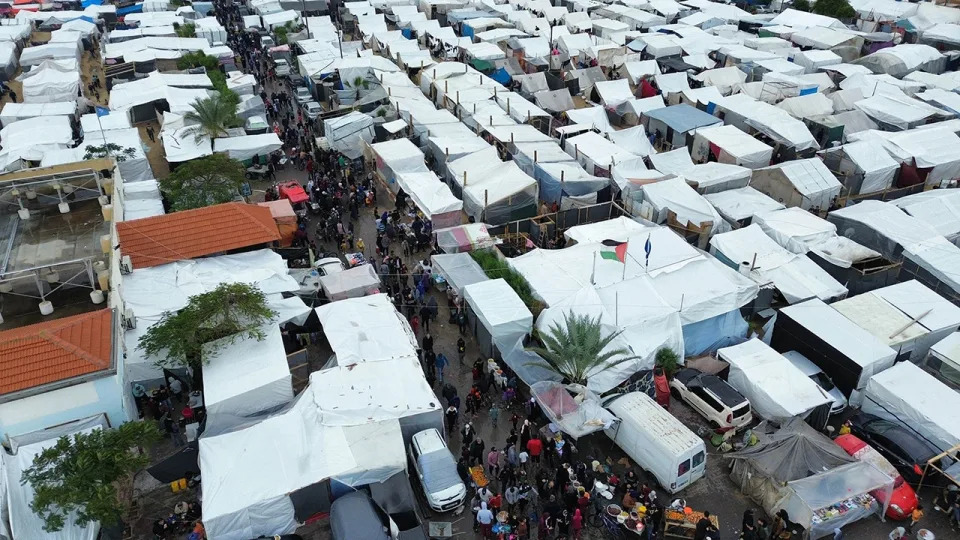
The war has destroyed families and their livelihoods, left thousands with life-changing injuries, and seen sprawling tent cities spring up, notably around the southern city of Rafah where many have fled.

Aid agencies have also warned of the severe impact that the war is having on both the physical and mental health of Palestinians.

As Israel faces increasing pressure to allow more aid into the enclave, the United Nations estimates that over half a million Gazans are facing starvation.

At the same time, an estimated 17,000 Palestinian children are now unaccompanied or have been separated from their parents.

The UN children’s agency (UNICEF) says malnutrition among children is spreading fast and quickly reaching devastating and unprecedented levels.

UN Secretary General, Antonio Guterres, has repeatedly spoken of the need for an “immediate humanitarian ceasefire” in Gaza and recently reiterated his call to the warring 

Bernie Sanders wants the US to adopt 32 hour workweek. Could workers and companies benefit?

RUSS BYNUM
Fri, March 15, 2024 

 Sen. Bernie Sanders, I-Vt., talks to the media as he walks to the House chamber before President Joe Biden's State of the Union address at the U.S. Capitol, March 7, 2024, in Washington. Sanders, the far-left independent from Vermont, introduced a bill Thursday, March 14, that would shorten to 32 hours the amount of time many Americans can work each week before they're owed overtime. 
(AP Photo/Jose Luis Magana, File)

The 40-hour workweek has been standard in the U.S. for more than eight decades. Now some members of Congress want to give hourly workers an extra day off.

Sen. Bernie Sanders, the far-left independent from Vermont, this week introduced a bill that would shorten to 32 hours the amount of time many Americans can work each week before they're owed overtime.

Given advances in automation, robotics and artificial intelligence, Sanders says U.S. companies can afford to give employees more time off without cutting their pay and benefits.


Critics say a mandated shorter week would force many companies to hire additional workers or lose productivity.

Here's what to know about the issue:

What would Sanders' proposal do?

The bill Sanders introduced Wednesday in the Senate would reduce the standard workweek from 40 hours to 32 hours. Employers would be prohibited from reducing their workers' pay and benefits to match their lost hours.

That means people who currently work Monday through Friday, eight hours per day, would get to add an extra day to their weekend. Workers eligible for overtime would get paid extra for exceeding 32 hours in a week.

Sanders says the worktime reductions would be phased in over four years. He held a hearing on the proposal Thursday in the Senate Health, Education, Labor and Pensions Committee, of which Sanders is the chairman.


How would a shorter workweek affect employees and productivity?


One recent study of British companies that agreed to adopt a 32-hour workweek concluded that employees came to work less stressed and more focused while revenues remained steady or increased.

In 2022, a team of university researchers and the nonprofit 4 Day Week Global enlisted 61 companies to reduce working hours for six months without cutting wages. Afterward, 71% of the 2,900 workers said they were less burned out and nearly half reported being more satisfied with their jobs.

Meanwhile, 24 of the participating companies reported revenue growth of more than 34% over the prior six months. Nearly two dozen others saw a smaller increase.

“The majority of employees register an increase in their productivity over the trial. They are more energized, focused and capable,” Juliet Shor, a Boston College sociology professor and a lead researcher on the UK study, told Sanders' Senate committee.

Critics say a 32-hour workweek might work for companies where employees spend most of their time at computers or in meetings, but could be disastrous for production at manufacturing plants that need hands-on workers to keep assembly lines running.

“These are concepts that have consequences," Roger King, of the HR Policy Association, which represents corporate human resource officers, told the Senate committee. “It just doesn’t work in many industries."

What’s the response in Washington?


With considerable opposition from Republicans, and potentially some Democrats, don't expect Sanders' proposal to get very far in the Senate. A companion bill by Democratic Rep. Mark Takano of California is likely doomed in the GOP-controlled House.

GOP Sen. Bill Cassidy of Louisiana said paying workers the same wages for fewer hours would force employers to pass the cost of hiring more workers along to consumers.

“It would threaten millions of small businesses operating on a razor-thin margin because they’re unable to find enough workers," said Cassidy, the ranking Republican on the committee. "Now they’ve got the same workers, but only for three-quarters of the time. And they have to hire more.”

Sanders has used his platform as the committee's chairman to showcase legislation aimed at holding big corporations more accountable to workers. He blamed greedy executives for pocketing extra profits as technology has boosted worker productivity.

“Do we continue the trend that technology only benefits the people on top, or do we demand that these transformational changes benefit working people?” Sanders said. "And one of the benefits must be a lower workweek, a 32-hour workweek.”

1933


How did we decide a 40-hour workweek was the standard?

The Fair Labor Standards Act, signed into law by President Franklin D. Roosevelt in 1938, restricted child labor and imposed other workplace protections that included limiting the workweek to 44 hours. The law was amended two years later to make it a 40-hour week.

The landmark law followed a century of labor-union efforts seeking protections for the many overworked people in the U.S., said Tejasvi Nagaraja, a labor historian at Cornell University’s School of Industry and Labor Relations.

“The issue of time was always as important, or more important, than money for labor unions and labor advocates,” Nagaraja said.

In the 1830s, coal miners and textile workers began pushing back against workdays of up to 14 hours. After the Civil War, the abolition of slavery caused those in the U.S. to take a fresh look at workers' rights. Unions rallied around the slogan: "Eight hours for work, eight hours for rest, eight hours for what you will.”

The federal government took tentative steps toward limiting working time. In 1869, President Ulysses S. Grant ordered an eight-hour workday for government employees. In 1916, Congress mandated the same for railroad workers.

Other reforms came from private industry. In 1926, Henry Ford adopted a 40-hour week for his automobile assembly workers more than a decade before Congress mandated it.

Ford wrote: "It is high time to rid ourselves of the notion that leisure for workmen is either lost time or a class privilege.”

___

Associated Press reporter Mary Clare Jalonick in Washington contributed.