Wednesday, September 25, 2024

A path towards freedom: the new route to Europe for desperate Chinese migrants

Amy Hawkins, senior China correspondent, in Bihać
The Guardian
Tue 24 September 2024 

Chinese people are travelling to the Balkans with the hope of getting into the EU
Illustration: Adam Parata/The Guardian

In a sleepy Bosnian town, barely five miles from the border with the European Union, a crumbling old water tower is falling into ruin. Inside, piles of rubbish, used cigarette butts and a portable wood-fired stove offer glimpses into the daily life of the people who briefly called the building home. Glued on to the walls is another clue: on pieces of A4 paper, the same message is printed out, again and again: “If you would like to travel to Europe (Italy, Germany, France, etc) we can help you. Please add this number on WhatsApp”. The message is printed in the languages of often desperate people: Somali, Nepali, Turkish, the list goes on. The last translation on the list indicates a newcomer to this unlucky club. It is written in Chinese.

Bihać water tower was once used to replenish steam trains travelling across the former Yugoslavia. Now it provides shelter to a different kind of person on the move: migrants making the perilous journey through the Balkans, with the hope of crossing into Croatia, Bosnia and Herzegovina’s neighbour in the EU.

Zhang* arrived in Bosnia in April with two young children in tow. The journey he describes as walking “towards the path of freedom” started months earlier in Langfang, a city in north China’s Hebei province. So far it has taken them through four countries, cost thousands of pounds, led to run-ins with the aggressive Croatian border police, and has paused, for now, in a temporary reception centre for migrants on the outskirts of Sarajevo.

Related: Growing numbers of Chinese citizens set their sights on the US – via the deadly Darién Gap

The camp, which is home to more than 200 people, is specifically for families, vulnerable people and unaccompanied minors. As well as the rows of dormitories set among the rolling Balkan hills, there is a playground with children skipping rope and an education centre. But it is a lonely life. It’s rare to meet another Chinese speaker. To pass the time, Zhang occasionally helps out in the canteen.

“Staying here is not a very good option,” Zhang says, as his son and daughter chase after each other in the courtyard. But “if I go back to China, what awaits me is either being sent to a mental hospital or a prison.”

The fear of what the future held for him and his children propelled the 39-year-old from Shandong province on a journey so difficult and dangerous that many struggle to understand why someone from China would embark on it. Most of Zhang’s new neighbours come from war-torn countries in the Middle East. Until recently, Zhang had a stable job working for a private company in the world’s second-biggest economy, earning an above average salary. But the political environment in China left him feeling that he had no choice other than to leave.

In September, the Guardian travelled to Bosnia to meet some of the Chinese migrants attempting the dangerous Balkan route, to reveal the personal and political factors behind the new migrant population on the frontier of Europe.

‘No one wants to leave his country if they are safe’

Zhang is one of a small but growing number of Chinese people who are travelling to the Balkans with the hope of getting into the EU by whatever means necessary.

He and his children were apprehended four times as they tried to cross into Europe. Armed with little more than some vague tips he’d seen on the messaging app Telegram, and the map on his smartphone, he headed to various towns on the Bosnia-Croatia border to try his luck. But every time they were caught. Most recently, he tried to cross into Metković, a small town in the south of Croatia where the border is fortified mainly by a small ridge of forested mountains. But after camping overnight in the wilderness with sinister-looking brown snakes, the family were caught once again by the notoriously tough Croatian border police, and hauled back into Bosnia.

“Going into other countries in this way is not very honourable for me, to be honest,” Zhang says. “We know that there are many countries where people hate people like us … but no one wants to leave his country if they are safe”. He says he only made the journey because of his family. “My children are very young,” Zhang says, referring to his 10-year-old son and seven-year-old daughter. “I couldn’t explain to them what’s really happening. I just told the children that I wanted to give them a better life … they have no future [in China] at all”.

In 2022, of the more than 14,000 people caught trying to illegally cross Bosnia’s borders, two were Chinese. In 2023, that number had increased to 148. The majority of them were caught trying to cross into Croatia, according to the border police of Bosnia. They said that more than 70 Chinese people were apprehended in the first half of this year.

And under a bilateral agreement, the Croatia can deport people without the right to remain in the EU country back to Bosnia. In 2021, three Chinese people were admitted to Bosnia and Herzegovina in this way. In 2023, it was 260.

In recent years, the surging numbers of Chinese people trying to cross into the US via the treacherous southern border has become a political talking point in Washington, with US authorities deporting more than 100 migrants on a charter flight earlier this year and working with neighbouring countries to try to deter further arrivals.

David Stroup, a lecturer of Chinese politics at the University of Manchester, says that the rapid expansion of China’s surveillance state during the pandemic combined with a gloomy economic outlook were some of the driving forces for this new wave of Chinese migrants.

“The lockdowns created a sense that ordinary people who were just living their lives could somehow find themselves under heavy observation of the state or subjected to long arbitrary periods of lockdown and confinement,” Stroup said.

Interactive

Part of the reason that Bosnia is an attractive staging post for Chinese migrants, is that like its neighbour Serbia, it offers visa-free travel. Aleksandra Kovačević, spokesperson for Bosnia’s Service for Foreigner’s Affairs, a government department, said that Chinese people were “gaining statistical significance as persons who increasingly violate migration regulations of Bosnia and Herzegovina”. She said that along with Turkish citizens, Chinese people were trying to use legal entry into Bosnia as a way to “illegally continue their journey to the countries of western Europe”.

But why?

Zhang’s ‘first awakening’

Zhang’s winding path to Bosnia started more than a decade ago. In 2012, thousands of people across China participated in anti-Japanese protests, triggered by an escalation in the dispute between China and Japan over contested islets in the East China Sea. But Zhang publicly questioned the official narrative that the archipelago was an undisputed part of Chinese territory. He was arrested and accused of inciting the subversion of state power. “That was my first awakening,” he says.

Many ordinary Chinese occasionally feel the rough end of the government’s tight control over public speech. Most learn to keep their head down and, begrudgingly or not, quietly navigate the invisible red lines that dictate what can be freely talked about. But Zhang couldn’t bear it.

Over the years, rumours about his political views rippled throughout his community. A teacher at his son’s school accused Zhang of being unpatriotic, in front of the whole class. He and his wife quarrelled and ultimately separated, in part because she “couldn’t stand that kind of gossip”.

Things truly came to a head in the pandemic, three years in which “the government locked people up in their homes like animals”. In November 2022, a fire in an apartment building in Urumqi, a city in far west China, killed 10 people, with many blaming strict public health controls for preventing the victims from escaping. Anger spread online and in the streets, as hundreds of people in cities across China participated in the first mass anti-government protests since Xi Jinping came to power. Zhang was one of them. In the following days, several of his friends were arrested. Zhang thinks that the only reason he was spared was because he didn’t bring his phone with him, making it harder for the police to trace his movements. But the disappearance of his friends convinced him that he had to leave.

“China’s control over speech is getting tighter and tighter. They don’t allow people to talk about political parties, and no matter if the government is doing a good or bad job, they don’t allow people to talk about it. It is limiting people’s freedom of speech tremendously, and that’s the most important thing I can’t accept,” Zhang says. “The economy is secondary”.

Since China’s zero-Covid regime was abruptly lifted, shortly after the 2022 protests, hordes of people have been leaving the country. Some are fed up with the political repression, which has spread far and wide under the current regime. Others feel hopeless about the economy, which has struggled to recover since the pandemic, with high youth unemployment rates and stagnant wages. For many, the bargain between the party and the people, that living standards will continue to improve so long as you keep your head down, no longer holds water. So scores of people are finding ways out through the cracks.

Some are using student or work visas to relocate to places where they can live and talk more freely, with new diaspora communities emerging in cities such as Bangkok, Tokyo, and Amsterdam. But others, often lower middle class people who don’t have the funds or the qualifications to emigrate by official means, are choosing more dangerous escape routes. The phenomenon has become so widely discussed online that it has it’s own buzzword: runxueor run philosophy, a coded term for emigration. Exact numbers are hard to come by as many people do not formally register their intention to leave, especially if they are planning on entering another country illegally. But in 2023, there were 137,143 asylum seekers from China, according to the UN’s refugee agency. That is more than five times the number registered a decade earlier, when Xi’s rule had just started.

Interactive

Stuck at the border

One potential pathway is the deadly Darién Gap, part of the migrant corridor that connects south and Central America with the southern border of the United States. Better known for attracting desperate Latin Americans, in recent years the number of Chinese people making that journey has surged. In the six months to April 2024, 24,367 Chinese nationals were apprehended by the US border police at the border with Mexico. That is more than the number of Chinese people who were apprehended in the whole of the previous financial year. In March alone, the number of times that the US border police encountered Chinese nationals increased by 8,500% compared with March 2021.

The Darién Gap route has been popular among Chinese migrants in part because they could start the journey in Ecuador, which allowed Chinese people to visit visa-free. In June, Ecuador suspended the visa waiver agreement, citing a “worrying increase” in arrivals from China.

Immigration officials describe the flow of migrants as being like a living organism. Its size swells and morphs, but it rarely shrinks. So when one door closes, the people on the move don’t stop moving, they just find another window.

For Zhang, the door to America, his first choice, closed when he was already en route. He had booked tickets to Ecuador via Singapore and Madrid early in the new year. But in Singapore the family was blocked from boarding the Spain-bound flight, with airline staff saying that the Spanish authorities had refused them entry. He was stranded, with no plan B. It was a kindly Czech couple who found him crying in the airport who suggested he try Europe, he says. So he booked a flight to Belgrade.

His hope is to find a way to northern Europe, where there is freedom of speech and employment opportunities. Other Chinese people have had the same idea. In the first eight months of this year, there were 569 new asylum applications from Chinese nationals in Germany, more than double the total number for 2022. In the Netherlands, 409 Chinese people applied for asylum last year, up from 151 the year before.

Some staff at the migrant reception centres gently encourage people to apply for asylum in Bosnia rather than continuing on into Europe.

But with high unemployment and a byzantine application process, most people would rather keep moving. Jing* a Chinese man living at another migrant centre near Sarajevo, tried to enter across the border into Croatia “six or seven times”. Now he has applied for asylum in Bosnia, “but I don’t think anything will come of it,” he says. He fled China after completing an eight-month prison sentence for anti-government comments he posted on X. Now he has run out of money and luck.

In the corner of a cemetery on the outskirts of Bihać, another unlikely journey from China to Bosnia has ended. Kai Zhu is buried here. Little is known about him, other than his year of birth, 1964, and the fact that he had expressed an intention to apply for asylum in Bosnia. Staff at the migrant reception centre where he died say that he had mental as well as physical health problems, and that his only acquaintance was another Chinese man in the camp, who soon moved on.

On 31 August, Asim Karabegović, a volunteer with SOS Balkanroute, an NGO, buried him in a corner of Humci cemetery that since 2019 has been reserved for migrants who have died on the EU’s doorstep. In the distance behind the rows of tombstones, the mountains that mark the border with Croatia form an imposing horizon. Karabegović says that the lonely traveller is the first Chinese person he has buried. His wooden tombstone reads only, “Kai Zhu, 1964 – 2024”.

Additional research by Chi-hui Lin and Džemal Ćatić

*Names have been changed

WAR IS ECOCIDE
French lake still riddled with bombs 80 years after World War II

Marine LEDOUX
Tue 24 September 2024 


Gerardmer is a beauty spot with a dark secret 
 (Olivier MORIN/AFP/AFP)


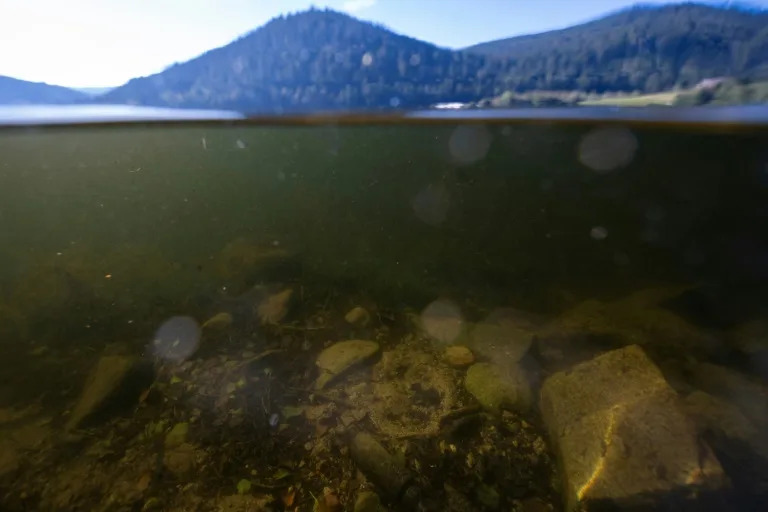
The apparently pristine Gerardmer lake in the Vosges mountains of eastern France conceals a bleak legacy of 20th-century conflict -- dozens of tonnes of unexploded ordnance from the two world wars.

The lake 660 metres (2,170 feet) above sea level is a popular summer bathing spot and is sometimes also tapped for drinking water for the picturesque local town.

Gerardmer's mayor Stessy Speissmann-Mozas started asking questions about the water safety after the Odysseus 3.1 environmental group said samples taken from the lake showed high levels of TNT explosive, as well as metals like iron, titanium and lead.


The group said it found artillery shells in the mud at the bottom of the lake. Some were "gutted, allowing the explosive they contained to escape", Odysseus 3.1's founder Lionel Rard said in a documentary broadcast by the France 5 channel in May.

Samples sent to a German lab showed TNT levels among "the highest ever measured by that team", as well as metal concentrations above legal limits.

- 'Stick all this in the lake' -

The mayor has said the government should pay for a more detailled study of the risks from the munitions that were initially dumped in Gerardmer by the French army. As a theatre of multiple conflicts over the past century and more, France is particularly afflicted by unexploded ordnance.

Most dates back to the world wars but shells are still found from the Franco-Prussian war of 1870, noted Charlotte Nihart of Robin des Bois (Robin Hood), an association that has charted unexploded bombs across France.

Unexploded ordnance is involved in around 10 deaths nationwide every year.

During the wars, retreating armies would dump munitions in lakes to stop enemy forces getting them, Nihart said.

In Gerardmer, disposal drives started in 1977 after a man was burned by a phosphorous shell. They continued through to 1994, removing explosives up to 10 metres below the lake surface.

"They took out 120 tonnes of munitions, made up of almost 100,000 individual pieces of different types from 1914-18 and 1939-45," said Pierre Imbert, an assistant to the mayor and former local fire chief and diver.

Disposal teams brought each explosive to the surface, where they could remove the detonator.

"Then they went and blew it up at the end of the lake," Imbert recalled.

Photos he has kept from the disposal campaigns show everything from "handmade grenades from World War I, more recent things from World War II, and even a little axe".

Officials called a halt to the ordnance disposal due to the difficulty of working further from the shore and deeper under the mud of the lake bed, the regional authority told Robin des Bois.

The region estimated that around 70 tonnes remain at the bottom of Gerardmer.

"There's no way of evaluating the quantity of munitions still sunk in the mud" up to 30 metres below the surface, Imbert said.

- 'Decontaminate everything' -

Since 1945, some of the munitions have moved around in the lake currents.

The state should "decontaminate everything around the edge" of the lake, said Aurelie Mathieu, head of the Vosges region's AKM eco-tourism association.

But the regional authority is refusing to act on the sole basis of the Odysseus 3.1 analysis.

"Neither the ARS (regional health agency) nor Anses (national health and safety agency) were involved in this investigation and we have no details of the methods used to collect and analyse samples," it told AFP.

Samples were taken by state agencies in February and analysed by "several French and German labs", it added.

"Initial results confirmed the conclusions of previous campaigns -- no concerning levels were detected" in the lake water, the regional authority said.

"No health risk has been identified" either for drinking the water or for swimming in it, it added.

One company has put in a bid to map the ordnance still lying at the bottom of the lake.

It would cost "almost 300,000 euros ($334,000)", mayor Speissman-Mozas said.

He is interested in the offer, as long as the national government pays.

"It's the French army who put all these munitions here," he reasoned.

mlx/tgb/sjw/gil
New ghost shark species with unusually long nose discovered in deep seas off New Zealand

Eva Corlett in Wellington
Tue 24 September 2024 


The new species of ghost shark was discovered in the Chathams Rise, roughly 750km east of New Zealand’s coast. Photograph: NIWA

A new species of ghost shark, with an unusually long nose and a whip-like tail, has been discovered in the inky depths of New Zealand waters.

Scientists at New Zealand’s National Institute for Water and Atmospherics (Niwa) initially believed the creature was part of an existing species found around the world, but further investigation revealed it was new, genetically distinct, species.

The newly described Australasian narrow-nosed spookfish is only found in New Zealand and Australian waters.

Related: Rare smelly penguin wins New Zealand bird of the year contest

Ghost sharks – also known as chimaeras and spookfish - are a group of cartilaginous fish closely related to sharks and rays. They have smooth skin, beak-like teeth and feed off crustaceans such as shrimp and molluscs. They are sometimes referred to as the ocean’s butterflies for the way they glide through the water with their large pectoral fins.

The mysterious fish are typically found at great ocean depths – up to 2,600 metres - and little is known about their biology or the threats they face.

“Ghost sharks are incredibly under-studied, there is a lot we don’t know about them,” said Dr Brit Finucci, a fisheries scientist at Niwa who helped discover the new species.

“Chimaeras are quite cryptic in nature – they can be hard to find in the deep ocean … and they generally don’t get the same attention sharks do, when it comes to research.”

The new ghost shark was found in the Chathams Rise, roughly 750km east of New Zealand’s coast. It is distinctive for its very elongated snout that can make up half of its entire body length and has likely evolved to aid its hunt for prey. The chocolate-brown fish can grow up to a metre long, has large milky-coloured eyes and a serrated dorsal fin to deter predators.

Roughly 55 species of ghost shark have been discovered globally, with about 12 of those found in New Zealand and South Pacific waters.

Scientists suspected it was a new species based off of its morphology – how it looks – but further genetic research was needed to confirm the theory. Discovering that it was indeed a distinct species was an exciting moment for Finucci.

“It’s really neat to be able to contribute to science,” she said. “Understanding the animal itself can feed into further research and whether they need conservation management.”

In a touching homage to her grandmother, Finucci gave the ghost shark the scientific name Harriotta avia: Harriotta being her grandmother’s name, and avia meaning grandmother in Latin.

“I also liked the idea that … sharks and ghost sharks are the old, ancient, relatives of fish, and I was naming the animal after an ancient relative of mine.”

Tuesday, September 24, 2024

Pope offers refuge to Myanmar's jailed Suu Kyi: report
AFP
Tue 24 September 2024 


Aung San Suu Kyi, 79, is serving a 27-year prison sentence on charges ranging from corruption to not respecting Covid pandemic restrictions (Vincenzo PINTO) (Vincenzo PINTO/AFP/AFP)


Pope Francis has offered refuge on Vatican territory for Myanmar's detained former leader Aung San Suu Kyi, Italian media said on Tuesday.

"I asked for the release of Aung San Suu Kyi and I met her son in Rome. I have proposed to the Vatican to give her shelter on our territory," the pope said, according to an account of his meetings with Jesuits in Asia during a trip there earlier this month.

The Corriere della Sera daily published an article by Italian priest Antonio Spadaro that provided extracts from the private meetings, which took place in Indonesia, East Timor and Singapore between September 2 and 13.

"We cannot stay silent about the situation in Myanmar today. We must do something," the pope is reported as saying.

"The future of your country should be one of peace based on respect for the dignity and rights of everyone and respect for a democratic system that enables everyone to contribute to the common good."

Suu Kyi, 79, is serving a 27-year prison sentence on charges ranging from corruption to not respecting Covid pandemic restrictions.

Rights groups say her closed-door trial was a sham designed to remove her from the political scene.

AFP was unable to reach a junta spokesman for comment on the reported offer from Pope Francis.

Suu Kyi's son Kim Aris told AFP he was sure his mother would be grateful for the offer.

"I am sure that Maymay would express her gratitude to Pope Francis for urging the military junta to release her and his proposal to the Vatican to offer her refuge," he said, using a Burmese word for mother.

"Nonetheless, I am doubtful that the junta would take such a request into account, as they remain fearful of Maymay's popularity among the Burmese people, even from outside of the country."

In 2015 Suu Kyi's National League for Democracy won Myanmar's first democratic election in 25 years.

The military arrested her when it staged a coup in 2021 and she is said by local media to be suffering health problems in detention.

The 1991 Nobel Peace laureate was once hailed as a beacon for human rights.

But she fell from grace among international supporters in 2017, accused of doing nothing to stop the army persecuting the country's mainly Muslim Rohingya minority.

The crackdown is the subject of an ongoing United Nations genocide investigation and persecution continues, according to Rohingya refugees in neighbouring Bangladesh.

Suu Kyi remains widely popular in Buddhist-majority Myanmar, which has been in turmoil since the 2021 coup, with the junta fighting both established ethnic rebel groups and newer pro-democracy forces.

cmk/gab/gil/yad/rma/gv

AI-generated images of stranded elephants circulate in Myanmar after Typhoon Yagi

AFP Thailand / AFP Sri Lanka
Tue 24 September 2024 

Two AI-generated images of elephants stuck in trees have been shared online alongside a false claim that they were taken in Myanmar after Typhoon Yagi rolled through Southeast Asia. The creators of the images -- originally shared in Facebook groups dedicated to AI-generated content -- told AFP that they did not show real events.

"An elephant got stuck in a tree even after waters receded in Taungoo," read a Burmese-language Facebook post uploaded on September 19, 2024.

The images began circulating on Burmese social media after water from the Sittaung River spilled over and submerged 30 villages in Taungoo township, in Myanmar's Bago Region, forcing hundreds of residents to flee in September 2024 (archived link).


Screenshot of the first false Facebook post taken on September 24, 2024


Screenshot of the second false Facebook post taken on September 24, 2024

Typhoon Yagi battered Vietnam, Myanmar, Laos and Thailand triggering floods and landslides that have killed hundreds of people across the region, according to official figures (archived link).


In Myanmar, the death toll had climbed to 419 as of September 24, 2024, according to the junta, AFP reported.

The images were shared alongside false claims on Facebook here, here, here, here, here and here.

However, the images were originally published in Facebook groups dedicated to sharing AI-generated content.
Facebook groups

Reverse image searches on Google found the first photo published in a group called "Lightroom Editing".

The group -- with more than 297,000 members -- was created by photo-editing enthusiasts in Sri Lanka.

One of the group's administrators, Janaka Senevirathne, uploaded the photo on March 25, 2024 (archived link).

Screenshot of the image posted in the "Lightroom Editing" Facebook group, taken on September 24, 2024

Senevirathne, who regularly uploads AI-generated content and describes himself as a digital creator, confirmed to AFP that he created the image using AI technology.

Another reverse image search on Google led to the second photo uploaded by Tatarat Trainarong (Earl) in a Thai-based Facebook group dedicated to AI content on March 23, 2024 (archived link).


Screenshot of the image posted in AI CREATIVES THAILAND Facebook group, taken on September 24, 2024

"CCTV News has brought you some weird images caught on camera – from a dog who lost its temper because the monk fed him late to an inexplicable mystery," read the caption in Thai language.

The post's author, Tatarat Trainarong, confirmed with AFP on September 23, 2024 that he used the generative AI program Dall-E 3 to create the images published in the post.
Signs of manipulation

Furthermore, visual clues in the images indicate that the images were created with AI.

In the first photo, the jeep's windscreen and number plate were blurred, and the "Yala National Park" watermark at the bottom-right corner is misspelt.

In the second photo, the vehicle's light source was not aligned with the headlights while the elephant did not appear in a natural balancing posture on the tree.

In addition, in the bottom-right corner of the photo, there was a watermark with the creator's name, Tatarat Trainarong.

Below is a screenshot of the AI-generated images, with visual inconsistencies highlighted by AFP:

Screenshot of the AI-generated images, with visual inconsistencies highlighted by AFP

Fabricated images are best ascertained by identifying visual inconsistencies, according to AFP's guide to spotting AI-generated images.

AFP previously debunked the same image shared in Sri Lanka here.
Parts of the Sahara Desert are turning green amid an influx of heavy rainfall

JULIA JACOBO
Mon 23 September 2024


One of the driest regions on earth is shifting green, as an influx of heavy rainfall causes vegetation to grow in the typically barren landscape.

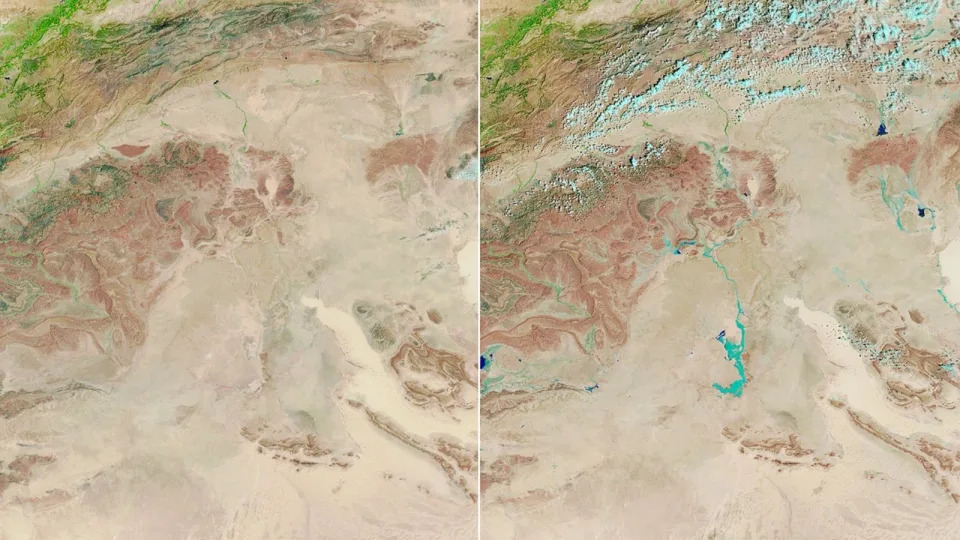
Satellite images released by NASA show pockets of plant life popping up all over the Sahara Desert after an extratropical cyclone drenched a large swath of northwestern Africa on Sept. 7 and Sept. 8.

Treeless landscapes in Morocco, Algeria, Tunisia and Libya -- areas that rarely receive rain -- are now seeing traces of green sprouting up, according to the NASA Earth Observatory.

PHOTO: The MODIS (Moderate Resolution Imaging Spectroradiometer) on NASA’s Terra satellite captured this false-color image (right) of the resulting runoff and floodwater on September 10, 2024. The image on the left shows the same area on August 14. (NASA)

The plants include shrubs and trees in low-lying areas, like riverbeds, Sylwia Trzaska, a climate variability researcher at the Columbia Climate School, told ABC News.

It is not wholly unusual for the plant life to sprout in the Sahara when a deluge of rain pours in, past research has shown. When parched regions in this part of Africa get heavy rainfall, the flora responds almost readily, Peter de Menocal, president and director of the Woods Hole Oceanographic Institution, told ABC News.

"When you get these really exceptional rainfall events, the dunes become these just incredibly verdant and flowered fields where the plants will just instantly grow for a short period of time to take advantage of," he said.

MORE: Why the Atlantic Basin has been unusually quiet as peak hurricane season nears

The region was once permanently home to lush greenery. Between 11,000 and 5,000 years ago, the Sahara was covered with vegetation and lakes, according to a 2012 paper authored by De Menocal.

"It looks like a desert, and then when the rain comes, then everything starts greening very quickly," Trzaska said.


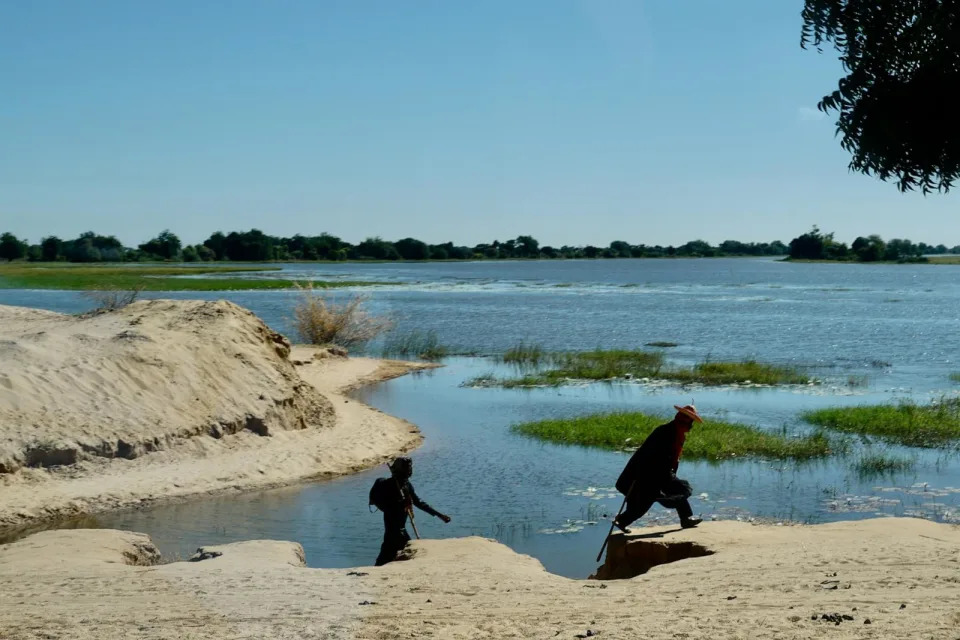
PHOTO: Extensive flooding in the Diffa region in Niger. (Giles Clarke/Getty Images)

In addition, lakes that are typically empty are filling up due to the most recent event, Moshe Armon, a senior lecturer at the Institute of Earth Sciences and the Hebrew University of Jerusalem, said in a statement released by NASA.

Between 2000 and 2021, Sebkha el Melah, a salt flat in central Algeria, has only filled six times in the past, according to research conducted by Armon and his colleagues.

Preliminary satellite analysis shows rainfall accumulations topping half a foot in the areas affected, according to NASA. Some areas of the Sahara receive just a few inches of rain per year.

MORE: Arctic fossils indicate ice shelf is not as stable as previously thought, scientists say

While some degree of rainfall every summer is normal due to the West African Monsoon season, it is unusual for the Intertropical Convergence Zone -- or the tropical rain belt -- to reach as far north as the Sahara, De Menocal said.

PHOTO: A view of Africa from NASA. (NASA)

The northward displacement of the storm track helped a developing system dump a year's worth of rainfall in some areas in just a matter of days, according to NASA. The system formed over the Atlantic Ocean and extended far southward, pulling moisture from equatorial Africa into the northern Sahara, according to NASA.


Since mid-July, the Intertropical Convergence Zone has been sending storms into the southern Sahara, according to the National Oceanic and Atmospheric Administration's Climate Prediction Center.


While much of the torrential rain fell in sparsely populated areas, more than 1,000 people have died from flooding in parts of West and Central Africa, including Chad, Nigeria, Mali and Niger, The Associated Press reported.

About 4 million people across 14 African countries have been impacted by flooding, according to the World Food Programme.

MORE: Prolonged ice-free periods putting Hudson Bay polar bear population at risk of extinction: Study

Record-high ocean temperatures in the northern Atlantic ocean is contributing to the shift in the rain belt, bringing heavy rainfall typical of regions in the equator farther north, De Menocal said.

The transition from El Niño to La Niña likely affected how far north the Intertropical Convergence Zone moved, Trzaska said.


PHOTO: Flash flooding in Merzouga, a small Moroccan town in the Sahara Desert, near the Algerian border. (Majority World/ Universal Images/Getty Images)

Climate change could cause the rain belt to shift farther northward in the future, according to a study published in Nature earlier this year. But as the ocean temperatures elsewhere in the world catch up to the Atlantic the rain belt will likely shift back down, even south of the equator, De Menocal said.

"Decades from now, when the larger oceans have warmed more uniformly, we expect the rain belt to actually go back to its original position, and it can even shift into the other hemisphere," he said.

MORE: What to know about Saharan dust affecting the US and how it can affect health

The northward shift of the Intertropical Convergence Zone across West Africa has also likely contributed to a lull in tropical activity in the Atlantic Basin, according to experts.

Disturbances moving across this region are then entering the Atlantic over relatively cooler waters, Dan Harnos, a meteorologist at NOAA's Climate Prediction Center, told ABC News last month. With greater exposure to dry air from the mid-latitudes, the chances of a storm developing are hindered.

Parts of the Sahara Desert are turning green amid an influx of heavy rainfall originally appeared on abcnews.go.com
Climate change doubles chance of floods like those in Central Europe, report says

Reuters
Tue 24 September 2024 

Flooding Danube in Hungary


WARSAW (Reuters) - Climate change has made downpours like the one that caused devastating floods in central Europe this month twice as likely to occur, a report said on Wednesday, as its scientific authors urged policymakers to act to stop global warming.

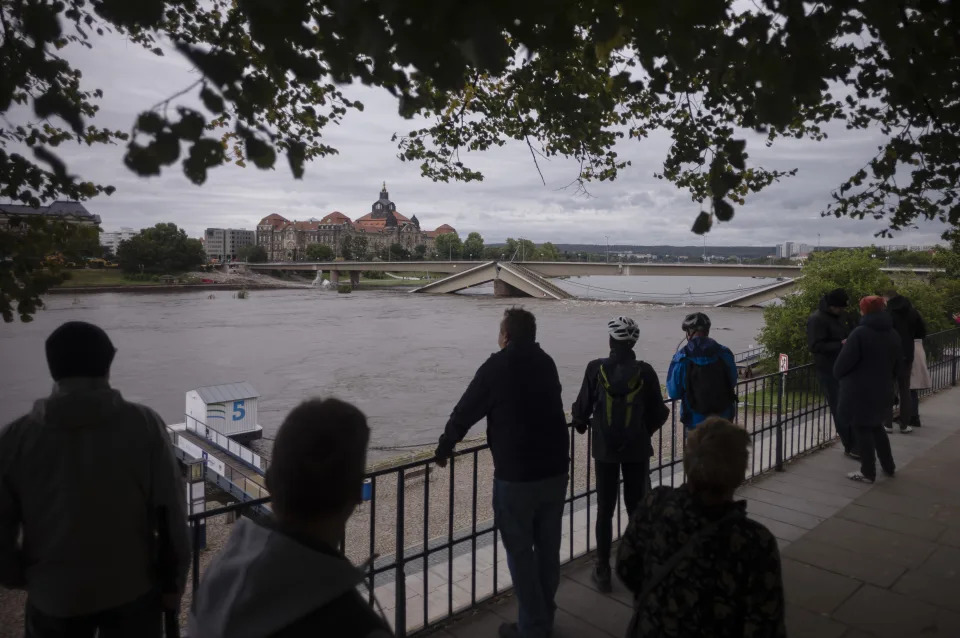
The worst flooding to hit central Europe in at least two decades has left 24 people dead, with towns strewn with mud and debris, buildings damaged, bridges collapsed and authorities left with a bill for repairs that runs into billions of dollars.

The report from World Weather Attribution, an international group of scientists that studies the effects of climate change on extreme weather events, found that the four days of rainfall brought by Storm Boris were the heaviest ever recorded in central Europe.


It said that climate change had made such downpours at least twice as likely and 7% heavier.

"Yet again, these floods highlight the devastating results of fossil fuel-driven warming," Joyce Kimutai, a researcher at Imperial College London's Grantham Institute and co-author of the study, said in a statement.

"Until oil, gas and coal are replaced with renewable energy, storms like Boris will unleash even heavier rainfall, driving economy-crippling floods."

The report said that while the combination of weather patterns that caused the storm - including cold air moving over the Alps and very warm air over the Mediterranean and the Black Seas - was unusual, climate change made such storms more intense and more likely.

According to the report, such a storm is expected to occur on average about once every 100 to 300 years in today's climate with 1.3 degrees Celsius of warming from pre-industrial levels.

However, it said that such storms will result in at least 5% more rain and occur about 50% more frequently than now if warming from pre-industrial levels reaches 2 C, which is expected to happen in the 2050s.

(Reporting by Alan Charlish; Editing by Ros Russell)

Deadly flooding in Central Europe made twice as likely by climate change

SUMAN NAISHADHAM
Updated Tue 24 September 2024


WASHINGTON (AP) — Human-caused climate change doubled the likelihood and intensified the heavy rains that led to devastating flooding in Central Europe earlier this month, a new flash study found.

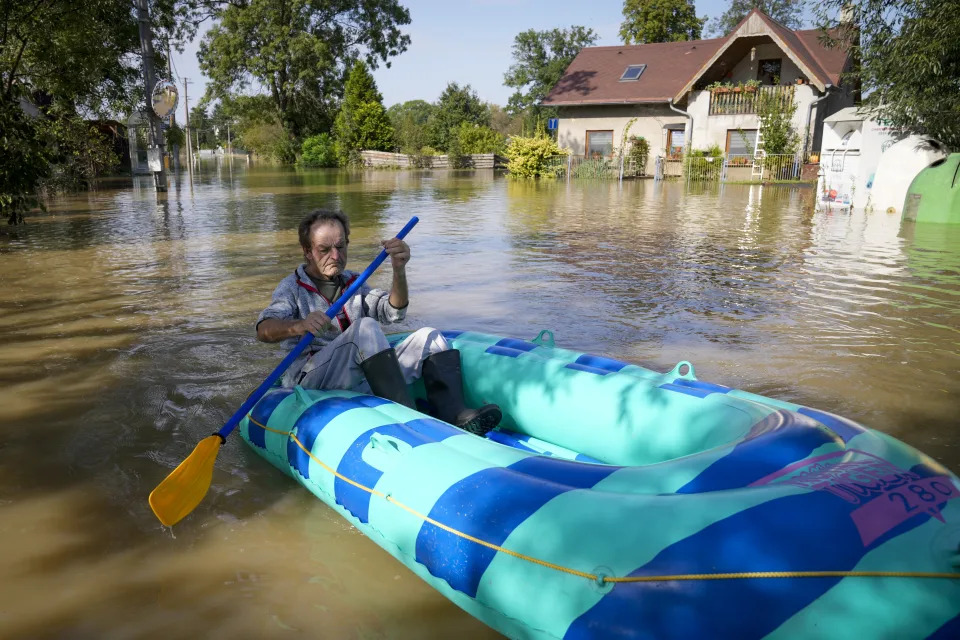
Torrential rain in mid-September from Storm Boris pummeled a large part of central Europe, including Romania, Poland, Czechia, Austria, Hungary, Slovakia and Germany, and caused widespread damage. The floods killed 24 people, damaged bridges, submerged cars, left towns without power and in need of significant infrastructure repairs.

The severe four-day rainfall was “by far” the heaviest ever recorded in Central Europe and twice as likely because of warming from the burning of coal, oil and natural gas, World Weather Attribution, a collection of scientists that run rapid climate attribution studies, said Wednesday from Europe. Climate change also made the rains between 7% and 20% more intense, the study found.

“Yet again, these floods highlight the devastating results of fossil fuel-driven warming," said Joyce Kimutai, the study's lead author and a climate researcher at Imperial College, London.

To test the influence of human-caused climate change, the team of scientists analyzed weather data and used climate models to compare how such events have changed since cooler preindustrial times to today. Such models simulate a world without the current 1.3 degrees Celsius (2.3 degrees Fahrenheit) of global warming since preindustrial times, and see how likely a rainfall event that severe would be in such a world.

The study analyzed four-day rainfall events, focusing on the countries that felt severe impacts.

Though the rapid study hasn't been peer-reviewed, it follows scientifically accepted techniques.

“In any climate, you would expect to occasionally see records broken," said Friederike Otto, an Imperial College, London, climate scientist who coordinates the attribution study team. But, “to see records being broken by such large margins, that is really the fingerprint of climate change. And that is only something that we see in a warming world.”

Some of the most severe impacts were felt in the Polish-Czech border region and Austria, mainly in urban areas along major rivers. The study noted that the death toll from this month's flooding was considerably lower than during catastrophic floods in the region in 1997 and 2002. Still, infrastructure and emergency management systems were overwhelmed in many cases and will require billions of euros to fix.

Last week, European Union chief Ursula von der Leyen pledged billions of euros in aid for countries that suffered damage to infrastructure and housing from the floods.

The World Weather Attribution study also warned that in a world with even more warming — specifically 2 degrees Celsius (3.6 degrees Fahrenheit) of warming since preindustrial times, the likelihood of ferocious four-day storms would grow by 50% compared to current levels. Such storms would grow in intensity, too, the authors found.

The heavy rainfall across Central Europe was caused by what's known as a “Vb depression” that forms when cold polar air flows from the north over the Alps and meets warm air from Southern Europe. The study's authors found no observable change in the number of similar Vb depressions since the 1950s.

The World Weather Attribution group launched in 2015 largely due to frustration that it took so long to determine whether climate change was behind an extreme weather event. Studies like theirs, within attribution science, use real-world weather observations and computer modeling to determine the likelihood of a particular happening before and after climate change, and whether global warming affected its intensity.

___

Read more of AP’s climate coverage at http://www.apnews.com/climate-and-environment

___

The Associated Press’ climate and environmental coverage receives financial support from multiple private foundations. AP is solely responsible for all content. Find AP’s standards for working with philanthropies, a list of supporters and funded coverage areas at AP.org.

Global heating ‘doubled’ chance of extreme rain in Europe in September

Ajit Niranjan Europe environment correspondent
THE GUARDIAN 
Tue 24 September 2024

Residents wade through flood water after the Nysa Klodzka River flooded the town of Lewin Brzeski in south-west Poland on 19 September.Photograph: Beata Zawrzel/NurPhoto/Rex/Shutterstock

Planet-heating pollution doubled the chance of the extreme levels of rain that hammered central Europe in September, a study has found.

Researchers found global heating aggravated the four days of heavy rainfall that led to deadly floods in countries from Austria to Romania.

The rains were made at least 7% stronger by climate change, World Weather Attribution (WWA) found, which led to towns being hit with volumes of water that would have been half as likely to occur if humans had not heated the planet.

“The trend is clear,” said Bogdan Chojnicki, a climate scientist at Poznań University of Life Sciences, and co-author of the study. “If humans keep filling the atmosphere with fossil fuel emissions, the situation will be more severe.”

Storm Boris stalled over central Europe in mid-September and unleashed record-breaking amounts of rain upon Austria, the Czech Republic, Hungary, Poland, Romania and Slovakia. The heavy rains turned calm streams into wild rivers, triggering floods that wrecked homes and killed two dozen people.

The researchers said measures to adapt had lowered the death toll compared with similar floods that hit the region in 1997 and 2002. They called for better flood defences, warning systems and disaster-response plans, and warned against continuing to rebuild in flood-prone regions.

“These floods indicate just how costly climate change is becoming,” said Maja Vahlberg, technical adviser at the Red Cross Red Crescent Climate Centre, and co-author of the study. “Even with days of preparation, flood waters still devastated towns, destroyed thousands of homes and saw the European Union pledge €10bn in aid.”

Rapid attribution studies, which use established methods but are published before going through lengthy peer-review processes, examine how human influence affects extreme weather in the immediate aftermath of a disaster.

The scientists compared the rainfall recorded in central Europe over four days in September with amounts simulated for a world that is 1.3C cooler – the level of warming caused to date by burning fossil fuels and destroying nature. They attributed a “doubling in likelihood and a 7% increase in intensity” to human influence.

But the results are “conservative”, the scientists wrote, because the models do not explicitly model convection and so may underestimate rainfall. “We emphasise that the direction of change is very clear, but the rate is not.”

Related: Storm Boris batters central Europe – in pictures

Physicists have shown that every degree celsius of warming allows the air to hold 7% more moisture, but whether it does so depends on the availability of water. The rains in central Europe were unleashed when cold air from the Arctic met warm, wet air from the Mediterranean and the Black Sea.

Warmer seas enhance the rainy part of the hydrological cycle, though the trend on parts of the land is towards drier conditions, said Miroslav Trnka, a climate scientist at the Global Change Research Institute, who was not involved in the study. When the conditions were right, he said, “you can have floods on steroids”.

Trnka compared the factors that result in extreme rainfall to playing the lottery. The increase in risk from global heating, he said, was like buying more lottery tickets, doing so over a longer period of time, and changing the rules so more combinations of numbers result in a win.

“If you bet long enough, you have a higher chance of a jackpot,” said Trnka.

The study found heavier four-day rainfall events would hit if the world heats 2C above preindustrial levels, with a further increase from today of about 5% in rainfall intensity and 50% in likelihood.

Other factors could increase this even more, such as the waviness of the jet stream, which some scientists suspect is increasingly trapping weather systems in one place as a result of global heating. A study published in Nature Scientific Reports on Monday projected that such blocking systems would increase under medium- and worst-case emissions scenarios.

Hayley Fowler, a climate scientist at Newcastle University, who was not involved in the study, said: “These large storms, cut off from the jet stream, are able to stagnate in one place and produce huge amounts of rainfall, fuelled by increased moisture and energy from oceans that are record-shatteringly hot.”

“These ‘blocked’ slow-moving storms are becoming more frequent and are projected to increase further with additional warming,” she added. “The question is not whether we need to adapt for more of these types of storm but can we.”

WWA described the week following Storm Boris as “hyperactive” because 12 disasters around the world triggered its criteria for analysis, more than in any week in the organisation’s history.

The study did not try to work out how much global heating had increased the destruction wreaked by the rains but the researchers said even minor increases in rainfall disproportionately increased damages.

“Almost everywhere in the world it is the case that a small increase in the rainfall leads to a similar order-of-magnitude increase in flooding,” said Friederike Otto, a climate scientist at Imperial College London’s Grantham Institute and co-author of the study. “But that leads to a much larger increase in the damages.”


8 / 8

Climate Central Europe Floods
FILE - Firefighters walk through a flooded road of Jesenik, Czech Republic, Sept. 15, 2024. (AP Photo/Petr David Josek, File)
ASSOCIATED PRESS

‘We’re getting rid of everything’: floods destroy homes and lives in Czech Republic

Ajit Niranjan
Tue 24 September 2024 

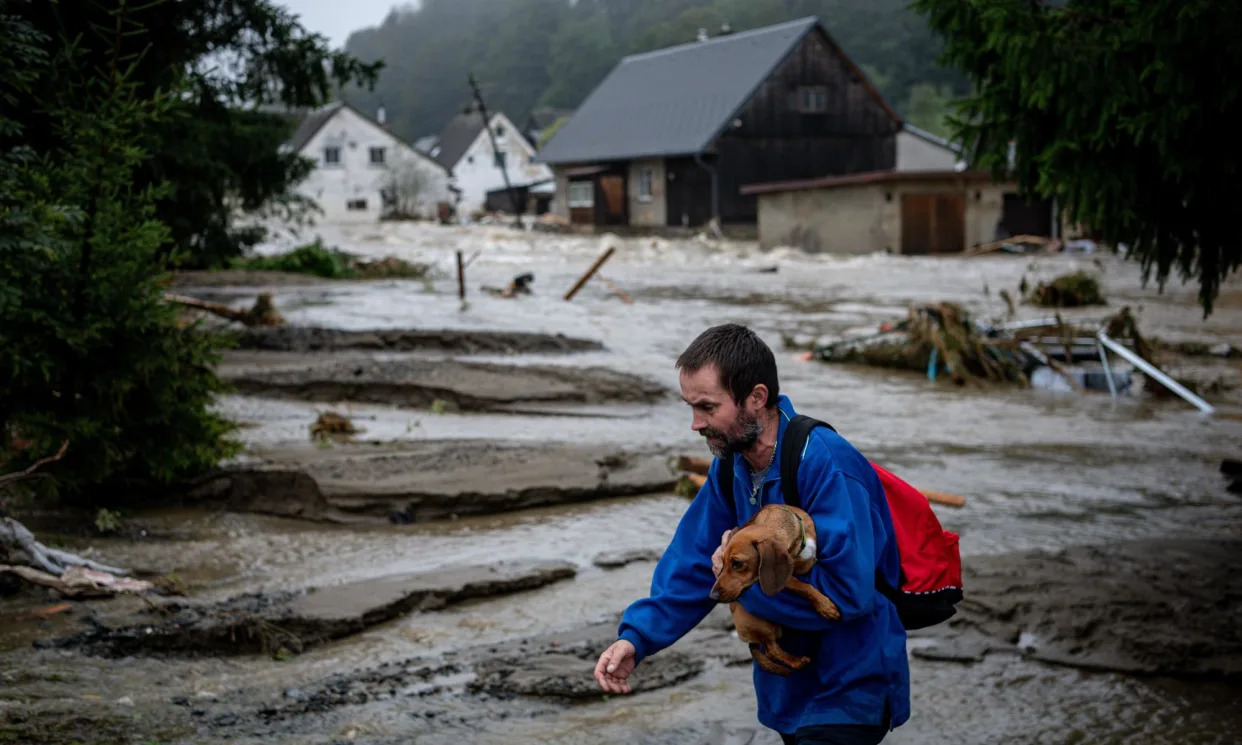
A resident and his dog are evacuated from his flooded house in Jesenik. Photograph: Anadolu/Getty Images

Jarmila Šišmová did not know what to expect when rain began to pound the small town of Litovel in the Czech Republic, and she was not prepared for the nightmare that would await her once it stopped.

The authorities told Šišmová to leave her home, so she took her children to their grandmother to wait out the storm. As the water level rose, a neighbour – one of the few on her street who stayed behind – checked the front of the house and saw the sandbags holding firm. But from the back, Šišmová would soon find out, the flood had burst into the building, drenching her belongings in dirty brown water.

“It was devastating for me,” said Šišmová, a sales manager and single mother of three, gesturing to a skip full of furniture, clothes and toys. “We’re getting rid of everything.”

Stories like Šišmová’s are being echoed around the world. The Czech Republic sat at the centre of a storm that has killed two dozen people across central Europe and prompted the EU to promise €10bn in aid to flood-stricken countries. It came as torrential rains swept through parts of Africa and Asia, triggering inundations that have killed more than 1,000 people. The UK was also hit by downpours on Monday, with more than a month’s worth of rain in 24 hours in some parts of the country.

The extreme levels of rain in Europe were made twice as likely by planet-heating pollution, a rapid attribution study found on Wednesday, and 7% stronger.

Miroslav Trnka, a climate scientist from the Global Change Research Institute, said a 7% average increase may not sound like a lot but can be enough to render a dam useless.

“It’s a binary problem” he said. “It’s not like flood defences partly work, they either don’t work or fully work, and there is a relatively small space in between.”

In towns along the Czech Republic’s border with Poland, where the floods hit hardest, residents described how the supercharged torrents of water tore their lives apart.Interactive

In Krnov, where three people died, the city library said it lost more than 20,000 books to the flood waters and only had enough time to save the most important volumes from its collection. Jakub Mruz, the director of the library, said the loss was “negligible” compared with what other people had experienced, but “it is sad and painful for anyone who loves books to see something like this.”

In Jesenik, where one person died, nearly 500mm of rain fell in five days, aggravated by wind patterns in the mountains and the bare slopes on which bark beetles had ravaged spongy spruce forests. The sewage system in the city failed and the flood smeared a layer of toxic mud across its streets.

“Now it’s dried up, people are breathing the dust and getting diarrhoea,” said Adriana Černá, an executive board member of People in Need, a humanitarian group working with the rescue services. “From day to day the situation is getting better. But there’s a big mess.”

Scientists have shown that warm air can hold more moisture – about 7% for each 1C increase in temperature – which allows for more violent rainfall if enough water is available.

Mountain towns such as Jesenik are particularly vulnerable. A study last year found a 15% increase in extreme rainfall per degree of warming at high altitude – double that expected by the physical relationship between temperature and moisture content.

In Litovel, further south, Petr Švancr, whose guesthouse was inundated, estimated the damage would come to 2m Czech crowns (£66,000). “The hotel’s closed, the restaurant is closed, everything is closed. My life has closed – it’s finished.”

Šišmová, who moved to Litovel 10 years ago, said she had cried in recent days because she no longer knew if she wanted to live there.

“If you have to start from zero, you can start anywhere,” she said. “I don’t know if I want to be part of another flood in a few years.”

In 1997, central Europe was devastated by what was dubbed the “flood of the century” – a disaster that killed 56 people in Poland and 50 in the Czech Republic. Since then, investments in systems to predict rain, warn communities and manage water have lowered the death toll from floods even when rains have hit hard.

But Michal Žák, a meteorologist at Czech Television, said although more rain fell over the total period in 1997 than in 2024, the one-day maximum amounts were greater in the latest disaster. “The extremity of the precipitation in the models was quite impressive,” said Žák, who had been alarmed by the projections. “I was not so sure it would really happen, but finally it did.”

Volunteers have been arriving to help clean up, with authorities asking that they register with aid groups before arrival. Václav Kvapil, a carpenter who runs a guesthouse in a village near Jesenik with his wife, said they hosted 80 volunteers for free after prospective visitors cancelled their reservations.

“We were surprised how many people wanted to come,” he said. “In the end, we were forced to refuse some people because the house was so full.”

First Look At Mystery Object Shot Down Over Canada By F-22 Raptor Last Year


Joseph Trevithick
Tue, September 24, 2024

Canadian authorities have released an image of an unidentified object that was shot down over the country's Yukon Territory by a U.S. Air Force F-22 Raptor stealth fighter in February 2023.


Canadian authorities have released an image of an unidentified object that was shot down over the country’s Yukon Territory by a U.S. Air Force F-22 Raptor stealth fighter in February 2023. This is the first image of any of a trio of still-unidentified objects that were downed over the United States and Canada that month, details about which remain scant. The new disclosure continues to raise more questions about those incidents given that the picture appears to have been declassified within days of the shootdown, but was then withheld from release until now.

Canada’s CTV News first published the image of what is also known as Unidentified Aerial Phenomena (UAP) 23, seen at the top of this story and below, along with an accompanying string of partially redacted internal emails from members of the Canadian armed forces earlier today. UAP is the term U.S., Canadian, and other authorities currently use to refer to what have been commonly described as unidentified flying objects (UFOs) in the past. The outlet said it independently verified the records after recieving them from an unnamed source who had obtained them via an Access to Information request. Canada’s Access to Information Act is similar in many respects to the U.S. Freedom of Information Act (FOIA), but the former is only accessible to Canadian citizens.

Canadian DND via Access to Information Request Via CTV News

UAP 23 was downed over the Yukon on February 11, 2023. This came two days after another unidentified object, also known as UAP 20, was shot down in U.S. airspace off the northern coast of Alaska. A shootdown of a third unidentified object as it passed over Lake Huron came on February 12. This all followed U.S. and Canadian authorities tracking a Chinese spy balloon passing through their airspace for days before deciding to destroy it as it soared out over the Atlantic Ocean off the coast of South Carolina on February 4.

The very low-resolution and grainy image we now have of UAP 23 shows a broadly doughnut-like shape with an open center, as well as an apparent notch or gap in its circumference on one side. It is possible that what is seen is light reflecting only from certain parts and that what is visible is not truly representative of its full shape.

The quality of the picture, which CTV News notes “appears to be a photocopy of an email printout,” makes it impossible to discern any definitive details. “The image appears to have been taken from an aircraft below it, although that has not been confirmed,” CTV News‘ report adds.

“The best description we have is: Visual – a cylindrical object. The top quarter is metallic, remainder white. 20 foot wire hanging below with a package of some sort suspended from it,” one of the associated emails, dated February 11, 2023, says. Looking at the released picture again with this description in hand it looks like it might show a balloon catching the sun with a payload underneath.

At the time, Canadian authorities described what had been shot down over the Yukon as a “small, cylindrical object.”


An F-22 Raptor stealth fighter, like the one seen here, shot down UAP 23 over the Yukon on February 11, 2023. USAF Senior Airman Julia Lebens

“It is unknown whether it [UAP 23] poses an armed threat or has intelligence collection capabilities,” according to a memo provided to Canadian Prime Minister Justin Trudeau on February 15, 2023, says. “The area in which the impact [after shootdown] occurred is a known (caribou) migration route, which opens the possibility of future accidental discovery by Indigenous hunters.”

CTV News published the heavily redacted document, which it also received from an unarmed source who obtained it first via an Access to Information request, in September 2023. The release of the memo had already raised new and still largely unanswered questions about what Canadian and U.S. authorities may or may not know about the trio of downed objects, as well as what other UAPs had been monitored in either country’s airspace before then, as you can read more about here.

No remains of any of the three still-unidentified objects brought down in February 2023 are known to have been recovered. The owners and/or operators of those objects, and whatever their purposes might have been, remain unknown, at least publicly. Past reports have suggested UAP 23, specifically, may have been a so-called “pico” balloon often launched by amateur radio enthusiasts.

U.S. officials subsequently said that the trio of objects appeared to be benign, which looks to have been a direct factor in withholding the image of UAP 23 from the public. The unredacted portions of the newly disclosed Emails, which you can find here, show a clear push between February 11 and February 15, 2023, including from then-Canadian Chief of the Defense Staff Gen. Wayne Eyre, to not only declassify the image, but also proactively release it, including on social media. However, by the end of February 15, the emails have taken a decidedly different tone.

Then-Canadian Chief of Defense Staff Gen. Wayne Eyre, at left, walks with Vice Chief of Space Operations Gen. David Thompson, at right, during a visit to the Pentagon in November 2023. USAF Eric Dietrich

“Should the image be released, it would be via the CAF [Canadian Armed Forces] social media accounts,” Taylor Paxton, then-acting Assistant Deputy Minister for Public Affairs with Canada’s Department of National Defense, writes in one Email. “Given the current public environment and statements related to the object being benign, releasing the image may create more questions/confusion, regardless of the text that will accompany the post.”

Major Doug Keirstead, Public Affairs Officer to Chief of the Defense Staff, subsequently sent another Email to his boss, Gen. Eyre, reiterating advice from acting Assistant Deputy Minister Taylor, as well as others, to hold off on releasing the image “pending U.S. engagement.”

The War Zone has reached out to the U.S. Office of the Secretary of Defense and the U.S.-Canadian North American Aerospace Defense Command (NORAD) for more information.

If the goal behind not releasing this image and any others from the Febraury 2023 shootdowns was to avoid confusion and speculation, it only appears to have had the opposite impact. The War Zone, along with others, has tried to obtain imagery from these incidents from the U.S. side on multiple occasions to no avail and we have called into question the puzzling optics of not doing so in the past.

Amazing how quickly they declassified the MQ-9's MTS-B sensor footage of the Su-27 collision but we still haven't even gotten a single still frame of the 3 objects NORAD shot down over North America during the great balloon hunt.

Quite telling.

— Tyler Rogoway (@Aviation_Intel) March 16, 2023

Even before February 2023, many members of Congress in the United States with access to classified information had criticized and otherwise called into question the U.S. military’s attitude towards UAP issues, broadly. The Department of Defense did establish an All-domain Anomaly Resolution Office (AARO) in 2022 as a focal point for tracking and investigating all things UAP, but significant questions have been raised since about its resourcing and authorities. There have also been as yet unsubstantiated accusations of AARO and others within the U.S. government engaging in more active coverups.

“Data release and footage is prioritized based on the geopolitical environment at the time,” then-head of AARO Sean Kirkpatrick said in response to a question from The War Zone about why imagery from the February shootdowns had not been released at a press briefing in October 2023. “So engagements with Chinese fighters, Russian fighters have a much larger priority in getting it through the review process or declassification than UAPs or other similar engagements.”

“We are however, working through those processes, which all exist and we’ve got several of them actually already declassified and ready to update on our website [which] we’ll be doing on the next update to the website,” Kirkpatrick, who left AARO in December 2023, added at that time. “And we’re putting them out as quickly as we can get them through their proper steps.”

In a report released earlier this year, the Department of Defense’s own Office of the Inspector General (DODIG) went so far as to warn that a continued “lack of a comprehensive, coordinated approach to address” UAP issues “may pose a threat to military forces and national security.” The War Zone has repeatedly highlighted the significant evidence that a substantial number of UAP sightings are not only explainable, but are likely drones, high-altitude balloons, and other uncrewed aerial assets that hostile actors are using to gather intelligence on critical capabilities and installations in and round the United States.

A more recent Congressional effort to push for more UAP transparency through an amendment to the annual defense policy bill, or National Defense Authorization Act (NDAA), for the 2025 Fiscal Year looks to have collapsed, at least for now.


UFO UPDATE:
THE UAP DISCLOSURE ACT FAILS TO MAKE THE CUT FOR THE MANAGER'S AMENDMENT TO THE NATIONAL DEFENSE AUTHORIZATION ACT

Senate Armed Services Committee Chairman Sen. Jack Reed (D-RI) and ranking Republican Roger Wicker (R-MS) yesterday (Sept. 19, 2024) filed a massive… pic.twitter.com/qVZdgUjLmF

— D. Dean Johnson (@ddeanjohnson) September 20, 2024

It will be interesting now to see whether or not the Canadian government’s decision to release the image of UAP 23, such as it is, and the accompanying emails, will lead to further disclosures about the February 2023 shootdowns by that country or the United States.

Contact the author: joe@twz.com
B.C. man speaks out on wrongful arrest after watchdog slams RCMP conduct at Fairy Creek

CBC
Tue, September 24, 2024 

Brian Smallshaw speaks with officers before his arrest at Fairy Creek in 2021. (Tom Mitchell - image credit)

A British Columbia man is speaking out after the RCMP watchdog chastised a controversial unit for its "frequent unreasonable actions" at Fairy Creek in 2021.

Brian Smallshaw, a web developer and historian from Salt Spring Island, said he suspected the force was breaking the law and breaching rights when arresting activists during protests against old-growth logging on Vancouver Island.

But now that the Civilian Review and Complaints Commission has upheld his allegations, he knows it.


In a scathing report completed last month, the commission found the Mounties wrongfully arrested Smallshaw while he was hiking three years ago when he wouldn't submit to a search he considered unconstitutional.

The company that owns the logging rights in the contested area, Teal-Jones Group, was granted an injunction in B.C. Supreme Court prohibiting protesters from blocking access to roads and company activity.

The report harshly criticizes the RCMP's Community-Industry Response Group (C-IRG) for using legally unjustified, "disproportionately intrusive" methods when enforcing that injunction.

"The commission is concerned about similarly broad and intrusive strategies being implemented during future protests, leading to similarly unreasonable searches and arrests," says the report.

Smallshaw is led away in cuffs on September 7, 2021.

Smallshaw is led away in cuffs on September 7, 2021. (Tom Mitchell)

The report, which Smallshaw agreed to share in full with CBC Indigenous, says the complaints commission made similar findings about C-IRG in three subsequent reviews, which are not yet public.

"Indeed, the RCMP C-IRG has repeatedly acted in a way that is contrary to the jurisprudence and to the rule of law," reads the report.

C-IRG was established in 2017 to deal with anticipated Indigenous-led protests against resource extraction projects, namely the Trans Mountain pipeline expansion and Coastal GasLink pipeline, its founding documents show.

The same unit faces abuse of process proceedings launched by First Nations activists who allege the unit violated their Charter rights during the Coastal GasLink pipeline dispute in northern B.C.

The evidence there includes recordings of Mounties mocking activists arrested at Wet'suwet'en-led blockades as "orcs" and "ogre" and laughing while discussing beating a man and twisting his genitals during one arrest.

Smallshaw said he became determined to challenge C-IRG's exclusion zone practices after observing what he considered disturbing and heavy-handed police tactics.

His historical research has examined the internment and dispossession of Japanese Canadians during the Second World War and looked at the ways governments have used the law against different groups of people, Smallshaw said.

"I think we really have to be vigilant with governments and police agencies to know what they're doing, watch what they're doing, and be concerned when they start to overstep their bounds," he said.

'A recipe for a police state'


The review found two Mounties tried to subject Smallshaw to an intrusive search to enter an exclusion zone that was overly broad, then groundlessly arrested him and released him without charges.

The watchdog agency cites leading court decisions that warn it "is a recipe for a police state, not a free and democratic society" when police use intrusive powers as a first resort to prevent rather than investigate crime.

The arresting officers were "perfunctory, grudging, and dismissive" when asked why they removed their name tags, which they were ordered to do at Fairy Creek, a policy the commission says hinders police accountability.

"The public might fear that police officers who cannot be identified will act with impunity," the review says.

The commission concluded this policy was unreasonable and also found one officer acted unreasonably when wearing a "Thin Blue Line" patch on his uniform, contrary to RCMP policy.

"The arrest raises serious questions about the quality of the training given to RCMP members acting to enforce the injunction, and about the attitudes of the individual police officers on the ground towards the rule of law and civil liberties," says the report.

In a statement, the RCMP said it values independent reviews and welcomes commission findings and recommendations at the conclusion of its investigations. The RCMP agreed with the recommendations, including that someone should apologize to Smallshaw.

'Carte blanche'

David Milward, a law professor at the University of Victoria and member of the Beardy's and Okemasis Cree Nation in Saskatchewan, said the commission's concerns are justified.

When you have exclusion zones of enormous size and infinite duration, strategically designed to cut off access by as many protesters as possible, "that starts to raise problems for the rule of law, when you just give the RCMP that kind of carte blanche," Milward said.

He suggested the Smallshaw report should serve as a reminder that limits on police powers are necessary to preserve democracy.

"If you're too condoning towards police conduct that runs roughshod over civil liberties and everything else, you run the risk of losing what you took for granted," he said.

The law professor previously reviewed C-IRG's founding documents, which CBC Indigenous obtained under access to information law.

At that time, Milward called the unit's focus on information collection and monitoring of Indigenous activism "a pretty scary dive off the slope to preventative repression, but it's targeted specifically towards Indigenous peoples."

The commission's latest review reinforces his initial view, he said.

For his part, Smallshaw said he is mostly satisfied with the commission's findings but saw a shortcoming in the lack of criticism for senior officers who greenlit the operation and drew up the policies.

The commission is doing a systemic investigation of C-IRG's operations that may cover those issues.

The unit was rebranded as the Critical Response Unit (CRU-BC) in April