Thursday, November 21, 2024

Nuclear Propaganda Exposed: The Dirty Truth Behind Government and Industry Claims


The international momentum behind nuclear power reflects a coordinated global effort to promote nuclear as a solution to climate change, despite ongoing concerns about radioactive waste, environmental risks, and the diversion of resources from renewable energy.
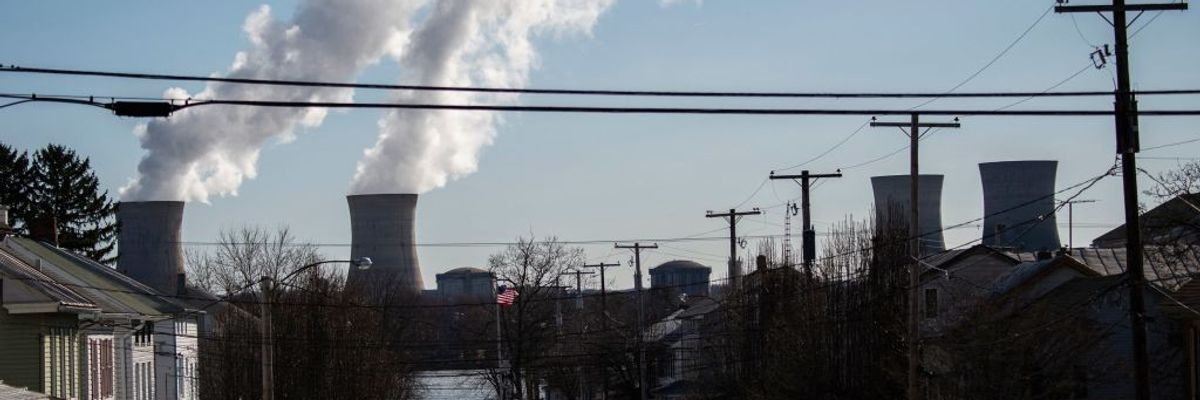


Steam rises out of the nuclear plant on Three Mile Island across the river from Goldsboro, Pennyslvania in March 2019.
(Photo: Andrew Caballero-Reynolds/AFP via Getty Images)


Lynda Williams
Nov 20, 2024
Common Dreams


As a physicist and concerned citizen, I find myself outraged every time I scroll through social media and encounter tweets from the Department of Energy, or DOE, and the Office of Nuclear Energy, or ONE, touting nuclear power as “clean, safe, and carbon-free.”

This narrative not only misrepresents the dirty reality of nuclear power but also obscures the significant environmental and health risks associated with its production and waste. It’s infuriating to see government agencies knowingly lie and promote such misleading information, while ignoring the pressing issues faced by communities affected by the toxic reality of the nuclear power industry—propaganda paid for by U.S. taxpayers!

Oh, Canada! Leading the Charge Against Nuclear Greenwashing

Finally, someone is doing something about it—but not in the U.S., where you’d expect it. In Canada, a coalition of seven environmental organizations recently filed a formal complaint with the Competition Bureau against the Canadian Nuclear Association (CNA), accusing it of misleading the public by marketing nuclear power as “clean” and “emissions-free.” Based on Canada’s Competition Act, the complaint challenges the CNA for violating provisions related to false or misleading advertising, similar to greenwashing regulations in other countries, where deceptive environmental claims distort market competition and misinform consumers.


The complaint argues that the CNA omits critical information about the environmental damage and health risks associated with the nuclear fuel cycle, including uranium mining, radioactive waste management, and the impacts on communities near nuclear facilities. By selectively framing nuclear power as a climate solution, the CNA diverts attention and resources away from truly sustainable alternatives like solar and wind energy.

In confronting the extremism of a potential Trump administration, it’s more vital than ever to collaborate with Canada and other nations committed to challenging nuclear misinformation.

In the U.S., similar deceptive practices could be challenged under the Federal Trade Commission (FTC) Act, which includes the FTC’s Green Guides. These guidelines require that any environmental claims be substantiated, transparent, and not misleading about the overall environmental impact. Yet, organizations like the Nuclear Energy Institute (NEI) and the American Nuclear Society (ANS) continue to promote nuclear power as a “clean” energy solution while conveniently ignoring the lifecycle emissions, radioactive waste, and long-term environmental costs.

Leading the charge in Canada are groups such as the Canadian Environmental Law Association (CELA), Environmental Defence Canada, and the Sierra Club Canada Foundation. Here in the U.S., organizations like the Union of Concerned Scientists (UCS), Natural Resources Defense Council (NRDC), and the Sierra Club could take similar action against the NEI and ANS by leveraging the FTC’s guidelines to expose deceptive marketing practices in the nuclear sector.

Let’s Be Real: Nuclear Power is Not Clean or Green

Sure, nuclear fission may not produce direct carbon emissions, but the nuclear fuel cycle—including uranium mining, reactor construction, radioactive waste management, and decommissioning—creates significant greenhouse gas emissions. In places like the Navajo Nation, uranium mining has already caused immeasurable harm. Over 523 abandoned uranium mines and mills continue to contaminate the land and water with radioactive waste, leading to severe health problems that affect multiple generations. The DOE’s failure to address these ongoing harms while simultaneously promoting the narrative of “clean, safe, carbon-free” nuclear power is not just unethical—it’s a dangerous distraction from real solutions for our energy needs and the fight against climate change.
Small Modular Reactors: A Costly and Dangerous Gamble

The Biden administration has funneled billions into developing Small Modular Reactors (SMRs), touting them as the future of “clean” energy. This renewed investment includes funding from the Bipartisan Infrastructure Law and the Inflation Reduction Act, which together allocate substantial financial support to accelerate the deployment of next-generation nuclear technologies. The push for SMRs is also bolstered by private sector investments, particularly from tech companies looking to power energy-intensive AI applications.

However, this push for nuclear expansion is not happening in isolation. At the recent COP29 climate summit in Baku, Azerbaijan, a declaration was endorsed by 31 countries—including the U.S.—to triple global nuclear capacity by 2050. The declaration emphasized nuclear energy’s crucial role in achieving net-zero emissions, aligning with the U.S. strategy to secure a low-carbon future. The international momentum behind nuclear power reflects a coordinated global effort to promote nuclear as a solution to climate change, despite ongoing concerns about radioactive waste, environmental risks, and the diversion of resources from renewable energy.
The Peak Uranium Crisis

In addition to the delayed deployment of SMRs, high-grade uranium resources are finite, with estimates suggesting they may only last another 10 to 15 years at current consumption rates. This means that SMRs could face fuel shortages before they even become widespread. As high-grade deposits run dry, the industry may turn to in-situ leaching (ISL) methods, which pose severe environmental risks, particularly groundwater contamination. Furthermore, reprocessing nuclear waste—an extremely hazardous and costly endeavor—is not currently practiced in the U.S. due to its dangers. However, as peak uranium approaches, reprocessing may be reconsidered as a necessary but risky solution.

Better Use of Funds: Investing in Renewables

Instead of funneling billions into new unproven nuclear projects, those funds should be redirected to renewable energy sources that are ready for deployment today to reduce carbon emissions. The $4 billion allocated for SMRs could fund solar panels on rooftops for every house in a city the size of Las Vegas.Investments in wind farms and solar plants can achieve far greater reductions in CO2 emissions without the risks of radioactive waste.

Congress has the power to reprogram funds from nuclear projects to support wind, solar, and energy storage, providing immediate climate benefits.

The Way Forward: Taking Action While We Can

People concerned about the DOE’s misleading promotion of nuclear power and SMRs can take meaningful action by contacting the Senate Committee on Energy and Natural Resources to advocate for oversight of nuclear greenwashing. Additionally, individuals can request the reprogramming of funds from SMR development to renewable energy initiatives, and they can file complaints with the DOE Office of Inspector General for industry and government greenwashing. We can also support nonprofit environmental groups and ask that they follow Canada’s lead to try to hold the nuclear industry and government agencies accountable. With the Trump administration poised to make sweeping cuts to federal agencies, reduced public oversight could embolden the nuclear industry to expand greenwashing efforts unchecked. Advocacy is more crucial than ever before.

We don’t need to face this challenge alone. In confronting the extremism of a potential Trump administration, it’s more vital than ever to collaborate with Canada and other nations committed to challenging nuclear misinformation. By working together across borders, we can expose the truth, resist industry propaganda, and push for real, sustainable energy solutions that prioritize our planet over corporate interests.

Action Contact InformationSenate Committee on Energy and Natural Resources—Phone: (202) 224-4971 / Website: https://www.energy.senate.gov

FTC fraud reporting—https://reportfraud.ftc.gov

Union of Concerned Scientists—Website: https://www.ucsusa.org / Email: ucs@ucsusa.org

Natural Resources Defense Council—Website: https://www.nrdc.org

Sierra Club—Website: https://www.sierraclub.org


Our work is licensed under Creative Commons (CC BY-NC-ND 3.0). Feel free to republish and share widely.


Lynda Williams is a physicist and environmental activist living in Hawaii.
Full Bio >


Could Trump 2.0 End the American Century?

ITS ALREADY ENDED
IT WAS LAST CENTURY 


Trump’s second term will almost certainly be one of imperial decline, increasing internal chaos, and a further loss of global leadership.


Alfred W. Mccoy
Nov 20, 2024


Some 15 years ago, on December 5, 2010, a historian writing for TomDispatch made a prediction that may yet prove prescient. Rejecting the consensus of that moment that U.S. global hegemony would persist to 2040 or 2050, he argued that “the demise of the United States as the global superpower could come... in 2025, just 15 years from now.”

To make that forecast, the historian conducted what he called “a more realistic assessment of domestic and global trends.” Starting with the global context, he argued that, “faced with a fading superpower,” China, India, Iran, and Russia would all start to “provocatively challenge U.S. dominion over the oceans, space, and cyberspace.” At home in the United States, domestic divisions would “widen into violent clashes and divisive debates… Riding a political tide of disillusionment and despair, a far-right patriot captures the presidency with thundering rhetoric, demanding respect for American authority and threatening military retaliation or economic reprisal.” But, that historian concluded, “the world pays next to no attention as the American Century ends in silence.”

Now that a “far-right patriot,” one Donald J. Trump, has indeed captured (or rather recaptured) the presidency “with thundering rhetoric,” let’s explore the likelihood that a second Trump term in office, starting in the fateful year 2025, might actually bring a hasty end, silent or otherwise, to an “American Century” of global dominion.
Making the Original Prediction

Let’s begin by examining the reasoning underlying my original prediction. (Yes, of course, that historian was me.) Back in 2010, when I picked a specific date for a rising tide of American decline, this country looked unassailably strong both at home and abroad. The presidency of Barack Obama was producing a “post-racial” society. After recovering from the 2008 financial crisis, the U.S. was on track for a decade of dynamic growth—the auto industry saved, oil and gas production booming, the tech sector thriving, the stock market soaring, and employment solid. Internationally, Washington was the world’s preeminent leader, with an unchallenged military, formidable diplomatic clout, unchecked economic globalization, and its democratic governance still the global norm.

Looking forward, leading historians of empire agreed that America would remain the world’s sole superpower for the foreseeable future. Writing in the Financial Times in 2002, for instance, Yale professor Paul Kennedy, author of a widely read book on imperial decline, argued that “America’s array of force is staggering,” with a mix of economic, diplomatic, and technological dominance that made it the globe’s “single superpower” without peer in the entire history of the world. Russia’s defense budget had “collapsed” and its economy was “less than that of the Netherlands.” Should China’s high growth rates continue for another 30 years, it “might be a serious challenger to U.S. predominance”—but that wouldn’t be true until 2032, if then. While America’s “unipolar moment” would surely not “continue for centuries,” its end, he predicted, “seems a long way off for now.”

Writing in a similar vein in The New York Times in February 2010, Piers Brendon, a historian of Britain’s imperial decline, dismissed the “doom mongers” who “conjure with Roman and British analogies in order to trace the decay of American hegemony.” While Rome was riven by “internecine strife” and Britain ran its empire on a shoestring budget, the U.S. was “constitutionally stable” with “an enormous industrial base.” Taking a few “relatively simple steps,” he concluded, Washington should be able to overcome current budgetary problems and perpetuate its global power indefinitely.

After the steady erosion of its global power for several decades, America is no longer the—or perhaps even an—“exceptional” nation floating above the deep global currents that shape the politics of most countries.

When I made my very different prediction nine months later, I was coordinating a network of 140 historians from universities on three continents who were studying the decline of earlier empires, particularly those of Britain, France, and Spain. Beneath the surface of this country’s seeming strength, we could already see the telltale signs of decline that had led to the collapse of those earlier empires.

By 2010, economic globalization was cutting good-paying factory jobs here, income inequality was widening, and corporate bailouts were booming—all essential ingredients for rising working-class resentment and deepening domestic divisions. Foolhardy military misadventures in Iraq and Afghanistan, pushed by Washington elites trying to deny any sense of decline, stoked simmering anger among ordinary Americans, slowly discrediting the very idea of international commitments. And the erosion of America’s relative economic strength from half the world’s output in 1950 to a quarter in 2010 meant the wherewithal for its unipolar power was fading fast.

Only a “near-peer” competitor was needed to turn that attenuating U.S. global hegemony into accelerating imperial decline. With rapid economic growth, a vast population, and the world’s longest imperial tradition, China seemed primed to become just such a country. But back then, Washington’s foreign policy elites thought not and even admitted China to the World Trade Organization (WTO), fully confident, according to two Beltway insiders, that “U.S. power and hegemony could readily mold China to the United States’ liking.”

Our group of historians, mindful of the frequent imperial wars fought when near-peer competitors finally confronted the reigning hegemon of their moment—think Germany versus Great Britain in World War I—fully expected China’s challenge would not be long in coming. Indeed, in 2012, just two years after my prediction, the U.S. National Intelligence Council warned that “China alone will probably have the largest economy, surpassing that of the United States a few years before 2030” and this country would no longer be “a hegemonic power.”

Just a year after that, China’s president, Xi Jinping, drawing on a massive $4 trillion in foreign-exchange reserves accumulated in the decade after joining the WTO, announced his bid for global power through what he called “the Belt and Road Initiative,” history’s largest development program. It was designed to make Beijing the center of the global economy.

In the following decade, the U.S.-China rivalry would become so intense that, last September, Secretary of the Air Force Frank Kendall warned: “I’ve been closely watching the evolution of [China’s] military for 15 years. China is not a future threat; China is a threat today.”
The Global Rise of the Strongman

Another major setback for Washington’s world order, long legitimated by its promotion of democracy (whatever its own dominating tendencies), came from the rise of populist strongmen worldwide. Consider them part of a nationalist reaction to the West’s aggressive economic globalization.

At the close of the Cold War in 1991, Washington became the planet’s sole superpower, using its hegemony to forcefully promote a wide-open global economy—forming the World Trade Organization in 1995, pressing open-market “reforms” on developing economies, and knocking down tariff barriers worldwide. It also built a global communications grid by laying 700,000 miles of fiber-optic submarine cables and then launching 1,300 satellites (now 4,700).

By exploiting that very globalized economy, however, China’s industrial output soared to $3.2 trillion by 2016, surpassing both the U.S. and Japan, while simultaneously eliminating 2.4 million American jobs between 1999 and 2011, ensuring the closure of factories in countless towns across the South and Midwest. By fraying social safety nets while eroding protection for labor unions and local businesses in both the U.S. and Europe, globalization reduced the quality of life for many, while creating inequality on a staggering scale and stoking a working-class reaction that would crest in a global wave of angry populism.

Riding that wave, right-wing populists have been winning a steady succession of elections—in Russia (2000), Israel (2009), Hungary (2010), China (2012), Turkey (2014), the Philippines (2016), the U.S. (2016), Brazil (2018), Italy (2022), the Netherlands (2023), Indonesia (2024), and the U.S. again (2024).

Set aside their incendiary us-versus-them rhetoric, however, and look at their actual achievements and those right-wing demagogues turn out to have a record that can only be described as dismal. In Brazil, Jair Bolsonaro ravaged the vast Amazon rainforest and left office amid an abortive coup. In Russia, Vladimir Putin invaded Ukraine, sacrificing his country’s economy to capture some more land (which it hardly lacked). In Turkey, Recep Erdogan caused a crippling debt crisis, while jailing 50,000 suspected opponents. In the Philippines, Rodrigo Duterte murdered 30,000 suspected drug users and courted China by giving up his country’s claims in the resource-rich South China Sea. In Israel, Benjamin Netanyahu has wreaked havoc on Gaza and neighboring lands, in part to stay in office and stay out of prison.
Prospects for Donald Trump’s Second Term

After the steady erosion of its global power for several decades, America is no longer the—or perhaps even an—“exceptional” nation floating above the deep global currents that shape the politics of most countries. And as it has become more of an ordinary country, it has also felt the full force of the worldwide move toward strongman rule. Not only does that global trend help explain Trump’s election and his recent reelection, but it provides some clues as to what he’s likely to do with that office the second time around.

In the globalized world America made, there is now an intimate interaction between domestic and international policy. That will soon be apparent in a second Trump administration whose policies are likely to simultaneously damage the country’s economy and further degrade Washington’s world leadership.

As the world shifts to renewable energy and all-electric vehicles, Trump’s policies will undoubtedly do lasting damage to the American economy.

Let’s start with the clearest of his commitments: environmental policy. During the recent election campaign, Trump called climate change “a scam” and his transition team has already drawn up executive orders to exit from the Paris climate accords. By quitting that agreement, the U.S. will abdicate any leadership role when it comes to the most consequential issue facing the international community while reducing pressure on China to curb its greenhouse gas emissions. Since these two countries now account for nearly half (45%) of global carbon emissions, such a move will ensure that the world blows past the target of keeping this planet’s temperature rise to 1.5°C until the end of the century. Instead, on a planet that’s already had 12 recent months of just such a temperature rise, that mark is expected to be permanently reached by perhaps 2029, the year Trump finishes his second term.

On the domestic side of climate policy, Trump promised last September that he would “terminate the Green New Deal, which I call the Green New Scam, and rescind all unspent funds under the misnamed Inflation Reduction Act.” On the day after his election, he committed himself to increasing the country’s oil and gas production, telling a celebratory crowd, “We have more liquid gold than any country in the world.” He will undoubtedly also block wind farm leases on Federal lands and cancel the $7,500 tax credit for purchasing an electrical vehicle.

As the world shifts to renewable energy and all-electric vehicles, Trump’s policies will undoubtedly do lasting damage to the American economy. In 2023, the International Renewable Energy Agency reported that, amid continuing price decreases, wind and solar power now generate electricity for less than half the cost of fossil fuels. Any attempt to slow the conversion of this country’s utilities to the most cost-effective form of energy runs a serious risk of ensuring that American-made products will be ever less competitive.

To put it bluntly, he seems to be proposing that electricity users here should pay twice as much for their power as those in other advanced nations. Similarly, as relentless engineering innovation makes electric vehicles cheaper and more reliable than petrol-powered ones, attempting to slow such an energy transition is likely to make the U.S. auto industry uncompetitive, at home and abroad.

Calling tariffs “the greatest thing ever invented,” Trump has proposed slapping a 20% duty on all foreign goods and 60% on those from China. In another instance of domestic-foreign synergy, such duties will undoubtedly end up crippling American farm exports, thanks to retaliatory overseas tariffs, while dramatically raising the cost of consumer goods for Americans, stoking inflation, and slowing consumer spending.

Reflecting his aversion to alliances and military commitments, Trump’s first foreign policy initiative will likely be an attempt to negotiate an end to the war in Ukraine. During a CNN town hall in May 2023, he claimed he could stop the fighting “in 24 hours.” Last July, he added: “I would tell [Ukraine’s president] Zelenskyy, no more. You got to make a deal.”

Just two days after the November election, according toThe Washington Post, Trump reputedly told Russian President Vladimir Putin in a telephone call, “not to escalate the war in Ukraine and reminded him of Washington’s sizable military presence in Europe.” Drawing on sources inside the Trump transition team, The Wall Street Journalreported that the new administration is considering “cementing Russia’s seizure of 20% of Ukraine” and forcing Kyiv to forego its bid to join NATO, perhaps for as long as 20 years.

With Russia drained of manpower and its economy pummeled by three years of bloody warfare, a competent negotiator (should Trump actually appoint one) might indeed be able to bring a tenuous peace to a ravaged Ukraine. Since it has been Europe’s frontline of defense against a revanchist Russia, the continent’s major powers would be expected to play a significant role. But Germany’s coalition government has just collapsed; French president Emmanuel Macron is crippled by recent electoral reverses; and the NATO alliance, after three years of a shared commitment to Ukraine, faces real uncertainty with the advent of a Trump presidency.
America’s Allies

Those impending negotiations over Ukraine highlight the paramount importance of alliances for U.S. global power. For 80 years, from World War II through the Cold War and beyond, Washington relied on bilateral and multilateral alliances as a critical force multiplier. With China and Russia both rearmed and increasingly closely aligned, reliable allies have become even more important to maintaining Washington’s global presence. With 32 member nations representing a billion people and a commitment to mutual defense that has lasted 75 years, the North Atlantic Treaty Organization (NATO) is arguably the most powerful military alliance in all of modern history.

Yet Trump has long been sharply critical of it. As a candidate in 2016, he called the alliance “obsolete.” As president, he mocked the treaty’s mutual-defense clause, claiming even “tiny” Montenegro could drag the U.S. into war. While campaigning last February, he announced that he would tell Russia “to do whatever the hell they want” to a NATO ally that didn’t pay what he considered its fair share.

Right after Trump’s election, caught between what one analyst called “an aggressively advancing Russia and an aggressively withdrawing America,” French President Macron insisted that the continent needed to be a “more united, stronger, more sovereign Europe in this new context.” Even if the new administration doesn’t formally withdraw from NATO, Trump’s repeated hostility, particularly toward its crucial mutual-defense clause, may yet serve to eviscerate the alliance.

In the Asia-Pacific region, the American presence rests on three sets of overlapping alliances: the AUKUS entente with Australia and Britain, the Quadrilateral Security Dialogue (with Australia, India, and Japan), and a chain of bilateral defense pacts stretching along the Pacific littoral from Japan through Taiwan to the Philippines. Via careful diplomacy, the Biden administration strengthened those alliances, bringing two wayward allies, Australia and the Philippines that had drifted Beijing-wards, back into the Western fold. Trump’s penchant for abusing allies and, as in his first term, withdrawing from multilateral pacts is likely to weaken such ties and so American power in the region.

Although his first administration famously waged a trade war with Beijing, Trump’s attitude toward the island of Taiwan is bluntly transactional. “I think, Taiwan should pay us for defense,” he said last June, adding: “You know, we’re no different than an insurance company. Taiwan doesn’t give us anything.” In October, he toldThe Wall Street Journal that he would not have to use military force to defend Taiwan because China’s President Xi “respects me and he knows I’m f—— crazy.” Bluster aside, Trump, unlike his predecessor Joe Biden, has never committed himself to defend Taiwan from a Chinese attack.

Should Beijing indeed attack Taiwan outright or, as appears more likely, impose a crippling economic blockade on the island, Trump seems unlikely to risk a war with China. The loss of Taiwan would break the U.S. position along the Pacific littoral, for 80 years the fulcrum of its global imperial posture, pushing its naval forces back to a “second island chain” running from Japan to Guam. Such a retreat would represent a major blow to America’s imperial role in the Pacific, potentially making it no longer a significant player in the security of its Asia-Pacific allies.
A Silent U.S. Recessional

Adding up the likely impact of Donald Trump’s policies in this country, Asia, Europe, and the international community generally, his second term will almost certainly be one of imperial decline, increasing internal chaos, and a further loss of global leadership. As “respect for American authority” fades, Trump may yet resort to “threatening military retaliation or economic reprisal.” But as I predicted back in 2010, it seems quite likely that “the world pays next to no attention as the American Century ends in silence.”


© 2023 TomDispatch.com


Alfred W. Mccoy is professor of history at the University of Wisconsin-Madison is the author of "In the Shadows of the American Century: The Rise and Decline of U.S. Global Power". Previous books include: "Torture and Impunity: The U.S. Doctrine of Coercive Interrogation" (University of Wisconsin, 2012), "A Question of Torture: CIA Interrogation, from the Cold War to the War on Terror (American Empire Project)", "Policing America's Empire: The United States, the Philippines, and the Rise of the Surveillance State", and "The Politics of Heroin: CIA Complicity in the Global Drug Trade".
Full Bio >


ICYMI

Cosmic Jokesters Buy Cesspool of Hatemongering Psycopath Who Is Not Taking It Well


Alex Jones on Infowars
Screenshot from Infowars

FURTHER
Abby Zimet
Nov 19, 2024
COMMON DREAMS


Oh sweet justice. We salute the supremely ironic sale of Alex Jones' vicious Infowars - now bankrupt thanks to the $1.4 billion he owes Sandy Hook families for claiming the massacre of their children was a hoax - to the satirical wise-acres of The Onion, working with those families. Aptly,The Onion's most iconic headline is on gun violence - "'No Way To Prevent This’, Says Only Nation Where This Regularly Happens"; it has run 37 times. They call their new buy "probably one of the better jokes we’ve ever told."

Surely there could be no riper moment for such schadenfreude than in these surreal times, when a sexual-assaulting Fox host may be running the Defense Department, a child-trafficking clown could be A.G., a road-kill-eating anti-vaxer might be making our health decisions, and the timeless question will resonate ever more deeply: Is this (mostly terrifying, occasionally uproarious) story real, or from The Onion? Of course the loopy meltdowns and fever dreams and new world order conspiracies of Jones' venomous show always seemed too weird to be real. Fake moon landing! Machete race war! Sex with goblins! Illuminati linked to Hillary and Lady Gaga! Often sobbing, he ripped off his shirt - Watch this! - screamed 1776 WILL COMMENCE AGAIN IF YOU TRY TO TAKE OUR FIREARMS, ranted the lining in juice boxes was making our children gay and the Pentagon-tested gay bomb on Eye-raq and our troops was doing it to adults and PUTTING CHEMICALS IN THE WATER TURNS THE FRIGGIN' FROGS GAY. "I'M SICK OF BEING SOCIAL ENGINEERED!" he shrieked. "ITS NOT FUNNY." No, it's not.

It was also not funny when he claimed America's bloody, ceaseless shootings - Gabbie Giffords, Boston Marathon et a l- were staged propaganda using "crisis actors" in order to wrest Americans' guns from their cold dead hands. Most grotesquely, he repeatedly claimed 2012's grisly murder of 20 first-graders, along with six educators, at Sandy Hook Elementary School in Newtown, Conn., was a hoax, as were all those small bodies mutilated beyond recognition and the grieving, ravaged families who had to endure them. Faced with those impossible losses as well as Jones' lies and threats from his followers, the Sandy Hook families sued him, for years keeping up a legal fight for "true accountability," aka "an end to Infowars and an end to Jones' ability to spread lies, pain and fear." Under relentless pressure - and after eventually acknowledging the shooting was real - he offered them more and more money if they'd let him stay on the air spewing vitriol; they rejected each offer because not doing so "would have put other families in harm’s way."

This fall, after the families won a $1.4 billion defamation judgment against Jones' "willful and malicious" actions, a U.S. bankruptcy judge finally ordered Infowars and its assets be sold off at auction, from its Austin studio, equipment, trademarks, video archive to its snake-oil nutritional supplement store. Last week, The Onion announced its parent company Global Tetrahedron was the winning bidder; they plan to relaunch a parody version of the site in January, thus seizing a fetid platform for hateful, right-wing skulduggery and turning it into its own mordant, smart-mouthed, big-hearted soapbox. In an "especially sweet bit of justice," they worked with Sandy Hook's non-profit Everytown for Gun Safety, which will contribute gun violence prevention stories to the site. "We thought it would be hilarious if we bought this thing," they said of a choice to leave Jones "unpunished for what he's done to these families, or we could make a dumb, stupid website, and we decided to do the second thing. We hope (the) families will be able to marvel at the cosmic joke we'll soon make of InfoWars."

It's a sublimely bonkers pairing for "America’s Finest News Source," which boasts of "rising from its humble beginnings in 1756" to grow into "the single most powerful organization in human history," with "a daily readership of 4.3 trillion people" supporting "over 350,000 journalism jobs in its news bureaus and labor camps around the world." Its headlines, often witlessly taken at face value, are its macabre crown jewels: "Planned Parenthood Opens $8 Billion Abortionplex," "Trump Boys Have Slap Fight Over Who Gets To Run Foreign Policy Meetings," "RFK Jr. Vows To Ban Soaps That Smell So Good You Eat A Little," followed by "RFK Jr. Performs "Self-Surgery To Extract Big Mac," which he ate on Trump's plane. They also offered civic lessons for Democrats from the last sorry election: "Lock in John Legend’s endorsement earlier," "Try to not already hold the presidency when a thing happens that voters dislike, "Appeal to other demographics beyond the Cheney family," "One more fundraising text would’ve done the job," and the reminder, "The soul of America is a black expanse."

They offer books - "Our Dumb Country" - and many videos: "Expert Explains Why Essentially You're Fucked," "U.S. Deploys Socially Awkward Men Along Border to Deter Migrants," "Neo-Nazi Pulls Off Surprise Victory In Longheld KKK District," "Conservative Man Proudly Frightened of Everything," from cartoons to Chinese babies to big coastal cities to languages that aren't English." There's even a horoscope - for Scorpios, "Stop avoiding conflict just because you're afraid of killing again" - and FAQs. "How can I bring The Onion to my event? The writers and editors are available for speaking engagements at universities, conferences and meet-ups for disgraced veterinarians." "What if I want to sue The Onion? Please do not do that." "Where can I find The Onion? The Onionis all around you." Given the nation's bloody history - at least 125 people a day killed by guns, twice as many wounded - their famous "No Way To Prevent This" headline was published "entirely too often," including the day after the Uvalde shooting, when its entire front page was plastered with reprints of 21 earlier iterations.

The gun-obsessed Jones was a frequent target. For the resolute, grieving families of Sandy Hook, his downfall is "the justice we have long awaited and fought for," said Robbie Parker, whose daughter Emilie was killed in the 2012 shooting. The families' attorney Chris Mattei called them "heroes" intent on bringing down Jones, "the perpetrator of the worst defamation in American history." John Feinblatt, the president of Everytown, praised their new partnership, including a multi-year advertising agreement. "It made all the sense in the world," he said, citing their access to gun violence research and data. He also nailed "really the bottom line here, and that is poetic justice." Having resumed his rabid show from a new studio and on X, Jones has reacted as gracefully as you'd expect, raging the sale is "a total attack on free speech," the auction was "rigged" with "money that isn't real," he's working with "good guy bidders" to keep him on the air, and with the inexplicable arrival of Elon Musk on the scene, "If you want a fight, you got one. "Trump is pissed," he snarled. "The cavalry is here."

Thursday, in a new legal wrangle, federal bankruptcy judge Christopher Lopez ordered a hearing to review the sale after a lawyer for the only other bidder alleged "fraud and impermissible collusion" in the auction. The bidder, First United American Companies, runs Jones' snake-oil business; their lawyer said their bid was higher, and auction trustee Christopher Murray violated earlier court-ordered rules by skipping an optional final round of bids. Calling the allegations "baseless" and "bullying from a disappointed bidder," he acknowledged their bid was higher: $3.5 million to The Onion's $1.75 million. But The Onion offered incentives by Sandy Hook families to forego up to 100% of the proceeds, enabling other Jones creditors to recover far more than under First United’s larger, but smaller-minded bid. "The sale is currently underway, pending standard processes," insisted Onion CEO Ben Collins, who used to write for NBC about paranoid quacks like Jones. "The idea he was just going to walk away (without) doing this sort of thing is funny in itself." Along with cash, he added, "We also accept Bitcoin."

In a Monday "editorial" about buying Infowars, Global Tetrahedron's "CEO" Bryce P. Tetraeder celebrated their "new addition" to the Global "family" whose members, like all families, are "abstract nodes (of) interchangeable assets for their patriarch to absorb and discard according to the opaque whims of the market." Buying Infowars was "an easy decision," he said, with its "true unicorn" mix of "delusional paranoia and dubious anti-aging nutrition hacks (to) make life both scarier and longer," and "a well-deserved victory for multinational elites." On Bluesky, Collins noted real media had requested interviews with "Tetraeder," who alas was "on his superyacht (to) do a quality control check at one of our 43,000 global puppy mills.” But The Onion is still churning out news. On Tuesday, it reported, "Trump Locks Bathroom Door So Elon Musk Can't Follow Him In" after "an audibly frustrated Trump" earlier stood up from the toilet to throw Musk out. "Bad Elon," he said. "Now, go to your kennel and lie down." Later, Trump reportedly sent Musk "to be neutered after he got out of his crate and impregnated dozens of female aides."


Our work is licensed under Creative Commons (CC BY-NC-ND 3.0). Feel free to republish and share widely.


Abby Zimet  has written CD's Further column since 2008. A longtime, award-winning journalist, she moved to the Maine woods in the early 70s, where she spent a dozen years building a house, hauling water and writing before moving to Portland. Having come of political age during the Vietnam War, she has long been involved in women's, labor, anti-war, social justice and refugee rights issues. Email: azimet18@gmail.com
Full Bio >
An 83-year-old short story by Borges portends a bleak future for the internet

Fifty years before the architecture for the web was created, Jorge Luis Borges had already imagined an analog equivalent. 
November 20, 2024

How will the internet evolve in the coming decades?

Fiction writers have explored some possibilities.

In his 2019 novel “Fall,” science fiction author Neal Stephenson imagined a near future in which the internet still exists. But it has become so polluted with misinformation, disinformation and advertising that it is largely unusable.

Characters in Stephenson’s novel deal with this problem by subscribing to “edit streams” – human-selected news and information that can be considered trustworthy.

The drawback is that only the wealthy can afford such bespoke services, leaving most of humanity to consume low-quality, noncurated online content.

To some extent, this has already happened: Many news organizations, such as The New York Times and The Wall Street Journal, have placed their curated content behind paywalls. Meanwhile, misinformation festers on social media platforms like X and TikTok.

Stephenson’s record as a prognosticator has been impressive – he anticipated the metaverse in his 1992 novel “Snow Crash,” and a key plot element of his “Diamond Age,” released in 1995, is an interactive primer that functions much like a chatbot.

On the surface, chatbots seem to provide a solution to the misinformation epidemic. By dispensing factual content, chatbots could supply alternative sources of high-quality information that aren’t cordoned off by paywalls.

Ironically, however, the output of these chatbots may represent the greatest danger to the future of the web – one that was hinted at decades earlier by Argentine writer Jorge Luis Borges.
The rise of the chatbots

Today, a significant fraction of the internet still consists of factual and ostensibly truthful content, such as articles and books that have been peer-reviewed, fact-checked or vetted in some way.

The developers of large language models, or LLMs – the engines that power bots like ChatGPT, Copilot and Gemini – have taken advantage of this resource.

To perform their magic, however, these models must ingest immense quantities of high-quality text for training purposes. A vast amount of verbiage has already been scraped from online sources and fed to the fledgling LLMs.

The problem is that the web, enormous as it is, is a finite resource. High-quality text that hasn’t already been strip-mined is becoming scarce, leading to what The New York Times called an “emerging crisis in content.”

This has forced companies like OpenAI to enter into agreements with publishers to obtain even more raw material for their ravenous bots. But according to one prediction, a shortage of additional high-quality training data may strike as early as 2026.

As the output of chatbots ends up online, these second-generation texts – complete with made-up information called “hallucinations,” as well as outright errors, such as suggestions to put glue on your pizza – will further pollute the web.

And if a chatbot hangs out with the wrong sort of people online, it can pick up their repellent views. Microsoft discovered this the hard way in 2016, when it had to pull the plug on Tay, a bot that started repeating racist and sexist content.

Over time, all of these issues could make online content even less trustworthy and less useful than it is today. In addition, LLMs that are fed a diet of low-calorie content may produce even more problematic output that also ends up on the web.
An infinite − and useless − library

It’s not hard to imagine a feedback loop that results in a continuous process of degradation as the bots feed on their own imperfect output.

A July 2024 paper published in Nature explored the consequences of training AI models on recursively generated data. It showed that “irreversible defects” can lead to “model collapse” for systems trained in this way – much like an image’s copy and a copy of that copy, and a copy of that copy, will lose fidelity to the original image.

How bad might this get?

Consider Borges’ 1941 short story “The Library of Babel.” Fifty years before computer scientist Tim Berners-Lee created the architecture for the web, Borges had already imagined an analog equivalent.

In his 3,000-word story, the writer imagines a world consisting of an enormous and possibly infinite number of hexagonal rooms. The bookshelves in each room hold uniform volumes that must, its inhabitants intuit, contain every possible permutation of letters in their alphabet

. 
In Borges’ imaginary, endlessly expansive library of content, finding something meaningful is like finding a needle in a haystack.
aire images/Moment via Getty Images

Initially, this realization sparks joy: By definition, there must exist books that detail the future of humanity and the meaning of life.

The inhabitants search for such books, only to discover that the vast majority contain nothing but meaningless combinations of letters. The truth is out there –but so is every conceivable falsehood. And all of it is embedded in an inconceivably vast amount of gibberish.

Even after centuries of searching, only a few meaningful fragments are found. And even then, there is no way to determine whether these coherent texts are truths or lies. Hope turns into despair.

Will the web become so polluted that only the wealthy can afford accurate and reliable information? Or will an infinite number of chatbots produce so much tainted verbiage that finding accurate information online becomes like searching for a needle in a haystack?

The internet is often described as one of humanity’s great achievements. But like any other resource, it’s important to give serious thought to how it is maintained and managed – lest we end up confronting the dystopian vision imagined by Borges.

Roger J. Kreuz, Associate Dean and Professor of Psychology, University of Memphis

This article is republished from The Conversation under a Creative Commons license. Read the original article.
'Fund Housing Not Genocide': Arrests at Capitol Protest Over US Complicity in Gaza

Demonstrators called on Congress to invest in climate action, education, healthcare, housing, and jobs rather than arming Israel.


Capitol Police arrested protesters calling for an end to U.S. arms sale to Israel inside Hart Senate Building in Washington, D.C. on November 19, 2024.
(Photo: Celal Gunes/Anadolu via Getty Images)


Jessica Corbett
Nov 19, 2024
COMMON DREAMS

At least 44 people were reportedly arrested at the U.S. Capitol in Washington, D.C. on Tuesday for a protest over government complicity in Israel's assault on the Gaza Strip, as Congress prepares for key votes this week.

The demonstrators who descended on the Philip A. Hart Senate Office Building are "members of faith groups, moms, healthcare workers, educators, students, [and] veterans," according toZeteo reporter Prem Thakker.

Participants wore red T-shirts and unfurled banners—which footage on social media shows were snatched by police—urging Congress to fund climate action, education, healthcare, housing, and jobs, "not genocide." There were also messages pushing lawmakers to "stop arming Israel" and telling them it is "time to act."

Thakker reported that the protesters were calling on senators to support joint resolutions of disapproval (JRDs) that Sen. Bernie Sanders (I-Vt.) introduced in September and plans to bring to the floor for a vote on Wednesday.

The JRDs would block the sale of U.S. tank rounds, bomb kits, and other weapons to the Israeli government, which faces a genocide case at the International Court of Justice for an assault on Gaza that has killed at least 43,972 Palestinians.


So far just six other members of the chamber—Sens. Tim Kaine (D-Va.), Jeff Merkley (D-Ore.), Brian Schatz (D-Hawaii), Chris Van Hollen (D-Md.), Elizabeth Warren (D-Mass.), and Peter Welch (D-Vt.)—have signaled support for the resolutions.

Even if the JRDs were passed by the Senate, they would need to get through the Republican-held U.S. House of Representatives to reach President Joe Biden's desk—and if the Democrat vetoed them, an override requires two-thirds support in both chambers.

Citing Capitol Police, ABC News reporter Beatrice Peterson said Tuesday that "all 44 individuals arrested were charged with crowding, obstructing, and incommoding. Two of them were also charged with assault on a police officer."


Meanwhile, in Illinois, 13 members of Chicago's chapter of Jewish Voice for Peace (JVP) were arrested for shutting down Caterpillar's Business and Analytics Hub by blocking escalators and elevators.

"Caterpillar builds armored D9 bulldozers that the Israeli military uses in its genocidal campaign in Gaza and to demolish homes in the occupied West Bank," JVP Chicago said in a statement. "This protest comes at a historic moment: This week Congress is set to vote on legislation to block U.S. weapons sales to the Israeli government."

As the Chicago protesters were arrested, they called on Sen. Tammy Duckworth (D-Ill.) to support Sanders' resolutions.


The other upcoming congressional vote garnering attention from anti-genocide activists is H.R. 9495, which would empower the treasury secretary to strip organizations of their nonprofit status by labeling them terrorist supporters with no due process. Republicans are reviving the bill after it failed to pass the House via a fast-track procedure last week, despite bipartisan support.

JVP's national arm has called H.R. 9495 "dangerous and unconstitutional," and warned that it "would give the incoming Trump administration the power to unilaterally shut down nonprofit organizations it doesn't like."

"This bill is part and parcel of the MAGA assault on democracy and fundamental freedoms," JVP said, "and it must be defeated again."


Senate Rejects Sanders' Bid to Halt Arms to Israel Over Gaza Atrocities


"Our taxpayer dollars should be used to fund education, housing, and healthcare for Americans, not to support the destruction of innocent lives abroad," said one advocacy leader "deeply saddened" by the votes.


An injured child lies on a hospital bed following their forced displacement from the Beit Lahia project in the Gaza Strip on November 20, 2024.
(Photo: Abood Abusalama/Middle East Images/AFP via Getty Images)

Jessica Corbett
COMMON DREAMS
Nov 20, 2024

The U.S. Senate on Wednesday refused to pass joint resolutions of disapproval proposed by Sen. Bernie Sanders that would prevent the sale of certain offensive American weaponry to Israel, which has killed nearly 44,000 Palestinians in Gaza since last fall.

S.J. Res. 111, S.J. Res. 113, and S.J. Res. 115 would have respectively blocked the sale of 120mm tank rounds, 120mm high-explosive mortar rounds, Joint Direct Attack Munitions (JDAMs), the guidance kits attached to "dumb bombs."

The first vote was 18-79, with Sen. Tammy Baldwin (D-Wis.) voting present and Sens. Mike Braun (R-Ind.) and JD Vance (R-Ohio)—the vice-president-elect—not voting. In addition to Sanders (I-Vt.), those in favor were: Sens. Dick Durbin (D-Ill.), Martin Heinrich (D-N.M.), Mazie Hirono (D-Hawaii), Tim Kaine (D-Va.), Angus King (I-Maine), Ben Ray Lujan (D-N.M.), Ed Markey (D-Mass.), Jeff Merkley (D-Ore.), Chris Murphy (D-Conn.), Jon Ossoff (D-Ga.), Brian Schatz (D-Hawaii), Jeanne Shaheen (D-N.H.), Tina Smith (D-Minn.), Chris Van Hollen (D-Md.), Raphael Warnock (D-Ga.), Elizabeth Warren (D-Mass.), and Peter Welch (D-Vt.).

The second vote was 19-78—Sen. George Helmy (D-N.J.) joined those voting for the resolution. The third vote was 17-80.

"What this extremist government has done in Gaza is unspeakable, but what makes it even more painful is that much of this has been done with U.S. weapons and American taxpayer dollars."

Ahead of the votes, Sanders took to the Senate floor to highlight that his resolutions were backed by over 100 groups, including pro-Israel J Street; leading labor organizations such as the Service Employees International Union, United Auto Workers, and United Electrical Workers; humanitarian groups like Amnesty International; and various faith organizations.

"I would also point out that poll after poll shows that a strong majority of the American people oppose sending more weapons and military aid to fund Netanyahu's war machine," the senator said, referring to Israeli Prime Minister Benjamin Netanyahu. "According to a poll commissioned by J Street... 62% of Jewish Americans support withholding weapons shipments to Israel until Netanyahu agrees to an immediate cease-fire."

In addition to stressing that his proposals would not affect any of the systems Israel uses to defend itself from incoming attacks, Sanders argued that "from a legal perspective, these resolutions are simple, straightforward, and not complicated. Bottom line: The United States government must obey the law—not a very radical idea. But unfortunately, that is not the case now."

"The Foreign Assistance Act and the Arms Export Control Act are very clear: The United States cannot provide weapons to countries that violate internationally recognized human rights or block U.S. humanitarian aid," he continued. "According to the United Nations, according to much of the international community, according to virtually every humanitarian organization on the ground in Gaza, Israel is clearly in violation of these laws."

To illustrate the devastating impact of Israel's assault on Gaza—which has led to a genocide case at the International Court of Justice—Sanders quoted from an October New York Timesopinion essay authored by American doctors who volunteered in Gaza. For example, Dr. Ndal Farah from Ohio said: "Malnutrition was widespread. It was common to see patients reminiscent of Nazi concentration camps with skeletal features."


Sanders said that "what this extremist government has done in Gaza is unspeakable, but what makes it even more painful is that much of this has been done with U.S. weapons and American taxpayer dollars. In the last year alone, the U.S. has provided $18 billion in military aid to Israel... and by the way, a few blocks from here, people are sleeping out on the street."

"We have also delivered more than 50,000 tons of military equipment to Israel," he added. "In other words... the United States of America is complicit in all of these atrocities. We are funding these atrocities. That complicity must end, and that is what these resolutions are about."

Merkley, Van Hollen, and Welch joined Sanders in speaking in favor of the resolutions on Wednesday. Members of both parties also spoke out against them: Senate Majority Leader Chuck Schumer (D-N.Y.) and Sens. Ted Budd (R-N.C.), Ben Cardin (D-Md.), Lindsey Graham (R-S.C.), John Kennedy (R-La.), James Risch (R-Idaho), and Jacky Rosen (D-Nev.).

Cardin quoted talking points from the White House that were reported on earlier Wednesday by HuffPost. The outlet detailed how officials in outgoing President Joe Biden's administration suggested that "lawmakers who vote against the arms are empowering American and Israeli foes from Iran to the militant groups Hamas and Hezbollah, which the U.S. treats as terror organizations."


Just hours before the Senate debate, the Biden administration vetoed a United Nations Security Council resolution calling for an immediate cease-fire in Gaza—the fourth time it has blocked such a measure at the world body since the Hamas-led October 7, 2023 attack on Israel.

After the Senate votes, groups that supported Sanders' resolutions expressed disappointment.

Wa'el Alzayat, CEO of the Muslim advocacy group Emgage Action, said in a statement that "we have a moral obligation to stand up for the people of Gaza and demand an end to the constant bombardment they face. I'm deeply saddened that our U.S. senators shot down the joint resolutions calling for a halt in weapons to Israel. Our taxpayer dollars should be used to fund education, housing, and healthcare for Americans, not to support the destruction of innocent lives abroad."

"Continuing to provide Israel with unrestricted military aid to attack innocent civilians in Gaza and Lebanon is a moral failure—one the American government will look back on in horror as the situation gets unimaginably worse," Alzayat added. "While the resolution did not pass this time, we will continue working with lawmakers and allies to advocate for legislation that promotes justice and adherence to international law."

While these resolutions did not advance to the House of Representatives, Demand Progress senior policy adviser Cavan Kharrazian noted that "never before have so many senators voted to restrict arms transfers to Israel, and we are extremely grateful to those who did. This historic vote represents a sea change in how elected Democrats feel about the Israeli military's campaign of death and destruction in Gaza."

"We have all seen with our own eyes the thousands of innocent civilians who have been killed, displaced, and starved by weapons paid for with U.S. tax dollars," Kharrazian said. "Now, almost half of the Senate Democratic caucus is backing up our collective outrage with their votes. Supporters of this destructive war will try to claim victory but even they know that today's vote proves that the movement to end the war is growing, across America and in Congress, and we won't stop."

Center for International Policy executive vice president Matt Duss, who formerly served as Sanders' foreign policy adviser, similarly welcomed the progress, commending those who voted in favor of the resolutions for having "the courage to stand up for U.S. law, the rights of civilians in conflict, and basic decency."

"As civilian deaths, displacement, and disease among Palestinians in Gaza mount alongside open calls for ethnic cleansing by Israeli officials, the Biden administration is not merely failing to act—it is actively enabling the Netanyahu government's war crimes," he continued. "Rather than taking steps to bolster democracy, rights, and rule of law at home and abroad in advance of [President-elect] Donald Trump's second term, President Biden and his top officials are spending their precious last days in office lobbying against measures to protect U.S. interests and vetoing otherwise unanimously supported resolutions in the United Nations Security Council that reflect its own stated policies."

"The lawmakers who stood on the right side of history today will be remembered for their leadership and humanity," he added. "The same cannot be said about President Biden and those who help him abet starvation and slaughter in Gaza."


Bernie Sanders’s Vote on Gaza Genocide Forces Senators to Go on the Record


Today, US senators will be forced to record for posterity whether they condone US enabling of the genocide in Gaza.
November 20, 2024   

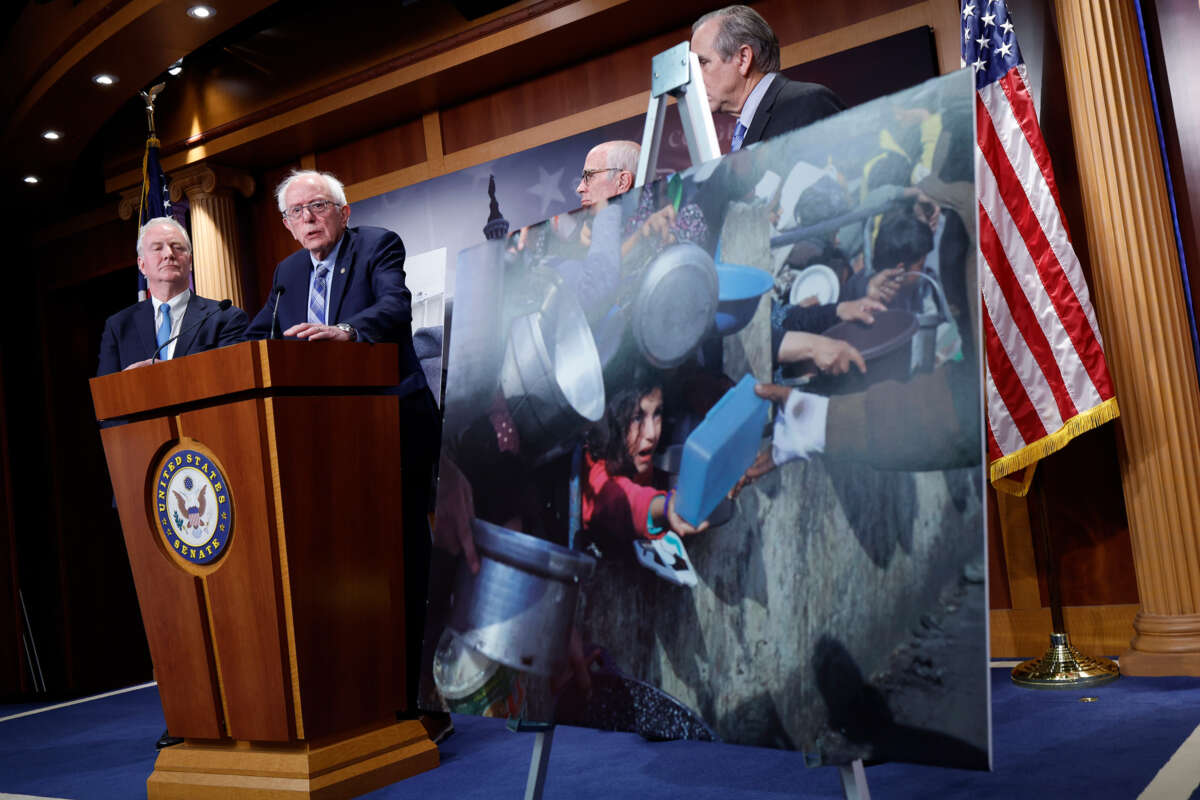
Sen. Bernie Sanders, joined by fellow Senators Chris Van Hollen, Peter Welch and Jeff Merkley, speaks at a news conference on restricting arms sales to Israel at the U.S. Capitol on November 19, 2024, in Washington, D.C.Kevin Dietsch / Getty Images


Truthout is a vital news source and a living history of political struggle. If you think our work is valuable, support us with a donation of any size.

Since last October, Israel has been able to wage a genocidal war on Gaza while receiving little more than a light slap on the wrist. President Joe Biden and his administration have claimed to be working tirelessly toward a ceasefire, all while continuing to supply Israel with the billions of dollars in weapons it needs to prolong its assault.

So, when Biden said last month that the United States would limit arms transfers to Israel if it did not stop blocking the flow of humanitarian aid into Gaza, his threat understandably rang hollow. The administration’s 30-day deadline for Israel to “surge” food and other aid into Gaza has now passed. And, just as predicted, the Biden administration said it will continue sending Israel weapons — even though aid groups like the World Food Programme say conditions in Gaza have only worsened since Biden first floated the possibility of consequences.

This is not only a moral failing, but also a violation of the law. The Foreign Assistance Act and the Leahy Law dictate that the U.S. cannot send weapons to governments committing human rights violations. But time and time again, the U.S. has failed to abide by its own legal code. In 2019, for instance, Donald Trump vetoed a congressional vote to end military support for Saudi Arabia’s war in Yemen, which at that time had killed more than 70,000 people. Shortly after taking office, Biden announced he would halt sales of “offensive weapons” to Saudi Arabia, citing their use in human rights abuses. The arms suspension was a major break from the status quo — but one that was quickly rolled back earlier this year.

The U.S. has also continued to shirk accountability in the case of Israel. The United Nations and Human Rights Watch are among those who have resoundingly documented the rampant violations of human rights that Israel has committed in the last year alone. This includes the systematic destruction of Gaza’s healthcare system through “relentless and deliberate attacks on medical personnel and facilities,” the torture and rape of Palestinians detained in Israeli military camps, deliberate home demolitions, the bombing of safe zones and evacuation corridors, and the forced displacement of 90 percent of Gaza’s population.

The latest evidence that the country is systematically and deliberately blocking humanitarian aid in Gaza arrives months after the International Court of Justice already found it “plausible” that Israel is committing acts of genocide. Citing the humanitarian crisis, hundreds of human rights organizations around the world have called for the U.S. to stop the weapons transfers. But the State Department still claims it doesn’t see a problem.

Today, for the first and probably last time, U.S. Senators will have an opportunity to tell Biden to chart a new course — and honor his own word. Sen. Bernie Sanders (I-Vermont) is bringing six measures, known as the Joint Resolutions of Disapproval, to the Senate floor for a vote. The bills, also backed by Sens. Peter Welch (D-Vermont), Jeff Merkley (D-Oregon) and Brian Schatz (D-Hawaii), would block the sales of six different kinds of weapons to Israel, worth a total of $20 billion.

It’s the first time Congress has voted on legislation blocking arms sales to Israel. Hassan El-Tayyab, an organizer with the Friends Committee on National Legislation, a Quaker peace group, described the vote as “historic.”

“I have met with doctors who have served in Gaza, treating hundreds of patients a day without electricity, anesthesia or clean water, including dozens of children arriving with gunshot wounds to the head,” Sanders wrote in a Washington Post op-ed this week, urging his fellow senators to pass the Joint Resolutions of Disapproval. “As Americans, we are complicit in these horrific and illegal atrocities. Our complicity must end.”

More than 100 civil society organizations have publicly backed the resolutions. Even J Street, which describes itself as a “pro-Israel, pro-peace” group, acknowledged that Israel’s mass killing and starvation of civilians in Gaza is “unacceptable” and expressed support for passing the resolutions in order to send a strong message to Israeli Prime Minister Benjamin Netanyahu.

Still, the Joint Resolutions of Disapproval are unlikely to pass. They would need to be approved by both the House and the Senate to be enacted, with at least a two-thirds majority to prevent the guaranteed presidential veto. But even if the resolutions won’t stop the bloodshed in Gaza, the vote still has a meaningful symbolic importance that will set a congressional precedent.

“Just the fact that this is happening is already sending that political signal,” El-Tayyab told Al Jazeera. “It’s not business as usual.”

All Senate members will now be forced to go on the official legislative record about whether or not they condone the United States’ continued facilitation of a genocide in Gaza. Polls have consistently shown that most Americans want the U.S. to halt weapons sales to Israel, yet our politicians have consistently ignored their constituents’ voices.

On the campaign trail this election cycle, Democrats have tried to fashion themselves as the political party that cares about the democratic process and the rule of law. Today’s vote is an opportunity for Democratic lawmakers to, in a sense, prove it.

In fact, the Biden administration released its own Conventional Arms Transfer policy in February 2023, which expanded the framework for evaluating the legality of arms transfers. The updated policy prohibits the sale of weapons that are “more likely than not” to be used to violate international law and bans arms transfers that “facilitate” or “aggravate risk” or human rights violations. This language is actually stronger than what was previously on the books — “actual knowledge” of violations is not required. The risk of human rights abuses is supposed to be sufficient.

Nine months later, the U.S. authorized more than $14 billion in new Israeli military funding. War crimes were documented within weeks.


Schuyler Mitchell is a writer, editor and fact-checker from North Carolina, currently based in Brooklyn. Her work has appeared in The Intercept, The Baffler, Labor Notes, Los Angeles Magazine, and elsewhere. Find her on X: @schuy_ler


Report: Biden Admin Lobbying Against Sanders Push to Block Israel Arms Deal

The administration claimed that blocking arms transfers would embolden Hamas — ignoring Israel’s genocidal slaughter.
November 20, 2024
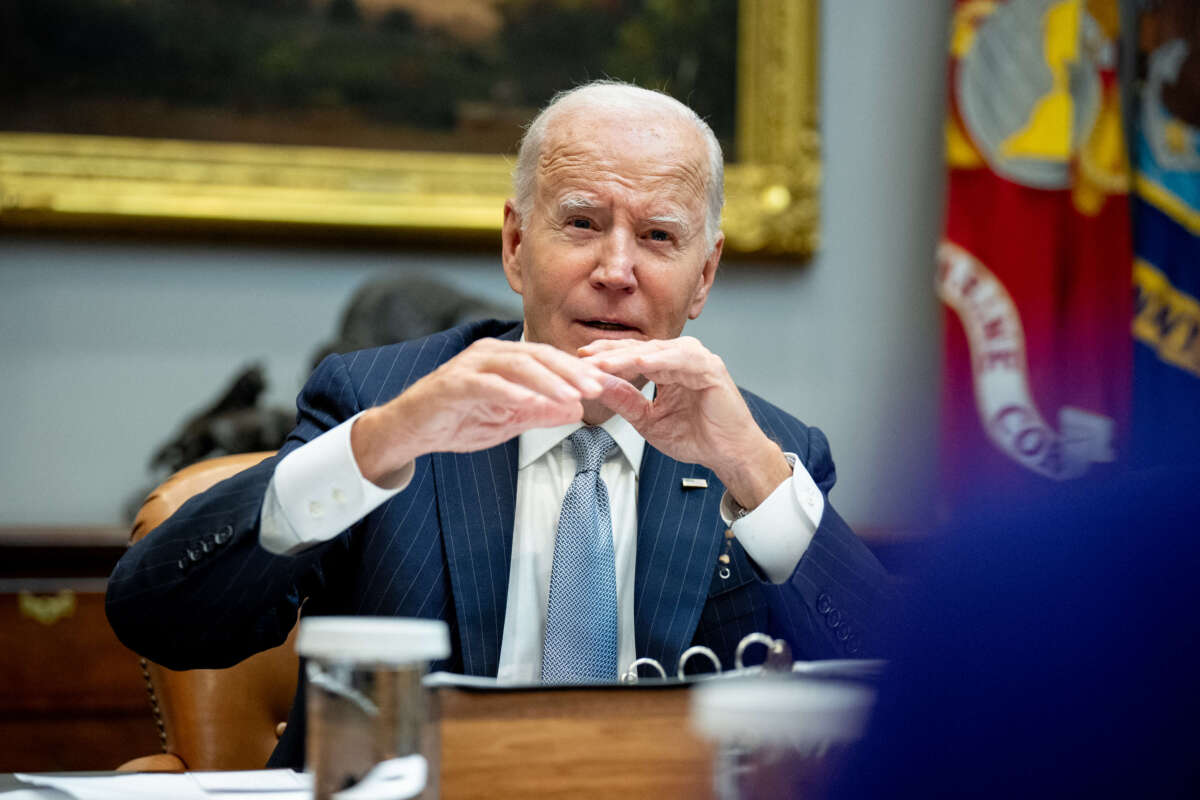
President Joe Biden speaks in the Roosevelt Room of the White House on October 11, 2024, in Washington, D.C.Andrew Harnik / Getty Images

The Biden administration has levied a strong effort to lobby against a set of resolutions introduced by Sen. Bernie Sanders (I-Vermont) to block several proposed arms sales to Israel ahead of a scheduled vote Wednesday, new reporting finds.

In a memo circulated to the Senate by the White House, obtained by HuffPost, the administration urges senators to vote against the resolutions. The memo claims that voting to block certain weapons to Israel would only empower Hamas and other entities opposed by the U.S. — invoking several such arguments meant to distract from the fact that Israel is making extensive use of U.S.-provided weapons in its genocidal assault of Gaza.

“Disapproving arms purchases for Israel at this moment would … put wind in the sails of Iran, Hezbollah, and Hamas at the worst possible moment,” the memo says, per HuffPost.

“Now is the time to focus pressure on Hamas to release the hostages and stop the war,” the document goes on. “Cutting off arms from Israel would put this goal even further out of reach and prolong the war, not shorten it.”

This line of reasoning is false. Israel is heavily dependent on U.S. weaponry to continue its genocide in Gaza, and Israeli officials have shown no indication that they would stop the assault if the remaining Israeli hostages are released. The memo also said that halting weapons transfers would jeopardize ceasefire talks between Israel and Hezbollah — despite the fact that Israeli leaders have categorically rejected the idea that they would stop their assault of Lebanon.

The White House’s memo is yet another show of the White House’s insistence that it back Israel’s genocide no matter what — to the extent that it is lobbying “aggressively,” as HuffPost reports, to block a set of resolutions that are likely to fail anyway, given the strong support for Israel within Congress. Indeed, despite the administration’s insistence that officials are “tirelessly” working for a ceasefire, the U.S. also vetoed a resolution in the UN Security Council calling for a ceasefire on Wednesday.

The Senate is slated to vote on three of Sanders’s joint resolutions of disapproval on Wednesday, regarding blocking sales of tank rounds, mortar rounds, and JDAMs to Israel. Together, the three sales represent just over $1 billion worth of the weapons in the Biden administration’s proposed $20 billion deal.

Despite widespread evidence that Israel is using these weapons to kill civilians in Gaza and violate international humanitarian law — and strong support from the public to half weapons transfers — just seven senators have so far come out in favor of the resolutions. Experts have repeatedly said that stopping weapons sales to Israel is one of the only ways to stop Israel’s genocidal slaughter in Gaza.

Senate Majority Leader Chuck Schumer (D-New York) is also reportedly asking senators to vote against the legislation — a move that lines up with Senate Minority Leader Mitch McConnell’s plea for colleagues to reject the bid.

Though the resolutions are unlikely to advance to the House, roughly a dozen House Democrats so far have expressed their support for the legislation, saying they would vote for them if given the opportunity. This includes prominent advocates for Palestinian rights like Representatives Rashida Tlaib (Michigan) and Cori Bush (Missouri).

“[President Joe Biden] has refused to enforce US law and stop sending weapons to the Israeli government as they commit genocide in Gaza and use starvation as a weapon of war. Today, every Senator will have to decide if they will vote to uphold our own laws and block arms sales to Israel,” said Rep. Rashida Tlaib (D-Michigan) on social media on Wednesday.

“We urge Senators to support these joint resolutions of disapproval to block specific offensive arms sales to Israel, upholding U.S. law that prohibits arms transfers to countries that engage in a consistent pattern of gross violations of internationally recognized human rights or restrict the delivery of U.S. humanitarian assistance,” said a group of nine Democrats in a joint statement led by Rep. Pramila Jayapal (D-Washington).