It’s possible that I shall make an ass of myself. But in that case one can always get out of it with a little dialectic. I have, of course, so worded my proposition as to be right either way (K.Marx, Letter to F.Engels on the Indian Mutiny)
Sunday, March 09, 2025
What Turkey’s Kurdish Process Means For The Broader Region – OpEd
In a historic call, the PKK’s imprisoned ringleader Abdullah Ocalan last month urged the Kurdish militant group to lay down its arms, disband and bring an end to its decades-long conflict with the Turkish state. Resolving the conflict will not be without obstacles, given its complexity and the involvement of several stakeholders.
However, if the PKK heeds its leader’s call and the process progresses positively, it could not only offer a significant opportunity to reshape Turkiye’s domestic politics, but also its foreign policy — most importantly, its relations with neighboring countries that have Kurdish populations, namely Syria, Iraq and Iran. So, what does this process mean for the region and beyond?
The call to dissolve the PKK came at a time when Syria had entered a new phase, after the four-decade-old Assad regime, which had long used the PKK as a tool against Turkiye, had collapsed. Historically, Syria has served as a key haven for PKK militants to train and launch attacks on Turkiye. The PKK’s Syrian branch, the YPG, had also strengthened its position in the face of Syria being a failed state, prompting Turkiye to launch several military operations in order to eliminate the threat. Ankara deemed that it posed. While the US and the EU have designated the PKK as a terrorist organization, the Syrian Democratic Forces, led by the YPG, has not been classified as such. Moreover, it has been seen by Washington as a key actor in the fight against Daesh since 2014.
Despite the SDF commander’s claim that Ocalan’s call does not apply to the group, as it considers itself distinct from the PKK, the SDF is evolving its strategy given the change in leadership in the Syrian Arab Republic. It aims to resolve issues with the new Damascus government in order to integrate itself into the new Syrian security structure. With the shifting balance of power in Syria and change of policies in the US, regional states and nonstate actors alike have started to reassess their strategies.
Beyond Syria, the success of this process will also impact the presence of the PKK in Iraq, especially at a time when Ankara and Baghdad are strengthening their security and political ties. In the past, one of the most contentious issues between the two countries was Turkiye’s military operations against the PKK in Iraq, which Baghdad viewed as a violation of its sovereignty.
However, if the PKK dissolves and disarms in the Qandil Mountains of northern Iraq, it would significantly alter the security dynamics between Turkiye and Iraq, removing the primary point of contention from their burgeoning relationship. In northern Iraq, the Kurdistan Regional Government has also welcomed Ocalan’s call, describing it as an important step toward achieving stability in the region.
The dissolution of the PKK would also have implications for Iran, where the Kurdistan Free Life Party, founded on the PKK’s ideology, has maintained a ceasefire with Tehran since 2011. Ocalan’s call for “all groups to lay down their arms” extends to all factions, including in Iran, signaling a broader regional shift. In the past, Iran has exploited Kurdish groups to counter Turkiye’s influence in the region. The end of the PKK in the region would likely compel Iran to change its strategy toward groups such as the Kurdistan Free Life Party. Moreover, Turkish-Iranian tensions soared last week following Ankara’s warning to Tehran not to support the SDF in Syria.
In Turkiye’s domestic political arena, analysts suggest that President Recep Tayyip Erdogan, who is pushing for a constitutional amendment to potentially further extend his tenure, will need support beyond his own party. Securing new coalition partners — especially from the pro-Kurdish parties — will be crucial. While the previous peace process with the PKK, which took place between 2011 and 2014, collapsed due to developments in Syria and domestic political struggles, this new call comes at a time of unprecedented political and security shifts in the region. If all PKK-affiliated Kurdish groups were to heed Ocalan’s call to disarm and dissolve, it could mark a significant breakthrough for all parties, bringing the stability that all these regional actors have desired for decades.
This renewed peace process is also viewed as a means to strengthen not only Turkiye’s economy but also those of Iraq and Syria, while removing a significant barrier to their reintegration into a Turkiye-led regional economy. Several projects are already on the agenda, including the Development Road scheme with Iraq.
The PKK was both a threat and a tool in the hands of previous governments in Syria, Iran and Iraq, but it was also used by Israel as a geopolitical tool in regional conflicts. For instance, Israel has historically supported the Kurdish autonomous regions in Syria and Iraq, viewing them as potential tools against Iran. Israeli policy toward the Kurds remains closely linked to its vision for a broader Middle East. This approach is seen as a threat by all regional states, not only now but even decades ago.
With the emergence of a new Syrian government, the weakening of Iran’s influence and Washington’s plan to end its military strategy in the region, the peace process comes on to the agenda at a pivotal moment. While all regional actors have expressed support for the call, cautious optimism remains. Only time will tell whether the call for PKK disarmament will initiate a new era of peace, bringing an end to four decades of conflict.
Dr. Sinem Cengiz is a Turkish political analyst who specializes in Turkiye’s relations with the Middle East. X: @SinemCngz
Arab News is Saudi Arabia's first English-language newspaper. It was founded in 1975 by Hisham and Mohammed Ali Hafiz. Today, it is one of 29 publications produced by Saudi Research & Publishing Company (SRPC), a subsidiary of Saudi Research & Marketing Group (SRMG).
Turkish defence firm accused of violating sanctions with Sudan weapons supplies
Turkey's Baykar allegedly violated EU and US sanctions by sending arms to Sudan's military, fueling the civil war, according to a Washington Post report.
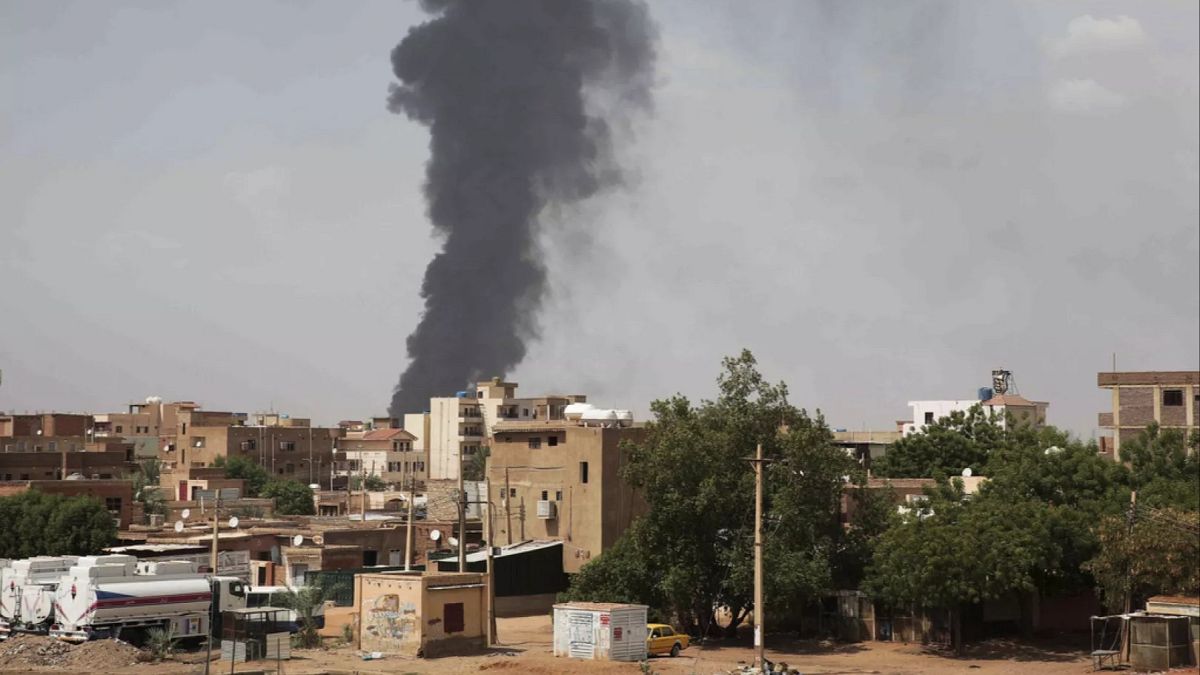
One of Turkey’s largest defence companies has been linked to Sudan's nearly two-year-old war after a report showed a series of arms shipments to the Horn of Africa nation in what could be a clear violation of EU and US-led sanctions on Darfur.
In a report published by the Washington Post, Baykar, a leading defence exporter and supplier of drones, was accused of sending a cache of weapons and ammunition to the Sudanese army between August and November last year.
According to the Washington Post, the first weapons, part of a $120 million (€110.7m) contract between Baykar and the Sudanese military’s procurement agency, known as Defense Industries System (DIS), landed by plane in August at Port Sudan, a Red Sea city on Sudan's eastern coastline, while messages the Post said it authenticated showed that the last flight arrived on 15 September.
The Post report said the contract, signed by Mirghani Idris Suleiman, director-general of DIS, was dated 16 November 2023, five months after the US imposed sanctions.
Six TB2 drones, three ground control stations, and 600 warheads were part of the contract, which stated that 48 employees were to deliver, including an offer to provide "in-country technical support".
Sudanese officials allegedly informed Baykar representatives during a meeting on 9 September that "Turkey had become the country that has supported them the most," according to an internal Baykar memo that the US outlet said detailed the discussions.
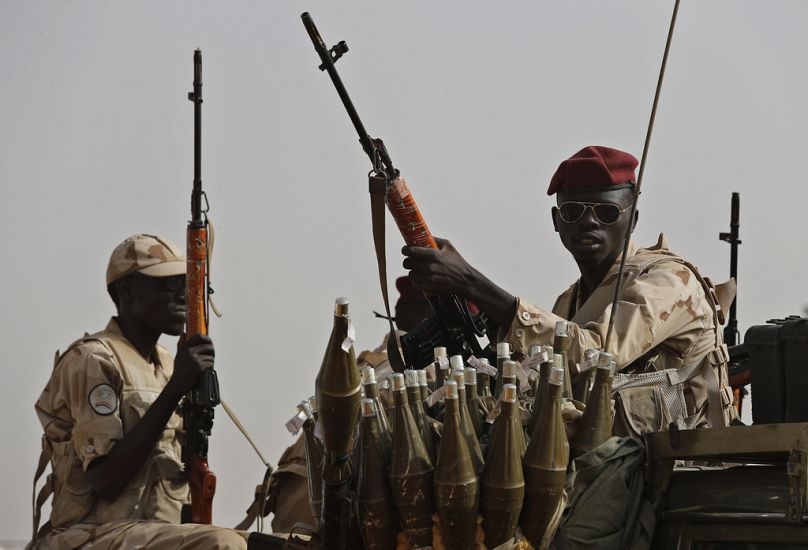
FILE - Sudanese soldiers from the Rapid Support Forces unit, led by Gen. Mohammed Hamdan Dagalo, the deputy head of the military council, secure the area where Dagalo attends Hussein Malla/Copyright 2019 The AP. All rights reserved.
Conflict turning into proxy battle?
The development casts Turkish defence companies among the foreign powers vying for spoils in the 22-month-long deadly war that has seen other international actors, such as the United Arab Emirates (UAE) and Russia, accused of playing different roles and fueling the conflict.
In November, rights group Amnesty International said armoured vehicles made by the UAE and equipped with French military technology were being used by paramilitary forces in the civil war.
On Thursday, the International Court of Justice said that Sudan had filed a complaint against the UAE for allegedly breaching its responsibilities under the Genocide Convention by supporting the paramilitary Rapid Support Forces (RSF). UAE officials have always denied involvement in the conflict.
Last month, Russia struck an agreement to create a naval station in Port Sudan, another important foothold along the Red Sea, according to a statement signed by the foreign ministers of Moscow and Darfur.
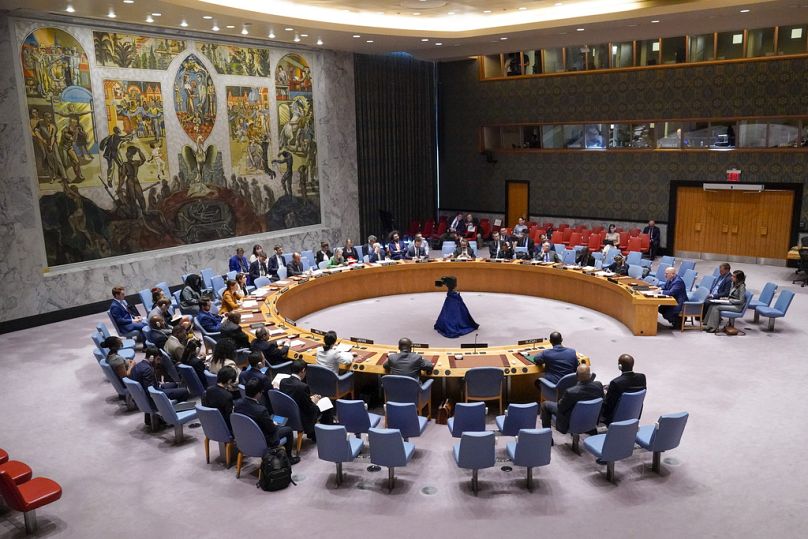
Sudanese Ambassador to the United Nations Al-Harith Idriss Al-Harith Mohamed, third from right bottom, listens as Karim Khan, third from right top, Prosecutor of InternationalMary Altaffer/Copyright 2023 The AP. All rights reserved.
Despite extending an arms embargo on Darfur in October with a unanimous vote, the UN Security Council has not attempted to take action against any of the foreign nations allegedly violating the embargo.
The war in Sudan broke out in April 2023 after a power struggle ensued between the army head Abdel Fattah al-Burhan and Mohamed Hamdan Dagalo, his former deputy who led the rival paramilitary Rapid Support Forces.
The battles, which have mostly been in Khartoum, the capital, have also sparked deadly ethnic clashes around the country.
The United Nations regards the Sudan civil war as the world’s worst humanitarian catastrophe, with as many as 14 million people displaced and starvation spreading to several areas of the nation.
Estimates of the dead from the war have varied between 20,000 and 150,000.
Czechia wants to phase out coal. But is natural gas the solution?
Europe's coal-age, industrial dinosaurs are getting fitted-out for the future. Take the Czech Republic, for example: The Prague government has promised to phase-out coal-fired power generation by the year 2033.
Operators of many ancient coal-fired power plants are on-board. The conversion has already begun at the Opatovice lignite-fired power plant. Opatovice will have completed its coal phase-out by 2030 at the latest (perhaps even earlier). The conversion will be to natural gas. This is controversial, since natural gas is also a fossil fuel.
To slow down climate change, the economy must be decarbonised. That’s the scientific consensus. The European Union’s objective is to become climate-neutral by the year 2050. The first milestone is the EU target of at least 55% less greenhouse gases by 2030 (as compared to 1990). That’s what it says in the EU law "Fit for 55".
The most important tool for this transition is emissions trading: Those who release CO2 into the atmosphere must pay. Major polluters need a lot of emission allowances. And they aren’t cheap! Consequently, operating a coal-fired power plant is no longer profitable. This is why the production of electricity and heat is shifting to less polluting energy sources.
The revenues from European emissions trading flow into the EU's "Modernisation Fund". This fund helps lower-income Member States finance the energy transition. Since 2021, the fund has paid out 15.5 billion euros. So far, most of the money has gone to the Czech Republic, Romania and Poland. Coal regions are the top priority, in order to accelerate the phase-out and make the phase-out socially acceptable in these regions.
The money from the EU Modernisation Fund will be invested in:
Renewable energy sources
Energy efficiency (e.g. thermal insulation)
Energy storage technology
and in modernisation of electricity and district heating networks
But there’s a problem and it’s a subject of heated debate throughout Europe. The modernisation fund also subsidises conversion to natural gas. Natural gas is indeed somewhat cleaner than coal. However: Burning natural gas also produces CO2, which heats up the earth's climate. There is a consensus among scientists that natural gas cannot serve as more than a temporary solution. Particularly, as climate-damaging methane escapes when natural gas is transported.
The Opatovice lignite-fired power plant in the Czech Republic has been supplying several towns, including Pardubice, with district heating for half a century. It is now being modernised with EU financial aid. In December, the Modernisation Fund approved an additional 130 million euros for coal phase-out in the Czech Republic. A significant portion will go towards investments in natural gas and development of an infrastructure for recovery of energy from waste – for example, in the forestry and agriculture sectors.
According to calculations by CEE Bankwatch, the Czech plants near Vrato and Opatovice alone are getting a total of almost 350 million euros in subsidies from the EU Modernisation Fund. The non-governmental organisation verifies whether European taxpayers' money is invested in line with the objectives. In other words, in such a manner that the environment and climate are not harmed. Morgan Henley is responsible for heating technology. She warns that the massive EU subsidies for natural gas mean that once again Europe is heading into a fossil-fuel dependency trap.
There are gigantic district heating networks in many cities of the former Eastern bloc. In the Communist Era they were ultra-modern – today they are in need of modernisation. I meet Robert Hrdina in Pardubice. The young father is concerned about his children’s future. He sits on the city's environmental committee as a Green Party representative. She considers natural gas to be problematic because it makes people dependent on foreign imports. But: "As far as the planned fuel shift in the power plant is concerned, the transition from coal to natural gas, that will be a bit cleaner." Hrdina emphasises: "Our district heating network currently runs on waste heat from the Opatovice power plant. Lignite is burned there and that produces nitrogen oxide and mercury emissions."
However, Hrdina also criticises the fact that the energy-saving potential of housing is not being fully exploited: "16,000 people live in my district. Half of the apartment blocks are still not thermally insulated, even though thermal insulation would offer energy savings of 50%. This should be our top priority.”
'St Pancras Sunrise': The award-winning short film shining a light on sex work and police brutality
Maeve Murphy is hoping to shine a spotlight on the 1981 murder of a sex worker in her new short film, exploring the powerful protest by the English Collective of Prostitutes and the ongoing battle against police brutality.
“15 women, some with children, have locked themselves in Holy Cross Church of Kings Cross. They won’t leave until they get guarantees about future police conduct,” announces a live broadcast on Thames News.
This powerful image of defiance and resilience, taken from real archive news footage, opens St Pancras Sunrise, a short film that packs a punch in just under 10 minutes.
Written and directed by Irish filmmaker Maeve Murphy, the film transports viewers to King’s Cross, London, in 1982, where a young Irish musician, Blathnaid, befriends a street sex worker named Nadina. But looming over them is the presence of a cop, Jake, whose actions will have fatal, horrific consequences.
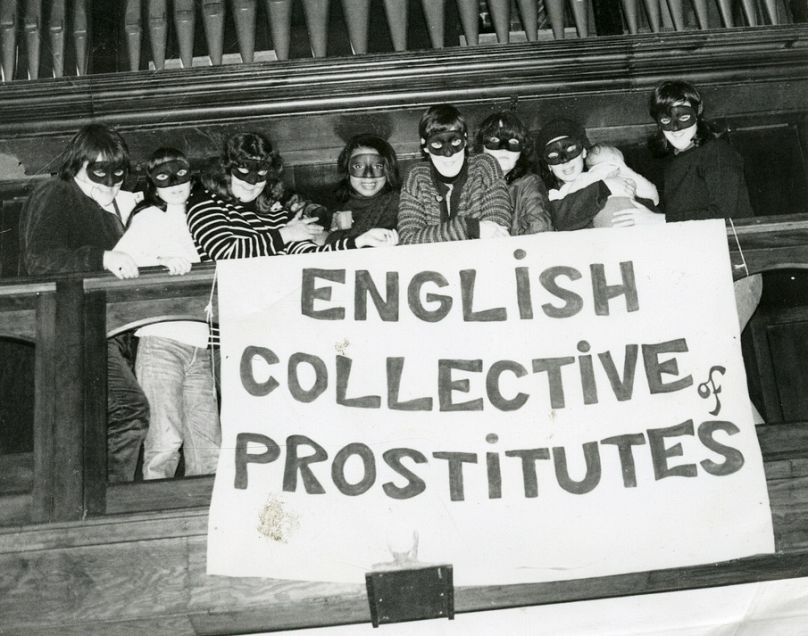
The short, which has so far won eight international film awards, including Best Short at the London International Screenwriters Film Festival, is inspired by the tragic 1981 murder of Patsy Malone, a sex worker killed by a police officer. The murder sparked a protest by the English Collective of Prostitutes (ECP), who wore black masks and occupied the Church of the Holy Cross for 12 days in the heart of King’s Cross.
The issues that fuelled that protest are alarmingly as urgent today as they were more than 40 years ago. Just this week marked the 4th anniversary of the murder of 33-year-old Sarah Everard, who was kidnapped, rapped and murdered by a Met Police officer.
"It’s extraordinary that we’re still having this conversation. Even now, a police officer can fail a vetting process and still not be sacked. When we’re talking about crimes as serious as sexual assault and murder, that level of neglect is unbelievable," states Murphy.
Sex workers "need protection and the police should be the people protecting them" says Murphy. "Yet in places, particularly in England, we've seen law enforcement not only failing that duty, but have been on the front line of perpetuating the harm to the point where a lot of sex workers are frightened as much of the police as any potential client".
To mark International Women's Day, Euronews Culture sat down with Maeve Murphy to dive deeper into the real-life events that inspired St Pancras Sunrise, the message she aims to convey through the film, and her plans to transform the short into a full-feature film.
A poster for 'St Pancras Sunrise' (2024)Directed by Maeve Murphy
Euronews Culture: Can you give us a brief synopsis of what your short St Pancras Sunrise is about?
Maeve Murphy: The film is seen through the eyes of a young Irish woman who's arriving in King's Cross in 1982 with hopes and dreams of being a musician. She becomes friends with a woman named Nadina, this force of life, who lives in the same flats as her. The story also involves a rogue policeman who keeps harassing both women. He repeatedly asks Nadina for business and she's sort of telling him to fuck off and we don't understand why. By the end, we realise that he is a policeman and the punishment that is given to her for refusing him is fatal.
What inspired you to make it?
First of all, I lived in the Hillview Estate in King's Cross in the early 90s, and the area was still heavily associated with the red-light district. Many artists were living there, attracted by cheap accommodation. The buildings had originally been squats, but over time, they turned into housing co-ops. It was rough, affordable living, but right in central London. Having lived there, I knew that world well, and I really wanted to write a human story rooted in friendship.
In my research for the film, I discovered that Patsy Malone also lived in those same flats at the Hillview Estate, which really shocked me. She lived there about a decade earlier, and it was in 1981 when she was killed by a police officer. I think that the context of the women’s protests at Holy Cross Church was strongly influenced by this event, so the two are connected.
Since a lot of the work I do as a filmmaker is based on real events or fact-driven, I put two things together: the world I knew well and created fictional characters inspired by people I may have met, alongside the real historical events of the time. I also spoke to the English Collective of Prostitutes, including a particular woman who had actually been in the church during that period.
ECP Church Occupation 1982
Credit: English Collective of Prostitutes (EDP)/Crossroads AV Collective
How much creative license did you take with the real-life events?
I think the most successful film I’ve ever made, in terms of features, was Silent Grace. It’s about the women in Armagh Prison during the Dirty Protests, fighting for political status, and some of them even went on hunger strikes. These women were written out of history. In the same way Ken Loach does, you take real events, but when creating drama, it has to be shaped in a way that an audience can connect with. It needs complete authenticity, but it also has to work as a piece of cinema.
When it comes to sex workers, there’s an added complexity. A lot of their lives involve anonymity. Some people are happy to publicly stand by their work, while others aren’t. So, how do you choose one person to represent that experience and not another? It’s a tricky situation. The ECP is behind the film - they’ve watched the film and provided the captions at the end. It’s authentic. The historical events are accurate, the humanity is accurate, and it’s also cinematically truthful.
The film opens to what feels like actual archive footage. Is this the case?
Yes, very well spotted. That is real news footage, I believe from Thames News, covering the Holy Cross occupation. You see a reporter reporting on it, and there are also clips of documentary archive footage showing them inside the church.
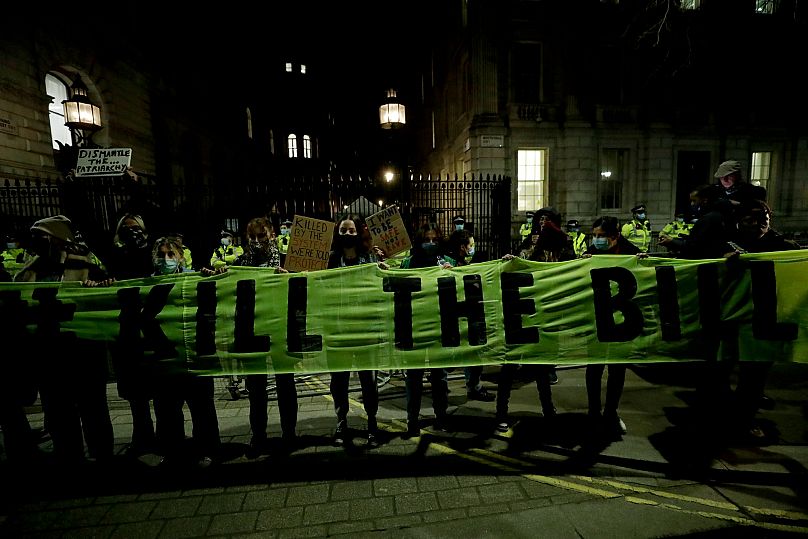
Protesters march with a banner against the British government's proposed crime bill, honoring 33-year-old Sarah Everard, murdered in London on March 15, 2021.Credit: AP Photo
What do you think is a common misconception that society has about the sex worker community?
I think there’s a real push at the moment to try and humanise sex workers in culture and cultural terms. For so long, the perception of them has been overwhelmingly negative - shaming, moral judgment, and taboo, or incredibly racy. But these are just ordinary women making a choice - though for some, it's more of a choice than others. When it comes to street work, there is a survival issue going on.
I think the most powerful thing filmmakers can do is create strong, powerful human characters that are unforgettable. And I think with the character of Nadina, for example, she has this incredible life force. You see her ice skating in the film, full of energy. She's not somebody that you think is gonna get suddenly mowed down. But that is also the reality of street sex work. They are still vulnerable. They do need protection and the police should be the people protecting them. Yet in places, particularly in England, we've seen law enforcement not only failing that duty, but have been on the front line of perpetuating the harm to the point where a lot of sex workers are frightened as much of the police as any potential client.
And this week was the fourth anniversary of Sarah Everard’s death. Patsy Malone died in 1981. It’s extraordinary that we’re still having this conversation. Even now, a police officer can fail a vetting process and still not be sacked. When we’re talking about crimes as serious as sexual assault and murder, that level of neglect is unbelievable. Every woman’s life should be safe, and the people responsible for their safety need to be trustworthy. The fact that some of these officers still have access to firearms is even more alarming.
I think what filmmakers can do is tell human stories that make people connect with a character, feel their loss, and share in the shock and sadness when something happens to them.
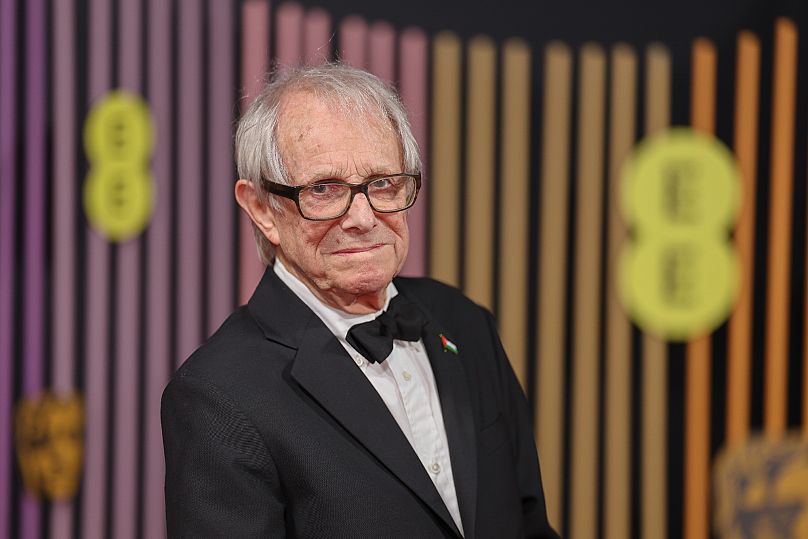
Ken Loach poses for photographers upon arrival at the 77th British Academy Film Awards, BAFTA's, in London. Credit: AP Photo
You mentioned Ken Loach earlier - have you taken inspiration from his work? If so, in what ways?
There’s a direct connection between myself and Ken Loach. I mean, in that I worked in his office, and my first short film, Amazing Grace, was kind of born out of that environment. Silent Grace and Beyond the Fire were both scripts that were developed in and around that production company. Rebecca O’Brien, his producer, saw the short and was really encouraging about it. She even suggested that to really capture the look of old King’s Cross, I should just go down there, walk the streets, and find those old buildings that are still standing. So that’s exactly what I did. That’s how we found those flats - people still live in them, interestingly enough - which are actually old hospital flats around Wickland Street.
I spoke with Rebecca about the short and about the whole ethos of approaching it with integrity - working with activists or local people in the area. And beyond that, I know the area like the back of my hand, having lived there for two and a half years. So there’s a personal connection as well. But at the same time, there’s also the professional responsibility as a filmmaker - to respect the craft and do your best to shape a story out of it.
Considering the ongoing issues of police violence, as well as violence against women and sex workers, do you believe the entire system needs a complete overhaul? Or are there specific changes that could be made right now to address these concerns?
Well, there are two things. First, the police need to have the power to sack officers who fail vetting or take serious disciplinary action against them. The fact that they can’t is just awful, right? That needs to change immediately. There’s no reason for delays - it should be fast-tracked. That would show real commitment and care.
And the second thing - well, look at what the women in Holy Cross Church did back in 1982. It gives a little bit of hope and shows that the fight is worth it. They actually managed to get local police monitoring in place. It broke down after a couple of years, but the fact that they achieved it at all proves that change is possible.
So, something like that - when it comes to the arrest of women - I’d say maybe a police officer shouldn’t be out there alone. Maybe there should always be a female officer present. Just an idea. I’m kind of riffing here, but that seems like a reasonable step.
Another thing that absolutely needs to change is this strange law about cautions for sex workers. If a sex worker is cautioned, they’re immediately criminalised, and it stays on their record for 100 years. That means if they try to get a job decades later, even after moving on completely, it still comes up. And because sex work is still taboo in society, it can seriously impact their employment. Meanwhile, for most people, cautions disappear from their record in a year or two. So why are sex workers being treated so differently? It doesn’t make sense. I know the English Collective of Prostitutes is really pushing to change that right now.
Mikey Madison, winner of Best Actress for Anora, attends the Oscars Governors Ball on Sunday, 2 March 2025, in Los Angeles.Credit: AP Photo
Recently, Sean Baker's Anora won Best Picture at the Oscars, and Mikey Madison, the lead actress, gave a shout-out to sex workers in her acceptance speech. What was your reaction to seeing this?
I think it’s great. I’ve seen the film and I really enjoyed it. It’s a completely different story from St Pancras Sunrise because we’re right in the middle of that conflict between the police and sex workers, or police violence and sex workers. It’s a very different narrative.
But I thought it was a really lovely film, and I was so glad to see it win. It was clearly well-researched, and I really appreciate the way it honours the community of sex workers. I also thought what she said was really lovely. So I thought it was fantastic.
Do you see this as an example of cinema starting to take these stories seriously, or do you feel there’s still more to be done in terms of representing sex workers?
Yeah, I definitely think so. And I think Sean Baker is a great filmmaker. I’ve seen Tangerine, and it’s also a powerful film about sex work. It really emotionally impacted me - I absolutely loved it. I think what’s happening now is natural, and there are so many more stories to tell from different perspectives. Not just the sexual fantasy of a sex worker, but the full complexity of their experiences. I think it’s a good thing. Cinema is opening up in terms of the stories it’s telling. It’s never easy, but those voices are starting to be heard.
I think what’s good is that people are ready to hear these stories. People are open to the idea that sex workers are just like anyone else. And also, that the police can be incredibly violent and brutal, especially towards women. That’s an issue that absolutely needs to be addressed.
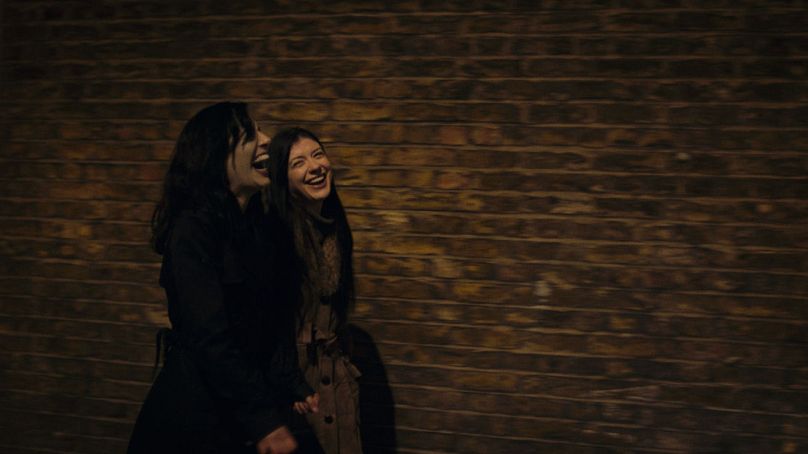
A still from 'St Pancras Sunrise' (2023)Directed by Maeve Murphy
What has the reception been like for St Pancras Sunrise so far? You've won some awards, which is amazing.
It’s been great! And the international response has been fantastic. Our first award was actually in LA on 9 September last year, and then it just snowballed - eight awards in about two weeks. It was unbelievable. That’s something that’s never happened to me in my life. Now, we’ve just heard it won an award at the beginning of the year at the London International Screenwriters Film Festival for Best Short. It’s also going to the Fastnet Film Festival in West Cork, which is great, especially since it’s been indirectly funded by Screen Ireland.
It’s wonderful to have it shown in Ireland, especially after it screened in Belfast and Iskia. It’s also available on the Irish Film & TV UK app, so people in Europe can watch it there. I think that really opens it up to a wider European audience.
I was honestly shocked, because it didn’t go through the usual channels. It’s a truly independent film - it wasn’t financed through any board or funding body. I used the director’s retainer from Screen Ireland to pay for it.
What's next for the project?
I’m definitely hoping to expand this into a feature, which would explore Blathnaid and Nadina’s friendship and further explore Jake, the unraveling cop. It would also extend into the church and the protest. There’s definitely room for a longer story. Screen Ireland and Northern Ireland Screen are involved so we hope to get this into production towards the end of this year or next year.
St Pancras Sunrise is currently available to watch on the Irish Film Television UK app (IFTUK).