Tuesday, March 11, 2025

Democracy first? Economic model begs to differ


Analysis of historical evolution of bureaucracy suggests that quality nation-building holds more importance


Osaka Metropolitan University

First things first 

image: 

A new economic model suggests that it may be important for societies to achieve nation-building before democracy.

view more 

Credit: Osaka Metropolitan University


Recent studies on economic growth report that preventing the abuse of state power through democratic institutions is critical to a nation’s development. However, there has been little prior research on how societies transition in response to the two conflicting goals of limiting the state’s stranglehold on governance while improving its administrative capacity through citizens’ political participation.

Osaka Metropolitan University Associate Professor Ryosuke Okazawa of the Graduate School of Economics led a team that focused on the quality of the bureaucracy, which has a significant impact on state capacity, and analyzed its historical evolution using an economic model.

Their model predicted that in nations where bureaucracies were historically underdeveloped, clientelism, in which politicians offer public office to their supporters in exchange for votes, would prevail rather than governments providing public services. It also turns out that under a corrupt government, the quality of the bureaucracy is likely to deteriorate further and society will likely fall into a vicious cycle.

The model also determined that democratization at a stage of an immaturely functioning government would hinder the development of the bureacratic institution because it would encourage vote-buying behavior by public office holders. To confirm the validity of this theoretical prediction, the team analyzed data from 108 nations from 1900 to 2000 and found a negative correlation between the experience of universal suffrage and the quality of current institutions in nations with low-quality bureaucracies in the past.

“The results of this study suggest that it may be important for societies to achieve nation-building before democracy,” explained Professor Okazawa. “Cases such as the public sector's inability to provide sufficient infrastructure and education necessary for economic development, thereby hampering the potential for economic growth, have been reported in many developing nations even today. Such an analysis of the relationship between national capacity and economic growth is a new area of research, and we hope that this study will serve as a catalyst for further discussion.”

The findings were published in the Journal of Development Economics.

###

About OMU 

Established in Osaka as one of the largest public universities in Japan, Osaka Metropolitan University is committed to shaping the future of society through “Convergence of Knowledge” and the promotion of world-class research. For more research news, visit https://www.omu.ac.jp/en/ and follow us on social media: XFacebookInstagramLinkedIn.

Sanders Warns Musk's Call for $700 Billion in Cuts Is a 'Prelude' to Social Security Privatization


"Why do you lie so much about Social Security? To get people to lose faith in the system, and then you can give it over to Wall Street," said Sen. Bernie Sanders.


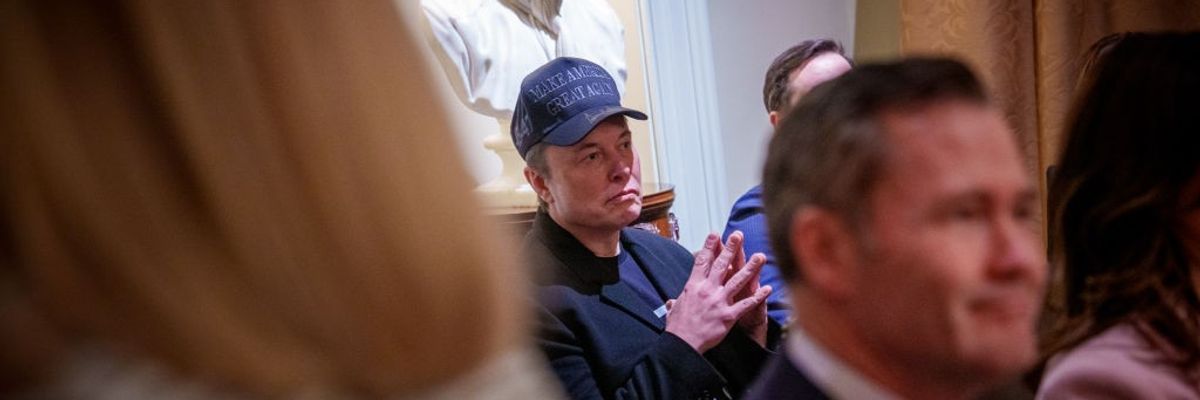
Elon Musk attends a Cabinet meeting at the White House on February 26, 2025.
(Photo: Andrew Harnik/Getty Images)

Jake Johnson
Mar 11, 2025
COMMON DREAMS

U.S. Sen. Bernie Sanders warned late Monday that billionaire Elon Musk's new call for up to $700 billion in cuts to mandatory federal spending is an alarming step in the direction of Social Security privatization, a longstanding—and deeply unpopular—goal of right-wing politicians and corporate-funded think tanks.

Musk, who is spearheading a large-scale assault on federal agencies and workers, told Fox Business host Larry Kudlow on Monday that "waste and fraud" in "entitlement spending"—a category that includes Social Security, Medicare, and Medicaid—is "the big one to eliminate," estimating that up to $700 billion could be cut from such programs.

It's not clear where Musk, who has lied repeatedly about Social Security in recent weeks, got the $700 billion figure. As Rolling Stone's Andrew Perez noted, "There is no expert on the planet who thinks there is $700 billion worth of annual fraud in America's safety net programs."

"Musk at one point in the interview cited a Government Accountability Office report which estimated that the government may lose between $233 billion and $521 billion annually to fraud, but that report covered the whole of the federal government—not just those programs," Perez wrote.

A 2024 report from the Social Security Administration's inspector general found that of the $8.6 trillion in Social Security benefits paid out between 2015 and 2022, roughly $71.8 billion was dispensed improperly—0.84% of the total.

"I think this is a prelude not only to cutting benefits, but to privatizing Social Security itself. I think that's in the back of their mind."

Musk also baselessly claimed that mandatory federal spending on programs such as Social Security, Medicare, and Medicaid is a "mechanism by which the Democrats attract and retain illegal immigrants, by essentially paying them to come here and then turning them into voters." (In reality, undocumented immigrants pay taxes that help finance Social Security and Medicare but cannot receive benefits from the programs.)

Sanders (I-Vt.) couldn't hide his disgust when he was asked during a CNN appearance to respond to Musk's remarks.

"Well, he has called Social Security a Ponzi scheme. They have already laid off 2,500 employees of the Social Security Administration," said Sanders. "If you ask me, I think this is a prelude not only to cutting benefits, but to privatizing Social Security itself. I think that's in the back of their mind."

"Why do you lie so much about Social Security? Why do you make it look like it's a broken, dysfunctional system?" Sanders asked. "The reason is to get people to lose faith in the system, and then you can give it over to Wall Street. That's my view."


Musk's latest attack on Social Security, a remarkably efficient program that has never missed a payment, came as his Department of Government Efficiency, or DOGE, has effectively taken over the Social Security Administration (SSA) and is pushing for massive cuts to the agency's staff and budget based on egregious lies.

"Appearing to misread a chart, for example, Musk said on social media in February that DOGE had identified payments to 'tens of millions' of deceased Americans—an incorrect assertion repeated by White House Press Secretary Karoline Leavitt," The Washington Postreported last week.

Everett Kelley, president of the American Federation of Government Employees—a union engaged in a legal fight against the Trump administration's purge of the federal workforce—wrote Monday that Musk's latest comments show that he "doesn't just want to cut the SSA workforce."


"He wants to eliminate Social Security entirely," Kelley added.


Joel Payne, chief communications officer at MoveOn Civic Action, said in a statement Tuesday that "Elon Musk and the Trump-led Republican Party are promising exactly what they have been trying to do for years: gut Social Security."

"Republicans want to illegally fire tens of thousands of workers responsible for making sure American seniors get their Social Security and then let Musk take his chainsaw to our benefits," said Payne. "We won't let them do it. Elon Musk, Donald Trump, and Republicans need to keep their hands off our Social Security."

The progressive advocacy group Social Security Works sounded a similarly defiant note.

"Elon Musk is a conman and a criminal, born with an emerald mine instead of a moral compass," the group wrote on social media. "Of course he wants to destroy Social Security, because he can't get his tiny greedy fingers on it any other way. HELL NO!"
House GOP Prepares to Make It Easier for Tech Giants—Like Musk's X—to Scam Consumers

"Allowing companies like Apple, PayPal, and X Money to avoid federal laws creates a blind spot for rampant financial abuse and fraud," said one watchdog group.


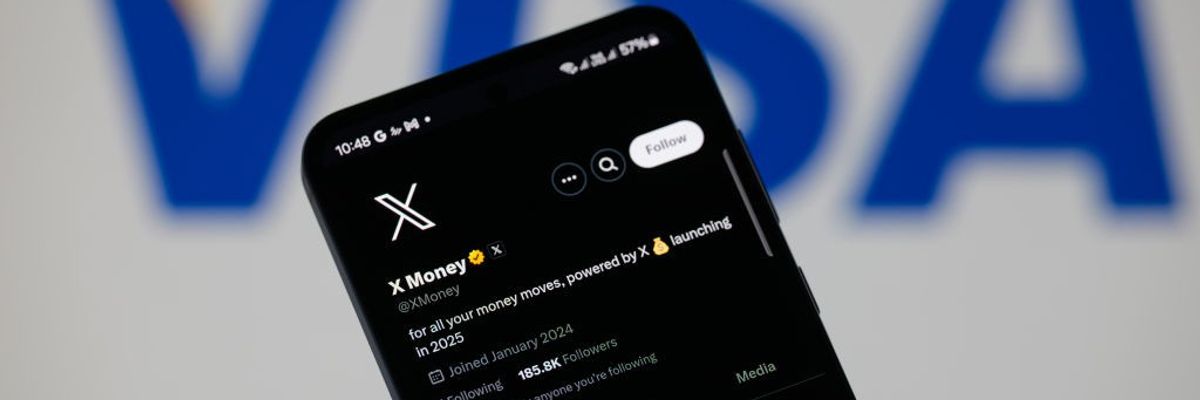
An X Money account is displayed on a mobile phone with Visa in the background, in this photo illustration in Brussels, Belgium, on January 29, 2025.
Photo by Jonathan Raa/NurPhoto via Getty Images

Jake Johnson
Mar 11, 2025
COMMON DREAMS

House Republicans on Tuesday are expected to join their Senate colleagues in advancing a resolution that would roll back a Consumer Financial Protection Bureau rule designed to protect the American public from scammers on digital payment platforms, a move that watchdog groups say would personally benefit President Donald Trump and billionaire Elon Musk.

The House resolution, led by Rep. Mike Flood (R-Neb.), targets a CFPB rule that was finalized shortly after the November election, in the waning days of the Biden administration. The CFPB said at the time that the rule would help ensure that companies offering digital payment services "follow federal law just like large banks, credit unions, and other financial institutions."

But the CFPB is now led by Project 2025 architect Russell Vought, who has halted virtually all of the agency's work while Musk's Department of Government Efficiency overtakes the bureau, looking to gut it from the inside.

With their effort to rescind the CFPB's digital payments rule, congressional Republicans are aiding Musk's assault on the CFPB and delivering a major win for his push into financial services with X Money. The Senate voted mostly along party lines to rescind the rule last week.

"This is a gift to Big Tech and likely the personal finances of Trump and Musk themselves," Tony Carrk, executive director of Accountable.US, said in a statement as the GOP-led House Financial Services Committee took up the resolution. "These companies process over 13 billion transactions a year, and millions of Americans are relying on them for safe and secure payments."

"Allowing companies like Apple, PayPal, and X Money to avoid federal laws creates a blind spot for rampant financial abuse and fraud," Carrk added.

Accountable.US noted in a recent report that both Trump and Musk stand to benefit financially from efforts to gut the CFPB and eliminate rules enacted under the Biden administration.

"Last year, Trump Media & Technology Group filed a trademark to create a broad financial services platform Truth.Fi," the group observed. "The products and services they said they would perform included the creation of a 'downloadable computer software' that serves as a 'digital wallet' to store and trade cryptocurrencies as well as a digital payments processing platform for purchases made with cryptocurrencies."

That initiative and Musk's X Money would fall under the purview of the rule that congressional Republicans are poised to roll back.

In a CNNappearance on Monday, former CFPB Director Rohit Chopra said that Musk and other powerful corporate executives are "fixated" on the consumer bureau because it is "responsible for monitoring all of those tech companies for how they're moving our money to protect against privacy errors and fraud."


'White collar defendants' and crypto entrepreneurs 'cast themselves as victims' in bid for Trump’s mercy


Sam Bankman-Fried in an interview during the Bitcoin 2021 conference, Image via YouTube/Wikimedia Commons.


Jeff Lawrence
March 11, 2025
ALTERNET

Since taking office, President Donald Trump has pardoned and granted clemency to many high profile individuals — and "potential petitioners have taken notice," Politico reports.

Per Politico, "white-collar defendants [are] jolting to attention" and "casting themselves as victims of a crooked justice system" in a bid for Trump's lenience.

“A Democratic District of Columbia Council member facing federal bribery charges has lavished public praise on Trump’s pick to lead the FBI; a Bitcoin entrepreneur fighting extradition from Spain on tax charges has sat down with Tucker Carlson to plead his case," Politico reports.

Sam Mangel, a consultant for incarcerated individuals, told Politico "everybody that is in prison now is keenly aware of the environment."

"It’s become a very hot topic within the low- and minimum-security inmate communities,” Mangel said.

"People intimately familiar with the current parameters" told Mangel there are "limits" to Trump's leniency, Politico reports.

Per Politico, "Undocumented immigrants and people convicted of sexual, drug-related or violent crimes, [Mangel] said, need not apply. A White House spokesperson, Elizabeth Huston, declined to comment.”

Mangel told Politico he's receiving two to four inquiries a day and has had to hire extra paralegals to handle the surge. “The level of interest is unheard of," he said.

As Politico notes, "crypto entrepreneurs" are at the top of trump's pardon list.

Bitcoin miner Joby Weeks is one such entrepreneur vying for the president's attention.

"Weeks pleaded guilty to tax evasion and an unregistered securities offering related to his crypto activities, and he has been awaiting sentencing ever since, as the Justice Department continues to pursue a broader conspiracy case against other defendants." Politico reports.
'Now Do Netanyahu': Philippines' Duterte Arrested Under ICC Warrant for Crimes Against Humanity


"Duterte's arrest on an ICC warrant... shows that suspected perpetrators of the worst crimes, including government leaders, can and will face justice," said one human rights advocate.


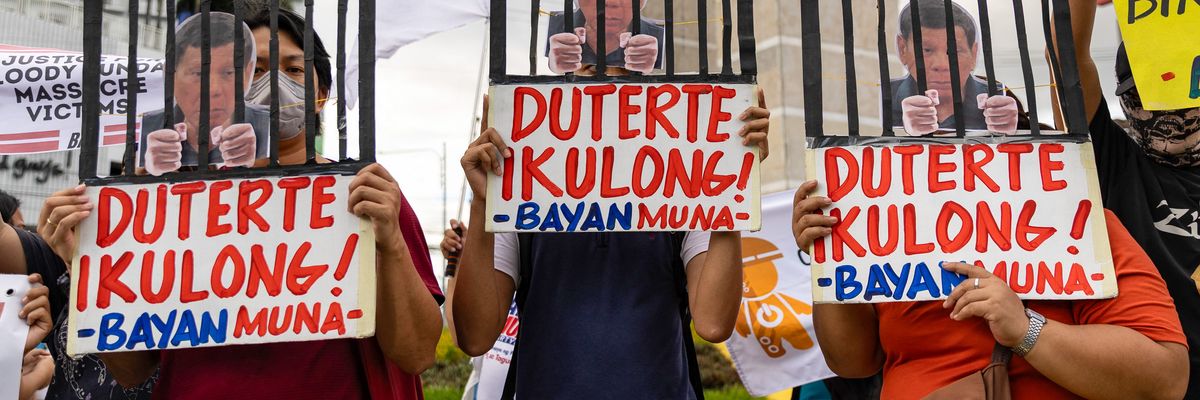
Protesters demonstrate demanding justice for drug war victims, after the arrest of former Philippine president Rodrigo Duterte, in Quezon City on March 11, 2025.
(Photo: Earvin Perias / AFP)

Eloise Goldsmith
Mar 11, 2025
COMMON DREAMS

On Tuesday, former Philippine President Rodrigo Duterte was arrested by local authorities at Manila's international airport after the International Criminal Court issued a warrant accusing him of crimes against humanity. News of his arrest prompted some observers to urge the arrest of another public figure who faces ICC charges: Israeli Prime Minister Benjamin Netanyahu.

The Duterte case will pose a test for the court, according to The New York Times. In the past six months, the ICC has issued arrest warrants for Netanyahu, former Israeli Defense Minister Yoav Gallant, and Min Aung Hlaing, the head of the military junta in Myanmar.

Trita Parsi, executive vice president of the Quincy Institute for Responsible Statecraft, wrote "Perhaps Netanyahu and Gallant will be next..." in response to the news. Danny Shaw, a professor at City University of New York, posted a video of Duterte's arrest and wrote: "Why don't they arrest Netanyahu?"

Wim Zwijnenburg, a project leader at the Dutch peace organization PAX, wrote, "now do Netanyahu."

On Tuesday night, Duterte was placed on a plane that was bound for The Hague, where the court is headquartered, per the Times, citing two people with knowledge of the matter.

The ICC has accused Duterte of crimes against humanity during his time as president and when he was the mayor of the city of Davao. During his tenure as president, from 2016 to 2022, Duterte's security forces carried out thousands of killings that his government cast as drug-related cases. In a 2017 report, Human Rights Watch described his "war on drugs" as effectively "a campaign of extrajudicial execution in impoverished areas of Manila and other urban areas." Philippine National Police officers and unidentified "vigilantes" killed over 7,000 people between the start of his term and the release of that Human Rights Watch report, according to the group.

In 2017, Duterte earned praise from U.S. President Donald Trump, who told him in a phone call that he was doing "an unbelievable job on the drug problem," according to reporting at the time.

"Duterte's arrest on an ICC warrant is a hopeful sign for victims in the Philippines and beyond. It shows that suspected perpetrators of the worst crimes, including government leaders, can and will face justice, wherever they are in the world," said Agnes Callamard, secretary general of the human rights group Amnesty International, in a statement Tuesday. "At a time when too many governments renege on their ICC obligations while others attack or sanction international courts, Duterte's arrest is a huge moment for the power of international law."

Duterte's former chief legal counsel and presidential spokesperson, Salvador Panelo, said that the "ICC has no jurisdiction in the Philippines," in part because "the country withdrew as an ICC member state in 2018," according to a post on social media.

According to the Times, the court says the case only considers alleged crimes from the time when the country was still part of the court.


According to a copy of he warrant, which was obtained by the Times, three judges of the ICC said they believed Duterte "was responsible for the drug war killings that took place when he was president and mayor of Davao, and that there were reasonable grounds to believe that these attacks were 'both widespread and systematic.'"

The government itself, in 2022, said that over 6,200 "drug suspects" were killed during Duterte's war on drugs starting in 2016. Rights groups put the total number of people who died much higher, in the tens of thousands, according to PBS.


Catching the world’s most wanted: the ICC’s impossible task


By AFP
March 11, 2025


ICC Deputy Prosecutor Mame Mandiaye Niang at the Hague court on August 22, 2023 - Copyright AFP Holmes CHAN

Olivia BUGAULT

The arrest on Tuesday of former Philippines President Rodrigo Duterte, by police acting on an International Criminal Court warrant tied to his deadly war on drugs, marks a success for the ICC, which has been struggling for almost 23 years against a lack of recognition and enforcement power.

Backed by 125 member states, the jurisdiction seeks to prosecute individuals responsible for the world’s gravest crimes when countries are unwilling or unable to do so themselves.

The wheels of international justice grind slowly, as evidenced by the court’s low conviction rate.

However, it’s not all about the final judgement, experts say.

The mere fact of pursuing alleged perpetrators of atrocities sends a message that the international community is determined to fight impunity.

– Catch me if you can –


Since it began work in 2002, the ICC has opened 32 cases for alleged war crimes, crimes against humanity, genocide and offences against the administration of justice.

Fourteen of them, or roughly 40 percent, are ongoing, in most cases because the suspects are still at large.

Without a police force, the Hague-based court is unlikely to catch them soon.

Of the 60 arrest warrants issued since 2002, only 21 had been carried out before Duterte’s arrest.

The ICC relies on states to apprehend suspects.

But the incentive for them to cooperate is low because the court has “nothing to offer in return, except a commitment to seeing justice served”, former ICC adviser Pascal Turlan said.

The court’s wanted list includes Russian President Vladimir Putin, Israeli Prime Minister Benjamin Netanyahu and Ugandan warlord Joseph Kony. All three are accused of war crimes.

Russia is one of dozens of nations, including the United States, Israel and China, that do not recognise the jurisdiction of the ICC, hampering its ability to investigate their nationals.

But some member states also defy its authority by, for instance, refusing to hand over suspects.

“When states don’t like what the ICC does, they don’t often cooperate,” said Nancy Combs, professor of law at William & Mary Law School in the United States.

– 11 convictions, all Africans –


ICC spokesperson Fadi El Abdallah stressed that the court’s role is not to go after all suspected war criminals but to “encourage nations to deal with their own cases”.

Each case comes with a unique set of challenges, from interference by national governments to witness intimidation.

The latter caused the case against Kenya’s former deputy president William Ruto to fall apart in 2016, according to a former chief prosecutor.

These challenges partly explain the court’s low conviction rate.

Since its inception it has handed down 11 guilty verdicts, mostly against officials from the war-torn Democratic Republic of Congo (DRC), and four acquittals.

All those judged were Africans, leading to accusations that the ICC is unfairly targeting the continent.

Combs pointed out that some African countries, including Uganda, Ivory Coast and the DRC, had referred their own wars to the court for investigation in the early days, while other cases had been instigated by the United Nations Security Council.

“The ICC has diversified a lot but non-African states have resisted ICC jurisdiction more fiercely,” she pointed out, citing Russia as an example.


Ex-Philippine president Duterte arrested for crimes against humanity

Manila (AFP) – Former Philippines president Rodrigo Duterte was arrested Tuesday in Manila by police acting on an International Criminal Court warrant tied to his deadly war on drugs.


Issued on: 11/03/2025 - FRANCE24
This handout photo taken and released by Rodrigo Duterte's PDP Laban party shows the former Philippine president (C) inside the Villamor Air Base in Manila © Handout / PARTIDO DEMOKRATIKO PILIPINO–LAKAS NG BAYAN (PDP LABAN)/AFP


The 79-year-old faces a charge of "the crime against humanity of murder", according to the ICC, for a crackdown that rights groups estimate killed tens of thousands of mostly poor men, often without proof they were linked to drugs.

"Early in the morning, Interpol Manila received the official copy of the warrant of the arrest from the ICC," the presidential palace said in a statement.

"As of now, he is under the custody of authorities."

Duterte demanded to know the basis of his arrest in a video posted to his youngest daughter Veronica's Instagram account following his detention.


"So what is the law and what is the crime that I committed? Show to me now the legal basis of my being here," he said in the video.

"I was brought here not of my own volition but somebody else's ... you have to answer now for the deprivation of liberty."

While no location was given for the video, a photo released by his political party said he was being held at the Villamor Air Base next to Manila airport.

Duterte's former chief legal counsel, Salvador Panelo, called the arrest "unlawful".
Police arrested former Philippines president Rodrigo Duterte as he arrived at Manila's international Airport © Jam STA ROSA / AFP

"The (Philippine National Police) didn't allow one of his lawyers to meet him at the airport and to question the legal basis for PRRD's arrest," he said.

Reactions from those who opposed to the drug war, however, were jubilant.

One group that worked to support mothers of those killed in the crackdown called the arrest a "very welcome development".

"The mothers whose husbands and children were killed because of the drug war are very happy because they have been waiting for this for a very long time," Rubilyn Litao, coordinator for Rise Up for Life and for Rights, told AFP.

"Now that Duterte has been arrested, (President) Ferdinand Marcos Jr. should make sure that he is actually delivered to the ICC for detention and trial," said Philippine rights alliance Karapatan, calling the arrest "long overdue".

Human Rights Watch also called on the government to "swiftly surrender (Duterte) to the ICC", saying the arrest was a "critical step for accountability in the Philippines".

China however warned the ICC against "politicisation" and "double standards" in the Duterte case and said it was "closely monitoring the development of the situation".
A winding path

Duterte's Tuesday morning arrest at Manila's international airport followed a brief trip to Hong Kong.

Speaking to thousands of overseas Filipino workers there Sunday, the former president decried the investigation, labelling ICC investigators "sons of whores" while saying he would "accept it" if an arrest were to be his fate.

Rights groups estimate that tens of thousands of mostly poor men were killed by police and vigilantes during Duterte's drug war © NOEL CELIS / AFP/File

The Philippines quit the ICC in 2019 on Duterte's instructions, but the tribunal maintained it had jurisdiction over killings before the pullout, as well as killings in the southern city of Davao when Duterte was mayor, years before he became president.

It launched a formal inquiry in September 2021, only to suspend it two months later after Manila said it was re-examining several hundred cases of drug operations that led to deaths at the hands of police, hitmen and vigilantes.

The case resumed in July 2023 after a five-judge panel rejected the Philippines' objection that the court lacked jurisdiction.

Since then, the Marcos government has on numerous instances said it would not cooperate with the investigation.

But Undersecretary of the Presidential Communications Office Claire Castro on Sunday said that if Interpol would "ask the necessary assistance from the government, it is obliged to follow".

Duterte is still hugely popular among many in the Philippines who supported his quick-fix solutions to crime, and he remains a potent political force.

He is running to reclaim his job as mayor of his stronghold Davao in May's mid-term election.

Charges have been filed locally in a handful of cases related to drug operations that led to deaths -- only nine police have been convicted for slaying alleged drug suspects.

A self-professed killer, Duterte instructed police to fatally shoot narcotics suspects if their lives were at risk and insisted the crackdown saved families and prevented the Philippines from turning into a "narco-politics state".

At the opening of a Philippine Senate probe into the drug war in October, Duterte said he offered "no apologies, no excuses" for his actions.

"I did what I had to do, and whether or not you believe it or not, I did it for my country," he said.

© 2025 AFP


Ex-Philippine president Duterte arrested for crimes against humanity


Philippines' Duterte earned international infamy, praise at home

Manila (AFP) – Former Philippines president Rodrigo Duterte earned international infamy for the deadly narcotics crackdown that led to his arrest Tuesday on charges of crimes against humanity, despite enjoying huge popularity at home.


Issued on: 11/03/2025 - FRANCE24

Former Philippine president Rodrigo Duterte, pictured here in 2018, was arrested Tuesday in Manila on charges of crimes against humanity © TED ALJIBE / AFP/File

A tough-talking populist and self-professed killer, Duterte's anti-crime campaign resulted in the deaths of thousands of alleged dealers and addicts.

Yet while drawing condemnation abroad, tens of millions of Filipinos backed his swift brand of justice -- even as he joked about rape in his rambling speeches, locked up his critics and failed to root out entrenched corruption.

That trust was dented by the coronavirus pandemic which plunged the country into its worst economic crisis in decades, leaving thousands dead and millions jobless with a slow-paced vaccine rollout.

Duterte's woes deepened in 2021, when the chief prosecutor of the International Criminal Court (ICC) sought an investigation into crimes against humanity during his drugs crackdown.

Duterte, now 79, repeatedly said there was no official campaign to illegally kill addicts and dealers, but his speeches included incitements to violence and he told police to kill drug suspects if their lives were in danger.
'Kill them'

"If you know of any addicts, go ahead and kill them yourself as getting their parents to do it would be too painful," Duterte said, hours after being sworn in as president in June 2016.

Months later, he would liken the deadly crackdown to Hitler's efforts to exterminate Jews, although vastly underestimating the number of people killed in the Holocaust.

"Hitler massacred three million Jews. Now there are three million drug addicts (in the Philippines). I'd be happy to slaughter them."

His unfiltered comments are part of his self-styled image as a maverick, which found traction in a nation where corruption, bureaucracy and dysfunction impact people's lives at every level.

While unable to run for president again after serving a six-year term that ended in 2022, Duterte remains a major figure in politics.

He has been seeking a return to his old job as mayor of his southern stronghold of Davao mid-term elections in May.

A one-time ally of the Marcos family, Duterte even allowed Ferdinand Marcos Sr, whose brutal regime silenced the legislature and killed opponents, to be buried in the capital's Heroes' Cemetery.

But the alliance of dynasties has long since collapsed, and Duterte is engaged in a feud with current President Ferdinand Marcos.

His daughter, Vice President Sara Duterte, faces an impeachment trial in the Senate.
'I simply love Xi'

The former lawyer and prosecutor was born in 1945 into a political family.

His father served for three years as a cabinet secretary before the nation plunged into dictatorship in 1972.

During his long tenure as mayor of the southern city of Davao, Duterte was accused of links to vigilante death squads that rights groups say killed more than 1,000 people there -- accusations he has both accepted and denied.

His tenure as president was also marked by a swing away from the nation's former colonial master, the United States, in favour of China.

"I simply love (Chinese president) Xi Jinping... he understands my problem and is willing to help, so I would say thank you China," he said in April 2018.

As part of that rapprochement, he set aside rivalry with Beijing over the resource-rich South China Sea, opting to court Chinese business instead.

He claimed this friendship helped secure millions of doses of a Chinese-made Covid-19 vaccine, but supplies still fell far short.

Billions of dollars of promised trade and investment from its superpower neighbour also failed to materialise.

President Marcos has made both Duterte's perceived coziness with Beijing and his bloody drug war a centrepiece of his campaigning ahead of the May mid-terms.

Duterte was arrested at Manila's international airport after returning from a brief trip to Hong Kong.

The former president had previously said he was ready to go to jail for his anti-narcotics crackdown, but vowed never to allow himself to come under ICC jurisdiction.

© 2025 AFP


Impeachment A Key Weapon In The Philippines’ Marcos–Duterte Divide – Analysis


By 

By Paolo S Tamase and Athena Charanne Presto


On 5 February 2025, the Philippine House of Representatives impeached Vice President Sara DuterteSeveral allegations prompted the impeachment, including her implied death threats towards President Ferdinand ‘Bongbong’ Marcos Jr, irregularities in her use of office funds, unexplained wealth, incitement of sedition, abuse of power and betrayal of public trust.

Following the impeachment, political commentaries have drawn attention to the rupture of UniTeam — Sara Duterte and Bongbong’s 2022 electoral alliance. But beyond this rupture, Duterte’s impeachment also signifies a shift at the heart of the Philippines’ democratic institutions.

Impeachment, as a constitutional mechanism, has shifted from being primarily a tool of moral accountability to becoming a mainly political strategy without clear ethical or democratic direction. This is not to argue against its political use or the progression of Duterte’s impeachment. Rather, it is an acknowledgement of how current political alliances exploit the process, sidelining impeachment’s role as a public safeguard as enshrined in the Constitution.

High-ranking officials have traditionally reserved impeachment for clear violations of ethical or legal duties, pursuing it alongside popular mobilisation. But the context surrounding Duterte’s impeachment suggests a strategic utility of this process, particularly as the country approaches the 2025 midterm elections and Duterte’s anticipated 2028 presidential bid (President Marcos is constitutionally limited to a single six-year term).

Impeaching public officials is not foreign to the Philippines’ recent political history. The 1987 Constitution, ratified after the fall of the Ferdinand Marcos Sr regime, included impeachment as an accountability mechanism for the highest constitutional officers. The House of Representatives has impeached five officials, including Duterte. Only two have advanced to trial in the Senate. The first trial, that of former president Joseph Estrada in 2001, was pre-terminated by his resignation after mass protests. The second, that of former Supreme Court chief justice Renato Corona in 2012, concluded in conviction.


Civil society supported Estrada and Corona’s impeachments, organising movements around moral governance and accountability. These impeachments were respectively seen as against a ‘gambler womaniser’ president and a chief justice who often ruled for the president who appointed him — acts which are not illegal per se, but undermine the moral fitness of these high officials. Notably, after Estrada resigned, active civic vigilance continued to fend off attempts to bypass term limits and protest the corruption of his successor.

Unlike these prior cases, the complaint that impeached Duterte in February stands out for lacking a clear moral or democratic actor or direction. While civic leaders, activists and religious figures opposed to both Duterte and Bongbong filed three impeachment complaints against Duterte, the House largely ignored them. Duterte’s impeachment advanced only when Bongbong’s congressional allies launched their own complaint via a rare procedural manoeuvre just as the House was supposed to go on a four-month recess. While corruption is among these charges, the principal allegation revolves around Duterte’s bizarre admission that she hired an assassin to kill Bongbong’s family.

The charges, since transmitted to the Senate for trial, raise serious concerns about the misuse, if not plundering, of public funds by Duterte and her fitness for public office. But with Bongbong’s allies dominating Congress, the impartiality and integrity of the impeachment process are in question.

Duterte’s impeachment illustrates how the moral framing of impeachment’s constitutional design is transitioning to pure political strategy. The articulation is crucial because while impeachment’s political utility is not in doubt, it was not intended to be a strategic tool. Rather, like in the United States, it was intended to be a moral crucible — a ‘national inquest into the conduct of public men’, before a Senate that is ‘sufficiently dignified, or sufficiently independent’.

The accusation of a betrayal of public trust, one of the grounds for Duterte’s impeachment, is a special legal concept that significantly affects Philippine politics. The Constitution’s framers intended this ground to be a ‘catchall phrase’ for any acts that make an official unfit for office. The Supreme Court has acknowledged that the Constitution sets no specific standards and that these matters were truly ‘political questions’ — better suited for Congress to decide than the courts.

The crux of the current difficulty lies in the erosion of trust in democratic institutions, which are supposed to wield impeachment powers with moral authority. After all, the Constitution’s premise is that democratically elected institutions can clearly assert moral accountability.

But with the decline in the quality of the Philippine Senate over the years and its capture by political dynasties, impeachment has become increasingly untethered from its moral foundations. When such bodies are perceived as compromised or biased, their decisions might further shake, rather than reinforce, democratic institutions.

This does not mean that the current impeachment is illegal and should not proceed, or that Duterte should not be removed from office. But this shift in the utilisation of impeachment highlights the need for heightened vigilance in the workings of supposed genuine democratic processes. This transformation also shows the perils of relying solely on grand institutions for moral accountability instead of more popular modes, like elections or sustained mass action and civic participation. Such reliance is risky if these institutions themselves are flawed or compromised.

Beyond the constitutional nature of impeachment, public perception and political narratives are likely to change in this particular case. For political observers inside the country and within the region, the Duterte impeachment will be an instructive case on constitutional tools and their sway in shaping political fortunes.

About the authors:

  • Paolo S Tamase is Assistant Professor at the College of Law, University of Philippines Diliman.
  • Athena Charanne Presto is Senior Lecturer at the Department of Sociology, University of the Philippines Diliman.

Source: This article was published by East Asia Forum


East Asia Forum

East Asia Forum is a platform for analysis and research on politics, economics, business, law, security, international relations and society relevant to public policy, centred on the Asia Pacific region. It consists of an online publication and a quarterly magazine, East Asia Forum Quarterly, which aim to provide clear and original analysis from the leading minds in the region and beyond.
Amidst Abiding Evil, Stupid and Racist, Selma Is Now


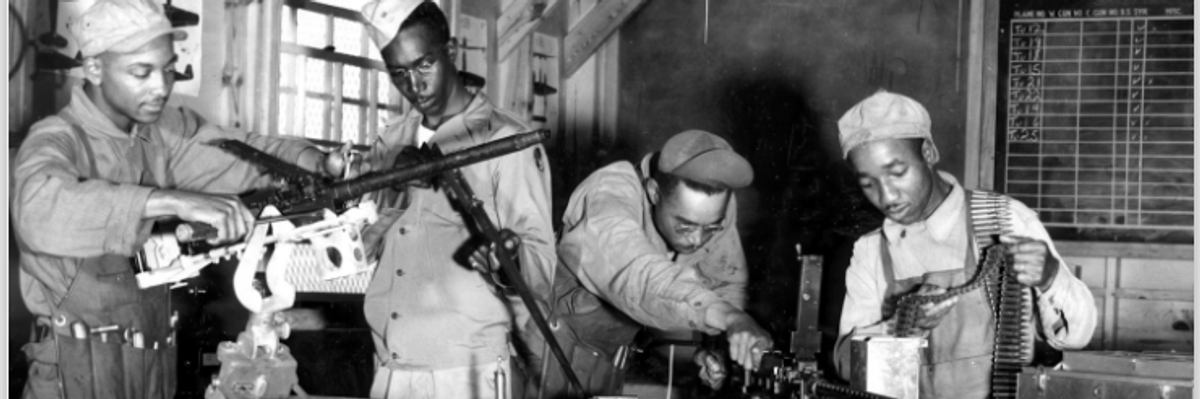
Black armorers and other Air Force ground personnel train during World War ll
Photo from U.S. Air Force

Abby Zimet
Mar 11, 2025
COMMON DREAMS

In Orwellian juxtaposition, this weekend marked the 60th anniversary of Bloody Sunday, when racial justice marchers "rewrote the story of the civil rights movement in their blood" even as the current regime moves ever further to erase that story and many others by deleting thousands of images of unholy diversity - women, minorities, yes the Enola Gay - and banning pernicious words like "at risk," "bias," "equity," "female," "marginalize," "systemic," the history of who we've been and tried to become. Beyond evil.

Thus is an alternate reality constructed under the rubric of a new Bigots 'R Us ruling party. "Climate" is scrubbed from government websites, we're shaking down Canada in a fantastical trade and drug war over imaginary fentanyl labs, we're awash in a "national energy emergency" as we drill for more oil and gas under less review than ever before, food stamps, cancer research, safety nets and humanitarian aid are "bad" but more billions for billionaires is "good, "free speech" means locking up opponents of genocide, Rep. Al Green should be ejected from civil discourse for shaking "his pimp cane" at the fuehrer, and people/airplanes on the East coast are scrambling to avoid falling space debris from "rapid, unscheduled disassembly" of things badly assembled by the unelected Nazi who's already inflicting many of these other ills.

Meanwhile the Dept. of Defense, run by drunken Christo-fascist and sexual predator Pete Hegseth, is safeguarding our national security by declaring "DEI is dead" and moving to obliterate any toxic remnants of racial or gender equity as a social good. The Gulf-of-Mexico-partial A.P. says the Pentagon has flagged and vowed to delete from websites over 26,000 photos for dubious diversity-adjacent connections. Some choices were clear-cut. Gone are all notable military females or people of color: Col. Jeannie Leavitt, America's first female fighter pilot, the first three women to graduate from the Marine Corps’ infantry training, World War II Medal of Honor winner Pfc. Harold Gonsalves (suspiciously brown), ditto Army Sgt. Maj. Ernesto Lopez Jr. graduating from Lackland Air Force Base and three of his relatives serving in the National Guard (ditto).

Other choices seemed just-right-no-brainers, but proved otherwise. Their move to obliterate the famed Tuskegee Airmen, the nation's first Black military pilots who served in a segregated WW ll unit, met with outrage, after which the Air Force quickly reversed itself; the White House charged the perps with "malicious compliance." Because these cretins are as stupid as they are venal, their most Leslie-Nelson-movie-dumb move was removing six photos of the historic B-29 aircraft Enola Gay, which dropped the world's first atomic bomb on Japan in 1945. Its pilot, Col. Paul Tibbetts Jr., had fondly named the plane after his mother Enola Gay Tibbetts, which okay is pretty weird in itself, but still never imagining the stupid of the future. On social media, many so-gay memes giddily popped up, along with several photos of a newly christened Enola Straight.

More stupid followed. Several soldiers named Gay - Sgt. Major A.C. Gay, Ensign George H. Gay (Battle of Midway) were summarily erased, and Brig. Gen. Jason Woodworth, nice and white but posing at Camp Pendleton with Philip Nguyen and Thu Ha Anders at a Vietnamese display during Diversity Celebration Day. Also photos of an Army Corps dredging project in California after they noted biologists were recording fish data - breed, weight...gender. More random idiocy, either perpetrated by AI or ketamine-fueled DOGE bros, led to the perplexing disappearance of "Deadlift contenders raise the bar pound by pound” and "Minnesota brothers reunite in Kuwait." Commemorative months - black, women's, Hispanic history - are already gone. With up to 100,000 items eventually targeted, many wonder how long the Dept of Transportation will survive.

Though King Donnie mostly looks at pictures, a word purge soon started, with over 400 terms disappeared by the guy who on Day One issued the executive order, "Restoring Freedom of Speech and Ending Federal Censorship.” Now banished by regime decree - encompassing government memos, guidelines, public-facing sites and possibly contracts - is language that tracks our political, social, moral history, often exposing a racist bent that views "diversity" as inherently at odds with "merit."and fairness a non-starter. Banned are accessible, activism, advocate, sense of belonging, cultural heritage, climate crisis, ethnicity, excluded, female, gender, health disparity, historically, multicultural, tribal, political, race, sex, social justice, women.
Purged from NIH records: obesity, fluoride, bird flu, opioids, stem cell, vaccine, abortion, peanut allergies (a Marxist hoax).

To revise the future, one must revise the past - when, you know, America was great. This moment of chaos depends on it, which is why record crowds visited Selma, Alabama on Sunday to mark the 60th anniversary of Bloody Sunday, March 7, 1965, when hundreds of civil rights leaders and non-violent activists both black and white attempted to march from Selma to Montgomery across the Edmund Pettus Bridge to demand voting rights for African Americans. They came to remember it, to honor it, to pay tribute to the fortitude of John Lewis and all the foot soldiers who came under and endured daily attacks - "We went where we were called" - and to reiterate that for far too many their long fight for voting rights, for equal justice, for the essential freedoms guaranteed by the U.S. Constitution remains, now more than ever, "an unfinished endeavor."

In that era of Jim Crow laws and KKK lynchings, almost a year after passage of the Civil Rights Act, Selma, Dallas County, Alabama and much of the American south was still a white supremacist police state. Not long before, white nationalist terrorists had bombed Birmingham's 16th Street Baptist Church, killing four young girls; it took many decades before any were brought to justice. Despite growing protests on behalf of voting and other rights, thanks to still-prevalent poll taxes, literacy tests, widespread intimidation and racist state leaders like Alabama's die-hard segregationist Gov. George Wallace, less than 1% of Black people, even if middle-class, were eligible to vote in many areas. "This was a vicious, violent system," recalled one activist. "You could die trying to register to vote and wasn’t nobody going to do anything about it."

The Selma march was sparked by both that fight and the murder in nearby Marion of Jimmie Lee Jackson, a 26-year-old veteran, organizer, father and church deacon as he tried to protect his mother and 82-year-old grandfather from being beaten by cops at an earlier voting rights protest. In response, Alabama state trooper James Fowler shot Jackson twice in the stomach; he died 8 days later. No charges were filed against Fowler until 2007, when he pled guilty to 2nd-degree manslaughter and served less than six months. Galvanized by Jackson's murder, John Lewis, then the young head of SNCC, decided to lead about 500 peaceful protesters, black and white, from Selma to the state capitol of Montgomery to denounce Jackson's death and insist on the rights he'd died for. First, though, they had to walk across the Edmund Pettus Bridge.

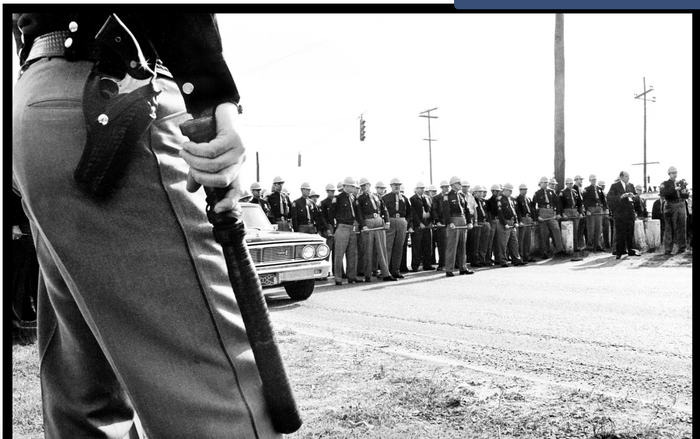
Mid-way, they were met with a phalanx of billy-club-armed state troopers, who issued their famous two-minute warning for the marchers to turn back. Within less than a minute, they began viciously beating the men, women and children , eventually turning tear gas, cattle prods and whips on them. At least 58 people were injured; many were hospitalized. Lewis, who later served decades in the House as "the conscience of Congress," famously had his skull fractured by a trooper's baton as he lay on the ground. For years, he declared that "Selma, the bridge, was a test of the belief that love was stronger than hate. And it was." Lewis' assault, and all the rest, was captured by James 'Spider' Martin, a 25-year-old photographer for the Birmingham News, who documented both Jackson's shooting and its subsequent violence using his camera as "a weapon of discovery."

His images of the savage reality of voter suppression hit the front pages of newspapers across the country; ABC even interrupted coverage about the Nazis' Nuremberg trials to show them. A grateful MLK Jr. told Martin, "The whole world saw your pictures," which galvanized nationwide civil rights protests, prompted LBJ to send 2,000 National Guardsmen to escort a subsequent, larger, non-violent march to Montgomery later that month, and arguably helped nudge him to sign the Voting Rights Act that August. Today, with a resurgent right wing relentlessly working to again disenfranchise black voters - redrawn district lines, voter IDs, fewer ballot drop boxes - while persistently, essentially seeking to erase that bloody past, Martin's images of what the Selma marchers achieved and are now fighting to hold onto help keep that history alive.

On Sunday, as large crowds went to Selma to march in carefully choreographed time slots, the Montgomery Museum of Fine Arts launched a national exhibit of 70 of Martin's newly-restored images titled,“Selma is Now," In this dark moment, the mood of the event was a complex mix of anger, determination, fear that today's "stress test of American resolve (isn’t) being met with sufficient opposition" as in the past, when "people stood together (to) march in hope." Some spoke of "a long trench warfare," of "not seeing themselves as protagonists of this story,” feeling "stuck between fear and anxiety looking at the world on fire," wondering how many will "be willing to bleed," like John Lewis. Most vitally, they insisted on recognizing that history happened here, and will not be erased: "It's a story that needs to be told and retold...that we simply cannot let pass."


Alabama state troopers form roadblock on far side of Edmund Pettus Bridge.Spider Martin/Briscoe Center for American History