Turkey: a mass movement builds against Erdogan’s power grab
Monday 24 March 2025, by Antoine Larrache, Uraz Aydin
Uraz Aydin answers questions from Antoine Larrache about the mobilization currently building in Turkey after the arrest of the mayor of Istanbul, who is seen as Erdogan’s main rival in the race for the next presidential election.
Can you tell us about the arrest of the mayor of Istanbul?
On the morning of March 19, Ekrem Imamoğlu, the mayor of Istanbul, was taken into custody along with around a hundred other mayoral staff on charges of “corruption” and “connection with terrorism”. The day before, his university degree (obtained 30 years ago) was arbitrarily annulled, with the obvious aim of preventing his candidacy in the next presidential election. Ekrem Imamoğlu, having twice won Istanbul’s municipal elections - in 2019 and 2024 - as a candidate for the CHP (Republican People’s Party, secular center-left), has established himself over time as Erdogan’s main opponent.
On March 23, the CHP was due to hold its “pre-elections” to decide on its candidate for the next ballot, normally scheduled for 2028 but most likely to take place earlier, to allow Erdogan to run one last time. Unless there is a constitutional change, which is also under discussion. The aim of this operation is therefore very clear: to render the main opposition candidate ineligible, criminalize his management of Istanbul’s mayoralty and perhaps even appoint an administrator in place of the elected mayor, as has been happening for several years in the municipalities of Kurdistan, in south-west Turkey.
Can you describe the mobilization in the face of this?
Today is the third day of mobilizations. Every day, the CHP calls for rallies in front of Istanbul City Hall. Tens of thousands of people are taking part. Of course, in addition to CHP members and supporters, all sectors of the opposition are mobilizing, including the radical left, against what has come to be known as the “March 19 coup”.
It’s worth remembering that the country has been living in an atmosphere of permanent repression since the Gezi revolt in 2013. The end of negotiations with the Kurdish movement, the remilitarization of the Kurdish question and the resumption of the war, the attempted coup d’état carried out by Erdogan’s former allies and the state of emergency decreed in its wake, the ban on strikes and the repression of the feminist and LGBTI+ movements are the main milestones in the development of authoritarianism articulated to the construction of an autocratic regime led by Erdogan. We are therefore in a country where mobilizations are rare, where the reflex to protest in the street has become quite unusual and risky for ordinary citizens. But despite this and the ban on rallies in Istanbul, there are major mobilizations and, above all, a spirit of protest that can be felt on the streets, in the workplace, on public transport, and so on.
On the second evening, in many parts of Istanbul and dozens of other cities, citizens came out to protest, with the main slogans “Government resign!”, “Down with the AKP dictatorship!”, “No individual liberation! All together or none of us”.
What is the scale of the mobilization among young people?
Precisely the most important and surprising element is the mobilization of university students. Universities have been depoliticized for years, radical left-wing movements are weak and their capacity for action is drastically reduced. So the current generation of students, while probably having grown up with stories of the Gezi revolt told by their parents, has almost no experience of organizing and mobilizing. This is true even of young revolutionary activists, who have not even had the opportunity to “do their job” in universities.
But despite this, through an “electric jolt” as Rosa Luxembourg1 used to say, a spontaneous radicalism is awakening in the universities. There are, of course, many social-economic (objective) and cultural-ideological (subjective) factors that come together to forge this mobilization. We’ll have to think about that later. But the fact that in a country that is becoming poorer, where it is difficult to find work, that offers no “promise of happiness” to young people, where years of study mean almost nothing on the job market, the fact that a diploma can be cancelled with a simple government pressure on the university is also an element that has probably contributed to achieving this jolt, in a sector of youth that was more or less predisposed to it.
What impact is this student radicalization having on the protests?
I think it’s shaking things up, and forcing the CHP to break out of its pre-constructed opposition patterns. As I said, CHP president Özgür Özel has called for a rally outside Istanbul town hall. But it has to be said that no serious preparations had been made to accommodate tens of thousands of people. The main objective was to call on citizens to vote in the pre-elections on March 23 and thus demonstrate Imamoğlu’s legitimacy against the regime, but also to continue the “fight” at the judicial level, by appealing, etc
Faced with this, the slogans most chanted by young people (who made up the majority of rallies in front of the mayor’s office) were “liberation is in the streets, not in the ballot box” or “resistance is in the streets, not in the ballot box”. Faced with this pressure from young people, who succeeded on several occasions in breaking down police barriers in front of universities, who marched en masse in Ankara to ODTÜ University and clashed with the CRS, who forced the police to send riot intervention vehicles to the universities (notably in Izmir), who refused to disperse at the end of official CHP rallies and wanted to march to Taksim (the historic symbolic site of resistance since the May 1st 1977 massacre to the Gezi uprising), the CHP leadership had to give in. Özgür Özel called on the people to “storm the squares”. “If obstacles are erected in front of us on the basis of an order contrary to the law, overthrow them, without hurting the police,” he added. Which is quite exceptional. Özel also agreed to install a second stand at Saraçhane, for the students.
How can we link this situation with what’s happening in Kurdistan, with the peace “process”?
It’s a very contradictory process, but one we’ve already experienced. Let’s not forget that during the Gezi uprising in 2013, when the west of the country was going up in flames, there were negotiations with Abdullah Öcalan, leader of the PKK. And of course, while the radical opposition to the regime usually came from the Kurdish regions, or from the Kurdish movement, this time their participation is naturally more limited. However, we saw that these two dynamics of contestation had converged in the candidacy of Selahattin Demirtaş, of the left-wing pro-Kurdish HDP party in the 2015 elections.
Today, while once again there is a process of “peace” according to the Kurds, of “disarmament” according to the regime (a facet of which can also be seen in the agreements initiated between Rojava and the new Syrian regime), the Turkish state is conducting a campaign of violent repression against the secular bourgeois opposition, journalists... but also against elements of the Kurdish movement. For the Kurds, the regime wants to show (above all to its own social and electoral base) that it still has its iron fist within its grasp, and that there is no question of negotiation but of “putting an end to terrorism”. As for the imprisonment of Imamoglu and other CHP mayors, if one of the charges is corruption, the other is links with or support for terrorism, since the CHP had forged an informal alliance with the Kurdish movement party in the 2024 municipal elections under the name of “urban consensus”.
Another surprising fact is that all demonstrations and gatherings in Istanbul have been banned except for Newroz, a festival celebrating the arrival of spring in the Middle East and the Caucasus, but which has acquired political-national significance for the Kurdish movement over several decades. So it could be said that Erdogan’s regime is trying to take another, decisive step in the construction of its regime, to reinforce its neo-fascist character by subduing the two biggest “chunks”, the secular bourgeois opposition represented by the CHP/Imamoglu and the Kurdish movement.
In the case of the former, by criminalizing it, imprisoning its representatives, perhaps forcing it to change its leadership and candidate, and finally destroying all legitimacy of the elections. As for the Kurdish movement, the regime will probably try to “de-radicalize” it, making it an ally at national and regional level (Syria, Iraq) in the hope that, in exchange for a few gains (of which no details are known at present), the movement will abandon its fight for the democratization of the entire country and guarantee a more peaceful existence with the regime. For the time being, the Dem Party (formerly HDP) has announced that it strongly opposes this “civil putsch” against Imamoglu and the other elected representatives, and that it is calling on the opposition forces to protest together at the Newroz rally on March 23.
Of course, we can’t anticipate the outcome of Erdogan’s two-pronged strategy, but as the Italian Marxist Antonio Gramsci once said, only the struggle can be foreseen
March 21 2025
Attached documentsturkey-a-mass-movement-builds-against-erdogan-s-power-grab_a8916.pdf (PDF - 899.5 KiB)
Extraction PDF [->article8916]
Antoine Larrache
Antoine Larrache is editor of Inprecor and a member of the leadership of the Fourth International
Uraz Aydin
* Uraz Aydin is the editor of Yeniyol, the review of the Turkish section of the Fourth International, and one of many academics dismissed for having signed a petition in favour of peace with the Kurdish people, in the context of the state of emergency decreed after the attempted coup in 2016.
International Viewpoint is published under the responsibility of the Bureau of the Fourth International. Signed articles do not necessarily reflect editorial policy. Articles can be reprinted with acknowledgement, and a live link if possible.
Monday 24 March 2025, by Antoine Larrache, Uraz Aydin
Uraz Aydin answers questions from Antoine Larrache about the mobilization currently building in Turkey after the arrest of the mayor of Istanbul, who is seen as Erdogan’s main rival in the race for the next presidential election.
Can you tell us about the arrest of the mayor of Istanbul?
On the morning of March 19, Ekrem Imamoğlu, the mayor of Istanbul, was taken into custody along with around a hundred other mayoral staff on charges of “corruption” and “connection with terrorism”. The day before, his university degree (obtained 30 years ago) was arbitrarily annulled, with the obvious aim of preventing his candidacy in the next presidential election. Ekrem Imamoğlu, having twice won Istanbul’s municipal elections - in 2019 and 2024 - as a candidate for the CHP (Republican People’s Party, secular center-left), has established himself over time as Erdogan’s main opponent.
On March 23, the CHP was due to hold its “pre-elections” to decide on its candidate for the next ballot, normally scheduled for 2028 but most likely to take place earlier, to allow Erdogan to run one last time. Unless there is a constitutional change, which is also under discussion. The aim of this operation is therefore very clear: to render the main opposition candidate ineligible, criminalize his management of Istanbul’s mayoralty and perhaps even appoint an administrator in place of the elected mayor, as has been happening for several years in the municipalities of Kurdistan, in south-west Turkey.
Can you describe the mobilization in the face of this?
Today is the third day of mobilizations. Every day, the CHP calls for rallies in front of Istanbul City Hall. Tens of thousands of people are taking part. Of course, in addition to CHP members and supporters, all sectors of the opposition are mobilizing, including the radical left, against what has come to be known as the “March 19 coup”.
It’s worth remembering that the country has been living in an atmosphere of permanent repression since the Gezi revolt in 2013. The end of negotiations with the Kurdish movement, the remilitarization of the Kurdish question and the resumption of the war, the attempted coup d’état carried out by Erdogan’s former allies and the state of emergency decreed in its wake, the ban on strikes and the repression of the feminist and LGBTI+ movements are the main milestones in the development of authoritarianism articulated to the construction of an autocratic regime led by Erdogan. We are therefore in a country where mobilizations are rare, where the reflex to protest in the street has become quite unusual and risky for ordinary citizens. But despite this and the ban on rallies in Istanbul, there are major mobilizations and, above all, a spirit of protest that can be felt on the streets, in the workplace, on public transport, and so on.
On the second evening, in many parts of Istanbul and dozens of other cities, citizens came out to protest, with the main slogans “Government resign!”, “Down with the AKP dictatorship!”, “No individual liberation! All together or none of us”.
What is the scale of the mobilization among young people?
Precisely the most important and surprising element is the mobilization of university students. Universities have been depoliticized for years, radical left-wing movements are weak and their capacity for action is drastically reduced. So the current generation of students, while probably having grown up with stories of the Gezi revolt told by their parents, has almost no experience of organizing and mobilizing. This is true even of young revolutionary activists, who have not even had the opportunity to “do their job” in universities.
But despite this, through an “electric jolt” as Rosa Luxembourg1 used to say, a spontaneous radicalism is awakening in the universities. There are, of course, many social-economic (objective) and cultural-ideological (subjective) factors that come together to forge this mobilization. We’ll have to think about that later. But the fact that in a country that is becoming poorer, where it is difficult to find work, that offers no “promise of happiness” to young people, where years of study mean almost nothing on the job market, the fact that a diploma can be cancelled with a simple government pressure on the university is also an element that has probably contributed to achieving this jolt, in a sector of youth that was more or less predisposed to it.
What impact is this student radicalization having on the protests?
I think it’s shaking things up, and forcing the CHP to break out of its pre-constructed opposition patterns. As I said, CHP president Özgür Özel has called for a rally outside Istanbul town hall. But it has to be said that no serious preparations had been made to accommodate tens of thousands of people. The main objective was to call on citizens to vote in the pre-elections on March 23 and thus demonstrate Imamoğlu’s legitimacy against the regime, but also to continue the “fight” at the judicial level, by appealing, etc
Faced with this, the slogans most chanted by young people (who made up the majority of rallies in front of the mayor’s office) were “liberation is in the streets, not in the ballot box” or “resistance is in the streets, not in the ballot box”. Faced with this pressure from young people, who succeeded on several occasions in breaking down police barriers in front of universities, who marched en masse in Ankara to ODTÜ University and clashed with the CRS, who forced the police to send riot intervention vehicles to the universities (notably in Izmir), who refused to disperse at the end of official CHP rallies and wanted to march to Taksim (the historic symbolic site of resistance since the May 1st 1977 massacre to the Gezi uprising), the CHP leadership had to give in. Özgür Özel called on the people to “storm the squares”. “If obstacles are erected in front of us on the basis of an order contrary to the law, overthrow them, without hurting the police,” he added. Which is quite exceptional. Özel also agreed to install a second stand at Saraçhane, for the students.
How can we link this situation with what’s happening in Kurdistan, with the peace “process”?
It’s a very contradictory process, but one we’ve already experienced. Let’s not forget that during the Gezi uprising in 2013, when the west of the country was going up in flames, there were negotiations with Abdullah Öcalan, leader of the PKK. And of course, while the radical opposition to the regime usually came from the Kurdish regions, or from the Kurdish movement, this time their participation is naturally more limited. However, we saw that these two dynamics of contestation had converged in the candidacy of Selahattin Demirtaş, of the left-wing pro-Kurdish HDP party in the 2015 elections.
Today, while once again there is a process of “peace” according to the Kurds, of “disarmament” according to the regime (a facet of which can also be seen in the agreements initiated between Rojava and the new Syrian regime), the Turkish state is conducting a campaign of violent repression against the secular bourgeois opposition, journalists... but also against elements of the Kurdish movement. For the Kurds, the regime wants to show (above all to its own social and electoral base) that it still has its iron fist within its grasp, and that there is no question of negotiation but of “putting an end to terrorism”. As for the imprisonment of Imamoglu and other CHP mayors, if one of the charges is corruption, the other is links with or support for terrorism, since the CHP had forged an informal alliance with the Kurdish movement party in the 2024 municipal elections under the name of “urban consensus”.
Another surprising fact is that all demonstrations and gatherings in Istanbul have been banned except for Newroz, a festival celebrating the arrival of spring in the Middle East and the Caucasus, but which has acquired political-national significance for the Kurdish movement over several decades. So it could be said that Erdogan’s regime is trying to take another, decisive step in the construction of its regime, to reinforce its neo-fascist character by subduing the two biggest “chunks”, the secular bourgeois opposition represented by the CHP/Imamoglu and the Kurdish movement.
In the case of the former, by criminalizing it, imprisoning its representatives, perhaps forcing it to change its leadership and candidate, and finally destroying all legitimacy of the elections. As for the Kurdish movement, the regime will probably try to “de-radicalize” it, making it an ally at national and regional level (Syria, Iraq) in the hope that, in exchange for a few gains (of which no details are known at present), the movement will abandon its fight for the democratization of the entire country and guarantee a more peaceful existence with the regime. For the time being, the Dem Party (formerly HDP) has announced that it strongly opposes this “civil putsch” against Imamoglu and the other elected representatives, and that it is calling on the opposition forces to protest together at the Newroz rally on March 23.
Of course, we can’t anticipate the outcome of Erdogan’s two-pronged strategy, but as the Italian Marxist Antonio Gramsci once said, only the struggle can be foreseen
March 21 2025
Attached documentsturkey-a-mass-movement-builds-against-erdogan-s-power-grab_a8916.pdf (PDF - 899.5 KiB)
Extraction PDF [->article8916]
Antoine Larrache
Antoine Larrache is editor of Inprecor and a member of the leadership of the Fourth International
Uraz Aydin
* Uraz Aydin is the editor of Yeniyol, the review of the Turkish section of the Fourth International, and one of many academics dismissed for having signed a petition in favour of peace with the Kurdish people, in the context of the state of emergency decreed after the attempted coup in 2016.
International Viewpoint is published under the responsibility of the Bureau of the Fourth International. Signed articles do not necessarily reflect editorial policy. Articles can be reprinted with acknowledgement, and a live link if possible.
Popular Fury Grows in Turkey Against Tyrannical Erdoğan Emboldened by Trump
The imprisonment of Istanbul Mayor Ekrem İmamoğlu, the far-right president's top political rival, has unleashed a new wave of protests against increasingly autocratic rule.
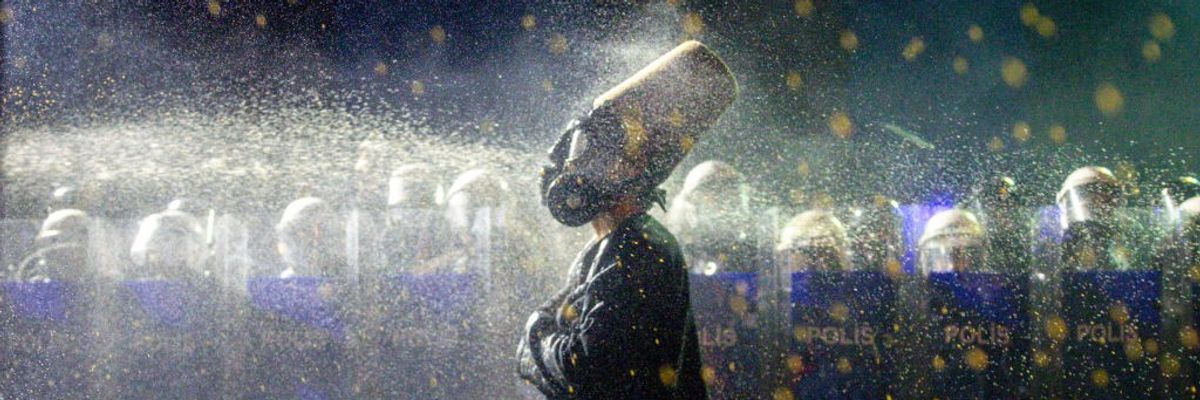
A protester wearing a gas mask and dressed as a Whirling Dervish is pepper sprayed by police during clashes with police in front of Istanbul's famous Aquaduct on March 23, 2025 in Istanbul, Turkey. The Mayor of Istanbul Ekrem Imamoglu, who was due to be selected as a presidential candidate for the opposition Republican People's Party (CHP) during a primary election today, was jailed on corruption charges following his detention earlier this week.
(Photo by Chris McGrath/Getty Images)
Jon Queally
Mar 24, 2025
COMMON DREAMS
International outrage and charges of "viciousness" and "outright autocracy" have followed Sunday's imprisonment of Turkey President Recep Tayyip Erdoğan's top political rival, the popular Istanbul Mayor Ekrem İmamoğlu, who is seen as Erdogan's likeliest opposition challenger in upcoming national elections.
The corruption charges levied against İmamoğlu, a member of the Republican People's Party (CHP), are seen as politically motivated and follow days of sustained protests by opposition voices opposed to Erdoğan's increasingly authoritarian rule.
Tens of thousands marched and clashed with riot police after fresh protests erupted Sunday in Istanbul and elsewhere in the country following the court's actions against İmamoğlu and on Monday, the CHP announced that nearly 15 million people, members and non-members alike, participated in national primaries to support the jailed mayor's candidacy to face off against Erdoğan in the next election.
The non-member vote of more than 13 million, "could indicate," reportsNBC News, "that İmamoğlu, 54, enjoys wide public support beyond the party faithful. The party's chairman said it showed the need for early elections."
Writing for Politico Europe, opinion editor Jamie Dettmer argues that that timing of Erdoğan's targeting of İmamoğlu has everything to do with the return of U.S. President Donald Trump to the international scene.
Erdoğan, Dettmer wrote on Saturday, "has spent years eroding democracy, stifling dissent and purging the country's army and civil service. Now, it looks as though he's chosen this geopolitical moment to bury the legacy of Mustafa Kemal Atatürk, the secular founder of the Republic of Turkey." He continued:
Erdoğan would harbor no worries as to Trump’s disapproval. The two have lavished priase on each other for years, and the Turkish leader has said he supports his American counterpart’s peace initiative in Ukraine—no doubt music to Trump’s ears.
Erdoğan isn't alone among the once embattled autocrats—and would-be autocrats—sniffing the change in the geopolitical air, and reckoning they're on the cusp of a new era, able to erase the rules and norms of old and replace them with ones more to their liking. It's influencing their behavior as they look to each other for inspiration and new ideas for running their respective countries—whether it be weaponizing policies affecting sexual minorities, scapegoating migrants, sharpening attacks on independent media, transforming public broadcasters into government mouthpieces or just closing them down.
Since his arrest on March 19, the ousted mayor has denied all charges against him and urged his supporters to continue protests in the face of the government crackdown.
"I totally believe these are bogus charges," Emre Can Erdogdu, a university student in Istanbul who attended street protests Sunday night, told the New York Times. "We entirely lost our trust in the government."
Erdogdu said he feared for the future of Turkey. "A person who could be the next president is now out of politics. It is not just about Istanbul. It is about all of Turkey."
Özgür Özel, the CHP chair, said the imprisonment would not dampen the party's prospects, but only further ignite the growing opposition. "Starting from tomorrow morning," he said from Istanbul on Sunday evening, "we will initiate a great struggle by harnessing the power of organization and using this strength for the good sake of all of us."
He called for "all democrats and all those who care the future of Turkey" to come out in sustained protest.
According to the Hürriyet Daily News, over 1,100 people have been arrested since mass protests erupted last week over İmamoğlu's initial arrest. Criticism only grew the court on Sunday stripped him of his position and sent him to prison.
"By arresting his main political rival," said human rights advocate and scholar Kenneth Roth, "Erdoğan shows he is too fearful of losing to risk even a managed election."
Roth said Erdoğan, an ally of U.S. President Donald Trump, would rather "opt for an electoral charade" than hold free and fair elections.
With Turkish officials set to visit the United States this week to visit with U.S. counterparts, world's richest man Elon Musk, who has taken a seat as a top advisor to Trump, is under fire for blocking accounts of opposition figures in Turkey on his social media platform X.
As Politicoreported over the weekend:
The majority of the suspended accounts were "university-associated activist accounts, basically sharing protest information, locations for students to go," Yusuf Can,coordinator and analyst at the Wilson Center's Middle East Program, told POLITICO. Many of these accounts are "grassroots activists" with their followings in the low tens of thousands, said Can.
Some accounts appear to be suspended only in Turkey and not in the rest of the world. Activist Ömer Faruk Aslan created a second account to avoid censorship. "Yesterday, my account was blocked by a court order because the tweets exceeded 6 million views," he posted.
Last week, Human Rights Watch said that İmamoğlu's arrest, as well as the targeting of other opposition figures, was politically motivated and an assault on the rule of law.
"Ekrem İmamoğlu and others detained should be released from police custody immediately," said Hugh Williamson, Europe and Central Asia director for the group. "The Erdoğan presidency should ensure that the results of the Istanbul municipal elections are respected and that the criminal justice system is not weaponized for political ends."
The imprisonment of Istanbul Mayor Ekrem İmamoğlu, the far-right president's top political rival, has unleashed a new wave of protests against increasingly autocratic rule.
A protester wearing a gas mask and dressed as a Whirling Dervish is pepper sprayed by police during clashes with police in front of Istanbul's famous Aquaduct on March 23, 2025 in Istanbul, Turkey. The Mayor of Istanbul Ekrem Imamoglu, who was due to be selected as a presidential candidate for the opposition Republican People's Party (CHP) during a primary election today, was jailed on corruption charges following his detention earlier this week.
(Photo by Chris McGrath/Getty Images)
Jon Queally
Mar 24, 2025
COMMON DREAMS
International outrage and charges of "viciousness" and "outright autocracy" have followed Sunday's imprisonment of Turkey President Recep Tayyip Erdoğan's top political rival, the popular Istanbul Mayor Ekrem İmamoğlu, who is seen as Erdogan's likeliest opposition challenger in upcoming national elections.
The corruption charges levied against İmamoğlu, a member of the Republican People's Party (CHP), are seen as politically motivated and follow days of sustained protests by opposition voices opposed to Erdoğan's increasingly authoritarian rule.
Tens of thousands marched and clashed with riot police after fresh protests erupted Sunday in Istanbul and elsewhere in the country following the court's actions against İmamoğlu and on Monday, the CHP announced that nearly 15 million people, members and non-members alike, participated in national primaries to support the jailed mayor's candidacy to face off against Erdoğan in the next election.
The non-member vote of more than 13 million, "could indicate," reportsNBC News, "that İmamoğlu, 54, enjoys wide public support beyond the party faithful. The party's chairman said it showed the need for early elections."
Writing for Politico Europe, opinion editor Jamie Dettmer argues that that timing of Erdoğan's targeting of İmamoğlu has everything to do with the return of U.S. President Donald Trump to the international scene.
Erdoğan, Dettmer wrote on Saturday, "has spent years eroding democracy, stifling dissent and purging the country's army and civil service. Now, it looks as though he's chosen this geopolitical moment to bury the legacy of Mustafa Kemal Atatürk, the secular founder of the Republic of Turkey." He continued:
Erdoğan would harbor no worries as to Trump’s disapproval. The two have lavished priase on each other for years, and the Turkish leader has said he supports his American counterpart’s peace initiative in Ukraine—no doubt music to Trump’s ears.
Erdoğan isn't alone among the once embattled autocrats—and would-be autocrats—sniffing the change in the geopolitical air, and reckoning they're on the cusp of a new era, able to erase the rules and norms of old and replace them with ones more to their liking. It's influencing their behavior as they look to each other for inspiration and new ideas for running their respective countries—whether it be weaponizing policies affecting sexual minorities, scapegoating migrants, sharpening attacks on independent media, transforming public broadcasters into government mouthpieces or just closing them down.
Since his arrest on March 19, the ousted mayor has denied all charges against him and urged his supporters to continue protests in the face of the government crackdown.
"I totally believe these are bogus charges," Emre Can Erdogdu, a university student in Istanbul who attended street protests Sunday night, told the New York Times. "We entirely lost our trust in the government."
Erdogdu said he feared for the future of Turkey. "A person who could be the next president is now out of politics. It is not just about Istanbul. It is about all of Turkey."
Özgür Özel, the CHP chair, said the imprisonment would not dampen the party's prospects, but only further ignite the growing opposition. "Starting from tomorrow morning," he said from Istanbul on Sunday evening, "we will initiate a great struggle by harnessing the power of organization and using this strength for the good sake of all of us."
He called for "all democrats and all those who care the future of Turkey" to come out in sustained protest.
According to the Hürriyet Daily News, over 1,100 people have been arrested since mass protests erupted last week over İmamoğlu's initial arrest. Criticism only grew the court on Sunday stripped him of his position and sent him to prison.
"By arresting his main political rival," said human rights advocate and scholar Kenneth Roth, "Erdoğan shows he is too fearful of losing to risk even a managed election."
Roth said Erdoğan, an ally of U.S. President Donald Trump, would rather "opt for an electoral charade" than hold free and fair elections.
With Turkish officials set to visit the United States this week to visit with U.S. counterparts, world's richest man Elon Musk, who has taken a seat as a top advisor to Trump, is under fire for blocking accounts of opposition figures in Turkey on his social media platform X.
As Politicoreported over the weekend:
The majority of the suspended accounts were "university-associated activist accounts, basically sharing protest information, locations for students to go," Yusuf Can,coordinator and analyst at the Wilson Center's Middle East Program, told POLITICO. Many of these accounts are "grassroots activists" with their followings in the low tens of thousands, said Can.
Some accounts appear to be suspended only in Turkey and not in the rest of the world. Activist Ömer Faruk Aslan created a second account to avoid censorship. "Yesterday, my account was blocked by a court order because the tweets exceeded 6 million views," he posted.
Last week, Human Rights Watch said that İmamoğlu's arrest, as well as the targeting of other opposition figures, was politically motivated and an assault on the rule of law.
"Ekrem İmamoğlu and others detained should be released from police custody immediately," said Hugh Williamson, Europe and Central Asia director for the group. "The Erdoğan presidency should ensure that the results of the Istanbul municipal elections are respected and that the criminal justice system is not weaponized for political ends."
Turkey detains 1,100 protesters since Erdogan rival held
LARGEST MASS DEMOS IN DECADES
By AFP
March 24, 2025

A whirling dervish stands in front riot police in Istanbul - Copyright AFP YASIN AKGUL
Police have detained more than 1,100 people, officials said Monday — including journalists — since the arrest of President Recep Tayyip Erdogan’s main rival triggered some of Turkey’s worst unrest in years.
The demonstrations began in Istanbul after Ekrem Imamoglu’s arrest last week and have since spread to more than 55 of Turkey’s 81 provinces, sparking clashes with riot police and drawing international condemnation.
The popular 53-year-old has been widely seen as the only politician who could defeat Turkey’s longtime leader Erdogan at the ballot box.
In just four days he went from being the mayor of Istanbul — a post that launched Erdogan’s political rise decades earlier — to being arrested, interrogated, jailed and stripped of the mayorship as a result of a graft and terror probe.
On Sunday, he was overwhelmingly voted in as the main opposition CHP’s candidate for the 2028 presidential run, with the ballot — that was opened beyond the party’s 1.7 million members — attracting 15 million votes.
A party spokesman on Monday confirmed his election as the party’s candidate.
Observers said it was the looming primary that triggered the move against Imamoglu, the main political rival of Erdogan who has dominated Turkey’s politics since 2003, first as prime minister and then as president.
His jailing drew a sharp condemnation from Germany, which called it “totally unacceptable”.
Early on Monday, police detained 10 Turkish journalists at home, including an AFP photographer, “for covering the protests”, the MLSA rights group said in a statement.
It said most of them were covering the mass demonstrations outside City Hall, where tens of thousands rallied late Sunday, a move denounced by Imamoglu’s wife.
“What is being done to members of the press and journalists is a matter of freedom. None of us can remain silent about this,” wrote Dilek Kaya Imamoglu on X.
Police have detained more than 1,133 people over “illegal activities” since the protests began Wednesday, Interior Minister Ali Yerlikaya said.
– Lawyers detained –
As on previous nights, Sunday’s gathering — the fifth such mass protest — descended into fierce clashes with riot seen kicking and beating people in Istanbul and elsewhere, AFP correspondents said.
There was no immediate word on overnights arrests but the Izmir Bar Association in the western coastal city said police had arrested two local lawyers, including its former head, who were representing protesters.
Early Monday, Istanbul governor Davut Gul accused demonstrators of “damaging mosques and cemeteries”, warning: “Any attempt to disrupt public order will not be tolerated,” he wrote on X.
As he was being shipped off to Silivri prison on the megacity’s western outskirts, Imamoglu had denounced the judicial moves against him as a political “execution without trial”.
In a later message from prison as tens of thousands rallied for a fifth night, he sounded a defiant tone.
“I wear a white shirt that you cannot stain. I have a strong arm that you cannot twist. I won’t budge an inch. I will win this war,” he said in the message passed through his lawyers.
Throughout Sunday, millions voted in the CHP’s highly symbolic primary — which effectively became a de facto referendum.
“Out of a total of 15 million votes, 13,211,000 are solidarity votes,” City Hall said, referring to the number of ballots cast by those who were not CHP members.
Faced with the massive protests, Turkey’s authorities sought to shut down more than 700 accounts on X, the online platform said Sunday.
“We object to multiple court orders from the Turkish Information and Communication Technologies Authority to block over 700 accounts of news organisations, journalists, political figures, students, and others within Turkiye,” its communications team said in a statement.
LARGEST MASS DEMOS IN DECADES
By AFP
March 24, 2025
A whirling dervish stands in front riot police in Istanbul - Copyright AFP YASIN AKGUL
Police have detained more than 1,100 people, officials said Monday — including journalists — since the arrest of President Recep Tayyip Erdogan’s main rival triggered some of Turkey’s worst unrest in years.
The demonstrations began in Istanbul after Ekrem Imamoglu’s arrest last week and have since spread to more than 55 of Turkey’s 81 provinces, sparking clashes with riot police and drawing international condemnation.
The popular 53-year-old has been widely seen as the only politician who could defeat Turkey’s longtime leader Erdogan at the ballot box.
In just four days he went from being the mayor of Istanbul — a post that launched Erdogan’s political rise decades earlier — to being arrested, interrogated, jailed and stripped of the mayorship as a result of a graft and terror probe.
On Sunday, he was overwhelmingly voted in as the main opposition CHP’s candidate for the 2028 presidential run, with the ballot — that was opened beyond the party’s 1.7 million members — attracting 15 million votes.
A party spokesman on Monday confirmed his election as the party’s candidate.
Observers said it was the looming primary that triggered the move against Imamoglu, the main political rival of Erdogan who has dominated Turkey’s politics since 2003, first as prime minister and then as president.
His jailing drew a sharp condemnation from Germany, which called it “totally unacceptable”.
Early on Monday, police detained 10 Turkish journalists at home, including an AFP photographer, “for covering the protests”, the MLSA rights group said in a statement.
It said most of them were covering the mass demonstrations outside City Hall, where tens of thousands rallied late Sunday, a move denounced by Imamoglu’s wife.
“What is being done to members of the press and journalists is a matter of freedom. None of us can remain silent about this,” wrote Dilek Kaya Imamoglu on X.
Police have detained more than 1,133 people over “illegal activities” since the protests began Wednesday, Interior Minister Ali Yerlikaya said.
– Lawyers detained –
As on previous nights, Sunday’s gathering — the fifth such mass protest — descended into fierce clashes with riot seen kicking and beating people in Istanbul and elsewhere, AFP correspondents said.
There was no immediate word on overnights arrests but the Izmir Bar Association in the western coastal city said police had arrested two local lawyers, including its former head, who were representing protesters.
Early Monday, Istanbul governor Davut Gul accused demonstrators of “damaging mosques and cemeteries”, warning: “Any attempt to disrupt public order will not be tolerated,” he wrote on X.
As he was being shipped off to Silivri prison on the megacity’s western outskirts, Imamoglu had denounced the judicial moves against him as a political “execution without trial”.
In a later message from prison as tens of thousands rallied for a fifth night, he sounded a defiant tone.
“I wear a white shirt that you cannot stain. I have a strong arm that you cannot twist. I won’t budge an inch. I will win this war,” he said in the message passed through his lawyers.
Throughout Sunday, millions voted in the CHP’s highly symbolic primary — which effectively became a de facto referendum.
“Out of a total of 15 million votes, 13,211,000 are solidarity votes,” City Hall said, referring to the number of ballots cast by those who were not CHP members.
Faced with the massive protests, Turkey’s authorities sought to shut down more than 700 accounts on X, the online platform said Sunday.
“We object to multiple court orders from the Turkish Information and Communication Technologies Authority to block over 700 accounts of news organisations, journalists, political figures, students, and others within Turkiye,” its communications team said in a statement.
By AFP
March 24, 2025

Chaos after Istanbul mayor Ekrem Imamoglu's arrest has battered the Turkish lira - Copyright AFP/File JUAN BARRETO
Rémi BANET
The arrest of Turkish President Recep Tayyip Erdogan’s leading political opponent has sparked a financial firestorm and thrust the hardline leader’s economic policies under scrutiny.
The stock market has plunged, the lira has plummeted and economists warn the ensuing panic will drive Turkey’s sharp inflation rate back up just as it had started to rein it in.
The arrest of Istanbul’s mayor Ekrem Imamoglu on March 19 in a graft and terror probe sparked fierce street clashes that have since seen more than 1,000 others detained.
“Erdogan started a new economic fire and turned the markets upside down,” economist Mustafa Sonmez told AFP.
– Stock markets fall –
Turkey’s BIST stock index fell 8.7 percent on the day of Imamoglu’s arrest and 7.8 percent two days later, down more than 16 percent in a week — its sharpest decline since the early days of the great world economic crisis in 2008.
It recovered by nearly three percent on Monday, remaining down more than 14 percent on the week overall.
Protests continued and European powers branded the arrest an affront to democracy.
The country’s state-controlled financial authority tweaked its trading rules in a bid to stabilise the markets.
– Currency plunges –
The Turkish lira plunged, prompting the central bank to step in. Economists say it spent more than $20 billion buying up lira to try to prop up its value.
Despite this, the lira remained around its historic low of 38 to the dollar on Monday.
“The central bank and government is trying to calm the market and to limit volatility,” said Emre Akcakmak, a portfolio advisor at investment group East Capital.
“It’s very difficult to attract longer-term strategic foreign investors to Turkey in this kind of environment where even locals don’t have a full understanding of what’s happening.”
– Inflation trap –
The lira’s plunge raised fears that Turkey would falter in its recent fight against surging inflation, which has sharply driven up the cost of household items.
The inflation rate reached 85 percent in late 2022.
Erdogan, a conservative from the Islamist-rooted AKP party, had previously voiced the unorthodox view that raising interest rates drives up inflation — rather than lowering it, as central bankers typically aim to do through rate hikes. Turkey nevertheless resorted to raising rates in 2023.
Inflation was hauled under 40 percent last month for the first time in two years and authorities were aiming to bring it below 24 percent by the end of this year.
“At times like these, those who have money run to foreign currencies, gold and real estate as a haven, and that feeds inflation,” warned Sonmez.
– Investment worries –
The chaos caused by Imamoglu’s arrest, along with the recent prosecution of two senior businessmen critical of the authorities, poses a challenge for Economy Minister Mehmet Simsek.
He has spent two years trying to draw back investors who had turned away from Turkey due to political tensions and Erdogan’s unorthodox monetary policy.
“It was never an easy task for Simsek. It was always mission impossible — and now this is just one more bump on his way,” said Akcakmak.
“It’s very difficult to attract longer-term strategic foreign investors to Turkey in this kind of environment where even locals don’t have a full understanding of what’s happening.”
– Pressure on minister –
Simsek, a former economist of US bank Merrill Lynch, was forced on Sunday to deny opposition claims that he was going to resign.
“We are working on this and we will continue to take all measures necessary for the correct functioning of the markets,” the minister wrote on X.
“I beg you not to believe false news.”
Erdogan threw his full support behind Simsek on Monday.


 ”
” More than fifteen martyrs were recovered from the bombed areas.”