Saturday, May 24, 2025

China Is on Its Way to Becoming World’s First ‘Electrostate’

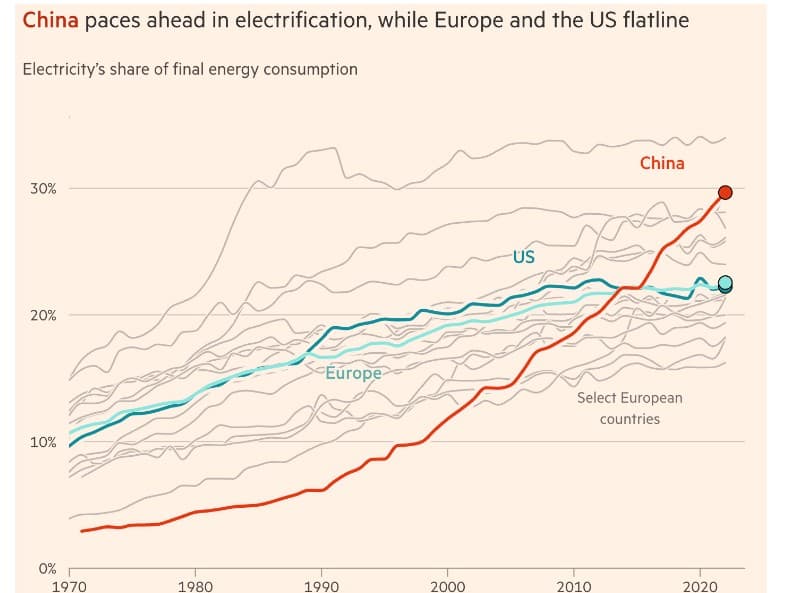
  • China leads the world in electrification, with a 30% electrification rate—far ahead of the U.S. and EU at ~22%—dominating sectors like transport and industry.

  • Massive investment in electric vehicles, high-speed rail, and renewables has positioned China as a superpower in clean energy technologies, with renewables now making up 10% of GDP.

  • Despite progress, China’s ongoing coal expansion complicates climate goals, as the country remains the largest greenhouse gas emitter, raising doubts about its transition timeline.

Many people are perhaps familiar with the term “petrostates”, which usually denotes oil-rich nations that are deeply intertwined with the oil industry, often facing economic and political challenges due to oil price fluctuations and the potential decline in hydrocarbon resources. Saudi Arabia, Iraq, the United Arab Emirates (UAE), Kuwait, and Iran are some of the world’s leading petrostates. But with the world’s electrification drive now in full gear, scientists have coined the term “electrostates” to refer to countries that have made the most progress transitioning away from processes and technologies that rely on fossil fuels to electrically powered alternatives.

According to the International Energy Agency (IEA), electrification is “one of the most important strategies for reducing carbon emissions from energy.” And, as in many other scientific arenas, China has emerged as the nation that is leading the electrification race, ahead of the United States and Europe.

According to a study, China’s electrification rate has hit 30%, significantly ahead of the U.S. and the EU and US where the electrification rate has plateaued at ~22% in recent years.

The study defines the electrification rate as the share of electricity in final energy consumption versus energy coming from fossil fuels. According to the study, the U.S. still leads the world in the electrification of buildings; however, China recently caught up to the U.S. and Europe in industrial electrification, and has overtaken both in the electrification of transport. In 2024, electric vehicles (EVs) made up approximately 47.9% of the total passenger car sales in China, a huge increase from 2020, when plug-in EVs accounted for just 6.3% of total sales. In comparison, electric vehicles accounted for less than 23% of new car sales in Europe over the timeframe.

The rapid expansion of China’s modern rail network has also helped supercharge the electrification of the country's transport sector. China boasts a 45,000 km high-speed rail network, five times the size of the EU’s. That figure is expected to expand to 60,000km by 2030.
China
China
Source: Climate Energy Finance

China’s President Xi Jinping has been largely credited with the country’s remarkable electrification journey. When Xi became the leader of the Chinese Communist Party in 2012,

China had emerged as the world’s second-largest economy and the United States’ archrival nuclear power. However, the country was still highly dependent on other countries for its energy needs. China’s oil and coal imports were surging to record highs, exposing the country to potential supply disruptions amid growing geopolitical tensions.

Fast forward to the present, and China is not only rapidly advancing towards energy security but also controls the critical minerals that underpin technologies of the future.

“Nobody had been seriously worrying about energy security or supply chains for armaments and critical industries and food because everyone thought that went with the Cold War,”

says Andrew Gilholm, head of China analysis at consultancy Control Risks. “Meanwhile, China has been working on that for years.”

China now leads the 4th Industrial Revolution, making huge strides in electrification, renewable energy, artificial intelligence (AI), robotics and the Internet of Things. And, just as oil and gas drive the petrostates of the Arab world, clean energy technologies are powering China’s growth.

To wit, renewable energy accounted for a record 10% of China’s GDP in 2024, driving a quarter of economic expansion, the Centre for Research on Energy and Clean Air (CREA) has revealed.

Beyond energy security and economic growth electrification is expected to play a critical role in addressing climate change.

“We cannot see any way to a zero-carbon economy except through massive electrification,”

Lord Adair Turner, head of the Energy Transitions Commission, said.

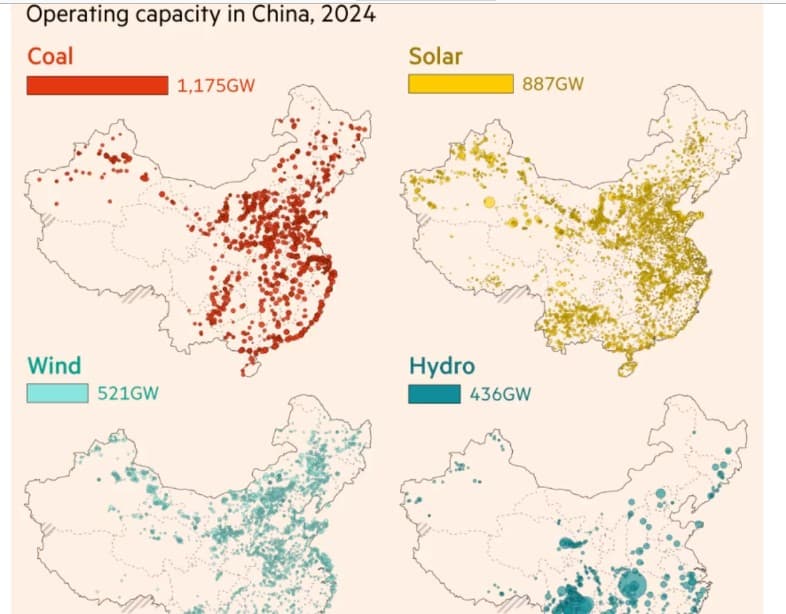
This is particularly critical for China, which remains the world’s biggest polluter and emitter of greenhouse gases. China’s power sector emissions hit record highs last year, driven by a surge in coal consumption. However, the country’s progress in electrification and the transition to renewable energy will be able to mitigate some of the damage.

Coal remains a controversial topic in China, with Beijing indicating it will start phasing down coal consumption between 2006 and 2030. Whereas this suggests a gradual decline rather than a complete and immediate phase-out, the IEA predicts that coal generation in China will likely peak around 2025 and decline thereafter. However, recent reports indicate that China is still building new coal plants, which raises questions about the commitment to phasing down coal use: Reuters has reported that China plans to keep building coal-fired power plants through 2030.

By Alex Kimani for Oilprice.com


Petrobras Strikes Deal With Unigel to Reclaim Key Fertilizer Plants

Petrobras (NYSE: PBR) announced on Thursday that it has signed an agreement with Proquigel, a subsidiary of Brazilian chemical company Unigel, to settle ongoing legal and contractual disputes. The deal—pending ratification by the Arbitral Tribunal—will restore Petrobras' operational control over the Fertilizer Plants of Bahia (FAFEN-BA) and Sergipe (FAFEN-SE).

This resolution marks a strategic move by Petrobras to reenter the domestic fertilizer market, a sector the company had distanced itself from in recent years amid cost-cutting and divestment efforts.

Strategic Context

This agreement follows a disclosure made on May 9, 2025, and is in line with Petrobras' 2025–2029 Strategic Plan, which outlines a renewed focus on value creation through vertical integration. By reclaiming these assets, Petrobras intends to revitalize its presence in nitrogen-based fertilizer production, a segment closely tied to Brazil’s vast agricultural sector and aligned with the broader energy transition strategy.

Petrobras plans to resume operations at the plants through a public tender for Operation and Maintenance (O&M) services, ensuring adherence to corporate governance standards and internal protocols.

Background

Petrobras had previously leased out the FAFEN units to Proquigel as part of a broader privatization and asset divestment initiative. However, operational and legal disputes emerged, leading to stalled production and arbitration proceedings. This new agreement not only ends those disputes but also positions Petrobras to leverage its natural gas supply for ammonia and urea production, reducing dependence on imports and strengthening domestic value chains.

The reinstatement of these plants comes as global fertilizer markets remain volatile and Brazil, one of the world's top agricultural producers, continues to seek greater self-sufficiency in fertilizer inputs.


U.S. Demands Unilateral Tariff Cuts From EU

The U.S. Administration wants the EU to make unilateral cuts to its tariffs on American goods and abolish a proposed digital tax for trade negotiations to advance, sources briefed on the U.S. trade negotiators’ latest stance have told the Financial Times.

The U.S. hit the EU with a 20% ‘reciprocal’ tariff in early April, but the Trump Administration later backtracked on the so-called reciprocal tariffs following a major market rout triggered by fears of recession. The United States has now left a baseline 10% tariff on all countries by July 8 as it is engaging in negotiations to secure trade deals. 

The U.S., however, kept the 25% tariff on EU steel, aluminum, and car parts. Washington is also threatening additional tariffs on pharmaceuticals and semiconductors. 

The U.S. is set to communicate to the EU’s trade negotiators on Friday that the bloc should make unilateral concessions and cut tariffs on U.S. goods, instead of seeking mutual cuts to the tariffs, according to FT’s sources. The Trump Administration is also unhappy that the EU’s proposal for negotiations did not include abolishing the proposed digital tax. 

Early last month, the EU proposed mutual zero tariffs. 

European Commission President Ursula von der Leyen said in early April that “Europe is ready to negotiate with the US.”

“We have offered zero-for-zero tariffs for industrial goods. Because we're always ready for a good deal. But we’re also prepared to respond with countermeasures. And protect ourselves against indirect effects through trade diversion,” von der Leyen added.

U.S. President Donald Trump has dismissed the ‘zero-for-zero tariffs’ offer and told reporters in the White House who asked if the EU offer was sufficient to back down on tariffs on the EU, “No, it's not.” 

The U.S. has made one trade deal – with the UK – since backing off tariffs temporarily to start negotiations. A failure in the U.S.-EU trade talks wouldn’t be good for the economies of either party and could dampen the prospects of oil demand growth.  

By Tsvetana Paraskova for Oilprice.com


Phillips 66 to Lay Off Most Workers at Los Angeles Refinery

U.S. refining giant Phillips 66, which will close its LA refinery later this year, will lay off in December most of the workers at the plant, Reuters reports, citing sources with knowledge of the plans.  

Last October, Phillips 66 said it would shut down its refinery in the Los Angeles area in the fourth quarter of 2025, due to “market dynamics.”

Approximately 600 employees and 300 contractors currently operate the Los Angeles-area refinery, Phillips 66 said when it announced the closure.

“We understand this decision has an impact on our employees, contractors and the broader community,” Mark Lashier, chairman and CEO of Phillips 66, said in October.    

“We will work to help and support them through this transition.” 

Lashier added that the long-term sustainability of the Los Angeles Refinery is uncertain and affected by market dynamics. 

The reduction of the workforce, to begin in December, will affect most employees, while a few retained workers would be transferred to the Los Angeles marine oil terminal operated by Phillips 66, according to Reuters’s sources. 

A spokesperson for the company told the newswire on Thursday, “Since the announcement was made to idle these facilities, Phillips 66 has stated its commitment to helping employees and contractors through this transition.” 

Phillips 66’s LA refinery will not be the only one to cease operations in California soon. 

Last month, Valero Energy said it plans to idle, restructure, or cease refining operations at its Benicia Refinery in California by the end of April 2026, as one of the biggest U.S. refiners continues to evaluate strategic alternatives for its operations in California. 

The Energy Information Administration (EIA) expects U.S. refinery capacity to be 17.9 million bpd at the end of 2025, about 3% less than at the beginning of this year, with LyondellBasell’s Houston oil refinery closing, and the Los Angeles refinery of Phillips 66 shutting down operations. 

By Tsvetana Paraskova for Oilprice.com

GRIFT

U.S. Courting Asian Investors for $44 Billion Alaska LNG Project

CANADA HAS A DEEP WATER LNG PORT IN PRINCE RUPERT BC

The top U.S. energy officials will host on June 2 an event with officials from South Korea, Japan, and Taiwan to tout the $44-billion Alaska LNG project for which the United States is seeking Asian investors, sources with knowledge of the plans told Reuters on Friday. 

State firm Alaska Gasline Development Corporation (AGDC) seeks to advance the Alaska LNG project, designed to deliver North Slope natural gas to Alaskans and export LNG to U.S. allies across the Pacific.

U.S. officials toured Asia earlier this year in search of potential Asian investors in the LNG project. The LNG export facility is strongly supported by the Trump Administration, which has been also pressing Japan and South Korea to buy more LNG as a way to reduce America’s trade deficit with its Asian allies.

U.S. Secretary of the Interior, Doug Burgum, and Energy Secretary Chris Wright will host the June 2 event in Alaska. However, the visit is unlikely to result in major investment deals for the Alaska LNG project, as it is not clear yet how senior the Asian officials will be, according to Reuters’s sources. 

In March, Taiwan’s state-held oil and gas company CPC Corporation signed a letter of intent to invest in Alaska LNG and buy LNG from the project as part of a move to bolster its gas supply and energy security.  

Despite the commitments to invest in the U.S., including in Alaska LNG, Taiwan was slapped with a now-halted 32% tariff. Taiwan wasn’t spared from one of the highest now-suspended tariffs despite being the only early committed investor in the huge Alaska LNG project, while Japan and South Korea are hesitating. 

Taiwan is so far the only Asian country to have committed investments and backing to the Alaska LNG project despite the state of Alaska and the Trump Administration’s weeks-long courting of investors from north Asia, such as Japan and South Korea. 

By Tsvetana Paraskova for Oilprice.com


Trump Slams UK’s North Sea Energy Policy, Again

U.S. President Donald Trump has taken to social media to criticize once again the UK’s energy policy to pursue renewables and tax North Sea oil and gas operators more.

Referring to the UK, President Trump posted on Truth Social,

“I strongly recommend to them, however, that in order to get their Energy Costs down, they stop with the costly and unsightly windmills, and incentivize modernized drilling in the North Sea, where large amounts of oil lay waiting to be taken.”

“A century of drilling left, with Aberdeen as the hub. The old fashioned tax system disincentivizes drilling, rather than the opposite. U.K.’s Energy Costs would go WAY DOWN, and fast!” President Trump wrote on Friday on the social media platform.

This isn’t the first time President Trump has criticized the energy policy of the United Kingdom.

Early this year, ahead of his inauguration, Trump weighed in on the UK’s energy policy to hike the windfall tax on North Sea oil and gas operators and become a clean energy superpower by boosting offshore wind development.

Trump called for opening up the UK North Sea to oil and gas and getting rid of windmills in response to an announcement by Texas-based Apache that it would cease oil and gas production in the region due to the uneconomical windfall tax.

“The U.K. is making a very big mistake. Open up the North Sea. Get rid of Windmills!” President-elect Trump posted in early January on Truth Social.

The post contained an attached article about Apache’s recent announcement that it would exit the UK North Sea.

In recent weeks, the UK’s clean energy targets came under scrutiny after SSE, a major energy company and renewable projects developer in the UK, said it is reducing spending on renewables in its five-year plan to 2027 by $2 billion (£1.5 billion) “in a changing macro environment.”

The warning from SSE came weeks after Orsted, the world’s biggest offshore wind project developer, announced it had decided to discontinue the development of the Hornsea 4 offshore wind project in the UK in its current form, due to “adverse macroeconomic developments, continued supply chain challenges, and increased execution, market and operational risks.”

By Tsvetana Paraskova for Oilprice.com


U.S. Oil Rig Count Plunges Amid Scary Price Environment

The total number of active drilling rigs for oil and gas in the United States came crashing down this week, according to new data that Baker Hughes published on Friday, following a 6-rig decrease last week.

The total rig count in the US fell by 10 to 566 rigs, according to Baker Hughes, down 34 from this same time last year.

The number of oil rigs fell by 8 to 465 after falling by 1 during the previous week—and down by 32 compared to this time last year. The number of gas rigs slipped by 2 this week, to 98 for a loss of 1 active gas rigs from this time last year. The miscellaneous rig count stayed the same at 3.

The latest EIA data showed that weekly U.S. crude oil production rose, from 13.387 million bpd to 13.392 million bpd. The figure is 239,000 bpd down from the all-time high reached during the week of December 6, 2024.

Primary Vision’s Frac Spread Count, an estimate of the number of crews completing wells, fell again during the week of May 16, this time to 193, compared to 195 in the week prior. The count is now 22 below where it was on March 21.

WTI is trading up on the day, but still well below what the Dallas Fed Survey says is the breakeven for Permian players, with drilling activity in the basin falling by 3 for a second week in a row, to 279—a figure that is 33 fewer than this same time last year. The count in the Eagle Ford fell by 4, to 42 active rigs. Rigs in the Eagle Ford are 8 below where they were this time last year.

At 12:30 p.m., ET, the WTI benchmark was trading up $0.20 per barrel (+0.33%) on the day at $61.40, and down more than $1 per barrel from last Friday’s price. The Brent benchmark was trading up $0.19 (+0.29%) on the day at $64.63— down roughly $0.80 per barrel from last Friday.

By Julianne Geiger for Oilprice.com