The failure of talks in Pakistan does not simply close a diplomatic episode. It clarifies the limits of what current diplomacy can realistically achieve.
KUSHNER WITKOFF REALITY BROS INC.
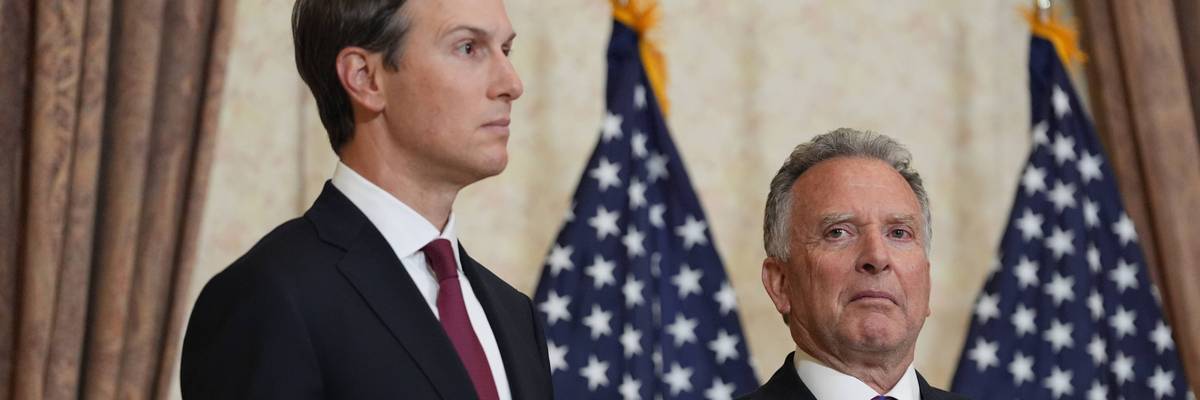
Jared Kushner, left, and Steve Witkoff, Special Envoy for Peace Missions listen as Vice President JD Vance speaks during a news conference after meeting with representatives from Pakistan and Iran, April 12, 2026 in Islamabad, Pakistan.
(Photo by Jacquelyn Martin - Pool/Getty Images)
Elkhan Nuriyev
Apr 20, 2026
(Photo by Jacquelyn Martin - Pool/Getty Images)
Elkhan Nuriyev
Apr 20, 2026
Common Dreams
The breakdown of recent US–Iran contacts in Pakistan does not represent an isolated diplomatic setback. It reflects something more structural: a relationship that is no longer moving toward resolution but instead stabilizing into a long-term cycle of managed confrontation.
In this emerging pattern, diplomacy has not disappeared, but its function has changed. It is no longer a pathway toward agreement; it has become part of the mechanism through which escalation is contained, calibrated, and periodically reset—without addressing the underlying conflict.
Recent signals that indirect contacts may still be continuing are not evidence of progress. Rather, they confirm the new logic of the relationship: diplomacy and coercion now operate in parallel. Negotiations persist, but without a shared framework, agreed end state, or credible roadmap toward settlement.
Diplomacy without resolution
Over the past several years, US-Iran engagement has increasingly shifted away from structured bargaining toward fragmented, episodic communication. The assumption that talks naturally lead toward de-escalation no longer holds.
Instead, both sides now use diplomacy tactically. It serves to manage risk, test boundaries, and signal restraint—while broader strategic competition continues uninterrupted.
This produces a paradox: dialogue continues, but trust erodes; engagement persists, but outcomes remain absent; communication expands, but political distance grows.
The breakdown of expectations following recent regional escalation and fragile ceasefire dynamics underscores this shift. The relationship is no longer oriented toward solving problems, but toward preventing them from spiraling out of control.
A fundamental strategic mismatch
At the core of this stalemate is not a failure of communication, but a deeper mismatch in strategic logic. The United States continues to approach diplomacy as an extension of pressure. Sanctions, military signaling, and containment strategies are intended to extract concessions on nuclear activity, regional influence, and security behavior. Iran, meanwhile, treats negotiations as a test of endurance and strategic recognition. It seeks economic relief and political acknowledgment of its regional position without fundamentally altering its core security doctrine.
These positions are not complementary. They are structurally incompatible. One side seeks behavioral change through pressure; the other seeks survival and recognition under pressure. As a result, negotiations do not converge toward compromise. They remain trapped within a constrained space of managed disagreement.
A region adapting to permanent instability
This dynamic is not confined to Washington and Tehran. It is reshaping the wider regional environment.
Pakistan’s role as a venue for indirect contacts highlights the growing importance of intermediary states attempting to contain escalation, even when their influence over outcomes is limited.
Turkey continues to balance mediation with strategic autonomy, engaging multiple actors while avoiding fixed alignment.
Russia benefits from prolonged US-Iran tensions, which divert Western attention and reinforce Moscow’s positioning as a partner for Tehran.
China prioritizes energy security and stability. It seeks to prevent open conflict but remains reluctant to assume a direct security role in the Gulf.
The combined effect is a fragmented regional order in which external actors are not neutral observers, but participants in managing—and at times exploiting—persistent instability.
Iran under layered pressure
Iran’s current strategic environment is shaped by three overlapping pressures: military, economic, and domestic.
Militarily, the likelihood of full-scale war remains relatively low. More plausible is a pattern of calibrated escalation—limited strikes, maritime tensions, cyber operations, and proxy activity.
Any sustained attempt to restrict Iranian-linked activity near critical maritime routes such as the Strait of Hormuz would mark a qualitative shift toward structural escalation, increasing long-term regional risk.
Iran, in turn, is unlikely to respond symmetrically. Its strategy relies on asymmetric tools: disruption of shipping, cyber capabilities, and the activation of regional networks. This produces a form of conflict that is continuous, dispersed, and difficult to resolve decisively.
Economically, the breakdown of talks reinforces Iran’s continued exclusion from the global financial system. Over time, sanctions have not only constrained Iran’s economy—they have reshaped it. Parallel trade networks, non-Western partnerships—particularly with Russia and China—and informal mechanisms have become structural features rather than temporary workarounds.
This reduces incentives for rapid compromise and increases the cost of reintegration into Western-led systems.
Domestically, sustained external pressure interacts with existing internal challenges. While external confrontation can temporarily reinforce political cohesion, it also intensifies long-term tensions between state capacity, economic performance, and public expectations.
The result is not collapse, but persistent strain.
The logic of strategic endurance
Taken together, these dynamics point toward a strategy best described as strategic endurance.
Iran’s likely trajectory is not decisive breakthrough or breakdown, but sustained resistance under pressure—preserving core capabilities, maintaining regional leverage, and keeping limited diplomatic channels open without major concessions.
This is not a strategy designed to resolve the conflict. It is a strategy designed to survive it.
The narrowing policy horizon in Washington
For the United States, the collapse of diplomatic momentum reinforces an increasingly familiar policy response: expanded sanctions, renewed military signaling, and limited tactical strikes against proxy-linked targets.
But the effectiveness of this approach is diminishing. Pressure without a credible political horizon tends to produce adaptation rather than compliance. It hardens positions, deepens fragmentation, and reduces the likelihood of negotiated outcomes over time.
What remains is a narrowing strategic space in which policy tools are still available, but less capable of producing meaningful change.
A durable cycle of confrontation
The most likely near-term trajectory is neither war nor resolution, but a prolonged cycle of managed confrontation.
This cycle will be characterized by intermittent escalation, partial and indirect diplomacy, and growing involvement of external actors attempting to prevent wider spillover.
Such an equilibrium may appear stable in the short term. Its danger lies in its durability. Conflicts that become structurally managed rather than resolved tend not to end through negotiation, but through accumulated crises that eventually exceed the system’s capacity to contain them.
The failure of talks in Pakistan does not simply close a diplomatic episode. It clarifies the limits of what current diplomacy can realistically achieve.
Unless the underlying strategic mismatch is addressed, US-Iran relations are likely to remain trapped in a pattern where escalation is managed, but resolution is continually deferred—at increasing cost to regional stability and global security.
Our work is licensed under Creative Commons (CC BY-NC-ND 3.0). Feel free to republish and share widely.
Elkhan Nuriyev is a former Fulbright Scholar at The George Washington University and has held senior positions at leading think tanks and research institutions in the United States and Europe. He is a senior fellow with the Alexander von Humboldt Foundation in Berlin and a global energy associate at the Brussels Energy Club, and serves as a senior expert at LM Political Risk and Strategy Advisory in Vienna.
Full Bio >
The breakdown of recent US–Iran contacts in Pakistan does not represent an isolated diplomatic setback. It reflects something more structural: a relationship that is no longer moving toward resolution but instead stabilizing into a long-term cycle of managed confrontation.
In this emerging pattern, diplomacy has not disappeared, but its function has changed. It is no longer a pathway toward agreement; it has become part of the mechanism through which escalation is contained, calibrated, and periodically reset—without addressing the underlying conflict.
Recent signals that indirect contacts may still be continuing are not evidence of progress. Rather, they confirm the new logic of the relationship: diplomacy and coercion now operate in parallel. Negotiations persist, but without a shared framework, agreed end state, or credible roadmap toward settlement.
Diplomacy without resolution
Over the past several years, US-Iran engagement has increasingly shifted away from structured bargaining toward fragmented, episodic communication. The assumption that talks naturally lead toward de-escalation no longer holds.
Instead, both sides now use diplomacy tactically. It serves to manage risk, test boundaries, and signal restraint—while broader strategic competition continues uninterrupted.
This produces a paradox: dialogue continues, but trust erodes; engagement persists, but outcomes remain absent; communication expands, but political distance grows.
The breakdown of expectations following recent regional escalation and fragile ceasefire dynamics underscores this shift. The relationship is no longer oriented toward solving problems, but toward preventing them from spiraling out of control.
A fundamental strategic mismatch
At the core of this stalemate is not a failure of communication, but a deeper mismatch in strategic logic. The United States continues to approach diplomacy as an extension of pressure. Sanctions, military signaling, and containment strategies are intended to extract concessions on nuclear activity, regional influence, and security behavior. Iran, meanwhile, treats negotiations as a test of endurance and strategic recognition. It seeks economic relief and political acknowledgment of its regional position without fundamentally altering its core security doctrine.
These positions are not complementary. They are structurally incompatible. One side seeks behavioral change through pressure; the other seeks survival and recognition under pressure. As a result, negotiations do not converge toward compromise. They remain trapped within a constrained space of managed disagreement.
A region adapting to permanent instability
This dynamic is not confined to Washington and Tehran. It is reshaping the wider regional environment.
Pakistan’s role as a venue for indirect contacts highlights the growing importance of intermediary states attempting to contain escalation, even when their influence over outcomes is limited.
Turkey continues to balance mediation with strategic autonomy, engaging multiple actors while avoiding fixed alignment.
Russia benefits from prolonged US-Iran tensions, which divert Western attention and reinforce Moscow’s positioning as a partner for Tehran.
China prioritizes energy security and stability. It seeks to prevent open conflict but remains reluctant to assume a direct security role in the Gulf.
The combined effect is a fragmented regional order in which external actors are not neutral observers, but participants in managing—and at times exploiting—persistent instability.
Iran under layered pressure
Iran’s current strategic environment is shaped by three overlapping pressures: military, economic, and domestic.
Militarily, the likelihood of full-scale war remains relatively low. More plausible is a pattern of calibrated escalation—limited strikes, maritime tensions, cyber operations, and proxy activity.
Any sustained attempt to restrict Iranian-linked activity near critical maritime routes such as the Strait of Hormuz would mark a qualitative shift toward structural escalation, increasing long-term regional risk.
Iran, in turn, is unlikely to respond symmetrically. Its strategy relies on asymmetric tools: disruption of shipping, cyber capabilities, and the activation of regional networks. This produces a form of conflict that is continuous, dispersed, and difficult to resolve decisively.
Economically, the breakdown of talks reinforces Iran’s continued exclusion from the global financial system. Over time, sanctions have not only constrained Iran’s economy—they have reshaped it. Parallel trade networks, non-Western partnerships—particularly with Russia and China—and informal mechanisms have become structural features rather than temporary workarounds.
This reduces incentives for rapid compromise and increases the cost of reintegration into Western-led systems.
Domestically, sustained external pressure interacts with existing internal challenges. While external confrontation can temporarily reinforce political cohesion, it also intensifies long-term tensions between state capacity, economic performance, and public expectations.
The result is not collapse, but persistent strain.
The logic of strategic endurance
Taken together, these dynamics point toward a strategy best described as strategic endurance.
Iran’s likely trajectory is not decisive breakthrough or breakdown, but sustained resistance under pressure—preserving core capabilities, maintaining regional leverage, and keeping limited diplomatic channels open without major concessions.
This is not a strategy designed to resolve the conflict. It is a strategy designed to survive it.
The narrowing policy horizon in Washington
For the United States, the collapse of diplomatic momentum reinforces an increasingly familiar policy response: expanded sanctions, renewed military signaling, and limited tactical strikes against proxy-linked targets.
But the effectiveness of this approach is diminishing. Pressure without a credible political horizon tends to produce adaptation rather than compliance. It hardens positions, deepens fragmentation, and reduces the likelihood of negotiated outcomes over time.
What remains is a narrowing strategic space in which policy tools are still available, but less capable of producing meaningful change.
A durable cycle of confrontation
The most likely near-term trajectory is neither war nor resolution, but a prolonged cycle of managed confrontation.
This cycle will be characterized by intermittent escalation, partial and indirect diplomacy, and growing involvement of external actors attempting to prevent wider spillover.
Such an equilibrium may appear stable in the short term. Its danger lies in its durability. Conflicts that become structurally managed rather than resolved tend not to end through negotiation, but through accumulated crises that eventually exceed the system’s capacity to contain them.
The failure of talks in Pakistan does not simply close a diplomatic episode. It clarifies the limits of what current diplomacy can realistically achieve.
Unless the underlying strategic mismatch is addressed, US-Iran relations are likely to remain trapped in a pattern where escalation is managed, but resolution is continually deferred—at increasing cost to regional stability and global security.
Our work is licensed under Creative Commons (CC BY-NC-ND 3.0). Feel free to republish and share widely.
Elkhan Nuriyev is a former Fulbright Scholar at The George Washington University and has held senior positions at leading think tanks and research institutions in the United States and Europe. He is a senior fellow with the Alexander von Humboldt Foundation in Berlin and a global energy associate at the Brussels Energy Club, and serves as a senior expert at LM Political Risk and Strategy Advisory in Vienna.
Full Bio >
Iran’s 10-Point Plan Is Still a Workable Basis for Negotiations
How long must the US war on Iran go on, and how badly must the US be defeated, before it will agree to a permanent peace?
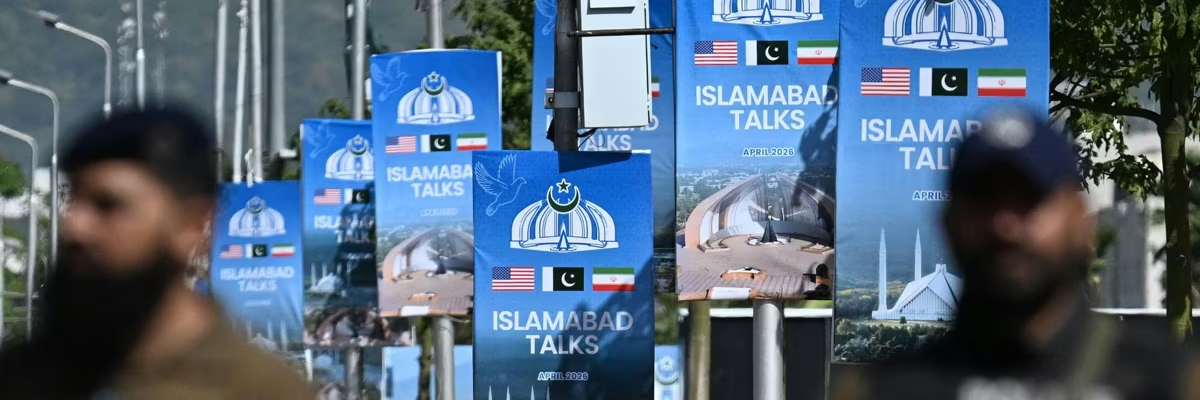
Security personnel stand guard at a security checkpost along a road temporarily closed near the Serena Hotel at the Red Zone area in Islamabad on April 20, 2026, ahead of US-Iran peace talks.
(Photo by Aamir Qureshi / AFP via Getty Images)
Nicolas J.S. Davies
Apr 20, 2026
How long must the US war on Iran go on, and how badly must the US be defeated, before it will agree to a permanent peace?
Security personnel stand guard at a security checkpost along a road temporarily closed near the Serena Hotel at the Red Zone area in Islamabad on April 20, 2026, ahead of US-Iran peace talks.
(Photo by Aamir Qureshi / AFP via Getty Images)
Nicolas J.S. Davies
Apr 20, 2026
Common Dreams
The US government under Donald Trump has twice used disingenuous negotiations with Iran to provide cover for attacking it, in June 2025 and again before launching the current war in February. Now it is trying to do so for a third time.
On April 8, the US and Iran began a two week ceasefire, after Trump accepted a 10-point peace plan drawn up by Iran as “a workable basis on which to negotiate.” But Vice President Vance and US negotiators rejected Iran’s plan out of hand at talks in Pakistan on April 11, and instead demanded that Iran must give up its right as a member of the Nuclear Non-Proliferation Treaty (or NPT) to enrich uranium for civilian purposes. The talks ended with no agreement.
As the end of the ceasefire on April 22 drew near, Trump claimed that Iran had agreed to US demands on enriched uranium and other matters. But Iran announced to the world on April 18 that it had not agreed to any of the terms Trump claimed, and that his lies and threats provided no basis for further negotiations. Iran then responded to US and Israeli ceasefire violations by once again closing the Strait of Hormuz to all vessels linked to hostile countries.
In other words, Iran called Trump’s bluff, holding the US to the terms of the two-week ceasefire. But Trump didn’t give up on his false claims, and instead insisted that Iran had agreed to another round of talks in Pakistan on April 21st, which Iran immediately denied.
The reversal in US policy that it would take to resolve this crisis would not be unprecedented.
As the April 22 deadline approaches with no agreement, many analysts now expect the end of the ceasefire to be followed, within hours or days, by a US escalation of the war and a proportionate military response from Iran, with no clear off-ramp from further escalation.
But this could be averted by a belated but genuine US reappraisal of its position, based on Iran’s ten point proposal that Trump accepted as “a workable basis on which to negotiate.”
If the United States government really wants an exit strategy from this self-imposed, ever-escalating war, it should take a fresh look at Iran’s ten point peace plan, and seriously consider how it can engage with this framework to turn over a new leaf in its relations with Iran and the region.
These are the ten points, as reported by Gulf News:A guarantee that Iran will not be attacked again
A permanent end to the war, not just a ceasefire
An end to Israeli strikes in Lebanon and against Iranian allies
The lifting of all US sanctions on Iran
Iran agreeing to reopen the Strait of Hormuz
Introduction of a $2 million fee per ship transiting Hormuz
Revenue from shipping fees to be shared with Oman
Funds to be used for reconstruction of war-damaged infrastructure
Establishment of safe passage protocols through Hormuz
A broader framework to end regional hostilities
Since the United States has failed to use the two-week ceasefire to negotiate on this “workable basis,” it will be up to Iran to decide whether to agree to extend the ceasefire so that the US and Iran can finally start real negotiations.
This would require the US to begin acting in good faith, an inherently tall order, to convince Iran that it would not just use an extension of the ceasefire to prepare an even more deadly and catastrophic attack. It should immediately lift its naval blockade of Iran, stop transporting more armed forces into the region, and do whatever it takes to end Israel’s ceasefire violations in Lebanon and Palestine, including by halting the transfer of weapons that Israel uses to violate those ceasefires, as US law requires.
Without such confidence-building measures, it is hard to see why Iran would agree to an extension of the ceasefire. As Professor Mostafa Khoshcheshm in Tehran explained to Al Jazeera, Trump’s lies convinced Tehran it would not find “a trustworthy partner for any kind of deal,” and, as long as the US acts this way, “Iran will continue the war.”
“Iran believes it has the upper hand and that this must be established in any future confrontation,” he said, noting that millions of people are still taking to the streets in Iran every night to call for continued resistance.
Maybe the most vital of Iran’s ten points is the first one listed above: a guarantee that Iran will not be attacked again, either by the United States or Israel. Trump’s war crimes, his undermining of US credibility and his connivance at Israel’s ceasefire violations make such a guarantee elusive, although it is only what international law requires of all countries, that they resolve their disputes peacefully and refrain from threatening or using military force against each other.
What form of guarantee could Iran possibly accept from a country that systematically violates treaties and agreements? Engaging in good faith negotiations over the rest of Iran’s 10-point agenda, especially the lifting of US sanctions, while also moving to restore diplomatic relations, might be good first steps.
The reversal in US policy that it would take to resolve this crisis would not be unprecedented. Vietnam, Iraq, and Afghanistan all forced US forces to withdraw from their countries. But those were much longer wars, involving many years of US occupation that went on until popular resistance movements made continued occupation untenable.
How long must the US war on Iran go on, and how badly must the US be defeated, before it will agree to a permanent peace? This crisis can be as long or as short, and as bloody or bloodless, as US leaders choose, and as the American people will tolerate.
The lifting of illegal US sanctions against Iran (#4 on the list) would be a vital part of any solution to this crisis. This would surely be good for both countries, and the United States would be less likely to attack Iran again if the US and Iran have reestablished mutually profitable trade relations.
Ending Israel’s attacks on Iran’s allies (#3), and a broader framework to end regional hostilities (#10) are both steps that most Americans would support. The failure of the US-Israeli war on Iran could be the desperately needed catalyst for the US to transform a US-Israeli military alliance that is committing genocide in Palestine and aggression throughout the region into a new and different relationship bounded by the rules of international law.
A US military withdrawal from its bases around the Persian Gulf could prevent the countries that host them from again becoming targets in US-Israeli wars on Iran, so it is interesting that Iran doesn’t mention them in its ten points. Perhaps Iran sees the value of these US bases as vulnerable targets in this and future wars as outweighing any threat they might pose, but that would be one more reason for the United States to withdraw from them before they cost more American lives.
There is a simple way to avoid one of the most destructive elements in recent failed negotiations with Iran, and that would be to remove Steve Witkoff and Jared Kushner from the US negotiating team.
The other five items in the ten-point agenda are all related to the Strait of Hormuz. The strait is within Iran’s and Oman’s territorial waters, although charging ships to pass through it is unprecedented and legally questionable. It is really the US and Israel that should pay reparations to Iran for the death and destruction they have wreaked, not the owners of international merchant ships. But if the US will not agree to pay reparations, Iran’s tollbooths may be a compromise that all sides can live with in order to reopen the strait, as Iran itself calls for in item # 5.
There is a simple way to avoid one of the most destructive elements in recent failed negotiations with Iran, and that would be to remove Steve Witkoff and Jared Kushner from the US negotiating team. Discussing prior negotiations, a diplomat from one of the Gulf countries told The Guardian, “We regarded Witkoff and Kushner as Israeli assets that dragged a president into a war he wants to get out of.”
Given Witkoff and Kushner’s foreign loyalties, Trump’s lies and corruption, Rubio’s subservience to Israel, and Hegseth’s bloodlust, the United States can surely find more professional officials to represent it in these difficult negotiations, which have only been made more difficult by the flood of threats, lies and deception from the US side.But since the United States has not really tried to make peace wit Iran since abandoning the JCPOA in 2018, a new team of qualified, experienced US diplomats charged with turning over a new leaf in US-Iran relations could start with a clean slate, and they would have the support of the whole world behind their efforts to resolve this global crisis.
Our work is licensed under Creative Commons (CC BY-NC-ND 3.0). Feel free to republish and share widely.
Nicolas J.S. Davies is an independent journalist and a researcher with CODEPINK. He is the co-author, with Medea Benjamin, of War in Ukraine: Making Sense of a Senseless Conflict, available from OR Books in November 2022, and the author of Blood On Our Hands: the American Invasion and Destruction of Iraq.
Full Bio >
The US government under Donald Trump has twice used disingenuous negotiations with Iran to provide cover for attacking it, in June 2025 and again before launching the current war in February. Now it is trying to do so for a third time.
On April 8, the US and Iran began a two week ceasefire, after Trump accepted a 10-point peace plan drawn up by Iran as “a workable basis on which to negotiate.” But Vice President Vance and US negotiators rejected Iran’s plan out of hand at talks in Pakistan on April 11, and instead demanded that Iran must give up its right as a member of the Nuclear Non-Proliferation Treaty (or NPT) to enrich uranium for civilian purposes. The talks ended with no agreement.
As the end of the ceasefire on April 22 drew near, Trump claimed that Iran had agreed to US demands on enriched uranium and other matters. But Iran announced to the world on April 18 that it had not agreed to any of the terms Trump claimed, and that his lies and threats provided no basis for further negotiations. Iran then responded to US and Israeli ceasefire violations by once again closing the Strait of Hormuz to all vessels linked to hostile countries.
In other words, Iran called Trump’s bluff, holding the US to the terms of the two-week ceasefire. But Trump didn’t give up on his false claims, and instead insisted that Iran had agreed to another round of talks in Pakistan on April 21st, which Iran immediately denied.
The reversal in US policy that it would take to resolve this crisis would not be unprecedented.
As the April 22 deadline approaches with no agreement, many analysts now expect the end of the ceasefire to be followed, within hours or days, by a US escalation of the war and a proportionate military response from Iran, with no clear off-ramp from further escalation.
But this could be averted by a belated but genuine US reappraisal of its position, based on Iran’s ten point proposal that Trump accepted as “a workable basis on which to negotiate.”
If the United States government really wants an exit strategy from this self-imposed, ever-escalating war, it should take a fresh look at Iran’s ten point peace plan, and seriously consider how it can engage with this framework to turn over a new leaf in its relations with Iran and the region.
These are the ten points, as reported by Gulf News:A guarantee that Iran will not be attacked again
A permanent end to the war, not just a ceasefire
An end to Israeli strikes in Lebanon and against Iranian allies
The lifting of all US sanctions on Iran
Iran agreeing to reopen the Strait of Hormuz
Introduction of a $2 million fee per ship transiting Hormuz
Revenue from shipping fees to be shared with Oman
Funds to be used for reconstruction of war-damaged infrastructure
Establishment of safe passage protocols through Hormuz
A broader framework to end regional hostilities
Since the United States has failed to use the two-week ceasefire to negotiate on this “workable basis,” it will be up to Iran to decide whether to agree to extend the ceasefire so that the US and Iran can finally start real negotiations.
This would require the US to begin acting in good faith, an inherently tall order, to convince Iran that it would not just use an extension of the ceasefire to prepare an even more deadly and catastrophic attack. It should immediately lift its naval blockade of Iran, stop transporting more armed forces into the region, and do whatever it takes to end Israel’s ceasefire violations in Lebanon and Palestine, including by halting the transfer of weapons that Israel uses to violate those ceasefires, as US law requires.
Without such confidence-building measures, it is hard to see why Iran would agree to an extension of the ceasefire. As Professor Mostafa Khoshcheshm in Tehran explained to Al Jazeera, Trump’s lies convinced Tehran it would not find “a trustworthy partner for any kind of deal,” and, as long as the US acts this way, “Iran will continue the war.”
“Iran believes it has the upper hand and that this must be established in any future confrontation,” he said, noting that millions of people are still taking to the streets in Iran every night to call for continued resistance.
Maybe the most vital of Iran’s ten points is the first one listed above: a guarantee that Iran will not be attacked again, either by the United States or Israel. Trump’s war crimes, his undermining of US credibility and his connivance at Israel’s ceasefire violations make such a guarantee elusive, although it is only what international law requires of all countries, that they resolve their disputes peacefully and refrain from threatening or using military force against each other.
What form of guarantee could Iran possibly accept from a country that systematically violates treaties and agreements? Engaging in good faith negotiations over the rest of Iran’s 10-point agenda, especially the lifting of US sanctions, while also moving to restore diplomatic relations, might be good first steps.
The reversal in US policy that it would take to resolve this crisis would not be unprecedented. Vietnam, Iraq, and Afghanistan all forced US forces to withdraw from their countries. But those were much longer wars, involving many years of US occupation that went on until popular resistance movements made continued occupation untenable.
How long must the US war on Iran go on, and how badly must the US be defeated, before it will agree to a permanent peace? This crisis can be as long or as short, and as bloody or bloodless, as US leaders choose, and as the American people will tolerate.
The lifting of illegal US sanctions against Iran (#4 on the list) would be a vital part of any solution to this crisis. This would surely be good for both countries, and the United States would be less likely to attack Iran again if the US and Iran have reestablished mutually profitable trade relations.
Ending Israel’s attacks on Iran’s allies (#3), and a broader framework to end regional hostilities (#10) are both steps that most Americans would support. The failure of the US-Israeli war on Iran could be the desperately needed catalyst for the US to transform a US-Israeli military alliance that is committing genocide in Palestine and aggression throughout the region into a new and different relationship bounded by the rules of international law.
A US military withdrawal from its bases around the Persian Gulf could prevent the countries that host them from again becoming targets in US-Israeli wars on Iran, so it is interesting that Iran doesn’t mention them in its ten points. Perhaps Iran sees the value of these US bases as vulnerable targets in this and future wars as outweighing any threat they might pose, but that would be one more reason for the United States to withdraw from them before they cost more American lives.
There is a simple way to avoid one of the most destructive elements in recent failed negotiations with Iran, and that would be to remove Steve Witkoff and Jared Kushner from the US negotiating team.
The other five items in the ten-point agenda are all related to the Strait of Hormuz. The strait is within Iran’s and Oman’s territorial waters, although charging ships to pass through it is unprecedented and legally questionable. It is really the US and Israel that should pay reparations to Iran for the death and destruction they have wreaked, not the owners of international merchant ships. But if the US will not agree to pay reparations, Iran’s tollbooths may be a compromise that all sides can live with in order to reopen the strait, as Iran itself calls for in item # 5.
There is a simple way to avoid one of the most destructive elements in recent failed negotiations with Iran, and that would be to remove Steve Witkoff and Jared Kushner from the US negotiating team. Discussing prior negotiations, a diplomat from one of the Gulf countries told The Guardian, “We regarded Witkoff and Kushner as Israeli assets that dragged a president into a war he wants to get out of.”
Given Witkoff and Kushner’s foreign loyalties, Trump’s lies and corruption, Rubio’s subservience to Israel, and Hegseth’s bloodlust, the United States can surely find more professional officials to represent it in these difficult negotiations, which have only been made more difficult by the flood of threats, lies and deception from the US side.But since the United States has not really tried to make peace wit Iran since abandoning the JCPOA in 2018, a new team of qualified, experienced US diplomats charged with turning over a new leaf in US-Iran relations could start with a clean slate, and they would have the support of the whole world behind their efforts to resolve this global crisis.
Our work is licensed under Creative Commons (CC BY-NC-ND 3.0). Feel free to republish and share widely.
Nicolas J.S. Davies is an independent journalist and a researcher with CODEPINK. He is the co-author, with Medea Benjamin, of War in Ukraine: Making Sense of a Senseless Conflict, available from OR Books in November 2022, and the author of Blood On Our Hands: the American Invasion and Destruction of Iraq.
Full Bio >
A War Nobody Voted For — And a Congress That Let It Happen
This is not a story about Trump breaking the law. It’s a story about Congress watching him do it and choosing, repeatedly, to look away.
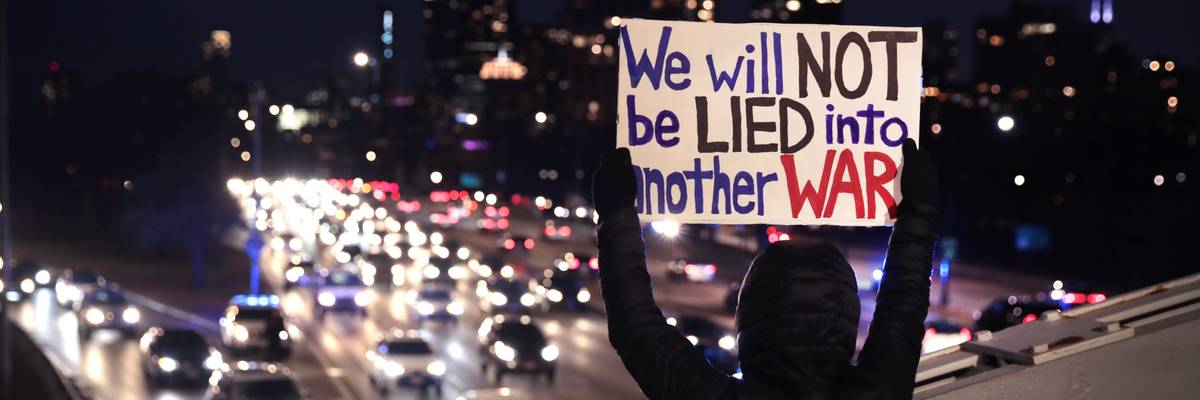
Demonstrators protest the possibility of War with Iran from a pedestrian bridge over Lakeshore Drive during rush hour on January 09, 2020 in Chicago, Illinois.
(Photo by Scott Olson/Getty Images)
Hassan Elbiali
Apr 20, 2026
This is not a story about Trump breaking the law. It’s a story about Congress watching him do it and choosing, repeatedly, to look away.
Demonstrators protest the possibility of War with Iran from a pedestrian bridge over Lakeshore Drive during rush hour on January 09, 2020 in Chicago, Illinois.
(Photo by Scott Olson/Getty Images)
Hassan Elbiali
Apr 20, 2026
Common Dreams
There’s a line in the U.S. Constitution so simple it shouldn’t require interpretation. Article I, Section 8: Congress has the power to declare war. Not the President. Congress. The Founders were explicit about this. James Madison called it “the most sacred of all” constitutional provisions — the one safeguard against a single person dragging a republic into bloodshed.
On February 28, 2026, at approxiomately 1:15 am ET, the United States began bombing Iran. No declaration of war. No congressional vote. No single national security incident was cited as the basis for the attack—Trump instead recounted 47 years of U.S.–Iran tensions, beginning with the 1979 hostage crisis, as justification. The bombs fell anyway.
‘The Constitution Is Clear and the Stakes Are High’: Coalition Demands Congress Rein In Pro-War Trump

Critics Slam Meeks, Jeffries Pushing Off War Powers Bill Just as It Gets Enough Votes to Pass
What happened next is the part that should disturb you more than the war itself.
Congress had a choice. It had the tool — the War Powers Resolution of 1973, passed over Nixon’s veto precisely to prevent this kind of unilateral military adventurism. The law is unambiguous: the president may not enter U.S. troops into hostilities without express congressional authorization, regardless of a conflict’s scale or duration. The 60-day clock started ticking the moment the first bomb dropped. Congress could have acted.
It didn’t. When Senators Kaine and Paul introduced a War Powers Resolution on March 1, the Senate voted it down 53–47. Then they voted it down again. And again. By mid-April, the Senate had rejected Democratic efforts to force an end to U.S. military involvement in Iran four separate times, voting largely along party lines.
Four votes. Four failures. This is not a story about Trump breaking the law. It’s a story about Congress watching him do it and choosing, repeatedly, to look away.
The War Powers Resolution was supposed to be the fix for exactly this situation. Widely considered a measure for preventing “future Vietnams,” it was nonetheless generally resisted or ignored by subsequent presidents, many of whom regarded it as an unconstitutional usurpation of their executive authority.
Every president since Nixon has treated it as optional; Clinton in Kosovo, Obama in Libya, and now Trump in Iran. The pattern is so consistent it barely registers as news anymore. But what has changed, and what makes Operation Epic Fury different, is the scale.
This is markedly different in scope, scale, and objective from the more limited US attack on Iran of June 2025 which targeted senior leadership, military infrastructure, and nuclear capabilities. This is a war by any honest definition. The administration just refuses to call it one.
Secretary of State Marco Rubio told Fox News: “This is not a war against Iran,” the same view held by most modern presidents and their lawyers in the Office of Legal Counsel. If you call it something else—a “police action,” a “limited engagement,” or a “kinetic military operation”—you never have to ask permission. Truman did it in Korea. Nixon did it in Cambodia. The euphemisms change; the evasion doesn’t.
But here’s the thing about this particular evasion. Congress isn’t powerless here it’s passive. The appropriations power alone gives lawmakers the ability to cut off funding for any military operation they find objectionable.
The annual National Defense Authorization Act process, combined with supplemental appropriations, provides multiple leverage points. Republican leadership isn’t using any of them. They’re not even seriously trying. Speaker Johnson called the War Powers Resolution vote “a terrible, dangerous idea” that would “empower our enemies.” That’s not a constitutional argument. That’s cover.
And the Democrats? They’ve forced the votes, yes. Sen. Tim Kaine (D-Va.) has been relentless. But Kaine himself acknowledged that the renewed effort was unlikely to go anywhere, but said it’s important for members of Congress to go on record. “Going on record.” That’s what it’s come to—symbolic gestures in the face of a $200 billion war that nobody voted for.
The costs are real. The war has already cost at least $12 billion, and the Pentagon has asked the White House to approve a $200 billion supplemental request to Congress to fund the conflict. The Strait of Hormuz closed. Global oil markets lurched. Economic shocks have rippled outward, with the costs falling on ordinary Americans while those who profit from endless war count their returns. Children were killed at a school in Minab. The 60-day deadline has come and gone.
The War Powers Resolution was built for this moment. It was written by legislators who had watched Vietnam consume a generation because no one in Congress had the spine to call a war a war. “After Nixon, it’s gone on from one president to the next , they believe they can use military force against one country after another,” says Louis Fisher, who served for 35 years as senior specialist in separation of powers at the Congressional Research Service.
Fifty years later, the lesson has not been learned. The resolution that was supposed to restore congressional war powers has instead become a ritual. A series of doomed votes that let lawmakers signal opposition without actually exercising it.
There is one question that cuts through all of it. Sen. Kaine asked it directly on the Senate floor: “If you don’t have the guts to vote yes or no on a war vote, how dare you send our sons and daughters into war where they risk their lives?”
No one answered him. That silence is the real story.
The 1973 War Powers Resolution wasn’t just a law. It was a promise that the United States would never again stumble into a catastrophic military conflict without the consent of the people’s elected representatives. Operation Epic Fury has broken that promise to the American people once again. Congress has the power to keep it. Right now, it is choosing not to.
That choice has a cost. Someone should start paying it.
Our work is licensed under Creative Commons (CC BY-NC-ND 3.0). Feel free to republish and share widely.
Hassan Elbiali is a political analyst and writer covering US foreign policy, international security, and Middle East geopolitics. His work has appeared in Independent Australia, Z Magazine, and other international affairs publications.
Full Bio >
There’s a line in the U.S. Constitution so simple it shouldn’t require interpretation. Article I, Section 8: Congress has the power to declare war. Not the President. Congress. The Founders were explicit about this. James Madison called it “the most sacred of all” constitutional provisions — the one safeguard against a single person dragging a republic into bloodshed.
On February 28, 2026, at approxiomately 1:15 am ET, the United States began bombing Iran. No declaration of war. No congressional vote. No single national security incident was cited as the basis for the attack—Trump instead recounted 47 years of U.S.–Iran tensions, beginning with the 1979 hostage crisis, as justification. The bombs fell anyway.
‘The Constitution Is Clear and the Stakes Are High’: Coalition Demands Congress Rein In Pro-War Trump
Critics Slam Meeks, Jeffries Pushing Off War Powers Bill Just as It Gets Enough Votes to Pass
What happened next is the part that should disturb you more than the war itself.
Congress had a choice. It had the tool — the War Powers Resolution of 1973, passed over Nixon’s veto precisely to prevent this kind of unilateral military adventurism. The law is unambiguous: the president may not enter U.S. troops into hostilities without express congressional authorization, regardless of a conflict’s scale or duration. The 60-day clock started ticking the moment the first bomb dropped. Congress could have acted.
It didn’t. When Senators Kaine and Paul introduced a War Powers Resolution on March 1, the Senate voted it down 53–47. Then they voted it down again. And again. By mid-April, the Senate had rejected Democratic efforts to force an end to U.S. military involvement in Iran four separate times, voting largely along party lines.
Four votes. Four failures. This is not a story about Trump breaking the law. It’s a story about Congress watching him do it and choosing, repeatedly, to look away.
The War Powers Resolution was supposed to be the fix for exactly this situation. Widely considered a measure for preventing “future Vietnams,” it was nonetheless generally resisted or ignored by subsequent presidents, many of whom regarded it as an unconstitutional usurpation of their executive authority.
Every president since Nixon has treated it as optional; Clinton in Kosovo, Obama in Libya, and now Trump in Iran. The pattern is so consistent it barely registers as news anymore. But what has changed, and what makes Operation Epic Fury different, is the scale.
This is markedly different in scope, scale, and objective from the more limited US attack on Iran of June 2025 which targeted senior leadership, military infrastructure, and nuclear capabilities. This is a war by any honest definition. The administration just refuses to call it one.
Secretary of State Marco Rubio told Fox News: “This is not a war against Iran,” the same view held by most modern presidents and their lawyers in the Office of Legal Counsel. If you call it something else—a “police action,” a “limited engagement,” or a “kinetic military operation”—you never have to ask permission. Truman did it in Korea. Nixon did it in Cambodia. The euphemisms change; the evasion doesn’t.
But here’s the thing about this particular evasion. Congress isn’t powerless here it’s passive. The appropriations power alone gives lawmakers the ability to cut off funding for any military operation they find objectionable.
The annual National Defense Authorization Act process, combined with supplemental appropriations, provides multiple leverage points. Republican leadership isn’t using any of them. They’re not even seriously trying. Speaker Johnson called the War Powers Resolution vote “a terrible, dangerous idea” that would “empower our enemies.” That’s not a constitutional argument. That’s cover.
And the Democrats? They’ve forced the votes, yes. Sen. Tim Kaine (D-Va.) has been relentless. But Kaine himself acknowledged that the renewed effort was unlikely to go anywhere, but said it’s important for members of Congress to go on record. “Going on record.” That’s what it’s come to—symbolic gestures in the face of a $200 billion war that nobody voted for.
The costs are real. The war has already cost at least $12 billion, and the Pentagon has asked the White House to approve a $200 billion supplemental request to Congress to fund the conflict. The Strait of Hormuz closed. Global oil markets lurched. Economic shocks have rippled outward, with the costs falling on ordinary Americans while those who profit from endless war count their returns. Children were killed at a school in Minab. The 60-day deadline has come and gone.
The War Powers Resolution was built for this moment. It was written by legislators who had watched Vietnam consume a generation because no one in Congress had the spine to call a war a war. “After Nixon, it’s gone on from one president to the next , they believe they can use military force against one country after another,” says Louis Fisher, who served for 35 years as senior specialist in separation of powers at the Congressional Research Service.
Fifty years later, the lesson has not been learned. The resolution that was supposed to restore congressional war powers has instead become a ritual. A series of doomed votes that let lawmakers signal opposition without actually exercising it.
There is one question that cuts through all of it. Sen. Kaine asked it directly on the Senate floor: “If you don’t have the guts to vote yes or no on a war vote, how dare you send our sons and daughters into war where they risk their lives?”
No one answered him. That silence is the real story.
The 1973 War Powers Resolution wasn’t just a law. It was a promise that the United States would never again stumble into a catastrophic military conflict without the consent of the people’s elected representatives. Operation Epic Fury has broken that promise to the American people once again. Congress has the power to keep it. Right now, it is choosing not to.
That choice has a cost. Someone should start paying it.
Our work is licensed under Creative Commons (CC BY-NC-ND 3.0). Feel free to republish and share widely.
Hassan Elbiali is a political analyst and writer covering US foreign policy, international security, and Middle East geopolitics. His work has appeared in Independent Australia, Z Magazine, and other international affairs publications.
Full Bio >

No comments:
Post a Comment