It’s possible that I shall make an ass of myself. But in that case one can always get out of it with a little dialectic. I have, of course, so worded my proposition as to be right either way (K.Marx, Letter to F.Engels on the Indian Mutiny)
Saturday, May 24, 2025
Europe's troublemakers meet in Belgrade
Europe's troublemakers, Viktor Orban (Hungary) and Aleksandar Vucic (Serbia) meet in Belgrade / Facebook: buducnostsrbijeavucic
By bne IntelliNewsMay 23, 2025
Hungarian Prime Minister Viktor Orban met Serbian President Aleksandar Vucic in Belgrade on May 23, in a display of solidarity between two of Europe’s most defiant political figures.
The visit, part of a broader working mission by a Hungarian delegation, underscores a deepening strategic alignment between Hungary and Serbia, at a time of heightened geopolitical uncertainty in the Western Balkans.
The pair, known for their illiberal governance styles and independent foreign policies, held what Vucic described as “a full day of consultations” covering geopolitics, defence, economic cooperation and bilateral strategic coordination.
"Today we are conducting a strategic dialogue on the most important issues for our two countries," Vucic wrote on social media, hailing what he called the "best relations in Serbian-Hungarian history."
The meeting comes amid growing friction within the European Union over Hungary’s adversarial stance toward Brussels. Orban has long positioned himself as a contrarian within the bloc, while simultaneously championing Serbia’s bid for EU membership. Hungary remains one of Belgrade’s most vocal advocates in Brussels, most recently supporting Serbia’s calls for the United States to delay sanctions on the majority-Russian-owned oil company NIS, citing concerns over energy security in the region.
Orban and Vucic have repeatedly demonstrated their mutual political affinity, maintaining close ties with Moscow and Beijing even as much of Europe seeks to recalibrate its dependencies following Russia’s invasion of Ukraine. Both men have rejected the mainstream EU consensus on several key issues, fostering a shared image as “sovereignist” leaders charting independent foreign policy paths.
Their alignment was starkly illustrated last year when Hungary stood alone among EU member states in voting against a United Nations General Assembly resolution on the 1995 Srebrenica genocide – siding with Serbia and the Bosnian Serb leadership in a move that drew condemnation from Western capitals.
The Belgrade talks follow an April announcement by Vucic of plans to build a full-fledged military alliance between the two countries. This followed the signing of a strategic defence partnership and came in response to a trilateral pact between Albania, Croatia and Kosovo – an agreement Serbia sharply criticised as destabilising. Vucic warned at the time that the pact could trigger an arms race in the Balkans.
The Hungarian leader, for his part, has maintained that Serbia’s accession to the EU remains critical for regional stability and has repeatedly called for an accelerated path for Belgrade’s membership. Orban’s strong advocacy has been reciprocated by Vucic, who described his counterpart on Friday as "a great friend" and a key partner in Serbia’s European ambitions.
As the EU's influence in the Western Balkans is tested by growing geopolitical competition from Russia and China, the Orban-Vucic axis is emerging as a significant counterweight to pro-Western currents in the region – one that could test the EU’s unity and undermine its influence in its immediate neighbourhood.
From frustration to innovation: Retired firefighter’s invention helps save homes from wildfires
Heli-Hydrants give firefighting helicopters quicker access to water, helping crews battle California wildfires faster.
Copyright AP Photo/Brittany Peterson
By Dorany Pineda & Brittany Peterson with AP Published on 24/05/2025 -
Mark Whaling and a crew raced up and down a hill in a tanker truck as they battled a wildfire in Los Angeles County, scrambling to get water from a street hydrant in time to stay ahead of flames moving up a ridge.
A helicopter flew in to drop water, but it had to fly a long distance to refill and a fire that might have been stopped went on to destroy homes.
As they fought that early 2000s blaze, Whaling says, he spotted a sealed water tank nearby that firefighters had no way of accessing. He thought that was ridiculous.
“We don’t tell fire engines, ‘Protect the city and go find your own water.’ We put fire hydrants every 600 feet (182 metres) all around cities,” said Whaling, who has since retired from the county fire department.
“But when it comes to the helicopters, we weren’t supporting them as robustly as we should.”
His frustration sparked an idea: the Heli-Hydrant, a relatively small, open tank that can be rapidly filled with water, enabling helicopters to fill up faster for urban fires rather than flying to sometimes distant lakes or ponds.
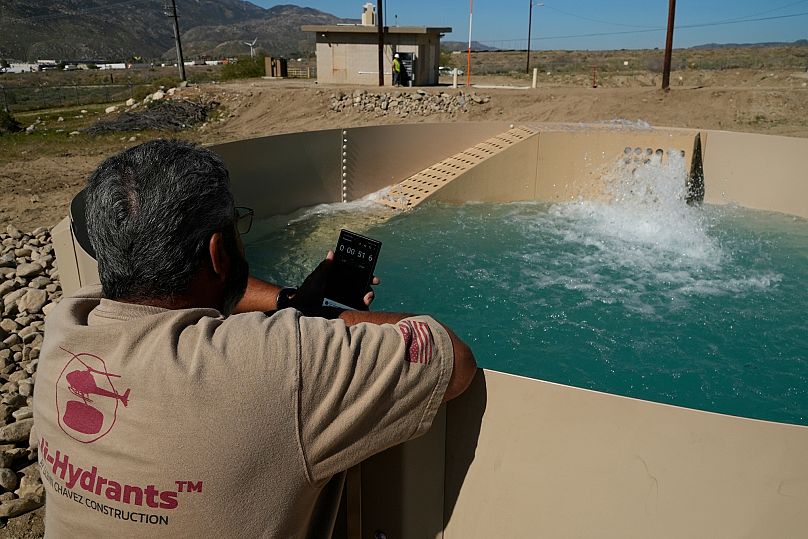
Glenn Chavez sets a timer as water fills a newly installed Heli-Hydrant.AP Photo/Brittany Peterson
As wildfires become more frequent, Whaling's invention is getting the attention of officials eager to boost preparedness. First used for the 2020 Blue Ridge Fire in Yorba Linda, 10 Heli-Hydrants have been built across Southern California and 16 more are in progress, according to Whaling.
Helicopters are essential for firefighting. They can drop about 3,785 litres of water at once - some much more. That's far more than hoses than get on a fire all at once, and can be the best way to attack fires that are difficult for ground crews to reach.
But pilots sometimes have to fly a long way to scoop up water, and in drought-prone areas, natural sources can sometimes dry up or diminish so they're hard to draw from. In Southern California's Riverside County, helicopters have had to fly up to about 16 kilometres to find water, eating critical time from battling fires.
Heli-Hydrants: An innovative solution
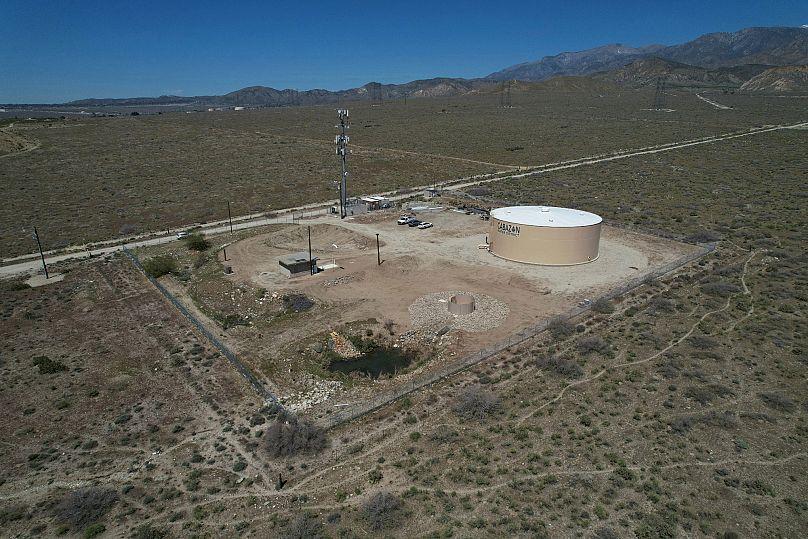
On a remote plot in the Southern California town of Cabazon, contractor Glenn Chavez stood on a ladder and peered into an empty Heli-Hydrant. A radio in hand, he clicked a button to activate the system and watched as water roared into the tank. In about six minutes, it filled with 32,176 liters.
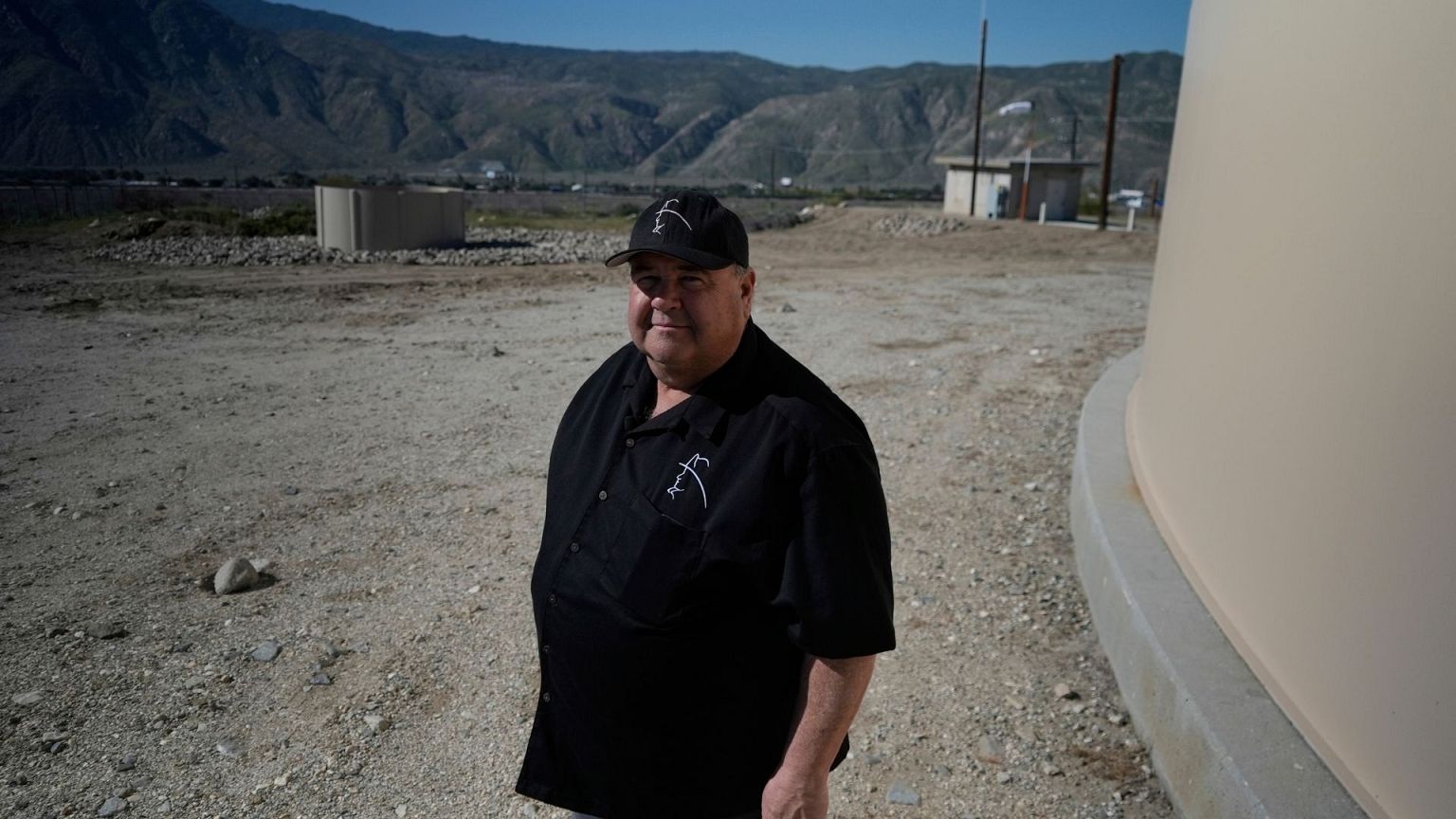
Chavez, a general contractor, was testing the Cabazon Water District’s lastest investment — a second Heli-Hydrant that local officials are counting on to help protect the town. At $300,000 (€265,000), it costs slightly less than the average price of a single home in Cabazon.
“Living in a beautiful desert community, you're going to have risks of fire," said Michael Pollack, the district's general manager. "And to have these Heli-Hydrants is a major advantage. People will have a little bit of comfort knowing that they have another tool for fighting fires in their community."
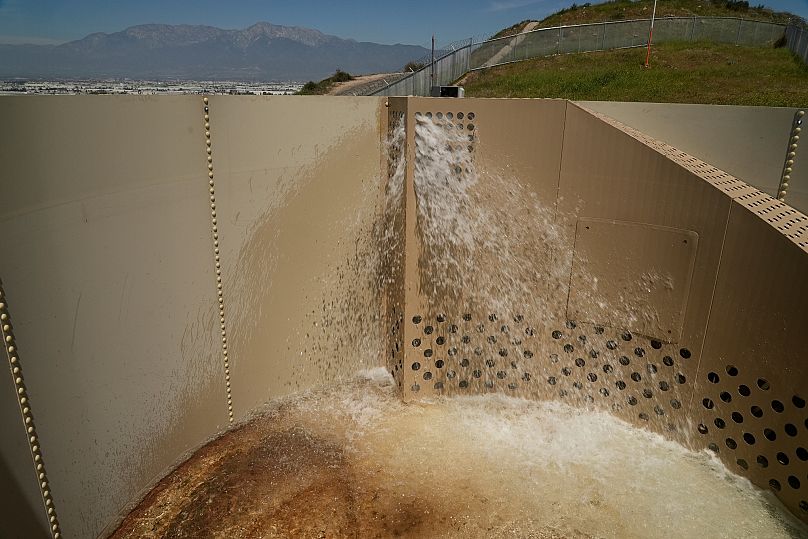
A Heli-Hydrant, a small, open tank that helicopters can rely on to get water faster for urban fires, fills with water during a demonstration.AP Photo/Brittany Peterson
Pilots can remotely activate the tanks from half a mile away, with the tank typically filling quickly from a city's water system. Helicopters can fill up in less than a minute. Once it's activated, solar panels and backup batteries ensure the system can still be used during power outages. And at night, lights from the tank and a tower nearby guide pilots toward it.
In November, fire responders in San Diego put the product to the test when the 19.5 hectare Garden Fire in Fallbrook, a community known for its avocado groves, prompted evacuation orders and warnings. Helicopters tapped the tank nearly 40 times.
Pilot Ben Brown said its proximity to the fire saved not just time but fuel.
“They’re great for when you don’t have other water sources,” he said. "The more dip sites, especially in some of the more arid environments in the county, the better.” The Heli-Hydrants can't always help
Heli-Hydrants have raised some concerns about their placement in urban areas where houses, buildings and power lines can be obstacles to flight and they might have to squeeze into tighter spaces.
In those cases, firefighters may choose to fly farther to a natural source that gives the helicopter more room, said Warren Voth, a deputy pilot with the San Diego County Sheriff's Department. A pilot's goal is to always to face the wind while entering and exiting an area, for safety, and they need room to accomplish that.
In some cases, the municipal systems needed to fill Heli-Hydrants could go empty during major fires. As the Palisades Fire in Los Angeles burned, three nearly 3.8 million litre tanks that helped pressurize city hydrants in the Pacific Palisades ran dry as demand soared and burning pipes leaked water.
Heli-Hydrant, a small, open tank that helicopters can rely on to get water faster for urban fires.AP Photo/Brittany Peterson
Other times, helicopters just can't access them. When winds are fierce, flying is nearly impossible; hurricane-force winds that supercharged the Los Angeles infernos initially grounded firefighting aircraft. When multiple helicopters respond to large blazes, they can't all use the Heli-Hydrant. And smoke can make it hard to see it.
Portable water tanks can accomplish some of the things that Heli-Hydrants do, but can require time, people and equipment to set up. A Heli-Hydrant gives one community hope
Areas where wildland vegetation intersects with human development have always been vulnerable to fires, but more people are living in them today, and climate change is creating conditions that can make these regions drier and more flammable.
Jake Wiley has seen intensifying wildfires devastate his community. Two blazes in 2007 and 2017 collectively scorched more than 400 structures in San Diego. The last one forced Wiley, now general manager for the Rainbow Municipal Water District, to evacuate.
That fire also prompted local agencies to install a Heli-Hydrant — and when the Garden Fire erupted in November, it played a big role helping firefighters protect homes.
“It seems like when you've seen the worst, you haven't yet,” Wiley said. “Anything we can do helps.”
Women's jobs three times more vulnerable to being taken by AI than men's, new report warns
A new UN-led report found that women's jobs in high-income countries are more likely to be replaced or touched by artificial intelligence than their male peers.
Women's jobs are at a higher risk of automation by artificial intelligence (AI) than those occupied by men, according to a new study from the United Nations.
The recent report from the UN's International Labour Organisation (ILO) and Poland's National Research Institute of the Ministry of Digital Affairs (NASK) found that automation could replace just under 10 per cent of female-dominated positions in high-income countries compared to the 3.5 per cent it could replace for men.
The biggest disparity between male and female-dominated jobs happens in high-income countries, where 41 percent of all high-income work for women could be exposed to AI, compared to 28 percent of men’s jobs.
In Europe and Central Asia, 39 per cent of women’s jobs could be affected compared to 26 percent of men.
The patterns identified by the study "reflect both occupational structures," and that AI-exposed jobs are "concentrated in higher-income countries".
Overall, the ILO found that one in four workers globally work in an occupation with some AI exposure.
Full replacement by AI still 'limited'
To reach these findings, the survey was conducted with1,640 people employed in various fields in Poland, with the results analysed by a small group of international experts.
Researchers then developed an AI that used this survey data alongside national job information to identify how likely 2,500 professions and over 29,000 work tasks would be automated.
The study found that clerical occupations like data entry clerks, typists, word processing operators, accountants, and bookkeeping clerks are the most exposed to AI, due to some of the tasks performed in those professions, like taking meeting notes or scheduling appointments.
Other professions identified with a large AI exposure are web and media developers, database specialists, financial, and software-related jobs.
The study notes that these numbers reflect the "potential exposure," but that they don't reflect any actual job losses.
Full replacement by AI is still "limited," the report continued, noting that human involvement is still needed to oversee certain tasks.
"As most occupations consist of tasks that require human input, transformation of jobs is the most likely impact of generative AI," the report reads.
What could impact the number of jobs lost or AI adoption more broadly are technological constraints, infrastructure gaps, and skills shortages, the report continued.
The report asks governments, employees, and workers organisations to shape "inclusive strategies" that can help protect job quality and productivity in endangered fields.
"It's easy to get lost in the AI hype," Janine Berg, senior economist at the ILO, said in a statement. "What we need is clarity and context".
Lawyer challenging Trump’s trade war says tariffs are ‘illegal and abusive’
"This administration is also characterized by severe economic illiteracy."
U.S. President Donald Trump speaks during an event to announce new tariffs in the Rose Garden at the White House, April 2, 2025, in Washington. (AP Photo/Mark Schiefelbein)
WASHINGTON — U.S. President Donald Trump's global trade war is an "illegal and abusive" use of power, said a lawyer representing small businesses who are challenging the tariffs.
George Mason University law professor Ilya Somin, along with the Liberty Justice Center, represents five American small businesses who had a hearing before the U.S. Court of International Trade last week in an effort to block Trump's sweeping "reciprocal" tariff agenda.
"He's sort of breaking various precedents and doing things which are highly illegal and obviously our contention is that this is highly illegal," Somin said in an interview Thursday.
The president is facing at least seven lawsuits that argue Trump has acted beyond his powers by wielding tariffs through the International Economic Emergency Powers Act of 1977.
The act, usually referred to by the acronym IEEPA, is a national security statute that gives the U.S. president authority to control economic transactions after declaring an emergency.
While its predecessor, the Trading With The Enemy Act, was used during the Nixon administration to briefly impose a 10 per cent tariff on all imports into the U.S., no president has used IEEPA for tariffs.
Somin said the statute does not mention tariffs, nor is there even a synonym, such as duties. The U.S. Constitution gives power over taxes and tariffs to Congress and Somin said Trump is misusing the statute.
"Our most basic argument, and also that of others challenging various uses of IEEPA to impose tariffs including against Canada, is that this statute does not authorize tariffs at all," Somin said.
Trump declared an emergency at the northern border in order to use IEEPA to slap Canada with tariffs in March. He partially paused the duties a few days later for imports under the Canada-U.S.-Mexico Agreement on trade.
At the same time he used the same presidential power to hit Mexico and China with tariffs, citing the flow of people and deadly fentanyl into the United States as the emergency for all three countries.
U.S. government data shows a minuscule volume of fentanyl is seized at the northern border.
Trump also declared an emergency around trade deficits in April, using IEEPA to take his trade war to the world with "reciprocal" tariffs. The president walked back the most devastating duties a few hours later, saying the 90-day pause would give countries time to negotiate a deal. He kept a 10 per cent universal levy in place.
Trump on Friday threatened to increase tariffs on imports from the European Union to 50 per cent next month. In a separate social media post, Trump said if Apple doesn't move iPhone manufacturing to the U.S., it will face 25 per cent tariffs.
Markets have been in turmoil with Trump's inconsistent tariff agenda.
Twelve states argued before the Court of International Trade in New York on Wednesday that tariffs make U.S. trade policy dependent on Trump's whims.
Lawyers for Arizona, Colorado, Connecticut, Delaware, Illinois, Maine, Minnesota, Nevada, New Mexico, New York, Oregon and Vermont argued the president exceeded his authority with the tariffs, including by hitting Canada with duties.
Lawyers for the Trump administration countered that Congress, not the courts, determines if the president's rationale for declaring an emergency complies with the law.
Somin's case is separate and only deals with Trump's "reciprocal" tariffs but many arguments are similar. The statute said the emergency must be "extraordinary and unusual " and Somin said they argue that does not apply to Trump's tariff rationale.
Somin said in both hearings the three-judge panel was "highly skeptical" of the claim that Trump has virtually unlimited tariff power.
Somin said he expects the judges to expedite their decision but whichever party loses is almost certainly going to appeal to the federal circuit. Somin said it could end up in front of the Supreme Court.
In the meantime, Somin said the tariffs are causing business uncertainty and economic harm.
"This administration is also characterized by severe economic illiteracy."
— With files from The Associated Press
This report by The Canadian Press was first published May 23, 2025.
U.S. President Donald Trump’s tariff decisions since he took office on January 20 have shocked financial markets and sent a wave of uncertainty through the global economy.
Here is a timeline of the major developments:
February 1 - Trump imposes 25% tariffs on Mexican and most Canadian imports and 10% on goods from China, demanding they curb the flow of fentanyl and illegal immigrants into the United States.
February 3 - Trump suspends his threat of tariffs on Mexico and Canada, agreeing to a 30-day pause in return for concessions on border and crime enforcement. The U.S. does not reach such a deal with China.
February 7 - Trump delays tariffs on de minimis, or low-cost, packages from China until the Commerce Department can confirm that procedures and systems are in place to process them and collect tariff revenue.
February 10 - Trump raises tariffs on steel and aluminum to a flat 25% “without exceptions or exemptions.”
March 3 - Trump says 25% tariffs on goods from Mexico and Canada will take effect from March 4 and doubles fentanyl-related tariffs on all Chinese imports to 20%.
March 5 - The president agrees to delay tariffs for one month on some vehicles built in Canada and Mexico after a call with the CEOs of General Motors GM.N and Ford F.N and the chair of Stellantis STLAM.MI.
March 6 - Trump exempts goods from Canada and Mexico under a North American trade pact for a month from the 25% tariffs.
March 26 - Trump unveils a 25% tariff on imported cars and light trucks.
April 2 - Trump announces global tariffs with a baseline of 10% across all imports and significantly higher duties on some of the U.S.’ biggest trading partners.
April 9 - Trump pauses for 90 days most of his country-specific tariffs that kicked in less than 24 hours earlier following an upheaval in financial markets that erased trillions of dollars from bourses around the world.
The 10% blanket duty on almost all U.S. imports stays in place.
Trump says he will raise the tariff on Chinese imports to 125% from the 104% level that took effect a day earlier. This pushes the extra duties on Chinese goods to 145%, including the fentanyl-related tariffs imposed earlier.
April 13 - The U.S. administration grants exclusions from steep tariffs on smartphones, computers and some other electronics imported largely from China.
April 22 - The Trump administration launches national security probes under Section 232 of the Trade Act of 1962 into imports of both pharmaceuticals and semiconductors as part of a bid to impose tariffs on both sectors.
May 4 - Trump imposes a 100% tariff on all movies produced outside the U.S.
May 9 - Trump and British Prime Minister Keir Starmer announce a limited bilateral trade agreement that leaves in place 10% tariffs on British exports, modestly expands agricultural access for both countries and lowers prohibitive U.S. duties on British car exports.
May 12 - The U.S. and China agree to temporarily slash reciprocal tariffs. Under the 90-day truce, the U.S. will cut the extra tariffs it imposed on Chinese imports to 30% from 145%, while China’s duties on U.S. imports will be slashed to 10% from 125%.
May 13 - The U.S. cuts the low value “de minimis” tariff on China shipments, reducing duties for items valued at up to $800 to 54% from 120%.
May 23 - Trump says he is recommending a straight 50% tariff on goods from the European Union starting on June 1.
He also warned Apple AAPL.O it would face 25% tariff if phones it sold in the U.S. were manufactured outside of the country.
Paolo Laudani and Mateusz Rabiega in Gdansk, editing by Jan Harvey, Kate Mayberry and Milla Nissi-Prussak, Reuters
‘Investment, not tariffs,’ says Japan's PM Ishiba after telephone talks with Trump before 3rd round of talks
Workers, back, unload vehicles while a car, centre front, is moved to another location of the area, where export vehicles are parked at the Daikoku vehicle terminal center in Yokohama, near Tokyo, April 8, 2025. (AP Photo/Hiro Komae)
TOKYO — Japan’s Prime Minister Shigeru Ishiba said Friday that he held telephone talks with U.S. President Donald Trump and agreed to hold “productive” discussions at an upcoming tariff talks between the two sides.
“Investment, not tariffs,” Ishiba told reporters after the talks. He said Japan’s position to keep pushing Washington to drop all recent tariff measures is unchanged and that he stands by plans to push for Japanese investment to create more jobs in the U.S. in exchange.
The two leaders held talks just after Economic Revitalization Minister Ryosei Akazawa, Japan’s chief tariff negotiator, headed to Washington for a third round of talks with his U.S. counterparts. In the earlier rounds of talks, the U.S. had not agreed to the Japanese requests.
Ishiba said he reminded Trump that Japan’s position was for the U.S. administration to scrap all recent tariffs on imports from Japan, to which the U.S. president made no specific response.
“I expressed my expectations for productive discussion to be held, and we agreed,” Ishiba told reporters.
The U.S. is charging a 25% tariff on imports of autos, a mainstay of Japan’s trade with the U.S. and a key driver of growth for the economy. Trump has relaxed some of those tariffs but has kept in place higher tariffs on steel and aluminum.
Friday’s talks were requested by Trump and the two leaders discussed about 45 minutes on range of topics that also included security cooperation between the two allies and the U.S. president’s recent visit to the Middle East, Ishiba said.
He said the two leaders also agreed to hold talks when they both attend the Group of Seven summit in Canada next month.
Mari Yamaguchi, The Associated Press
New Canadian energy minister vows an end to lengthy project approvals
Minister of Energy and Natural Resources Tim Hodgson arrives for a meeting of the federal cabinet in West Block on Parliament Hill in Ottawa on Wednesday, May 14, 2025. THE CANADIAN PRESS/Justin Tang (Justin Tang/The Canadian Press)
Canada’s new Natural Resources Minister Tim Hodgson vowed to speed up the permitting process for major projects on Friday, in a speech welcomed by oil and gas executives eager to see Ottawa reset its regulatory approach to energy development.
It was Hodgson’s first speech in Canada’s corporate oil capital of Calgary, Alberta, since being sworn in as part of Prime Minister Mark Carney’s new cabinet.
The oil and gas sector had a tense relationship with former Prime Minister Justin Trudeau’s government, which it viewed as prioritizing climate action over economic development, but Carney has pledged to help diversify energy export markets amid a trade dispute with Canada’s No. 1 customer, the United States.
“In the new economy we are building, Canada will no longer be defined by delay, we will be defined by delivery,” Hodgson said at an event hosted by the Calgary Chamber of Commerce.
A former Goldman Sachs banker who was elected in a Toronto riding, Hodgson pledged to be a voice for western Canada and help the country’s energy sector improverelations with Ottawa.
He said he will work to identify and fast-track projects of national interest aimed at helping the country become a conventional and clean energy superpower. Canada is the world’s fourth-largest oil producer.
“No more five-year reviews. Decisions will come in two years for all projects to make that happen,” Hodgson said.
Hodgson said responsibly produced Canadian oil could displace oil produced in authoritarian regimes, but the country needed infrastructure to get its energy to ports for export to markets beyond the U.S.
In recent years, major Canadian oil pipelines have faced years of regulatory delay and legal challenges, leading to cancellations for some projects and spiraling costs for others, like the Trans Mountain expansion.
The CEOs of many of Canada’s biggest oil and gas companies said they were encouraged by Hodgson’s background in finance as well as the pro-development tone of his remarks.
“The renewed sense of collaboration is welcomed and genuinely appreciated,” said John Whelan, president of Imperial Oil IMO.TO, after the speech.
Hodgson also said the federal government, the province of Alberta, and industry leaders must work together to build a proposed oil sands carbon capture and storage project.
Six of Canada’s largest oil sands companies have proposed building a C$16 billion carbon capture network to reduce emissions from the sector, but negotiations with both levels of government have stalled.
Kendall Dilling, president of the Pathways Alliance consortium behind the proposed project, said on Friday he is optimistic that under Canada’s new government, the project will proceed.
“I do think the time is now,” Dilling said.
Reporting by Amanda Stephenson; Writing by David Ljunggren; Editing by Mark Porter, Reuters
The Bank of Canada is seen in Ottawa, on Wednesday, April 16, 2025. THE CANADIAN PRESS/Justin Tang (Justin Tang/The Canadian Press)
The latest economic forecasts from TD Bank, BMO, National Bank and Deloitte all suggest that Canada could be heading towards a recession this year.
Those financial institutions predict that Canada’s gross domestic product (GDP) will shrink in the second and third quarters of 2025. Two quarters, or six months, of negative economic growth meets the traditional definition of a recession, although there are many other indicators. A recession is essentially a temporary period of economic decline characterized by reduced spending, a drop in business activity and a rise in job losses.
Dalhousie University economics professor Lars Osberg says GDP changes don’t provide a full picture and Canada could already be in the midst of a recession.
“The unemployment rate’s been ticking up for some time, labour force participation is trending down, average income is declining,” Osberg told CTVNews.ca. “We’ve been in that situation for a little while. The trade war comes along and makes it a whole lot worse.”
U.S. President Donald Trump’s tariffs have upended international trade and pushed up prices. But even if Canada is able to come to a quick agreement with the U.S. on a new trade deal, the uncertainty created by Trump could still linger.
“The impact of tariff uncertainty on investment is going to depress economic activity going forward even if we manage to design a new agreement, because we don’t really know how long that agreement is going to last,” Osberg said. “Suddenly in the last few months, we’ve had a massive increase in uncertainty.” Recession and job losses
“The problem that the Bank of Canada and the government is facing is that a trade war, a tariff war, is affecting both inflation and unemployment in negative ways,” Osberg said. “We get higher unemployment because we’ve got lower investment, lower exports, less consumer spending; and we get higher prices because of course the tariffs are bumping up prices.”
According to TD’s forecast, Canada’s GDP will shrink by 1 per cent in the second quarter of 2025, and 0.2 per cent in the third quarter. BMO puts the decline at 1 per cent in both quarters. The National Bank forecasts the largest decline at 1.1 and 1 per cent. Deloitte forecasts a similar GDP drop of 1.1 and 0.9 per cent.
That assessment is not shared by other major Canadian banks like RBC and Scotiabank, which forecast low but positive growth in both quarters. CIBC meanwhile is forecasting only one negative quarter.
All predict a return to positive GDP growth in the first quarter of 2026. Economic slowdown, not a recession
Concordia University senior economics lecturer Moshe Lander also doesn’t predict Canada will enter a recession, but he says we are in the midst of an “economic slowdown.”
“That doesn’t necessarily require two consecutive quarters of declining GDP, just we’re not going to grow as fast as we could, should or did,” Lander explained. “The stock market could soften, the housing market could soften, the labour market could soften. We could start to see be more and more people caught up in financial distress because of job losses, or that their income isn’t growing as fast as it otherwise could or should.”
Like Osberg, Lander says Canada’s economic problems were not created by the Trump administration.
“We probably would have experienced a slowdown anyway, it’s just we’re experiencing a more severe slowdown or a more sudden slowdown because of the tariff talk,” he said. “So it is certainly a major contributor, but the economy was already showing signs of stress.”
Lander says the difference in economic forecasts boils down to it being an “imperfect science.”
“It’s the joke among economists that they’ve successfully predicted nine of the last five recessions,” he said. “Inherently there’s going to be variability… those could be things like, how long do they think the tariffs are going to last, or how high are they going to go?”
York University associate economics professor George Georgopoulos says recent deals with countries like the U.K. show that U.S. trade tensions could be thawing.
“While I expect GDP growth to slow down in Canada over the second and third quarter, I do not expect negative GDP growth in either quarter,” Georgopoulos told CTVNews.ca. “The environment now is more conciliatory and open to a healthy discussion on reducing tariff rates.” Daniel Otis CTVNews.ca Journalist
The head of the $714.7 billion investment arm of the Canada Pension Plan (CPP) says he sees opportunity in large-scale domestic infrastructure projects proposed by Prime Minister Mark Carney.
John Graham told The Canadian Press this week there could be value in giant infrastructure projects like bridges and pipelines for the millions of Canadians invested in the public workplace pension.
“We think that there may be the will to actually build some of these things,” he said. Investing for Canada by investing in Canada
The comments come as Canada moves to decrease its economic reliance on the United States, stoke the domestic economy, and strengthen ties with the rest world.
The move by the CPP Investment Board (CPPIB) to increase its stake in Canada would be a reversal of a decades-long push to diversify beyond Canada.
Canadian public equities account for under three per cent of global equities and two-thirds of that tiny sliver are tied to the resource and finance sectors. Investing too much in Canada concentrates risk and blocks opportunity in the remaining 97 per cent of the world.
As of March 31, 47 per cent of the fund remained invested in the U.S. compared with 12 per cent in Canada. 19 per cent was invested in Europe, 17 per cent in the Asia Pacific region and five per cent in Latin America.
Holdings are further diversified among asset classes and sectors.
Diversification pays off for investors
The comments from John Graham come as CPP Investments reported a net return of 9.3 per cent for its latest fiscal year - a bit short of its benchmark return of 10.9 per cent.
The biggest gains came from public equities in the U.S. and China despite the threat of a global trade war.
Results also got a boost from a weak loonie in relation to other currencies when foreign gains are converted to Canadian dollars. By any standard, long-term performance has been stellar. In its May 2025 report, state-run investment fund tracker Global SWF ranked CPP Investments second among 25 global pension funds for 10-year returns from 2015 to 2024 with an average annual return of 9.2 per cent.
Only Sweden’s AP7 pension ranked higher. In a 2012 report, the Office of the Chief Actuary of Canada estimated the CPP investment fund would only need a real rate of return of four per cent annually until 2087 to sustain the entire plan at the current contribution rate.
How much Canada is too much Canada?
On one hand, investing Canadian retirement dollars in Canadian infrastructure and the Canadian economy seems like a win-win. But if geographic diversification is the key to bigger returns and less risk, over-investment in Canada could compromise future returns.
That really depends on how much Canada the CPPIB is prepared to take on.
Canadian investment industry groups have suggested preferential tax treatment to encourage domestic investments. Up until the 1990s registered retirement saving plans (RRSPs) were restricted from holding more than twenty per cent of assets outside Canada.
There’s a risk politics and patriotism could take priority over sound investment decisions, but one guardrail is the fact that the CPP is a crown corporation and not a sovereign wealth fund. Technically, it operates at arm’s length from the government and solely manages contributions paid by workers and employers, not public funds. What it means for your retirement portfolio
In most cases, CPP benefits are intended as a supplement to other retirement savings like RRSPs and company pensions. In 2025 the maximum annual payout at age 65 is $17,200 but few Canadians actually reach that amount.
Individual benefits are calculated based on the amount contributed, average earnings throughout your working life, and the age you start collecting.
One big bonus is that CPP benefits are adjusted to the cost of living and that creates an inflation hedge most pensions don’t have.
Canada's first SMR project: How is CAD20.9 billion cost calculated?
Friday, 23 May 2025
World Nuclear News
The go-ahead has been given for Ontario Power Generation to begin construction of the first of four small modular reactors at the Darlington New Nuclear Project site - the total projected cost is CAD20.9 billion (USD15.1 billion), but what does that figure include?
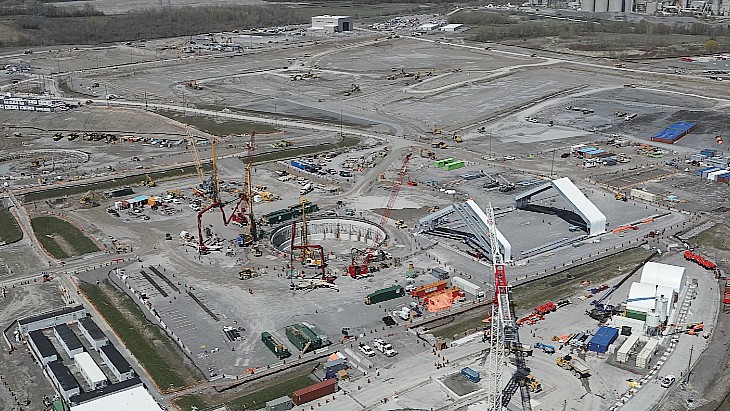
The Darlington New Nuclear Project site is alongside the existing Darlington Nuclear Generating Station (Image: OPG)
Firstly, what is the project?
The Province of Ontario on 8 May announced its final investment decision to give the green light to Ontario Power Generation (OPG) for construction of what is expected to be the first operating commercial small modular reactor (SMR) in any G7 country. The plan is to eventually have four of GE Vernova Hitachi Nuclear Energy's BWRX-300 SMRs at the site - each able to generate 300 MW, enough to power about 300,000 homes.
What is the small modular reactor chosen?
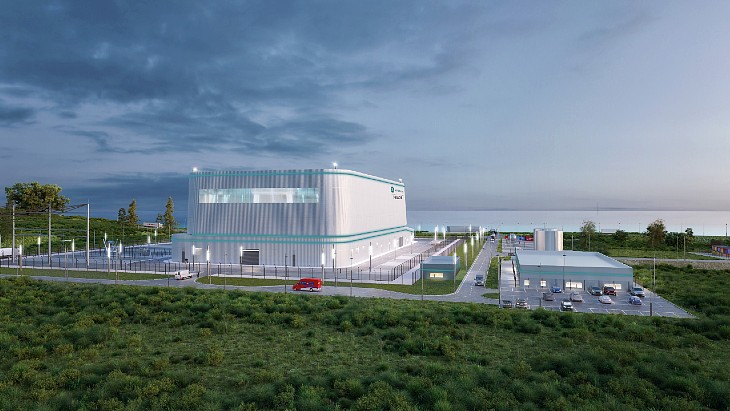
A small modular reactor is widely defined as a nuclear reactor that produces up to about 300 MW - that output is about a third, or a quarter, of the output of the traditional large nuclear power plant. They are called modular because the aim is to be able to factory-produce and preassemble many of the parts on what would effectively be a production line, and then assemble some on-site. They are slated to take up a lot less space than a traditional nuclear power plant - one BWRX-300 reactor and associated building structures takes up about the same space as a football field. Here's a rendering of how one might look:
(Image: GE Vernova Hitachi Nuclear Energy)
The BWRX-300 is a 300 MWe water-cooled, natural circulation SMR with passive safety systems that leverages the design and licensing basis of GE Vernova Hitachi's 1500 MW (ie a traditional large-scale unit) ESBWR boiling water reactor.
How much will the project cost?
The total cost of the four-SMR project is CAD20.9 billion. That's USD15.1 billion, GBP11.2 billion or EUR13.3 billion.
How much will the first SMR cost?
The initial SMR is forecast to cost CAD6.1 billion. In addition, a series of infrastructure and services will be needed to be developed for the site - such as roads, sewers, bridges, ancillary buildings, fibre lines and tunnels for cooling water supplies - which will eventually service all four SMRs. That will cost CAD1.6 billion. So, in total there is a budget of CAD7.7 billion for the first SMR and the shared or common infrastructure.
How final are the estimates for the second, third and fourth SMRs?
OPG says that together with its project partners "it will continue to refine the total estimated project cost during the definition phase of the remaining three units, incorporating lessons learned from the construction of the first SMR", similar to the manner in which the Darlington Refurbishment project is being executed. Planning and licensing efforts are currently taking place for the next three SMRs and the provincial government provided CAD55 million in funding in March to support the development of the plans for these three units.
What does the total project cost estimate include?
OPG says that it includes everything needed to build the new nuclear plant, including licensing, engineering, procurement, construction, operations readiness, contingency, interest and escalation. Often, when discussing or comparing energy generation projects, people refer to 'overnight costs', which is the theoretical cost of constructing a project overnight, so will not include the impact of interest and other charges on the money borrowed to finance a scheme. Some estimates only include costs borne by the technology developer and not the owner's costs. By contrast the Darlington New Nuclear Project estimate of CAD20.9 billion includes all costs, including interest charges and escalation costs. Escalation costs refers to inflation's impacts on equipment and labour costs and has been calculated for the entire 10-year project horizon (including the planning stages).
What about contingency costs?
There is also a contingency element within the project budget, although its size has not been published. This is estimated by identifying known risks and applying a contingency figure to them with OPG saying "over the course of the project, we will use contingency for risk that cannot be fully mitigated. This is an extremely prudent project management approach that includes highly detailed analysis".
How can a budget be solid when it's a first-of-a-kind project?
OPG says that it has taken lessons on board from its Darlington Refurbishment programme, which is in the ninth year of a 10-year execution phase and remains on time and on budget. That project involved the massive refurbishment of four nuclear power units and OPG says it intends to again use the system of "staged execution" to "ensure we can apply learnings from the first unit’s construction to deliver cost and time savings on subsequent units". Refurbishment work on the second unit was completed 250 days faster than the first.
Will this project demonstrate the cost benefits of modularity?
OPG says that the figure for the cost of the first unit is a "release-quality estimate". This basically means it is a well-informed figure with maturity in engineering design, procurement and schedule. The estimates for the second, third and fourth units are not yet as far developed, but see a gradual reduction in costs for each successive unit to CAD4.1 billion (USD2.9 billion) for the fourth unit - that makes it about 33% cheaper than the first unit.
So are they going to be built as four separate projects?
No. The plan is for OPG to build the first-of-a-kind BWRX-300 SMR and learn every lesson they can from the process and then implement the lessons into the subsequent units. The plan is effectively to build the one unit, then develop an optimised plan to build the future units. The remaining three will overlap during construction and be executed as a rolling programme.
What is the timeline for the project?
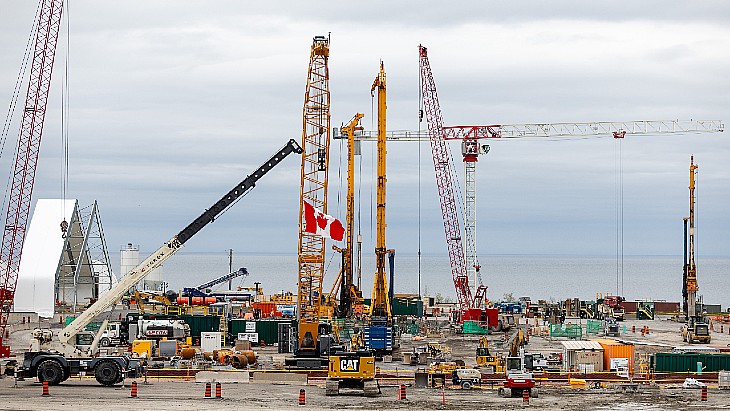
The timeline for the first unit is to complete construction by the end of the decade and in service in 2030. The remaining three units will be completed in the mid-2030s. Preparation work on the site has been advancing for all four units, ahead of the construction go-ahead:
(Image: OPG)
What will be the economic benefits of the new nuclear units?
The Conference Board of Canada estimates that the deployment and operation of the four SMR units will increase Ontario's GDP by CAD35.1 billion (in 2024 dollars) over 65 years and Canada's GDP by CAD38.5 billion. It will also sustain 18,000 jobs during the construction phase and 2,500 jobs over the projected 60 years of operation. The economic multiplier - the ratio of increased GDP to spending - is estimated as 0.91 (so one dollar spent will boost GDP by 91 cents).
What do we know about the cost of the electricity generated?
The Ontario Energy Board will review the recovery of the costs for the project in future proceedings for OPG's regulated prices. The province is exploring potential financial policy tools that would benefit ratepayers, and OPG "continues to explore optimal financing arrangements in support of funding requirements for the planned capital investments". OPG will be recouping the cost of the unit(s) from customers' bills over the 60-year generating life of the units and says the projected cost of about 14.9 cents per kWh would be comparable with alternative renewable energy sources. OPG points to Ontario’s Independent Electricity System Operator evaluating the new nuclear project against viable non-emitting alternatives which found that replacing the project with wind, solar, and battery storage would require 5,600 to 8,900 MW of capacity at a cost of 13.5–18.4 cents per kWh compared with the 14.9 cents.
What are seen as the broader benefits?
Nuclear energy is seen as producing baseload clean energy, without the harmful climate emissions of fossil fuels - and without the land use and new transmission infrastructure requirements associated with alternative renewable energy sources. It produces energy around-the-clock, so can help in terms of energy security for Canada and help power things such as data centres which need huge amounts of reliable energy.
Why is the Canadian project getting so much attention?
In the past decade or two the promise and potential of small modular reactors has been well documented. There are more than 70 different designs in development and numerous projects being proposed. You can check out the projects being proposed on this World Nuclear Association tracker:
By going ahead now with the Darlington project Canada looks set to have the first commercial SMR operating in North America, or anywhere in G7. (Russia and China are in the lead with SMR construction and Argentina has a pilot SMR under construction). Poland, the USA and the UK are among a range of countries currently looking at BWRX-300 deployment. OPG says that "as the first mover on small modular reactors, the Darlington SMR project will create jobs for Canadian workers, contracts for Canada's booming supply chain and showcase Canada's capabilities and expertise to the world to further grow the industry while strengthening Canada's energy security".