Friday, August 29, 2025

Morocco tests floating solar panels to save water, generate power

Tangier (Morocco) (AFP) – Sun-baked Morocco, grappling with its worst drought in decades, has launched a pilot project aimed at slowing water evaporation while simultaneously generating green energy using floating solar panels.


Issued on: 30/08/2025 - FRANCE24

The so-called 'floatovoltaic' panels protect the water surface from the blazing sun and absorb its light to generate electricity © Abdel Majid BZIOUAT / AFP

At a major reservoir near the northern city of Tangier, thousands of so-called "floatovoltaic" panels protect the water's surface from the blazing sun and absorb its light to generate electricity.

Authorities plan to power the neighbouring Tanger Med port complex with the resulting energy, and if it proves a success, the technology could have far wider implications for the North African kingdom.

According to official figures, Morocco's water reserves lost the equivalent of more than 600 Olympic-sized swimming pools every day to evaporation between October 2022 and September 2023.

Over that same period, temperatures averaged 1.8C higher than normal, meaning water evaporated at a higher rate.

Alongside other factors like declining rainfall, this has reduced reservoirs nationwide to about one-third of their capacity.

Water ministry official Yassine Wahbi said the Tangier reservoir loses around 3,000 cubic metres a day to evaporation, but that figure more than doubles in the hot summer months.
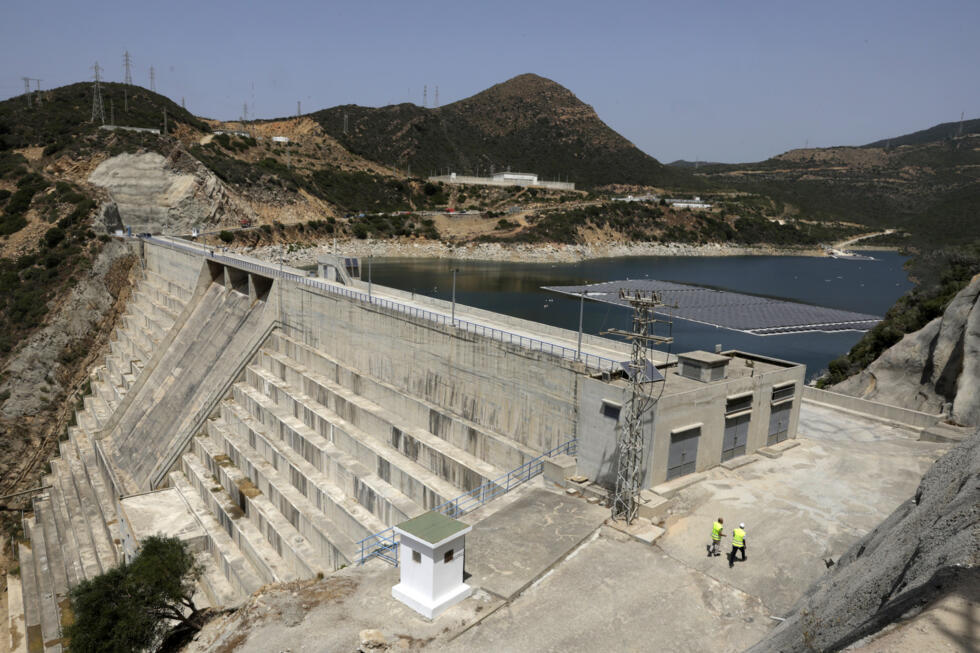
Moroccan authorities hope that the pilot programme could make the drought-hit country better equipped to deal with water scarcity © Abdel Majid BZIOUAT / AFP


The floating photovoltaic panels can help cut evaporation by about 30 percent, he said.

The water ministry has said the floating panels represent "an important gain in a context of increasingly scarce water resources", even if the evaporation they stop is, for now, relatively marginal.

Assessment studies are underway for another two similar projects in Oued El Makhazine, at one of Morocco's largest dams in the north, and in Lalla Takerkoust near Marrakesh.

Similar technology is being tested in France, Indonesia and Thailand, while China already operates some of the world's largest floating solar farms.

'Pioneering'

Since the Moroccan pilot programme began late last year, more than 400 floating platforms supporting several thousand panels have been installed.

The government wants more, planning to reach 22,000 panels that would cover about 10 hectares at the 123-hectare Tangier reservoir.

Once completed, the system would generate roughly 13 megawatts of electricity -- enough to power the Tanger Med complex.
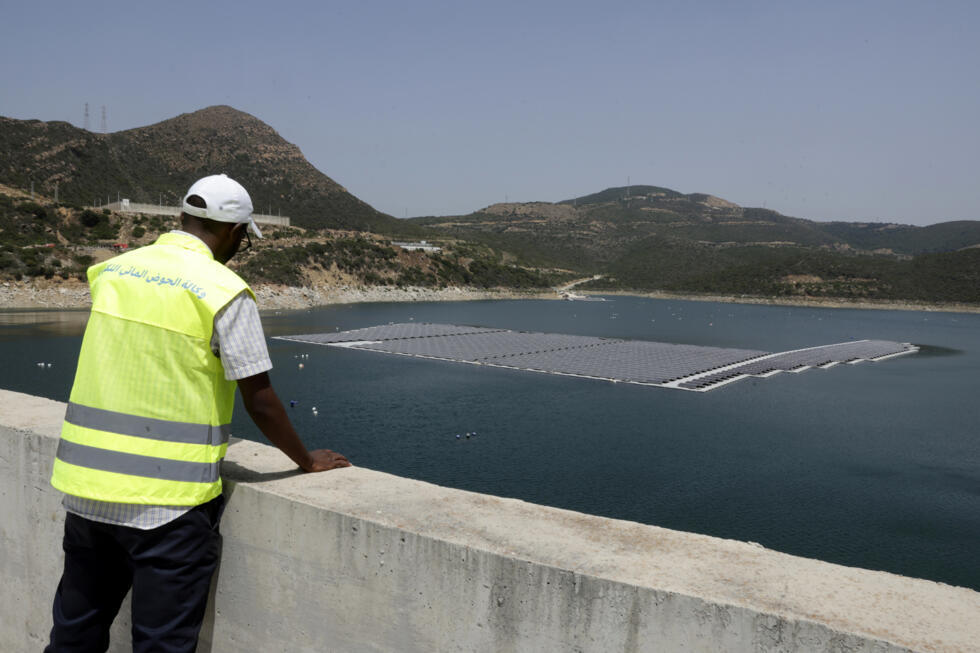
China already operates some of the world's largest floating solar farms, with similar technology being tested in France, Indonesia and Thailand © Abdel Majid BZIOUAT / AFP

Authorities also have plans to plant trees along the banks of the reservoir to reduce winds, believed to exacerbate evaporation.

Climate science professor Mohammed-Said Karrouk called it a "pioneering" project.

He noted, however, that the reservoir is too large and its surface too irregular to cover completely with floating panels, which could be damaged with fluctuating water levels.

Official data shows water reserves fed by rainfall have fallen by nearly 75 percent in the past decade compared with the 1980s, dropping from an annual average of 18 billion cubic metres to only five.

Morocco has so far mainly relied on desalination to combat shortages, producing about 320 million cubic metres of potable water a year.

Authorities aim to expand production to 1.7 billion cubic metres yearly by 2030.

Karrouk said an urgent priority should be transferring surplus water from northern dams to regions in central and southern Morocco that are more impacted by the years-long drought.

The kingdom already has a system dubbed the "water highway" -- a 67-kilometre canal linking the Sebou basin to the capital Rabat -- with plans to expand the network to other dams.

© 2025 AFP

Wagner Russian paramilitary group's troubled legacy in Mali revealed

A new report has cast a harsh light on the Wagner Group's three years in Mali, showing how the Russian mercenary group was a source of instability rather than a solution to the country’s security woes.


Issued on: 29/08/2025 - RFI

Wagner mercenaries pictured in Mali, 2024. © Thomas Coex/AFP


The Russian paramilitary group Wagner has left behind a troubled record in Mali, according to a report published by the United States-based war crimes watchdog The Sentry.

The organisation assessed Wagner’s impact in the Sahel country between January 2022 and June 2025 – when its mercenaries were replaced by the Africa Corps, a new force directly under Moscow’s command.

When the Wagner Group announced its departure earlier this year, it claimed its "mission was accomplished".

However, the report's findings detail three and a half years of insecurity and strategic failure.

Vladimir Putin and Assimi Goita prior to talks at the Kremlin on 23 June, 2025. © AP


'A triple failure'

The report outlines what it calls Wagner’s “triple failure”.

The first is a military one: the Russian fighters proved unable to secure northern and central Mali, despite high expectations from Bamako’s transitional authorities.

Secondly, their arrival coincided with a “significant increase” in attacks against civilians.

And third, far from strengthening ties between the army and local populations, their actions “gravely undermined” confidence, creating fertile ground for jihadist groups to boost recruitment.

Wagner’s presence, the Sentry argues, also destabilised the Malian security apparatus.

“The fighters of Wagner sowed chaos and fear within the military hierarchy,” the report notes, describing a chain of command now plagued by mistrust and poor communication.


Fragile partnership

Speaking to RFI, Justyna Gudzowska, executive director of the Sentry, said Malian authorities turned to Wagner believing the Russian mercenaries would “take greater risks and truly commit to fighting terrorists".

Instead, she explained, “Wagner fighters refused to act without payment, refused to help without financial compensation, and in some cases flatly refused to take risks".

What was intended to be a partnership with the Malian armed forces quickly soured, she said. “Wagner treated Malian soldiers as subordinates, perpetrated grave abuses, and instilled such fear that even Malian troops were afraid to speak out.”

These issues culminated in a decisive defeat in July 2024, when rebels from the Azawad region of northern Mali and jihadists from the al Qaeda-linked JNIM group ambushed Malian and Wagner forces at Tinzaouatène, killing more than 80 Russian mercenaries and around 50 Malian soldiers.

This blow, according to Gudzowska, tarnished Wagner’s reputation well beyond Mali’s borders: “More than a year later, it has still not recovered.”

Five years after the 2020 coup, where is Mali today?

While Wagner has departed and Russia's Africa Corps has stepped into its shoes, Mali’s security crisis shows little sign of abating.

Jihadist groups remain active across wide swathes of the country. Earlier this week, they reportedly seized the strategic town of Farabougou in central Mali, days after forcing the army to abandon one of its largest camps in the region.

JNIM fighters now control the town, imposing their rule on returning residents, including bans on secular music, alcohol and cigarettes.


Bolsonaro coup trial enters final phase as ally Trump watches

Brasília (AFP) – Brazil's far-right former president Jair Bolsonaro will learn soon whether he is headed to prison as his trial on attempted coup charges enters the final stretch despite pressure from his US ally, President Donald Trump.

Issued on: 30/08/2025 - RFI

Former Brazilian leader Jair Bolsonaro risks 40 years in prison if convicted in a trial alleging he attempted a coup © Evaristo SA / AFP/File

On Tuesday, Brazil's Supreme Court will start passing judgement after weeks of hearings that saw witnesses testify about Bolsonaro's alleged involvement in a plot to claw back power after a 2022 election defeat to leftist rival Luiz Inacio Lula da Silva.

The 70-year-old Bolsonaro risks about 40 years in prison, and a guilty verdict will likely end any hopes he had of making a political comeback.

In deeply divided Brazil, the case elicits strong opinions: some hailing it as a defense of democratic norms while others denounce a political show trial.

It has also caused a diplomatic rift with the Trump administration, which punished Brazil with sky-high export tariffs for its "politically motivated persecution" of Bolsonaro.

On Tuesday, the trial's presiding judge Alexandre de Moraes -- who has repeatedly clashed with Bolsonaro in the past -- will start summarizing the evidence in the case.

Five days, spread out over 10 days until September 12, have been set aside for the proceedings.

There will be closing statements by the prosecution and defense before Moraes and four other judges vote, one by one, to convict or acquit Bolsonaro and seven co-accused.

A simple majority of three "yes" votes are needed for a verdict in the first-ever coup trial for a former leader of Brazil, which emerged from two decades of military dictatorship in 1985.

Prosecutors maintain Bolsonaro was aware of plans to assassinate Lula and the judge, Moraes, as part of the comeback plot that would have entailed the declaration of a "state of siege" to allow for new elections to be held.
'Witch hunt'

The former head of state, who served a single term from 2019 to 2022, claims to be the victim of political persecution.

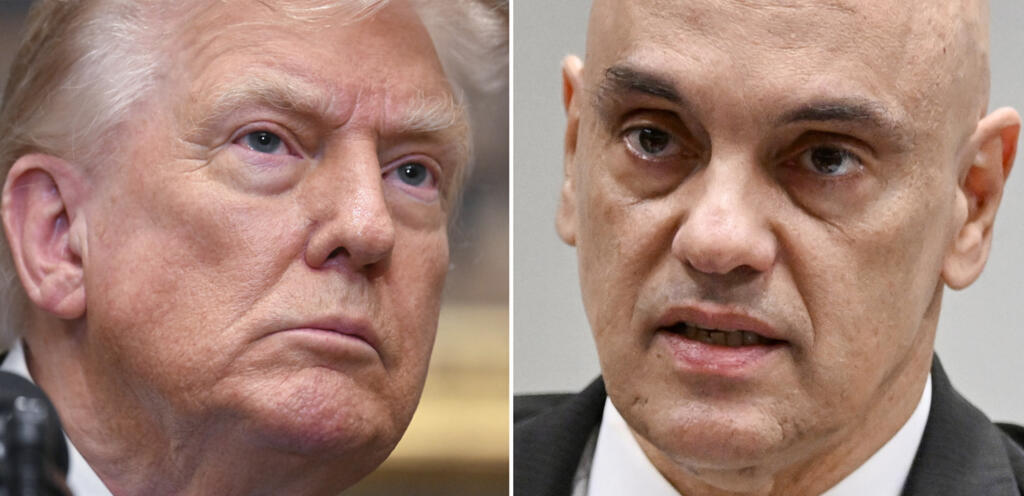
The admininistration of Donald Trump (L) has imposed financial sanctions on Brazilian Supreme Court judge Alexandre de Moraes (R) © Evaristo SA / AFP/File

It is a view shared by Trump, who has denounced a "witch hunt" of his ally and imposed a 50 percent tariff on a variety of exports from Brazil while the US Treasury sanctioned Moraes.

The pressure has done little to alleviate Bolsonaro's plight.

While awaiting the verdict, he has been ordered to wear an electronic bracelet, and was banned from social media and placed under house arrest with round-the-clock surveillance.

He is expected to follow the final phase of the trial from home, according to people close to the former president.

In the event of a guilty verdict, he could be sent to prison right away. He could still appeal.
High stakes

The setting of the trial is symbolic for a country rocked on January 8, 2023 by thousands of Bolsonaro backers violently storming the Supreme Court, presidential palace and parliamentary buildings in Brasilia.

A police officer falls from his horse during clashes with Bolsonaro supporters after an invasion of Planalto Presidential Palace in 2023 © Sergio Lima / AFP/File


The protesters, who left a trail of material destruction in their wake, had urged the military to intervene to unseat Lula, who had assumed office just a week earlier.

Security around the court will be reinforced in the coming days.

Four of the last seven occupants of Brazil's Planalto presidential palace have been convicted, jailed or impeached. Bolsonaro would be the fifth.

The group includes Lula, 79, who was imprisoned for 580 days in 2018 and 2019 on a corruption conviction later overturned for procedural errors.

Regardless of the outcome of his trial, Bolsonaro has been declared ineligible to seek public office until 2030 after being found guilty of spreading disinformation about Brazil's voting system.

Lula has said he will seek another term in elections next year.

© 2025 AFP
DeSADEAN MISOGYNY

Comorian woman says justice minister among men who raped her for years


A young Comorian woman, Raanti A, has spoken to RFI about multiple rapes she alleges she was subjected to by a man she is related to, who she says also invited several other men to sexually abuse her – one of whom she claims is the Comorian minister of justice
.


Issued on: 29/08/2025 - RFI


Raanti A, pictured at home in France in August 2025. © Baptiste Coulon/RFI


Raanti A, who is 27, says she was repeatedly raped between 2018 and 2022 by various men at the invitation of her late father’s cousin – a 47-year-old public servant working at the Ministry of Planning.

One of the men she accuses of participating in the rapes is the Comorian Minister of Justice and Islamic Affairs, Anfani Hamada Bacar.

She told RFI she recognised him last April when she saw that he had been appointed as a minister.

She says this shock led her to file complaints two months later, in June 2025, in both France and in the Comoros.

In these documents, which RFI has seen, Raanti A says that around 10 people subjected her to rape, sexual assault, acts of deliberate violence, false imprisonment, human trafficking and forced abortions.

Bacar told RFI that he knows the victim, but “categorically denies” the rape allegations.

"These allegations are completely false and without any basis. I have no idea what could have motivated this person to accuse me of these alleged rapes," he said in a written response.
'I just had to keep quiet and endure'

Raanti A says that her ordeal began in 2018, when her mother suggested she ask her late father’s cousin for money to pay her university admission fees. The man is regarded as an influential figure in the community. She says she went to meet him at his home.

"He said that he would help me, but that he wanted something in return. Suddenly, he pushed me on to a mattress and positioned himself on top of me. I panicked, I screamed, I cried. He kept saying 'it's going to be OK, relax'," she told RFI. She said he then raped her.

"When I got home, I took a shower immediately and scrubbed my body to try and get rid of his smell," she continued.

She said she attempted suicide the following day.

'A very difficult ordeal': Gisèle Pelicot's statement after mass rape trial

In the complaint registered by the police, Raanti A alleges that he subjected her to several sexual assaults and also handed her over to other men who raped her.

"He would ask people he met by chance or people he knew if they wanted a girl or a woman to have sex with. And most of the time, people accepted," she said.

According to Raanti A, the man was present during the alleged rapes by other men, which she says took place in isolated houses, huts and cars, in the town of Moroni, on the island of Anjouan and in Tanzania.

She also alleges that the man forced her to terminate eight pregnancies resulting from rape, including one at six months that required surgery. Abortion is illegal in the Comoros, except in cases of serious medical reasons confirmed in writing by two doctors.

Raanti A told the police officer who took her statement in France: "It wasn't just sexual violence, it was an attempt to completely dominate my body, my will, my freedom. "

She continued: He deleted my social media accounts, changed my passwords, confiscated my phone and my credit card. Then he forbade me from seeing friends or going to university. I felt possessed. I followed him without asking questions. I had to keep quiet and endure. I think he was afraid I would end up talking about it."

RFI contacted the man several times in order to put the allegations to him, but received no response.

France set to include consent in legal definition of rape
'You're not alone'

Raanti A has lived in France as a refugee since 2022.

After she arrived in the country, she says she moved three times, because the man always managed to track her down. She also alleges that he raped her in France.

On one occasion, French police intervened on grounds of physical assault, but the case did not progress.

She showed RFI two psychological reports from examinations carried out in June and in July, which conclude that she is suffering from "post-traumatic generalised anxiety disorder, which may be linked to the repeated assaults, particularly sexual, that she reports".

After Raanti A filed the complaints, she claims her mother was intimidated into attempting to convince her to withdraw them.

She also says that her partner received messages from an unknown person with offers of €10,000 to take her to Italy.

The lawyer representing her also claims to have been intimidated by "judicial authorities", saying: "Certain people have an interest in seeing this case buried."

Raanti A believes that the case has a better chance of being heard in France than in the Comoros.

She added that her mother and brothers have assured her of their support and that her mother told her: "Do what you can, you're not alone, we must prevent other women from going through what you've been through."

According to the United Nations, 17 percent of women in the Comoros have experienced at least one incident of physical or sexual violence.

This article has been adapted from the original version in French.
Child homelessness soars in France as aid groups denounce political inaction

More than 2,000 children are sleeping rough on the streets of France due to a lack of emergency shelter, new figures show. Aid groups are demanding the government take urgent action.


Issued on: 29/08/2025 - 

A boy holds a survival blanket during a rally organised by the NGO Utopia 56 outside Paris city hall on 5 August 2025, in support of homeless families demanding emergency accommodation. 
AFP - STEPHANE DE SAKUTIN

A report by UNICEF France and the Federation of Solidarity Actors (FAS), a network of organisations supporting homeless and vulnerable people, said child homelessness has risen by 6 percent in a year and 30 percent since 2022.

On 18 August, 2,159 children – including 503 under the age of three – had no place to sleep.


The count is likely an underestimate, as it only covers children whose parents called 115, the emergency number for homeless people.

“There are all kinds of children, but what worries us most is the rising number of very young ones,” said Adeline Hazan, president of UNICEF France, speaking to RFI.

“Between 500 and 600 children are under three, and that number is increasing fast, as is the number of single mothers with children.”

People take part in a rally called by the association Utopia 56 in support of several homeless families outside Paris City Hall, France, Tuesday, 5 August 2025. 
AP - Aurelien Morissard


Need for 'political will'

For 11-year-old Jayyed, who arrived in Lyon from Italy five years ago, life on the streets was a daily struggle. “We slept on bits of cardboard. I had trouble falling asleep, I was afraid we’d be attacked,” he told the French news agency AFP.

“To go to school, I couldn’t take a shower, just wash my hands in fountains.”

His family has since found temporary shelter in a house lent by an association, thanks to the collective Jamais sans toit (Never Without a Roof), a grassroots group in Lyon that campaigns to secure housing for homeless pupils and their families.

Campaigners say many children face similar experiences.

Eléonore Schmitt of the Abbé Pierre Foundation, a leading French housing NGO, told RFI the rise in child homelessness “shows that nothing has been done.

It is obviously a lack of political will. We are calling for strong measures now, because this situation has gone on far too long. Pupils are about to start school and many may spend the entire year without a roof over their heads.”


'Lasting scars'


Child homelessness leaves deep scars. It can lead to delayed schooling, health problems and, in some cases, dropping out altogether. “It’s about their future – and it’s about ours too,” said Juliette Murtin of Jamais sans toit.

Associations are calling on the state to create at least 10,000 new shelter places, including 1,000 for pregnant women and new mothers. The regions of Auvergne-Rhône-Alpes, Occitanie and Île-de-France are among the hardest hit.

The housing ministry has defended its record, saying the number of emergency accommodation places has been stable since 2021 “despite budgetary pressures”. But official reports point to chronic underfunding and weak management.


Europe-wide issue

Across the European Union and the UK, at least 400,000 minors are homeless and millions more live in inadequate housing, according to the European Federation of National Organisations Working with the Homeless (Feantsa).

Unicef says the situation is especially alarming in Britain, Germany and France.

Campaigners stress that solutions exist. “It’s a scandal, but it’s not inevitable,” said Hazan.
French villages rely on bottled water as forever chemicals taint supplies

Towns in rural north-east France have been forced to give up tap water after record levels of toxic “forever chemicals”, or PFAS, were found. Locals are worried about their health, while mayors say they have been left powerless.


Issued on: 29/08/2025 - RFI


With tap water undrinkable, Marion is forced to stock bottled water in her garage. 
© Baptiste Coulon / RFI

For the past six months, 3,500 people in around 20 towns across the Meuse and Ardennes departments have had to rely on bottled water for drinking and cooking.

"I need to buy more, I’m running out," says Marion, a foster carer in Malandry, pointing to four packs of bottled water stacked in her garage.

With the taps off limits, she now stocks up at the supermarket each week.

"I don’t have a choice, especially as I look after very young children. There’s no way I’ll let them drink the tap water," she tells RFI.

In early July, the prefectures of Meuse and Ardennes formally banned tap water after high levels of PFAS (per- and polyfluoroalkyl substances) were found.

An investigation by Disclose and France 3, published 4 July, showed concentrations were three to 27 times higher than the health authority limit of 100 nanograms per litre. The EU plans to impose this limit on 20 types of PFAS from 2026.

PFAS – commonly known as “forever chemicals” because they do not break down naturally – are synthetic compounds used in items as varied as automotive parts and wind turbines, cosmetics and non-stick cookware.

They build up in air, soil, water and the human body. Studies show long-term exposure can affect fertility and raise the risk of certain cancers and other illnesses.


‘Will this make his illness worse?’

"When you choose to live in the countryside, you expect a good quality of life – and then you realise that’s not the case," says Annick, another Malandry resident. She'd never even heard of PFAS before the scandal broke out.

Neither had Aurore, who lives a few streets away. Mother of four children, she's deeply worried about the health risks, particularly for her husband, who has a genetic condition.

"His illness means he’s more prone to developing a tumour in the kidneys and jaw. He’s always drunk tap water. Will this make his genetic condition worse? We just don’t know."

Malandry’s mayor Annick Dufils has recorded contamination three times higher in her local commune than the limit set by the health authorities.

"How can these tiny rural villages be affected like industrial sites?" she asks.

From the high plateaux surrounding the village, there’s no factory in sight – only woodland and maize fields.

On the plateau overlooking Malandry in the Ardennes. © Baptiste Coulon / RFI


The source of the pollution has not yet been confirmed. But local officials suspect the former Stenpa paper mill in Stenay, 15 kilometres from Malandry. Before shutting at the end of 2024, the plant discharged PFAS-contaminated sludge, which was spread on farmland as fertiliser.

Mayors of the affected villages says the sludge spreading began in 1995.

Dufils and Richard Philbiche, mayor of the contaminated commune of Villy, have recovered the spreading plan for 2000-2013. In total, 23,000 tonnes of industrial sludge were to be spread on farmland in Villy and neighbouring Olizy-sur-Chiers "with a limit of 30 tonnes per hectare every three years", says Philbiche.

He shows a satellite photo, taken in June 2000, of a farm plot near Malandry and Villy’s water catchments.

"The little white dots you see are sludge heaps. About 1,500 tonnes. But the plot is only about 10 hectares. With the 30-tonne-per-hectare limit, it should only have held 300 tonnes. So where did the other 1,200 tonnes go?"

The two mayors suspect the sludge was buried, contaminating their water catchments through runoff.


Mayors left to handle the situation

"I was stunned to learn about the pollution, especially as the annual water reports had always been excellent," says Dufils.

The mayor was informed of the contamination on 19 May 2025 after an analysis by the Grand Est Regional Health Agency. A few days later, during a meeting convened by the sub-prefect, Dufils was shocked to discover that PFAS had been "detected in our water by the health authorities since 2016".

The prefectures of Meuse and Ardennes say the health agency carried out "exploratory analysis campaigns" in 2023 and 2024. Tests in Villy in late 2024 confirmed PFAS in the water. "Further investigations" were made in 2024 and 2025. But PFAS monitoring was only added to sanitary checks this year.

"They hid this pollution from us!" says Dufils, adding that she has personally lost confidence in the health authorities.

Mayor Annick Dufils stands in front of the activated carbon filter unit installed in her town's water tower on 21 July. © Baptiste Coulon / RFI

Local officials also feel abandoned since the scandal broke.

"The authorities are leaving it to us to deal with the problem, even though we’re not to blame. But we’re totally powerless," says Philbiche.

Both he and Dufils are legally obliged to provide residents with bottled water. They reimburse households via bank transfer – the equivalent of two litres of water per person per day for the last six months.

In Malandry, that has cost around €3,500 over six months, out of a yearly budget of €200,000. "It’s an enormous expense that wasn’t in our forecasts. There are things we won’t be able to do in the commune because we’ll have to pay for the water," says Dufils.

Her requests for state aid have failed. "The authorities’ recommendation is ‘increase the price of water’. But our residents aren’t going to pay more for water they can’t even drink!" she says.

Other options include finding another water source or linking to a neighbouring commune. But the work is far too expensive.

On 21 July, two activated carbon filtration units were installed in the water towers of Malandry and Haraucourt, about 30 kilometres away. The system traps PFAS particles on carbon surfaces.

The cost of the €20,000 units must be paid by the communes. Early results look promising, but no one knows how long the filters will last.

For now, the mayors are relying on each other. "We’re standing together as mayors affected by this pollution," says Philbiche. He and Dufils are considering legal action.

This article was adapted from the original version in French by Baptiste Coulon
NGOs wary of Norway’s world-first scheme to bury CO2 under the North Sea

Environmental groups are warning that Norway’s Northern Lights project – the world’s first commercial offshore carbon storage scheme – could end up masking continued fossil fuel use. It began operations this week, pumping CO2 into a reservoir deep beneath the North Sea seabed.


Issued on: 29/08/2025  RFI

The liquefied CO2 carrier Northern Pioneer of Northern Lights in Oslo, Norway. 
AFP - STIAN LYSBERG SOLUM

The first injection came from Heidelberg Materials’ cement plant in Brevik, in southeastern Norway.

"We now injected and stored the very first CO2 safely in the reservoir," Northern Lights managing director Tim Heijn said in a statement. "Our ships, facilities and wells are now in operation."

Northern Lights is run by oil companies Equinor, Shell and TotalEnergies.

The scheme collects CO2 from smokestacks across Europe, liquifies it and ships it to the Oygarden terminal near Bergen on Norway’s west coast. From there it is pumped through a 110-kilometre pipeline into a reservoir about 2.6 kilometres beneath the seabed.

The project is intended to stop emissions entering the atmosphere and help limit climate change.

Carbon capture and storage (CCS) is backed by the UN’s Intergovernmental Panel on Climate Change (IPCC) and the International Energy Agency (IEA) as a tool to cut pollution from heavy industries like steel and cement.


A smokescreen?


But environmentalists fear it could become a smokescreen.

"I think it's worrisome because we've previously seen that the oil industry which is a very powerful industry in Norway, has used the carbon capture and storage [to justify] prolonging the extraction of oil and gas," Halvard Raavand, deputy programme manager for Greenpeace Norway, told RFI.

"In itself, storing isn't necessarily bad, but what we've seen so far is that the potential in CCS is overhyped. Even the International Energy Agency has come out and warned against a kind of overoptimism on CCS."

"This cannot end up as a sleeping pill for Norway and other countries when talking about climate action, because what's most urgently needed is just to phase out fossil fuels."

The technology is also complex and costly.

Without subsidies, industries often find it cheaper to buy "pollution permits" on the European carbon market than to pay for capture and storage.
'Costs are huge'

"The costs are huge. At Greenpeace, we think it would be better if this money were invested in real solutions," Raavand said.

"We need more investments in offshore wind power. Especially Norway which has a huge potential."

Northern Lights has signed three commercial contracts so far: with a Yara ammonia plant in the Netherlands, two Orsted biofuel plants in Denmark and a Stockholm Exergi thermal power plant in Sweden.

The project is largely funded by the Norwegian state. Its current storage capacity is 1.5 million tonnes of CO2 a year, with plans to reach five million tonnes by 2030.

Countries including the United States, India and Japan are also moving ahead with carbon capture and storage projects.

(with newswires)
TRUMP TARIFF'S ARE ALL TALK

US appeals court finds Trump's global tariffs illegal

Washington (AFP) – A US appeals court on Friday ruled that many of President Donald Trump's tariffs, which have upended global trade, were illegal -- but allowed them to remain in place for now, giving him time to take the fight to the Supreme Court.


Issued on: 30/08/2025 - RFI

A US appeals court found most of President Donald Trump's tariffs illegal but allowed them to remain in place, allowing parties to take the case to the Supreme Court © Brendan SMIALOWSKI / AFP/File

The 7-4 ruling by the US Court of Appeals for the Federal Circuit affirmed a lower court's finding that Trump had exceeded his authority in tapping emergency economic powers to impose wide-ranging duties.

But the judges allowed the tariffs to stay in place through mid-October -- and Trump swiftly made clear he would put the time to use.


The appeals court "incorrectly said that our Tariffs should be removed, but they know the United States of America will win in the end," he said in a statement on his Truth Social platform lashing out at the ruling.

He added that he would fight back "with the help of the United States Supreme Court."

The decision marks a blow to the president, who has wielded duties as a wide-ranging economic policy tool.

It could also cast doubt over deals Trump has struck with major trading partners such as the European Union, and raised the question of what would happen to the billions of dollars collected by the United States since the tariffs were put in place if the conservative-majority Supreme Court does not back him.

Friday's case, however, does not deal with sector-specific tariffs that the Trump administration has also imposed on steel, aluminum, autos and other imports.

- 'Diplomatic embarrassment'-


Since returning to the presidency in January, Trump has invoked the International Emergency Economic Powers Act (IEEPA) to impose "reciprocal" tariffs on almost all US trading partners, with a 10-percent baseline level and higher rates for dozens of economies.

He has invoked similar authorities to slap separate tariffs hitting Mexico, Canada and China over the flow of deadly drugs into the United States.

The Court of International Trade had ruled in May that Trump overstepped his authority with across-the-board global levies, blocking most of the duties from taking effect, but the appeals court later put the ruling on hold to consider the case.

Friday's ruling noted that "the statute bestows significant authority on the President to undertake a number of actions in response to a declared national emergency, but none of these actions explicitly include the power to impose tariffs, duties, or the like, or the power to tax."

It added that it was not addressing if Trump's actions should have been taken as a matter of policy or deciding whether IEEPA authorizes any tariffs at all.

Instead, it sought to resolve the question of whether Trump's "reciprocal" tariffs and those imposed over trafficking were authorized, with the document noting: "We conclude they are not."

In a supplementary filing just hours before the appeals court released its decision, Trump cabinet officials argued that ruling the global tariffs illegal and blocking them would hurt US foreign policy and national security.

"Such a ruling would threaten broader US strategic interests at home and abroad, likely lead to retaliation and the unwinding of agreed-upon deals by foreign-trading partners," wrote Commerce Secretary Howard Lutnick.

Lutnick added that they could also "derail critical ongoing negotiations" with partners.

Treasury Secretary Scott Bessent, meanwhile, warned that suspending the effectiveness of tariffs "would lead to dangerous diplomatic embarrassment."

Several legal challenges have been filed against the tariffs Trump invoked citing emergencies.

If these tariffs are ultimately ruled illegal, companies could possibly seek reimbursements.

© 2025 AFP

MOSCOW BLOG: a tale of two sets of talks

MOSCOW BLOG: a tale of two sets of talks
There are two sets of talks going on at the moment: one where the EU are trying to halt the war in Ukraine; and other one between Putin and Trump where Ukraine plays a very minor role. / bne IntelliNews
By Ben Aris in Berlin August 29, 2025

There are two sets of talks going on at the moment. In one set, Europe is trying to help its ally bring an end to the conflict in Ukraine with a “just peace”, retaining as much of its land as it can and extracting as much money to rebuild its wrecked economy as it can.

In the other set of talks, US President Donald Trump is talking to Russian President Vladimir Putin and Ukraine plays a very minor role.

Since taking office, Trump has cut off all financial aid and stopped weapons deliveries. The only weapons that are being delivered, such as this week’s deal to supply thousands of Extended Range Attack Munition (ERAM) missiles worth over $800mn has only been possible as Denmark, the Netherlands and Norway will pay for them. The US contribution to this deal? To book the mark-up it says it's charging on all weapons sales for Ukraine.

He has made plenty of threats, but he has given Russia “another two weeks” four times this year after making these threats. The Trump administration has imposed no new sanctions or duties on Russia since he became president. Even on Liberation Day when all of America’s trade partners got a minimum 10% duty, Russia was assigned 0%.

Based on his actions, the only reason Trump seems to be participating in the Ukraine peace deal at all, apart from his desire to win a Nobel Peace Prize, is that it gives him leverage over Putin.

For his part, Putin is happy to parley. He has little to lose. If the talks don’t come off, he is winning on the battlefield and Europe has neither the money nor the materiel to force him out of Ukraine without US help. If the talks do come off then he will get most of what he has demanded, including significant sanctions relief and he has already effectively broken up the unipolar world order that he has been complaining about since his Munich Security Conference (MSC) speech in 2007.

The conversation between the two leaders is on-going and friendly. Trump has consistently backed Putin’s position when drawing up his compromises. In his first big push to “broker” a ceasefire, the seven-point “final offer” peace plan presented in April was pretty consistent with most of Putin’s key demands, including giving up sovereignty over the five occupied regions and significant sanctions relief. That was rejected out of hand by Ukrainian President Volodymyr Zelenskiy and his European allies.

Now more details are trickling out of the conversation that Trump and Putin had in Anchorage during the Alaska summit on August 15 and it includes several important items that have little to do with Ukraine. One detail is that they talked about oil and gas details, apparently preparing the way for ExxonMobil to return to the Sakhalin-1 oil project worth billions of dollars to the company. Putin signed off on a decree to make that easier the next day and it has been revealed that the company’s management has already had a secret meeting with the Kremlin earlier this year to work out a blueprint for its return.

Business obviously plays a big part in the largely unspoken Trump agenda. The head of Russia’s sovereign wealth fund Kirill Dmitriev has participated in all the main meetings since the start, despite having zero diplomatic experience, and said after the first meeting in Riyadh in February that he was conducting “a parallel track” of negotiations on business. His counter party, Special Envoy to the Middle East Steve Witkoff, has an almost identical profile to Dmitriev. Witkoff has been heavily criticised for also having zero foreign policy experience, but both men are fund managers, both are experts on the Middle East where they have both done a lot of business and know a lot of the same people. Witkoff has shown himself to be a useless diplomat, but as an interlocutor for Dmitriev on business, he is perfect.

Another detail slipped out this week. Putin and Trump also talked about restarting some of the Cold War-era missile agreements. This is another topic that has little to do with Ukraine and is not amongst the agenda items in the current negotiations on providing Ukraine with security guarantees. But it is a topic close to Putin’s heart and Trump has also expressed what appears to be a genuine interest in reducing the number of nuclear missiles the world has. It appears as if the two will make a serious effort to extend the START missile treaty again when it expires next February.

This is bad news for Kyiv as it suggests he doesn’t care about ending the conflict in Ukraine and that he sees Europe as irrelevant. The big guns of French President Emmanuel Macron, German Chancellor Friedrich Merz and UK Prime Minister Keir Starmer make a lot of bluster, but the bottom line is the EU have been entirely excluded from the ceasefire talks chain so far. Trump is going through the motions because he has to, but when it came to delivering on EU demands at the Alaska summit on August 15, he said no to almost everything.

Trump has conceded that he will “help” Europe with its security guarantees arrangement, but explicitly said no US troops will be involved and what they will get is maybe some satellite intelligence without which the Nato-made missiles won’t work. US Secretary for Defence Pete Hegseth said this week, the US won’t even provide that despite the $825mn ERAM deal which completely relies on US satellite data to work.

Another key EU demand to provide a “backstop” to any security guarantee that the EU signed with Kyiv also got a flat “no” from Trump. Starmer says Europe security deals won’t work without this assurance. Trump is leading Europe up the garden path, while he continues his negotiations with Putin.

“[European leaders] contend that they have been able to get in Trump’s ear and, through the Jedi mind trick of sucking up to him, bend some of his most problematic instincts,” editor-in-chief of Carnegie’s Comments Rym Momtaz wrote in a recent commentary for Carnegie Endowment for International Peace.

“And yet, the overall picture emerging eight months into Trump’s second presidency confirms that on Ukraine and on trade, he is not on the same team as the Europeans.”

Unlike Europe, Trump is not interested in getting a just and lasting peace deal for Ukraine. He is just interested in getting a deal so that he can start the process of rolling back sanctions and setting up companies. The only leverage the EU has over Trump, as he discovered in April when he tried to force his final offer on Zelenskiy, is that the US can’t roll back the sanctions without Europe’s cooperation. But that is not enough leverage for Europe to be able to force any of their demands on the White House.

The upshot is that Europe has become increasingly irrelevant as it is forced to roll over to Trump's demands, just as the leading BRICS countries are standing up to Trump and winning. India and Brazil have both been hit with big tariff increases they are trying to wiggle out of and China has gotten off largely scot-free. Trump’s aggressive action against the BRICS is only likely to drive the members closer together into the increasingly powerful BRICS bloc that has emerged in recent years.

“Instead of finally conquering their naive discomfort with the language of power.. [European leaders] are leaning hard into appeasement and toadying,” says Momtaz. “They call it pragmatism but, compared with how China or India have handled Trump, Brussels and a few European capitals are signalling to their international interlocutors that they are not first-tier players. Not even on trade.”

The truth is that over the last six months there have been two sets of negotiations going on: a public one to try and stop the killing in the wheat fields of the Donbas with a ceasefire; and a secret one where the Trump team are trying to do some big business deals to tap Russia’s cornucopia of raw material riches.

In the new economic paradigm of Trump’s transactional world, who cares about Ukrainian sovereignty? For Trump it's all about Making America Great Again and putting America First and everyone else last.

Russia making steady gains in the battle for the Donbas

Fighting remains fierce. / bne IntelliNews

By bne IntelliNews August 29, 2025

Russian forces have made significant territorial advances across several fronts in eastern Ukraine since July, and the battle for the key logistical hub of Pokrovsk is still raging after the Armed Forces of Ukraine (AFU) threw its elite reserves into the fight to prevent its fall to the Russians.

The tempo of the conflict in Donbas has soared. The Armed Forces of Russia (AFR)'s progress previously measured in metres gave way to breakthroughs measured in kilometres in August, according to battlefield reports and Ukrainian sources.

Along the Pokrovsk axis, what began as a limited push has evolved into a dramatic breach of Ukrainian defensive lines. By mid-August, Russian assault groups were reported to have entered parts of Pokrovsk city and the nearby strategic town of Rodninskoye. Ukrainian sources acknowledged that their infantry presence in the area “has all but collapsed,” with defence efforts increasingly reliant on drone warfare.

Russian forces have been unable to secure Rodninskoye due to intense Ukrainian fire, Kyiv and then an AFU response by deploying all available reserves, including the veteran Azov regiment. According to limited reports, Ukrainian units temporarily unblocked the Dobropolye–Konstantinovka road that supplies the city and partially recaptured nearby towns of Zolotoy Kolodez. However, the situation remains fluid and hard information scarce.

On the Liman and Seversk fronts — located in the northeastern part of Donetsk region in eastern Ukraine, while Pokrovsk lies significantly to the southwest of them – previously considered secondary, Russian forces have pushed up to 4km through heavily forested terrain, aiming to sever supply routes to Liman by capturing key roads north of the Seversky Donets River. The city, with a prewar population of 20,000, had been recaptured by Ukrainian forces in October 2022 but has since been retaken by the AFR.

Further south, the Chasov Yar and Konstantinovka axes have also seen Russian progress. Chasov Yar has reportedly fallen to the AFR and the encirclement of Konstantinovka “from three sides is now largely complete,” according to milbloggers, with advancing units likely to secure the high ground and threaten the city’s last major supply route via Druzhkovka.

In the South Donetsk axis, Russian troops have reportedly pushed across the administrative boundary into the Dnipropetrovsk region for the first time last week, Bankova (Ukraine’s equivalent of the Kremlin) admitted, reducing Ukrainian-held territory to a single small village in the area.

Military experts say Russia’s push into the region has created a buffer zone on the border and that as fighting winds down, the AFR will switch to a more defensive posture along the border.

Peace talks

Putin demanded that Ukraine withdraw its forces from the Donetsk and Luhansk regions during the Alaska summit with US President Donald Trump on August 15, in return for Russia freezing its military positions in the Kherson and Zaporizhzhia regions.

According to sources briefed on the discussion, the Russian president’s offer would see Moscow cease offensive operations in southern Ukraine, while consolidating gains in the Donbas. The demand underscores the Kremlin’s goal of fully occupying of Donbas over advancing across the Dnipro River into western Ukraine.

“Russia remains intent on occupying all of Donbas, while other parts of the front are seemingly less important to Putin,” according to a commentary by Meduza. “The prospect of seizing the city of Zaporizhzhia or the Kherson region now appears to have been set aside.”

Russian forces have seized more than 4,000 square kilometres of entrenched Ukrainian positions in Donetsk and Luhansk. Ukrainian forces continue to hold approximately 6,000 square kilometres of territory in Donbas, but the balance has shifted, says Meduza. Even while diverting major units to address cross-border attacks in Russia’s Kursk region, Moscow has managed to press forward along the key axes in eastern Ukraine.

The land-swap deal suggested by the Kremlin opens up the possibility of a peace deal as it is a narrowing of Russia’s immediate objectives in the war. The future of any negotiation, however, remains contingent on both military dynamics and the form of the security guarantees Ukraine’s western allies propose.