.jpeg)
By Arab News
By Najia Houssari
Lebanon faces growing concern over what officials describe as potential Israeli encroachment onto its offshore energy resources, after the Israeli military published a map extending its buffer zone into the Mediterranean, raising questions about the fate of the Qana gas field.
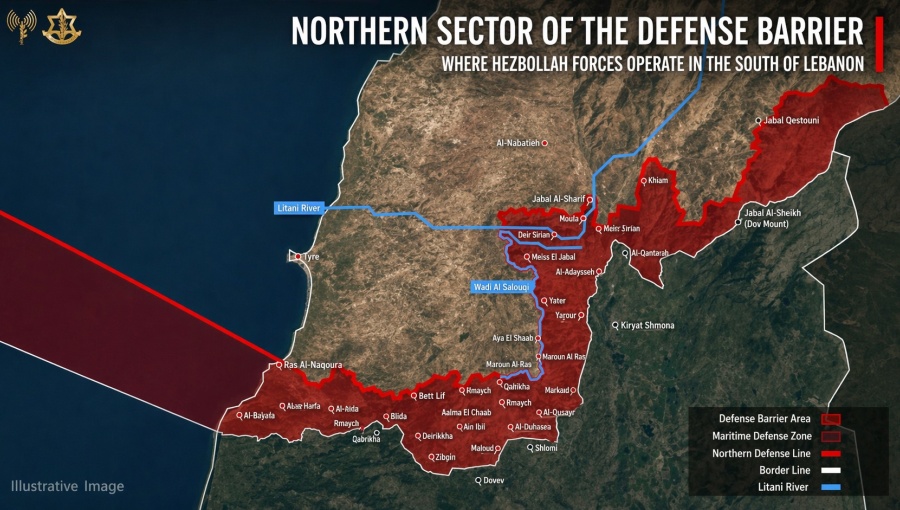
The map, released by the Israeli army on April 19 amid a fragile ceasefire with Hezbollah, outlines the deployment of its forces following their advance into parts of southern Lebanon, which Israel said was intended to prevent direct threats to its northern towns.
Israel’s newly delineated “Yellow Line,” which marks the expanded buffer zone about 5-10 km into Lebanese territory, appeared to extend not only across areas south of the Litani River — where Israeli forces pushed deeper during the recent war — but also into maritime areas, including waters linked to the Qana gas field.
The development has triggered alarm in Beirut, particularly as Lebanon had secured exploration rights in Qana under a US-brokered maritime border agreement with Israel in 2022, following years of complex negotiations.
Analysts and observers warned that Israel’s expansion of its operational map into the sea could signal a shift toward asserting influence over offshore resources, mirroring what they describe on land as the doctrine of “forward defense.”
Lebanon now faces the challenge of how to respond to what it sees as a new threat to its sovereignty both on land and its offshore economic lifeline.
Retired Brig. Gen. Mounir Shehadeh, former head of Lebanon’s Military Court, said Israel would face significant challenges in attempting to control or exploit offshore gas resources.
“Control over gas fields is not that simple. A field is not just a maritime space,” he told Arab News, noting that fields such as Qana (Block 9) require extensive infrastructure, including drilling and production platforms and the involvement of international companies such as TotalEnergies.
He stressed that any temporary military control would not translate into the ability to extract gas or derive economic benefit.
“Maritime operations differ fundamentally from land occupation. Israel may assert military pressure, but it cannot legally operate gas fields unilaterally without the participation of international firms,” Shehadeh said.
Any company working in a disputed area without a formal agreement risks sanctions and legal disputes, he added, warning that the political and financial costs would be considerable.
Israeli Prime Minister Benjamin Netanyahu said he plans to establish a buffer zone extending from Lebanese territorial waters in the south to the Syrian side of Mount Hermon, via its Lebanese slopes.
In Lebanon, officials have described the move as Israel “reshaping the map of the region.”
Shehadeh warned that any attempt to seize Lebanese oil fields would amount to a major regional escalation and a direct threat to the Eastern Mediterranean’s economic infrastructure, one that could spark a far wider confrontation, not a one-off operation.
Addressing whether the maritime border demarcation prevents such a move, Shehadeh said that the 2022 agreement, mediated by US envoy Amos Hochstein, serves as a significant deterrent.
“It clearly defines the maritime boundary, Line 23, and implicitly recognizes Lebanon’s right to develop the Qana field,” he told Arab News.
There is also an indirect mechanism for sharing revenues in the event of a geological extension, but its boundaries remain to be determined.
The agreement, Shehadeh said, is not a full peace treaty, but what prevents military violations depends largely on political balance and deterrence, not just the law.
“To be more precise: the agreement makes it difficult for Israel to act unilaterally, but it does not prevent it on the ground if it decides to escalate.”
Lebanese Minister of Energy and Water Joe Saddi said the Israeli map “does not change any of the facts established by the maritime border demarcation agreement,” and that “the agreement remains in effect, with no official amendment.”
The maritime border demarcation agreement between Lebanon and Israel is legally binding on both signatories and has been registered with the UN.
Lawyer Christina Abi Haidar, an expert in energy and governance law, said it would be illegal for Israel to cancel it unilaterally.
“Legally speaking, any change to the agreement requires the consent of both parties,” she told Arab News. “The agreement also stipulates that any party objecting must file a complaint with the American side, which has not occurred. At this stage, no changes are permissible.”
Israeli Energy Minister Eli Cohen said in mid-March that the Israeli government was considering canceling the maritime border demarcation agreement.
Abi Haidar warned that no company would move forward with drilling operations while the country remains at war.
She said it remains unclear whether Block 9 has been formally awarded to the consortium or approved by the Lebanese government.
“Either way, as long as the country is in a state of war, this is no moment to be talking about investment,” she said.
Even if the fighting ends, any continued Israeli presence in the occupied border strip would require Lebanon to escalate the issue diplomatically, including at the UN and with the US as mediator, she added.
However, Lebanon’s situation is largely without precedent.
“Here you have a country technically at war with Israel, yet one that managed to strike a maritime demarcation deal through American mediation,” she said, pointing out that Israel has not signed the UN Convention on the Law of the Sea — a factor that complicated negotiations and ultimately led Lebanon to accept US involvement in reaching the current arrangement.
Israel, meanwhile, appeared to be seeking to establish a buffer zone stretching from the slopes of Mount Hermon in Syria to Lebanon’s territorial waters, a move that could give it significant leverage in future negotiations over offshore resources.
It also casts a long shadow over the maritime demarcation agreement with Lebanon and the fate of the oil and gas reserves lying beneath the seabed.
Shehadeh dismissed Israel’s Yellow Line as having no legal standing.
“It carries no weight under international law,” he told Arab News.
“It is a military and media tool aimed at creating new realities on the ground and expanding Israel’s room for maneuver.”
He said extending the line into maritime areas suggests an attempt to merge land and sea into a single “operational zone,” calling it a “bargaining tactic” rather than a legitimate claim of sovereignty, and an effort to sidestep the maritime demarcation agreement between the two countries.
On safeguarding Lebanon’s rights, Shehadeh stressed that neither legal measures nor military capabilities alone are sufficient.
“The equation is a mixture of the two,” he said, adding that diplomatic pressure, particularly from the US and Europe, remains essential, given Washington’s role as the agreement’s sponsor.
Shehadeh warned that any targeting of gas infrastructure could provoke a response from Hezbollah, underscoring the need to resolve the issue through agreement rather than force.
“So far, Israel has not completely broken the agreement because it realizes that doing so could trigger a wide confrontation and destabilize its own fields as well,” he said.
While Israel may exert pressure and maneuver politically and militarily, it cannot unilaterally seize or operate Lebanon’s gas resources.
“Lebanon’s real guarantees lie in the presence of international companies, American backing, and a balance of deterrence on the ground,” he added.
In January, before the latest war between Israel and Hezbollah broke out, Lebanon signed an agreement with a consortium comprising French TotalEnergies, QatarEnergy, and Italian Eni to explore for gas in Block 8.
Lebanon has divided its exclusive economic zone into 10 blocks for oil and gas exploration. Seismic surveys have been conducted across most of them, with the exception of Block 8, which lies adjacent to the disputed maritime border with Israel.
According to unofficial estimates, Lebanon’s offshore gas reserves are estimated at 96 trillion cubic feet, and oil reserves at 865 million barrels.
Israel and Lebanon extended their shaky ceasefire by three weeks on Friday, President Donald Trump said, as the US remained at a standstill in negotiations with Iran to end the Middle East war.
Trump announced the truce extension as he met with ambassadors of the two countries and despite recent Israeli strikes in Lebanon and fresh rocket fire from Iran-backed Hezbollah, which was not part of the talks in Washington.
“I think there’s a very good chance of having peace. I think it should be an easy one,” Trump told reporters. The truce had initially been set to expire on Sunday.
Hezbollah reacted dismissively to Trump’s statement, warning that it would respond to any Israeli attacks.
Ali Fayad, an MP for the party, said extending the ceasefire “makes no sense” in light of continued “hostile acts” by Israel, saying they gave “the resistance the right to respond at the appropriate time.”
Israel's Lebanon offensive threatens to unravel US-brokered gas deal and block Beirut's energy future
Israel's military occupation of southern Lebanon is threatening to upend a landmark 2022 US-brokered maritime border agreement and derail Lebanon's best remaining hope of tapping its offshore gas wealth.
On April 19, the Israel Defence Forces published an official Arabic-language map explicitly delineating what it calls a "Forward Maritime Defence Zone" extending diagonally into the Mediterranean from the Lebanese coast.
The map, bearing the IDF emblem and distributed publicly, places the Qana Gas Prospect within the declared zone — making the maritime dimension of Israel's southern Lebanon operation a matter of stated military doctrine rather than analyst inference.
A separate map distributed by researcher Ahmad Baydoun, drawing on IDF, UN and US State Department sources, confirmed that the IDF's declared maritime exclusion boundary runs northwest into the Mediterranean, encompassing the Qana Prospect in Block 9.
The IDF's on-land zone also covers dozens of Lebanese villages named on the official map, including the Christian villages of Rmeish and Ain Ebel, which are clearly labelled within the declared occupation area.
Israel has been explicit that it wants to occupy all of southern Lebanon as part of its Greater Israel project to create a buffer zone on its northern border.
The dry well that isn't the point
The map has been taken by many to infer that Israel is also in annexing gas deposits in the Qana Prospect and not just security issues.
But the energy dimension of Israel's Lebanon occupation is a bit more complicated than that. The Qana Prospect, which sits within the IDF's declared maritime zone, is not a producing gas field. Test drilling some of the blocks has come up dry.
TotalEnergies (NYSE: TTE) drilled in 2023 and found no commercial reserves, abandoning Block 9 entirely.
"There's no gas in the Qana prospect," noted Elai Rettig, an assistant professor in Energy Politics at Bar-Ilan University. "In 2023, TotalEnergies announced it did not find commercial gas reserves in that field and abandoned Block 9 entirely."
However, the same may not be true of Block 8, which lies further northwest of the IDF's published maritime line.
"The more interesting issue is Block 8, which is beyond this map, which Total wants to explore," Rettig added.
In January 2026, TotalEnergies announced it was redirecting its Lebanon exploration efforts to that block.
"Although the drilling of the well Qana 31/1 on Block 9 did not give positive results, we remained committed to pursue our exploration activities in Lebanon," TotalEnergies chief executive Patrick Pouyanné said earlier this year. "We will now focus our efforts on Block 8."
A consortium of TotalEnergies, Eni (BIT: ENI) and QatarEnergy — holding stakes of 35%, 35% and 30% respectively — signed the Block 8 exploration agreement with Lebanon in January 2026 and planned to begin 3D seismic surveys across 1,200 square kilometres.
If Israel moves to formally revise its maritime coordinates back to what is known as Israeli Line 1, a large part of Lebanese Block 8 could fall within disputed territory, effectively sending a warning to the consortium that exploration in parts of the block is untenable.
Lebanese Petroleum Administration president Gaby Daaboul had said Lebanon aimed to "step up exploration and achieve a commercial discovery to boost the economy and support sustainable development."
Energy Minister Joseph Saddi said Lebanon was working on its fourth exploration licensing round before the war started at the end of February. Both statements now look premature.
The 2022 deal under threat
The 2022 US-brokered maritime border agreement was hailed as a diplomatic breakthrough for a region long locked in dispute. Under its terms, Israel obtained full control of the Karish field, while Lebanon received rights to the disputed area including the Qana Prospect — along with recognition that Israel was entitled to royalties on portions of the Qana field that overlapped with Israeli maritime claims.
Now Israel is moving the lines on the maps. The occupation zone now extends into Lebanese territorial waters, cutting approximately nine kilometres into Lebanon's exclusive economic zone according to researchers tracking the boundary.
If Israel formally revises its maritime boundary, Lebanon would retain legal options. Analysts note that in such a scenario Lebanon could demand adoption of Line 29 — the line it had abandoned in 2022 — which would give it the entire Qana area and approximately half of the Karish field. That outcome would represent a significant economic blow to Israel's existing energy infrastructure.
Israel's energy minister Eli Cohen has already signalled interest in revisiting the 2022 agreement, which was signed by the outgoing government of Yair Lapid and has long been contested by the Netanyahu coalition. During the 2022 election campaign, Netanyahu had threatened to "neutralise" the maritime border deal if elected. Now he has boots on the ground in Lebanon, the change in territorial ownership may be simply delivered as a fait accompli as part of the current military operation.
The Gaza precedent
The energy dimension of Israel's Lebanon operations has prompted comparisons to Gaza Marine, the gas field discovered approximately 36 kilometres west of Gaza City in 2000.
Containing an estimated 28.3 to 39.6bn cubic metres of natural gas, it has been stalled for decades. The field is owned by the Palestine Investment Fund and Consolidated Contractors Company. Although Israel approved its development in June 2023, ongoing conflict has rendered any near-term exploitation impossible, and Palestinian access to the resource remains effectively blocked by Israeli security control over the maritime area.
Israel and Cyprus have made major offshore gas discoveries in the eastern Mediterranean — including the Leviathan and Aphrodite fields — highlighting the region's geological potential and the enormous value of controlling maritime territory in these waters. The question now being asked in Beirut, Paris and Doha is whether Lebanon will ever be permitted to join them.
Israel's military occupation of southern Lebanon is threatening to upend a landmark 2022 US-brokered maritime border agreement and derail Lebanon's best remaining hope of tapping its offshore gas wealth.
On April 19, the Israel Defence Forces published an official Arabic-language map explicitly delineating what it calls a "Forward Maritime Defence Zone" extending diagonally into the Mediterranean from the Lebanese coast.
The map, bearing the IDF emblem and distributed publicly, places the Qana Gas Prospect within the declared zone — making the maritime dimension of Israel's southern Lebanon operation a matter of stated military doctrine rather than analyst inference.
A separate map distributed by researcher Ahmad Baydoun, drawing on IDF, UN and US State Department sources, confirmed that the IDF's declared maritime exclusion boundary runs northwest into the Mediterranean, encompassing the Qana Prospect in Block 9.
The IDF's on-land zone also covers dozens of Lebanese villages named on the official map, including the Christian villages of Rmeish and Ain Ebel, which are clearly labelled within the declared occupation area.
Israel has been explicit that it wants to occupy all of southern Lebanon as part of its Greater Israel project to create a buffer zone on its northern border.
The dry well that isn't the point
The map has been taken by many to infer that Israel is also in annexing gas deposits in the Qana Prospect and not just security issues.
But the energy dimension of Israel's Lebanon occupation is a bit more complicated than that. The Qana Prospect, which sits within the IDF's declared maritime zone, is not a producing gas field. Test drilling some of the blocks has come up dry.
TotalEnergies (NYSE: TTE) drilled in 2023 and found no commercial reserves, abandoning Block 9 entirely.
"There's no gas in the Qana prospect," noted Elai Rettig, an assistant professor in Energy Politics at Bar-Ilan University. "In 2023, TotalEnergies announced it did not find commercial gas reserves in that field and abandoned Block 9 entirely."
However, the same may not be true of Block 8, which lies further northwest of the IDF's published maritime line.
"The more interesting issue is Block 8, which is beyond this map, which Total wants to explore," Rettig added.
In January 2026, TotalEnergies announced it was redirecting its Lebanon exploration efforts to that block.
"Although the drilling of the well Qana 31/1 on Block 9 did not give positive results, we remained committed to pursue our exploration activities in Lebanon," TotalEnergies chief executive Patrick Pouyanné said earlier this year. "We will now focus our efforts on Block 8."
A consortium of TotalEnergies, Eni (BIT: ENI) and QatarEnergy — holding stakes of 35%, 35% and 30% respectively — signed the Block 8 exploration agreement with Lebanon in January 2026 and planned to begin 3D seismic surveys across 1,200 square kilometres.
If Israel moves to formally revise its maritime coordinates back to what is known as Israeli Line 1, a large part of Lebanese Block 8 could fall within disputed territory, effectively sending a warning to the consortium that exploration in parts of the block is untenable.
Lebanese Petroleum Administration president Gaby Daaboul had said Lebanon aimed to "step up exploration and achieve a commercial discovery to boost the economy and support sustainable development."
Energy Minister Joseph Saddi said Lebanon was working on its fourth exploration licensing round before the war started at the end of February. Both statements now look premature.
The 2022 deal under threat
The 2022 US-brokered maritime border agreement was hailed as a diplomatic breakthrough for a region long locked in dispute. Under its terms, Israel obtained full control of the Karish field, while Lebanon received rights to the disputed area including the Qana Prospect — along with recognition that Israel was entitled to royalties on portions of the Qana field that overlapped with Israeli maritime claims.
Now Israel is moving the lines on the maps. The occupation zone now extends into Lebanese territorial waters, cutting approximately nine kilometres into Lebanon's exclusive economic zone according to researchers tracking the boundary.
If Israel formally revises its maritime boundary, Lebanon would retain legal options. Analysts note that in such a scenario Lebanon could demand adoption of Line 29 — the line it had abandoned in 2022 — which would give it the entire Qana area and approximately half of the Karish field. That outcome would represent a significant economic blow to Israel's existing energy infrastructure.
Israel's energy minister Eli Cohen has already signalled interest in revisiting the 2022 agreement, which was signed by the outgoing government of Yair Lapid and has long been contested by the Netanyahu coalition. During the 2022 election campaign, Netanyahu had threatened to "neutralise" the maritime border deal if elected. Now he has boots on the ground in Lebanon, the change in territorial ownership may be simply delivered as a fait accompli as part of the current military operation.
The Gaza precedent
The energy dimension of Israel's Lebanon operations has prompted comparisons to Gaza Marine, the gas field discovered approximately 36 kilometres west of Gaza City in 2000.
Containing an estimated 28.3 to 39.6bn cubic metres of natural gas, it has been stalled for decades. The field is owned by the Palestine Investment Fund and Consolidated Contractors Company. Although Israel approved its development in June 2023, ongoing conflict has rendered any near-term exploitation impossible, and Palestinian access to the resource remains effectively blocked by Israeli security control over the maritime area.
Israel and Cyprus have made major offshore gas discoveries in the eastern Mediterranean — including the Leviathan and Aphrodite fields — highlighting the region's geological potential and the enormous value of controlling maritime territory in these waters. The question now being asked in Beirut, Paris and Doha is whether Lebanon will ever be permitted to join them.
Israel’s security buffer zone in southern Lebanon is supposed to be a shield against Hezbollah missile and drone attacks that have battered its northern communities for months. But even if the IDF occupies the entire territory that won’t protect it from attack by fibre-optic drones.
The US-Israeli coalition appears to have learnt nothing from the conflict in Ukraine that has seen the rapid development of drone warfare. Traditional air defences have proven ineffective against drone swarms in the asymmetric warfare tactics that has changed the face of modern warfare. Israel may have more sophisticated US-made interceptor missiles but facing swarms of some 200 drones or more for each interceptor missile, defences are easily overwhelmed.
The fibre-optic -controlled drones, reportedly made in Ukraine, are even more deadly. Developed by Russia before being adopted by the Armed Forces of Ukraine (AFU), the fibre-optic control wires mean these drones are totally impervious to electronic warfare (EW) countermeasures. The only way to stop them is to shoot down each drone individually, one-by-one.
Ukraine supply controversial
Hezbollah is now deploying these fibre-optic controlled drones and Israeli newspaper Haaretz claims they are Ukraine-made, but there is no confirmation.
They could also be Russian-made, produced in the upgraded Iranian factories or domestically assembled by Hezbollah itself. As IntelliNews reported, the members of the CRINK alliance (China, Russia, Iran and North Korea) have been sharing military technology with Iran, which in turn may be passing this technology to its regional proxies. Iran has long armed Hezbollah to act as its proxy in Lebanon.
Ukraine has sent advisors to Gulf states contending with Iranian Shahed drones, demonstrating it is willing to share drone expertise. However, there is no confirmed evidence of Ukraine supplying drones or components directly to Hezbollah, which would be politically extraordinary, given Ukraine's dependence on Israeli-aligned Western support.
On March 27, Andriy Kovalenko, head of Ukraine's Centre for Countering Disinformation, stated there was "information that the proxies may be receiving assistance from Russians, including instructors from the Wagner PMC," adding that "the more active use of FPV drones by Iranian proxies points to deeper Russian involvement, which may include providing instructors and mercenaries."
He was careful to frame this as an assessment rather than a proven fact The Times of Israel reported.
The Knyaz Vandal Novgorodsky fibre-optic FPV drone, built by Russian volunteers, was first deployed in Russia's Kursk region to counter Ukrainian incursions in August 2024, with elite Russian fibre-optic units achieving ranges of 20-30km by late 2024. Russia has both the technology and the motive to transfer it to Hezbollah via Iran.
It is also not unlikely that Hezbollah has been given the technology to assemble the drones itself. Hezbollah operatives already assemble FPV drones using components purchasable online or produced with 3D printers, with warheads based on RPG charges or grenades. This has been confirmed by multiple sources.
The technology is clearly Ukrainian/Russian in origin, but the fibre-optic drones could be homemade on a small scale in kitchen factories, similar to how Ukraine produced drones in the earlier stages of its war with Russia.
This week, the IDF released a map of its intended occupation zone, that includes all of southern Lebanon up to the Litani River and beyond, that it has dubbed the “Forward Maritime Defence Zone” that includes a block extending into the sea that includes offshore gas fields.
Within days of that declaration, the fibre-optic technology, refined on the battlefields of Ukraine, was already demonstrating why the zone may offer less protection than its architects had hoped.
Writing in Haaretz, a left-leaning Israeli publication that has been critical of Israel’s military campaigns in Lebanon and Gaza, defence analyst Oded Yaron argues that fibre-optic guided drones — cheap, precise, jam-resistant and with rapidly increasing range — are being transferring from Ukraine to Lebanon at a pace that the Israeli defence establishment did not anticipate and has not yet solved.
"Over the past three years, while Israel has been absorbed in its own wars, the drone revolution in Ukraine has advanced at a breakneck pace," Yaron writes. "But in the latest round of fighting with Hezbollah, something changed."
The technology
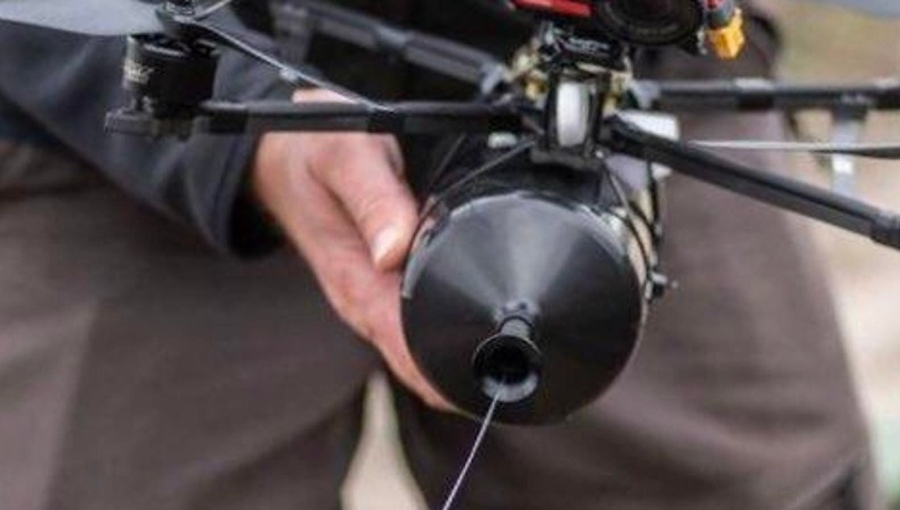
The fibre-optic drone is a first-person view (FPV) drone guided not by radio signal but by a spool of ultra-thin cable that unspools as the drone flies, maintaining a direct physical connection between the operator and the aircraft. That cable — which can extend up to 10 to 20km— makes the drone completely invulnerable to electronic warfare jamming systems, which have no effect on a physical connection. Radio-controlled drones can be detected by radar and jammed; fibre-optic drones cannot.
Electronic spoofing was effective against Iranian-made drones in the 12-day war between Iran and Israel last summer, but Tehran learnt its lessons from that conflict. It has abandoned using the US-controlled GPS satellite system since then and switched to China’s BeiDou satellite navigation system that has made its drones impervious to Israeli EW countermeasures and a lot more accurate, allowing these drones to penetrate Israel’s famed Iron Dome defences. The introduction of Russia/Ukraine style fibre-optic drones would represent another innovation lifted from the war in Ukraine against which Israel or America have not developed any effective defences.
The number of reported FPV assault drones attacks using optical fibres has escalated dramatically in just the last few weeks, The Jerusalem Post reported, citing Israeli defence officials.
The drones are also cheaply made using 3D printers and armed with RPG charges or grenades. Their affordability gives Hezbollah an practical way to attack Israel and negates the advantage Israel has with a much larger defence budget. This is an entirely different economic proposition from the anti-tank missiles the IDF's buffer zone was principally designed to defeat.
Both Israel and the US have armed themselves for the wrong war. The Russian-made Kornet missiles, which generally require a relatively direct line of sight, and Iranian-made Almas missiles, typically limited to a range of around eight kilometres, cost tens of thousands of dollars per unit and require supply chains that run through Iran. Drones have no such constraints.
Hezbollah has released dozens of videos of assault drones striking Israeli armoured vehicles and military installations, including Merkava Mk.4 tanks, a D9 Caterpillar armoured bulldozer, and what appears to be a rare Namer heavy infantry fighting vehicle. In early report as the IDF moved into Lebanon, Hezbollah reported it destroyed over 20 Merkava tanks in a single day in a move that echoes the early days of the Ukraine conflict when small teams of Armed Forces of Ukraine (AFU) armed with US-made Javelin shoulder launched missiles destroyed Russian tanks with impunity.
Nevertheless, the technology arrived in Lebanon via a well-documented route. There are indications that Hezbollah has learned from Russian and Ukrainian experience in utilising fibre-optic guided drones to evade Israeli electronic interference, fuelling speculation that a sharing of experience between Hezbollah and Russian forces may have taken place.
"Military commanders believe 2025 is the 'year of the fiber-drone,'" with Ukrainian officers describing the current goal as increasing their range even further, with some spools already reaching beyond 20 kilometres, Yaron claims,
Fiber-optic -controlled drones are already in use at ranges of 20 to 30 kilometres, and beyond in Ukraine as the drone arms race between Russia and Ukraine continues to unfold.
"Based on past experience, it is likely that long-range fibre-optic drones will soon reach this region as well," Yaron writes. That trajectory points to a weapon that could strike Israeli targets from positions well behind the forward defence line — negating the strategic geography on which the buffer zone is premised.
The widespread use of drones in Lebanon could be a gamechanger. The Ukraine conflict has already shown that a smaller, weaker army can effectively bog down a much larger and heavily armed invading force and make infantry advances impossible. While the Armed Forces of Russia (AFR) outguns and outmans the AFU, as drones have a 50% kill-rate, following through on assault with infantry advances to occupy territory becomes impossible, as was illustrated in the recent battle of Pokrovsk in Ukraine, where the AFR took the city but has been unable to occupy it due to constant at-distance deadly drone attacks on its men.
The buffer zone's logic — and its limits
Israel's Defence Minister Israel Katz described the security zone last week as "extending 10km from the border to the 'anti-tank line,' stretching from the Mediterranean coast in the west to the Mount Hermon area in the east, in order to remove infiltration threats and defend against direct fire on communities."
Katz’s remarks highlight that the IDF is still thinking in terms of countering anti-tank missiles and has not taken into account the threat of Hezbollah’s drones. Ukraine’s European allies made a similar mistake when they finally supplied the AFU with Germany’s state-of-the-art Leopard II tanks that were supposed to be a gamechanger in that conflict. However, the Leopards proved to be ineffective as they were overwhelmed by Russia drone swarms and since have been held in the rear. One destroyed Leopard tank is currently on display on Red Square in Moscow to rub the point in.
The IDF has acknowledged that Hezbollah likely possesses more advanced versions of its anti-tank missiles, with ranges of up to 16km and the ability to overcome line-of-sight limitations. The buffer zone was calibrated with those weapons in mind. But drones threaten to turn the whole of southern Lebanon into a kill-zone for the IDF.
The effective operating range for a fibre-optic drone is about 20km which has created a no-go zone of those dimensions along the Russian/Ukraine line of contact in Donbas. The distance between the Israel-Lebanon border, the Blue Line, and the Litani River, is between 20-30km, increasing to 30-35km at its widest point at the eastern end. That puts almost the entire Forward Maritime Defence Zone within effective drone range – deadly drones that can be operated by small teams hidden in positions tens of kilometres away from their targets. A Hezbollah unit positioned north of the occupied buffer zone could, in principle, fly a fibre-optic drone south across the line of contact and strike Israeli targets with precision at will.
"The implication is that Hezbollah could soon possess a cheap, flexible and precise weapon, resistant to electronic warfare, capable of 'leapfrogging' the 'anti-tank line' in southern Lebanon," Yaron concludes.
Israel's response
The Israeli defence establishment is aware of the problem. The IDF has moved to purchase thousands of FPV drones of its own as drone warfare reshapes the battlefield, but it is still playing catch-up.
Israeli defence companies are simultaneously developing dedicated interception and protection solutions for fibre-optic threats, though no system has yet demonstrated reliable operational effectiveness against them.
Ukraine has made the most progress in dealing with the problem and has developed a new family of interceptor drones that it has been rolling out this year, but it is also locked in an arm race with Russia, which continues to develop its own counters. For example, Russia has recently rolled out the Geran-5 jet powered drone that doesn’t rely on fibre-optic control, but travels so fast it is almost impossible to stop, and has an upgraded electronic guidance and communication system that makes it largely impervious to EW countermeasures.
Fibre-optic drones are cheap enough to be produced in volume by a non-state actor, require no sophisticated supply chain beyond commercially available components, and cannot be neutralised by the electronic warfare systems in which Israel has invested heavily.
Former Ukraine commander-in-chief General Valerii Zaluzhnyi summed up the changes in modern warfare in a recent opinion piece: “The large-scale changes that have occurred on the battlefields of the Russian-Ukrainian war have changed the paradigm of how warfare is waged… Today, in a relatively cheap way, any country can have combat capabilities that completely outstrip its economic or demographic situation if there is a desire and political will for it.”
Israeli strikes kill 5 in Lebanon, Beirut to seek truce extension
ByAFP
April 22, 2026
Rescue teams work to remove the rubble of a building hit by the Israeli army in the southern Lebanese village of Hanaouay - Copyright AFP Kawnat HAJU
Israeli strikes killed five people, including a journalist, and wounded another in Lebanon on Wednesday, despite an ongoing ceasefire that Beirut will request an extension for in upcoming talks with Israel in Washington.
Ahead of the talks on Thursday, Israel called on the Lebanese government to “work together” with it against Iran-backed militant group Hezbollah.
The two governments, which do not have diplomatic relations with each other, are set to hold a second round of talks under US auspices on Thursday, in a bid to end more than six weeks of fighting between Israel and Hezbollah that began on March 2.
Lebanon will request a one-month extension of the ceasefire during the meeting with Israel, a Lebanese official told AFP.
“Lebanon will request an extension of the truce for one month, an end of Israel’s bombing and destruction in the areas where it is present, and a commitment to the ceasefire,” the Lebanese official told AFP, on condition of anonymity given the sensitive nature of the talks.
The 10-day ceasefire, which expires Sunday, was announced after an initial meeting last week.
Lebanese President Joseph Aoun, for his part, said that “contacts are underway to extend the ceasefire period”.
Israeli Foreign Minister Gideon Saar said Israel does not have any “serious disagreements” with Lebanon.
“Unfortunately, Lebanon is a failed state, a state that is de facto under Iranian occupation through Hezbollah,” he said.
Hezbollah, which is represented in the Lebanese cabinet and parliament, strongly opposes the direct talks with Israel pushed by Aoun and Prime Minister Nawaf Salam.
A Hezbollah lawmaker, however, told AFP on Monday that the group might accept indirect talks mediated by the United States.
“The obstacle to peace and normalisation between the (two) countries is one — Hezbollah,” said Saar.
– ‘Serious disagreements’ –
Israeli attacks on Lebanon have killed at least 2,454 people since the start of the war, according to Lebanese authorities.
On Wednesday, the state’s scientific research council estimated that more than 50,000 housing units had been damaged or destroyed by the war.
Israeli forces remain in dozens of southern villages, behind what the army has called a “Yellow Line”, described by the Israelis as a 10-kilometre (six-mile) deep “security zone” along the border in southern Lebanon.
Despite the truce, Israel is continuing its strikes in Lebanon.
Lebanese rescuers said an Israeli strike killed journalist Amal Khalil on Wednesday.
Before rescuers had found her body, Lebanon’s state media said Israeli strikes had killed four people in the south and east of the country.
Khalil’s employer, Lebanese daily newspaper Al-Akhbar, also announced her death and said fellow journalist Zeinab Faraj was wounded.
The health ministry said Faraj was transported to hospital.
Lebanon’s Information Minister Paul Morcos said on X that Khalil “was targeted by the Israeli army while carrying out her professional duty”.
The Israeli army said in a statement it had “identified two vehicles in southern Lebanon that had departed from a military structure used by Hezbollah”.
“After identifying the individuals as violating the ceasefire understandings and posing an imminent threat, the Israeli Air Force struck one of the vehicles. Subsequently, the structure from which the individuals had fled was also struck.”
Hezbollah issued four statements on Wednesday saying it had struck Israeli targets in south Lebanon, “in response to the Israeli enemy’s violation of the ceasefire”.
French President Emmanuel Macron said on Wednesday that a second French soldier died “of the consequences of his wounds” suffered in a weekend ambush against UN peacekeepers in Lebanon blamed on Hezbollah, which has denied responsibility.

No comments:
Post a Comment