Sunday, September 07, 2025

Labor Day 2025: What’s Next for Unions?

Source: Nonprofit Quarterly

As Labor Day comes this year, US workers and the labor movement face a critical juncture.

In some ways, labor is on a roll. Petitions for union elections with the National Labor Relations Board (NLRB) doubled from 2021 to 2025. Workers have formed their first-ever unions at big companies, including AmazonStarbucksTrader Joe’s, and REI. And people in the United States support unions more now than they have in decades: 70 percent of those surveyed in a Gallup poll approve of labor unions, the highest since 1965. A recent report by the Economic Policy Institute (EPI) found a rise in the number of US workers who are curious about unions and fewer who were explicitly opposed. Research also suggests that as many as 60 million of US workers would join unions if they could.

Yet unionization rates are still declining.

The state of the labor movement has repercussions for the entire country.

Overall, 9.9 percent of US workers in 2024 were union members, with the private sector membership at 5.9 percent. The fact is that organizing a union remains risky. A few years ago, an EPI report found that pro-union workers were illegally fired in nearly one in five union election campaigns. Even when workers vote in favor of a union, management recalcitrance often impedes them from securing a first contract. For example, workers at the big companies mentioned above are all still negotiating their first contracts.

Meanwhile, the labor movement is also staring down threats to long-held institutional protections for working people. For instance, SpaceX, Trader Joe’s, and Starbucks have filed lawsuits in an effort to get the US Supreme Court to declare the National Labor Relations Act—the foundational labor law of 1935—unconstitutional.

So, how can labor turn the tide?

Why Should We Care About Unions?

The roughly 90 percent of US workers who are not union members may wonder why they should be concerned. One reason is that the state of the labor movement has repercussions for the entire country.

Strong unions help create a more equitable economy. This is partially true due to the wage gains that unions help workers obtain, but also because, when union membership rates are high, nonunion workers enjoy higher wages as well, as nonunion employers seek to match the gains that workers at unionized companies receive. Unions are also important political actors that can advance policies to boost workers’ rights and benefits. For example, an academic study from the Swedish Institute for Social Research at Stockholm University found that in US states where unions are strong, paid family leave policies are much more likely to become law.

Unfortunately, the reverse is also true: weaker unions lead to less equitable economies. Nowadays, we are living that reality—US income inequality has been on the rise for more than 40 years. A 2020 study published by RAND estimated that $47 trillion had been transferred from the bottom 90 percent to the top 1 percent from 1985 to 2018.

The share of wealth going to the top 10 percent has climbed since unionization rates began falling in the 1970s. Researchers at EPI found that deunionization was the second most contributing factor in suppressed wage growth and growing inequality in the past four decades, behind only excessive unemployment.

Economic inequality is hurting many families: 42 percent do not have any emergency savings funds, and 40 percent could not cover an emergency cost of $1,000. According to a Pew Research survey, 77 percent of respondents in the United States reported being anxious about finances, and 74 percent believe that their children will be worse off than they are.

Capital Is Highly Organized

The threats facing workers and unions today largely stem from the fact that the business-owning class is highly organized. In the United States, corporations spend approximately $400 million annually on union-busting consultants. It is estimated that these consultants (typically lawyers) are hired in two-thirds of all organizing campaigns.

An ironic result of increased US income inequality is that higher stock values…have enabled union assets to grow rapidly.

Corporations have also sought to circumvent employment law, using “gig workers” both to avoid paying benefit costs and to keep unions out. App-based businesses like Uber rake in billions in revenue generated by gig drivers. The 390,000 drivers who make Amazon’s delivery system function, whose trucks are painted with Amazon’s logo and who wear Amazon logo shirts, are not considered Amazon employees but are employed by “delivery service partners.” Yet Amazon mandates a pace of work so unbearable that many drivers have been reduced to urinating in bottles.

How Can Labor Fight Back and Build Power?

The challenges facing workers and the labor movement are not easy to solve. However, only a highly organized labor movement can help workers win against a highly organized capitalist class, which requires a combination of worker-to-worker organizing, enhanced research capacity, and political movement building.

Each of these themes is discussed below:

  • Organizing: If 60 million US workers want to join unions, unions must meet this demand! This is not a novel concept. In the 1990s, John J. Sweeney, then president of the AFL-CIO, called on unions to devote 30 percent of their resources to new organizing. But most unions did not heed this call.

But could they do so now? An ironic result of increased US income inequality is that higher stock values—an important indicator of capital’s power—have enabled union assets to grow rapidly.

Labor researcher Chris Bohner wrote in Jacobin that unions’ net assets have climbed from $14.4 billion in 2010 to $32.7 billion in 2022. He argues that rather than being invested on Wall Street, these assets should be invested in building union power. For example, Bohner talks about how the United Auto Workers (UAW) was willing to spend $152 million on strike benefits in 2023—more than was spent on union strike benefits by all unions in 2022—to get a better contract for the union’s members. The strike was widely considered a success: Ford workers received a 25 percent wage increase over four and a half years, for example.

The UAW, however, understands that long-term power building requires a larger labor movement, which is why, the following year, it announced a $40 million commitment toward a new organizing drive, focused on electric vehicle plant workers.

In addition to money, unions must consider their organizing methods. In We Are the Union: How Worker-to-Worker Organizing Is Revitalizing Labor and Winning Big, Rutgers Labor Studies Professor Eric Blanc argues for a worker-to-worker organizing model.

Blanc points out to Starbucks Workers United as an example of the power of worker-to-worker organizing. After the first workers voted to unionize two Starbucks stores in Buffalo in 2021, today more than 12,000 workers at 600 stores have joined the union.

The Emergency Workplace Organizing Committee (EWOC)—a project of the Democratic Socialists of America and United Electrical, Radio and Machine Workers of America—offers its own worker-led model, one in which workers who are in the early stages of forming a union can get support from an EWOC volunteer organizer and, later on, help connect organizing drives to national unions. Since its founding in 2020, EWOC has built a network of over 600 volunteer organizers.

Workers’ interests have been ignored in US politics for a long time….which is something labor unions could act on.

  • Research: Research is an important tool for labor unions to better understand how to leverage worker power against employers. Good research allows unions to identify a company’s profit centers, its key relationships, and its reputational pressure points. As Erica Smiley and Daniel Schlademan wrote in NPQ, “Every company has its Achilles’ heel.”

Take, for example, UNITE HERE Local 11’s use of strategic research to support hotel worker strikes in Southern California. First, the union purposefully aligned over 60 hotel contracts to expire in the summer of 2023, giving them a chance to raise the industry standard for hotel workers in the region. The union also identified several shadowy private equity firms that owned many of the hotels.

UNITE HERE Local 11 used this information to both publicly shame the private equity firms and to get public pension funds, many of which have union trustees, to leverage their investment holdings to support hotel workers. The union’s strategic planning and the workers’ brave action paid off in union contracts that raised pay by unprecedented amounts, with many workers receiving $11.25 hourly wage increases.

  • Movement building: Unions must also now contend with what organizing looks like under an increasingly authoritative government. It is unquestionable that, in the short run, the shift of politics at the federal level will make union gains more difficult. Already, the Trump administration has launched a myriad of attacks—including seeking to strip bargaining rights for hundreds of thousands of federal workers, and an unprecedented firing of an NLRB member whose term wasn’t up until 2028.

But the longer-term effect of the nation’s authoritarian turn is far less predictable. To give but one example, today’s Brazilian President, Luiz InĂ¡cio Lula da Silva, was first known for building and leading the metal workers’ union during Brazil’s military dictatorship.

Many union activists will tell you that the best organizer is a bad boss. In other words, draconian anti-worker federal policies could motivate working people to organize and take action. In a joint 2024 article published by Jacobin, Blanc and Bohner pointed out that more workers formed unions under George W. Bush than during  Barack Obama’s administration. This is likely because labor spent more on organizing in those years, they argued.

Fast-forward to 2025, and the Federal Unionist Network (FUN) has risen as an opposition force to Trump’s attack on federal workers. The network has garnered the support of all major federal unions, a notable achievement for a previously fractured segment of the labor movement.

The Best Defense Is a Good Offense

Workers’ interests have been ignored in US politics for a long time. As a recent report by Working Families Power exposed how “the working class is structurally underrepresented,” which is something labor unions could act on.

Even given their historically low numbers, unions still have 14.3 million members, which is no small number. Indeed, that number is 1.5 million more people than the 12.8 million workers that the entire nonprofit sector employs.

Of course, it may feel easier to remain on the defensive, but as Hildy Gottlieb observed back in April, “Making yourself small is rarely a strong long-term strategy.” She was writing about nonprofits, but the same logic applies to the labor movement.

Unions must take bold, strategic action to organize workers and win strong contracts. That is what unions do.

Working people know they are worth more than their bosses give them, and they’re ready to organize to fight for their rights. They need a strong, fighting, and unified labor movement to help them do so.Email

avatar

Bernadette King Fitzsimons is a research analyst at SEIU United Healthcare Workers West and an executive committee member of the Union Co-ops Council of the US Federation of Worker Cooperatives. She writes about labor unions, cooperatives, and connections between the two.


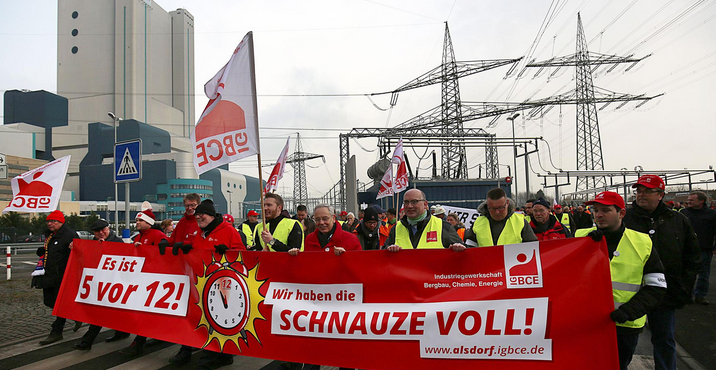
Labor & Capital in Today’s Germany

Source: Originally published by Z. Feel free to share widely.

After more than 200-plus years of capitalism and generations of workers confined to authoritarian work regimes, most workers in Germany have learned (read: learned helplessness) – and/or were successfully conditioned – to accept the managerial regime at work.

From pre-schools with a teacher as boss to kindergarten and schools with the same authoritarian structures, virtually everything in society is geared towards a key message that sustains capitalism: there will always be a boss

To what degree capitalism’s overall message has been accepted by workers, is one of the key findings of a Gallup survey that asked 1,700 workers called “engagement index”. As so often, the survey finds what it was set out to deliver. In general, workers submit themselves to managerial domination.

Meanwhile, many workers aren’t really “enthusiastic” about their work – a rather stable finding during the past decades. Accordingly, the infamous turnover rate – that often serves as an indicator on dissatisfaction – has remained almost unchanged for years.

In other words, many workers in Germany remain loyal to their company and they do so for a long time. Yet, such corporate loyalty can quickly turn into a one-way street as many workers – who were all too readily dismissed only a few years ago in the wake of the COVID-19 pandemic – have, rather painfully, experienced.

Interestingly, a whopping 78% of workers in Germany only go to work “to fulfill their duty”. They follow regulations and rules, “I do it by the book” – they do what they are told and no more. 

Aligned to this, 13% of all workers have already quit internally.” Like Zombies, they are at work while being mentally absent, they follow the rules and do what they are told. 

Otherwise, they are disengaged, they hardly move or move slowly, they are almost unresponsive, they follow a managerially prescribed routine, they blend in, they are virtually present as bodies but only function at the most minimum level.

For capitalism, businesses, zealous HR-manager, line-supervisors, and the eager enforcers of performance management and KPIs, these are worrisome findings. Modern capitalism demands “fully engaged” workers – not the exact opposite.

In other words, a substantial section of the workforce in Germany is practically absent-minded, lethargic and frustrated. Even more worryingly, the study casts no doubt on this. It is a rather unambiguous finding.

For example, the study measures the commitment of workers by whether they have a good friend in the circle of colleagues – many no longer do.

Since the beginning of the 1990s, workers in Germany have always placed job satisfaction at seven – on a scale of zero to ten – a whopping 30% are dissatisfied with what they do.

A similar survey found that less than half of all workers say that they are satisfied with their work. Unsurprisingly, just about 3% were completely dissatisfied with their job. 

In other words, many workers in Germany do sit back but are still somewhat satisfied with the work they have been assigned to do.

Of the roughly 5,000 respondents, just thirty (“30”) workers achieved the maximum value of absolute job satisfaction. This 0.60% is a devastating number as 99.4% are not “totally” happy with what they do.

Only 0.60% stated that they were “always enthusiastic” about the work and “never doubted the importance of the job”

The self-assessment of all respondents on the three work characteristics underlines how uncommitted most workers are to doing their job

  1. Close to 90% of workers are still convinced that they “mostly do a good job”
  2. Almost 43% are not enthusiastic about their job. 
  3. Only ½ feel “energetic at work”.

The analysis of the survey results also shows that workers with commitment to the job depict a low probability of changing jobs in the next two years. This is neither new nor surprising.

It fits in with the known fact that that turnover in Germany has been fluctuating only very slightly during the last 30 years. From this, one can easily imagine that a significant change of personnel takes place in just about one third of all workplaces.

Yet, an increased level of workers wanting to leave their job should have been found. After all, Germany’s much debated skills shortage and the high demand for skilled labor in recent years, should have told workers that Germany’s labor market offers plenty of options.

Yet, even in Germany’s public administration, the turnover remains low. Similar trends can also be found in Germany’s manufacturing industry, such as the metal and electrical industries, for example.

The relative stable bond that German workers still feel towards the company is also reflected in the duration of the employment relationship.

In 2022, workers in Germany had already been working in their current company for an average of about eleven years. Surprisingly, and this is since 2012, the average length of working for the same company has decreased by just 0.4 years. 

For those workers over the age of 50, the average length – in the year 2022 – was still 17 years. In other words, job hopping is not a German virtue.

Meanwhile, one should not forget that – like never before – have so many workers in Germany gone to work with the feeling that they just do their duty, follow the rules, and do what is asked of them.

At the same time, this is spiced up with declining loyalties. The number of “emotionally highly bonded” workers is falling rapidly, reaching only “single digits”.

Simultaneously, a whopping half of all workers (50%) no longer want to be with their current employer – in one year’s time. And, just about a third (34%) want to stay no longer than another three years (it was at 65% in 2018).

Worse, only 34% (a 1/3) of all workers have confidence in their employer’s financial future. And confidence in management has dropped by 20%. Perhaps mismanagement is ripe.

Perhaps, many German managers might still do “something” about demotivation, but way not enough to motivate workers. The result is that many workers just do their job according to the rules

Beyond all that, the current economic crisis in Germany is also affecting the outlook of workers. Simultaneously, attachment to a company, loyalty to the boss, and trust in the financial future of a company have all fallen significantly.

For the first time since 2001, the question of a high significant attachment to a company is in the single-digit range – 9% in 2023 compared to 14% in 2001.

Remarkably, the number of “internal or quiet quitters – the aforementioned Zombies – has reached worrying levels. With 78% of all workers only “working by the book”, never before had Germany seen so many workers in a category that might be described as: “I have switched off”.

Meanwhile, 78% of workers said they have low attachments to work. They tend to work according to the rules”. This phenomenon has reached historic heights.

At the same time, just 9% of all workers in Germany experience a work environment characterized by “good managerial leadership. This is interesting in two respects: 

  1. a change by just one percentage corresponds to over 390,000 workers – these are very serious numbers; and, secondly,
  2. one wonders why just 9% of all German workers see their managerial “leadership” as good when “leadership” has been pushed by CEOs, business schools – including, rafts of professors – the business press, by think tanks, management consultancies, hundreds of academic articles and endless business conferences?

Perhaps not unrelated to bad management, the “internal/quiet quitter” phenomenon is ripe. This has an impact not only on companies, but also on Germany’s economy. The costs incurred as a result of “productivity losses” (read: lost profits) amounts to a total of somewhere between €113bn and €135bn billion for 2024 – roughly $145bn.

In the midst of economic uncertainties sparked by:

  • the Russian war against the Ukraine, 
  • the high cost of energy,
  • the notes shortage of skilled workers,
  • Trump’s daily tariff escapades, 
  • the much-debated labor market shortage, and
  • transformational issues like the move towards a sustainable economy that moves human survival during global warming, at least, into the vicinity of being possible, 

Managerial leadership in Germany remains highly dysfunctional as reflected in the survey. In short, Germany’s corporate bosses and management leaders have continuously failed to create a motivating organizational culture that leads to high loyalty, increases performance and competitiveness. In other words, the acclaimed managerial “leader” has gone AWOL – absent without leave

With management gone AWOL, the loyalty of German workers to companies has further decreased. Only half of all respondents (50%, in the previous year it was still: 53%) intend to be with their current employer in one year’s time. Since 2018, this has continuously gone down by a whopping 28%: in 2018, it was at 78% and today, it is 50%.

In short, bad management and a weak attachment contribute to the willingness to change jobs. Despite the bad news on Germany’s economy in recent months, workers seem to assess their chances on the labor market rather positively.

Most certainly, this has to do with the noted shortage of skilled workers that is debated on an almost daily basis. Not unconnected, a third (33%) of all workers have been offered a job by a headhunter in the last twelve months. In the previous year, the figure was just 25%.

At the same time, trust in companies and managers is declining as well as job satisfaction. This happens in the face of a challenging economic environment. 

For many workers, there is an increasing lack of confidence in the financial future of their current employer. This serves as an indicator of the economic mood in Germany. Many workers notice whether their company, for example, is winning orders, investing or tendering for new jobs. 

In 2019, 49% of all workers in Germany still trusted their managers. This fell to 41% in 2022. It has now fallen by another 20% – to just 21%. In other words, only 1 in 5 workers in Germany still trust their management.

Overall, the survey paints a rather problematic picture of capital and businesses in Germany, today. On the other side, German workers are increasingly dissatisfied with work. And, they are disengaged. Workers simply “switch off” while being physically present at work.

Meanwhile, workers also see that management has failed them – despite the hype about managerial leadership in the past years. While still sticking to their jobs, the willingness to leave is increasing, at least for those workers in areas where the skill shortage is most severe. Add Germany’s demographic changes, the aging society to the mix, and some workers might get closer to balancing the prevailing power asymmetry that defines work in Germany.


avatar

Thomas Klikauer has over 800 publications (including 12 books) and writes regularly for BraveNewEurope (Western Europe), the Barricades (Eastern Europe), Buzzflash (USA), Counterpunch (USA), Countercurrents (India), Tikkun (USA), and ZNet (USA). One of his books is on Managerialism