The Department of War Is Back!
Originally appeared at TomDispatch.
My fellow Americans, my critical voice has finally been heard inside the Oval Office. No, not my voice against the $1.7 trillion this country is planning to spend on new nuclear weapons. No, not my call to cut the Pentagon budget in half. No, not my imprecations against militarism in America. It was a quip of mine that the Department of Defense (DoD) should return to its roots as the War Department, since the U.S. hasn’t known a moment’s peace since before the 9/11 attacks, locked as it’s been into a permanent state of global war, whether against “terror” or for its imperial agendas (or both).
A rebranded Department of War, President Trump recently suggested, simply sounds tougher (and more Trumpian) than “defense.” As is his wont, he blurted out a hard truth as he stated that America must have an offensive military. There was, however, no mention of war bonds or war taxes to pay for such a military. And no mention of a wartime draft or any other meaningful sacrifice by most Americans.
Rebranding the DoD as the Department of War is, Trump suggested, a critical step in returning to a time when America was always winning. I suspect he was referring to World War II. Give him credit, though. He was certainly on target about one thing: since World War II, the United States has had a distinctly victoryless military. Quick: Name one clear triumph in a meaningful war for the United States since 1945. Korea? At best, a stalemate. Vietnam? An utter disaster, a total defeat. Iraq and Afghanistan? Quagmires, debacles that were waged dishonestly and lost for that very reason.
Even the Cold War that this country ostensibly won in 1991 with the collapse of the Soviet Union didn’t lead to the victory Americans thought was coming their way. After much hype about a “new world order” where the U.S. would cash in its peace dividends, the military-industrial-congressional complex found new wars to wage, new threats to meet, even as the events of 9/11 enabled a surge — actually, a gusher — of spending that fed militarism within American culture. The upshot of all that warmongering was a soaring national debt driven by profligate spending. After all, the Iraq and Afghan Wars alone are estimated to have cost us some $8 trillion.
Those disasters (and many more) happened, of course, under the Department of Defense. Imagine that! America was “defending” itself in Vietnam, Afghanistan, Iraq, Libya, Syria, Somalia, and elsewhere, even as those wars killed and wounded significant numbers of our troops while doing far more damage to those on the receiving end of massive American firepower. All this will, I assume, go away with a “new” Department of War. Time to win again! Except, as one Vietnam veteran reminded me, you can’t do a wrong thing the right way. You can’t win wars by fighting for unjust causes, especially in situations where military force simply can’t offer a decisive solution.
It’s going to take more than a rebranded Department of War to fix wanton immorality and strategic stupidity.
We Need a Return of the Vietnam Syndrome
Hey, I’m okay with the Pentagon’s rebranding. War, after all, is what America does. This is a country made by war, a country of macho men hitching up their big boy pants on the world stage, led by the latest (greatest?) secretary of war, “Pomade Pete” Hegseth, whose signature move has been to do pushups with the troops while extolling a “warrior ethos.” Such an ethos, of course, is more consistent with a War Department than a Defense Department, so kudos to him. Too bad it’s inconsistent with a citizen-soldier military that’s supposed to be obedient to and protective of the Constitution. But that’s just a minor detail, right?
Here’s the rub. As Trump and Hegseth have now tacitly admitted, the national security state has never been about “security” for Americans. Rather, it’s existed and continues to exist as a war state in a state of constant war (or preparations for the same), now stuffed to the popping point with more than a trillion dollars yearly in taxpayer funds. And the leaders of that war state — an enormous blood-sucking parasite on society — are never going to admit that it’s in any way too large or overfed, let alone so incompetent as to have been victoryless for the last 80 years of regular war-making.
And count on one grim reality: that war state will always find new enemies to attack, new rivals to deter, new weapons to buy, and a new spectrum of warfare to try to dominate. Venezuela appears to be the latest enemy, China the latest peer rival, hypersonic missiles and drone swarms the new weaponry, and artificial intelligence the new spectrum. For America’s parasitic war state, there will always be more to feed on and to attempt (never very successfully) to dominate.
Mind you, this is exactly what President Dwight D. Eisenhower warned us against in his 1961 Farewell Address. Sixty-plus years ago, Ike could already see that what he was the first to call the military-industrial complex was already too powerful (as the Vietnam War loomed). And of course, it has only grown more powerful since he left office. As Ike also wisely said, only Americans can truly hurt America — notably, I’d add, those Americans who embrace war and the supposed benefits of a warrior ethos instead of democracy and the rule of law.
Again, I’m okay with a War Department. But if we’re reviving older concepts in the name of honesty, what truly needs a new lease on life is the Vietnam Syndrome that, according to President George H.W. Bush, America allegedly got rid of once and for all with a rousing victory against Saddam Hussein’s Iraq in Operation Desert Storm in 1991 (that would prove to be anything but).
That Vietnam Syndrome, you may recall, was an allegedly paralyzing American reluctance to use military force in the aftermath of disastrous interventions in Vietnam, Laos, and Cambodia in the 1960s and early 1970s. According to that narrative, the U.S. government had become too slow, too reluctant, too scarred (or do I mean scared?) to march speedily to war. As President Richard Nixon once said, America must never resemble a “pitiful, helpless giant.” To do so, he insisted, would threaten not just our country but the entire free world (as it was known then). America had to show that, when the chips were down, our leaders were up for going all-in, no matter how bad our cards were vis-à-vis those of our opponents.
If nothing else, no country had more chips than we did when it came to sheer military firepower and a willingness to use it (or so, at least, it seemed to Nixon and crew). A skilled poker player, Nixon was blinded by the belief that the U.S. couldn’t afford to suffer a humiliating loss on the world stage (especially when he was its leader). But the tumult that resulted from the fall of Saigon to communist forces in 1975 taught Americans something, if only temporarily: that one should hasten very slowly to war, a lesson Sparta, the quintessential warrior city-state of Ancient Greece, knew to be the sign of mature wisdom.
Spartan wannabes like Pete Hegseth, with his ostentatious displays of “manliness,” however, fail to understand the warrior ethos they purport to exhibit. Wise warrior-leaders don’t wage war for war’s sake. Considering the horrific costs of war and its inherent unpredictability, sage leaders weigh their options carefully, knowing that wars are always far easier to get into than out of and that they often mutate in dangerously unpredictable ways, leaving those who have survived them to wonder what it was ever all about — why there was so much killing and dying for so little that was faintly meaningful.
What Will Trump’s “Winning” War Department Look Like?
Perhaps Americans got an initial look at Trump’s new “winning” War Department off the coast of Venezuela with what could be the start of a new “drug war” against that country. A boat carrying 11 people, allegedly with fentanyl supplies on board, was obliterated by a U.S. missile in this country’s first “drug war” strike. It was a case where President Trump decided that he was the only judge and jury around and the U.S. military was his executioner. We may never know who was actually on board that boat or what they were doing, questions that undoubtedly matter not a whit to Trump or Hegseth. What mattered to them was sending an ultimate message of toughness, regardless of its naked illegality or its patent stupidity.
Similarly, Trump has put the National Guard on the streets of Washington, D.C., deployed Marines and the National Guard to Los Angeles, and warned of yet more troop deployments to come in Chicago, New Orleans, and elsewhere. Supposedly looking to enforce “law and order,” the president is instead endangering it, while disregarding the 1878 Posse Comitatus Act that prohibits a president from deploying active-duty troops as domestic law enforcers.
If America isn’t a nation of laws, what is it? If the president is a lawbreaker instead of an upholder of those laws, what is he?
Recall that every American servicemember takes a solemn oath to support and defend the Constitution and bear true faith and allegiance to the same. Warriors are driven by something different. Historically, they often just obeyed their chieftain or warlord, killing without thought or mercy. If they were bound by law, it was most often that of the jungle.
Knowingly or unknowingly, that’s exactly the kind of military Pete Hegseth and the new Department of War (and nothing but war) are clearly seeking to create. A force where might makes right (although in our recent history, it’s almost invariably made wrong).
I must admit that, from the recent attack on that boat in the Caribbean to the sending of troops into Washington, I find I’m not faintly surprised by this developing crisis (that’s almost guaranteed to grow ever worse). Remember, after all, that Donald Trump, a distinctly lawless man, boasted during the Republican debate in the 2016 election campaign that the military would follow his orders irrespective of their legality. I wrote then that, with such a response, he had disqualified himself as a candidate for the presidency:
“Trump’s performance last night [3/3/16] reminded me of Richard Nixon’s infamous answer to David Frost about Watergate: ‘When the president does it, that means it’s not illegal.’ No, no, a thousand times no. The president has to obey the law of the land, just as everyone else has to. No person is above the law, an American ideal that Trump seems neither to understand nor to embrace. And that disqualifies him to be president and commander-in-chief.”
If only.
In retrospect, I guess Trump had it right. After all, he’s won the presidency twice, no matter that his kind of “rightness” threatens the very foundations of this country.
So, color me more than worried. In this new (yet surprisingly old) age of a War Department, I see even more possibilities for lawlessness, wanton violence, and summary executions — and, in the end, the defeat of everything that matters, all justified by that eternal cry: “We’re at war.” At which point, I return to war’s miseries and how quickly we humans forget its lessons, no matter how harsh or painful they may be.
Someday, America’s soon-to-be War Department, led by wannabe warrior chieftains Trump and Hegseth, will perhaps seem like the ultimate blowback from this country’s disastrous wars overseas since its name changed to the Defense Department in the wake of World War II. In places like Iraq and Afghanistan, this country allegedly waged war in the name of spreading democracy and freedom. That cause failed and America’s own grip on democracy and freedom only continues to loosen — perhaps fatally so.
In harkening back to a War Department, perhaps Trump is also channeling a nostalgia for the Old West, or at least the myth of it, where justice was served through personal bounties and murderous violence enforced by steely-eyed men wielding steel-blue pistols. Trump’s idea of “justice” does seem to be that of a hanging judge on a “wild” frontier facing hostile “Injuns” of various sorts. For men like Trump, those were the glory days of imperial expansion, never mind all the bodies left in the wake of America’s manifest destiny. If nothing else, that old imperial Department of War certainly knew what it was about.
Whatever else one might expect from America’s “new” Department of War, you can bet your life (or death) on a whole lot of future body bags. Warriors are, of course, okay with this as long as there are more boats to blow up, more people to bomb, and more foreign resources to steal in the pursuit of a “victory” that never actually arrives. So hitch up those big boy pants, grab a rifle or a Hellfire missile, and start killing. After all, in what might be thought of as a distinctly victoryless culture, it seems as if America is destined to be at war forever and a day.
William J. Astore, a retired lieutenant colonel (USAF) and professor of history, is a TomDispatch regular and a senior fellow at the Eisenhower Media Network (EMN), an organization of critical veteran military and national security professionals. His personal substack is Bracing Views. His video testimony for the Merchants of Death Tribunal is available at this link. His new book, made up of the 110 pieces he wrote for TomDispatch, is American Militarism on Steroids: The Military-Industrial Complex, Unbounded, Uncontained, and Undemocratic.
Copyright 2025 William J. Astore
Follow TomDispatch on Twitter and join us on Facebook. Check out the newest Dispatch Books, John Feffer’s new dystopian novel, Songlands (the final one in his Splinterlands series), Beverly Gologorsky’s novel Every Body Has a Story, and Tom Engelhardt’s A Nation Unmade by War, as well as Alfred McCoy’s In the Shadows of the American Century: The Rise and Decline of U.S. Global Power, John Dower’s The Violent American Century: War and Terror Since World War II, and Ann Jones’s They Were Soldiers: How the Wounded Return from America’s Wars: The Untold Story.
Dirty Wars and Endless Lies: Scott Horton’s Shattering History of America’s War on Terror
Scott Horton’s masterpiece “Enough Already” shows how the U.S. and its allies spread devastation through Iraq, Afghanistan, Syria, Yemen, Libya, Somalia, and Pakistan, propping up despots and arming extremists along the way. The final balance sheet: two million dead, thirty-seven million displaced, and a world made more dangerous than before.
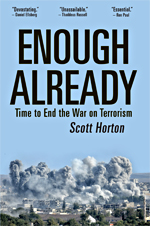 Scott Horton – editor-in-chief of Antiwar.com and host of the legendary Scott Horton Show with over 6,000 interviews – is one of the most profound critics of US foreign policy since 9/11. His fact-filled and compelling 2021 book “Enough Already: Time to End the War on Terror” is one of the most comprehensive accounts of the so-called War on Terror: In a precise chronology, Horton shows how, after the attacks of September 11, the US and its allies unleashed a global spiral of intervention that not only claimed millions of victims but often spawned “wars for terror” itself – through support for radical Islamists in Syria and elsewhere. From the Iraq wars to Afghanistan, Libya, Somalia, and the genocide in Yemen, Horton’s work offers an unflinching overview of the American wars of the 21st century. Anyone who wants to understand why Washington systematically launched wars that strengthened its own enemies after 9/11 cannot ignore this book. It’s an indictment of relentless moral force that reads like an evidence brief for the prosecution. Horton’s central claim is both simple and devastating: the dirty wars in Iraq, Afghanistan, Pakistan, Syria, Yemen, Libya and Somalia increased the terrorist threat that was then used as an excuse for further intervention. Horton’s achievement is to bring into one narrative the scattered fragments of this bloody history: the covert deals, the proxy wars, the torture programs, the sanctions regimes, and the bombings whose scale Western publics still grossly underestimate. He makes clear that the real continuity in U.S. policy was not democracy or human rights, but partnership with Israel’s occupation, brutal dictatorships in Saudi Arabia and the other Gulf states, Egypt, Jordan, Turkey and Pakistan, with warlords and militias whose crimes rivalled those of our official enemies. The result was a cycle of violence that bred more enemies than it destroyed. Nowhere is this more visible than in Iraq and Syria, where one war bled into another, and where American power not only failed to defeat terrorism but midwifed its most monstrous incarnation in ISIS.
Horton also shows that the War on Terror was just as often a War for Terror. Again and again, the United States and its allies armed, financed, and legitimized the very extremist factions and dictatorships whose crimes were then cited as justification for the next war. With an almost grim consistency, regimes or groups that Washington demonized in one decade had been cultivated as clients or proxies in another. This, Horton argues, was not a series of mistakes or accidents – it was the logic of empire applied to the Muslim world, with catastrophic results.
Cold War Roots: Dictators and Jihadists as Clients
To understand the War on Terror, Horton insists, one must start before 2001. The pattern of supporting both jihadists and dictators as instruments of U.S. policy was set in the Cold War. In Afghanistan during the 1980s, Washington, together with Saudi Arabia and Pakistan, poured money and weapons into the most fanatical Mujahideen factions. Gulbuddin Hekmatyar, infamous for throwing acid in the faces of unveiled women, was one of the CIA’s favored clients. Jalaluddin Haqqani, later head of the Haqqani network allied with al-Qaeda, was another. Arab volunteers drawn to the jihad – including Osama bin Laden and Ayman al-Zawahiri – were able to build networks, training camps, and financing pipelines that would become the infrastructure of al-Qaeda. What began as a bid to bleed the Soviets left behind a Frankenstein’s monster of transnational jihad.
The same cynical logic applied in the Gulf. When Saddam Hussein invaded Iran in 1980, Washington tilted toward Baghdad, providing satellite intelligence and diplomatic cover, while Western firms sold the chemical precursors that fed Saddam’s arsenal of gas. His worst atrocities – the gassing of Iranian troops and the Kurdish civilians of Halabja – were committed while he was, effectively, our client. The U.S. only rediscovered its outrage when Saddam turned those weapons on Kuwait, a betrayal of the order he was supposed to uphold. Horton stresses this pattern because it repeats with numbing regularity: yesterday’s ally is tomorrow’s “new Hitler,” and the memory of our complicity is always erased from the official narrative.
The architecture of American power in the Middle East rested on partnerships with authoritarian regimes. Saudi Arabia exported Wahhabism abroad while beheading dissidents at home. Pakistan’s military dictatorship and ISI were both conduits for U.S. aid to jihadists and patrons of their own Islamist networks. Jordan’s mukhabarat state, Mubarak’s Egypt – all were propped up with U.S. aid and arms. Israel brutally occupied Palestine, parts of Lebanon and Syria. Turkey, a NATO ally, long ran dirty counterinsurgency campaigns against the Kurds that blurred into state terrorism. These were not aberrations; they were the pillars of the so-called “rules-based order.” And they guaranteed that any U.S. intervention in the region would mean working hand-in-glove with the very forces – dictators and extremists – that perpetuated violence and repression.
Horton stresses that al-Qaeda’s war on the United States was never about abstract religious ideology but a direct response to Washington’s own policies in the Middle East. Osama bin Laden’s speeches laid out a clear bill of grievances: the mass killing of Iraqis under the U.S.-backed sanctions regime, the permanent stationing of American troops in Saudi Arabia after the Gulf War, and uncritical U.S. support for Israel’s crimes in Palestine and Lebanon. These policies, Horton explains, were not fringe complaints but widely felt across the Arab and Muslim world, and they provided al-Qaeda with the recruitment narrative it needed.
Iraq War I and the Sanctions Regime: The Siege of a Nation
The first Iraq war set the pattern for the decades that followed. Horton demonstrates that Saddam’s invasion of Kuwait could likely have been reversed by negotiation – Baghdad floated offers to withdraw in exchange for discussion of oil disputes – but Washington, flush with the Cold War’s end, chose to make war a spectacle of new imperial authority. The campaign was marketed at home as a clean victory. In reality, it was anything but.
As Iraqi troops retreated from Kuwait in February 1991, U.S. aircraft turned the coastal highway into a killing field. The infamous “Highway of Death” left miles of charred corpses and burnt-out vehicles – conscripts and looters incinerated in retreat, not battle. At the same time, the U.S. deliberately destroyed Iraq’s civilian infrastructure: power plants, water treatment facilities, bridges, and food warehouses. The aim, as post-war Pentagon studies admitted, was to make civilian life unsustainable, to weaken Iraq not just militarily but socially. Disease and deprivation followed. When uprisings broke out against Saddam in the south and north – rebellions openly encouraged by George H.W. Bush – American forces stood aside and even allowed Saddam to use helicopters to crush them. Tens of thousands were slaughtered, a betrayal that revealed Washington’s real calculus: Saddam weakened and contained was preferable to revolutionary change that might empower Iran.
The war did not end in 1991. It morphed into a decade-long siege. The sanctions regime imposed by the United Nations but enforced at Washington’s insistence was, Horton argues, a form of collective punishment unprecedented in scale. Essential medicines, water purification chemicals, even pencils were classified as “dual-use” and blocked. Malnutrition soared, hospitals ran out of basic drugs, and childhood mortality rates skyrocketed. Horton discusses serious research according to which at least 200’000 Iraqis perished. The policy was designed to strangle a society into submission. When Secretary of State Madeleine Albright declared that “the price is worth it,” she revealed the moral bankruptcy of a system willing to sacrifice a generation of children to geopolitical calculation. It was siege warfare conducted under the banner of international law, and it prepared the ground for the next war by leaving Iraq broken, humiliated, and desperate.
Afghanistan After 2001: Torture and Warlords
September 11 could have been met with a narrowly targeted operation against al-Qaeda. The Taliban even offered to hand over bin Laden to a third country if presented with evidence. Washington refused. Instead, it launched a war for regime change and a twenty-year occupation whose hallmarks were torture, drones, and the empowerment of some of the region’s most notorious warlords.
The fall of Kabul in 2001 was not the liberation depicted in Western media but the restoration of the Northern Alliance – a constellation of warlords with blood-soaked histories from the civil wars of the 1990s. Abdul Rashid Dostum, whose men had suffocated thousands of Taliban prisoners in metal shipping containers at Dasht-i-Leili, was placed on the CIA payroll. Mohammad Fahim, Atta Noor, and Ismail Khan – all accused of massacres, rape, and ethnic cleansing – were reinstalled as America’s “partners.” Afghans who had fled their rule returned to find the same predators back in power, now clad in the armor of American sponsorship.
The U.S. built a global torture archipelago, and Afghanistan was at its center. Bagram Air Base became synonymous with beatings, stress positions, and detainees found dead in their cells. When torture failed to produce intelligence, Washington turned to assassination. The drone program expanded from Afghanistan outward, killing not just targeted militants but wedding parties, funerals, and family compounds. So-called “signature strikes” killed military-aged men for the crime of behaving like Afghans – carrying a rifle, traveling in groups. Entire provinces lived under the sound of drones, children traumatized by the buzz in the sky. Each strike killed not just its immediate victims but recruited their surviving relatives into the insurgency. Horton shows how the war became a self-licking ice cream cone: violence produced insurgents, insurgents justified more violence.
After two decades, the outcome was clear. The Taliban, whom we had supposedly overthrown, returned to power. The Kabul government collapsed under the weight of corruption and lies – the very flaws U.S. officials had long known about but concealed in what later became infamous as the Afghanistan Papers. What remained was a devastated society: mass graves, amputees, trauma, and a population left to the rule of those we had claimed to overthrow. It was not liberation. It was the substitution of one form of terror for another, with American fingerprints on every horror.
Iraq War II: Aggression, Occupation, and Sectarian Cleansing
If Afghanistan revealed America’s reliance on warlords and torture, Iraq was the supreme crime: a war of aggression launched on lies. There were no weapons of mass destruction, no nuclear program, no alliance between Saddam and al-Qaeda. The case was constructed on forged documents and coerced confessions, then sold with a propaganda barrage. Horton is unsparing: under the standards of Nuremberg, it was a textbook war of aggression.
The invasion began with “shock and awe” – a phrase that masked terror from the air. Bombs struck Baghdad’s power plants, bridges, and government buildings. Civilian casualties mounted immediately. Fallujah became the symbol of occupation brutality. Twice in 2004, U.S. forces besieged the city. The second assault, Operation Phantom Fury, saw artillery, airstrikes, and white phosphorus rain down on neighborhoods. Hospitals were targeted, ambulances barred, and families found incinerated in their homes. The city was left in ruins, poisoned by depleted uranium and other munitions, with residents suffering soaring cancer rates for years after.
The occupation’s most infamous scandal, Abu Ghraib, was not an aberration but a window into systematic policy. The hooded man on the box, the naked pyramids of prisoners, the sexual humiliation – these were the surface signs of a deeper machinery of abuse. Camp Nama, Forward Operating Bases, and CIA black sites practiced waterboarding, sleep deprivation, and beatings. The point was not intelligence but domination, and the effect was to radicalize a generation of detainees.
Perhaps the most enduring crime was the sponsorship of sectarian cleansing. Having dismantled the Iraqi state and disbanded its army, U.S. officials turned to Shiite militias as instruments of control. The Badr Brigade, Asa’ib Ahl al-Haq, and other paramilitaries were folded into Interior Ministry units like the Wolf Brigade, which ran death squads that tortured, drilled, and executed Sunni men, dumping their bodies on the roadside. Baghdad was carved into sectarian cantons by blast walls and checkpoints. A city once mixed was divided by fear and blood. This was not collateral damage; it was the architecture of occupation, built with U.S. funding and oversight.
Strategically, the war achieved the opposite of its proclaimed aims. It delivered Baghdad to Iranian-aligned parties and militias. Instead of crushing terrorism, it inflamed a Sunni insurgency that, brutalized by both occupation and Shiite death squads, would evolve into al-Qaeda in Iraq and ultimately ISIS. Horton is clear: the 2003 invasion was not only a crime in itself – it set in motion the very forces that would fuel the next round of wars, in Syria and in Iraq once again.
The Redirection: From Empowering Shiites to Arming Jihadists
The catastrophe of Iraq did not merely destroy a country. It reshaped the entire region. By installing Shiite parties and militias in Baghdad, the United States handed Iran the greatest geopolitical gift in its modern history. Tehran’s allies now governed Iraq, commanded its ministries, and controlled its streets. For Washington, this outcome was intolerable. Having unleashed sectarian war, U.S. planners decided to tilt the balance back – not by confronting Iran directly, but by empowering Sunni allies and, fatally, the very jihadist factions that had once flown the banner of al-Qaeda.
This was the strategy Seymour Hersh called the “Redirection,” and Horton develops it with devastating clarity. The logic was simple: if Shiite power was rising across Iraq, Syria, Yemen and Lebanon, the United States would align even closer with Sunni states – Saudi Arabia, Qatar, Turkey, and Jordan – and back their preferred proxies. In practice, this meant channeling money, weapons, and political cover to radical Islamist groups. The policy was a grotesque mirror image of the “Afghan trap” of the 1980s: once again, Washington and its allies used jihadists as foot soldiers, only this time the battlefield was the heart of the Arab world.
Syria: A War for Terror
Nowhere did this policy reach its most destructive expression than in Syria. When protests erupted in 2011, the Assad regime responded with brutal force. But almost immediately, outside powers moved to shape the uprising. The CIA set up covert operations centers with Turkish, Saudi, and Qatari intelligence, funneling arms across the border. Horton documents that much of this weaponry ended up in the hands of jihadist groups – the very factions most capable of fighting on the ground.
The Free Syrian Army was held up in Western media as a secular alternative, but in practice it was a brand, a flag of convenience under which Islamist brigades operated. Washington’s regional allies, above all Turkey, prioritized groups like Ahrar al-Sham and al-Nusra Front, al-Qaeda’s Syrian affiliate. Saudi and Qatari money paid salaries; Turkish intelligence opened the borders; Jordan’s bases became CIA training grounds. American officials knew full well who their proxies were. Declassified documents from the Defense Intelligence Agency in 2012 predicted that a “Salafist principality” could emerge in eastern Syria – and welcomed it as a way to weaken Assad. That principality would become ISIS.
The horror of Syria was not only the scale of the war – half a million dead, millions displaced – but the fact that Western policy was bound up with its most savage elements. Al-Nusra imposed Taliban-style rule in Idlib, amputating hands, executing prisoners, and destroying Christian and Alawite villages. ISIS, birthed in the chaos of both Iraq and Syria, declared a caliphate and filmed beheadings. Yet these groups grew precisely because the U.S. and its allies flooded Syria with weapons and turned a blind eye to the jihadist takeover of the rebellion. Our allies on the ground were not democrats but men who crucified their opponents, trafficked Yazidi women, and massacred religious minorities.
When ISIS surged across the Iraqi border in 2014, capturing Mosul and routing the American-trained Iraqi army, it was the direct result of this policy. Horton’s point is withering: in the name of counterterrorism, Washington had midwifed the most powerful terrorist state in modern history. Syria, more than any other theater, proves his thesis that the War on Terror was all too often a War for Terror.
Iraq War III: The Return to the Slaughterhouse
The rise of ISIS triggered the third U.S. war in Iraq, sold once again as a crusade against barbarism. In reality, it was the continuation of a cycle America itself had unleashed. Having shattered Iraq in 2003, empowered Shiite death squads, and then backed Sunni jihadists in Syria, Washington now declared itself the indispensable force to put out the fire it had set.
The war against ISIS was fought largely through air power, artillery, and proxy militias. Cities like Mosul, Ramadi, and Fallujah were pulverized in campaigns that left entire neighborhoods flattened. Civilian casualties were written off as “collateral damage” even when airstrikes incinerated families sheltering in basements. Human rights groups documented thousands of dead, but Western publics barely registered the carnage. What mattered was the optics of fighting ISIS, not the reality of obliterating Sunni cities.
On the ground, the U.S. relied on Kurdish forces in the north and Shiite militias in the south. The Kurdish Peshmerga were lionized in Western media, but in practice their campaigns included ethnic cleansing of Arab villages under the fog of war. The Shiite Popular Mobilization Forces, many of them aligned with Iran, committed massacres and summary executions in Sunni areas. Horton underscores the bitter irony: in order to defeat ISIS, Washington once again empowered sectarian militias whose brutality was indistinguishable from that of the jihadists. The occupation of Mosul may have ended the caliphate, but it deepened the wounds that had given rise to it.
The Pattern: Demonize, Support, Repeat
What emerges from Horton’s account of Syria and Iraq is a pattern so grotesque it borders on absurd. The United States demonizes a dictator or a terrorist group, but behind the scenes has often supported them before – or will again once the political winds shift. Saddam Hussein, ally in the 1980s, new Hitler in 1990. Gaddafi, enemy in the 1980s, partner in the War on Terror in the 2000s, then target of NATO’s bombs in 2011. The Mujahideen, heroes against the Soviets, then al-Qaeda terrorists, then “rebels” in Syria supported by CIA pipelines.
Horton shows that this is not chaos. It is the logic of empire: today’s ally is tomorrow’s enemy, and the victims are always the people on the ground – those tortured in secret prisons, bombed in their homes, or starved under sieges and sanctions. The War on Terror, far from extinguishing the fire of jihad, poured gasoline on it, creating the very terror it claimed to fight.
Yemen: The Man-Made Catastrophe
If Syria was the most blatant example of the US and its allies fueling jihadist terror, Yemen stands as the most shocking humanitarian catastrophe directly enabled by Washington. For decades before the Saudi war, Washington had backed brutal dictators in Sana’a, first Ali Abdullah Saleh and then his successor Abed Rabbo Mansour Hadi. Saleh, who ruled Yemen for more than thirty years, was a master of corruption and repression, yet after 9/11 he became a celebrated American partner in the War on Terror. He greenlit U.S. drone strikes, pocketed military aid, and used the cover of counterterrorism to crush rivals at home. His rule hollowed out Yemen, concentrating wealth in the hands of his family and fueling the resentments that would later explode.
When the Arab Spring shook his regime, Washington and Riyadh orchestrated a transition that replaced Saleh with Hadi, his longtime vice president and an equally pliant client. Hadi lacked legitimacy, commanded little popular support, and was widely seen as Saudi Arabia’s man. By throwing their weight behind him, the U.S. and its allies doubled down on dictatorship and deepened Yemen’s instability. This failure of governance opened the door for the rise of the Houthi movement, whose rebellion was rooted in Yemen’s broken politics, not in Iranian puppetry as Riyadh claimed.
When Saudi Arabia launched its war in 2015 to crush the Houthi movement, it was waging not a defensive war but an aggressive intervention against one of the poorest nations in the Arab world. From the start, the war was conducted with genocidal methods. The Saudi-led coalition bombed markets, hospitals, schools, water treatment plants, and even funerals and weddings. Cluster munitions and U.S.-supplied bombs turned entire villages into rubble. Ports were blockaded, preventing food and medicine from entering. By 2017, cholera had spread to hundreds of thousands, famine stalked millions, and children starved in plain sight.
Horton is blunt: this was a U.S. war, fought with American planes, American munitions, American logistics, and American diplomatic cover. Britain, France, and Australia joined in as well, supplying weapons, intelligence, and diplomatic cover, making themselves complicit in what Yemenis widely called a genocidal war against their people. Without Western support, the Saudi Air Force would have been grounded in weeks. And it was not just Saudi Arabia – Emirati forces ran secret torture prisons in southern Yemen, and hired mercenaries assassinated political opponents. Al-Qaeda in the Arabian Peninsula, supposedly America’s most dangerous terrorist foe, actually gained ground in the chaos, seizing towns and arms while Riyadh and Washington looked away. The war on terror had once again produced more terror, while the real victims were Yemen’s children, skeletal in hospitals, their lives bartered away for Saudi and American strategic vanity. The result was the greatest humanitarian catastrophe in the world at the time.
Libya: From Rehabilitation to Ruin
Libya demonstrates Horton’s thesis in microcosm. In the 1980s, Muammar Gaddafi was demonized as a terrorist sponsor. After 2003, he was welcomed back into the fold, praised by Western leaders for dismantling his WMD programs and cooperating in the rendition and torture of Islamist suspects. Then in 2011, with the Arab Spring uprisings, he was once again “the mad dog,” targeted by NATO bombs.
The intervention was justified as a humanitarian mission to prevent massacres. In practice, it quickly became a regime-change operation. NATO planes destroyed Libyan armor, command posts, and Gaddafi’s convoy itself. The dictator was lynched in the streets, his corpse desecrated. Hillary Clinton laughed: “We came, we saw, he died.” But what followed was not democracy – it was anarchy.
Militias carved up the country, slave markets reappeared, ISIS established beachheads in Sirte. Horton underscores the grotesque irony: Gaddafi had been cooperating against jihadists, handing suspects over to CIA torturers. By killing him and collapsing the state, the U.S. and NATO opened Libya to exactly the forces they claimed to fight.
Horton underscores how Western leaders justified the NATO war by accusing Gaddafi of preparing large-scale massacres in Benghazi – charges that later proved grossly exaggerated. Yet while they sounded alarms about hypothetical atrocities, Washington and its allies turned a blind eye to very real crimes carried out by their partners on the ground, including the brutal persecution and murder of black African migrants and workers by the NATO-backed rebels. The supposed “humanitarian war” thus unleashed racist pogroms that the West preferred not to see. The destruction of the Libyan state flooded weapons across North Africa and the Middle East, fueling jihadist insurgencies from Mali to Syria and entrenching a cycle of terror that the intervention had promised to prevent.
Somalia: Proxy Wars and Endless Drones
Somalia’s nightmare is often invisible in Western media, but Horton places it squarely within the War on Terror’s ledger of crimes. He shows that Somalia’s tragedy begins not with al-Qaeda but with the Cold War, when Washington armed and financed the brutal dictatorship of Siad Barre. For two decades, Barre ruled through torture, mass killings, and clan favoritism, while the U.S. and its allies poured in weapons because he was seen as a bulwark against Soviet influence in the Horn of Africa. When his regime finally collapsed in 1991, Somalia disintegrated into a warlord free-for-all. Washington doubled down, backing Barre’s old rivals in the Ali Mahdi faction of the United Somali Congress and other militias, men who extorted civilians and hoarded food aid while Mogadishu descended into chaos. When the strongest of these warlords, Mohamed Farrah Aidid, resisted American control, U.S. and U.N. forces took sides, launching raids on his supporters. Horton recounts how in July 1993, U.S. helicopters massacred hundreds of Somalis at a meeting house in Mogadishu – an atrocity that turned public rage into open war and set the stage for the infamous “Black Hawk Down” battle that October.
It was out of this devastation that the Islamic Courts Union emerged, a broad and mostly moderate Islamist movement that finally restored a measure of stability and development in Mogadishu. Its popularity reflected the yearning of Somalis for order after years of warlord predation. But after 9/11, the U.S. fixated on the idea that al-Qaeda might find a haven in Somalia. In 2006 Washington backed Ethiopia, Somalia’s historic archenemy, to invade. Ethiopian troops, armed and supported by the U.S., unleashed atrocities: massacres, gang rapes, and indiscriminate shelling of neighborhoods. The invasion shattered the Courts Union and radicalized their youth wing, al-Shabaab, which soon pledged allegiance to al-Qaeda.
Here again, Horton stresses the pattern: in seeking to eliminate terrorism, the U.S. manufactured it. Al-Shabaab might have remained a minor militia; instead, it became a regional menace, bombing malls in Kenya and conscripting child soldiers. Washington then escalated with drone strikes and Special Forces raids, killing not just militants but villagers, elders, and families. Kenyan troops, folded into the African Union Mission but pursuing their own territorial ambitions, looted and committed abuses of their own. Somalia’s people were trapped in an endless cycle of occupation, insurgency, and airstrikes – a war for terror, fought on the bodies of the poor.
Pakistan: The Double Game and Drone State
Pakistan is one of the most egregious example of America’s reliance on dictatorships. Throughout the Cold War and the War on Terror, Washington poured billions into Islamabad’s military while the Inter-Services Intelligence agency (ISI) sheltered and armed jihadists. The Taliban itself was a creation of Pakistan’s madrassas and intelligence services, designed to dominate Afghanistan and deny influence to India. Even as U.S. troops fought Taliban fighters in Helmand, Pakistani safe havens sheltered their leaders in Quetta. Osama bin Laden himself was found in Abbottabad, a short walk from a major military academy.
Meanwhile, the U.S. waged a drone war over Pakistan’s tribal areas. “Signature strikes” targeted men assembling outdoors, convoys on dirt roads, and homes thought to harbor militants. Entire wedding parties were obliterated; children collecting firewood were blown apart. The strikes terrorized whole regions – parents kept children home from school when the sky buzzed. Pakistani dictatorships – first Pervez Musharraf, then military-dominated governments – enabled the strikes while publicly denouncing them, playing both sides to maintain U.S. funding. Ordinary Pakistanis paid the price: hundreds of civilians killed in secret, without trial, their names unknown even to the Americans who ordered their deaths.
Horton notes that the Pakistani military offensives Washington funded were not aimed at the Afghan Taliban leadership, who remained sheltered, but at the Pakistani Taliban (TTP) and other local militants in Waziristan and the Swat Valley. These campaigns relied on scorched-earth tactics -indiscriminate shelling, aerial bombardments, and collective punishment- that killed civilians by the thousands and displaced millions. Villages were razed, entire populations uprooted, and those left behind terrorized.
The Western Alliance with Authoritarian Regimes
Beyond the central war zones of Iraq, Afghanistan, and Yemen, Horton emphasizes that America’s War on Terror was always built on alliances with some of the world’s most repressive regimes. For decades, Washington and its Western allies armed and financed the dictatorships of Saudi Arabia, the United Arab Emirates and the other Arab Gulf States, Egypt, Jordan and Tunisia – to name just the most important examples -, despite their records of torture, censorship, and crushing dissent. These regimes provided bases, intelligence, and political cover for U.S. wars, while repressing their own populations in ways that bred the very extremism Washington claimed to be fighting. Horton underlines that this wasn’t a side effect but the very logic of American strategy: stability for the empire was purchased by keeping millions under authoritarian rule. In fact, the West supported the great majority of dictatorships in the Greater Middle East.
He also stresses that Israel’s military occupation of Palestinian lands must be seen as part of this same system. The billions in U.S. aid and weapons that sustain the occupation, the sieges of Gaza, and repeated bombing campaigns against Lebanon and other nations have radicalized generations, giving jihadist recruiters a constant source of grievance to exploit.
Torture and the Archipelago of Horror
Threaded through every theater was the architecture of torture. Horton refuses to let readers forget it. From Bagram to Abu Ghraib, Guantánamo to CIA black sites in Poland, Romania, and Thailand, the War on Terror institutionalized practices that had once been prosecutable crimes. The CIA’s extraordinary rendition program delivered prisoners to Egypt, Syria, Jordan, and Morocco, where allied secret police practiced electric shocks, rape, and mock executions. Far from being a few “bad apples,” torture was institutionalized, overseen by lawyers in Washington and executed by contractors and special forces on the ground. Men were waterboarded until they vomited, kept awake for days under blinding lights, stripped and humiliated, raped with foreign objects, chained to ceilings, or left to freeze to death. “Enhanced interrogation” was the euphemism, but the reality was sadism codified by lawyers and sanitized by bureaucrats.
What torture produced was not truth, but false confessions. It fed the lies about Saddam’s supposed WMDs and ties to al-Qaeda. It destroyed lives and psyches. And it advertised to the world that America’s war for “freedom” rested on the oldest instruments of tyranny. Horton insists: this was not the work of rogue agents. It was policy, approved at the highest levels, and it remains unpunished.
Sanctions: Collective Punishment as Policy
Even when bombs were not falling, sanctions served as weapons. Iraq in the 1990s was the prototype, but the pattern extended to Iran, Syria, and beyond. Essential medicines, industrial parts, even foodstuffs were restricted. Horton is relentless in highlighting the human toll: children denied chemotherapy, hospitals without electricity, parents unable to feed their families. Sanctions were sold as “smart” tools, but in practice they hit the vulnerable while elites found ways around them. They were siege warfare by another name, instruments of cruelty masquerading as diplomacy.
Conclusion: The War for Terror
What Horton accomplishes in Enough Already is more than a history of post-9/11 wars. It is a demolition of the central myth: that the United States and its allies fought for security and democracy. In case after case – Iraq, Afghanistan, Syria, Yemen, Libya, Somalia, Pakistan – he shows the opposite. The U.S. fought not to end terror but to reconfigure it, to use it, to produce it. Our allies on the ground were almost always dictatorships or militias – men who tortured, raped, and killed with impunity. Our methods – bombing cities, torturing prisoners, starving populations – were indistinguishable from the evils we claimed to fight.
The human and financial toll is staggering. Horton cites research showing that these wars have cost at least $6.4 trillion – money that could have rebuilt American society but instead went to destruction abroad. The direct death toll across all fronts of the War on Terror is at least 2 million people, a figure that rises much higher if one includes the indirect victims of hunger, disease, and collapsing infrastructure. Meanwhile, at least 37 million human beings have been displaced from their homes, producing refugee crises from Afghanistan to Libya. These are not abstract numbers: they represent millions of shattered lives, whole societies ripped apart, and generations condemned to trauma and exile. Horton forces readers to confront this staggering arithmetic of empire.
The War on Terror was the greatest own goal in modern history. It killed millions, displaced tens of millions, shattered whole societies, and incubated the very jihadist movements it sought to destroy. It betrayed our professed values and disfigured the international order. And yet, as Horton shows, it was not a series of mistakes—it was the logic of empire, where human lives are expendable, where allies and enemies can trade places overnight, and where the cycle of violence sustains itself endlessly.
By the end of Enough Already, one conclusion is unavoidable: the true war criminals of the 21st century sit not in caves in Tora Bora but in the polished offices of Washington, London, and Riyadh. The War on Terror was a war of choice, a war of lies, and above all a war for terror. To understand it is not merely to revisit recent history, but to confront the bloody architecture of our present world.
You can find Michael’s interviews with Jeffrey Sachs, Trita Parsi, Scott Horton, and other antiwar voices on his author’s page for NachDenkSeiten — the videos are in English!
Michael Holmes is a German-American freelance journalist specializing in global conflicts and modern history. His work has appeared in Neue Zürcher Zeitung – the Swiss newspaper of record – Responsible Statecraft, Psychologie Heute, taz, Welt, and other outlets. He regularly conducts interviews for NachDenkSeiten. He has reported on and travelled to over 70 countries, including Iraq, Iran, Palestine, Lebanon, Ukraine, Kashmir, Hong Kong, Mexico, and Uganda. He is based in Potsdam, Germany.


